


2 Samuel 11:11
Bible text: King James Version (1769 Blayney text) · Public domain
Bible text: King James Version with Strong's numbers · Public domain
Bible text: Berean Standard Bible · Public domain
Bible text: American Standard Version (1901) · Public domain
Bible text: World English Bible, Messianic edition · Public domain
Bible text: Geneva Bible (1599) · Public domain
Bible text: Young's Literal Translation · Public domain
- וַיֹּאמֶרvai·Yo·merand he saidH559Conj-w ¦ V-Qal-ConsecImperf-3msVerb Qal Consecutive Imperfect 3rd Singular Masculineוַandיֹּאמֶרhe said
- אוּרִיָּה'u·ri·YahUriahH223N-proper-mNoun Proper Masculine
- אֶל'eltoH413PrepPreposition
- דָּוִדda·VidDavidH1732N-proper-mNoun Proper Masculine
- הָאָרוֹןHa·'a·ronthe arkH727Art ¦ N-msNoun Singular Masculine Absoluteהָtheאָרוֹןark
- וְיִשְׂרָאֵלve·Yis·ra·'Eland IsraelH3478Conj-w ¦ N-properNoun Proper LocationוְandיִשְׂרָאֵלIsrael
- וִיהוּדָהvi·hu·Dahand JudahH3063Conj-w ¦ N-properNoun Proper LocationוִandיהוּדָהJudah
- יֹשְׁבִיםyo·she·Vim[are] dwellingH3427V-Qal-Prtcpl-mpVerb Qal Participle Plural Masculine Absolute
- בַּסֻּכּוֹתba·su·Kotin <the> boothsH5521Prep-b ¦ N-fpNoun Plural Feminine Absoluteבַּin <the>סֻּכּוֹתbooths
- וַאדֹנִיva·do·Niand my lordH113Conj-w ¦ N-msc ¦ 1csNoun Singular Masculine Constructוַandאדֹנִlordיmy
- יוֹאָבyo·'AvJoabH3097N-proper-mNoun Proper Masculine
- וְעַבְדֵיve·'av·Deiand [the] servants ofH5650Conj-w ¦ N-mpcNoun Plural Masculine Constructוְandעַבְדֵי[the] servants of
- אֲדֹנִי'a·do·Nimy lordH113N-msc ¦ 1csNoun Singular Masculine Constructאֲדֹנִlordיmy
- עַל'alonH5921PrepPreposition
- פְּנֵיpe·Nei[the] face ofH6440N-mpcNoun Plural Masculine Construct
- הַשָּׂדֶהha·sa·Dehthe open countryH7704Art ¦ N-msNoun Singular Masculine Absoluteהַtheשָּׂדֶהopen country
- חֹנִיםcho·Nim[are] encampingH2583V-Qal-Prtcpl-mpVerb Qal Participle Plural Masculine Absolute
- וַאֲנִיva·'a·Niand IH589Conj-w ¦ Pro-1csPronoun Personal 1st Singular common genderוַandאֲנִיI
- אָבוֹא'a·Vo'will I go?H935V-Qal-Imperf-1csVerb Qal Imperfect 1st Singular common gender
- אֶל'eltoH413PrepPreposition
- בֵּיתִיbei·Timy houseH1004N-msc ¦ 1csNoun Singular Masculine Constructבֵּיתִhouseיmy
- לֶאֱכֹלle·'e·Kholto eatH398Prep-l ¦ V-Qal-InfVerb Qal Infinitive Constructלֶtoאֱכֹלeat
- וְלִשְׁתּוֹתve·lish·Totand to drinkH8354Conj-w ¦ Prep-l ¦ V-Qal-InfVerb Qal Infinitive Constructוְandלִtoשְׁתּוֹתdrink
- וְלִשְׁכַּבve·lish·Kavand to lieH7901Conj-w ¦ Prep-l ¦ V-Qal-InfVerb Qal Infinitive Constructוְandלִtoשְׁכַּבlie
- עִם'imwithH5973PrepPreposition
- אִשְׁתִּי'ish·Timy wifeH802N-fsc ¦ 1csNoun Singular Feminine Constructאִשְׁתִּwifeיmy
- חַיֶּךָchai·Ye·kha[by] [the] life of youH2416N-mpc ¦ 2msNoun Plural Masculine Constructחַיֶּ[by] [the] life ofךָyou
- וְחֵיve·Cheiand [by] [the] life ofH2416Conj-w ¦ Adj-mscAdjective Singular Masculine Constructוְandחֵי[by] [the] life of
- נַפְשֶׁךָnaf·She·khayour selfH5315N-fsc ¦ 2msNoun Singular Feminine Constructנַפְשֶׁselfךָyour
- אִם'imifH518PrtParticle Conditional
- אֶעֱשֶׂה'e·'e·SehI will doH6213V-Qal-Imperf-1csVerb Qal Imperfect 1st Singular common gender
- אֶת'et<obj.>H853DirObjMParticle Object Indicator
- הַדָּבָרha·da·Varthe thingH1697Art ¦ N-msNoun Singular Masculine Absoluteהַtheדָּבָרthing
- הַזֶּהha·Zeh<the> thisH2088Art ¦ PrtParticle Demonstrativeהַ<the>זֶּהthis
English is a literal word-by-word gloss of the Hebrew, not the KJV's wording. Why?
This is the original text the KJV's translators worked from — each Hebrew word with its own literal English meaning in this verse, prepared by scholars at Tyndale House, Cambridge. The KJV translates whole sentences, not word by word, so its wording differs: one Hebrew word can become several English words, and the KJV may choose “the LORD” where the gloss reads “Yahweh”. Both are faithful — they answer different questions. For the KJV's own rendering, switch to the KJV text.
Details
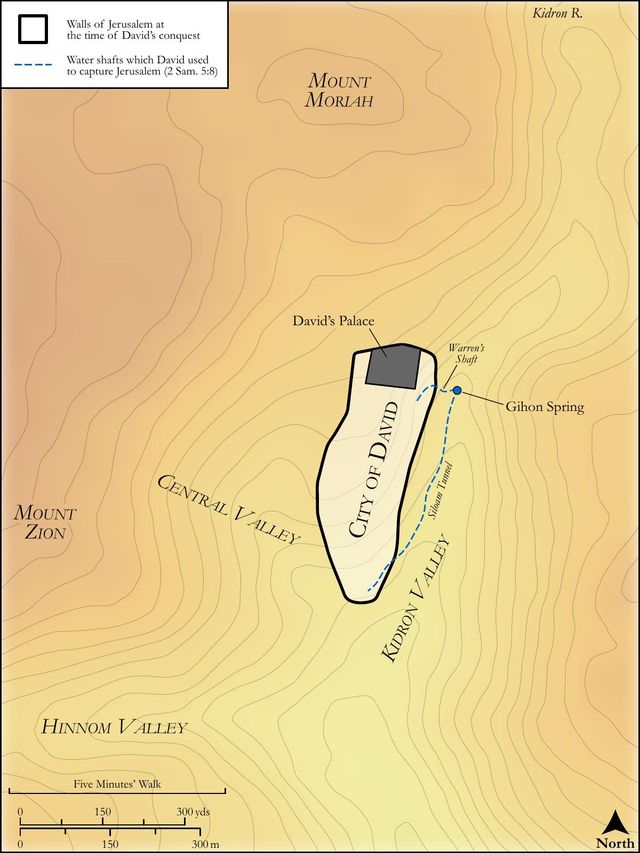
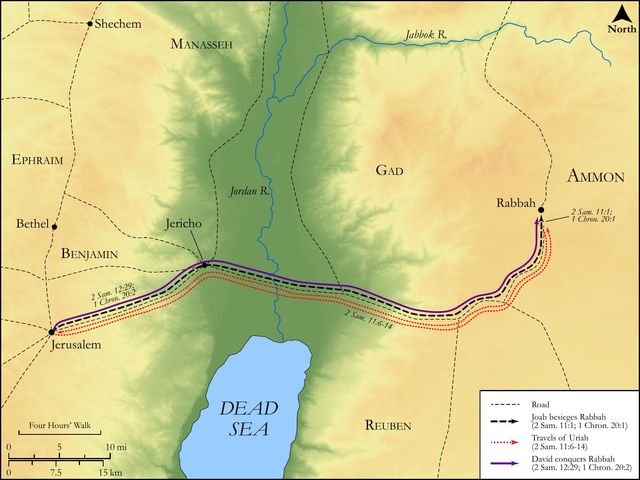
See on the biblical-era maps
Study this verse
Public-domain commentary
Matthew Henry
From his Commentary on the Whole Bible. Henry comments on passages, not single verses — this entry covers 2 Samuel 11:6–13. His four-level outline is real structure in the source text, so it is rendered as structure.
Uriah, we may suppose, had now been absent from his wife some weeks, making the campaign in the country of the Ammonites, and not intending to return till the end of it. The situation of his wife would bring to light the hidden works of darkness; and when Uriah, at his return, should find how he had been abused, and by whom, it might well be expected, 1. That he would prosecute his wife, according to law, and have her stoned to death; for jealousy is the rage of a man, especially a man of honour, and he that is thus injured will not spare in the day of vengeance, Pro 6:34. This Bath-sheba was apprehensive of when she sent to let David know she was with child, intimating that he was concerned to protect her, and, it is likely, if he had not promised her so to do (so wretchedly abusing his royal power), she would not have consented to him. Hope of impunity is a great encouragement to iniquity. 2. It might also be expected that since he could not prosecute David by law for an offence of this nature he would take his revenge another way, and raise a rebellion against him. There have been instances of kings who by provocations of this nature, given to some of their powerful subjects, have lost their crowns. To prevent this double mischief, David endeavours to father the child which should be born upon Uriah himself, and therefore sends for him home to stay a night or two with his wife. Observe,
I.How the plot was laid.
Uriah must come home from the army under pretence of bringing David an account how the war prospered, and how they went on with the siege of Rabbah, Sa2 11:7. Thus does he pretend a more than ordinary concern for his army when that was the least thing in his thoughts; if he had not had another turn to serve, an express of much less figure than Uriah might have sufficed to bring him a report of the state of the war. David, having had as much conference with Uriah as he thought requisite to cover the design, sent him to his house, and, that he might be the more pleasant there with the wife of his youth, sent a dish of meat after him for their supper, Sa2 11:8. When that project failed the first night, and Uriah, being weary of his journey and more desirous of sleep than meat, lay all night in the guard-chamber, the next night he made him drunk (Sa2 11:13), or made him merry, tempted him to drink more than was fit, that he might forget his vow (Sa2 11:11), and might be disposed to go home to his own bed, to which perhaps, if David could have made him dead drunk, he would have ordered him to be carried. It is a very wicked thing, upon any design whatsoever, to make a person drunk. Woe to him that does so, Hab 2:15, Hab 2:16. God will put a cup of trembling into the hands of those who put into the hands of others the cup of drunkenness. Robbing a man of his reason is worse than robbing him of his money, and drawing him into sin worse than drawing him into any trouble whatsoever. Every good man, especially every magistrate, should endeavour to prevent this sin, by admonishing, restraining, and denying the glass to those whom they see falling into excess; but to further it is to do the devil's work, to officiate as factor for him.
II.How this plot was defeated by Uriah's firm resolution not to lie in his own bed.
Both nights he slept with the life-guard, and went not down to his house, though, it is probable, his wife pressed him to do it as much as David, Sa2 11:9, Sa2 11:12. Now,
1.Some think he suspected what was done, being informed of his wife's attendance at court, and therefore he would not go near her. But if he had had any suspicion of that kind, surely he would have opened the letter that David sent by him to Joab.
2.Whether he suspected any thing or no, Providence put this resolution into his heart, and kept him to it, for the discovering of David's sin, and that the baffling of his design to conceal it might awaken David's conscience to confess it and repent of it.
3.The reason he gave to David for this strange instance of self-denial and mortification was very noble, Sa2 11:11. While the army was encamped in the field, he would not lie at ease in his own house. "The ark is in a tent," whether at home, in the tent David had pitched for it, or abroad, with Joab in the camp, is not certain. "Joab, and all the mighty men of Israel, lie hard and uneasy, and much exposed to the weather and to the enemy; and shall I go and take my ease and pleasure at my own house?" No, he protests he will not do it. Now,
(1.)This was in itself a generous resolution, and showed Uriah to be a man of a public spirit, bold and hardy, and mortified to the delights of sense. In times of public difficulty and danger it does not become us to repose ourselves in security, or roll ourselves in pleasure, or, with the king and Haman, to sit down to drink when the city Shushan was perplexed, Est 3:15. We should voluntarily endure hardness when the church of God is constrained to endure it.
(2.)It might have been of use to awaken David's conscience, and make his heart to smite him for what he had done.
[1.]That he had basely abused so brave a man as Uriah was, a man so heartily concerned for him and his kingdom, and that acted for him and it with so much vigour.
[2.]That he was himself so unlike him. The consideration of the public hardships and hazards kept Uriah from lawful pleasures, yet could not keep David, though more nearly interested, from unlawful ones. Uriah's severity to himself should have shamed David for his indulgence of himself. The law was, When the host goeth forth against the enemy then, in a special manner, keep thyself from every wicked thing, Deu 23:9. Uriah outdid that law, but David violated it.
Historical interpretation
Historical reception
1 surviving comment on this verse from the historical church.
We have taken up the task of writing an apology for the present style of the prophet David, not because he needs this gift, who has excelled in such great merits and flourished in virtues, but because many people, reading the sequence of his deeds without considering the power of the Scriptures or the hidden mysteries, wonder how such a great prophet did not avoid the contagion of adultery first and then of murder.
Therefore, it was our desire to review the history itself, which seems to have been exposed to sin. For in the second book of Kings (2 Samuel 11:2-27), we read that while David was walking in his royal palace, he saw a woman bathing (her name was Bathsheba), of remarkable beauty and grace, with a very attractive face, and he was overcome by the desire to possess her. However, the woman was married to a man named Uriah, and the scene of his death was arranged by royal command. For although it had no effect on his desire, yet it was considered to greatly impede his sense of shame for adultery.
Therefore, let us begin with the most obvious, whom God justified, so that you may not judge. 'For it is of little concern to me,' says Paul, 'that I should be judged by you or by any human court; indeed, I do not even judge myself' (1 Corinthians 4:3). Even though he was still in the body and subject to temptation, he did not judge himself because a spiritual person is not judged by anyone but God alone. Finally, he added, 'The one who judges me is the Lord' (1 Corinthians 4:4). Therefore, do not judge anything before the appointed time (ibid., 4 and 5). But David has already fulfilled his time and has earned grace, and he is justified by Christ; since David himself rejoiced in being called the son of the Lord, and those who confessed him in this way were enlightened. Why do you call a man of God from a reward to judgment? The Lord has already judged him, of whom he said to Solomon: If you walk before me as your father David walked in the holiness of heart and righteousness, in order to do everything I commanded him (3 Kings 9:4). Is he worthy of judgment or reward, who has done everything according to heavenly commands, walking in holiness and righteousness of heart? Where the vices and sins of others are hidden, there David receives divine testimony of his virtue and glory. And we discuss his sin in vain, for it is through his merit and grace that the sins of others have been revealed. For when Solomon sinned by not keeping the Lord's commands and God intended to divide his kingdom into many parts, He said to him: However, I will not do this in your days because of your father David. I will take it from the hand of your son. However, I will not take the whole kingdom; I will give him one scepter because of my servant David (3 Kings 11:12-13). Therefore, since the Lord justifies, who is there to condemn? What God has cleansed, you must not call common (Acts 10:15).
Nevertheless, with due regard to heavenly judgment, in which you honor the prophet even more, enter into his actions and behaviors. Do not marvel at the man, and do not judge him to be equal to the angels, because he has spent most of his life, even from childhood, dwelling in riches, honors, and positions of power, and has been subjected to many temptations. He has only once given in to error, and it is through this error that even the angels of heaven, as Scripture recounts (Genesis 6:2), were cast down from their virtue and grace. Indeed, another error of his is mentioned, that he caused the people to be counted.
Continue studying 2 Samuel 11:11 across the web’s major study libraries — every link below opens this exact verse, chapter, or book on the destination site.
Read & Compare
 BibleGatewayThis verse in more than 200 translations and 70 languages.
 Bible.comThe YouVersion reader — hundreds of translations, reading plans, and highlights.
 ESV.orgCrossway's official English Standard Version reader.
 NET BibleThe NET translation with 60,000+ translators' notes on every rendering decision.
 STEP BibleTyndale House's free study tool — original text, vocabulary, and scholarly resources.
 BibliaLogos Bible Software's free web reader.
 USCCBThe New American Bible (Revised Edition) with the U.S. bishops' study notes.
Commentaries
 BibleHub CommentariesDozens of classic commentaries on this verse, gathered on one page.
 StudyLightMore than 100 commentary sets — the largest collection on the web.
 BibleRefPlain-English commentary on what this verse means, verse by verse.
 Enduring WordDavid Guzik's free commentary on this chapter, widely used by Bible teachers.
 Bible Study ToolsVerse commentary alongside Greek and Hebrew study aids.
Original Language & Research
- BibleHub InterlinearThe verse word by word — original language, transliteration, and English.
- BibleHub LexiconEvery word's original-language definition and Strong's entry.
 Blue Letter BibleDeep-study tools — Strong's numbers, concordance, and word studies.
 SefariaThe Hebrew text with Rashi and centuries of Jewish commentary.
Sermons, Hymns & Audio


TrulyRandomVerse is not affiliated with these sites and doesn’t control their content. They’re linked because they’re genuinely useful.
Summary
Uriah's resolute declaration in 2 Samuel 11:11 stands as a stark moral counterpoint to King David's escalating sin. Recalled from the battlefield by David, who sought to conceal Bathsheba's pregnancy by having Uriah cohabit with his wife, Uriah adamantly refuses to indulge in personal comfort while his comrades and the sacred Ark of the Covenant remain in the field. His unwavering loyalty to his fellow soldiers, the nation, and God's presence, expressed through a solemn oath, inadvertently thwarts David's initial cover-up attempt and highlights his profound integrity amidst the king's profound moral failure.
Context
ShowHideLiterary Context
This verse is a pivotal moment within the tragic narrative of David's sin, detailed in 2 Samuel 11 - David's Sin with Bathsheba and Uriah. The preceding verses describe David's adultery with Bathsheba while his army, led by Joab, is engaged in battle against the Ammonites at Rabbah. Upon learning of Bathsheba's pregnancy, David attempts to cover his sin by recalling Uriah, Bathsheba's husband, from the front lines. David's intention is for Uriah to return home, sleep with his wife, and thus be presumed the father of the child. However, Uriah's profound sense of duty and solidarity, expressed in this verse, completely foils David's initial, relatively benign, deception, forcing the king into a far more heinous act: arranging Uriah's death on the battlefield. Uriah's integrity here directly sets the stage for David's subsequent murder of an innocent man and the severe divine judgment that follows in 2 Samuel 12 - Nathan Confronts David.
Historical & Cultural Context
The setting is a time of war, specifically the siege of Rabbah, a significant military campaign for Israel. The military customs of Israel often involved a period of ritual purity for soldiers, sometimes requiring abstinence from sexual relations during active campaigns or before battle, as seen in 1 Samuel 21:4-5 - David and the Holy Bread. Uriah's reference to "the ark, and Israel, and Judah" abiding "in tents" underscores the mobile, campaigning nature of the army and the presence of the Ark of the Covenant, which symbolized God's presence and leadership in battle. His refusal to enjoy domestic comforts while his comrades faced hardship reflects a deep-seated military ethos of shared suffering and solidarity. The solemn oath, "as thou livest, and as thy soul liveth," was a common and powerful form of affirmation in ancient Israel, indicating an unbreakable commitment and absolute sincerity, making Uriah's declaration undeniable.
Key Themes
ShowHideUriah's words powerfully articulate several key themes. First, unwavering loyalty and integrity are paramount. Uriah demonstrates an extraordinary devotion not only to his king and general but, more profoundly, to his fellow soldiers and the sacred symbols of Israel (the Ark). His commitment to military discipline and solidarity far outweighs any personal desire for comfort or pleasure, standing in stark contrast to David's self-indulgent behavior and lack of discipline at this time. Second, the theme of self-sacrifice versus self-indulgence is vividly portrayed. Uriah's refusal to "eat and to drink, and to lie with my wife" while his comrades are in the field epitomizes self-sacrifice and a shared sense of duty. He embodies the principle of solidarity with those facing hardship, highlighting David's moral failure in his pursuit of personal gratification. Finally, a significant moral contrast is drawn. Uriah, a Hittite by birth but a loyal Israelite soldier and one of David's mighty men (2 Samuel 23:39 - Uriah the Hittite), exemplifies a higher moral standard than David, the King of Israel, in this particular moment. His integrity shines brightly against the backdrop of David's deceit and escalating sin, foreshadowing the severe consequences that would befall David's house as a result of his actions, as prophesied in 2 Samuel 12:10 - The Sword Will Never Depart from Your House.
Exposition and Analysis
ShowHideKey Word Analysis
ShowHideThis refers to the Ark of the Covenant (H727), the most sacred object in ancient Israel, representing God's presence among His people. Its mention by Uriah signifies the spiritual and national focus of his loyalty. The Ark's presence with the army underscored the holy nature of their mission and the divine involvement in their campaign, implying a need for ritual purity and dedication from all involved.
This word (H5521) denotes temporary shelters or booths, specifically referring to the military encampment. Uriah's statement that "the ark, and Israel, and Judah, abide in tents" emphasizes the shared hardship and temporary, mobile nature of their existence on campaign. It highlights his commitment to solidarity with his fellow soldiers and the sacred presence of God, who also "abides in tents" with them.
Used twice in the solemn oath "as thou livest, and as thy soul liveth," this verb (H2416) signifies existence, vitality, and life itself. The double oath, invoking both David's life and his very soul, is a powerful and absolute declaration of Uriah's resolve. It underscores the depth of his commitment and the unbreakable nature of his promise, making his refusal undeniable and deeply impactful.
Verse Breakdown
ShowHide"And Uriah said unto David,"
This opening clause immediately establishes the direct confrontation and Uriah's agency. It is not a passive acceptance but an active, verbal refusal, highlighting his strength of character in rebuking the powerful, even to the king.
"The ark, and Israel, and Judah, abide in tents;"
Uriah articulates the primary objects of his loyalty and concern. He first mentions the Ark, symbolizing God's presence and the holy nature of their mission, then "Israel" (the northern tribes) and "Judah" (the southern kingdom, David's own tribe), representing the entire nation. Their "abiding in tents" emphasizes the shared hardship and the temporary, campaigning nature of their existence, setting the moral standard for his own conduct.
"and my lord Joab, and the servants of my lord, are encamped in the open fields;"
Uriah extends his loyalty to his immediate commander, Joab, and his fellow soldiers ("the servants of my lord"). "Encamped in the open fields" further stresses the harsh realities of military life, contrasting sharply with the comforts of home. This demonstrates Uriah's deep solidarity with his comrades, sharing their privations.
"shall I then go into mine house, to eat and to drink, and to lie with my wife?"
This is a powerful rhetorical question, designed to highlight the moral incongruity of David's suggestion. It expresses Uriah's incredulity and firm rejection of personal indulgence while his compatriots face danger and discomfort. The question implies that such an act would be a betrayal of his duty and his fellow soldiers.
"[as] thou livest, and [as] thy soul liveth, I will not do this thing."
This is Uriah's solemn and emphatic oath, sealing his refusal. Invoking David's life and soul makes the declaration absolute and unbreakable. It underscores the profound sincerity and unyielding nature of Uriah's integrity, leaving no room for doubt regarding his commitment to his principles.
Literary Devices
ShowHideThe passage masterfully employs several literary devices to heighten its dramatic and moral impact. Contrast is the most prominent, setting Uriah's unwavering integrity, self-sacrifice, and loyalty against David's self-indulgence, deceit, and moral compromise. This moral chasm is made even more poignant through Irony: the foreign-born Uriah, a Hittite, embodies a higher standard of Israelite faithfulness and military discipline than the Israelite king himself. The Rhetorical Question ("shall I then go into mine house...?") effectively conveys Uriah's moral indignation and the absurdity of David's proposition from a soldier's perspective, demanding a negative answer by its very nature. Finally, the Oath/Solemn Declaration ("as thou livest, and as thy soul liveth, I will not do this thing") serves as a powerful concluding statement, emphasizing the absolute and unyielding nature of Uriah's commitment, making his resolve undeniable and setting the stage for David's desperate and tragic next steps.
Theological and Thematic Connections
ShowHideUriah's steadfastness serves as a profound biblical example of integrity, self-sacrifice, and unwavering commitment to duty and community. His refusal to prioritize personal comfort over shared hardship resonates with the broader biblical call for faithfulness and moral consistency, particularly in the face of temptation or moral compromise. Theologically, Uriah's character highlights that true righteousness is not merely about adherence to rules but about the heart's disposition towards God and neighbor, even when it demands personal cost. His actions implicitly critique David's failure to live up to the high standards expected of God's anointed king, demonstrating that moral integrity is valued by God regardless of one's social standing or origin.
Reflection and Application
ShowHideUriah's steadfastness serves as a timeless example of integrity and moral consistency that challenges believers today to consider their own priorities and commitments. In a world often driven by self-interest and immediate gratification, Uriah's willingness to forgo personal comfort for a higher call to duty, community, and spiritual commitment provides a powerful counter-narrative. His actions prompt us to examine whether we are truly willing to share in the burdens and hardships of others, especially those on the "front lines" of spiritual or social battles, or if we retreat to personal indulgence. For those in positions of leadership, Uriah's actions are a sobering reminder that true leadership involves shared sacrifice and moral uprightness, not hypocrisy or the abuse of power. His integrity, though it ultimately contributed to David's further sin and his own death, remains unblemished in the biblical record, serving as a testament to the enduring power of a life lived with unwavering principle, even when it comes at a great personal cost.
Questions for Reflection
ShowHideFAQ
ShowHideWhy was Uriah, a Hittite, so loyal to Israel and David?
ShowHideWhile Uriah was ethnically a Hittite, he was clearly a fully integrated and devout member of Israelite society. He was one of David's "mighty men" (2 Samuel 23:39 - Uriah the Hittite, One of David's Mighty Men), a highly esteemed position reserved for the most elite and loyal warriors. This indicates not only his exceptional military prowess but also his deep personal commitment to David and the nation of Israel. It is highly probable that he was a proselyte, having embraced the God of Israel and the Israelite way of life. His loyalty to "the ark, and Israel, and and Judah" demonstrates a profound spiritual and national allegiance that transcended his ethnic origin, highlighting that faithfulness to God and His people is not limited by birthright.
What is the significance of Uriah mentioning "the ark...abide in tents"?
ShowHideUriah's mention of "the ark...abide in tents" carries deep significance. The Ark of the Covenant represented the very presence of God among His people, leading them in battle and symbolizing His covenant faithfulness. Its presence with the army underscored the holy nature of their campaign against the Ammonites. For Uriah, the Ark's "abiding in tents" (a temporary, campaigning dwelling) meant that God Himself, along with the entire nation and the army, was enduring hardship and sharing the rigors of war. This fact reinforced his conviction that he, as a dedicated soldier, should not seek personal comfort or luxury when God's presence and his comrades were in a state of shared sacrifice and readiness for battle. It also subtly alludes to the ritual purity required of soldiers in the presence of the Ark, which would preclude sexual relations, further justifying his refusal to go home, as seen in 1 Samuel 4:3 - The Ark Brought to Battle.
Christ-Centered Fulfillment
ShowHideUriah's profound integrity and self-sacrifice, tragically leading to his innocent death at David's hands, powerfully foreshadow the ultimate self-giving of Jesus Christ. Uriah, a righteous man, suffers and dies not for his own sin but as a consequence of another's sin and cover-up, echoing the innocent Lamb of God who takes away the sin of the world. While Uriah's loyalty was to an earthly king and nation, Christ's loyalty was to His Father's will and the redemption of humanity, demonstrating the greatest love by laying down His life for His friends. Unlike David, who failed in his kingly duty and succumbed to sin, Jesus, the perfect King, perfectly embodies the self-sacrificial posture Uriah exemplified. He did not consider equality with God something to be grasped, but emptied himself, taking the form of a servant, even to the point of death on a cross. Uriah's refusal to seek comfort while his brethren suffered finds its ultimate fulfillment in Christ, who, though rich, became poor for our sake and who perfectly empathizes with our struggles, having been tempted in every way, yet without sin. Uriah's character, though tragically cut short, points to the perfect, unblemished integrity of Christ, through whom God demonstrates His own love for us in that while we were still sinners, Christ died for us.