


2 Samuel 20:6
Bible text: King James Version (1769 Blayney text) · Public domain
Bible text: King James Version with Strong's numbers · Public domain
Bible text: Berean Standard Bible · Public domain
Bible text: American Standard Version (1901) · Public domain
Bible text: World English Bible, Messianic edition · Public domain
Bible text: Geneva Bible (1599) · Public domain
Bible text: Young's Literal Translation · Public domain
- וַיֹּאמֶרvai·Yo·merand he saidH559Conj-w ¦ V-Qal-ConsecImperf-3msVerb Qal Consecutive Imperfect 3rd Singular Masculineוַandיֹּאמֶרhe said
- דָּוִדda·VidDavidH1732N-proper-mNoun Proper Masculine
- אֶל'eltoH413PrepPreposition
- אֲבִישַׁי'a·vi·ShaiAbishaiH52N-proper-mNoun Proper Masculine
- עַתָּה'a·TahnowH6258AdvAdverb
- יֵרַעYe·ra'he will be badH7489V-Qal-Imperf-3msVerb Qal Imperfect 3rd Singular Masculine
- לָנוּLa·nufor <the> usPrep-l ¦ 1cpSuffix Personal 1st Plural common genderלָfor <the>נוּus
- שֶׁבַעShe·va'ShebaH7652N-proper-mNoun Proper Masculine
- בֶּןben[the] son ofH1121N-mscNoun Singular Masculine Construct
- בִּכְרִיbikh·RiBicriH1075N-proper-mNoun Proper Masculine
- מִןminmore thanH4480PrepPreposition
- אַבְשָׁלוֹם'av·sha·LomAbsalomH53N-proper-mNoun Proper Masculine
- אַתָּה'A·tahyouH859Pro-2msPronoun Personal 2nd Singular Masculine
- קַחkachtakeH3947V-Qal-Imp-2msVerb Qal Imperative 2nd Singular Masculine
- אֶת'et<obj.>H853DirObjMParticle Object Indicator
- עַבְדֵי'av·Dei[the] servants ofH5650N-mpcNoun Plural Masculine Construct
- אֲדֹנֶיךָ'a·do·Nei·khayour master<s>H113N-mpc ¦ 2msNoun Plural Masculine Constructאֲדֹנֶיmaster<s>ךָyour
- וּרְדֹףu·re·Dofand pursueH7291Conj-w ¦ V-Qal-Imp-2msVerb Qal Imperative 2nd Singular Masculineוּandרְדֹףpursue
- אַחֲרָיו'a·cha·Ravafter himH310Adj-mpc ¦ 3msAdjective Numerical Plural Masculine Constructאַחֲרָיafterוhim
- פֶּןpenlestH6435PrtParticle Conditional
- מָצָאMa·tza'he has foundH4672V-Qal-Perf-3msVerb Qal Perfect 3rd Singular Masculine
- לוֹlofor <the> himselfPrep-l ¦ 3msSuffix Personal 3rd Singular Masculineלfor <the>וֹhimself
- עָרִים'a·RimcitiesH5892N-mpNoun Plural Masculine Absolute
- בְּצֻרוֹתbe·tzu·RotfortifiedH1219Adj-fpAdjective Plural Feminine Absolute
- וְהִצִּילve·hi·Tziland he will tear outH5337Conj-w ¦ V-Hiphil-ConsecPerf-3msVerb Hiphil Consecutive Perfect 3rd Singular Masculineוְandהִצִּילhe will tear out
- עֵינֵנוּ'ei·Ne·nuour eyeH5869N-fsc ¦ 1cpNoun Singular Feminine Constructעֵינֵeyeנוּour
English is a literal word-by-word gloss of the Hebrew, not the KJV's wording. Why?
This is the original text the KJV's translators worked from — each Hebrew word with its own literal English meaning in this verse, prepared by scholars at Tyndale House, Cambridge. The KJV translates whole sentences, not word by word, so its wording differs: one Hebrew word can become several English words, and the KJV may choose “the LORD” where the gloss reads “Yahweh”. Both are faithful — they answer different questions. For the KJV's own rendering, switch to the KJV text.
Details
See on the biblical-era maps
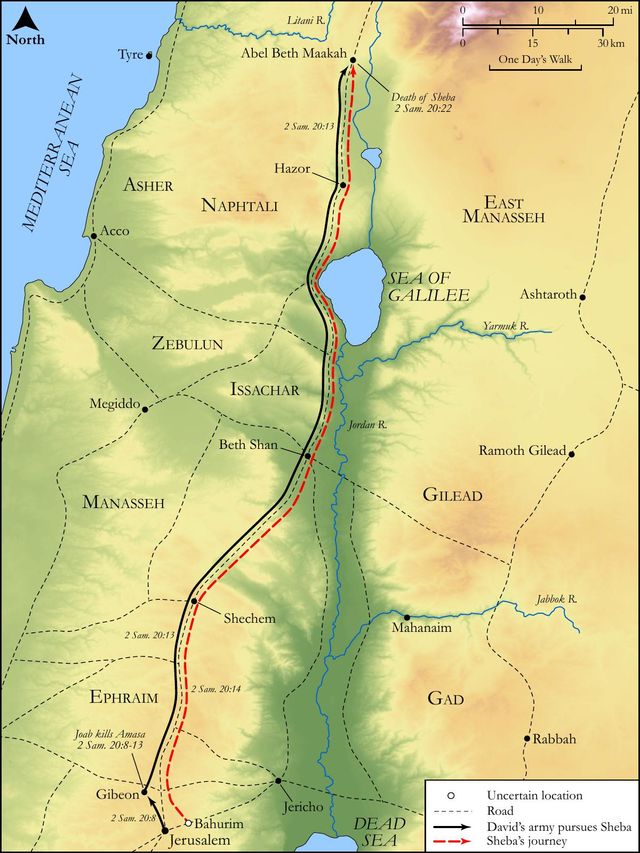
Study this verse
Public-domain commentary
Matthew Henry
From his Commentary on the Whole Bible. Henry comments on passages, not single verses — this entry covers 2 Samuel 20:4–13. His two-level outline is real structure in the source text, so it is rendered as structure.
We have here Amasa's fall just as he began to rise. He was nephew to David (Sa2 17:25), had been Absalom's general and commander-in-chief of his rebellious army, but, that being routed, he came over into David's interest, upon a promise that he should be general of his forces instead of Joab. Sheba's rebellion gives David an occasion to fulfil his promise sooner than he could wish, but Joab's envy and emulation rendered its fulfillment of ill consequence both to him and David.
I.Amasa has a commission to raise forces for the suppressing of Sheba's rebellion, and is ordered to raise them with all possible expedition, Sa2 20:4. It seems, the men of Judah, though forward to attend the king's triumphs, were backward enough to fight his battles; else, when they were all in a body attending him to Jerusalem, they might immediately have pursued Sheba, and have crushed that cockatrice in the egg. But most love a loyalty, as well as a religion, that is cheap and easy. Many boast of their being akin to Christ that yet are very loth to venture for him. Amasa is sent to assemble the men of Judah within three days; but he finds them so backward and unready that he cannot do it within the time appointed (Sa2 20:5), though the promotion of Amasa, who had been their general under Absalom, was very obliging to them, and a proof of the clemency of David's government.
II.Upon Amasa's delay, Abishai, the brother of Joab, is ordered to take the guards and standing forces, and with them to pursue Sheba (Sa2 20:6, Sa2 20:7), for nothing could be of more dangerous consequence than to give him time. David gives these orders to Abishai, because he resolves to mortify Joab, and degrade him, not so much, I doubt, for the blood of Abner, which he had shed basely, as for the blood of Absalom, which he had shed justly and honourably. "Now (says bishop Hall) Joab smarteth for a loyal disobedience. How slippery are the stations of earthly honours and subject to continual mutability! Happy are those who are in favour with him in whom there is no shadow of change." Joab, without orders, though in disgrace, goes along with his brother, knowing he might be serviceable to the public, or perhaps now meditating the removal of his rival.
III.Joab, near Gibeon, meets with Amasa, and barbarously murders him, Sa2 20:8-10.
It should seem, the great stone in Gibeon was the place appointed for the general rendezvous. There the rivals met; and Amasa, relying upon his commission, went before, as general both of the new-raised forces which he had got together, and of the veteran troops which Abishai had brought in; but Joab there took an opportunity to kill him with his own hand; and,
1.He did it subtilely, and with contrivance, and not upon a sudden provocation. He girded his coat about him, that it might not hang in his way, and girded his belt upon his coat, that his sword might be the readier to his hand; he also put his sword in a sheath too big for it, that, whenever he pleased, it might, upon a little shake, fall out, as if it fell by accident, and so he might take it into his hand, unsuspected, as if he were going to return it into the scabbard, when he designed to sheath it in the bowels of Amasa. The more there is of plot in a sin the worse it is.
2.He did it treacherously, and under pretence of friendship, that Amasa might not be upon his guard. He called him brother, for they were own cousins, enquired of his welfare (Art thou in health?) and took him by the beard, as one he was free with, to kiss him, while with the drawn sword in his other hand he was aiming at his heart. Was this done like a gentleman, like a soldier, like a general? No, but like a villain, like a base coward. Just thus he slew Abner, and went unpunished for it, which encouraged him to do the like again.
3.He did it impudently, not in a corner, but at the head of his troops, and in their sight, as one that was neither ashamed nor afraid to do it, that was so hardened in blood and murders that he could neither blush nor tremble.
4.He did it at one blow, gave the fatal push with a good-will, as we say, so that he needed not strike him again; with such a strong and steady hand he gave this one stroke that it was fatal.
5.He did it in contempt and defiance of David and the commission he had given to Amasa; for that commission was the only ground of his quarrel with him, so that David was struck at through the side of Amasa, and was, in effect, told to his face that Joab would be general, in spite of him.
6.He did it very unseasonably, when they were going against a common enemy and were concerned to be unanimous. This ill-timed quarrel might have scattered their forces, or engaged them one against another, and so have made them all an easy prey to Sheba. So contentedly could Joab sacrifice the interest both of king and kingdom to his personal revenge.
IV.Joab immediately resumes his general's place, and takes care to lead the army on in pursuit of Sheba, that, if possible, he might prevent any prejudice to the common cause by what he had done. 1. He leaves one of his men to make proclamation to the forces that were coming up that they were still engaged in David's cause, but under Joab's command, Sa2 20:11. He knew what an interest he had in the soldiery, and how many favoured him rather than Amasa, who had been a traitor, was now a turn-coat, and had never been successful; on this he boldly relied, and called them all to follow him. What man of Judah would not be for his old king and his old general? But one would wonder with what face a murderer could pursue a traitor; and how, under such a heavy load of guilt, he had courage to enter upon danger. Surely his conscience was seared with a hot iron. 2. care is taken to remove the dead body out of the way, because at that they made a stand (as Sa2 2:23), and to cover it with a cloth, Sa2 20:12, Sa2 20:13. Wicked men think themselves safe in their wickedness if they can but conceal it from the eye of the world: if it be hidden, it is with them as if it were never done. But the covering of blood with a cloth cannot stop its cry in God's ear for vengeance, or make it the less loud. However, since this was no time to arraign Joab for what he had done, and the common safety called for expedition, it was prudent to remove that which retarded the march of the army; and then they all went on after Joab, while David, who no doubt had notice soon brought him of this tragedy, could not but reflect upon it with regret that he had not formerly done justice upon Joab for the death of Abner, and that he now had exposed Amasa by preferring him. And perhaps his conscience reminded him of his employing Joab in the murder of Uriah, which had helped to harden him in cruelty.
Continue studying 2 Samuel 20:6 across the web’s major study libraries — every link below opens this exact verse, chapter, or book on the destination site.
Read & Compare
 BibleGatewayThis verse in more than 200 translations and 70 languages.
 Bible.comThe YouVersion reader — hundreds of translations, reading plans, and highlights.
 ESV.orgCrossway's official English Standard Version reader.
 NET BibleThe NET translation with 60,000+ translators' notes on every rendering decision.
 STEP BibleTyndale House's free study tool — original text, vocabulary, and scholarly resources.
 BibliaLogos Bible Software's free web reader.
 USCCBThe New American Bible (Revised Edition) with the U.S. bishops' study notes.
Commentaries
 BibleHub CommentariesDozens of classic commentaries on this verse, gathered on one page.
 StudyLightMore than 100 commentary sets — the largest collection on the web.
 BibleRefPlain-English commentary on what this verse means, verse by verse.
 Enduring WordDavid Guzik's free commentary on this chapter, widely used by Bible teachers.
 Bible Study ToolsVerse commentary alongside Greek and Hebrew study aids.
Original Language & Research
- BibleHub InterlinearThe verse word by word — original language, transliteration, and English.
- BibleHub LexiconEvery word's original-language definition and Strong's entry.
 Blue Letter BibleDeep-study tools — Strong's numbers, concordance, and word studies.
 SefariaThe Hebrew text with Rashi and centuries of Jewish commentary.
Sermons, Hymns & Audio


TrulyRandomVerse is not affiliated with these sites and doesn’t control their content. They’re linked because they’re genuinely useful.
Summary
2 Samuel 20:6 captures King David's urgent and decisive response to Sheba's rebellion, which he immediately perceives as a more insidious and existential threat to the kingdom's unity than Absalom's recent uprising. Having just returned to Jerusalem amidst lingering tribal tensions, David commands his trusted military commander, Abishai, to swiftly pursue Sheba with his elite forces, recognizing the critical need to prevent the rebel from fortifying cities and establishing a prolonged, destructive civil war that could permanently fracture the nation. This verse highlights David's matured leadership, strategic foresight, and unwavering commitment to preserving the fragile unity of Israel in the face of persistent internal strife.
Context
ShowHideLiterary Context
This verse is situated immediately after the tumultuous resolution of Absalom's rebellion and King David's controversial return to Jerusalem. The preceding chapter, 2 Samuel 19, details the contentious dispute between the tribes of Judah and Israel over who had a greater claim in bringing David back to his throne. This unresolved tension, characterized by deep-seated tribal rivalries and a sense of dispossession among the northern tribes, provided fertile ground for Sheba, a Benjamite from the tribe of Saul, to incite a new revolt. Sheba's rallying cry, "We have no part in David, neither have we inheritance in the son of Jesse" (2 Samuel 20:1), directly capitalized on this disunity, posing a fundamental challenge not just to David's personal rule but to the very fabric of the united kingdom. David's immediate and forceful command in 2 Samuel 20:6 demonstrates his acute awareness that this rebellion, unlike Absalom's personal coup, was a direct assault on national cohesion and required an even swifter, more decisive response.
Historical & Cultural Context
David's reign, while bringing significant expansion and consolidation to Israel, was perpetually challenged by internal divisions, particularly between the more established southern tribe of Judah and the northern tribes, who often felt overlooked. Sheba's rebellion, led by a Benjamite, tapped into lingering resentment from the former house of Saul and a desire for greater tribal autonomy, echoing earlier periods of disunity in Israel's history. The concept of "fenced cities" (fortified strongholds) was paramount in the wars of David's day; such cities offered a rebel leader a secure base, a source of supplies and recruits, and a defensive position from which to prolong a conflict, making suppression far more difficult and costly. David's rapid deployment of "thy lord's servants" refers to his highly disciplined and loyal professional army, likely comprising the Cherethites and Pelethites, who were distinct from the general tribal levy and essential for swift, surgical action against a nascent threat to the kingdom's stability.
Key Themes
ShowHideThe passage powerfully underscores several critical themes central to David's reign and the broader narrative of Israel. First, Decisive Leadership is prominently displayed in David's swift assessment and immediate command, reflecting lessons learned from his initial, perhaps overly lenient, response to Absalom's protracted uprising. Second, the Fragility of National Unity is a pervasive concern; Sheba's rebellion was a direct assault on the kingdom's cohesion, threatening to splinter Israel along tribal lines, a stark reminder of the ongoing challenge of maintaining a unified nation under a single monarch, as also seen in the later division of the kingdom in 1 Kings 12. Third, Strategic Urgency is paramount, as David's fear of Sheba securing "fenced cities" reveals his astute understanding of military strategy and the critical importance of preemptive action to prevent a localized rebellion from escalating into a prolonged and devastating civil war. This strategic foresight, coupled with his willingness to act, is a hallmark of effective governance and a necessary response to threats against the divinely established order.
Exposition and Analysis
ShowHideKey Word Analysis
ShowHideThe Hebrew word יָרַע (yâraʻ), here translated as "harm," carries the primary sense of "to be broken up" or "to be grievous." In this context, David's assessment that Sheba would do "more harm" than Absalom implies a threat that goes beyond mere personal challenge or military defeat; it signifies a deeper, more destructive disintegration of the kingdom's very foundation. It suggests a calamitous unraveling that could permanently fracture the nation along tribal lines, causing pervasive damage and widespread grief.
The Hebrew term עֶבֶד (ʻebed), meaning "servant" or "bondman," when used in the phrase "thy lord's servants" (specifically referring to David's personal guard), denotes a highly loyal, professional, and disciplined military force. These were not conscripted soldiers but career warriors, such as the Cherethites and Pelethites, known for their unwavering allegiance to David. Their deployment underscores the critical nature of the mission and David's need for absolute reliability and swift execution, contrasting with the broader, less disciplined forces that might have swelled Absalom's ranks.
The Hebrew root בָּצַר (bâtsar), translated here as "fenced" (as in "fenced cities"), means "to clip off," "to gather grapes," or "to be isolated (i.e., inaccessible by height or fortification)." When applied to cities, it signifies being fortified, walled, or made impregnable. David's immediate concern was to prevent Sheba from establishing such a stronghold, as a "fenced city" would provide a secure base for operations, a place to gather supplies and recruits, and a defensive position, transforming a nascent rebellion into a protracted, devastating conflict that would be far more difficult and costly to suppress.
Verse Breakdown
ShowHide"And David said to Abishai,"
This opening clause immediately establishes the direct, urgent, and authoritative nature of David's command. Abishai, Joab's brother, was a seasoned, loyal, and trusted military commander, making him the ideal recipient of such a critical and sensitive order.
"Now shall Sheba the son of Bichri do us more harm than [did] Absalom:"
This is David's crucial and insightful assessment of the new threat. He recognizes that Sheba's rebellion, rooted in tribal disunity and a call for secession (2 Samuel 20:1), poses a deeper, more existential threat to the kingdom's integrity and future than Absalom's personal bid for the throne. Absalom sought to replace David; Sheba sought to dismantle the united kingdom itself.
"take thou thy lord's servants, and pursue after him,"
This is the core command for immediate and decisive action. David instructs Abishai to mobilize the most reliable and effective military units—his loyal personal guard—for an urgent and relentless pursuit. This demonstrates a learned urgency and strategic shift, contrasting with the initial, slower response to Absalom's uprising that allowed it to gain significant momentum.
"lest he get him fenced cities, and escape us."
This final clause reveals David's strategic foresight and the critical motivation behind his urgency. He understands the profound military and political importance of preventing Sheba from establishing fortified strongholds. Such a development would not only make Sheba's capture far more difficult but also provide him with a secure base to prolong the rebellion indefinitely, causing far greater instability, bloodshed, and fragmentation throughout the land.
Literary Devices
ShowHideThe passage employs several potent literary devices to convey the gravity and urgency of the situation David faces. The phrase "more harm than Absalom" uses Hyperbole to underscore David's perception of the new threat's unparalleled severity, emphasizing that while Absalom's rebellion was devastating, Sheba's represented a more fundamental and insidious challenge to the kingdom's very existence. There is a clear Contrast drawn between the nature of Absalom's rebellion (a personal coup for the throne) and Sheba's (a tribal secessionist movement), highlighting the evolving and increasingly dangerous types of threats David faced. The entire command structure, from David's direct address to Abishai to the specific, immediate instructions, creates a powerful sense of Urgency and imperative action. Furthermore, David's concern about Sheba securing "fenced cities" functions as Foreshadowing, hinting at the strategic challenges and prolonged conflict that would inevitably arise if the rebellion were allowed to gain momentum, thereby justifying the swift and decisive military response.
Theological and Thematic Connections
ShowHideThis pivotal moment in David's reign offers profound theological and thematic insights into the nature of leadership, unity, and divine sovereignty. It underscores the ever-present danger of disunity within God's people, a recurring theme throughout biblical history, from the tower of Babel to the early church's struggles. David's immediate and decisive action, born from the painful lessons of Absalom's rebellion, illustrates the wisdom required for godly leadership—a wisdom that discerns the true nature of a threat and acts proactively to preserve peace and order. The passage also subtly points to divine sovereignty, as even in the midst of human rebellion and strategic maneuvering, God's ultimate plan for His chosen king and His people continues to unfold, ensuring the preservation of the Davidic line. The fragility of human kingdoms and the constant need for vigilance against internal strife are starkly portrayed, reminding us that true security and lasting peace are ultimately found not in human strength alone, but in adherence to God's covenant and His ways.
Reflection and Application
ShowHide2 Samuel 20:6 provides invaluable lessons for leaders and individuals alike in navigating times of crisis and disunity. David's response demonstrates the critical importance of learning from past mistakes and applying those lessons with wisdom, decisiveness, and strategic foresight. His ability to quickly assess the true nature of Sheba's threat—recognizing it as more fundamentally destructive than Absalom's—highlights the need for profound discernment beyond surface-level appearances. For us, this means not only addressing immediate problems but also understanding and confronting the underlying issues that fuel division and conflict, whether in our families, communities, churches, or personal lives. Proactive measures and strategic foresight, as exemplified by David's concern for "fenced cities," are essential to prevent minor issues from escalating into entrenched, intractable problems that become far more costly to resolve. Ultimately, this passage calls us to be vigilant against forces that seek to sow discord, to act with courage and wisdom to preserve unity and pursue peace, and to trust that God's grace empowers us in these endeavors, knowing that true peace is a gift to be diligently guarded.
Questions for Reflection
ShowHideFAQ
ShowHideWhy did David consider Sheba's rebellion more harmful than Absalom's?
ShowHideDavid perceived Sheba's rebellion as more fundamentally damaging because it threatened the very unity and existence of the kingdom, whereas Absalom's was primarily a personal coup. Absalom sought to replace David as king, but Sheba's call, "We have no part in David, neither have we inheritance in the son of Jesse" (2 Samuel 20:1), was a rallying cry for tribal secession, particularly appealing to the northern tribes and those still resentful after the dispute over David's return (2 Samuel 19:40-43). This threatened to splinter Israel into separate entities, leading to a prolonged and devastating civil war that could unravel the entire nation David had worked so hard to unite under God's covenant.
Who were "thy lord's servants" and why were they chosen for this mission?
ShowHide"Thy lord's servants" refers to David's personal, highly loyal, and professional standing army, specifically the Cherethites and Pelethites, along with other elite warriors. These forces were distinct from the general Israelite levy and were renowned for their unwavering allegiance to David, even during Absalom's rebellion (2 Samuel 15:18). David chose them because of their proven reliability, discipline, and effectiveness, ensuring a swift and decisive response to Sheba's nascent rebellion. Entrusting Abishai, a proven and trusted military commander, with these elite troops underscored the critical need for immediate and successful action to prevent the rebellion from gaining momentum.
What was the significance of Sheba "getting fenced cities"?
ShowHideIn ancient warfare, "fenced cities" (fortified or walled cities) served as crucial strategic strongholds. If Sheba had managed to secure such cities, he would have gained a secure base of operations, a place to gather supplies and recruits, and a formidable defensive position from which to resist David's forces. This would have transformed a relatively contained rebellion into a protracted, widespread, and much more costly conflict, potentially prolonging the civil war and causing immense suffering and instability throughout the kingdom. David's immediate concern highlights his astute military strategy and his determination to nip the rebellion in the bud before it could become an entrenched, national crisis.
Christ-Centered Fulfillment
ShowHideDavid's decisive action against Sheba's rebellion, aimed at preserving the unity of Israel and preventing further division, powerfully foreshadows the ultimate work of Jesus Christ, the true Son of David and the King of kings. Just as David sought to counter forces that would tear his earthly kingdom apart, Christ came to establish an eternal kingdom characterized by perfect unity and peace. He is the ultimate leader who strategically confronts the forces of disunity and rebellion, not with earthly armies, but through His atoning sacrifice and the unifying power of His Spirit. Where Sheba sought to divide Israel along tribal lines, Christ breaks down all dividing walls, uniting Jew and Gentile into one new humanity in Himself (Ephesians 2:14-16). He is the Good Shepherd who gathers His scattered sheep, ensuring that no one can snatch them out of His hand (John 10:27-29). The "fenced cities" that Sheba sought to fortify represent strongholds of rebellion against God and His people, but Christ has triumphed over all such powers and authorities, disarming them through the cross (Colossians 2:15). Ultimately, Christ's reign brings about the true and lasting unity of God's people, establishing a kingdom that cannot be shaken (Hebrews 12:28), where there is no longer Jew or Gentile, slave or free, male or female, but all are one in Him through faith (Galatians 3:28), fulfilling God's eternal purpose for His unified people.