


2 Samuel 20:5
- וַיֵּלֶךְvai·Ye·lekhand he wentH1980Conj-w ¦ V-Qal-ConsecImperf-3msVerb Qal Consecutive Imperfect 3rd Singular Masculineוַandיֵּלֶךְhe went
- עֲמָשָׂא'a·ma·Sa'AmasaH6021N-proper-mNoun Proper Masculine
- לְהַזְעִיקle·haz·'Ikto summonH2199Prep-l ¦ V-Hiphil-InfVerb Hiphil Infinitive Constructלְtoהַזְעִיקsummon
- אֶת'et<obj.>H853DirObjMParticle Object Indicator
- יְהוּדָהye·hu·DahJudahH3063N-properNoun Proper Location
- וַיּוֹחֶרvai·yi·cherand he was delayedH309Conj-w ¦ V-Hiphil-ConsecImperf-3msVerb Hiphil Consecutive Imperfect 3rd Singular Masculineוַandיּוֹחֶרhe was delayed
- מִןminfromH4480PrepPreposition
- הַמּוֹעֵדha·mo·'Edthe appointed timeH4150Art ¦ N-msNoun Singular Masculine Absoluteהַtheמּוֹעֵדappointed time
- אֲשֶׁר'a·SherwhichH834RelParticle Relative
- יְעָדוֹye·'a·Dohe had appointed for himH3259V-Qal-Perf-3ms ¦ 3msVerb Qal Perfect 3rd Singular Masculineיְעָדhe had appointed forוֹhim
English is a literal word-by-word gloss of the Hebrew, not the KJV's wording. Why?
This is the original text the KJV's translators worked from — each Hebrew word with its own literal English meaning in this verse, prepared by scholars at Tyndale House, Cambridge. The KJV translates whole sentences, not word by word, so its wording differs: one Hebrew word can become several English words, and the KJV may choose “the LORD” where the gloss reads “Yahweh”. Both are faithful — they answer different questions. For the KJV's own rendering, switch to the KJV text.
Details
See on the biblical-era map
Study this verse
Public-domain commentary
Matthew Henry
From his Commentary on the Whole Bible. Henry comments on passages, not single verses — this entry covers 2 Samuel 20:4–13. His two-level outline is real structure in the source text, so it is rendered as structure.
We have here Amasa's fall just as he began to rise. He was nephew to David (Sa2 17:25), had been Absalom's general and commander-in-chief of his rebellious army, but, that being routed, he came over into David's interest, upon a promise that he should be general of his forces instead of Joab. Sheba's rebellion gives David an occasion to fulfil his promise sooner than he could wish, but Joab's envy and emulation rendered its fulfillment of ill consequence both to him and David.
I.Amasa has a commission to raise forces for the suppressing of Sheba's rebellion, and is ordered to raise them with all possible expedition, Sa2 20:4. It seems, the men of Judah, though forward to attend the king's triumphs, were backward enough to fight his battles; else, when they were all in a body attending him to Jerusalem, they might immediately have pursued Sheba, and have crushed that cockatrice in the egg. But most love a loyalty, as well as a religion, that is cheap and easy. Many boast of their being akin to Christ that yet are very loth to venture for him. Amasa is sent to assemble the men of Judah within three days; but he finds them so backward and unready that he cannot do it within the time appointed (Sa2 20:5), though the promotion of Amasa, who had been their general under Absalom, was very obliging to them, and a proof of the clemency of David's government.
II.Upon Amasa's delay, Abishai, the brother of Joab, is ordered to take the guards and standing forces, and with them to pursue Sheba (Sa2 20:6, Sa2 20:7), for nothing could be of more dangerous consequence than to give him time. David gives these orders to Abishai, because he resolves to mortify Joab, and degrade him, not so much, I doubt, for the blood of Abner, which he had shed basely, as for the blood of Absalom, which he had shed justly and honourably. "Now (says bishop Hall) Joab smarteth for a loyal disobedience. How slippery are the stations of earthly honours and subject to continual mutability! Happy are those who are in favour with him in whom there is no shadow of change." Joab, without orders, though in disgrace, goes along with his brother, knowing he might be serviceable to the public, or perhaps now meditating the removal of his rival.
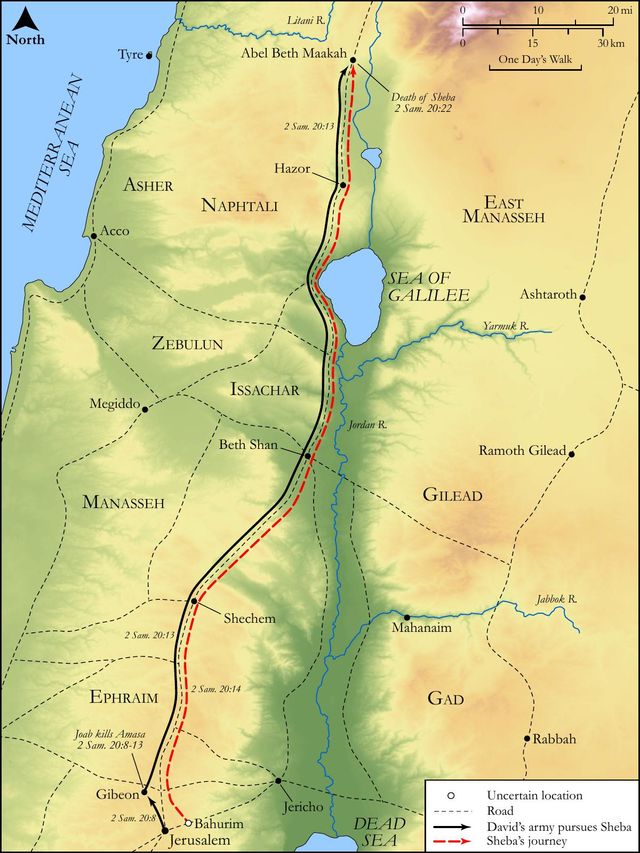
III.Joab, near Gibeon, meets with Amasa, and barbarously murders him, Sa2 20:8-10.
It should seem, the great stone in Gibeon was the place appointed for the general rendezvous. There the rivals met; and Amasa, relying upon his commission, went before, as general both of the new-raised forces which he had got together, and of the veteran troops which Abishai had brought in; but Joab there took an opportunity to kill him with his own hand; and,
1.He did it subtilely, and with contrivance, and not upon a sudden provocation. He girded his coat about him, that it might not hang in his way, and girded his belt upon his coat, that his sword might be the readier to his hand; he also put his sword in a sheath too big for it, that, whenever he pleased, it might, upon a little shake, fall out, as if it fell by accident, and so he might take it into his hand, unsuspected, as if he were going to return it into the scabbard, when he designed to sheath it in the bowels of Amasa. The more there is of plot in a sin the worse it is.
2.He did it treacherously, and under pretence of friendship, that Amasa might not be upon his guard. He called him brother, for they were own cousins, enquired of his welfare (Art thou in health?) and took him by the beard, as one he was free with, to kiss him, while with the drawn sword in his other hand he was aiming at his heart. Was this done like a gentleman, like a soldier, like a general? No, but like a villain, like a base coward. Just thus he slew Abner, and went unpunished for it, which encouraged him to do the like again.
3.He did it impudently, not in a corner, but at the head of his troops, and in their sight, as one that was neither ashamed nor afraid to do it, that was so hardened in blood and murders that he could neither blush nor tremble.
4.He did it at one blow, gave the fatal push with a good-will, as we say, so that he needed not strike him again; with such a strong and steady hand he gave this one stroke that it was fatal.
5.He did it in contempt and defiance of David and the commission he had given to Amasa; for that commission was the only ground of his quarrel with him, so that David was struck at through the side of Amasa, and was, in effect, told to his face that Joab would be general, in spite of him.
6.He did it very unseasonably, when they were going against a common enemy and were concerned to be unanimous. This ill-timed quarrel might have scattered their forces, or engaged them one against another, and so have made them all an easy prey to Sheba. So contentedly could Joab sacrifice the interest both of king and kingdom to his personal revenge.
IV.Joab immediately resumes his general's place, and takes care to lead the army on in pursuit of Sheba, that, if possible, he might prevent any prejudice to the common cause by what he had done. 1. He leaves one of his men to make proclamation to the forces that were coming up that they were still engaged in David's cause, but under Joab's command, Sa2 20:11. He knew what an interest he had in the soldiery, and how many favoured him rather than Amasa, who had been a traitor, was now a turn-coat, and had never been successful; on this he boldly relied, and called them all to follow him. What man of Judah would not be for his old king and his old general? But one would wonder with what face a murderer could pursue a traitor; and how, under such a heavy load of guilt, he had courage to enter upon danger. Surely his conscience was seared with a hot iron. 2. care is taken to remove the dead body out of the way, because at that they made a stand (as Sa2 2:23), and to cover it with a cloth, Sa2 20:12, Sa2 20:13. Wicked men think themselves safe in their wickedness if they can but conceal it from the eye of the world: if it be hidden, it is with them as if it were never done. But the covering of blood with a cloth cannot stop its cry in God's ear for vengeance, or make it the less loud. However, since this was no time to arraign Joab for what he had done, and the common safety called for expedition, it was prudent to remove that which retarded the march of the army; and then they all went on after Joab, while David, who no doubt had notice soon brought him of this tragedy, could not but reflect upon it with regret that he had not formerly done justice upon Joab for the death of Abner, and that he now had exposed Amasa by preferring him. And perhaps his conscience reminded him of his employing Joab in the murder of Uriah, which had helped to harden him in cruelty.
Continue studying 2 Samuel 20:5 across the web’s major study libraries — every link below opens this exact verse, chapter, or book on the destination site.
Read & Compare
 BibleGatewayThis verse in more than 200 translations and 70 languages.
 Bible.comThe YouVersion reader — hundreds of translations, reading plans, and highlights.
 ESV.orgCrossway's official English Standard Version reader.
 NET BibleThe NET translation with 60,000+ translators' notes on every rendering decision.
 STEP BibleTyndale House's free study tool — original text, vocabulary, and scholarly resources.
 BibliaLogos Bible Software's free web reader.
 USCCBThe New American Bible (Revised Edition) with the U.S. bishops' study notes.
Commentaries
 BibleHub CommentariesDozens of classic commentaries on this verse, gathered on one page.
 StudyLightMore than 100 commentary sets — the largest collection on the web.
 BibleRefPlain-English commentary on what this verse means, verse by verse.
 Enduring WordDavid Guzik's free commentary on this chapter, widely used by Bible teachers.
 Bible Study ToolsVerse commentary alongside Greek and Hebrew study aids.
Original Language & Research
- BibleHub InterlinearThe verse word by word — original language, transliteration, and English.
- BibleHub LexiconEvery word's original-language definition and Strong's entry.
 Blue Letter BibleDeep-study tools — Strong's numbers, concordance, and word studies.
 SefariaThe Hebrew text with Rashi and centuries of Jewish commentary.
Sermons, Hymns & Audio


TrulyRandomVerse is not affiliated with these sites and doesn’t control their content. They’re linked because they’re genuinely useful.
Summary
Second Samuel 20:5 records a critical moment of failed leadership during King David's tumultuous reign, specifically highlighting the inaction of Amasa, whom David had recently appointed as commander of Judah's forces. Tasked with swiftly assembling the men of Judah to quell the burgeoning rebellion of Sheba son of Bichri, Amasa instead "tarried longer than the set time," failing to meet the urgent three-day deadline imposed by the king. This delay proved to be a significant misstep, demonstrating a lack of diligence and ultimately setting in motion a chain of events with severe consequences for Amasa and the stability of David's kingdom, showcasing the perils of procrastination in times of crisis.
Context
ShowHideLiterary Context
This verse is situated immediately after King David's precarious return to Jerusalem following the suppression of Absalom's rebellion and the subsequent political maneuvering to restore unity between Israel and Judah. David, seeking to reconcile with Judah and perhaps to punish Joab for killing Absalom, had controversially appointed Amasa—his nephew and former commander of Absalom's rebel army—as his new chief general over the loyal Joab, a decision detailed in 2 Samuel 19:13. The narrative then swiftly transitions to a new, immediate threat: the rebellion of Sheba son of Bichri, who rallied disaffected elements of Israel against David, as introduced in 2 Samuel 20:1. David's urgent command to Amasa in 2 Samuel 20:4 for a swift mobilization within three days underscores the immediate danger and the king's desperate need for decisive action. Verse 2 Samuel 20:5 then directly reveals Amasa's critical failure to meet this deadline, setting the stage for Joab's re-entry into the narrative and the tragic events that follow, including Amasa's demise.
Historical & Cultural Context
The period immediately following Absalom's rebellion (recorded in 2 Samuel 15-19) was one of profound political instability and fractured loyalties within David's kingdom. The deep-seated tribal divisions between Judah and the northern tribes of Israel were exacerbated, creating fertile ground for new insurrections like Sheba's. In this context, effective military leadership was paramount, and the ability of a general to quickly muster forces was crucial for national security and the preservation of the monarchy. David's appointment of Amasa, a figure who had recently led an army against him, was a politically risky move intended to heal the rift with Judah but also alienated Joab, David's long-standing and fiercely loyal (though often ruthless) general. The "set time" for mobilization was not merely a suggestion but a royal command, the failure of which could be interpreted as incompetence, disloyalty, or a critical lapse in judgment, with potentially dire consequences for the kingdom's stability and the king's authority.
Key Themes
ShowHideThis verse powerfully contributes to several overarching themes within 2 Samuel and the broader biblical narrative. Firstly, it highlights the theme of Timeliness and Obedience, emphasizing that in matters of leadership and divine calling, prompt and faithful execution of commands is vital. Amasa's failure to act within the king's appointed timeframe directly contravenes the principle of diligent obedience, a virtue highly valued in biblical wisdom literature. Secondly, the verse underscores the Consequences of Delay and Inaction. Amasa's procrastination had immediate and severe repercussions, demonstrating how a lack of diligence can escalate crises and lead to further instability, ultimately contributing to his tragic demise at Joab's hand, as seen in 2 Samuel 20:9-10. Finally, it speaks to the theme of Leadership and Trust. King David's trust in Amasa, a calculated political gamble, was immediately tested and found wanting. Effective leadership requires not only strategic vision and skill but also unwavering reliability and the ability to execute commands faithfully and on schedule, especially when the security of a nation hangs in the balance.
Exposition and Analysis
ShowHideKey Word Analysis
ShowHideThe Hebrew verb אָחַר (ʼâchar) means "to loiter," "to be behind," or "to procrastinate." In this context, the KJV's "tarried longer" accurately captures the negative nuance of culpable delay. It implies not merely a passive waiting, but an active failure to meet an appointed deadline, indicating a lack of urgency, competence, or perhaps even commitment. This delay is presented as a deliberate act of non-compliance, rather than an unavoidable circumstance, thereby highlighting Amasa's culpability and the gravity of his inaction in the face of a national emergency.
The Hebrew word מוֹעֵד (môwʻēd) refers to an appointment, a fixed time or season, or a designated meeting. It often carries a sense of a specific, non-negotiable deadline or even a divinely appointed season. Here, it emphasizes that David's command was not open-ended but came with a strict, urgent three-day limit. Amasa's transgression was not just a general slowness, but a direct violation of a precisely "appointed" time, underscoring the severity of his failure to adhere to the king's explicit instructions.
Verse Breakdown
ShowHide"So Amasa went to assemble [the men of] Judah"
This initial clause indicates Amasa's nominal compliance with King David's command. He did indeed set out to perform the task of gathering the forces. The specific mention of "Judah" highlights the limited scope of his initial assignment—to gather the forces from David's own tribe, which was crucial for consolidating support after Absalom's rebellion and before confronting the broader Israelite insurgency led by Sheba.
"but he tarried longer than the set time which he had appointed him."
The conjunction "but" introduces a stark contrast to Amasa's initial action, revealing his critical failure. He did not complete the task within the specified three-day period. The phrase "which he had appointed him" underscores that the deadline was explicitly communicated and understood by Amasa, making his delay a direct act of disobedience or gross incompetence rather than a misunderstanding. This failure to meet the "set time" is the crux of the verse, immediately signaling a breakdown in leadership and trust.
Literary Devices
ShowHideThe verse primarily employs Contrast and Foreshadowing. The Contrast is evident between King David's urgent command for swift action and Amasa's subsequent culpable delay. David's expectation of immediate mobilization within a "set time" is sharply juxtaposed with Amasa's failure to meet that deadline, highlighting the chasm between royal directive and a general's execution. Furthermore, this delay serves as significant Foreshadowing. Amasa's inability to perform his first critical task for David immediately signals his unsuitability for the demanding role of commander and hints at the tragic fate that awaits him. His tardiness sets the stage for Joab's reassertion of power and Amasa's eventual assassination, as the narrative must find a more decisive leader to address the rebellion.
Theological and Thematic Connections
ShowHideThe narrative of Amasa's delay serves as a profound theological lesson on the importance of diligence, faithfulness, and the stewardship of time and responsibility. In the biblical worldview, obedience is not merely about performing an action, but often about performing it at the right time and with the right spirit. Amasa's failure to meet the "set time" for mobilization, though seemingly a practical lapse, carries theological weight, reflecting a deeper lack of diligence or commitment. It illustrates that even when given a clear command and a specific timeframe, human weakness, procrastination, or incompetence can hinder divine or kingly purposes. This resonates with broader biblical principles that emphasize the value of promptness in duty and the serious consequences of neglecting responsibilities, especially those entrusted by authority. It underscores that opportunities, particularly in times of crisis, are often time-sensitive, and delay can lead to compounding problems and missed blessings.
Reflection and Application
ShowHideAmasa's failure to act promptly in 2 Samuel 20:5 offers a timeless and sobering lesson for believers today. In a world that often celebrates busyness over diligence, and where procrastination can be a common struggle, this verse reminds us that obedience often includes the element of timeliness. Whether in our personal commitments, professional duties, or spiritual callings, delays can have far-reaching negative consequences, not just for ourselves but for those we serve and for the broader purposes of God. Amasa's inaction jeopardized David's kingdom; similarly, our own delays in responding to God's call, fulfilling our responsibilities, or acting on opportunities for service can hinder the progress of His kingdom, erode trust in our character, and cause us to miss critical moments for impact. This narrative challenges us to cultivate a spirit of diligence, faithfulness, and decisiveness, recognizing that our actions (or inactions) have tangible effects on the spiritual and practical landscapes around us. It calls us to be good stewards of the time and opportunities God entrusts to us, acting with wisdom and urgency when the moment demands it.
Questions for Reflection
ShowHideFAQ
ShowHideWhy was Amasa appointed general over Joab, and what were the implications of this decision?
ShowHideDavid appointed Amasa as general of Judah's forces (and effectively, his chief general) over Joab primarily for political reasons, as detailed in 2 Samuel 19:13. After Absalom's rebellion, David sought to reconcile with the tribe of Judah, who had largely supported Absalom. Amasa, being David's nephew and having led Absalom's army, was a strategic choice to win back Judah's loyalty. This decision also served as a way for David to punish Joab, who had defied David's direct order by killing Absalom (2 Samuel 18:14-15). The implication of this appointment was immediate instability; Joab, a seasoned and powerful general, was deeply resentful, and Amasa, despite his lineage, proved to be an incompetent or unreliable leader in a crisis, leading directly to his tragic downfall.
What were the immediate consequences of Amasa's delay in assembling the men of Judah?
ShowHideAmasa's failure to meet the three-day deadline had immediate and severe consequences. King David, recognizing the urgency of the Sheba rebellion and Amasa's critical failure, could not afford further delay. He was forced to dispatch Abishai (and by extension, Joab, who was likely with him or quickly joined) to pursue Sheba, as recorded in 2 Samuel 20:6-7. This effectively reinstated Joab as the de facto military commander. The most tragic and direct consequence for Amasa was his assassination by Joab. As Joab pursued Sheba, he encountered Amasa, feigned a greeting, and then brutally murdered him, likely out of a combination of personal ambition, resentment, and a desire to eliminate a rival who had proven himself unfit for command (described in 2 Samuel 20:9-10). Amasa's delay thus directly led to his death and Joab's reassertion of military dominance.
Christ-Centered Fulfillment
ShowHideWhile 2 Samuel 20:5 highlights the failure of human leadership and the perils of delay, it implicitly points to the perfect and decisive leadership of Jesus Christ. Unlike Amasa, who "tarried longer than the set time," Christ always acted in perfect obedience to the Father's will and in the "fullness of time" (Galatians 4:4). His earthly ministry was characterized by an unwavering commitment to His mission, never delaying or procrastinating in fulfilling the divine mandate to seek and save the lost. When the time came for His ultimate sacrifice, He did not hesitate but resolutely set His face toward Jerusalem (Luke 9:51), demonstrating perfect promptness in His obedience, even unto death on the cross. Furthermore, while Amasa failed to gather the men of Judah for an earthly king, Christ is the ultimate Shepherd who perfectly gathers His sheep, calling them from every tribe and nation into His eternal kingdom (John 10:16). His leadership is characterized by absolute trustworthiness and reliability, offering a stark contrast to Amasa's unreliability. Believers are called to emulate Christ's diligence and obedience, serving Him faithfully and without delay, knowing that He is the perfectly reliable Commander of our salvation.