


1 Samuel 13:8
Bible text: King James Version (1769 Blayney text) · Public domain
Bible text: King James Version with Strong's numbers · Public domain
Bible text: Berean Standard Bible · Public domain
Bible text: American Standard Version (1901) · Public domain
Bible text: World English Bible, Messianic edition · Public domain
Bible text: Geneva Bible (1599) · Public domain
Bible text: Young's Literal Translation · Public domain
- וַיּוֹחֶלvai·yi·cheland he waitedH3176Conj-w ¦ V-Hiphil-ConsecImperf-3msVerb Hiphil Consecutive Imperfect 3rd Singular Masculineוַandיּוֹחֶלhe waited
- שִׁבְעַתshiv·'AtsevenH7651N-cscNoun Singular common gender Construct
- יָמִיםya·MimdaysH3117N-mpNoun Plural Masculine Absolute
- לַמּוֹעֵדla·mo·'Edto the appointed timeH4150Prep-l ¦ N-msNoun Singular Masculine Absoluteלַto theמּוֹעֵדappointed time
- אֲשֶׁר'a·SherwhichH834RelParticle Relative
- שְׁמוּאֵלshe·mu·'ElSamuelH8050N-proper-mNoun Proper Masculine
- וְלֹאve·lo'and notH3808Conj-w ¦ NegParticle Negativeוְandלֹאnot
- בָאva'he had comeH935V-Qal-Perf-3msVerb Qal Perfect 3rd Singular Masculine
- שְׁמוּאֵלshe·mu·'ElSamuelH8050N-proper-mNoun Proper Masculine
- הַגִּלְגָּלha·gil·Gal<the> GilgalH1537Art ¦ N-properNoun Proper Locationהַ<the>גִּלְגָּלGilgal
- וַיָּפֶץvai·Ya·fetzand it scatteredH6327Conj-w ¦ V-Hiphil-ConsecImperf-3msVerb Hiphil Consecutive Imperfect 3rd Singular Masculineוַandיָּפֶץit scattered
- הָעָםha·'Amthe peopleH5971Art ¦ N-msNoun Singular Masculine Absoluteהָtheעָםpeople
- מֵעָלָיוme·'a·Lavfrom with <the> himH5921Prep-m ¦ Prep ¦ 3msPreposition Definiteמֵfromעָלָיwith <the>וhim
English is a literal word-by-word gloss of the Hebrew, not the KJV's wording. Why?
This is the original text the KJV's translators worked from — each Hebrew word with its own literal English meaning in this verse, prepared by scholars at Tyndale House, Cambridge. The KJV translates whole sentences, not word by word, so its wording differs: one Hebrew word can become several English words, and the KJV may choose “the LORD” where the gloss reads “Yahweh”. Both are faithful — they answer different questions. For the KJV's own rendering, switch to the KJV text.
Details
See on the biblical-era map
Study this verse
Public-domain commentary
Matthew Henry
From his Commentary on the Whole Bible. Henry comments on passages, not single verses — this entry covers 1 Samuel 13:8–14. His three-level outline is real structure in the source text, so it is rendered as structure.
Here is, I. Saul's offence in offering sacrifice before Samuel came. Samuel, when he anointed him, had ordered him to tarry for him seven days in Gilgal, promising that, at the end of those days, he would be sure to come to him, and both offer sacrifices for him and direct him what he should do. This we had Sa1 10:8. Perhaps that order, though inserted there, was given him afterwards, or was given him as a general rule to be observed in every public congress at Gilgal, or, as is most probable, though not mentioned again, was lately repeated with reference to this particular occasion; for it is plain that Saul himself understood it as obliging him from God now to stay till Samuel came, else he would not have made so many excuses as he did for not staying, Sa1 13:11. This order Saul broke. He staid till the seventh day, yet had not patience to wait till the end of the seventh day. Perhaps he began to reproach Samuel as false to his word, careless of his country, and disrespectful of his prince, and thought it more fit that Samuel should wait for him than he for Samuel. However, 1. He presumed to offer sacrifice without Samuel, and nothing appears to the contrary but that he did it himself, though he was neither priest nor prophet, as if, because he was a king, he might do any thing, a piece of presumption which king Uzziah paid dearly for, Ch2 26:16, etc. 2. He determined to engage the Philistines without Samuel's directions, though he had promised to show him what he should do. So self-sufficient Saul was that he thought it not worth while to stay for a prophet of the Lord, either to pray for him or to advise him. This was Saul's offence, and that which aggravated it was, (1.) That for aught that appears, he did not send any messenger to Samuel, to know his mind, to represent the case to him, and to receive fresh directions from him, though he had enough about him that were swift enough of foot at this time. (2.) That when Samuel came he rather seemed to boast of what he had done than to repent of it; for he went forth to salute him, as his brother-sacrificer, and seemed pleased with the opportunity he had of letting Samuel know that he needed him not, but could do well enough without him. He went out to bless him, so the word is, as if he now thought himself a complete priest, empowered to bless as well as sacrifice, whereas he should have gone out to be blessed by him. (3.) That he charged Samuel with breach of promise: Thou camest not within the days appointed (Sa1 13:11), and therefore if any thing was amiss Samuel must bear the blame, who was God's minister; whereas he did come according to his word, before the seven days had expired. Thus the scoffers of the latter days think the promise of Christ's coming is broken, because he does not come in their time, though it is certain he will come at the set time. (4.) That when he was charged with disobedience he justified himself in what he had done, and gave no sign at all of repentance for it. It is not sinning that ruins men, but sinning and not repenting, falling and not getting up again. See what excuses he made, Sa1 13:11, Sa1 13:12. He would have this act of disobedience pass, [1.] For an instance of his prudence. The people were most of them scattered from him, and he had no other way than this to keep those with him that remained and to prevent their deserting too. If Samuel neglected the public concerns, he would not. [2.] For an instance of his piety. He would be thought very devout, and in great care not to engage the Philistines till he had by prayer and sacrifice engaged God on his side: "The Philistines," said he, "will come down upon me, before I have made my supplication to the Lord, and then I am undone. What! go to war before I have said my prayers!" Thus he covered his disobedience to God's command with a pretence of concern for God's favour. Hypocrites lay a great stress upon the external performances of religion, thinking thereby to excuse their neglect of the weightier matters of the law. And yet, lastly, He owns it went against his conscience to do it: I forced myself and offered a burnt-offering, perhaps boasting that he had broken through his convictions and got the better of them, or at least thinking this extenuated his fault, that he knew he should not have done as he did, but did it with reluctancy. Foolish man! to think that God would be well pleased with sacrifices offered in direct opposition both to his general and particular command.
II.The sentence passed upon Saul for this offence.
Samuel found him standing by his burnt-offering, but, instead of an answer of peace, was sent to him with heavy tidings, and let him know that the sacrifice of the wicked is abomination to the Lord, much more when he brings it, as Saul did, with a wicked mind.
1.He shows him the aggravations of his crime, and says to this king, Thou art wicked, which it is not for any but a prophet of the Lord to say, Job 34:18. He charges him with being an enemy to himself and his interest - Thou hast done foolishly, and a rebel to God and his government - "Thou hast not kept the commandment of the Lord thy God, that commandment wherewith he intended to try thy obedience." Note, Those that disobey the commandments of God do foolishly for themselves. Sin is folly, and sinners are the greatest fools.
2.He reads his doom (Sa1 13:14): "Thy kingdom shall not continue long to thee or thy family; God has his eye upon another, a man after his own heart, and not like thee, that will have thy own will and way." The sentence is in effect the same with Mene tekel, only now there seems room left for Saul's repentance, upon which this sentence would have been reversed; but, upon the next act of disobedience, it was made irreversible, Sa1 15:29. And now, better a thousand times he had continued in obscurity tending his asses than to be enthroned and so soon dethroned. But was not this hard, to pass so severe a sentence upon him and his house for a single error, an error that seemed so small, and in excuse for which he had so much to say? No, The Lord is righteous in all his ways and does no man any wrong, will be justified when he speaks and clear when he judges. By this,
(1.)He shows that there is no sin little, because no little god to sin against; but that every sin is a forfeiture of the heavenly kingdom, for which we stood fair.
(2.)He shows that disobedience to an express command, though in a small matter, is a great provocation, as in the case of our first parents.
(3.)He warns us to take heed of our spirits, for that which to men may seem but a small offence, yet to him that knows from what principle and with what disposition of mind it is done, may appear a heinous crime.
(4.)God, in rejecting Saul for an error seemingly little, sets off, as by a foil, the lustre of his mercy in forgiving such great sins as those of David, Manasseh, and others.
(5.)We are taught hereby how necessary it is that we wait on our God continually. Saul lost his kingdom for want of two or three hours' patience.
Historical interpretation
Historical reception
1 surviving comment on this verse from the historical church.
And he waited seven days according to Samuel’s appointed time, etc. The assembly of legal scholars, together with their listeners, waited for the advent of Christ in the flesh throughout the entire time that the Sabbath was observed in the law, knowing that He would come in the last days of legal observance; but as He delayed, so that He might come at the fullness of time which He had predestined, a considerable portion of their listeners, having slipped away, deserted the camp of the spiritual army. And indeed, concerning those who waited well, the prophet says: “But My just one lives by faith” (Habakkuk 2). But concerning those who fell away, he adds: “But if he draws back, My soul shall have no pleasure in him” (Hebrews 10).
Continue studying 1 Samuel 13:8 across the web’s major study libraries — every link below opens this exact verse, chapter, or book on the destination site.
Read & Compare
 BibleGatewayThis verse in more than 200 translations and 70 languages.
 Bible.comThe YouVersion reader — hundreds of translations, reading plans, and highlights.
 ESV.orgCrossway's official English Standard Version reader.
 NET BibleThe NET translation with 60,000+ translators' notes on every rendering decision.
 STEP BibleTyndale House's free study tool — original text, vocabulary, and scholarly resources.
 BibliaLogos Bible Software's free web reader.
 USCCBThe New American Bible (Revised Edition) with the U.S. bishops' study notes.
Commentaries
 BibleHub CommentariesDozens of classic commentaries on this verse, gathered on one page.
 StudyLightMore than 100 commentary sets — the largest collection on the web.
 BibleRefPlain-English commentary on what this verse means, verse by verse.
 Enduring WordDavid Guzik's free commentary on this chapter, widely used by Bible teachers.
 Bible Study ToolsVerse commentary alongside Greek and Hebrew study aids.
Original Language & Research
- BibleHub InterlinearThe verse word by word — original language, transliteration, and English.
- BibleHub LexiconEvery word's original-language definition and Strong's entry.
 Blue Letter BibleDeep-study tools — Strong's numbers, concordance, and word studies.
 SefariaThe Hebrew text with Rashi and centuries of Jewish commentary.
Sermons, Hymns & Audio


TrulyRandomVerse is not affiliated with these sites and doesn’t control their content. They’re linked because they’re genuinely useful.
Summary
1 Samuel 13:8 details a pivotal moment in King Saul's early reign, revealing his character under duress. Having faithfully waited the prescribed seven days for Samuel to arrive and offer sacrifices before a critical battle, Saul faces immense pressure as the prophet fails to appear and his Israelite army begins to desert him. This verse encapsulates Saul's precarious position at Gilgal, setting the stage for his fateful act of disobedience and highlighting the profound tension between human expediency and divine timing, ultimately foreshadowing his unsuitability for enduring kingship.
Context
ShowHideLiterary Context
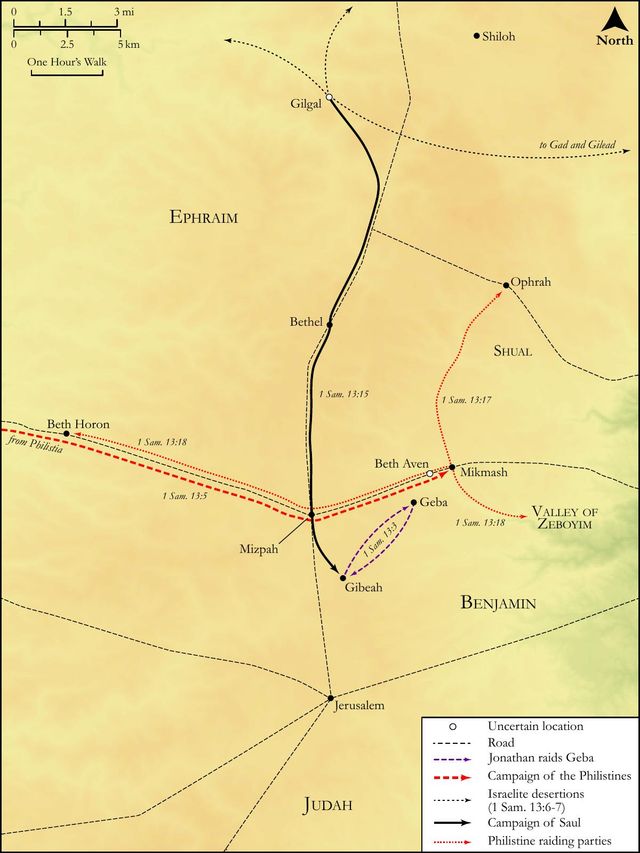
This verse is a crucial turning point within the narrative arc of Saul's kingship, immediately following Jonathan's daring strike against a Philistine garrison, which provoked a massive Philistine counter-mobilization (as described in 1 Samuel 13:3-5). This aggressive Philistine response created an atmosphere of fear and desperation among the Israelites, amplifying the pressure on Saul. The "seven days" mentioned in 1 Samuel 13:8 directly refers back to Samuel's explicit and foundational instruction to Saul at the very outset of his reign, a command given to establish the proper relationship between the new monarchy and God's prophetic authority (1 Samuel 10:8). Saul's actions in 1 Samuel 13:8 directly precede his rash decision to usurp the priestly role by offering the burnt offering himself (1 Samuel 13:9), which, upon Samuel's arrival, leads to the prophet's severe rebuke and the pronouncement of the loss of Saul's dynasty (1 Samuel 13:13-14).
Historical & Cultural Context
Saul's reign marked Israel's challenging transition from a decentralized tribal confederacy under judges to a centralized monarchy. This period was characterized by constant existential threats, particularly from the Philistines, a powerful and technologically advanced people who held a significant military advantage, including a monopoly on ironworking (as vividly detailed in 1 Samuel 13:19-22). This technological disparity left the Israelite army poorly equipped, often with only rudimentary weapons. Gilgal, the site of this critical event, was not merely a strategic location but held profound historical and religious significance for Israel. It was their first encampment after crossing the Jordan into the Promised Land (Joshua 4:19), a place of covenant renewal, and where Saul himself had been publicly confirmed as king (1 Samuel 11:14-15). Culturally, the offering of sacrifices was a sacred, priestly function, strictly regulated and not to be performed by kings. Samuel, as God's prophet, served as the divine intermediary, and his instructions carried the weight of God's direct command. Saul's actions thus touched upon the delicate balance of authority between the newly established monarchy, the prophetic office, and the established priestly functions, a tension central to Israel's early monarchical period.
Key Themes
ShowHide1 Samuel 13:8 is a crucible for several foundational themes that resonate throughout Saul's reign and beyond. Foremost is the theme of Obedience vs. Disobedience, as Saul's ultimate failure to wait patiently for Samuel highlights the absolute necessity of adhering to God's explicit commands, even under the most extreme duress. This directly intertwines with the theme of Divine Timing, underscoring that God's sovereign plans unfold according to His perfect schedule, which often demands human patience, trust, and a willingness to endure uncertainty rather than resort to human expediency. The verse also serves as a critical Testing of Leadership, revealing that true leadership, particularly for a king appointed by God, requires spiritual steadfastness, unwavering faith, and reliance on the Almighty, rather than merely strategic acumen or human initiative. Furthermore, it powerfully foreshadows the Consequences of Impatience and Self-Reliance, demonstrating how a lack of faith in God's sovereignty can lead to severe repercussions for one's calling, position, and ultimately, one's dynasty, a theme explicitly articulated by Samuel later in 1 Samuel 15:22.
Exposition and Analysis
ShowHideKey Word Analysis
ShowHideThis verb (H3176, יָחַל) means "to wait," "to hope," "to be patient," or "to endure." In this context, it describes Saul's physical act of waiting for Samuel for the prescribed seven days. However, the deeper implication of this word, encompassing patience and hope, reveals a critical deficiency in Saul's internal disposition. While he fulfilled the duration of the command, his subsequent actions demonstrate a failure to embody the patient trust inherent in true waiting, highlighting the mounting internal and external pressure he faced as the deadline approached without Samuel's arrival.
The noun (H4150, מוֹעֵד) refers to an "appointed time," "fixed period," or "season." It denotes a specific, pre-determined, and often divinely ordained moment or assembly. Samuel's instruction to Saul in 1 Samuel 10:8 established a clear, non-negotiable deadline, making this "set time" not merely a human arrangement but a divine test. Saul's failure to fully honor this divinely appointed time was a direct affront to God's authority and His sovereign timing.
The verb (H6327, פּוּץ) means "to dash in pieces," "to disperse," "to break," or "to shatter." It vividly describes the demoralization and desertion of the Israelite troops. Faced with a technologically superior Philistine force and the apparent absence of divine intervention (symbolized by Samuel's delay), the soldiers lost morale and began to abandon Saul. This "scattering" created the immediate, overwhelming pressure that Saul later cited as his justification for acting impulsively, yet it also served as a test of his faith and leadership in crisis.
Verse Breakdown
ShowHide"¶ And he tarried seven days, according to the set time that Samuel [had appointed]:"
This opening clause establishes Saul's initial, albeit partial, compliance. He physically waited for the full seven days as commanded by Samuel. The parenthetical "had appointed" subtly reinforces the divine authority behind the instruction, emphasizing that this was not merely a human arrangement but a specific, divinely mandated period. This sets up the tension, indicating that while the king fulfilled the temporal requirement, the true test lay in his internal disposition and ultimate obedience to the spirit of the command.
"but Samuel came not to Gilgal;"
This is the pivotal moment of crisis and the heart of the test. Despite Saul's adherence to the timeline, the crucial element—Samuel's presence to offer the sacrifice—was conspicuously absent. This absence was not an oversight but a deliberate, divinely orchestrated test of Saul's faith, patience, and obedience. It created a vacuum of spiritual authority and assurance at a critical juncture, forcing Saul to confront his reliance on God's sovereignty rather than human intervention.
"and the people were scattered from him."
This clause describes the immediate and dire consequence of Samuel's non-arrival combined with the Philistine threat. The Israelite army, already fearful, poorly equipped, and lacking the spiritual reassurance of a sacrifice, lost morale and began to desert Saul. This "scattering" amplified the pressure on the king, presenting him with a seemingly impossible dilemma: lose his army entirely or act outside of God's explicit command. This human pressure became the catalyst for Saul's subsequent, disobedient action.
Literary Devices
ShowHideThe narrative of 1 Samuel 13:8 is rich with literary devices that amplify its theological impact and underscore the gravity of Saul's situation. Suspense is masterfully built through the meticulous counting of the "seven days," culminating in the dramatic non-arrival of Samuel precisely at the "set time." This creates a palpable tension for both Saul and the reader, anticipating the king's response to the escalating crisis. There is a profound Irony in Saul's predicament: chosen by God to lead Israel, he fails a fundamental test of obedience related to divine timing and trust. His initial partial obedience (waiting the days) is tragically undermined by his ultimate impatience and self-reliance. The verse also employs powerful Foreshadowing, as Saul's failure to wait patiently here serves as a potent harbinger of his later, more significant acts of disobedience that ultimately lead to the rejection of his dynasty and the loss of his kingship. Furthermore, the Contrast between the divine command for patient waiting and Saul's human expediency highlights the core conflict of the narrative—the clash between God's perfect will and human imperfection under pressure.
Theological and Thematic Connections
ShowHideThe narrative of 1 Samuel 13:8 profoundly illustrates the theological truth that God's timing is perfect, and human impatience, even when driven by seemingly pragmatic concerns, often leads to disobedience and detrimental consequences. Saul's failure to wait on Samuel, despite the immense pressure from a deserting army and an encroaching enemy, reveals a fundamental lack of trust in God's sovereign ability to deliver His people. This incident underscores that true faith is demonstrated not merely by initiating action, but by patiently enduring and trusting God's process, even when it appears counter-intuitive or when circumstances are dire. It highlights the principle that obedience to God's specific commands, regardless of the cost or perceived urgency, is paramount and more valuable than any humanly conceived solution or religious act. God values humble submission and trust over human initiative or even zealous, but disobedient, religious performance.
Reflection and Application
ShowHideThe account of Saul at Gilgal in 1 Samuel 13:8 offers timeless and poignant lessons for believers navigating the complexities of life. We often find ourselves in situations that parallel Saul's, facing immense pressure, uncertain outcomes, and the powerful temptation to take matters into our own hands rather than patiently waiting on God's perfect timing. Whether it's a career decision, a relational conflict, a financial crisis, or a spiritual struggle, the "seven days" of waiting can feel interminable, especially when our "people are scattering" or our "enemies are advancing." This verse challenges us to deeply examine our hearts: Do we truly trust God's sovereignty and faithfulness when His plan doesn't align with our immediate desires or perceived necessities? Do we genuinely believe that His delays are purposeful, designed to test and strengthen our faith, rather than abandon us? Saul's failure reminds us that true spiritual strength is found not in human expediency, self-reliance, or even well-intentioned but disobedient actions, but in unwavering obedience and patient reliance on God's Word and His appointed means, even when the path forward is unclear or fraught with difficulty. It calls us to cultivate a spirit of quiet trust and confident expectation, knowing that God is actively at work even in the silence and the waiting, orchestrating events for His glory and our good.
Questions for Reflection
ShowHideFAQ
ShowHideWhy did Samuel not come on time?
ShowHideSamuel's delay was not an oversight or a failure on his part, but a deliberate, divinely orchestrated test of King Saul's obedience and trust in God's sovereign timing. God often uses periods of waiting, uncertainty, and perceived abandonment to reveal the true state of our hearts, to refine our faith, and to teach us dependence on Him. For Saul, this was a crucial opportunity to demonstrate his reliance on God as the newly appointed king, proving that he would prioritize divine command and God's authority over human expediency or fear of the Philistines. Samuel's absence created the precise conditions under which Saul's character and commitment to God's authority would be fully exposed.
What was the significance of Gilgal as the location for this event?
ShowHideGilgal held profound historical and religious significance for Israel, making Saul's actions there particularly poignant and symbolic. It was the place where Israel first encamped after miraculously crossing the Jordan River into the Promised Land (Joshua 4:19), where the covenant of circumcision was renewed (Joshua 5:2-9), and where the kingdom was formally renewed under Saul himself after his victory over the Ammonites (1 Samuel 11:14-15). As a site of covenant, divine encounter, and national identity, Gilgal symbolized Israel's relationship with God. For Saul to act disobediently and usurp sacred authority at such a hallowed location underscored the gravity of his transgression against the very God who had established the covenant and appointed him king.
Was Saul's action truly so bad, given the circumstances?
ShowHideFrom a purely human, pragmatic, or military perspective, Saul's decision to offer the sacrifice might seem justifiable, even necessary, given the desertion of his troops and the imminent Philistine threat. He was attempting to rally his demoralized army and seek divine favor before battle. However, from a divine perspective, it was a profound act of disobedience and a usurpation of authority. Samuel had given Saul a clear, explicit command to wait for him to offer the sacrifice (1 Samuel 10:8). Saul's action demonstrated a fundamental lack of trust in God's ability to deliver, a preference for human initiative over divine instruction, and an encroachment upon the priestly role that was strictly reserved for those consecrated for it. This act revealed a deep-seated flaw in Saul's heart: his tendency to prioritize his own judgment and control over humble submission to God's revealed will. It was not merely a tactical error but a spiritual failure that set a dangerous precedent for his kingship and ultimately led to the rejection of his dynasty.
Christ-Centered Fulfillment
ShowHideThe failure of King Saul in 1 Samuel 13:8 stands in stark contrast to the perfect obedience and patient endurance of Jesus Christ, our true King and eternal High Priest. Where Saul succumbed to human pressure and acted impatiently, usurping a sacred role not his own, Jesus perfectly fulfilled the will of His Father, even unto death. Saul's attempt to offer a sacrifice out of expediency highlights the utter inadequacy of human efforts to appease God or secure victory, pointing forward to the ultimate, once-for-all sacrifice of the Lamb of God, who takes away the sin of the world!. Unlike Saul, who failed the test of waiting, Jesus exemplified perfect trust in God's timing, even in the agonizing wait in Gethsemane, where He prayed, "Not my will, but yours be done" (Luke 22:42). He patiently endured the cross, knowing it was the Father's appointed time for the redemption of humanity (Hebrews 12:2). Thus, Saul's disobedience at Gilgal underscores the desperate need for a King who is perfectly obedient, perfectly patient, and perfectly able to offer the true, acceptable sacrifice—a need fully met in Jesus Christ, who, unlike Saul, never failed to wait on the Father, and whose eternal reign is established upon His perfect submission and atoning work (Philippians 2:8-11).