


1 Samuel 13:7
Bible text: King James Version (1769 Blayney text) · Public domain
Bible text: King James Version with Strong's numbers · Public domain
Bible text: Berean Standard Bible · Public domain
Bible text: American Standard Version (1901) · Public domain
Bible text: World English Bible, Messianic edition · Public domain
Bible text: Geneva Bible (1599) · Public domain
Bible text: Young's Literal Translation · Public domain
- וְעִבְרִיםve·'iv·Rimand HebrewsH5680Conj-w ¦ N-mpNoun Gentilic Plural Masculine AbsoluteוְandעִבְרִיםHebrews
- עָבְרוּ'a·ve·Ruthey passed overH5674V-Qal-Perf-3cpVerb Qal Perfect 3rd Plural common gender
- אֶת'et<obj.>H853DirObjMParticle Object Indicator
- הַיַּרְדֵּןhai·yar·Denthe JordanH3383Art ¦ N-properNoun Proper LocationהַtheיַּרְדֵּןJordan
- אֶרֶץ'E·retz[the] land ofH776N-fscNoun Singular Feminine Construct
- גָּדgadGadH1410N-proper-mNoun Proper Masculine
- וְגִלְעָדve·gil·'Adand GileadH1568Conj-w ¦ N-properNoun Proper LocationוְandגִלְעָדGilead
- וְשָׁאוּלve·sha·'Uland SaulH7586Conj-w ¦ N-proper-mNoun Proper MasculineוְandשָׁאוּלSaul
- עוֹדֶנּוּo·De·nustill heH5750Adj-msc ¦ 3msAdjective Numerical Singular Masculine Constructעוֹדֶstillנּוּhe
- בַגִּלְגָּלva·gil·Gal[was] at <the> GilgalH1537Prep-b ¦ N-properNoun Proper Locationבַ[was] at <the>גִּלְגָּלGilgal
- וְכָלve·kholand allH3605Conj-w ¦ N-mscNoun Singular Masculine Constructוְandכָלall
- הָעָםha·'Amthe peopleH5971Art ¦ N-msNoun Singular Masculine Absoluteהָtheעָםpeople
- חָרְדוּcha·re·Duthey trembledH2729V-Qal-Perf-3cpVerb Qal Perfect 3rd Plural common gender
- אַחֲרָיו'a·cha·Ravafter himH310Adj-mpc ¦ 3msAdjective Numerical Plural Masculine Constructאַחֲרָיafterוhim
English is a literal word-by-word gloss of the Hebrew, not the KJV's wording. Why?
This is the original text the KJV's translators worked from — each Hebrew word with its own literal English meaning in this verse, prepared by scholars at Tyndale House, Cambridge. The KJV translates whole sentences, not word by word, so its wording differs: one Hebrew word can become several English words, and the KJV may choose “the LORD” where the gloss reads “Yahweh”. Both are faithful — they answer different questions. For the KJV's own rendering, switch to the KJV text.
Details
See on the biblical-era map
Study this verse
Public-domain commentary
Matthew Henry
From his Commentary on the Whole Bible. Henry comments on passages, not single verses — this entry covers 1 Samuel 13:1–7. His two-level outline is real structure in the source text, so it is rendered as structure.
We are not told wherein it was that the people of Israel offended God, so as to forfeit his presence and turn his hand against them, as Samuel had threatened (Sa1 12:15); but doubtless they left God, else he would not have left them, as here it appears he did; for,
I.Saul was very weak and impolitic, and did not order his affairs with discretion.
Saul was the son of one year (so the first words are in the original), a phrase which we make to signify the date of his reign, but ordinarily it signifies the date of one's birth, and therefore some understand it figuratively - he was as innocent and good as a child of a year old; so the Chaldee paraphrase: he was without fault, like the son of a year. But, if we admit a figurative sense, it may as well intimate that he was ignorant and imprudent, and as unfit for business as a child of a year old: and the subsequent particulars make this more accordant with his character than the former. But we take it rather, as our own translation has it, Saul reigned one year, and nothing happened that was considerable, it was a year of no action; but in his second year he did as follows: - 1. he chose a band of 3000 men, of whom he himself commanded 2000, and his son Jonathan 1000, Sa1 13:2. The rest of the people he dismissed to their tents. If he intended these only for the guard of his person and his honorary attendants, it was impolitic to have so many, if for a standing army, in apprehension of danger from the Philistines, it was no less impolitic to have so few; and perhaps the confidence he put in this select number, and his disbanding the rest of that brave army with which he had lately beaten the Ammonites (Sa1 11:8-11), was looked upon as an affront to the kingdom, excited general disgust, and was the reason he had so few at his call when he had occasion for them. The prince that relies on a particular party weakens his own interest in the whole community. 2. He ordered his son Jonathan to surprise and destroy the garrison of the Philistines that lay near him in Geba, Sa1 13:3. I wish there were no ground for supposing that this was a violation or infraction of some articles with the Philistines, and that it was done treacherously and perfidiously. The reason why I suspect it is because it is said that, for doing it, Israel was had in abomination, or, as the word is, did stink with the Philistines (Sa1 13:4), as men void of common honesty and whose word could not be relied on. If it was so, we will lay the blame, not on Jonathan who did it, but on Saul, his prince and father, who ordered him to do it, and perhaps kept him in ignorance of the truth of the matter. Nothing makes the name of Israel odious to those that are without so much as the fraud and dishonesty of those that are called by that worthy name. If professors of religion cheat and over-reach, break their word and betray their trust, religion suffers by it, and is had in abomination with the Philistines. Whom may one trust if not an Israelite, one that, it is expected, should be without guile? 3. When he had thus exasperated the Philistines, then he began to raise forces, which, if he had acted wisely, he would have done before. When the Philistines had a vast army ready to pour in upon him, to avenge the wrong he had done them, then was he blowing the trumpet through the land, among a careless, if not a disaffected people, saying, Let the Hebrews hear (Sa1 13:3), and so as many as thought fit came to Saul to Gilgal, Sa1 13:4. But now the generality, we may suppose, drew back (either in dislike of Saul's politics or in dread of the Philistines' power), who, if he had summoned them sooner, would have been as ready at his beck as they were when he marched against the Ammonites. We often find that after-wit would have done much better before and have prevented much inconvenience.
II.Never did the Philistines appear in such a formidable body as they did now, upon this provocation which Saul gave them.
We may suppose they had great assistance from their allies, for (Sa1 13:5), besides 6000 horse, which in those times, when horses were not so much used in war as they are now, was a great body, they had an incredible number of chariots, 30,000 in all: most of them, we may suppose, were carriages for the bag and baggage of so vast an army, not chariots of war. But their foot was innumerable as the sand of the sea-shore, so jealous were they for the honour of their nation and so much enraged at the baseness of the Israelites in destroying their garrison. If Saul had asked counsel of God before he had given the Philistines this provocation, he and his people might the better have borne this threatening trouble which they had now brought on themselves by their own folly.
III.Never were the people of Israel so faint-hearted, so sneaking, so very cowardly, as they were now.
Some considerable numbers, it may be, came to Saul to Gilgal; but, hearing of the Philistines' numbers and preparations, their spirits sunk within them, some think because they did not find Samuel there with Saul. Those that, awhile ago, were weary of him, and wished for a king, now had small joy of their king unless they could see him under Samuel's direction. Sooner or later, men will be made to see that God and his prophets are their best friends. Now that they saw the Philistines making war upon them, and Samuel not coming in to help them, they knew not what to do; men's hearts failed them for fear. And.
1.Some absconded. Rather than run upon death among the Philistines, they buried themselves alive in caves and thickets, Sa1 13:6. See what work sin makes; it exposes men to perils, and then robs them of their courage and dispirits them. A single person, by faith, can say, I will not be afraid of 10,000 (Psa 3:6); but here thousands of degenerate Israelites tremble at the approach of a great crowd of Philistines. Guilt makes men cowards.
2.Others fled (Sa1 13:7): They went over Jordan to the land of Gilead, as far as they could from the danger, and to a place where they had lately been victorious over the Ammonites. Where they had triumphed they hoped to be sheltered.
3.Those that staid with Saul followed him trembling, expecting no other than to be cut off, and having their hands and hearts very much weakened by the desertion of so many of their troops. And perhaps Saul himself, though he had so much honour as to stand his ground, yet had no courage to spare wherewith to inspire his trembling soldiers.
Historical interpretation
Historical reception
1 surviving comment on this verse from the historical church.
But the Hebrews crossed over the Jordan into the land of Gad and Gilead. Those who are more perfect, under the pressures of enduring temptations, set aside all the affairs of the world, in which the reprobates descend and slip into the world, and whose snares either try to catch them or they are usually caught when tempted; they also surpass the swelling pride, on account of which Satan descended from heaven with his followers, healthily inclined; for the obstacles of such vices, the Jordan River, not only by its name, because it is called their descent or apprehension—namely of the unclean, whether men or demons—but also by its nature, flowing into the Dead Sea and losing its praiseworthy waters, symbolically shows. Because certainly all worldly enticements and the flood of carnal concupiscence are extinguished in the lowest darkness of perpetual death. Indeed, those who traverse this Jordan, that is the apprehension and descent of the wicked, enter the land of Gad and Gilead, that is, the land of the prepared and the heap of testimony; because they ascend to a mind endowed with the constant exercise of virtues, and always fruitful in good works, which bear praiseworthy testimony about themselves. And it is fitting that those who are said to cross over the opposing river of vices are called Hebrews, that is, those who cross over. And to whom one says, seeing the wicked exalted and lifted up above the cedars of Lebanon, "I passed by, and behold, he was not." And elsewhere: "And with my God, I shall leap over a wall."
Continue studying 1 Samuel 13:7 across the web’s major study libraries — every link below opens this exact verse, chapter, or book on the destination site.
Read & Compare
 BibleGatewayThis verse in more than 200 translations and 70 languages.
 Bible.comThe YouVersion reader — hundreds of translations, reading plans, and highlights.
 ESV.orgCrossway's official English Standard Version reader.
 NET BibleThe NET translation with 60,000+ translators' notes on every rendering decision.
 STEP BibleTyndale House's free study tool — original text, vocabulary, and scholarly resources.
 BibliaLogos Bible Software's free web reader.
 USCCBThe New American Bible (Revised Edition) with the U.S. bishops' study notes.
Commentaries
 BibleHub CommentariesDozens of classic commentaries on this verse, gathered on one page.
 StudyLightMore than 100 commentary sets — the largest collection on the web.
 BibleRefPlain-English commentary on what this verse means, verse by verse.
 Enduring WordDavid Guzik's free commentary on this chapter, widely used by Bible teachers.
 Bible Study ToolsVerse commentary alongside Greek and Hebrew study aids.
Original Language & Research
- BibleHub InterlinearThe verse word by word — original language, transliteration, and English.
- BibleHub LexiconEvery word's original-language definition and Strong's entry.
 Blue Letter BibleDeep-study tools — Strong's numbers, concordance, and word studies.
 SefariaThe Hebrew text with Rashi and centuries of Jewish commentary.
Sermons, Hymns & Audio


TrulyRandomVerse is not affiliated with these sites and doesn’t control their content. They’re linked because they’re genuinely useful.
Summary
First Samuel 13:7 vividly captures a moment of profound national crisis and widespread fear early in King Saul's reign, immediately following his son Jonathan's daring strike against a Philistine garrison. This verse portrays the demoralized state of the Israelite army and the strategic predicament facing Saul, with a significant portion of his forces deserting in panic across the Jordan River, while those remaining with him at Gilgal were gripped by profound terror. It sets the stage for Saul's critical test of faith and obedience, highlighting the immense pressure under which he operated and foreshadowing the pivotal events that would follow.
Context
ShowHideLiterary Context
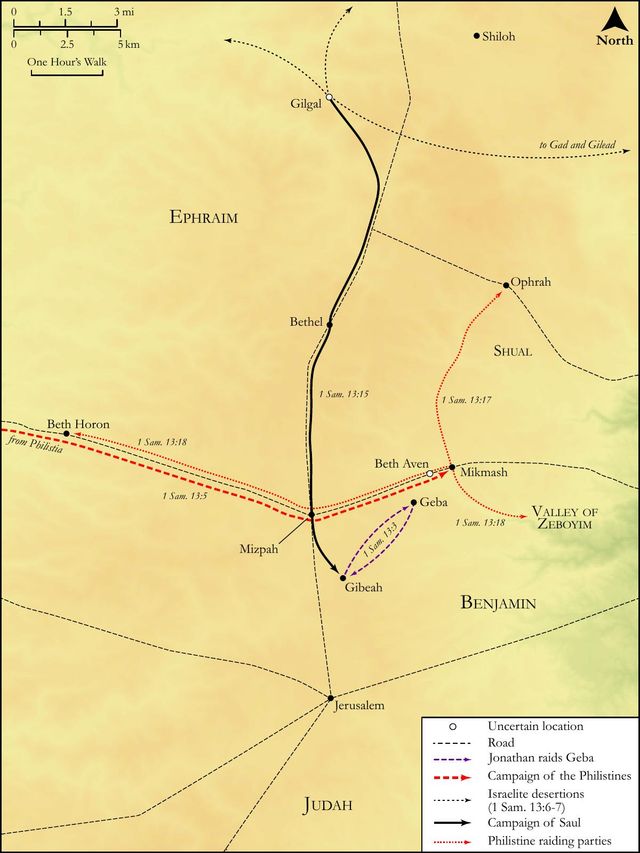
This verse is strategically placed at a critical juncture in the narrative of Saul's kingship, specifically within 1 Samuel 13. The chapter details the escalating conflict with the Philistines, initiated by Jonathan's bold, yet unauthorized, attack on the Philistine garrison at Geba (1 Samuel 13:3). This act provoked a massive Philistine counter-mobilization, described in overwhelming terms in 1 Samuel 13:5. The sheer size and technological superiority of the Philistine army immediately precede 1 Samuel 13:7, explaining the widespread panic and desertion among the Israelite ranks. The verse thus serves as a crucial narrative bridge, illustrating the dire circumstances that would soon prompt Saul's fateful act of offering the burnt offering himself, rather than waiting for Samuel as explicitly commanded in 1 Samuel 10:8. It underscores the pressure-cooker environment that contributed to Saul's disobedience, leading directly to Samuel's pronouncement of his rejection as king in 1 Samuel 13:13-14.
Historical & Cultural Context
The Philistines were a formidable military power on the southwestern coast of Canaan, renowned for their superior iron weaponry and well-organized forces. This technological and tactical advantage gave them a significant edge over the Israelites, who were still largely reliant on bronze and less centralized military structures. This disparity contributed significantly to the Israelites' fear and sense of inferiority. Gilgal, where Saul was stationed, held deep historical and religious significance for Israel. It was the first encampment of Israel after crossing the Jordan into the Promised Land (Joshua 4:19), a place of covenant renewal (Joshua 5:9), and a central gathering point for Samuel (1 Samuel 7:16). For Israelites to flee across the Jordan to Gad and Gilead, regions east of the river, indicates a desperate attempt to escape the immediate Philistine threat and find refuge in less accessible territories, highlighting the extreme nature of their panic and the perceived vulnerability of their homeland.
Key Themes
ShowHideThe verse powerfully illustrates several key themes prevalent in the book of 1 Samuel. Foremost is the theme of fear versus faith, as the Israelites' overwhelming dread leads to desertion and a crisis of confidence in their divinely appointed king and, by extension, in God's deliverance. This fear stands in stark contrast to the steadfastness required for leadership and divine obedience. Another critical theme is leadership under pressure, showcasing Saul's early struggles to maintain control and morale amidst overwhelming odds. His inability to inspire confidence and his subsequent rash decision in 1 Samuel 13:8-12 are directly linked to the desperate situation depicted here. Finally, the verse subtly introduces the theme of divine testing and human failure, as this moment of crisis serves as a crucible for Saul's character, setting the stage for his eventual rejection and the subsequent rise of David, a man after God's own heart (1 Samuel 16:1).
Exposition and Analysis
ShowHideKey Word Analysis
ShowHideThis term (H5680) is a patronymic from Eber, often used by non-Israelites (like the Philistines) or in contexts that emphasize the Israelites' distinct ethnic identity, or sometimes their vulnerable, transient status. Here, its use by the narrator might subtly underscore the perception of the Israelites by themselves or their enemies as a people under duress, highlighting their desperate flight from the heartland and their perceived lack of a stable, secure homeland in the face of Philistine dominance. It emphasizes their identity as a people, rather than a cohesive army, in this moment of disarray.
This Hebrew verb (H2729) is a primitive root meaning "to shudder with terror; hence, to fear; also to hasten (with anxiety)." It conveys a profound sense of fear, anxiety, and agitation. It describes not merely an emotional state but often a physical reaction to terror, suggesting a visible shaking, quivering, or shuddering. The use of this word emphasizes the extreme psychological and physical state of Saul's remaining soldiers, indicating a complete breakdown of morale and military cohesion due to overwhelming dread. Their fear was palpable and incapacitating.
Verse Breakdown
ShowHide"And [some of] the Hebrews went over Jordan to the land of Gad and Gilead."
This clause immediately establishes the dire state of the Israelite forces. The phrase "some of the Hebrews" indicates a significant portion of the army, or at least a visible contingent, was deserting. Their flight "over Jordan to the land of Gad and Gilead" signifies a strategic retreat to the eastern side of the Jordan River, a region perceived as safer and more remote from the Philistine threat in the central highlands. This act of desertion underscores the widespread panic and lack of faith in Saul's leadership or God's imminent deliverance, revealing a people more concerned with self-preservation than national defense or divine promise.
"As for Saul, he [was] yet in Gilgal,"
This phrase highlights Saul's static and increasingly isolated position. "Yet in Gilgal" emphasizes his continued, though precarious, presence at this specific, historically significant location, where he had been explicitly instructed to wait for Samuel. His remaining there, while others flee, sets him apart as the king, but also underscores his vulnerability and the mounting pressure he faced as his forces dwindled. Gilgal becomes a symbol of his predicament and the crucible of his obedience, where his resolve is being severely tested.
"and all the people followed him trembling."
This final clause describes the state of the remaining Israelite soldiers who had not deserted. The phrase "all the people" might be a hyperbole, but it effectively conveys the pervasive fear that had gripped those still loyal to Saul. They were not confident or resolute, but "trembling" (חָרַד, chârad), indicating a deep-seated terror that rendered them ineffective and demoralized. This widespread, paralyzing fear among his immediate followers placed immense psychological pressure on Saul, challenging his ability to lead, inspire, and maintain military readiness.
Literary Devices
ShowHideThe verse employs several literary devices to convey the atmosphere of crisis and despair. Contrast is powerfully evident between the fleeing "Hebrews" who crossed the Jordan and "Saul" and "all the people" who remained, albeit "trembling." This highlights the two primary reactions to the overwhelming Philistine threat: complete desertion versus terrified adherence, both indicative of a profound lack of faith. Imagery is vividly used, with phrases like "went over Jordan" painting a picture of desperate flight and "trembling" viscerally depicting the physical manifestation of fear gripping the remaining soldiers. The use of "all the people" might be considered hyperbole, emphasizing the pervasive and overwhelming nature of the fear rather than a literal headcount, thereby magnifying the sense of national panic and demoralization. Furthermore, the entire scene serves as foreshadowing, hinting at Saul's impending failure of leadership and obedience due to the immense pressure of the situation, which will culminate in his rash and disobedient actions later in the chapter.
Theological and Thematic Connections
ShowHideThis verse profoundly illustrates the destructive power of fear when it overtakes faith, both individually and nationally. The desertion and trembling of the Israelites demonstrate a fundamental lack of trust in God's ability to deliver them from their formidable enemy, despite His past victories for Israel. This human response to overwhelming circumstances sets the stage for a critical test of leadership and obedience, particularly for Saul. The crisis at Gilgal underscores that true security and victory do not come from military might or strategic retreat, but from faithful reliance on God's promises and adherence to His commands. It foreshadows the ongoing tension in Israel's history between human fear and divine sovereignty, a theme that reverberates throughout the Old Testament, emphasizing that God's power is often most visible in human weakness.
Reflection and Application
ShowHideFirst Samuel 13:7 serves as a poignant reminder of the human tendency to succumb to fear when faced with overwhelming odds. The panic and desertion of the Israelites, and the trembling of those who remained, reflect a universal human experience of anxiety and uncertainty in the face of perceived danger. For believers today, this verse challenges us to examine our own responses to life's crises. Do we, like some of the Hebrews, flee to what seems like immediate safety, abandoning our post, our responsibilities, or our principles? Or do we, like those with Saul, remain but are paralyzed by fear, unable to act in faith or courage? The narrative implicitly calls us to cultivate a spirit of steadfast faith and patient obedience, even when circumstances seem dire and God's timing seems delayed. It reminds us that true strength is found not in human might or strategic escape, but in trusting God's sovereign plan and His empowering presence, even when the world around us is trembling and our resources feel inadequate. Our response to fear reveals the depth of our trust in God.
Questions for Reflection
ShowHideFAQ
ShowHideWhy did some of the Hebrews flee across the Jordan to Gad and Gilead?
ShowHideThey fled across the Jordan to Gad and Gilead because these regions, located east of the Jordan River, were perceived as more remote and thus safer from the immediate and overwhelming Philistine military threat in the central Israelite highlands. This desperate move was a direct result of widespread panic and a profound lack of confidence in their ability to withstand the technologically superior and numerically vast Philistine army, as described in 1 Samuel 13:5. It was a strategic retreat born of fear, seeking refuge in less accessible territories, highlighting the extreme demoralization of the Israelite forces.
What is the significance of Saul being "yet in Gilgal"?
ShowHideSaul's continued presence "yet in Gilgal" is highly significant for several reasons. Gilgal was a historically and religiously important site for Israel, serving as a place of national assembly, covenant renewal, and worship (e.g., Joshua 5:9). More immediately, Saul had been explicitly commanded by Samuel to wait for him at Gilgal for seven days to offer sacrifices before engaging in battle (1 Samuel 10:8). Therefore, Saul's presence there highlights his precarious position, caught between a divine command to wait and the immense pressure of a deserting, terrified army. This setting becomes the crucible for his fateful act of disobedience, leading to his rejection as king (1 Samuel 13:13-14), underscoring the severe consequences of impatience and fear-driven decisions.
Christ-Centered Fulfillment
ShowHideWhile 1 Samuel 13:7 paints a stark picture of human fear and leadership under duress, it ultimately points forward to the perfect King, Jesus Christ, who faced the ultimate trial without trembling or fleeing. Unlike Saul, who succumbed to the pressure of a terrified army and disobeyed God's command, Jesus perfectly fulfilled the Father's will, even in the face of overwhelming fear and abandonment. In the Garden of Gethsemane, facing the full weight of God's wrath against sin, Jesus's soul was "overwhelmed with sorrow to the point of death" (Matthew 26:38), yet He did not flee or compromise, but prayed, "not my will, but yours be done" (Luke 22:42). His disciples, much like Saul's army, fled in fear (Matthew 26:56), yet Jesus remained steadfast, becoming the ultimate Lamb of God who takes away the sin of the world. He is the true Shepherd who gathers His sheep, providing perfect security and peace, conquering the fear of death itself through His resurrection (Hebrews 2:14-15). In Christ, we find the leadership that never falters, the courage that never trembles, and the ultimate victory over every enemy, offering a peace that the world cannot give (John 14:27).