


Deuteronomy 3:12
Bible text: King James Version (1769 Blayney text) · Public domain
Bible text: King James Version with Strong's numbers · Public domain
Bible text: Berean Standard Bible · Public domain
Bible text: American Standard Version (1901) · Public domain
Bible text: World English Bible, Messianic edition · Public domain
Bible text: Geneva Bible (1599) · Public domain
Bible text: Young's Literal Translation · Public domain
- וְאֶתve·'Etand <obj.>H853Conj-w ¦ DirObjMParticle Object Indicatorוְandאֶת<obj.>
- הָאָרֶץha·'A·retzthe landH776Art ¦ N-fsNoun Singular Feminine Absoluteהָtheאָרֶץland
- הַזֹּאתha·Zot<the> thisH2063Art ¦ PrtParticle Demonstrativeהַ<the>זֹּאתthis
- יָרַשְׁנוּya·Rash·nuwe took possession ofH3423V-Qal-Perf-1cpVerb Qal Perfect 1st Plural common gender
- בָּעֵתba·'Etat the timeH6256Prep-b ¦ N-csNoun Singular common gender Absoluteבָּat theעֵתtime
- הַהִואha·Hiv'<the> thatH1931Art ¦ Pro-3fsPronoun Personal 3rd Singular Feminineהַ<the>הִואthat
- מֵעֲרֹעֵרme·'a·ro·'Erfrom AroerH6177Prep-m ¦ N-properNoun Proper LocationמֵfromעֲרֹעֵרAroer
- אֲשֶׁר'a·SherwhichH834RelParticle Relative
- עַל'al[was] atH5921PrepPreposition
- נַחַלNa·chal[the] wadi ofH5158N-mscNoun Singular Masculine Construct
- אַרְנֹן'ar·NonArnonH769N-properNoun Proper Location
- וַחֲצִיva·cha·Tziand [the] half ofH2677Conj-w ¦ N-mscNoun Singular Masculine Constructוַandחֲצִי[the] half of
- הַרhar[the] hill country ofH2022N-mscNoun Singular Masculine Construct
- הַגִּלְעָדha·gil·'Ad<the> GileadH1568Art ¦ N-properNoun Proper Locationהַ<the>גִּלְעָדGilead
- וְעָרָיוve·'a·Ravand its citiesH5892Conj-w ¦ N-mpc ¦ 3msNoun Plural Masculine Constructוְandעָרָיcitiesוits
- נָתַתִּיna·Ta·tiI gaveH5414V-Qal-Perf-1csVerb Qal Perfect 1st Singular common gender
- לָרֻאוּבֵנִיla·ru·'u·ve·Nito the Reubenite[s]H7206Prep-l ¦ N-msNoun Gentilic Singular Masculine Absoluteלָto theרֻאוּבֵנִיReubenite[s]
- וְלַגָּדִיve·la·ga·Diand to the Gadite[s]H1425Conj-w ¦ Prep-l ¦ N-msNoun Gentilic Singular Masculine Absoluteוְandלַto theגָּדִיGadite[s]
English is a literal word-by-word gloss of the Hebrew, not the KJV's wording. Why?
This is the original text the KJV's translators worked from — each Hebrew word with its own literal English meaning in this verse, prepared by scholars at Tyndale House, Cambridge. The KJV translates whole sentences, not word by word, so its wording differs: one Hebrew word can become several English words, and the KJV may choose “the LORD” where the gloss reads “Yahweh”. Both are faithful — they answer different questions. For the KJV's own rendering, switch to the KJV text.
Details
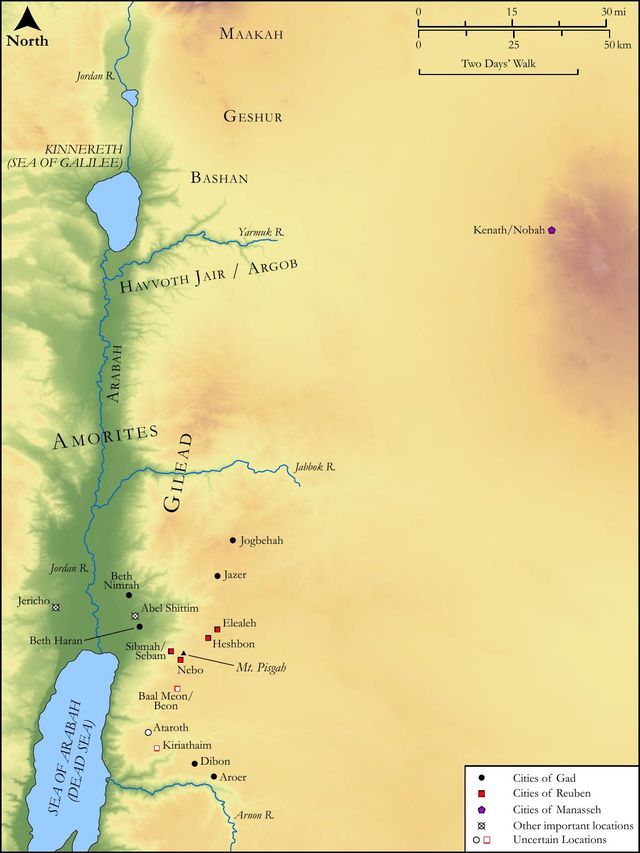
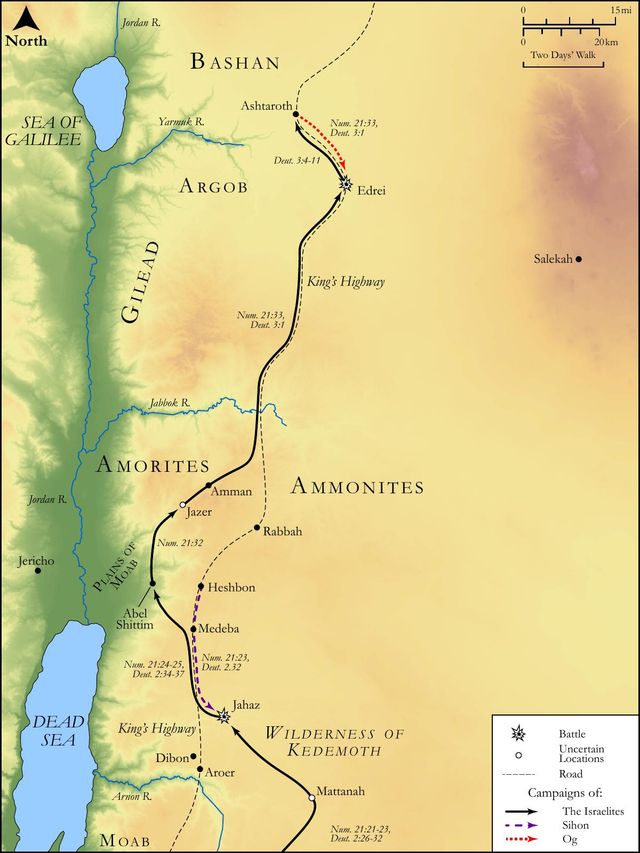
See on the biblical-era maps
Study this verse
Public-domain commentary
Matthew Henry
From his Commentary on the Whole Bible. Henry comments on passages, not single verses — this entry covers Deuteronomy 3:12–20.
Having shown how this country which they were now in was conquered, in these verses he shows how it was settled upon the Reubenites, Gadites, and half the tribe of Manasseh, which we had the story of before, Num. 32. Here is the rehearsal. 1. Moses specifies the particular parts of the country that were allotted to each tribe, especially the distribution of the lot to the half tribe of Manasseh, the subdividing of which tribe is observable. Joseph was divided into Ephraim and Manasseh; Manasseh was divided into one half on the one side Jordan and the other half on the other side: that on the east side Jordan was again divided into two great families, which had their several allotments: Jair, Deu 3:14, Machir, Deu 3:15. And perhaps Jacob's prediction of the smallness of that tribe was now accomplished in these divisions and subdivisions. Observe that Bashan is here called the land of the giants, because it had been in their possession, but Og was the last of them. These giants, it seems, had lost their country, and were rooted out of it sooner than any of their neighbours; for those who, presuming upon their strength and stature, had their hand against every man, had every man's hand against them, and went down slain to the pit, though they were the terror of the mighty in the land of the living. 2. He repeats the condition of the grant which they had already agreed to, Deu 3:18-20. That they should send a strong detachment over Jordan to lead the van in the conquest of Canaan, who should not return to their families, at least not to settle (though for a time they might retire thither into winter quarters, at the end of a campaign), till they had seen their brethren in as full possession of their respective allotments as they themselves were now in of theirs. They must hereby be taught not to look at their own things only, but at the things of others, Phi 2:4. It ill becomes an Israelite to be selfish, and to prefer any private interest before the public welfare. When we are rest we should desire to see our brethren at rest too, and should be ready to do what we can towards it; for we are not born for ourselves, but are members one of another. A good man cannot rejoice much in the comforts of his family unless withal he sees peace upon Israel, Psa 128:6.
Continue studying Deuteronomy 3:12 across the web’s major study libraries — every link below opens this exact verse, chapter, or book on the destination site.
Read & Compare
 BibleGatewayThis verse in more than 200 translations and 70 languages.
 Bible.comThe YouVersion reader — hundreds of translations, reading plans, and highlights.
 ESV.orgCrossway's official English Standard Version reader.
 NET BibleThe NET translation with 60,000+ translators' notes on every rendering decision.
 STEP BibleTyndale House's free study tool — original text, vocabulary, and scholarly resources.
 BibliaLogos Bible Software's free web reader.
 USCCBThe New American Bible (Revised Edition) with the U.S. bishops' study notes.
Commentaries
 BibleHub CommentariesDozens of classic commentaries on this verse, gathered on one page.
 StudyLightMore than 100 commentary sets — the largest collection on the web.
 BibleRefPlain-English commentary on what this verse means, verse by verse.
 Enduring WordDavid Guzik's free commentary on this chapter, widely used by Bible teachers.
 Bible Study ToolsVerse commentary alongside Greek and Hebrew study aids.
Original Language & Research
- BibleHub InterlinearThe verse word by word — original language, transliteration, and English.
- BibleHub LexiconEvery word's original-language definition and Strong's entry.
 Blue Letter BibleDeep-study tools — Strong's numbers, concordance, and word studies.
 SefariaThe Hebrew text with Rashi and centuries of Jewish commentary.
Sermons, Hymns & Audio


TrulyRandomVerse is not affiliated with these sites and doesn’t control their content. They’re linked because they’re genuinely useful.
Summary
Deuteronomy 3:12 precisely details Moses' authoritative allocation of the recently conquered Transjordanian territory to the tribes of Reuben and Gad. This administrative act, defining the boundaries from Aroer by the Arnon River northward through half of Mount Gilead, marked a significant initial fulfillment of God's covenantal promise of land to Israel. It served as a tangible demonstration of divine faithfulness and the commencement of Israel's inheritance, even before their entry into the primary Promised Land west of the Jordan, establishing the foundational territorial claims for these tribes.
Context
ShowHideLiterary Context
Deuteronomy 3:12 is situated within Moses' second major discourse to the Israelite generation poised to enter Canaan, delivered on the plains of Moab. This discourse, spanning Deuteronomy 1 through Deuteronomy 4, functions as a retrospective review of Israel's journey from Horeb to their current location, emphasizing God's steadfast faithfulness and Israel's responses of obedience and disobedience. Specifically, the preceding verses, Deuteronomy 3:1-11, recount the decisive victories over King Sihon of Heshbon and King Og of Bashan, which secured these eastern territories. Verse 12 then logically follows as the administrative consequence of these conquests, demonstrating Moses' divinely appointed role in distributing the spoils and establishing initial tribal boundaries. This act also serves as a precursor to the more extensive land distribution that will occur under Joshua in Joshua 13.
Historical & Cultural Context
The historical setting is critical: Israel stands on the threshold of the Promised Land, having completed forty years of wilderness wandering. The Transjordanian region, east of the Jordan River, was highly valued for its strategic importance and agricultural richness, particularly its suitability for the large livestock holdings characteristic of the Reubenites and Gadites. Their initial request to settle this land, first recorded in Numbers 32:1-5, was driven by these pastoral needs. Moses' subsequent allocation, as described here, was contingent upon their solemn agreement to participate fully in the conquest of the land west of the Jordan, a crucial condition ensuring tribal unity and shared responsibility for fulfilling the divine mandate. The specific geographical markers—Aroer by the Arnon River and Mount Gilead—were well-known and recognized boundaries in the days of Moses, signifying concrete, tangible possession and establishing a clear legal and territorial claim among the nations round about.
Key Themes
ShowHideThis verse powerfully reinforces several foundational themes woven throughout Deuteronomy and the Pentateuch. Firstly, it highlights Divine Provision and Fulfillment, showcasing God's unwavering commitment to His covenant promises, particularly the grant of land to Abraham's descendants, as articulated in passages like Genesis 15:18-21. The immediate inheritance of this territory, even prior to crossing the Jordan, serves as a tangible foretaste and guarantee of the greater inheritance yet to come. Secondly, it underscores Moses' Leadership and Administration, portraying him as a faithful mediator and steward of God's will, meticulously overseeing the distribution of land as a divinely appointed act. This administrative precision reflects God's orderly character and His use of human agents to accomplish His purposes. Thirdly, it initiates the theme of Tribal Inheritance and Identity, as specific territories begin to define the distinct portions and responsibilities of the Israelite tribes, laying the groundwork for the future socio-political and religious structure of the nation. The allocation here sets a precedent for the subsequent divisions under Joshua, emphasizing the importance of each tribe's unique role within the larger covenant community, as seen in Joshua 13.
Exposition and Analysis
ShowHideKey Word Analysis
ShowHideThis verb signifies "to occupy (by driving out previous tenants, and possessing in their place); by implication, to seize, to rob, to inherit." In Deuteronomy 3:12, it emphasizes Israel's active role in taking the land through conquest, yet it implicitly acknowledges that it is God who grants the ability and right to dispossess the previous inhabitants and inherit the territory. It carries the theological weight of receiving an inheritance promised by God, implying both a divine gift and human effort in its acquisition.
This geographical name refers to "Gilad, a region East of the Jordan." Its inclusion here, specifically as "half mount Gilead," denotes a precise division of this significant mountainous region, indicating the northern boundary of the allocated territory for Reuben and Gad, with the other half eventually assigned to the half-tribe of Manasseh (as mentioned in Deuteronomy 3:13). It grounds the narrative in concrete geography, making the inheritance tangible and real.
This primitive root means "to give, used with greatest latitude of application (put, make, etc.)." In this context, it highlights Moses' authoritative role as God's representative in distributing the land. The act of "giving" underscores that the land is not merely seized by force, but is a divinely sanctioned grant, an act of sovereign allocation by God through His chosen leader. It emphasizes the definitive and binding nature of this territorial assignment.
Verse Breakdown
ShowHide"¶ And this land, [which] we possessed at that time"
Moses, speaking collectively on behalf of the Israelite community ("we"), refers to the Transjordanian territory recently secured through decisive military victories over King Sihon and King Og. The phrase "at that time" precisely anchors this administrative act to the immediate aftermath of those conquests, emphasizing the completed nature of the possession and its direct link to God's empowering presence in battle.
"from Aroer, which [is] by the river Arnon"
This clause meticulously defines the southern extent of the newly allocated territory. Aroer was a strategically important city situated on the northern bank of the Arnon River, which served as a significant natural and political boundary in the region. This precise geographical marker highlights the meticulous nature of the land distribution and the clear demarcation of tribal territories, ensuring no ambiguity regarding their southern border.
"and half mount Gilead, and the cities thereof"
This specifies the northern portion of the land assigned to Reuben and Gad. Mount Gilead was a prominent and fertile mountain range and region, and the allocation of "half" of it indicates a deliberate division of this significant territory. The addition of "and the cities thereof" signifies that the grant included not only the rural lands but also the urban centers within this region, granting the tribes full control and ownership of both agricultural and populated areas.
"gave I unto the Reubenites and to the Gadites"
This final clause explicitly states Moses' role as the divinely appointed leader and administrator. The verb "gave" underscores his authority and the definitive, binding nature of the allocation. The recipients are clearly identified as the tribes of Reuben and Gad, acknowledging their specific request for this land and their subsequent commitment to participate in the broader conquest of Canaan, demonstrating a covenantal partnership between the tribes and their leader.
Literary Devices
ShowHideDeuteronomy 3:12 employs several literary devices that enhance its impact and meaning. Geographical Specificity is paramount, with the precise naming of "Aroer," "river Arnon," and "half mount Gilead." This detailed cartography grounds the narrative in historical reality, making the divine promise of land tangible and verifiable. The use of Recapitulation is evident, as Moses is recounting past events to the new generation, reinforcing the historical continuity of God's actions and His faithfulness across generations. The verse also exhibits Administrative Language, reflecting the legal and organizational precision involved in the allocation of territory, which underscores the orderly and just nature of God's dealings with His people. Finally, the narrative employs a subtle but significant Shift in Perspective, moving from the collective "we possessed" (referring to Israel's joint effort in conquest) to the singular "gave I" (referring to Moses' individual, divinely appointed authority in distributing the land). This shift highlights Moses' unique role as the mediator and executor of God's will for the nation.
Theological and Thematic Connections
ShowHideDeuteronomy 3:12 transcends a mere geographical or administrative record; it is a profound theological statement on God's unwavering covenant faithfulness and His active, meticulous involvement in the history of His people. The allocation of this Transjordanian territory, even before the main conquest of Canaan, serves as a powerful "down payment" on God's ancient promise to Abraham that his descendants would inherit the land. It demonstrates that God's word is utterly reliable, and His plans are unfolding precisely as declared, providing a tangible assurance of future fulfillment. This act of giving land also foreshadows the ultimate inheritance God provides for His people, not merely physical territory, but spiritual blessings, eternal rest, and a place in His eternal kingdom. It underscores the profound theological principle that all possession and inheritance, whether material or spiritual, ultimately derive from God's sovereign hand and are granted according to His wise and gracious purposes.
Reflection and Application
ShowHideDeuteronomy 3:12 offers a profound lesson in God's unwavering faithfulness and the nature of His divine provision. Just as God meticulously fulfilled His promise to Israel by giving them a tangible, specific inheritance, He continues to be faithful in providing for His people today, both materially and, more profoundly, spiritually. This verse encourages us to cultivate a deep trust in God's timing and methods, even when the full scope of His promises seems distant or the path unclear. It reminds us that our "inheritance" in Christ is a sure thing, already partially realized through the indwelling of the Holy Spirit and fully guaranteed for eternity. Furthermore, Moses' careful and just administration of the land prompts us to consider our own stewardship of the resources, talents, and opportunities God has entrusted to us. We are called to manage what God has given us with wisdom, integrity, and a view towards His greater redemptive purposes, recognizing that all we possess is ultimately from Him and for His glory.
Questions for Reflection
ShowHideFAQ
ShowHideWhy were the tribes of Reuben and Gad given land east of the Jordan, rather than crossing into Canaan proper?
ShowHideThe tribes of Reuben and Gad (and later, half the tribe of Manasseh) possessed a great number of livestock and recognized that the Transjordanian region, particularly the fertile plains of Gilead and Bashan, was exceptionally well-suited for pasturing their vast flocks. They approached Moses with this request, as detailed in Numbers 32:1-5. Moses initially expressed concern that this arrangement might discourage the other tribes from fully participating in the conquest of the Promised Land west of the Jordan. However, after the Reubenites and Gadites pledged to send their fighting men fully armed across the Jordan to help conquer the land for the other tribes before returning to their own inheritance, Moses granted their request. This pragmatic arrangement ensured tribal unity and shared responsibility in the conquest, even as it accommodated their specific pastoral needs and strategic interests in the rich Transjordanian plains.
What is the significance of "Aroer" and "the river Arnon" being mentioned as boundaries?
ShowHideThe mention of "Aroer, which is by the river Arnon," is highly significant for several reasons. Geographically, the Arnon River was a major natural boundary in the Transjordan region, often serving as a dividing line between different kingdoms (e.g., Moab and the Amorites). Aroer was a city strategically located on the northern bank of this river, making it a prominent landmark. Their inclusion in the description of the allocated land provides precise, verifiable geographical markers that would have been well-understood by the ancient audience. This level of detail underscores the historical accuracy and concrete, tangible nature of the land inheritance described in the biblical narrative. Furthermore, it serves a crucial legal and administrative function, clearly delineating the southern border of the territory given to Reuben and Gad, leaving no ambiguity about their rightful possession and preventing future disputes over territorial claims.
Christ-Centered Fulfillment
ShowHideDeuteronomy 3:12, detailing the initial allocation of a physical land inheritance to specific tribes, finds its ultimate and profound fulfillment in Jesus Christ. The "land" promised to Israel was a type and shadow of the true, spiritual inheritance and eternal rest that God provides for His people. While Israel received a temporal, earthly territory, believers in Christ receive an eternal, heavenly inheritance that is "imperishable, undefiled, and unfading, kept in heaven for you" (1 Peter 1:4). Jesus is the true "possessor" who, through His victory on the cross and resurrection, dispossesses the powers of darkness (Colossians 2:15), not merely from a geographical region, but from the hearts and lives of His people, granting them true freedom, belonging, and spiritual dominion. He is the ultimate fulfillment of God's covenant promises, bringing about the new covenant in His blood, which grants access to a spiritual kingdom and an eternal dwelling place with God Himself (Hebrews 8:6; Hebrews 9:15). Through Christ, we inherit not just a portion of land, but fellowship with God Himself, citizenship in the heavenly Jerusalem (Philippians 3:20; Hebrews 12:22), and co-heirship with Him in God's eternal glory (Romans 8:17). The meticulous division of land in Deuteronomy points forward to the precise and perfect provision of God in Christ, who secures for us an inheritance far greater and more enduring than any earthly territory.