


Deuteronomy 3:13
Bible text: King James Version (1769 Blayney text) · Public domain
Bible text: King James Version with Strong's numbers · Public domain
Bible text: Berean Standard Bible · Public domain
Bible text: American Standard Version (1901) · Public domain
Bible text: World English Bible, Messianic edition · Public domain
Bible text: Geneva Bible (1599) · Public domain
Bible text: Young's Literal Translation · Public domain
- וְיֶתֶרve·Ye·terand [the] remainder ofH3499Conj-w ¦ N-mscNoun Singular Masculine Constructוְandיֶתֶר[the] remainder of
- הַגִּלְעָדha·gil·'Ad<the> GileadH1568Art ¦ N-properNoun Proper Locationהַ<the>גִּלְעָדGilead
- וְכָלve·kholand allH3605Conj-w ¦ N-mscNoun Singular Masculine Constructוְandכָלall
- הַבָּשָׁןha·ba·Shan<the> BashanH1316Art ¦ N-properNoun Proper Locationהַ<the>בָּשָׁןBashan
- מַמְלֶכֶתmam·Le·khet[the] kingdom ofH4467N-fscNoun Singular Feminine Construct
- עוֹגogOgH5747N-proper-mNoun Proper Masculine
- נָתַתִּיna·Ta·tiI gaveH5414V-Qal-Perf-1csVerb Qal Perfect 1st Singular common gender
- לַחֲצִיla·cha·Tzito [the] half ofH2677Prep-l ¦ N-mscNoun Singular Masculine Constructלַtoחֲצִי[the] half of
- שֵׁבֶטShe·vet[the] tribe ofH7626N-mscNoun Singular Masculine Construct
- הַמְנַשֶּׁהham·na·Sheh<the> ManassehH4519Art ¦ N-csNoun Gentilic Singular common gender Absoluteהַ<the>מְנַשֶּׁהManasseh
- כֹּלkolallH3605N-mscNoun Singular Masculine Construct
- חֶבֶלChe·vel[the] region ofH2256N-cscNoun Singular common gender Construct
- הָאַרְגֹּבha·'ar·Go<the> ArgobH709Art ¦ N-properNoun Proper Locationהָ<the>אַרְגֹּבArgob
- לְכָלle·kholto allH3605Prep-l ¦ N-mscNoun Singular Masculine Constructלְtoכָלall
- הַבָּשָׁןha·ba·Shan<the> BashanH1316Art ¦ N-properNoun Proper Locationהַ<the>בָּשָׁןBashan
- הַהוּאha·Hu'<the> itH1931Art ¦ Pro-3msPronoun Personal 3rd Singular Masculineהַ<the>הוּאit
- יִקָּרֵאyi·ka·Re'it was calledH7121V-Niphal-Imperf-3msVerb Niphal Imperfect 3rd Singular Masculine
- אֶרֶץ'E·retz[the] land ofH776N-fscNoun Singular Feminine Construct
- רְפָאִיםre·fa·'Im[the] RephaitesH7497N-mpNoun Gentilic Plural Masculine Absolute
English is a literal word-by-word gloss of the Hebrew, not the KJV's wording. Why?
This is the original text the KJV's translators worked from — each Hebrew word with its own literal English meaning in this verse, prepared by scholars at Tyndale House, Cambridge. The KJV translates whole sentences, not word by word, so its wording differs: one Hebrew word can become several English words, and the KJV may choose “the LORD” where the gloss reads “Yahweh”. Both are faithful — they answer different questions. For the KJV's own rendering, switch to the KJV text.
Details
See on the biblical-era maps
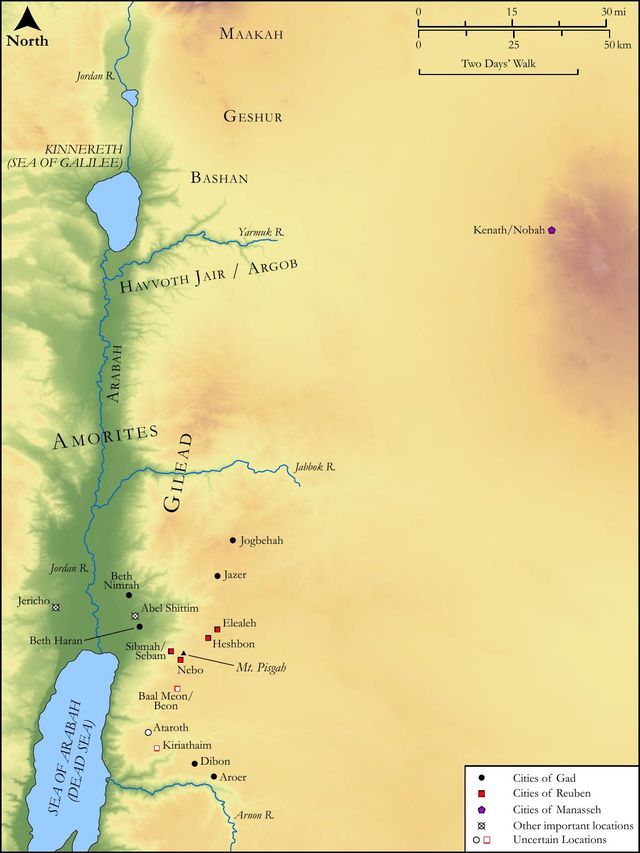
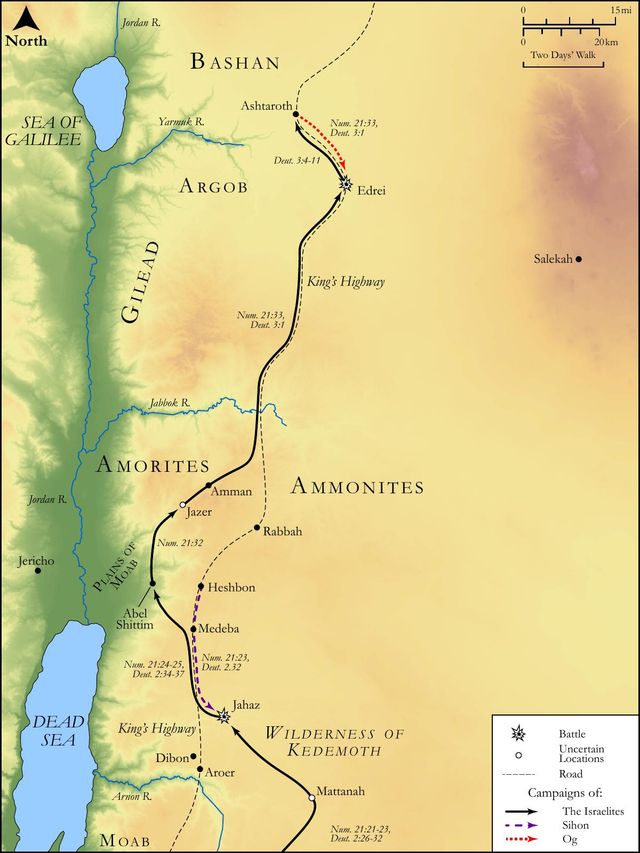
Study this verse
Public-domain commentary
Matthew Henry
From his Commentary on the Whole Bible. Henry comments on passages, not single verses — this entry covers Deuteronomy 3:12–20.
Having shown how this country which they were now in was conquered, in these verses he shows how it was settled upon the Reubenites, Gadites, and half the tribe of Manasseh, which we had the story of before, Num. 32. Here is the rehearsal. 1. Moses specifies the particular parts of the country that were allotted to each tribe, especially the distribution of the lot to the half tribe of Manasseh, the subdividing of which tribe is observable. Joseph was divided into Ephraim and Manasseh; Manasseh was divided into one half on the one side Jordan and the other half on the other side: that on the east side Jordan was again divided into two great families, which had their several allotments: Jair, Deu 3:14, Machir, Deu 3:15. And perhaps Jacob's prediction of the smallness of that tribe was now accomplished in these divisions and subdivisions. Observe that Bashan is here called the land of the giants, because it had been in their possession, but Og was the last of them. These giants, it seems, had lost their country, and were rooted out of it sooner than any of their neighbours; for those who, presuming upon their strength and stature, had their hand against every man, had every man's hand against them, and went down slain to the pit, though they were the terror of the mighty in the land of the living. 2. He repeats the condition of the grant which they had already agreed to, Deu 3:18-20. That they should send a strong detachment over Jordan to lead the van in the conquest of Canaan, who should not return to their families, at least not to settle (though for a time they might retire thither into winter quarters, at the end of a campaign), till they had seen their brethren in as full possession of their respective allotments as they themselves were now in of theirs. They must hereby be taught not to look at their own things only, but at the things of others, Phi 2:4. It ill becomes an Israelite to be selfish, and to prefer any private interest before the public welfare. When we are rest we should desire to see our brethren at rest too, and should be ready to do what we can towards it; for we are not born for ourselves, but are members one of another. A good man cannot rejoice much in the comforts of his family unless withal he sees peace upon Israel, Psa 128:6.
Continue studying Deuteronomy 3:13 across the web’s major study libraries — every link below opens this exact verse, chapter, or book on the destination site.
Read & Compare
 BibleGatewayThis verse in more than 200 translations and 70 languages.
 Bible.comThe YouVersion reader — hundreds of translations, reading plans, and highlights.
 ESV.orgCrossway's official English Standard Version reader.
 NET BibleThe NET translation with 60,000+ translators' notes on every rendering decision.
 STEP BibleTyndale House's free study tool — original text, vocabulary, and scholarly resources.
 BibliaLogos Bible Software's free web reader.
 USCCBThe New American Bible (Revised Edition) with the U.S. bishops' study notes.
Commentaries
 BibleHub CommentariesDozens of classic commentaries on this verse, gathered on one page.
 StudyLightMore than 100 commentary sets — the largest collection on the web.
 BibleRefPlain-English commentary on what this verse means, verse by verse.
 Enduring WordDavid Guzik's free commentary on this chapter, widely used by Bible teachers.
 Bible Study ToolsVerse commentary alongside Greek and Hebrew study aids.
Original Language & Research
- BibleHub InterlinearThe verse word by word — original language, transliteration, and English.
- BibleHub LexiconEvery word's original-language definition and Strong's entry.
 Blue Letter BibleDeep-study tools — Strong's numbers, concordance, and word studies.
 SefariaThe Hebrew text with Rashi and centuries of Jewish commentary.
Sermons, Hymns & Audio


TrulyRandomVerse is not affiliated with these sites and doesn’t control their content. They’re linked because they’re genuinely useful.
Summary
Deuteronomy 3:13 meticulously details Moses' allocation of the conquered territories of Gilead and Bashan, including the region of Argob and the famed "land of giants," to the half-tribe of Manasseh. This verse stands as a profound testament to God's faithful fulfillment of His covenant promises, demonstrating His sovereign power to overcome formidable foes and provide an enduring inheritance for His people, even in the face of seemingly insurmountable obstacles.
Context
ShowHideLiterary Context
This verse is embedded within Moses' third major discourse to the Israelites, delivered on the plains of Moab as they stand poised to enter the Promised Land. Chapters 1-3 serve as a historical review, recounting the journey from Horeb to the current location, emphasizing God's faithfulness and Israel's past victories. Specifically, Deuteronomy 3:13 follows the detailed account of the decisive defeat of Og, the formidable king of Bashan, in Deuteronomy 3:1-11. Moses, acting as God's instrument, is now explaining the practical outcome of these divine victories: the distribution of the newly acquired Transjordanian territories. This allocation to the eastern tribes (Reuben, Gad, and the half-tribe of Manasseh) fulfills the prior agreement made in Numbers 32. The verse thus bridges the narrative of conquest with the theme of inheritance, setting the stage for the subsequent instructions and exhortations regarding life in the land.
Historical & Cultural Context
The setting is the plains of Moab, east of the Jordan River, around 1406 BC, at the conclusion of Israel's forty-year wilderness wandering. The Israelites are about to embark on the conquest of Canaan. The territories of Gilead and Bashan were strategically important and agriculturally rich regions east of the Jordan. Bashan, in particular, was renowned for its fertile pastures, strong cattle, and dense oak forests. Culturally, the mention of "the land of giants" (referring to the Rephaim) is significant. These were ancient, formidable inhabitants of the land, often described as exceptionally large and powerful, whose presence would have instilled terror in ordinary people. Og himself is identified as one of the last of the Rephaim (Deuteronomy 3:11). The conquest of such a land and its king underscored the miraculous nature of Israel's victory, demonstrating that their success was not due to their own strength or military prowess but to the direct intervention and power of Yahweh. The land of Bashan, like every tribal inheritance, was tied to Israel's covenant relationship with God, who had promised the land to Abraham and his seed, making the land a sacred trust.
Key Themes
ShowHideDeuteronomy 3:13 powerfully contributes to several overarching themes within Deuteronomy and the broader Pentateuch. Firstly, it highlights Divine Provision and Inheritance, emphasizing that the land was a gift from God, fulfilling the ancient promises made to Abraham regarding the land (Genesis 12:7). The phrase "gave I unto" underscores God's active role as the ultimate granter of the inheritance. Secondly, the verse reinforces the theme of Conquest of Formidable Foes, particularly through the reference to "the kingdom of Og" and "the land of giants." This emphasizes God's ability to empower His people to overcome seemingly insurmountable obstacles and terrifying adversaries, showcasing His unmatched power. The defeat of Og, a remnant of the Rephaim, as detailed in Deuteronomy 3:1-11, serves as a powerful testament to this theme. Thirdly, it illustrates Orderly Provision and Fulfillment of Covenant, as the precise allocation of land to the half-tribe of Manasseh demonstrates God's meticulous care and the fulfillment of the agreement made with the Transjordanian tribes in Numbers 32. This precision reflects God's faithfulness to His word and His orderly nature in providing for His people.
Exposition and Analysis
ShowHideKey Word Analysis
ShowHideThis term refers to a significant region located east of the Jordan River, characterized by its mountainous terrain and fertile pastures. In this context, "the rest of Gilead" specifically denotes the northern portion of this territory, which was distinct from the southern part already allotted to the tribes of Reuben and Gad. Its inclusion signifies the comprehensive nature of the land acquisition.
A high, fertile plateau region situated northeast of Gilead, Bashan was renowned for its rich agricultural land, strong cattle, and dense oak forests. It was the formidable kingdom ruled by Og, whose defeat was a major victory for Israel. The acquisition of "all Bashan" represented a substantial and valuable addition to Israel's territory.
This term refers to a race of formidable, often exceptionally large people, also known as Rephaim, who inhabited various parts of Canaan and Transjordan. They were frequently depicted as exceptionally tall and powerful, inspiring widespread fear. The identification of Bashan as "the land of giants" underscores the overwhelming odds Israel faced in conquering it, thereby magnifying the miraculous nature of their victory and highlighting God's unparalleled power to defeat even the most intimidating adversaries.
Verse Breakdown
ShowHide"And the rest of Gilead, and all Bashan, [being] the kingdom of Og, gave I unto the half tribe of Manasseh;"
This clause precisely specifies the territories allocated and the recipient tribe. "The rest of Gilead" distinguishes this portion from the southern Gilead given to Reuben and Gad, emphasizing a specific northern division. "All Bashan" highlights the complete conquest and transfer of this significant kingdom. The parenthetical "[being] the kingdom of Og" serves as a powerful identifier, reminding the audience of the formidable power that was utterly overcome. The divine "I" (referring to Moses, acting as God's authorized agent) underscores the ultimate authority and divine mandate behind this land distribution, signifying God's direct and sovereign involvement in providing for His people.
"all the region of Argob, with all Bashan, which was called the land of giants."
This second clause further clarifies the geographical extent of the allocation and reiterates the formidable nature of the conquered land. "All the region of Argob" is a specific district within Bashan, notable for its sixty fortified cities (Deuteronomy 3:4), emphasizing the strategic importance and defensive strength of the conquered territory. The repetition of "all Bashan" reinforces the totality of the conquest and the completeness of the inheritance, leaving no doubt about the extent of the land granted. The concluding phrase, "which was called the land of giants," serves as a powerful descriptor, imbuing the territory with a sense of awe, danger, and divine triumph, thereby magnifying the miraculous nature of Israel's victory and God's power in delivering it into their hands.
Literary Devices
ShowHideDeuteronomy 3:13 employs several literary devices to enhance its impact and convey its theological message. Repetition is prominently featured in the phrase "all Bashan," which appears twice within the verse. This rhetorical device serves to emphasize the completeness of the conquest and the totality of the land given to the half-tribe of Manasseh, underscoring the thoroughness of God's provision. The phrase "the land of giants" functions as a form of hyperbole or emphasis, highlighting the formidable and terrifying nature of the previous inhabitants (the Rephaim) and, by extension, the extraordinary, supernatural power of God who enabled Israel to overcome such adversaries. It evokes a sense of awe and wonder at the divine intervention. Furthermore, "the kingdom of Og" serves as a form of metonymy, where the name of the king stands in for the entire political, military, and territorial power structure of the region, signifying the comprehensive and decisive defeat of a powerful enemy. These devices collectively amplify the message of God's unwavering faithfulness, His unmatched power, and the certainty of His promised inheritance.
Theological and Thematic Connections
ShowHideDeuteronomy 3:13 is a profound theological statement about God's unwavering faithfulness to His covenant promises and His sovereign power over all creation and its inhabitants. The conquest of Og and the "land of giants" was not merely a military victory achieved by human strength; it was a divine act demonstrating unequivocally that no foe, however formidable or terrifying, could stand against the Lord's will for His chosen people. This act of giving land underscores the vital theme of divine provision and inheritance, reminding Israel that their prosperity, security, and very existence in the land were entirely dependent on God's grace and power, not their own might or military prowess. It served as a tangible, undeniable proof of God's steadfast commitment to establish them in the land He had promised to their ancestors, providing an unshakable foundation of trust for the challenges that lay ahead in Canaan.
Reflection and Application
ShowHideDeuteronomy 3:13 offers profound encouragement and practical application for believers today. Just as God empowered Israel to conquer "the land of giants" and inherit their promised portion, so too does He equip and enable us to face the "giants" in our own lives—whether they are overwhelming challenges, persistent sins, spiritual strongholds, daunting circumstances, or seemingly insurmountable obstacles. This verse powerfully reminds us that our true victories are not achieved by our own might, cleverness, or power, but by the Spirit of the Lord working through us. It calls us to cultivate a deep and active trust in God's faithfulness, remembering His past acts of deliverance and provision, both in the grand narrative of Scripture and in our personal experiences, as a solid foundation for our present hope and future confidence. Furthermore, the meticulous and orderly division of the land speaks to God's precise nature and His personal, tender care in providing for each of His children according to His perfect plan. We are invited to step confidently into the spiritual inheritance He has prepared for us in Christ, knowing that He has already secured the ultimate victory through His Son, enabling us to live in the abundance of His grace and fulfill His divine purpose for our lives.
Questions for Reflection
ShowHideFAQ
ShowHideWhy is Bashan being called "the land of giants" so significant?
ShowHideThe designation of Bashan as "the land of giants" (Hebrew: eretz Rephaim) is highly significant because it profoundly emphasizes the formidable nature of the enemy Israel faced and, consequently, the miraculous power of God in their victory. The Rephaim were an ancient race of exceptionally large and powerful people, often associated with a terrifying reputation and immense physical stature. Og, the king of Bashan, was himself described as one of the last of the Rephaim, with an unusually large iron bedstead (Deuteronomy 3:11) serving as a tangible testament to his immense size and strength. By conquering such a land and its king, God demonstrated unequivocally that no human or supernatural power could stand against His sovereign will and purpose for His people. This detail underscores that Israel's success was not due to their military prowess or numerical superiority but to God's direct, supernatural intervention, thereby magnifying His glory and reinforcing the crucial theme of divine faithfulness and provision for His covenant people.
Christ-Centered Fulfillment
ShowHideDeuteronomy 3:13, with its vivid account of conquering the "land of giants" and inheriting the promised territory, finds its ultimate and most profound fulfillment in the person and work of Jesus Christ. The physical conquest of formidable foes like Og and the Rephaim by God's power foreshadows Christ's decisive and ultimate victory over far greater, spiritual adversaries—sin, death, and the demonic powers that held humanity captive. Just as ancient Israel was given an earthly inheritance through God's miraculous power, believers in Christ receive a heavenly and spiritual inheritance, not through their own might or merit, but solely through His finished work on the cross. The land given to the half-tribe of Manasseh was a type and shadow of the true and eternal rest and inheritance that Christ secures for His people, a "promised land" of spiritual blessings and eternal life. Through His death and resurrection, Christ disarmed the principalities and powers, triumphing over them publicly (Colossians 2:15). He is the ultimate conqueror who leads His people into a new covenant reality, where we are blessed with every spiritual blessing in the heavenly places in Him (Ephesians 1:3) and are invited to enter into His eternal rest (Hebrews 4:1-11). The victory over the giants in Bashan powerfully points to the Lamb of God who takes away the sin of the world (John 1:29), securing for us an inheritance that is imperishable, undefiled, and unfading, kept in heaven for us by God's power (1 Peter 1:4).