


Deuteronomy 3:15
Bible text: King James Version (1769 Blayney text) · Public domain
Bible text: Berean Standard Bible · Public domain
Bible text: American Standard Version (1901) · Public domain
Bible text: World English Bible, Messianic edition · Public domain
Bible text: Geneva Bible (1599) · Public domain
Bible text: Young's Literal Translation · Public domain
- וּלְמָכִירu·le·ma·Khirand to MakirH4353Conj-w ¦ Prep-l ¦ N-proper-mNoun Proper MasculineוּandלְtoמָכִירMakir
- נָתַתִּיna·Ta·tiI gaveH5414V-Qal-Perf-1csVerb Qal Perfect 1st Singular common gender
- אֶת'et<obj.>H853DirObjMParticle Object Indicator
- הַגִּלְעָדha·gil·'Ad<the> GileadH1568Art ¦ N-properNoun Proper Locationהַ<the>גִּלְעָדGilead
English is a literal word-by-word gloss of the Hebrew, not the KJV's wording. Why?
This is the original text the KJV's translators worked from — each Hebrew word with its own literal English meaning in this verse, prepared by scholars at Tyndale House, Cambridge. The KJV translates whole sentences, not word by word, so its wording differs: one Hebrew word can become several English words, and the KJV may choose “the LORD” where the gloss reads “Yahweh”. Both are faithful — they answer different questions. For the KJV's own rendering, switch to the KJV text.
Details
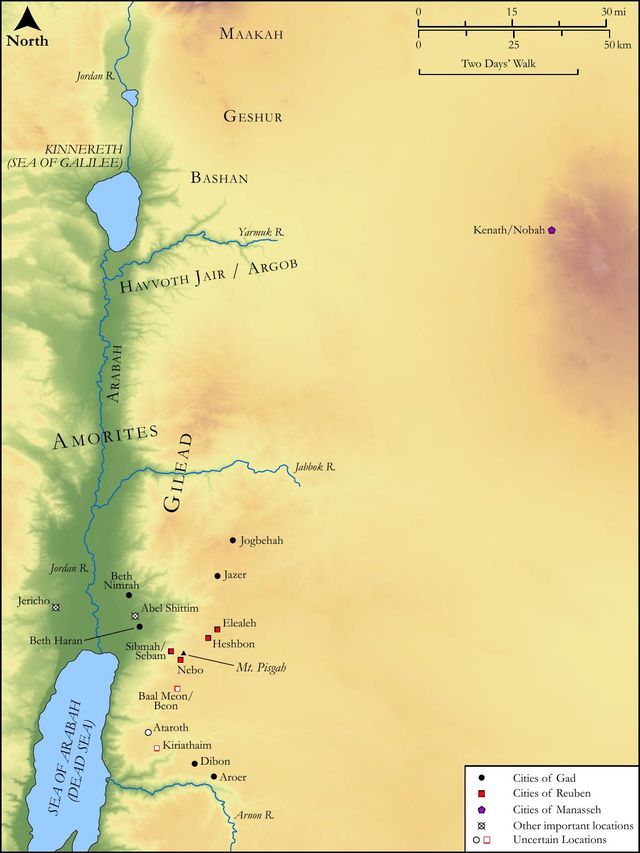
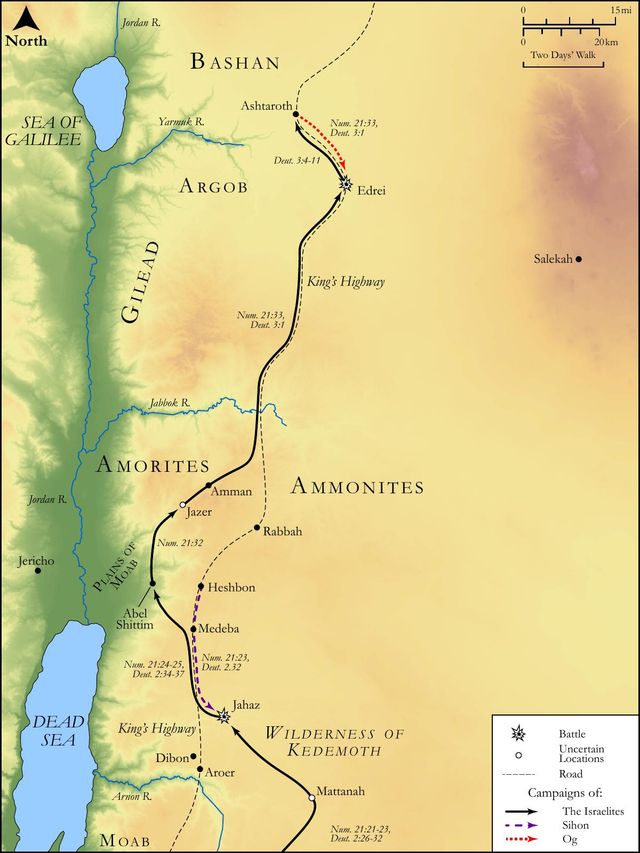
See on the biblical-era maps
Study this verse
Public-domain commentary
Matthew Henry
From his Commentary on the Whole Bible. Henry comments on passages, not single verses — this entry covers Deuteronomy 3:12–20.
Having shown how this country which they were now in was conquered, in these verses he shows how it was settled upon the Reubenites, Gadites, and half the tribe of Manasseh, which we had the story of before, Num. 32. Here is the rehearsal. 1. Moses specifies the particular parts of the country that were allotted to each tribe, especially the distribution of the lot to the half tribe of Manasseh, the subdividing of which tribe is observable. Joseph was divided into Ephraim and Manasseh; Manasseh was divided into one half on the one side Jordan and the other half on the other side: that on the east side Jordan was again divided into two great families, which had their several allotments: Jair, Deu 3:14, Machir, Deu 3:15. And perhaps Jacob's prediction of the smallness of that tribe was now accomplished in these divisions and subdivisions. Observe that Bashan is here called the land of the giants, because it had been in their possession, but Og was the last of them. These giants, it seems, had lost their country, and were rooted out of it sooner than any of their neighbours; for those who, presuming upon their strength and stature, had their hand against every man, had every man's hand against them, and went down slain to the pit, though they were the terror of the mighty in the land of the living. 2. He repeats the condition of the grant which they had already agreed to, Deu 3:18-20. That they should send a strong detachment over Jordan to lead the van in the conquest of Canaan, who should not return to their families, at least not to settle (though for a time they might retire thither into winter quarters, at the end of a campaign), till they had seen their brethren in as full possession of their respective allotments as they themselves were now in of theirs. They must hereby be taught not to look at their own things only, but at the things of others, Phi 2:4. It ill becomes an Israelite to be selfish, and to prefer any private interest before the public welfare. When we are rest we should desire to see our brethren at rest too, and should be ready to do what we can towards it; for we are not born for ourselves, but are members one of another. A good man cannot rejoice much in the comforts of his family unless withal he sees peace upon Israel, Psa 128:6.
Continue studying Deuteronomy 3:15 across the web’s major study libraries — every link below opens this exact verse, chapter, or book on the destination site.
Read & Compare
 BibleGatewayThis verse in more than 200 translations and 70 languages.
 Bible.comThe YouVersion reader — hundreds of translations, reading plans, and highlights.
 ESV.orgCrossway's official English Standard Version reader.
 NET BibleThe NET translation with 60,000+ translators' notes on every rendering decision.
 STEP BibleTyndale House's free study tool — original text, vocabulary, and scholarly resources.
 BibliaLogos Bible Software's free web reader.
 USCCBThe New American Bible (Revised Edition) with the U.S. bishops' study notes.
Commentaries
 BibleHub CommentariesDozens of classic commentaries on this verse, gathered on one page.
 StudyLightMore than 100 commentary sets — the largest collection on the web.
 BibleRefPlain-English commentary on what this verse means, verse by verse.
 Enduring WordDavid Guzik's free commentary on this chapter, widely used by Bible teachers.
 Bible Study ToolsVerse commentary alongside Greek and Hebrew study aids.
Original Language & Research
- BibleHub InterlinearThe verse word by word — original language, transliteration, and English.
- BibleHub LexiconEvery word's original-language definition and Strong's entry.
 Blue Letter BibleDeep-study tools — Strong's numbers, concordance, and word studies.
 SefariaThe Hebrew text with Rashi and centuries of Jewish commentary.
Sermons, Hymns & Audio


TrulyRandomVerse is not affiliated with these sites and doesn’t control their content. They’re linked because they’re genuinely useful.
Summary
Deuteronomy 3:15 succinctly records Moses' direct action in allocating the fertile Transjordanian region of Gilead to the clan of Machir, a prominent lineage within the half-tribe of Manasseh. This specific distribution, occurring after the decisive victories over Sihon and Og, underscores God's unwavering faithfulness in providing an inheritance for His people and Moses' crucial role as the divinely appointed leader in executing this covenant promise, thereby establishing an orderly pattern for the future settlement of the Promised Land.
Context
ShowHideLiterary Context
Deuteronomy 3:15 is embedded within Moses' extensive recollection of Israel's journey from Horeb to the plains of Moab, specifically detailing the conquest and initial division of the Transjordanian territories. Following the decisive defeat of King Sihon of Heshbon, recounted in Deuteronomy 2:26-37, and King Og of Bashan, detailed in Deuteronomy 3:1-11, Moses recounts the allocation of their lands. Verses Deuteronomy 3:12-17 provide the broader context for this distribution, explaining how the land was given to the Reubenites, Gadites, and the half-tribe of Manasseh. Our verse, Deuteronomy 3:15, focuses on a specific portion of that allocation, emphasizing the precise nature of God's provision and Moses' meticulous execution of divine instructions. This narrative serves to reinforce God's power and faithfulness, preparing the Israelites for the greater challenge of conquering Canaan.
Historical & Cultural Context
The period described in Deuteronomy 3:15 places the Israelites on the cusp of entering the Promised Land, having spent forty years in the wilderness. The conquest of the Transjordanian kingdoms of Sihon and Og was a significant military and theological victory, establishing a crucial foothold for Israel. Culturally, land inheritance was paramount, signifying identity, security, and a direct fulfillment of God's covenant promises to Abraham, Isaac, and Jacob. The allocation of land "unto Machir" specifically highlights the patriarchal and clan-based societal structure, where inheritance passed through male lines. Gilead itself was a strategically important and fertile region, known for its rich pastures, which made it particularly attractive to tribes with large livestock holdings, such as Reuben, Gad, and Manasseh, as noted in Numbers 32. The act of Moses distributing the land underscores the authority vested in him by God, functioning as a divinely sanctioned legal and administrative process that validated future claims.
Key Themes
ShowHideDeuteronomy 3:15 contributes to several overarching themes within Deuteronomy and the broader Pentateuch. Primarily, it exemplifies Divine Faithfulness and Covenant Fulfillment, demonstrating God's unwavering commitment to His promise to give Israel a land (e.g., Genesis 12:7). The orderly distribution highlights God's Order and Provision, showcasing that His blessings are not chaotic but meticulously planned and executed through human agents like Moses. It also reinforces the theme of Leadership and Obedience, as Moses faithfully carries out God's instructions for land allocation, serving as a model for the people's future obedience in conquering and settling Canaan. Furthermore, the specific mention of Machir underscores the theme of Tribal Identity and Inheritance, emphasizing the importance of lineage and the communal aspect of Israel's possession of the land, a concept foundational to their national identity as seen throughout Numbers 26.
Exposition and Analysis
ShowHideKey Word Analysis
ShowHideThis term refers to a mountainous, fertile region east of the Jordan River. It was renowned for its rich pastures, forests, and agricultural productivity. Beyond its geographical significance, Gilead also carried historical and cultural weight, often associated with the tribe of Manasseh and later becoming a strategic area in Israel's history (e.g., Judges 10:8). Its allocation to Machir signifies the bestowal of a valuable and productive inheritance, crucial for the sustenance and prosperity of the clan.
Machir was the firstborn son of Manasseh (see Genesis 50:23). He was the progenitor of a significant clan within the tribe of Manasseh, whose descendants were particularly prominent and numerous. The specific mention of Machir, rather than simply "the half-tribe of Manasseh," emphasizes the patriarchal and clan-based nature of Israelite society and land distribution. It highlights that the inheritance was not merely tribal but often delineated by specific family lines within the larger tribal structure, reflecting the detailed and personal nature of God's provision.
The verb "gave" (nâthan) is a common Hebrew verb with a broad semantic range, but in this context, it signifies the authoritative act of bestowing, granting, or assigning. When used in relation to Moses, it implies an act performed under divine mandate. It is not merely a transfer of property but an act of divine provision and covenant fulfillment, executed through God's chosen leader. This verb underscores the source of the land's possession – not by Israel's might alone, but by God's gracious gift and sovereign will.
Verse Breakdown
ShowHide"And I gave Gilead"
This clause highlights Moses' direct agency in the distribution of the land. The "I" refers to Moses, acting as God's appointed representative and mediator of the covenant. The act of "giving" signifies the authoritative and intentional allocation of territory, not a mere taking or seizing. It underscores that the land of Gilead, a valuable and significant region, was specifically designated by divine instruction through Moses, reinforcing the theme of orderly and divinely sanctioned inheritance. This initial phrase establishes Moses' role as the executor of God's promises.
"unto Machir"
This specifies the recipient of the land. Machir, representing a prominent clan of the half-tribe of Manasseh, receives this inheritance. This detail is crucial as it demonstrates the meticulous nature of the land division, extending beyond generic tribal allocations to specific clan designations. It also serves as a historical record, validating the later possession of Gilead by the descendants of Machir and establishing their claim based on Moses' direct action under God's command. This precision reinforces the reliability of the historical account and the fulfillment of God's promises to specific lineages within Israel.
Literary Devices
ShowHideDeuteronomy 3:15, though a concise statement, functions within a larger Historical Narrative that recounts Israel's journey and the initial fulfillment of God's land promise. The verse employs Direct Statement ("And I gave...") to convey Moses' authoritative role and the finality of the land allocation. It is an example of Fulfillment Narrative, where the actions described directly correspond to and fulfill earlier divine promises regarding the land. The specific naming of "Gilead" and "Machir" provides Specificity, grounding the theological truths in concrete geographical and genealogical details, making the account tangible and verifiable for the original audience. This specificity also contributes to the overall Verisimilitude of Moses' address, lending credibility to his recounting of past events and his subsequent exhortations to the new generation of Israelites.
Theological and Thematic Connections
ShowHideDeuteronomy 3:15, while brief, is rich in theological implications, primarily serving as a tangible demonstration of God's unwavering faithfulness to His covenant promises. The precise allocation of Gilead to Machir underscores that God's provision for His people is not vague but specific, orderly, and meticulously planned. It illustrates the principle that God works through human agents, with Moses acting as the divinely authorized administrator of the divine will. This act of giving land establishes a foundational aspect of Israel's identity as a people dwelling in a land given by God, a theme that reverberates throughout their history and shapes their understanding of divine blessing and responsibility. It also highlights the importance of inheritance, not just as property, but as a sign of God's enduring commitment to His chosen people.
Reflection and Application
ShowHideThe seemingly simple declaration in Deuteronomy 3:15, "And I gave Gilead unto Machir," offers profound insights for contemporary believers. It serves as a powerful reminder of God's meticulous care and faithfulness in fulfilling His promises. Just as God precisely allocated land to the tribes of Israel, providing for their physical needs and establishing their identity, He continues to work in our lives with purpose and order. This verse encourages us to trust in God's sovereign provision and His perfect plan, even when our circumstances seem uncertain. It calls us to recognize that our "inheritance" – whether spiritual gifts, opportunities, or even our very lives – are not accidental but are divinely appointed. We are invited to live with gratitude for what God has given us and to steward our "Gilead" – whatever resources, talents, or relationships we possess – for His glory, knowing that He is faithful to His word and brings His intentions to fruition in our lives and in the world.
Questions for Reflection
ShowHideFAQ
ShowHideWhy was Gilead given specifically to Machir, rather than just "the half-tribe of Manasseh"?
ShowHideThe specific mention of Machir, the firstborn son of Manasseh, highlights the patriarchal and clan-based nature of Israelite society and land distribution. While the land was broadly allocated to the "half-tribe of Manasseh" (as seen in Deuteronomy 3:13), Machir's clan was particularly prominent and militarily strong, having played a significant role in conquering the region (see Numbers 32:39-40). Therefore, the land of Gilead became specifically associated with and inherited by the descendants of Machir, emphasizing the detailed and personal nature of God's provision and the validation of their claim within the larger tribal inheritance. This level of detail reinforces the historical accuracy and precision of the biblical record regarding the land allotments.
Does this verse have any prophetic significance for future land divisions?
ShowHideWhile Deuteronomy 3:15 primarily records a historical event of land allocation, it contributes to the broader biblical theme of God's promise of land to Israel. The principle of a divinely appointed inheritance for God's people is a recurring motif throughout Scripture. While this specific verse doesn't directly prophesy future land divisions in the same way that some prophetic books do, it serves as a foundational example of God's faithfulness to His covenant promises regarding the land. It sets a precedent for the orderly and divinely sanctioned distribution of territory, which finds its ultimate spiritual fulfillment in the New Covenant's promise of an eternal inheritance for all believers in Christ, as described in passages like Ephesians 1:11 and 1 Peter 1:4.
What was the strategic importance of Gilead?
ShowHideGilead was a region of significant strategic and economic importance. Geographically, it was a mountainous and fertile area east of the Jordan River, known for its rich pastures, forests, and agricultural productivity, making it ideal for livestock (which was a primary reason the Reubenites, Gadites, and Manasseh's half-tribe desired it, as per Numbers 32:1). Economically, it was famous for its "balm of Gilead," a medicinal resin (Jeremiah 8:22). Militarily, its rugged terrain provided natural defenses, and its control was crucial for securing the eastern frontier of Israel. Throughout Israelite history, Gilead was often a contested region due to its fertility and strategic location, serving as a buffer zone and a vital link to trade routes. Its allocation to Machir ensured a strong Israelite presence in this key area.
Christ-Centered Fulfillment
ShowHideDeuteronomy 3:15, with its declaration of land allocation, finds its ultimate and profound fulfillment in Jesus Christ. The earthly inheritance of Gilead, a tangible promise fulfilled through Moses' hand, foreshadows the far greater spiritual inheritance promised and secured by Christ. Just as the land provided rest and sustenance for Israel, Jesus is our true rest and provider, inviting us into a spiritual inheritance that is "imperishable, undefiled, and unfading, kept in heaven for you" (1 Peter 1:4). The precise and orderly giving of Gilead to Machir points to the meticulous plan of God for our salvation, where Christ, the ultimate "seed" of Abraham, secures a spiritual "land" for all who believe, a new creation and a heavenly kingdom that transcends earthly boundaries (Romans 4:13). Christ is the true "Machir," the firstborn over all creation (Colossians 1:15), through whom all spiritual blessings and the ultimate inheritance are given to God's children (Ephesians 1:3-14). The fulfillment of the land promise in Christ transforms a physical territory into a spiritual reality, where believers are heirs with Christ to the glory of God, experiencing the abundant life and eternal dwelling that the earthly Gilead could only dimly represent.