


Joshua 17:3
Bible text: King James Version (1769 Blayney text) · Public domain
Bible text: King James Version with Strong's numbers · Public domain
Bible text: Berean Standard Bible · Public domain
Bible text: American Standard Version (1901) · Public domain
Bible text: World English Bible, Messianic edition · Public domain
Bible text: Geneva Bible (1599) · Public domain
Bible text: Young's Literal Translation · Public domain
- וְלִצְלָפְחָדve·litz·la·fe·Chadand to ZelophehadH6765Conj-w ¦ Prep-l ¦ N-proper-mNoun Proper MasculineוְandלִtoצְלָפְחָדZelophehad
- בֶּןben[the] son ofH1121N-mscNoun Singular Masculine Construct
- חֵפֶרChe·ferHepherH2660N-proper-mNoun Proper Masculine
- בֶּןben[the] son ofH1121N-mscNoun Singular Masculine Construct
- גִּלְעָדgil·'AdGileadH1568N-proper-mNoun Proper Masculine
- בֶּןben[the] son ofH1121N-mscNoun Singular Masculine Construct
- מָכִירma·KhirMakirH4353N-proper-mNoun Proper Masculine
- בֶּןben[the] son ofH1121N-mscNoun Singular Masculine Construct
- מְנַשֶּׁהme·na·ShehManassehH4519N-proper-mNoun Proper Masculine
- לֹאlo'notH3808NegParticle Negative
- הָיוּHa·yuthey belongedH1961V-Qal-Perf-3cpVerb Qal Perfect 3rd Plural common gender
- לוֹloto <the> himPrep-l ¦ 3msSuffix Personal 3rd Singular Masculineלto <the>וֹhim
- בָּנִיםba·NimsonsH1121N-mpNoun Plural Masculine Absolute
- כִּיkithatH3588PrtParticle Conditional
- אִם'imexceptH518PrtParticle Conditional
- בָּנוֹתba·NotdaughtersH1323N-fpNoun Plural Feminine Absolute
- וְאֵלֶּהve·'E·lehand theseH428Conj-w ¦ PrtParticle Demonstrativeוְandאֵלֶּהthese
- שְׁמוֹתshe·Mot[are] [the] names ofH8034N-fpcNoun Plural Feminine Construct
- בְּנֹתָיוbe·no·Tavhis daughtersH1323N-fpc ¦ 3msNoun Plural Feminine Constructבְּנֹתָיdaughtersוhis
- מַחְלָהmach·LahMahlahH4244N-proper-fNoun Proper Feminine
- וְנֹעָהve·no·'Ahand NoahH5270Conj-w ¦ N-proper-fNoun Proper FeminineוְandנֹעָהNoah
- חָגְלָהcha·ge·LahHoglahH2295N-proper-fNoun Proper Feminine
- מִלְכָּהmil·KahMilcahH4435N-proper-fNoun Proper Feminine
- וְתִרְצָהve·tir·Tzahand TirzahH8656Conj-w ¦ N-proper-fNoun Proper FeminineוְandתִרְצָהTirzah
English is a literal word-by-word gloss of the Hebrew, not the KJV's wording. Why?
This is the original text the KJV's translators worked from — each Hebrew word with its own literal English meaning in this verse, prepared by scholars at Tyndale House, Cambridge. The KJV translates whole sentences, not word by word, so its wording differs: one Hebrew word can become several English words, and the KJV may choose “the LORD” where the gloss reads “Yahweh”. Both are faithful — they answer different questions. For the KJV's own rendering, switch to the KJV text.
Details
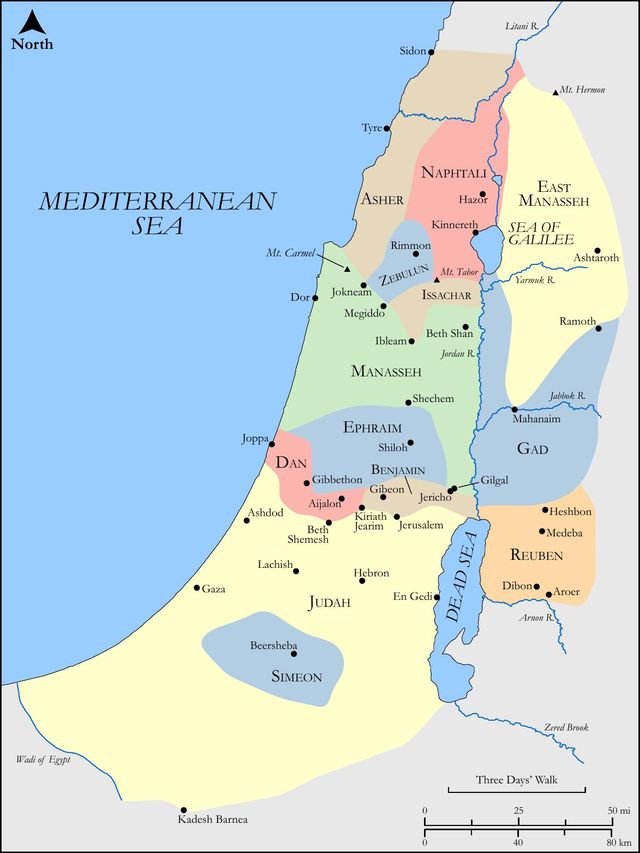
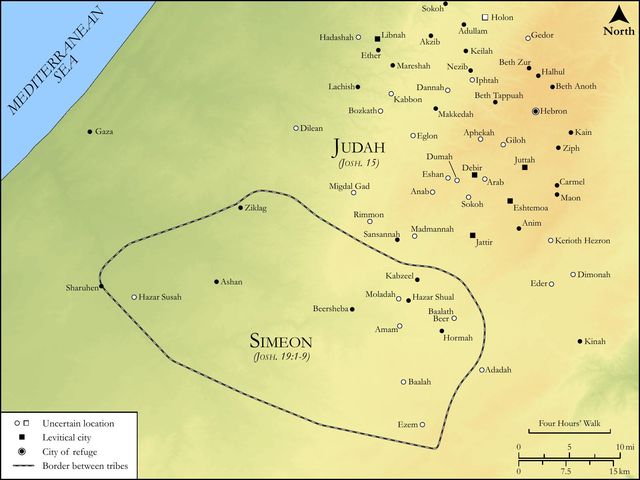
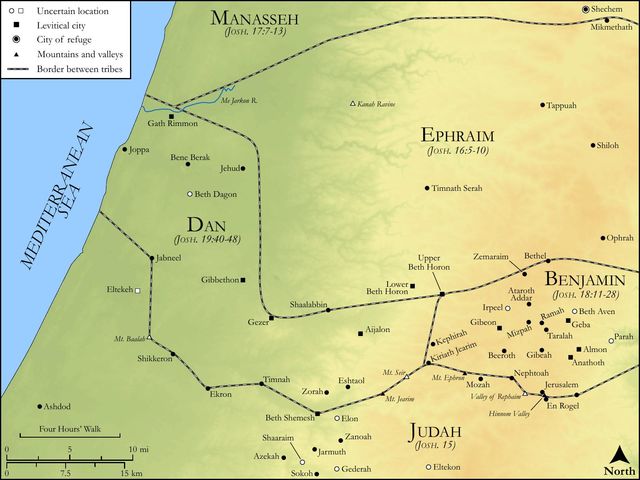
See on the biblical-era maps
Study this verse
Public-domain commentary
Matthew Henry
From his Commentary on the Whole Bible. Henry comments on passages, not single verses — this entry covers Joshua 17:1–6.
Manasseh was itself but one half of the tribe of Joseph, and yet was divided and subdivided. 1. It was divided into two parts, one already settled on the other side Jordan, consisting of those who were the posterity of Machir, Jos 17:1. This Machir was born to Manasseh in Egypt; there he had signalized himself as a man of war, probably in the contests between the Ephraimites and the men of Gath, Ch1 7:21. His warlike disposition descended to his posterity, and therefore Moses gave them Gileaxdand Bashan, on the other side Jordan, of which before, Jos 13:31. It is here said that the lot came to Manasseh, for he was the first-born of Joseph. Bishop Patrick thinks it should be translated, though he was the first-born of Joseph, and then the meaning is plain, that the second lot was for Manasseh, because, though he was the first-born, yet Jacob had preferred Ephraim before him. See the names of those heads of the families that settled on the other side Jordan, Ch1 5:24. 2. That part on this side Jordan as subdivided into ten families, Jos 17:5. There were six sons of Gilead here named (Jos 17:2), the same that are recorded Num 26:30-32, only that he who is there called Jezeer is here called Abiezer. Five of these sons had each of them their portion; the sixth, which was Hepher, had his male line cut off in his son Zelophehad, who left daughters only, five in number, of whom we have often read, and these five had each of them a portion; though perhaps, they claiming under Hepher, all their five portions were but equal to one of the portions of the five sons. Or if Hepher had other sons besides Zelophehad, in whom the name of his family was kept up, their posterity married to the daughters of Zelophehad the elder brother, and in their right had these portions assigned them. See Num 36:12. Here is, (1.) The claim which the daughters of Zelophehad made, grounded upon the command God gave to Moses concerning them, Jos 17:4. They had themselves, when they were young, pleaded their own cause before Moses, and obtained the grant of an inheritance with their brethren, and now they would not lose the benefit of that grant for want of speaking to Joshua, but seasonably put in their demand themselves, as it should seem, and not their husbands for them. (2.) The assignment of their portions according to their claim. Joshua knew very well what God had ordered in their case, and did not object that they having not served in the wars of Canaan there was no reason why they should share in the possessions of Canaan, but readily gave them as inheritance among the brethren of their father. And now they reaped the benefit of their own pious zeal and prudent forecast in this matter. Thus those who take care in the wilderness of this world to make sure to themselves a place in the inheritance of the saints in light will certainly have the comfort of it in the other world, while those that neglect it now will lose it for ever.
Continue studying Joshua 17:3 across the web’s major study libraries — every link below opens this exact verse, chapter, or book on the destination site.
Read & Compare
 BibleGatewayThis verse in more than 200 translations and 70 languages.
 Bible.comThe YouVersion reader — hundreds of translations, reading plans, and highlights.
 ESV.orgCrossway's official English Standard Version reader.
 NET BibleThe NET translation with 60,000+ translators' notes on every rendering decision.
 STEP BibleTyndale House's free study tool — original text, vocabulary, and scholarly resources.
 BibliaLogos Bible Software's free web reader.
 USCCBThe New American Bible (Revised Edition) with the U.S. bishops' study notes.
Commentaries
 BibleHub CommentariesDozens of classic commentaries on this verse, gathered on one page.
 StudyLightMore than 100 commentary sets — the largest collection on the web.
 BibleRefPlain-English commentary on what this verse means, verse by verse.
 Enduring WordDavid Guzik's free commentary on this chapter, widely used by Bible teachers.
 Bible Study ToolsVerse commentary alongside Greek and Hebrew study aids.
Original Language & Research
- BibleHub InterlinearThe verse word by word — original language, transliteration, and English.
- BibleHub LexiconEvery word's original-language definition and Strong's entry.
 Blue Letter BibleDeep-study tools — Strong's numbers, concordance, and word studies.
 SefariaThe Hebrew text with Rashi and centuries of Jewish commentary.
Sermons, Hymns & Audio


TrulyRandomVerse is not affiliated with these sites and doesn’t control their content. They’re linked because they’re genuinely useful.
Summary
Joshua 17:3 meticulously details the lineage of Zelophehad, a descendant of Manasseh, emphasizing his unique family situation: he had no male heirs, only five daughters—Mahlah, Noah, Hoglah, Milcah, and Tirzah. This verse is crucial as it reiterates a divinely established legal precedent from the wilderness wanderings, setting the stage for these women to receive a land inheritance in Canaan. This exceptional provision ensured the continuity of their family's claim within the tribal allotment of Manasseh, safeguarding their legacy despite the absence of sons and highlighting God's faithfulness in upholding justice for His people.
Context
ShowHideLiterary Context
Joshua 17:3 is strategically placed within the larger narrative of the division of the Promised Land among the Israelite tribes, specifically focusing on the allocation to the half-tribe of Manasseh (Joshua 17:1-13). Chapters 13-19 of Joshua systematically record this intricate process, demonstrating the fulfillment of God's covenant promises to Israel. This particular verse serves as a vital interjection, interrupting the general geographical description of Manasseh's territory to recall and affirm a significant legal precedent first established in the book of Numbers. Its inclusion here underscores the meticulousness with which the land was distributed, highlighting not only the general tribal allotments but also specific, divinely mandated exceptions. The verse confirms that the earlier ruling concerning Zelophehad's daughters was indeed being honored and implemented during the actual land allocation, thereby validating God's prior instructions and Moses's judgment.
Historical & Cultural Context
In ancient Israelite society, land inheritance was paramount, serving as the foundation for tribal identity, economic stability, and the fulfillment of God's covenant with Abraham, Isaac, and Jacob. The prevailing patriarchal custom dictated that land passed from father to son, ensuring the continuity of family lines and the integrity of tribal boundaries. This practice was designed to prevent the fragmentation of ancestral holdings and maintain the integrity of the twelve tribal allotments. However, the case of Zelophehad's daughters (first presented in Numbers 27:1-11 and further elaborated in Numbers 36:1-12) was an extraordinary circumstance. Their father had died in the wilderness without sons, and without a divine intervention, their family line would have lost its rightful inheritance in the Promised Land. Their bold petition to Moses led to a groundbreaking divine decree allowing daughters to inherit in the absence of sons, provided they married within their own tribe to prevent tribal land transfer. Joshua 17:3 confirms the practical implementation of this unique, divinely ordained legal precedent during the actual settlement of Canaan.
Key Themes
ShowHideThis verse powerfully contributes to several overarching themes within the books of Joshua and the Pentateuch. Firstly, it highlights God's meticulous justice and unwavering faithfulness in fulfilling His promises to His people, ensuring that no family would be unjustly dispossessed of their rightful inheritance in the land of Canaan. This divine oversight extends even to unique and challenging circumstances. Secondly, it underscores the adaptability and equity of God's law, demonstrating that divine statutes were not rigid or insensitive to individual circumstances but could be applied with compassion and fairness, even when challenging established social norms. The case of Zelophehad's daughters exemplifies how God's law provided for the vulnerable and upheld the dignity of all His people, as seen in the divine response to their plea in Numbers 27:6-7. Lastly, it subtly emphasizes the agency and significance of women in ancient Israelite society, particularly in matters of legal standing and property rights. Their proactive petition and the subsequent divine affirmation reveal a remarkable recognition of their rights and a divine willingness to respond to their legitimate claims, ensuring their inclusion in the covenant blessings of the land, a principle echoed in God's care for the lowly throughout scripture (e.g., Deuteronomy 10:18).
Exposition and Analysis
ShowHideKey Word Analysis
ShowHideWhile the precise etymology is debated, possibly meaning "first-born rupture" or "shadow of fear," the significance of Zelophehad here is less about his name's meaning and more about his status as a man who died without male heirs. His lack of sons directly precipitated the legal crisis that led to the groundbreaking divine ruling on female inheritance, making him a pivotal figure in the narrative of land distribution and a symbol of the unique circumstances God addresses.
Derived from a root meaning "to build," referring to a son as a builder or perpetuator of the family name and lineage. The repeated mention of "son" in the genealogy (e.g., "the son of Hepher, the son of Gilead") emphasizes the traditional patriarchal line of inheritance. The subsequent declaration that Zelophehad "had no sons" highlights the critical absence of this traditional means of inheritance, setting the stage for the exceptional divine provision for his daughters.
The feminine form of bên, this term refers to a female offspring. The explicit mention of "daughters" as Zelophehad's sole offspring is crucial because it directly contrasts with the expectation of sons for inheritance. Their presence, in the absence of male heirs, highlights the exceptional nature of their claim and the divine intervention required to secure their inheritance, given so that their father's name would not be lost (Numbers 27:4).
Verse Breakdown
ShowHide"But Zelophehad, the son of Hepher, the son of Gilead, the son of Machir, the son of Manasseh, had no sons, but daughters:"
This opening clause meticulously traces Zelophehad's lineage through five generations back to Manasseh, solidifying his tribal identity and legitimate claim to an inheritance within Manasseh's allotment. This genealogical precision is not merely descriptive but legally foundational, establishing the family's right to a portion of the land. The emphatic statement "had no sons, but daughters" immediately highlights the unique and challenging circumstance that necessitated a deviation from the standard inheritance laws, setting the stage for the exceptional divine decree that would follow. It emphasizes the critical void in male heirs that prompted the daughters' extraordinary petition.
"and these [are] the names of his daughters, Mahlah, and Noah, Hoglah, Milcah, and Tirzah."
The specific naming of all five daughters underscores the personal nature of their case and the divine attention given to their petition. This detailed enumeration serves as a legal and historical record, confirming their identity as the rightful beneficiaries of the unique inheritance ruling. By listing their individual names, the text emphasizes their collective agency and the fact that their claim was not merely theoretical but applied to specific, known individuals who would now receive their portion in the Promised Land, a testament to God's precise and personal care.
Literary Devices
ShowHideThe primary literary device employed in Joshua 17:3 is Genealogy, which serves as a foundational element for establishing legitimacy and tribal connection. The detailed tracing of Zelophehad's lineage back to Manasseh is not merely informative but legally crucial, reinforcing his family's rightful claim to a portion of the land. This meticulous listing underscores the importance of tribal identity and inheritance within ancient Israel. The verse also functions as a form of Recapitulation or Allusion, recalling and re-affirming the divine ruling previously given in Numbers 27 and Numbers 36. By reiterating the specific circumstance (no sons, only daughters) and naming the daughters again, the text emphasizes the enduring importance and validity of this precedent as it is now being practically applied in the land distribution. This repetition ensures that the reader understands the historical and legal weight behind this unique exception to the standard inheritance laws, highlighting God's consistent justice.
Theological and Thematic Connections
ShowHideJoshua 17:3 serves as a powerful reminder of God's character as a just and compassionate lawgiver who provides for the vulnerable and ensures equity within His covenant community. The inclusion of Zelophehad's daughters' case here, as the land is being physically divided, demonstrates the practical application of divine justice and the flexibility of God's law to address unforeseen circumstances. It highlights that God's ordinances are not merely abstract principles but are designed to secure the well-being and inheritance of all His people, even when it requires adjusting established social norms. This narrative underscores the truth that God hears the petitions of His people and responds with wisdom and fairness, upholding the dignity and rights of individuals within the broader community, ensuring that no one is dispossessed of their rightful blessing.
Reflection and Application
ShowHideThe story of Zelophehad's daughters, brought to the forefront again in Joshua 17:3, offers profound lessons for contemporary believers. It challenges us to consider how we uphold justice and equity within our own communities, especially for those who might be overlooked or whose circumstances fall outside traditional norms. This narrative encourages us to advocate for fairness, knowing that God Himself is a God who hears the cries of the vulnerable and provides just solutions. It reminds us that God's wisdom is not rigid but adaptable, always seeking the flourishing of His people. We are called to embody this divine compassion, ensuring that our structures and practices reflect God's heart for justice and inclusion. Furthermore, it inspires us to boldly bring our unique circumstances and petitions before God, trusting that He is attentive to our needs and capable of providing pathways that honor His covenant promises, even when those pathways are unconventional.
Questions for Reflection
ShowHideFAQ
ShowHideWhat was the significance of Zelophehad having no sons?
ShowHideIn ancient Israelite society, land inheritance typically passed through the male line to ensure the continuity of family names and the preservation of tribal land allotments. Zelophehad's death without male heirs presented a unique legal dilemma: without a son to inherit, his family's portion of the Promised Land would have been lost to his lineage and absorbed into another family's or tribal holding. This situation prompted his daughters to petition Moses for their right to inherit, leading to a groundbreaking divine ruling that allowed daughters to inherit when there were no sons. This ruling, however, came with a stipulation: they had to marry within their own tribe to keep the land within the tribal boundaries of Manasseh, as detailed in Numbers 27 and further elaborated in Numbers 36. The significance lies in God's equitable intervention to ensure justice and prevent the dispossession of a family line.
Christ-Centered Fulfillment
ShowHideThe story of Zelophehad's daughters, reiterated in Joshua 17:3, powerfully foreshadows the universal reach and just reordering of inheritance found in Christ. In a world where earthly inheritance was often bound by lineage, gender, and social status, Jesus Christ redefines true inheritance through faith, not bloodline. He is the ultimate "heir of all things" (Hebrews 1:2), and through Him, all believers, regardless of their earthly standing or gender, become "heirs of God, and joint-heirs with Christ" (Romans 8:17). Just as God's law provided a way for Zelophehad's daughters to receive their earthly inheritance, Christ opens the way for all who believe to receive an imperishable, undefiled, and unfading heavenly inheritance (1 Peter 1:4). The divine responsiveness to the daughters' plea for justice points forward to the perfect justice and compassion embodied in Christ, who broke down all barriers—including those between Jew and Gentile, male and female—so that all might be "one in Christ Jesus" and "heirs according to the promise" (Galatians 3:28-29). Their story is a testament to God's heart for inclusion and equity, fully realized in the new covenant where spiritual inheritance is universally offered through the finished work of the Lamb of God who takes away the sin of the world.