


Joshua 17:4
- וַתִּקְרַבְנָהva·tik·Rav·nahand they drew nearH7126Conj-w ¦ V-Qal-ConsecImperf-3fpVerb Qal Consecutive Imperfect 3rd Plural Feminineוַandתִּקְרַבְנָהthey drew near
- לִפְנֵיlif·Nei<to> beforeH6440Prep-l ¦ N-mpcNoun Plural Masculine Constructלִ<to>פְנֵיbefore
- אֶלְעָזָר'el·'a·ZarEleazarH499N-proper-mNoun Proper Masculine
- הַכֹּהֵןha·ko·Henthe priestH3548Art ¦ N-msNoun Singular Masculine Absoluteהַtheכֹּהֵןpriest
- וְלִפְנֵיve·lif·Neiand <to> beforeH6440Conj-w ¦ Prep-l ¦ N-mpcNoun Plural Masculine Constructוְandלִ<to>פְנֵיbefore
- יְהוֹשֻׁעַye·ho·Shu·a'JoshuaH3091N-proper-mNoun Proper Masculine
- בִּןbin[the] son ofH1121N-mscNoun Singular Masculine Construct
- נוּןNunNunH5126N-proper-mNoun Proper Masculine
- וְלִפְנֵיve·lif·Neiand <to> beforeH6440Conj-w ¦ Prep-l ¦ N-mpcNoun Plural Masculine Constructוְandלִ<to>פְנֵיbefore
- הַנְּשִׂיאִיםha·ne·si·'Imthe leadersH5387Art ¦ N-mpNoun Plural Masculine Absoluteהַtheנְּשִׂיאִיםleaders
- לֵאמֹרle·Mor<to> sayingH559Prep-l ¦ V-Qal-InfVerb Qal Infinitive Constructלֵ<to>אמֹרsaying
- יְהוָהYah·wehYahwehH3068N-properNoun Proper Title
- צִוָּהtzi·Vahhe commandedH6680V-Piel-Perf-3msVerb Piel Perfect 3rd Singular Masculine
- אֶת'et<obj.>H853DirObjMParticle Object Indicator
- מֹשֶׁהmo·ShehMosesH4872N-proper-mNoun Proper Masculine
- לָתֶתla·tetto giveH5414Prep-l ¦ V-Qal-InfVerb Qal Infinitive Constructלָtoתֶתgive
- לָנוּLa·nuto <the> usPrep-l ¦ 1cpSuffix Personal 1st Plural common genderלָto <the>נוּus
- נַחֲלָהna·cha·Lahan inheritanceH5159N-fsNoun Singular Feminine Absolute
- בְּתוֹךְbe·Tokhin amongH8432Prep-b ¦ N-mscNoun Singular Masculine Constructבְּinתוֹךְamong
- אַחֵינוּ'a·Chei·nuour brothersH251N-mpc ¦ 1cpNoun Plural Masculine Constructאַחֵיbrothersנוּour
- וַיִּתֵּןvai·yi·Tenand he gaveH5414Conj-w ¦ V-Qal-ConsecImperf-3msVerb Qal Consecutive Imperfect 3rd Singular Masculineוַandיִּתֵּןhe gave
- לָהֶםla·Hemto <the> themPrep-l ¦ 3mpSuffix Personal 3rd Plural Masculineלָto <the>הֶםthem
- אֶל'eltoH413PrepPreposition
- פִּיpi[the] mouth ofH6310N-mscNoun Singular Masculine Construct
- יְהוָהYah·wehYahwehH3068N-properNoun Proper Title
- נַחֲלָהna·cha·Lahan inheritanceH5159N-fsNoun Singular Feminine Absolute
- בְּתוֹךְbe·Tokhin amongH8432Prep-b ¦ N-mscNoun Singular Masculine Constructבְּinתוֹךְamong
- אֲחֵי'a·Chei[the] brothers ofH251N-mpcNoun Plural Masculine Construct
- אֲבִיהֶן'a·vi·Hentheir fatherH1N-msc ¦ 3fpNoun Singular Masculine Constructאֲבִיfatherהֶןtheir
English is a literal word-by-word gloss of the Hebrew, not the KJV's wording. Why?
This is the original text the KJV's translators worked from — each Hebrew word with its own literal English meaning in this verse, prepared by scholars at Tyndale House, Cambridge. The KJV translates whole sentences, not word by word, so its wording differs: one Hebrew word can become several English words, and the KJV may choose “the LORD” where the gloss reads “Yahweh”. Both are faithful — they answer different questions. For the KJV's own rendering, switch to the KJV text.
Details
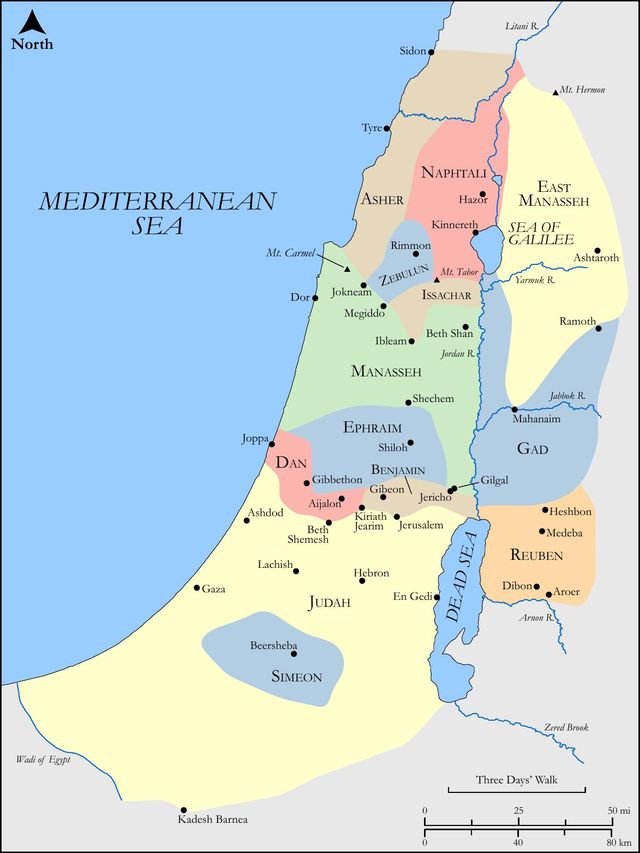
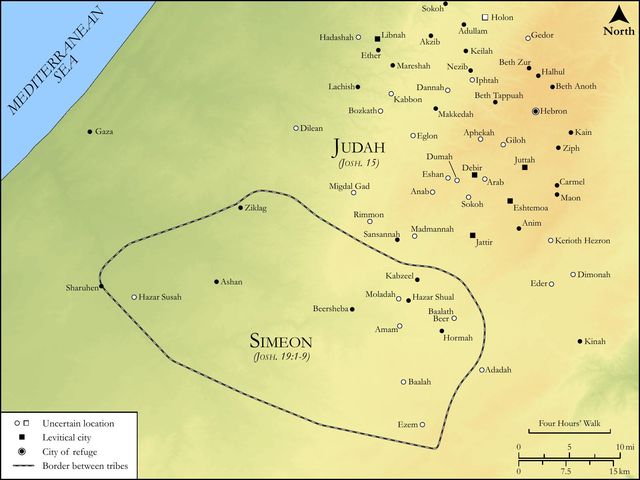
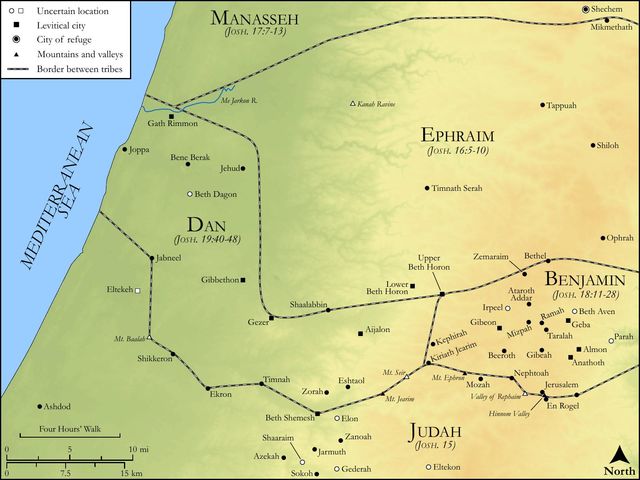
See on the biblical-era maps
Study this verse
Public-domain commentary
Matthew Henry
From his Commentary on the Whole Bible. Henry comments on passages, not single verses — this entry covers Joshua 17:1–6.
Manasseh was itself but one half of the tribe of Joseph, and yet was divided and subdivided. 1. It was divided into two parts, one already settled on the other side Jordan, consisting of those who were the posterity of Machir, Jos 17:1. This Machir was born to Manasseh in Egypt; there he had signalized himself as a man of war, probably in the contests between the Ephraimites and the men of Gath, Ch1 7:21. His warlike disposition descended to his posterity, and therefore Moses gave them Gileaxdand Bashan, on the other side Jordan, of which before, Jos 13:31. It is here said that the lot came to Manasseh, for he was the first-born of Joseph. Bishop Patrick thinks it should be translated, though he was the first-born of Joseph, and then the meaning is plain, that the second lot was for Manasseh, because, though he was the first-born, yet Jacob had preferred Ephraim before him. See the names of those heads of the families that settled on the other side Jordan, Ch1 5:24. 2. That part on this side Jordan as subdivided into ten families, Jos 17:5. There were six sons of Gilead here named (Jos 17:2), the same that are recorded Num 26:30-32, only that he who is there called Jezeer is here called Abiezer. Five of these sons had each of them their portion; the sixth, which was Hepher, had his male line cut off in his son Zelophehad, who left daughters only, five in number, of whom we have often read, and these five had each of them a portion; though perhaps, they claiming under Hepher, all their five portions were but equal to one of the portions of the five sons. Or if Hepher had other sons besides Zelophehad, in whom the name of his family was kept up, their posterity married to the daughters of Zelophehad the elder brother, and in their right had these portions assigned them. See Num 36:12. Here is, (1.) The claim which the daughters of Zelophehad made, grounded upon the command God gave to Moses concerning them, Jos 17:4. They had themselves, when they were young, pleaded their own cause before Moses, and obtained the grant of an inheritance with their brethren, and now they would not lose the benefit of that grant for want of speaking to Joshua, but seasonably put in their demand themselves, as it should seem, and not their husbands for them. (2.) The assignment of their portions according to their claim. Joshua knew very well what God had ordered in their case, and did not object that they having not served in the wars of Canaan there was no reason why they should share in the possessions of Canaan, but readily gave them as inheritance among the brethren of their father. And now they reaped the benefit of their own pious zeal and prudent forecast in this matter. Thus those who take care in the wilderness of this world to make sure to themselves a place in the inheritance of the saints in light will certainly have the comfort of it in the other world, while those that neglect it now will lose it for ever.
Continue studying Joshua 17:4 across the web’s major study libraries — every link below opens this exact verse, chapter, or book on the destination site.
Read & Compare
 BibleGatewayThis verse in more than 200 translations and 70 languages.
 Bible.comThe YouVersion reader — hundreds of translations, reading plans, and highlights.
 ESV.orgCrossway's official English Standard Version reader.
 NET BibleThe NET translation with 60,000+ translators' notes on every rendering decision.
 STEP BibleTyndale House's free study tool — original text, vocabulary, and scholarly resources.
 BibliaLogos Bible Software's free web reader.
 USCCBThe New American Bible (Revised Edition) with the U.S. bishops' study notes.
Commentaries
 BibleHub CommentariesDozens of classic commentaries on this verse, gathered on one page.
 StudyLightMore than 100 commentary sets — the largest collection on the web.
 BibleRefPlain-English commentary on what this verse means, verse by verse.
 Enduring WordDavid Guzik's free commentary on this chapter, widely used by Bible teachers.
 Bible Study ToolsVerse commentary alongside Greek and Hebrew study aids.
Original Language & Research
- BibleHub InterlinearThe verse word by word — original language, transliteration, and English.
- BibleHub LexiconEvery word's original-language definition and Strong's entry.
 Blue Letter BibleDeep-study tools — Strong's numbers, concordance, and word studies.
 SefariaThe Hebrew text with Rashi and centuries of Jewish commentary.
Sermons, Hymns & Audio


TrulyRandomVerse is not affiliated with these sites and doesn’t control their content. They’re linked because they’re genuinely useful.
Summary
Joshua 17:4 narrates the crucial moment when the five daughters of Zelophehad formally presented their case to Eleazar the priest, Joshua the son of Nun, and the tribal princes. Their appeal was firmly rooted in a divine command previously given to Moses, which mandated that families without male heirs should still receive their rightful portion of the Promised Land. This verse powerfully underscores the faithful and meticulous execution of God's specific instructions by Israel's leadership, demonstrating both divine justice and the unwavering fulfillment of covenant promises during the intricate process of land distribution in Canaan.
Context
ShowHideLiterary Context
Joshua 17:4 is strategically placed within the larger narrative of Israel's conquest and, more specifically, the detailed division of the land of Canaan among the tribes, particularly focusing on the inheritance of Manasseh (Joshua 17:1-13). This chapter follows the foundational principles of land allocation established earlier, notably in Joshua 14, which sets the stage for the meticulous distribution process. The verse specifically recounts the fulfillment of a unique legal precedent concerning the five daughters of Zelophehad (Mahlah, Noah, Hoglah, Milcah, and Tirzah), who, having no brothers, faced the prospect of their family line losing its inheritance. Their initial, groundbreaking plea in a patriarchal society was brought before Moses, Eleazar, and the congregation's leaders in the wilderness, a pivotal event meticulously documented in Numbers 27:1-11. Joshua 17:4 thus serves as a powerful testament to the continuity of divine decree and the leaders' steadfast obedience, decades after the initial command, underscoring the unwavering nature of God's word and its faithful execution under Joshua's leadership during the land distribution.
Historical & Cultural Context
In the ancient Near East, including Israel, land inheritance was overwhelmingly patrilineal. Property and family identity were inextricably linked to the male line, ensuring the perpetuation of the family name and its economic and social standing. To lose one's land was to lose one's place, security, and future within the community. The case of Zelophehad's daughters, therefore, presented a profound challenge to these deeply ingrained societal norms. Their father had died in the wilderness without sons, leaving them vulnerable to the loss of their family's portion of the promised inheritance. God's ruling, delivered through Moses, which granted them the right to inherit, was revolutionary. It demonstrated a divine concern for justice and the preservation of family lines that transcended conventional societal structures, ensuring that no family's covenant land portion would be lost simply due to the absence of male heirs. This reflects God's equitable nature and His unwavering commitment to the holistic well-being of all His people, regardless of gender.
Key Themes
ShowHideThis verse powerfully encapsulates several foundational themes central to the book of Joshua and the broader Pentateuch. Firstly, it highlights Divine Command and Faithfulness, explicitly stating, "The LORD commanded Moses to give us an inheritance." This reiterates that the entire land distribution was not an arbitrary human decision but a direct fulfillment of God's specific, long-standing instructions given years prior, as detailed in Numbers 27. Joshua and Eleazar's actions demonstrate exemplary faithfulness in upholding this divine commandment, even decades after its initial pronouncement. Secondly, the passage champions Justice and Women's Inheritance Rights. In a deeply patriarchal society, this case stands as a groundbreaking example of divine justice ensuring that women, in the absence of male heirs, could inherit property. This precedent ensured that family lines and their portions of the Promised Land would not be lost, reflecting God's profound concern for the vulnerable and for equitable distribution within the covenant community. Finally, it underscores Leadership and Adherence to Law. Joshua and Eleazar, as the primary spiritual and civil leaders, are depicted as diligently applying established laws and divine precedents. Their role was not merely to conquer but to fairly administer God's covenant promises, demonstrating righteous governance in the allocation of tribal territories, as seen throughout Joshua 14-19.
Exposition and Analysis
ShowHideKey Word Analysis
ShowHideThe Hebrew verb צָוָה (H6680, tsâvâh) signifies a strong, authoritative directive, an imperative that carries the full weight of the one giving the command. Its use here emphasizes that the decision regarding the daughters' inheritance was not a human invention or a matter of negotiation, but a direct, binding divine imperative from Yahweh Himself. This word underscores the absolute authority behind the land distribution and the leaders' solemn obligation to obey.
The Hebrew noun נַחֲלָה (H5159, nachălâh) is central to the theological framework of the book of Joshua. It refers to an allotted portion of land, a permanent, divinely-given possession that secures a family's future, identity, and place within the covenant community. More than just property, nachălâh represents the tangible fulfillment of God's promise to Abraham, Isaac, and Jacob, signifying rest, security, and the concrete manifestation of God's faithfulness to His people.
The Hebrew word אָב (H1, ʼâb) denotes a father, often in a literal sense, but also figuratively referring to a progenitor or head of a family. In the context of inheritance, the father's role was paramount as the one through whom the family's portion of land was typically passed down. The absence of a male ʼâb (father) to continue the line and hold the land was the precise issue that Zelophehad's daughters sought to address, which God's ruling resolved by giving them an inheritance "among the brethren of their father" (17:4).
Verse Breakdown
ShowHide"And they came near before Eleazar the priest, and before Joshua the son of Nun, and before the princes"
"They" refers to the five courageous daughters of Zelophehad (Mahlah, Noah, Hoglah, Milcah, and Tirzah), whose names are explicitly stated in Numbers 27:1 and reiterated in Joshua 17:3. Their approach to Eleazar (the high priest, representing spiritual authority), Joshua (the military and civil leader, Moses' successor), and "the princes" (representatives of the tribes and heads of families) signifies a formal, public, and legitimate appeal to the highest established authorities in Israel. This demonstrates their courage, their understanding of due process, and the legitimacy of their claim, seeking justice through the divinely ordained channels of leadership.
"saying, The LORD commanded Moses to give us an inheritance among our brethren"
This pivotal clause reveals the unshakeable foundation of their bold claim: not a plea for mercy or a special favor, but a demand for the fulfillment of a direct, previously issued divine command. They are asserting a divinely ordained right, established by Yahweh Himself through Moses. The phrase "among our brethren" is crucial, indicating their desire for a full, integrated, and undiminished portion of the tribal land, not a separate or lesser allocation. This ensured their family's continuity and full integration within the larger clan of Manasseh, preserving their identity and legacy.
"Therefore according to the commandment of the LORD he gave them an inheritance among the brethren of their father"
This final clause confirms the immediate, righteous, and faithful fulfillment of the daughters' request. The emphatic repetition, "according to the commandment of the LORD," reiterates that the leaders' action was not arbitrary or a concession, but a direct act of obedience to God's precise word. "He gave them" refers to Joshua and Eleazar, acting as God's authorized agents, ensuring that the divine decree was meticulously carried out. This secured the daughters' portion within their ancestral tribal territory, demonstrating the unwavering commitment of Israel's leadership to divine justice and the covenant promises.
Literary Devices
ShowHideJoshua 17:4 employs several potent literary devices to convey its profound message. Repetition is prominently featured through the repeated emphasis on "the commandment of the LORD" and "inheritance among our brethren." This serves to underscore the divine authority behind the land distribution and the specific, divinely sanctioned nature of the daughters' claim, reinforcing the unwavering character of God's word and the leaders' faithful adherence to it. The entire narrative surrounding Zelophehad's daughters, from its inception in Numbers 27 to its culmination here in Joshua 17, functions as a powerful example of Foreshadowing and Fulfillment. The initial divine ruling given to Moses in the wilderness directly foreshadows its concrete implementation under Joshua's leadership in the Promised Land, demonstrating God's long-term faithfulness to His promises and the meticulous way in which His plans unfold across generations. Furthermore, the passage showcases Divine Mandate, where human actions—specifically the leaders' decision to grant the inheritance—are presented as direct obedience to a higher, divine authority, underscoring God's absolute sovereignty over the land and its distribution. The establishment of a Legal Precedent is also a key literary and theological function, as this specific case set a lasting standard for future inheritance disputes involving women without male heirs, demonstrating the adaptability and justice inherent in God's law.
Theological and Thematic Connections
ShowHideJoshua 17:4 stands as a profound testament to God's character as a God of justice, equity, and meticulous faithfulness to His covenant promises. It reveals that God's concern for His people extends beyond broad national plans to the specific, individual circumstances of families, even challenging established societal norms to uphold what is righteous. The case of Zelophehad's daughters underscores that God's law is not rigid or uncaring, but is designed for the flourishing and well-being of all His people, ensuring that no one is unjustly dispossessed. This divine intervention in inheritance law demonstrates God's active involvement in the daily lives of His people and His commitment to ensuring that His promises of land and blessing are fully realized for every family unit. It teaches us that true leadership involves not only conquest but also the diligent, compassionate, and faithful administration of God's revealed will, prioritizing justice and equity for all within the covenant community.
Reflection and Application
ShowHideJoshua 17:4 offers timeless lessons for contemporary believers and leaders, emphasizing the unwavering nature of God's justice and the call to faithful obedience. The courageous defense of the weak of Zelophehad's daughters serves as a powerful inspiration for seeking justice in our own contexts, especially for the lowly and vulnerable. Their persistence, rooted in a deep knowledge of God's character and His previously revealed commands, led to a groundbreaking divine ruling that not only benefited them but also established a crucial legal precedent for future generations. This reminds us that God is meticulous in His plans and cares deeply about the details of justice and provision, even in individual family circumstances. His commands are comprehensive and designed for the well-being of His people, challenging us to trust in His perfect wisdom and timing, even when His ways diverge from human traditions. Furthermore, the actions of Eleazar and Joshua exemplify faithful leadership that adheres rigorously to God's word and applies it fairly and impartially. True leadership involves upholding divine principles, ensuring that justice is served for all, regardless of their status, gender, or perceived vulnerability. This commitment to God's established law, even when it challenges human tradition, is a model for leaders in all spheres of life today, urging us to prioritize divine truth over societal convenience or personal bias.
Questions for Reflection
ShowHideFAQ
ShowHideWho were the daughters of Zelophehad and why was their case significant?
ShowHideThe daughters of Zelophehad (Mahlah, Noah, Hoglah, Milcah, and Tirzah) were members of the tribe of Manasseh whose father had died in the wilderness without leaving any sons. In ancient Israel, land inheritance typically passed exclusively through male heirs. Their case was profoundly significant because they boldly approached Moses, Eleazar the priest, and the leaders of the congregation to request an inheritance for themselves, arguing that their family name should not be lost from their clan simply because their father had no sons. God heard their plea and, through Moses, issued a groundbreaking ruling that allowed daughters to inherit land in the absence of sons, setting a new and revolutionary legal precedent within Israelite law, as meticulously recorded in Numbers 27:1-11. Joshua 17:4 then shows the faithful fulfillment of this divine command during the actual land distribution in Canaan, decades later.
What does this verse teach us about God's justice?
ShowHideJoshua 17:4 powerfully demonstrates God's profound commitment to justice and equity, revealing that His justice is not bound by human traditions or societal norms. Instead, God actively intervenes to ensure fairness and prevent the vulnerable from being dispossessed. By commanding that Zelophehad's daughters receive an inheritance, God showed that His concern extends to every family and individual, ensuring that the covenant promises of land and identity were fully realized for all His people. This passage teaches us that God's justice is compassionate, meticulous, and always seeks to uphold the dignity and well-being of His people, even providing for a family left without a son. It underscores that true justice originates from God and is to be administered faithfully by His appointed leaders, reflecting His own righteous character.
Christ-Centered Fulfillment
ShowHideThe inheritance of the land in Joshua finds its ultimate and glorious fulfillment in the spiritual inheritance that believers receive in Christ. Just as the daughters of Zelophehad received a tangible, physical portion of the Promised Land, securing their identity and future within Israel, so too believers are granted an eternal, spiritual inheritance through their union with Jesus Christ. This inheritance is not earned by human merit but is a gracious gift, described as "an inheritance that is imperishable, undefiled, and unfading, kept in heaven for you" (1 Peter 1:4). The meticulous justice demonstrated in Joshua 17:4, where God intervenes to ensure the vulnerable receive their rightful portion, powerfully foreshadows the perfect righteousness and divine justice found in Christ. He, as the ultimate and rightful heir of all things, graciously shares His inheritance with all who believe and are adopted into God's family (Romans 8:17). While the land provided a place of physical rest and security for Israel, Christ offers the ultimate spiritual rest for our weary souls (Matthew 11:28) and the profound promise of inheriting the earth for the meek (Matthew 5:5). Thus, Joshua 17:4 points us to the greater reality that in Christ, we receive a secure, eternal inheritance, rooted in God's unwavering faithfulness and administered by the perfect Son, who ensures that all His adopted children receive their full, glorious portion in His everlasting kingdom (Ephesians 1:11).