


Numbers 34:17
Bible text: King James Version (1769 Blayney text) · Public domain
Bible text: Berean Standard Bible · Public domain
Bible text: American Standard Version (1901) · Public domain
Bible text: World English Bible, Messianic edition · Public domain
Bible text: Geneva Bible (1599) · Public domain
Bible text: Young's Literal Translation · Public domain
- אֵלֶּה'E·lehtheseH428PrtParticle Demonstrative
- שְׁמוֹתshe·Mot[are] [the] names ofH8034N-fpcNoun Plural Feminine Construct
- הָאֲנָשִׁיםha·'a·na·Shimthe menH582Art ¦ N-mpNoun Plural Masculine Absoluteהָtheאֲנָשִׁיםmen
- אֲשֶׁר'a·SherwhoH834RelParticle Relative
- יִנְחֲלוּyin·cha·Luthey will give as inheritanceH5157V-Qal-Imperf-3mpVerb Qal Imperfect 3rd Plural Masculine
- לָכֶםla·Khemto <the> youPrep-l ¦ 2mpSuffix Personal 2nd Plural Masculineלָto <the>כֶםyou
- אֶת'et<obj.>H853DirObjMParticle Object Indicator
- הָאָרֶץha·'A·retzthe landH776Art ¦ N-fsNoun Singular Feminine Absoluteהָtheאָרֶץland
- אֶלְעָזָר'el·'a·ZarEleazarH499N-proper-mNoun Proper Masculine
- הַכֹּהֵןha·ko·Henthe priestH3548Art ¦ N-msNoun Singular Masculine Absoluteהַtheכֹּהֵןpriest
- וִיהוֹשֻׁעַvi·ho·Shu·a'and JoshuaH3091Conj-w ¦ N-proper-mNoun Proper MasculineוִandיהוֹשֻׁעַJoshua
- בִּןbin[the] son ofH1121N-mscNoun Singular Masculine Construct
- נוּןNunNunH5126N-proper-mNoun Proper Masculine
English is a literal word-by-word gloss of the Hebrew, not the KJV's wording. Why?
This is the original text the KJV's translators worked from — each Hebrew word with its own literal English meaning in this verse, prepared by scholars at Tyndale House, Cambridge. The KJV translates whole sentences, not word by word, so its wording differs: one Hebrew word can become several English words, and the KJV may choose “the LORD” where the gloss reads “Yahweh”. Both are faithful — they answer different questions. For the KJV's own rendering, switch to the KJV text.
Details
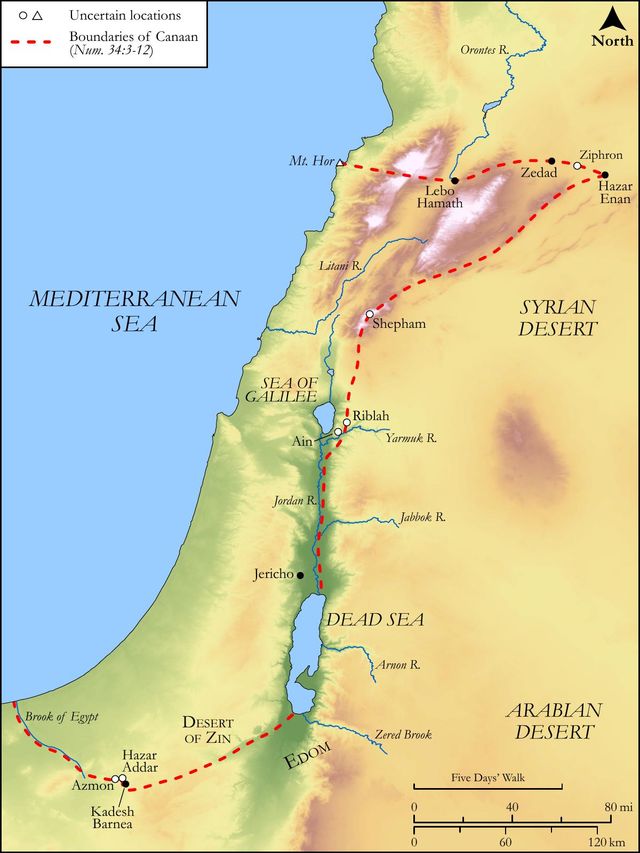
See on the biblical-era map
Study this verse
Historical interpretation
Historical reception
1 surviving comment on this verse from the historical church.
He places the priest before the leader, since the priest comes closer to God.
Continue studying Numbers 34:17 across the web’s major study libraries — every link below opens this exact verse, chapter, or book on the destination site.
Read & Compare
 BibleGatewayThis verse in more than 200 translations and 70 languages.
 Bible.comThe YouVersion reader — hundreds of translations, reading plans, and highlights.
 ESV.orgCrossway's official English Standard Version reader.
 NET BibleThe NET translation with 60,000+ translators' notes on every rendering decision.
 STEP BibleTyndale House's free study tool — original text, vocabulary, and scholarly resources.
 BibliaLogos Bible Software's free web reader.
 USCCBThe New American Bible (Revised Edition) with the U.S. bishops' study notes.
Commentaries
 BibleHub CommentariesDozens of classic commentaries on this verse, gathered on one page.
 StudyLightMore than 100 commentary sets — the largest collection on the web.
 BibleRefPlain-English commentary on what this verse means, verse by verse.
 Enduring WordDavid Guzik's free commentary on this chapter, widely used by Bible teachers.
 Bible Study ToolsVerse commentary alongside Greek and Hebrew study aids.
Original Language & Research
- BibleHub InterlinearThe verse word by word — original language, transliteration, and English.
- BibleHub LexiconEvery word's original-language definition and Strong's entry.
 Blue Letter BibleDeep-study tools — Strong's numbers, concordance, and word studies.
 SefariaThe Hebrew text with Rashi and centuries of Jewish commentary.
Sermons, Hymns & Audio


TrulyRandomVerse is not affiliated with these sites and doesn’t control their content. They’re linked because they’re genuinely useful.
Summary
Numbers 34:17 precisely identifies Eleazar the priest and Joshua the son of Nun as the divinely appointed leaders tasked with overseeing the equitable distribution of the Promised Land to the tribes of Israel. This pivotal verse, embedded within God's meticulous instructions for Israel's settlement, underscores His sovereign, orderly, and faithful plan for His people's inheritance, marking a crucial transition from their wilderness wanderings to the fulfillment of ancient covenant promises in their long-awaited homeland.
Context
ShowHideLiterary Context
Numbers 34:17 is situated within a highly prescriptive and administrative section of the book of Numbers, specifically detailing the preparations for Israel's entry into the land of Canaan. The preceding verses (Numbers 34:1-12) meticulously delineate the precise geographical boundaries of the land God promised to the Israelites, emphasizing the divine origin and scope of their inheritance. Following this detailed territorial demarcation and the general command to divide the land by lot (Numbers 34:13), verse 17 then names the two principal leaders—Eleazar and Joshua—who will execute this monumental task. This verse serves as a crucial bridge, setting the stage for the subsequent naming of the tribal princes who will assist Eleazar and Joshua in the division (Numbers 34:18-29), thereby demonstrating a structured, hierarchical, and divinely ordained approach to a task foundational for Israel's identity as a settled nation.
Historical & Cultural Context
The historical setting for Numbers 34:17 is the plains of Moab, on the eastern side of the Jordan River, with the Israelites poised to enter Canaan after forty years of wilderness wandering. In Israel, land was the primary source of identity, security, and wealth, making its distribution a foundational act for establishing a stable, settled society. Unlike typical conquests where victors arbitrarily divided spoils, Israel's land division was a divinely ordained process, emphasizing God's absolute sovereignty over the land and His unwavering faithfulness to His covenant with Abraham (Genesis 12:7). The roles of "priest" (Eleazar) and "son of Nun" (Joshua) were critical. The priest's involvement ensured the sacredness and divine sanction of the process, likely involving the consultation of God through the Urim and Thummim, while Joshua, as the military and administrative leader, would oversee the practical implementation. This divine oversight was essential to prevent disputes and ensure a just allocation, reflecting God's commitment to order, justice, and the well-being of His covenant people.
Key Themes
ShowHideNumbers 34:17 contributes significantly to several overarching themes within the book of Numbers and the broader Pentateuch. Firstly, it powerfully highlights Divine Providence and Faithfulness, demonstrating God's unwavering commitment to fulfilling His covenant promises, particularly the land promise made to Abraham. God not only provides the land but also meticulously orchestrates the means for its proper inheritance, ensuring every detail is covered. Secondly, the verse underscores Order and Administration, showcasing God's desire for structure, fairness, and precision in the life of His people. The precise naming of specific, divinely appointed leaders for such a critical task emphasizes that God's plans are not chaotic but are executed with divine wisdom and meticulous organization. Thirdly, it speaks profoundly to Leadership and Succession, as Eleazar had succeeded his father Aaron as High Priest (Numbers 20:28), and Joshua was divinely appointed to succeed Moses as the leader who would bring Israel into the promised land (Deuteronomy 34:9). This continuity of divinely appointed and qualified leadership was crucial for Israel's successful transition from a nomadic wilderness people to a settled nation.
Exposition and Analysis
ShowHideKey Word Analysis
ShowHideFrom אֵל and עָזַר, meaning "God (is) helper." As the High Priest, Eleazar's involvement in the land distribution signifies that this crucial administrative task was not merely a secular undertaking but a sacred act under divine guidance. His name fittingly reflects the divine assistance and enablement that would be necessary for such a monumental and potentially contentious division. His presence ensured the process was imbued with spiritual authority and divine approval, emphasizing that the land was a gift from God.
An active participle of כָּהַן, literally "one officiating," a priest. This title highlights Eleazar's sacred office and his role as the mediator between God and Israel. His participation in the land division underscored its religious significance, ensuring that the allocation was carried out according to God's will and by sacred lot, thereby preventing human bias and affirming divine sovereignty over the inheritance.
From יְהֹוָה and יָשַׁע, meaning "Jehovah-saved" or "The Lord is salvation." Joshua's name is profoundly significant, as he was Moses' chosen successor, divinely appointed to lead the Israelites into the Promised Land. This task required immense faith, courage, and reliance on God's saving power. The theological weight of his name points directly to his role as a deliverer and, more importantly, foreshadows the ultimate deliverer, Jesus, whose name is the Greek equivalent of Joshua.
Verse Breakdown
ShowHide"These [are] the names of the men which shall divide the land unto you"
This opening clause serves as a formal, authoritative declaration, immediately establishing the verse's purpose: to identify the specific human agents through whom God's command for the land's distribution will be executed. The phrase "unto you" emphasizes that this division is for the direct benefit and inheritance of the entire Israelite community, underscoring the communal aspect of God's provision and covenant fulfillment. It highlights the transparency and accountability of the process.
"Eleazar the priest"
The first named individual, Eleazar, is identified by his sacred office. His role as "the priest" signifies that the division of the land is a divinely sanctioned and religiously significant act, not merely a secular administrative task. As High Priest, Eleazar would have been responsible for consulting God, likely through the Urim and Thummim, to ensure the land was divided according to God's will and by lot, thus imparting divine legitimacy, preventing human bias or corruption, and consecrating the inheritance.
"and Joshua the son of Nun"
The second named individual, Joshua, is identified by his lineage, highlighting his established identity, authority, and continuity of leadership within the Israelite community. As Moses' divinely chosen successor and the military commander, Joshua would be responsible for the practical implementation of the land division, ensuring its orderly and just execution among the tribes. His inclusion alongside the High Priest underscores the dual nature of leadership—spiritual and administrative/military—necessary for Israel's successful settlement and the establishment of a righteous society.
Literary Devices
ShowHideNumbers 34:17, though seemingly a straightforward administrative statement, employs several significant literary techniques. It functions as a Nominal List or Register, a common biblical device used to record genealogies, officials, or military rosters, which lends authority, historical weight, and divine sanction to the information presented. By explicitly naming Eleazar and Joshua, the text emphasizes their Divine Mandate; their appointment is not a human political decision but a direct command from God, reinforcing the idea of divine sovereignty over the land and its distribution. Furthermore, the naming of Joshua carries a profound layer of Foreshadowing and Typology. His name, meaning "The Lord is salvation," subtly points beyond his immediate role as a military and administrative leader to the ultimate salvation and inheritance brought by the Messiah, Jesus (Yeshua), whose name is the Greek equivalent of Joshua. This seemingly mundane administrative detail thus carries significant theological resonance, hinting at God's broader redemptive plan for His people.
Theological and Thematic Connections
ShowHideNumbers 34:17, while administrative in nature, is profoundly theological. It powerfully illustrates God's meticulous faithfulness to His covenant promises, particularly the promise of land to Abraham and his descendants. The naming of specific, divinely appointed leaders for the task of land distribution underscores that God's plans are not abstract ideals but are concretely realized through human agents, guided by His wisdom and authority. This verse highlights that even the seemingly mundane details of administration and logistics are integral to God's overarching redemptive purpose for His people. It reveals a God who is orderly, just, and committed to providing for His people's inheritance, ensuring that the transition from wilderness wandering to settled life is conducted with divine precision, integrity, and sacred oversight.
Reflection and Application
ShowHideNumbers 34:17 offers profound lessons for contemporary believers, reminding us that God is a God of order, intention, and meticulous care, even in the seemingly small details of our lives. Just as He meticulously planned for Israel's inheritance and appointed specific, qualified leaders to ensure its just distribution, He has a divine purpose and plan for each of us, often working through human instruments and established structures. This verse encourages us to trust in God's unwavering faithfulness to His promises, knowing that He will provide the means, the people, and the wisdom to accomplish His will in our lives and in the life of the church. It also highlights the importance of godly leadership, characterized by divine appointment, integrity, and a humble commitment to executing God's will for the benefit of the community. We are called to be good stewards of the "inheritance" God has given us—whether it be spiritual gifts, material resources, relationships, or opportunities—and to seek His guidance in managing them with wisdom and integrity, reflecting His divine order and justice in our own spheres of influence.
Questions for Reflection
ShowHideFAQ
ShowHideWhy is it important that specific individuals are named for this task?
ShowHideThe naming of specific individuals, Eleazar and Joshua, is crucial because it signifies divine appointment and ensures accountability. It underscores that the division of the land was not left to chance or human political maneuvering but was a sacred task under God's direct oversight. These men represented the highest spiritual and administrative authority in Israel, lending legitimacy and divine sanction to the process, ensuring fairness, and preventing disputes among the tribes. It also highlights the continuity of divinely ordained leadership after Moses and Aaron, establishing a clear line of authority for the monumental task ahead, as seen in Joshua 14:1.
What is the significance of Eleazar's role as "the priest"?
ShowHideEleazar's role as "the priest" is paramount. As the High Priest, he represented God's presence and authority among the people and was responsible for mediating between God and Israel. His involvement ensured that the land division was conducted according to divine will, likely involving the casting of lots, which was a sacred method of discerning God's will, as seen later in Joshua 18:6. This priestly oversight imbued the entire process with sacredness, making it a religious act of covenant fulfillment rather than merely a secular administrative task, thereby preventing human corruption or favoritism and affirming God's ultimate ownership of the land.
How does Joshua's name foreshadow future events?
ShowHideJoshua's name, Yehoshu'a in Hebrew, means "The Lord is salvation" or "The Lord saves." This name is highly significant because it is the Hebrew equivalent of "Jesus" (Yeshua in Aramaic, Iesous in Greek). Just as Joshua led the Israelites into their physical inheritance in the Promised Land, his name and role powerfully foreshadow the ultimate deliverer, Jesus Christ, who leads believers into their spiritual inheritance, eternal salvation, and true rest found in Him (Hebrews 4:8-9). Joshua's earthly mission to secure a physical land points to Christ's heavenly mission to secure an eternal inheritance for all who believe.
Christ-Centered Fulfillment
ShowHideNumbers 34:17, though seemingly a dry administrative detail, finds profound Christ-centered fulfillment. The appointment of Eleazar the priest and Joshua the son of Nun to "divide the land" serves as a powerful type and shadow pointing to Christ's multifaceted ministry. Joshua, whose very name is the Hebrew equivalent of "Jesus," leads God's people into their physical inheritance, foreshadowing Jesus as the ultimate leader who brings His people into their spiritual inheritance and the promised rest of God (Hebrews 4:8-10). Just as Joshua secured a physical land for Israel, Christ secures an eternal, heavenly inheritance for all who believe, a new creation and a kingdom that cannot be shaken (Hebrews 12:28). Eleazar, as the High Priest, prefigures Christ's perfect and eternal high priestly ministry. While Eleazar facilitated the division of a physical land, Christ, our great High Priest, through His once-for-all sacrifice, has secured and now intercedes for our spiritual inheritance, granting us direct access to the very presence of God (Hebrews 4:14-16 and Hebrews 9:11-12). Thus, the administrative act of land division in Numbers 34:17 ultimately points to the comprehensive work of Christ, who, as our true Joshua and High Priest, secures and graciously apportions the immeasurable spiritual blessings and eternal life that are our inheritance in Him (Ephesians 1:3 and Colossians 1:12).