


Numbers 13:16
Bible text: King James Version (1769 Blayney text) · Public domain
Bible text: Berean Standard Bible · Public domain
Bible text: American Standard Version (1901) · Public domain
Bible text: World English Bible, Messianic edition · Public domain
Bible text: Geneva Bible (1599) · Public domain
Bible text: Young's Literal Translation · Public domain
- אֵלֶּה'E·lehtheseH428PrtParticle Demonstrative
- שְׁמוֹתshe·Mot[are] [the] names ofH8034N-fpcNoun Plural Feminine Construct
- הָאֲנָשִׁיםha·'a·na·Shimthe menH582Art ¦ N-mpNoun Plural Masculine Absoluteהָtheאֲנָשִׁיםmen
- אֲשֶׁר'a·SherwhomH834RelParticle Relative
- שָׁלַחsha·Lachhe sentH7971V-Qal-Perf-3msVerb Qal Perfect 3rd Singular Masculine
- מֹשֶׁהmo·ShehMosesH4872N-proper-mNoun Proper Masculine
- לָתוּרla·Turto spy outH8446Prep-l ¦ V-Qal-InfVerb Qal Infinitive Constructלָtoתוּרspy out
- אֶת'et<obj.>H853DirObjMParticle Object Indicator
- הָאָרֶץha·'A·retzthe landH776Art ¦ N-fsNoun Singular Feminine Absoluteהָtheאָרֶץland
- וַיִּקְרָאvai·yik·Ra'and he calledH7121Conj-w ¦ V-Qal-ConsecImperf-3msVerb Qal Consecutive Imperfect 3rd Singular Masculineוַandיִּקְרָאhe called
- מֹשֶׁהmo·ShehMosesH4872N-proper-mNoun Proper Masculine
- לְהוֹשֵׁעַle·ho·She·a'<to> HosheaH1954Prep-l ¦ N-proper-mNoun Proper Masculineלְ<to>הוֹשֵׁעַHoshea
- בִּןbin[the] son ofH1121N-mscNoun Singular Masculine Construct
- נוּןnunNunH5126N-proper-mNoun Proper Masculine
- יְהוֹשֻׁעַye·ho·Shu·a'JoshuaH3091N-proper-mNoun Proper Masculine
English is a literal word-by-word gloss of the Hebrew, not the KJV's wording. Why?
This is the original text the KJV's translators worked from — each Hebrew word with its own literal English meaning in this verse, prepared by scholars at Tyndale House, Cambridge. The KJV translates whole sentences, not word by word, so its wording differs: one Hebrew word can become several English words, and the KJV may choose “the LORD” where the gloss reads “Yahweh”. Both are faithful — they answer different questions. For the KJV's own rendering, switch to the KJV text.
Details
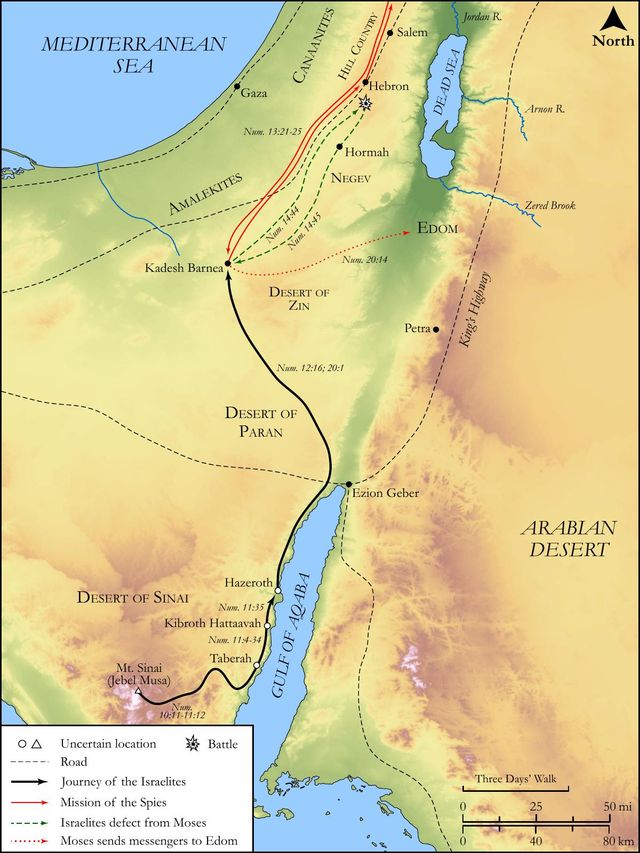
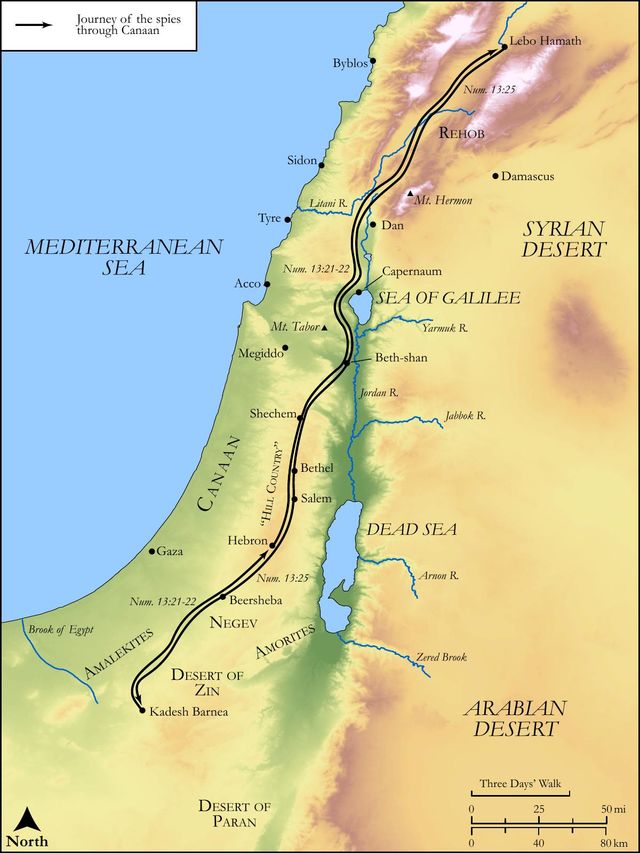
See on the biblical-era maps
Study this verse
Public-domain commentary
Matthew Henry
From his Commentary on the Whole Bible. Henry comments on passages, not single verses — this entry covers Numbers 13:1–20. His two-level outline is real structure in the source text, so it is rendered as structure.
Here we have, I. Orders given to send spies to search out the land of Canaan. It is here said, God directed Moses to send them (Num 13:1, Num 13:2), but it appears by the repetition of the story afterwards (Deu 1:22) that the motion came originally from the people; they came to Moses, and said, We will send men before us; and it was the fruit of their unbelief. They would not take God's word that it was a good land, and that he would, without fail, put them in possession of it. They could not trust the pillar of cloud and fire to show them the way to it, but had a better opinion of their own politics than of God's wisdom. How absurd was it for them to send to spy out a land which God himself had spied out for them, to enquire the way into it when God himself had undertaken to show them the way! But thus we ruin ourselves by giving more credit to the reports and representations of sense than to divine revelation; we walk by sight, not by faith; whereas, if we will receive the witness of men, without doubt the witness of God is greater. The people making this motion to Moses, he (perhaps not aware of the unbelief at the bottom of it) consulted God in the case, who bade him gratify the people in this matter, and send spies before them: "Let them walk in their own counsels." Yet God was no way accessory to the sin that followed, for the sending of these spies was so far from being the cause of the sin that if the spies had done their duty, and the people theirs, it might have been the confirmation of their faith, and of good service to them.
II.The persons nominated that were to be employed in this service (Num 13:4, etc.), one of each tribe, that it might appear to be the act of the people in general; and rulers, person of figure in their respective tribes, some of the rulers of thousands or hundreds, to put the greater credit upon their embassy. This was designed for the best, but it proved to have this ill effect that the quality of the persons occasioned the evil report they brought up to be the more credited and the people to be the more influenced by it. Some think that they are all named for the sake of two good ones that were among them, Caleb and Joshua. Notice is taken of the change of Joshua's name upon this occasion, Num 13:16. He was Moses's minister, but had been employed, though of the tribe of Ephraim, as general of the forces that were sent out against Amalek. The name by which he was generally called and known in his own tribe was Oshea, but Moses called him Joshua, in token of his affection to him and power over him; and now, it should seem, he ordered others to call him so, and fixed that to be his name henceforward. Oshea signifies a prayer for salvation, Save thou; Joshua signifies a promise of salvation, He will save, in answer to that prayer: so near is the relation between prayers and promises. Prayers prevail for promises, and promises direct and encourage prayers. Some think that Moses designed, by taking the first syllable of the name Jehovah and prefixing it to his name, which turned Hoshea into Jehoshua, to put an honour upon him, and to encourage him in this and all his future services with the assurances of God's presence. Yet after this he is called Hoshea, Deu 32:44. Jesus is the same name with Joshua, and it is the name of our Lord Christ, of whom Joshua was a type as successor to Moses, Israel's captain, and conqueror of Canaan. There was another of the same name, who was also a type of Christ, Zac 6:11. Joshua was the saviour of God's people from the powers of Canaan, but Christ is their Saviour from the powers of hell.
III.The instructions given to those spies.
They were sent into the land of Canaan the nearest way, to traverse the country, and to take account of its present state, Num 13:17. Two heads of enquiry were given them in charge,
1.Concerning the land itself: See what that is (Num 13:18, and again, Num 13:19), see whether it be good or bad, and (Num 13:20) whether it be fat or lean. All parts of the earth do not share alike in the blessing of fruitfulness; some countries are blessed with a richer soil than others. Moses himself was well satisfied that Canaan was a very good land, but he sent these spies to bring an account of it for the satisfaction of the people; as John Baptist sent to Jesus, to ask whether he was the Christ, not to inform himself, but to inform those he sent. They must take notice whether the air was healthful or no, what the soil was, and what the productions; and, for the better satisfaction of the people, they must bring with them some of the fruits.
2.Concerning the inhabitants - their number, few or many - their size and stature, whether strong able-bodied men or weak, - their habitations, whether they lived in tents or houses, whether in open villages or in walled towns, - whether the woods were standing as in those countries that are uncultivated, through the unskillfulness and slothfulness of the inhabitants, or whether the woods were cut down, and the country made champaign, for the convenience of tillage. These were the things they were to enquire about. Perhaps there had not been of late years such commerce between Egypt and Canaan as there was in Jacob's time, else they might have informed themselves of these things without sending men on purpose to search. See the advantage we may derive from books and learning, which acquaint those that are curious and inquisitive with the state of foreign countries, at a much greater distance than Canaan was now from Israel, without this trouble and expense.
IV.Moses dismisses the spies with this charge, Be of good courage, intimating, not only that they should be themselves encouraged against the difficulties of this expedition, but that they should bring an encouraging account to the people and make the best of every thing. It was not only a great undertaking they were put upon, which required good management and resolution, but it was a great trust that was reposed in them, which required that they should be faithful.
Historical interpretation
Historical reception
1 surviving comment on this verse from the historical church.
And the same [Moses] by divine inspiration foresaw the name Jesus very clearly and again also endowed this with special privilege. The name of Jesus, which had never been uttered among men before it was made known to Moses, Moses applied first to this one alone. He knew that Joshua, again as a type and a symbol, would receive the rule over all after Moses’ death. His successor, at any rate, had never before used the title Jesus. He had been called by another name, Auses, which his parents had bestowed upon him. Moses himself proclaims Jesus, as a privilege of honor far greater than a royal crown, giving him the name because Jesus, the son of Nave, himself bore a resemblance to our Savior, who alone, after Moses and the completion of the symbolic worship transmitted by him, received the rule of true and pure religion.
Continue studying Numbers 13:16 across the web’s major study libraries — every link below opens this exact verse, chapter, or book on the destination site.
Read & Compare
 BibleGatewayThis verse in more than 200 translations and 70 languages.
 Bible.comThe YouVersion reader — hundreds of translations, reading plans, and highlights.
 ESV.orgCrossway's official English Standard Version reader.
 NET BibleThe NET translation with 60,000+ translators' notes on every rendering decision.
 STEP BibleTyndale House's free study tool — original text, vocabulary, and scholarly resources.
 BibliaLogos Bible Software's free web reader.
 USCCBThe New American Bible (Revised Edition) with the U.S. bishops' study notes.
Commentaries
 BibleHub CommentariesDozens of classic commentaries on this verse, gathered on one page.
 StudyLightMore than 100 commentary sets — the largest collection on the web.
 BibleRefPlain-English commentary on what this verse means, verse by verse.
 Enduring WordDavid Guzik's free commentary on this chapter, widely used by Bible teachers.
 Bible Study ToolsVerse commentary alongside Greek and Hebrew study aids.
Original Language & Research
- BibleHub InterlinearThe verse word by word — original language, transliteration, and English.
- BibleHub LexiconEvery word's original-language definition and Strong's entry.
 Blue Letter BibleDeep-study tools — Strong's numbers, concordance, and word studies.
 SefariaThe Hebrew text with Rashi and centuries of Jewish commentary.
Sermons, Hymns & Audio


TrulyRandomVerse is not affiliated with these sites and doesn’t control their content. They’re linked because they’re genuinely useful.
Summary
Numbers 13:16 records a pivotal moment within the account of the twelve spies sent into Canaan: Moses renames Oshea, son of Nun, to Jehoshua. This seemingly minor detail, occurring just before the spies embark on their critical mission, profoundly redefines Oshea's identity, imbuing him with a divine purpose and foreshadowing his indispensable role as the future leader who would, by God's power, bring Israel into the Promised Land, thereby intrinsically linking his destiny to the Lord's saving work.
Context
ShowHideLiterary Context
Numbers 13:16 is strategically embedded within the narrative of Israel's journey from Mount Sinai to the threshold of the Promised Land. It immediately follows the divine directive to Moses to dispatch spies to reconnoiter Canaan (Numbers 13:1-2) and the subsequent enumeration of the twelve tribal leaders selected for this crucial reconnaissance mission (Numbers 13:4-15). The renaming of Oshea, presented as a parenthetical but highly significant note, serves as a profound theological marker. It sets apart this individual, highlighting divine foresight and preparation for leadership even before the specific instructions for the mission are given (Numbers 13:17-20). This act of divine commissioning stands in stark contrast to the subsequent faithless report of ten of the spies and the resulting forty years of wilderness wandering, which underscore the consequences of unbelief (Numbers 13:26-33 and Numbers 14:1-38).
Historical & Cultural Context
In Hebrew thought, names were far more than mere identifiers; they often conveyed a person's character, destiny, or even a prophetic message. A name change, especially when initiated by a figure of authority like Moses or by God Himself, frequently signified a new status, a divine calling, or a profound transformation. Classic biblical examples include Abram's transformation to Abraham, signifying his role as "father of a multitude," or Jacob's renaming to Israel, meaning "he struggles with God." This cultural understanding amplifies the profound significance of Moses' action in Numbers 13:16. Furthermore, the Israelites were on the precipice of a monumental transition—from a nomadic existence to conquering and settling a land promised to their ancestors. Such an undertaking demanded strong, divinely appointed leadership, making the preparation of a successor like Jehoshua a critical act of divine providence and strategic planning for the future of the nation.
Key Themes
ShowHideThis verse powerfully contributes to several overarching themes woven throughout the book of Numbers and the broader Pentateuch. It profoundly underscores the theme of Divine Sovereignty in Leadership, demonstrating God's active and meticulous hand in preparing and appointing individuals for His specific purposes, often long before their full role is revealed. The very act of renaming highlights the Significance of Names in conveying profound theological truth—that true "salvation" or "deliverance" originates solely from God. Moreover, the verse serves as a potent instance of Foreshadowing, subtly pointing to Jehoshua's future, indispensable role as the one who would actually lead Israel into the Promised Land, a task Moses himself would not complete due to his disobedience (Deuteronomy 3:27-28). The renaming thus sets the stage for Jehoshua to embody God's saving power in the midst of Israel's journey and future conquest, as clearly seen in his commissioning in Joshua 1.
Exposition and Analysis
ShowHideKey Word Analysis
ShowHideFrom the root יָשַׁע (yasha), this original Hebrew name (H1954) means "deliverer" or "he saves." In its original form, it implies a human capacity or desire for salvation or rescue. However, it does not inherently specify the source of that salvation, leaving it open to interpretation as a human-initiated act of deliverance.
This name (H4872) means "drawing out" or "rescued," reflecting his own miraculous deliverance from the Nile. As the Israelite lawgiver and God's primary prophet, Moses' (H4872) action of renaming Oshea is significant. It is not a casual decision but an act of divine authority and prophetic insight, underscoring his role as God's chosen instrument in preparing the next generation of leadership.
This transformed name (H3091) is profoundly theologically potent. Moses adds the prefix "Jeho-" (or "Yeho-"), which is a shortened form of the divine covenant name, Yahweh (YHWH). Thus, "Jehoshua" translates to "Yahweh is salvation" or "The Lord saves." This linguistic alteration dramatically shifts the focus from human capability to divine agency, emphasizing that any true deliverance, victory, or success experienced by Israel through this leader would emanate directly from God's power and presence working through His chosen instrument.
Verse Breakdown
ShowHide"These [are] the names of the men which Moses sent to spy out the land."
This initial clause serves as a direct continuation and summary of the preceding verses (Numbers 13:4-15), which enumerate the twelve tribal leaders chosen for the reconnaissance mission. It firmly establishes the immediate context of the verse within the spy narrative, reminding the reader of the purpose and participants of this crucial undertaking. The mention of "Moses sent" underscores his authority as God's appointed leader, acting under divine command.
"And Moses called Oshea the son of Nun Jehoshua."
This is the pivotal statement of the verse, recording a specific and deliberate act by Moses: the renaming of Oshea, the spy from the tribe of Ephraim. The inclusion of "the son of Nun" clearly identifies the individual, linking him to his lineage and ensuring no ambiguity. The act of renaming itself is not casual; it signifies a profound change in identity, purpose, and divine association. By adding the divine name "Yahweh" to "Oshea," Moses prophetically declares that this man, Jehoshua, will be the vessel through whom God's salvation and deliverance will be manifested for Israel, not by his own strength, but by the power of the Most High.
Literary Devices
ShowHideThe primary literary device at play in Numbers 13:16 is Nomen Omen, a Latin phrase meaning "the name is an omen" or "a name is a sign." The transformation of Oshea's name to Jehoshua is a powerful example, as the new name ("Yahweh is salvation") directly foreshadows his future role as the one who, by God's power, would lead Israel into the Promised Land, embodying divine deliverance. This act also functions as Foreshadowing, subtly hinting at Jehoshua's elevated status and crucial destiny beyond the immediate spying mission, preparing the reader for his eventual succession to Moses. Furthermore, the divine inspiration behind Moses' act, though not explicitly stated, implies Divine Providence, showcasing God's active and sovereign hand in preparing His chosen instruments for future redemptive purposes, even before their full mission is revealed to the people or even to the individual himself.
Theological and Thematic Connections
ShowHideThe renaming of Oshea to Jehoshua in Numbers 13:16 is a profound theological statement about the nature of salvation and divine leadership. It teaches that true deliverance, success, and the fulfillment of God's promises come not from human strength, ingenuity, or even inherent ability, but solely from God Himself. By embedding the divine name Yahweh into Oshea's name, Moses underscores that the future leader's effectiveness and the nation's ultimate victory would be entirely dependent on God's presence, power, and saving work. This act establishes a pattern of divine preparation and empowerment for those whom God calls to lead His people, ensuring that His purposes are fulfilled through instruments consecrated by His own name and power. It is a powerful reminder that God is the ultimate source of all salvation, whether physical deliverance from enemies or spiritual redemption from sin.
Reflection and Application
ShowHideNumbers 13:16 offers a rich tapestry for reflection on God's sovereign hand in our lives and His meticulous preparation of individuals for His divine purposes. Just as God, through Moses, prepared Jehoshua for the monumental task of leading Israel into the Promised Land, so too does He equip and empower believers today for their unique callings within His kingdom. This verse reminds us that our true identity, our inherent worth, and our ultimate effectiveness are not rooted in our own abilities, our original circumstances, or even the names we bear, but in our profound connection to the God who saves. When we bear the name of Christ, we are called to embody the truth that "Yahweh is salvation" in a world desperately needing deliverance. It challenges us to surrender our own plans, our perceived capacities, and our self-reliance, trusting that God will work powerfully through us, not because of who we are in ourselves, but because of who He is and His boundless saving power. Our hope, strength, and ultimate victory are found not in human effort, but in the transforming and commissioning power of the Lord.
Questions for Reflection
ShowHideFAQ
ShowHideWhy did Moses change Oshea's name to Jehoshua?
ShowHideMoses changed Oshea's name to Jehoshua as an act of divine foresight and prophetic significance, likely under God's inspiration. In Hebrew thought, a name change often indicated a new destiny, a divine calling, or a profound transformation in relationship with God (e.g., Abram to Abraham). By adding the "Jeho-" (or "Yeho-") prefix, which is a shortened form of God's covenant name, Yahweh, Moses transformed "Oshea" (meaning "salvation" or "he saves") into "Jehoshua" (meaning "Yahweh is salvation" or "The Lord saves"). This renaming signified that the salvation and deliverance Oshea would bring to Israel would not be by his own power, but by the power and presence of Yahweh working through him. It was a divine anointing and preparation for his future role as the leader who would bring Israel into the Promised Land, a task that required God's direct intervention and saving power.
What is the connection between the name Jehoshua and Jesus?
ShowHideThe connection between Jehoshua and Jesus is profound and direct. "Jehoshua" (יְהוֹשֻׁעַ) is the original Hebrew name from which the Greek name "Iesous" (Ἰησοῦς) is derived. From "Iesous," we get the English name "Jesus." Both names carry the identical core meaning: "Yahweh is salvation" or "The Lord saves." This linguistic and theological link highlights Joshua as a significant Old Testament "type" or foreshadowing of Jesus Christ. Just as Joshua led God's people into the earthly promised land, overcoming formidable foes and establishing their inheritance, Jesus, the ultimate "Yahweh is salvation," leads His people into the true, heavenly rest and delivers them from the bondage of sin and death. The shared name underscores their shared mission of salvation, with Jesus being the ultimate and perfect fulfillment.
Christ-Centered Fulfillment
ShowHideNumbers 13:16, though seemingly a minor detail in the narrative of the spies, holds profound Christ-centered fulfillment. The renaming of Oshea to Jehoshua ("Yahweh is salvation") powerfully foreshadows the ultimate Savior, Jesus Christ. Just as Joshua was chosen and divinely empowered to lead God's people into the earthly Promised Land, overcoming formidable enemies and establishing their inheritance, so too is Jesus the one true leader who brings His people into the eternal, heavenly inheritance. His very name, "Jesus," is the Greek equivalent of "Jehoshua," meaning "the Lord saves" (as revealed in Matthew 1:21). Joshua's mission, though significant, was limited; he led Israel into a physical land, but could not provide ultimate rest from sin and striving. The author of Hebrews makes this clear, stating that if Joshua had given them true rest, God would not have spoken later of another day of rest, which is found in Christ (see Hebrews 4:8-9). Jesus is the Lamb of God who takes away the sin of the world (John 1:29), and there is salvation in no other name given among men by which we must be saved (Acts 4:12). Thus, the renaming of Oshea points prophetically to the One through whom God's ultimate and complete salvation would be accomplished, securing an eternal inheritance for all who believe.