


Exodus 17:9
Bible text: King James Version (1769 Blayney text) · Public domain
Bible text: King James Version with Strong's numbers · Public domain
Bible text: Berean Standard Bible · Public domain
Bible text: American Standard Version (1901) · Public domain
Bible text: World English Bible, Messianic edition · Public domain
Bible text: Geneva Bible (1599) · Public domain
Bible text: Young's Literal Translation · Public domain
- וַיֹּאמֶרvai·Yo·merand he saidH559Conj-w ¦ V-Qal-ConsecImperf-3msVerb Qal Consecutive Imperfect 3rd Singular Masculineוַandיֹּאמֶרhe said
- מֹשֶׁהmo·ShehMosesH4872N-proper-mNoun Proper Masculine
- אֶל'eltoH413PrepPreposition
- יְהוֹשֻׁעַye·ho·Shu·a'JoshuaH3091N-proper-mNoun Proper Masculine
- בְּחַרbe·charchooseH977V-Qal-Imp-2msVerb Qal Imperative 2nd Singular Masculine
- לָנוּLa·nufor <the> usPrep-l ¦ 1cpSuffix Personal 1st Plural common genderלָfor <the>נוּus
- אֲנָשִׁים'a·na·ShimmenH582N-mpNoun Plural Masculine Absolute
- וְצֵאve·Tze'and go outH3318Conj-w ¦ V-Qal-Imp-2msVerb Qal Imperative 2nd Singular Masculineוְandצֵאgo out
- הִלָּחֵםhi·la·ChemfightH3898V-Niphal-Imp-2msVerb Niphal Imperative 2nd Singular Masculine
- בַּעֲמָלֵקba·'a·ma·Lekagainst AmalekH6002Prep-b ¦ N-properNoun Proper LocationבַּagainstעֲמָלֵקAmalek
- מָחָרma·ChartomorrowH4279N-msNoun Singular Masculine Absolute
- אָנֹכִי'a·no·KhiIH595Pro-1csPronoun Personal 1st Singular common gender
- נִצָּבni·Tzav[will be] standingH5324V-Niphal-Prtcpl-msVerb Niphal Participle Singular Masculine Absolute
- עַל'alonH5921PrepPreposition
- רֹאשׁrosh[the] top ofH7218N-mscNoun Singular Masculine Construct
- הַגִּבְעָהha·giv·'Ahthe hillH1389Art ¦ N-fsNoun Singular Feminine Absoluteהַtheגִּבְעָהhill
- וּמַטֵּהu·ma·Tehand [the] staff ofH4294Conj-w ¦ N-mscNoun Singular Masculine Constructוּandמַטֵּה[the] staff of
- הָאֱלֹהִיםha·'E·lo·Him<the> GodH430Art ¦ N-mpNoun Plural Masculine Absoluteהָ<the>אֱלֹהִיםGod
- בְּיָדִיbe·ya·Di[will be] in my handH3027Prep-b ¦ N-csc ¦ 1csNoun Singular common gender Constructבְּ[will be] inיָדִhandיmy
English is a literal word-by-word gloss of the Hebrew, not the KJV's wording. Why?
This is the original text the KJV's translators worked from — each Hebrew word with its own literal English meaning in this verse, prepared by scholars at Tyndale House, Cambridge. The KJV translates whole sentences, not word by word, so its wording differs: one Hebrew word can become several English words, and the KJV may choose “the LORD” where the gloss reads “Yahweh”. Both are faithful — they answer different questions. For the KJV's own rendering, switch to the KJV text.
Details
See on the biblical-era maps

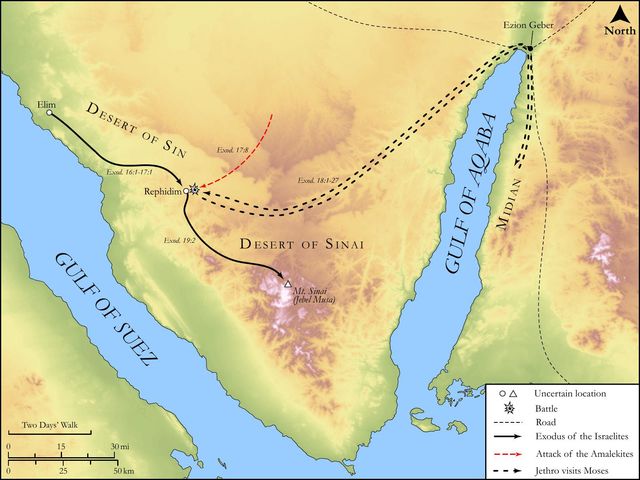
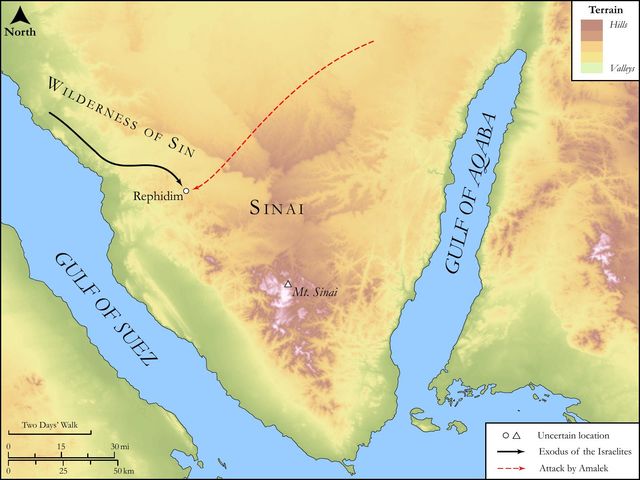
Study this verse
Public-domain commentary
Matthew Henry
From his Commentary on the Whole Bible. Henry comments on passages, not single verses — this entry covers Exodus 17:8–16. His three-level outline is real structure in the source text, so it is rendered as structure.
We have here the story of the war with Amalek, which, we may suppose, was the first that was recorded in the book of the wars of the Lord, Num 21:14. Amalek was the first of the nations that Israel fought with, Num 24:20. Observe,
I.Amalek's attempt:
They came out, and fought with Israel, Exo 17:8. The Amalekites were the posterity of Esau, who hated Jacob because of the birthright and blessing, and this was an effort of the hereditary enmity, a malice that ran in the blood, and perhaps was now exasperated by the working of the promise towards an accomplishment. Consider this,
1.As Israel's affliction. They had been quarrelling with Moses (Exo 17:2), and now God sends Amalekites to quarrel with them; wars abroad are the just punishment of strifes and discontents at home.
2.As Amalek's sin; so it is reckoned, Deu 25:17, Deu 25:18. They did not boldly front them as a generous enemy, but without any provocation given by Israel, or challenge given to them, basely fell upon their rear, and smote those that were faint and feeble and could neither make resistance nor escape. Herein they bade defiance to that power which had so lately ruined the Egyptians; but in vain did they attack a camp guarded and victualled by miracles: verily they knew not what they did.
II.Israel's engagement with Amalek, in their own necessary defence against the aggressors. Observe,
1.The post assigned to Joshua, of whom this is the first mention: he is nominated commander-in-chief in this expedition, that he might be trained up to the services he was designed for after the death of Moses, and be a man of war from his youth. He is ordered to draw out a detachment of choice men from the thousands of Israel and to drive back the Amalekites, Exo 17:9. When the Egyptians pursued them Israel must stand still and see what God would do; but now it was required that they should bestir themselves. Note, God is to be trusted in the use of means.
2.The post assumed by Moses: I will stand on the top of the hill with the rod of God in my hand, Exo 17:9. See how God qualifies his people for, and calls them to, various services for the good of his church: Joshua fights, Moses prays, and both minister to Israel. Moses went up to the top of the hill, and placed himself, probably, so as to be seen by Israel; there he held up the rod of God in his hand, that wonder-working rod which had summoned the plagues of Egypt, and under which Israel had passed out of the house of bondage. This rod Moses held up to Israel, to animate them; the rod was held up as the banner to encourage the soldiers, who might look up, and say, "Yonder is the rod, and yonder the hand that used it, when such glorious things were wrought for us." Note, It tends much to the encouragement of faith to reflect upon the great things God has done for us, and review the monuments of his favours. Moses also held up this rod to God, by way of appeal to him: "Is not the battle the Lord's? Is not he able to help, and engaged to help? Witness this rod, the voice of which, thus held up, is (Isa 51:9, Isa 51:10), Put on strength, O arm of the Lord; art not thou it that hath cut Rahab?" Moses was not only a standard-bearer, but an intercessor, pleading with God for success and victory. Note, When the host goes forth against the enemy earnest prayers should be made to the God of hosts for his presence with them. It is here the praying legion that proves the thundering legion. There, in Salem, in Sion where prayers were made, there the victory was won, there broke the arrows of the bow, Psa 76:2, Psa 76:3. Observe,
(1.)How Moses was tired (Exo 17:12): His hands were heavy. The strongest arm will fail with being long extended; it is God only whose hand is stretched out still. We do not find that Joshua's hands were heavy in fighting, but Moses's hands were heavy in praying. The more spiritual any service is the more apt we are to fail and flag in it. Praying work, if done with due intenseness of mind and vigour of affection, will be found hard work, and, though the spirit be willing, the flesh will be weak. Our great Intercessor in heaven faints not, nor is he weary, though he attends continually to this very thing.
(2.)What influence the rod of Moses had upon the battle (v. 11): When Moses held up his hand in prayer (so the Chaldee explains it) Israel prevailed, but, when he let down his hand from prayer, Amalek prevailed. To convince Israel that the hand of Moses (with whom they had just now been chiding) contributed more to their safety than their own hands, his rod than their sword, the success rises and falls as Moses lifts up or lets down his hands. It seems, the scale wavered for some time, before it turned on Israel's side. Even the best cause must expect disappointments as an alloy to its successes; though the battle be the Lord's, Amalek may prevail for a time. The reason was, Moses let down his hands. Note, The church's cause is, commonly, more or less successful according as the church's friends are more or less strong in faith and fervent in prayer.
(3.)The care that was taken for the support of Moses. When he could not stand any longer he sat down, not in a chair of state, but upon a stone (v. 12); when he could not hold up his hands, he would have them held up. Moses, the man of God, is glad of the assistance of Aaron his brother, and Hur, who, some think, was his brother-in-law, the husband of Miriam. We should not be shy either of asking help from others or giving help to others, for we are members one of another. Moses's hands, thus stayed, were steady till the going down of the sun; and, though it was with much ado that he held out, yet his willing mind was accepted. No doubt it was a great encouragement to the people to see Joshua before them in the field of battle and Moses above them upon the top of the hill: Christ is both to us - our Joshua, the captain of our salvation who fights our battles, and our Moses, who, in the upper world, ever lives making intercession, that our faith fail not.
III.The defeat of Amalek.
Victory had hovered awhile between the camps; sometimes Israel prevailed and sometimes Amalek, but Israel carried the day, v. 13. Though Joshua fought with great disadvantages - his soldiers undisciplined, ill-armed, long inured to servitude, and apt to murmur; yet by them God wrought a great salvation, and made Amalek pay dearly for his insolence. Note, Weapons formed against God's Israel cannot prosper long, and shall be broken at last. The cause of God and his Israel will be victorious. Though God gave the victory, yet it is said, Joshua discomfited Amalek, because Joshua was a type of Christ, and of the same name, and in him it is that we are more than conquerors. It was his arm alone that spoiled principalities and powers, and routed all their force.
IV.The trophies of this victory set up.
1.Moses took care that God should have the glory of it (v. 15); instead of setting up a triumphal arch, to the honour of Joshua (though it had been a laudable policy to put marks of honour upon him), he builds an altar to the honour of God, and we may suppose it was not an altar without sacrifice; but that which is most carefully recorded is the inscription upon the altar, Jehovah-nissi - The Lord is my banner, which probably refers to the lifting up of the rod of God as a banner in this action. The presence and power of Jehovah were the banner under which they enlisted, by which they were animated and kept together, and therefore which they erected in the day of their triumph. In the name of our God we must always lift up our banners, Psa 20:5. It is fit that he who does all the work should have all the praise.
2.God took care that posterity should have the comfort and benefit of it: "Write this for a memorial, not in loose papers, but in a book, write it, and then rehearse it in the ears of Joshua, let him be entrusted with this memorial, to transmit it to the generations to come." Moses must now begin to keep a diary or journal of occurrences; it is the first mention of writing that we find in scripture, and perhaps the command was not given till after the writing of the law upon the tables of stone: "Write it in perpetuam rei memoriam - that the event may be had in perpetual remembrance; that which is written remains." (1.) "Write what has been done, what Amalek has done against Israel; write in gall their bitter hatred, write in blood their cruel attempts, let them never be forgotten, nor yet what God has done for Israel in saving them from Amalek. Let ages to come know that God fights for his people, and he that touches them touches the apple of his eye." (2.) Write what shall be done. [1.] That in process of time Amalek shall be totally ruined and rooted out (Exo 17:14), that he shall be remembered only in history." Amalek would have cut off the name of Israel, that it might be no more in remembrance (Psa 83:4, Psa 83:7); and therefore God not only disappoints him in this, but cuts off his name. "Write it for the encouragement of Israel, whenever the Amalekites are an annoyance to them, that Israel will at last undoubtedly triumph in the fall of Amalek." This sentence was executed in part by Saul (1 Sa. 15), and completely by David (ch. 30; Sa2 1:1; Sa2 8:12); after his time we never read so much as of the name of Amalek. [2.] This is the mean time God would have a continual controversy with him (v. 16): Because his hand is upon the throne of the Lord, that is, against the camp of Israel in which the Lord ruled, which was the place of his sanctuary, and is therefore called a glorious high throne from the beginning (Jer 17:12); therefore the Lord will have war with Amalek from generation to generation. This was written for direction to Israel never to make any league with the Amalekites, but to look upon them as irreconcilable enemies, doomed to ruin. Amalek's destruction was typical of the destruction of all the enemies of Christ and his kingdom. Whoever make war with the Lamb, the Lamb will overcome them.
Continue studying Exodus 17:9 across the web’s major study libraries — every link below opens this exact verse, chapter, or book on the destination site.
Read & Compare
 BibleGatewayThis verse in more than 200 translations and 70 languages.
 Bible.comThe YouVersion reader — hundreds of translations, reading plans, and highlights.
 ESV.orgCrossway's official English Standard Version reader.
 NET BibleThe NET translation with 60,000+ translators' notes on every rendering decision.
 STEP BibleTyndale House's free study tool — original text, vocabulary, and scholarly resources.
 BibliaLogos Bible Software's free web reader.
 USCCBThe New American Bible (Revised Edition) with the U.S. bishops' study notes.
Commentaries
 BibleHub CommentariesDozens of classic commentaries on this verse, gathered on one page.
 StudyLightMore than 100 commentary sets — the largest collection on the web.
 BibleRefPlain-English commentary on what this verse means, verse by verse.
 Enduring WordDavid Guzik's free commentary on this chapter, widely used by Bible teachers.
 Bible Study ToolsVerse commentary alongside Greek and Hebrew study aids.
Original Language & Research
- BibleHub InterlinearThe verse word by word — original language, transliteration, and English.
- BibleHub LexiconEvery word's original-language definition and Strong's entry.
 Blue Letter BibleDeep-study tools — Strong's numbers, concordance, and word studies.
 SefariaThe Hebrew text with Rashi and centuries of Jewish commentary.
Sermons, Hymns & Audio


TrulyRandomVerse is not affiliated with these sites and doesn’t control their content. They’re linked because they’re genuinely useful.
Summary
Exodus 17:9 captures a pivotal moment in Israel's wilderness journey, marking their first direct military encounter after the miraculous liberation from Egypt. This verse sets the stage for the strategic battle against Amalek at Rephidim, illuminating the essential interplay between human responsibility, strategic leadership, and divine intervention. Moses, acting as the spiritual and strategic leader, delegates the physical combat to Joshua while positioning himself as the primary conduit for God's power, thereby emphasizing that ultimate victory would be secured not by human might alone, but through God's active presence and sovereign authority.
Context
ShowHideLiterary Context
Exodus 17:9 emerges immediately after a sequence of events that underscore both God's miraculous provision and Israel's persistent grumbling. The preceding verses detail the Israelites' arrival at Rephidim, their bitter complaint about the lack of water, and God's subsequent instruction to Moses to strike the rock at Horeb, from which water miraculously flowed (Exodus 17:1-7). This divine provision highlights Yahweh's unwavering faithfulness even in the face of Israel's faithlessness. The sudden, unprovoked attack by the Amalekites, as described in Exodus 17:8, therefore introduces a dramatic shift in the narrative, moving from internal strife and divine sustenance to an external military threat. Moses' command to Joshua in verse 9 is a direct, decisive response to this new, aggressive opposition, transitioning the narrative focus from murmuring and provision to conflict and the necessity of both human action and divine enablement. The subsequent verses (Exodus 17:10-16) meticulously detail the execution and outcome of the battle, profoundly emphasizing Moses' crucial intercessory role.
Historical & Cultural Context
The Amalekites were a formidable, nomadic, and predatory people, identified as descendants of Esau (Genesis 36:12), who inhabited the arid regions of the Negeb desert and the Sinai peninsula. Their attack on Israel was not a defensive maneuver but an opportunistic and particularly cruel ambush, specifically targeting the weary, vulnerable, and straggling members at the rear of the Israelite camp (Deuteronomy 25:17-18). This unprovoked aggression, especially against a people freshly delivered by overwhelming divine power, marked them as a perpetual and insidious enemy of God's chosen people, leading to a solemn divine decree of perpetual warfare against them (Exodus 17:16). Among the nations of that day, in warfare, the visible presence of the leader and the perceived favor of the gods were considered paramount for securing victory. Moses' strategic decision to stand on the hill with the "rod of God" was far more than a mere symbolic gesture; it was a tangible and potent act of spiritual warfare, signifying an absolute reliance on divine power that transcended conventional military strategy. The "rod of God" itself had already been established as a powerful emblem of Yahweh's authority and miraculous intervention, having been instrumental in the plagues of Egypt, the miraculous parting of the Red Sea (Exodus 14:16), and the provision of water from the rock (Exodus 17:6).
Key Themes
ShowHideExodus 17:9 contributes significantly to several overarching themes within the book of Exodus and the broader Pentateuch. Firstly, it powerfully illustrates the theme of Divine Sovereignty and Human Responsibility, demonstrating that while God is the ultimate provider and deliverer, He calls His people to active participation in their deliverance and in the struggles they face. Secondly, the verse introduces and develops the theme of Spiritual Warfare, portraying the battle against Amalek not merely as a physical conflict but as a profound spiritual confrontation against forces hostile to God's covenant people. Thirdly, it highlights the theme of Leadership and Delegation, as Moses wisely empowers Joshua, foreshadowing his future role and emphasizing the importance of equipping and entrusting others with responsibility. Finally, the role of the "rod of God" underscores the theme of Divine Presence and Power, serving as a tangible symbol of God's active involvement and the source of Israel's strength and victory, a theme echoed throughout the wilderness narrative and in God's covenant relationship with His people (Exodus 33:14).
Exposition and Analysis
ShowHideKey Word Analysis
ShowHideThis is the inaugural explicit mention of Joshua in the biblical narrative, introducing him as Moses' hand-picked military commander and, significantly, his eventual successor. His name, derived from the Hebrew for "Yahweh is salvation" or "Yahweh saves," carries profound theological weight, foreshadowing his pivotal role in leading Israel into the Promised Land and securing numerous victories. His immediate and unwavering obedience to Moses' command here highlights his character as a faithful, capable, and divinely prepared leader, ready to execute divine directives through courageous human action.
The name of this tribal group becomes an enduring symbol of a persistent, insidious, and divinely opposed enemy of God's people throughout biblical history. Their attack was characterized by its treachery and lack of mercy, specifically targeting the most vulnerable members of the Israelite community. The battle against Amalek, therefore, transcends a mere physical conflict; it takes on a profound spiritual dimension, representing the ongoing and often relentless struggle between the forces aligned with God's divine plan and those who actively oppose His people and purposes.
While the text specifies "the rod of God" (Hebrew, maṭṭeh ʼĕlôhîym), the core word maṭṭeh refers to a staff, branch, or rod. In this context, it is not merely a shepherd's crook but an instrument consecrated by God and powerfully imbued with His divine authority and miraculous power. It had served as the tangible conduit through which Yahweh performed mighty signs and wonders, from the plagues in Egypt to the parting of the Red Sea and the provision of water from the rock. Its presence in Moses' hand on the hilltop profoundly signifies that the battle's outcome would ultimately depend on God's active presence and intervention, not solely on Israel's military might or strategic prowess.
Verse Breakdown
ShowHide"And Moses said unto Joshua"
This clause initiates a crucial act of leadership and delegation, formally introducing Joshua into a significant leadership role. Moses, as the established primary leader, wisely recognizes the immediate need for specialized military command and strategically empowers Joshua, thereby demonstrating effective and discerning governance. This moment signifies a transition from a period of almost exclusive miraculous divine provision to one that necessitates both direct divine intervention and proactive human strategic action.
"Choose us out men, and go out, fight with Amalek"
This constitutes a direct and unequivocal command for military engagement. It powerfully underscores the necessity of human responsibility, active participation, and courageous engagement in the face of an enemy. While God is the ultimate provider and protector, He consistently calls His people to act, to prepare, and to engage in the struggle. The phrase "choose us out men" implies a deliberate selection of capable, courageous, and spiritually prepared warriors, highlighting the practical and essential preparations for battle.
"to morrow I will stand on the top of the hill"
Moses' declaration of his strategic position on the hilltop profoundly reveals the spiritual dimension of the impending conflict. This elevated vantage point is not primarily for tactical observation of the battle unfolding below, but rather for assuming a posture of intense intercession and absolute reliance on God. It signifies that the true power for victory would emanate from above, channeled through Moses' unique and intimate connection with God.
"with the rod of God in mine hand"
This final clause is deeply symbolic and powerfully encapsulates the theological essence of the verse. The "rod of God" represents divine authority, miraculous power, and God's active, personal presence. Moses holding it aloft signifies his unique role as God's chosen representative and the divinely appointed channel through which God's omnipotent power would be manifested. It unequivocally communicates that the battle is ultimately Yahweh's, and His tangible presence, powerfully symbolized by the uplifted rod, is the ultimate guarantee of victory.
Literary Devices
ShowHideExodus 17:9 is replete with literary devices that significantly deepen its theological and narrative impact. The introduction of a key character, Joshua, marks a pivotal moment, not only for the immediate narrative but also in foreshadowing his future, indispensable leadership and his central role in Israel's history. The narrative masterfully employs juxtaposition by presenting two distinct yet profoundly interdependent spheres of action: Joshua's physical engagement in direct combat on the plain and Moses' spiritual intercession on the hilltop. This highlights the essential interplay between diligent human effort and indispensable divine enablement. The "rod of God" functions as powerful symbolism, representing divine authority, miraculous power, and God's active, sustaining presence. Moses' deliberate posture on the hill, with the rod uplifted, foreshadows the critical and enduring role of intercessory prayer in securing spiritual victories, a theme that resonates with profound significance throughout the entirety of biblical history. The entire scene can also be interpreted as an allegory for the spiritual warfare that believers consistently face, necessitating both active, courageous engagement and absolute reliance on divine power accessed through prayer and unwavering faith.
Theological and Thematic Connections
ShowHideExodus 17:9 powerfully illustrates the intricate and indispensable relationship between divine sovereignty and human responsibility within the context of spiritual warfare. While God is unequivocally the ultimate provider, protector, and deliverer, He consistently calls His people to active, courageous participation, whether through strategic leadership, physical combat, or fervent spiritual intercession. The battle against Amalek is not merely a historical skirmish but a foundational narrative for understanding that God's people will perpetually face real, often insidious, enemies, and that true victory is achieved through a dynamic combination of human effort empowered and sustained by divine presence. Moses' strategic position with the "rod of God" emphatically underscores that true strength and ultimate triumph are rooted not in human might or cunning, but in God's omnipotent power and supreme authority, accessed through faith and persistent prayer. This passage establishes a profound precedent for the ongoing spiritual battles believers must wage, always relying on God's enablement and never presuming self-sufficiency.
Reflection and Application
ShowHideExodus 17:9 provides timeless and profound lessons for believers navigating the multifaceted challenges of life. It compels us to recognize the diverse nature of our struggles, acknowledging that some battles demand direct, courageous, and strategic action, while others necessitate fervent spiritual intercession and unwavering reliance on God. Just as Moses wisely delegated the physical fight to Joshua, we are reminded of the crucial importance of discerning leadership, effective delegation, and empowering others in their specific giftings and roles within the community of faith. Yet, the ultimate and most profound lesson is an absolute reliance on God. Our human efforts, no matter how strategic, courageous, or well-intentioned, must always be tethered to and empowered by divine power. Moses' uplifted rod serves as a powerful reminder that our true victory comes not from our inherent strength, our tactical brilliance, or our personal cunning, but from God's active presence and supreme authority, accessed through humble prayer and steadfast faith. In our personal and corporate "battles," we are therefore called to both "fight" with diligence and "pray" with devotion, understanding that these are not disparate endeavors but two inseparable facets of the same spiritual reality, both absolutely essential for God's triumph to be fully realized through us.
Questions for Reflection
ShowHideFAQ
ShowHideWho was Amalek and why was this battle significant?
ShowHideAmalek was a nomadic, predatory people, identified as descendants of Esau, who inhabited the desert regions south of Canaan. Their attack on Israel was unprovoked and particularly cruel, specifically targeting the weak and stragglers at the rear of the Israelite camp (Deuteronomy 25:17-18). This battle was profoundly significant for several reasons: it marked Israel's very first military engagement after their miraculous liberation from Egypt, demonstrating the immediate necessity for both human action and divine intervention; it formally introduced Joshua as a key military leader, foreshadowing his future role; and it definitively marked Amalek as a perpetual and divinely decreed enemy of God's people, leading to an ongoing mandate for conflict (Exodus 17:16). The Amalekites thus became a powerful symbol of persistent, insidious opposition to God's divine purposes and His covenant people.
What is the significance of the "rod of God"?
ShowHideThe "rod of God" (or "staff of God") was Moses' ordinary shepherd's staff, which God supernaturally consecrated and used as a tangible instrument of His divine power and supreme authority. It was central to many of the awe-inspiring miracles performed during the Exodus narrative, including its transformation into a serpent before Pharaoh (Exodus 7:10), its role in bringing forth the plagues (Exodus 8:5), its power in parting the Red Sea (Exodus 14:16), and its ability to bring forth water from the rock (Exodus 17:6). In Exodus 17:9, Moses holding it aloft on the hill profoundly signifies that the victory over Amalek would not be achieved by human might or military strategy alone, but by God's active, sovereign presence and power channeled through His chosen vessel. It powerfully symbolizes divine enablement and the ultimate source of true authority in all spiritual warfare.
Why did Moses delegate the fighting to Joshua?
ShowHideMoses delegated the physical fighting to Joshua for several strategic and theological reasons. Firstly, it demonstrates wise and effective leadership, as Moses recognized the immediate need for specialized military command while he maintained his primary, indispensable role as spiritual leader and intercessor. Joshua, whose very name means "Yahweh is salvation," was being intentionally prepared and trained for his monumental future role as Israel's leader, guiding them in the conquest of the Promised Land. This delegation was therefore a crucial act of empowering and developing his successor. Secondly, it powerfully highlights the dual nature of the battle: while human effort and military prowess were undeniably required on the plain, the ultimate victory depended entirely on spiritual power accessed through Moses' intercession on the hill. By delegating the physical fight, Moses was strategically freed to focus on the spiritual dimension of the conflict, thereby emphasizing that both aspects—human action and divine enablement—were absolutely crucial for ultimate success.
Christ-Centered Fulfillment
ShowHideExodus 17:9, with its vivid depiction of a battle fought through the combined efforts of human action and divine intercession, finds its most profound and glorious Christ-centered fulfillment in the person and work of Jesus Christ. Joshua, leading the people into physical battle, serves as a powerful type or foreshadowing of Christ, the true Captain of our Salvation, who courageously leads His people against all spiritual enemies (Hebrews 2:10). Just as Joshua engaged in decisive combat on the plain, Christ Himself engaged in the ultimate spiritual warfare, decisively triumphing over sin, death, and the principalities and powers of darkness through His sacrificial crucifixion and glorious resurrection (Colossians 2:15). Moses, standing on the hill with the "rod of God" uplifted and interceding tirelessly, powerfully foreshadows Christ's ongoing and eternal high priestly ministry. Our Lord Jesus Christ, having ascended to the right hand of God, continually and perfectly intercedes for His people (Romans 8:34; Hebrews 7:25). The "rod of God," symbolizing divine authority and omnipotent power, finds its ultimate and complete embodiment in Christ, who possesses all authority in heaven and on earth (Matthew 28:18). Our ultimate victory over the spiritual Amalekites of sin, temptation, and the forces of evil is secured not by our own striving or strength, but by the finished work of Christ on the cross and His ceaseless, powerful intercession on our behalf, empowering us to stand firm and wage good spiritual warfare (Ephesians 6:10-18).