


Deuteronomy 32:44
Bible text: King James Version (1769 Blayney text) · Public domain
Bible text: Berean Standard Bible · Public domain
Bible text: American Standard Version (1901) · Public domain
Bible text: World English Bible, Messianic edition · Public domain
Bible text: Geneva Bible (1599) · Public domain
Bible text: Young's Literal Translation · Public domain
- וַיָּבֹאvai·ya·Vo'and he cameH935Conj-w ¦ V-Qal-ConsecImperf-3msVerb Qal Consecutive Imperfect 3rd Singular Masculineוַandיָּבֹאhe came
- מֹשֶׁהmo·ShehMosesH4872N-proper-mNoun Proper Masculine
- וַיְדַבֵּרvay·da·Berand he spokeH1696Conj-w ¦ V-Piel-ConsecImperf-3msVerb Piel Consecutive Imperfect 3rd Singular Masculineוַandיְדַבֵּרhe spoke
- אֶת'et<obj.>H853DirObjMParticle Object Indicator
- כָּלkolallH3605N-mscNoun Singular Masculine Construct
- דִּבְרֵיdiv·Rei[the] words ofH1697N-mpcNoun Plural Masculine Construct
- הַשִּׁירָהha·shi·rahthe songH7892Art ¦ N-fsNoun Singular Feminine Absoluteהַtheשִּׁירָהsong
- הַזֹּאתha·Zot<the> thisH2063Art ¦ PrtParticle Demonstrativeהַ<the>זֹּאתthis
- בְּאָזְנֵיbe·'a·ze·Neiin [the] ears ofH241Prep-b ¦ N-fdcNoun Dual Feminine Constructבְּinאָזְנֵי[the] ears of
- הָעָםha·'Amthe peopleH5971Art ¦ N-msNoun Singular Masculine Absoluteהָtheעָםpeople
- הוּאhu'heH1931Pro-3msPronoun Personal 3rd Singular Masculine
- וְהוֹשֵׁעַve·ho·She·a'and HosheaH1954Conj-w ¦ N-proper-mNoun Proper MasculineוְandהוֹשֵׁעַHoshea
- בִּןbin[the] son ofH1121N-mscNoun Singular Masculine Construct
- נוּןNunNunH5126N-proper-mNoun Proper Masculine
English is a literal word-by-word gloss of the Hebrew, not the KJV's wording. Why?
This is the original text the KJV's translators worked from — each Hebrew word with its own literal English meaning in this verse, prepared by scholars at Tyndale House, Cambridge. The KJV translates whole sentences, not word by word, so its wording differs: one Hebrew word can become several English words, and the KJV may choose “the LORD” where the gloss reads “Yahweh”. Both are faithful — they answer different questions. For the KJV's own rendering, switch to the KJV text.
Details
See on the biblical-era map
Study this verse
Public-domain commentary
Matthew Henry
From his Commentary on the Whole Bible. Henry comments on passages, not single verses — this entry covers Deuteronomy 32:44–52. His three-level outline is real structure in the source text, so it is rendered as structure.
Here is, I. The solemn delivery of this song to the children of Israel, Deu 32:44, Deu 32:45. Moses spoke it to as many as could hear him, while Joshua, in another assembly, at the same time, delivered it to as many as his voice would reach. Thus coming to them from the mouth of both their governors, Moses who was laying down the government, and Joshua who was taking it up, they would see they were both in the same mind, and that, though they changed their commander, there was no change in the divine command; Joshua, as well as Moses, would be a witness against them if ever they forsook God.
II.An earnest charge to them to mind these and all the rest of the good words that Moses had said to them.
How earnestly does he long after them all, how very desirous that the word of God might make deep and lasting impressions upon them, how jealous over them with a godly jealousy, lest they should at any time let slip these great things!
1.The duties he charges upon them are, (1.) Carefully to attend to these themselves: "Set your hearts both to the laws, and to the promises and threatenings, the blessings and curses, and now at last to this song. Let the mind be closely applied to the consideration of these things; be affected with them; be intent upon your duty, and cleave to it with full purpose of heart." (2.) Faithfully to transmit these things to those that should come after them: "What interest you have in your children, or influence upon them, use it for this purpose; and command them (as your father Abraham did, Gen 18:19) to observe to do all the words of this law." Those that are good themselves cannot but desire that their children may be so likewise, and that posterity may keep up religion in their day and the entail of it may not be cut off.
2.The arguments he uses to persuade them to make religion their business and to persevere in it are,
(1.)The vast importance of the things themselves which he had charged upon them (Deu 32:47): "It is not a vain thing, because it is your life. It is not an indifferent thing, but of absolute necessity; it is not a trifle, but a matter of consequence, a matter of life and death; mind it, and you are made for ever; neglect it, and you are for ever undone." O that men were but fully persuaded of this, that religion is their life, even the life of their souls!
(2.)The vast advantage it would be of to them: Through this thing you shall prolong your days in Canaan, which is a typical promise of that eternal life which Christ has assured us those shall enter into that keep the commandments of God, Mat 19:17.
III.Orders given to Moses concerning his death.
Now that this renowned witness for God had finished his testimony, he must go up to Mount Nebo and die; in the prophecy of Christ's two witnesses there is a plain allusion to Moses and Elias (Rev 11:6), and perhaps their removal, being by martyrdom, is no less glorious than the removal either of Moses or Elias. Orders were given to Moses that self-same day, Deu 32:48. Now that he had done his work, why should he desire to live a day longer? He had indeed formerly prayed that he might go over Jordan, but now he is entirely satisfied, and, as God had bidden him, saith no more of that matter.
1.God here reminds him of the sin he had been guilty of, for which he was excluded Canaan (Deu 32:51), that he might the more patiently bear the rebuke because he had sinned, and that now he might renew his sorrow for that unadvised word, for it is good for the best of men to die repenting of the infirmities they are conscious to themselves of. It was an omission that was thus displeasing to God; he did not sanctify God, as he ought to have done, before the children of Israel, he did not carry himself with a due decorum in executing the orders he had then received.
2.He reminds him of the death of his brother Aaron (Deu 32:50), to make his own the more familiar and the less formidable. Note, It is a great encouragement to us, when we die, to think of our friends that have gone before us through that darksome valley, especially of Christ, our elder brother and great high priest.
3.He sends him up to a high hill, thence to take a view of the land of Canaan and then die, Deu 32:49, Deu 32:50. The remembrance of his sin might make death terrible, but the sight God gave him of Canaan took off the terror of it, as it was a token of God's being reconciled to him, and a plain indication to him that though his sin shut him out of the earthly Canaan, yet it should not deprive him of that better country which in this world can only be seen, and that with an eye of faith. Note, Those may die with comfort and ease whenever God calls for them (notwithstanding the sins they remember against themselves) who have a believing prospect and a well-grounded hope of eternal life beyond death.
Continue studying Deuteronomy 32:44 across the web’s major study libraries — every link below opens this exact verse, chapter, or book on the destination site.
Read & Compare
 BibleGatewayThis verse in more than 200 translations and 70 languages.
 Bible.comThe YouVersion reader — hundreds of translations, reading plans, and highlights.
 ESV.orgCrossway's official English Standard Version reader.
 NET BibleThe NET translation with 60,000+ translators' notes on every rendering decision.
 STEP BibleTyndale House's free study tool — original text, vocabulary, and scholarly resources.
 BibliaLogos Bible Software's free web reader.
 USCCBThe New American Bible (Revised Edition) with the U.S. bishops' study notes.
Commentaries
 BibleHub CommentariesDozens of classic commentaries on this verse, gathered on one page.
 StudyLightMore than 100 commentary sets — the largest collection on the web.
 BibleRefPlain-English commentary on what this verse means, verse by verse.
 Enduring WordDavid Guzik's free commentary on this chapter, widely used by Bible teachers.
 Bible Study ToolsVerse commentary alongside Greek and Hebrew study aids.
Original Language & Research
- BibleHub InterlinearThe verse word by word — original language, transliteration, and English.
- BibleHub LexiconEvery word's original-language definition and Strong's entry.
 Blue Letter BibleDeep-study tools — Strong's numbers, concordance, and word studies.
 SefariaThe Hebrew text with Rashi and centuries of Jewish commentary.
Sermons, Hymns & Audio


TrulyRandomVerse is not affiliated with these sites and doesn’t control their content. They’re linked because they’re genuinely useful.
Summary
Deuteronomy 32:44 chronicles a monumental moment in Israel's history: Moses' final, authoritative public recitation of the "Song of Moses" to the assembled Israelites on the plains of Moab. This verse underscores the profound importance of transmitting divine truth, as Moses, on the precipice of his death, ensures the complete and communal reception of this prophetic and historical testimony. His companion, Hoshea (Joshua), stands alongside him, symbolizing the enduring continuity of God's covenantal leadership and the perpetual relevance of His word as Israel prepares to enter the Promised Land under new guidance.
Context
ShowHideLiterary Context
This verse serves as the concluding statement to the public delivery of the monumental "Song of Moses," which spans Deuteronomy 32:1-43. The Lord Himself commanded this song to be written and taught to the Israelites in Deuteronomy 31:19, intending it to serve as a perpetual witness against them should they abandon the covenant. Following this powerful poetic and prophetic declaration, verse 44 emphasizes the physical act of its transmission, ensuring that "all the words" were delivered directly to the people. It immediately precedes Moses' final exhortations and blessing in Deuteronomy 32:45-47, solidifying the song's place as a foundational element of Israel's covenant instruction before Moses' death and the pivotal transition of leadership to Joshua.
Historical & Cultural Context
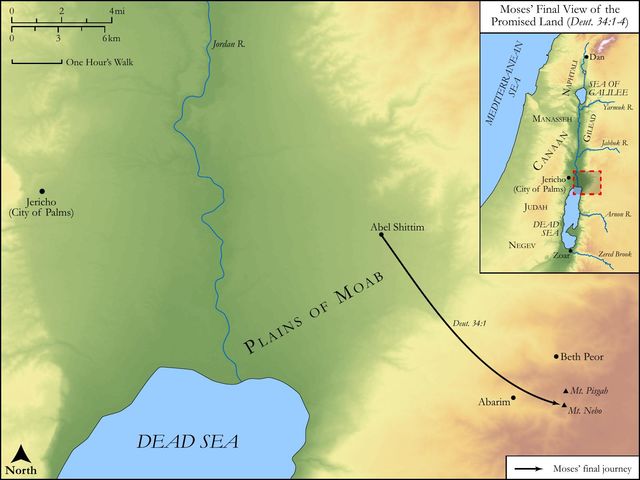
The setting for this profound event is the plains of Moab, situated east of the Jordan River, where the Israelites were encamped and poised to enter Canaan. Moses, now 120 years old and keenly aware of his impending death (as prophesied in Deuteronomy 31:2), seized this final opportunity to impart critical instruction to the nation. In Israel, oral tradition played a paramount role in transmitting laws, history, and wisdom, as parents were charged to teach the words of the LORD diligently to their children. A "song" was a highly effective mnemonic device, specifically designed for memorization and recitation, making it an ideal vehicle for embedding core theological truths and covenant stipulations into the collective memory of a people. The public, communal hearing emphasized the corporate responsibility of the covenant community to heed God's word.
Key Themes
ShowHideDeuteronomy 32:44 powerfully articulates several enduring themes central to the book of Deuteronomy and the broader Pentateuch. Firstly, it highlights the enduring authority and necessity of divine revelation, underscoring that God's word, even in song form, is a binding and life-giving instruction. Secondly, the verse emphasizes leadership transition and continuity, as Moses, the foundational leader, is joined by Hoshea (Joshua), his designated successor. This joint presentation signifies a seamless transfer of divine mandate and assures the people that God's plan and covenant will persist beyond individual leadership. Finally, the phrase "spake... in the ears of the people" stresses the theme of corporate hearing and communal reception. It is not enough for the word to merely exist; it must be heard, internalized, and acted upon by the entire community, preparing them for the challenges and responsibilities of life in the Promised Land, as seen in the call to remember the Law and teach it diligently in Deuteronomy 6:4-9.
Exposition and Analysis
ShowHideKey Word Analysis
ShowHideA primitive root meaning "to arrange; but used figuratively (of words), to speak; rarely (in a destructive sense) to subdue." In this context, "spake" implies a weighty, authoritative declaration, far beyond casual conversation. When Moses "speaks" God's words, it carries the full weight of divine authority and covenant obligation, emphasizing the solemnity and crucial importance of the message being delivered.
Meaning "a word; by implication, a matter (as spoken of) or thing; adverbially, a cause." This term refers to the specific content of the "Song of Moses." The use of "all the words" emphasizes the completeness and integrity of the message; nothing was omitted or altered. It signifies the divine origin and comprehensive nature of the instruction, which encompassed historical recount, theological truth, and prophetic warning.
Meaning "deliverer; Hoshea, the name of five Israelites." This is the original name of Joshua, meaning "salvation" or "he saves." Moses later changed his name to Yehoshua (יְהוֹשֻׁעַ), meaning "Yahweh is salvation" or "the LORD saves," as recorded in Numbers 13:16. The use of his original name here might subtly highlight his role as Moses' assistant and apprentice before fully stepping into his prophetic and military leadership, or it could simply be a stylistic choice reflecting the historical moment before his full assumption of leadership. Regardless, his presence clearly identifies the man who would lead Israel into the Promised Land.
Verse Breakdown
ShowHide"And Moses came and spake all the words of this song"
This clause highlights Moses' active and intentional role in the final transmission of God's message. "Came" (H935, bôwʼ) suggests a deliberate and purposeful action, while "spake" (H1696, dâbar') implies an authoritative and weighty declaration. The phrase "all the words of this song" (H1697, dâbâr'; H7892, shîyr') emphasizes the completeness and integrity of the message; nothing was omitted or altered. This underscores the divine origin and comprehensive nature of the instruction, which was a full and final testament from God through Moses.
"in the ears of the people"
This phrase is crucial, emphasizing the direct, public, and communal nature of the delivery. It signifies that the message was not merely written down or spoken in private, but was audibly proclaimed to the entire assembly of Israel (H5971, ʻam). This direct address ensured that every individual had the opportunity to hear and, by extension, internalize and be held accountable for the "song's" profound contents. It speaks to the importance of active listening and the corporate reception of divine truth as foundational for the community's spiritual health and obedience.
"he, and Hoshea the son of Nun"
The inclusion of Hoshea (H1954, Hôwshêaʻ') alongside Moses is highly significant. It serves as a public endorsement of Joshua as Moses' designated successor, demonstrating a seamless transfer of authority and divine favor. Joshua's presence signifies continuity in leadership and reinforces the message's enduring relevance beyond Moses' lifetime. It also implies a shared responsibility for the transmission and upholding of God's covenant, with Joshua poised to continue the legacy of teaching and leading Israel in obedience to God's commands.
Literary Devices
ShowHideDeuteronomy 32:44, though concise, employs several significant literary techniques. The most prominent is Symbolism: the very act of Moses speaking the song, accompanied by Joshua, profoundly symbolizes the continuity of divine revelation and the seamless, divinely ordained transition of leadership. The "song" itself is a powerful symbol of the covenant, serving as a mnemonic device designed to embed God's faithfulness, Israel's history, and their covenantal obligations deeply into the national consciousness. Furthermore, the inclusion of Hoshea (Joshua) foreshadows his imminent leadership role in bringing Israel into the Promised Land, effectively linking the culmination of Moses' ministry with the commencement of Joshua's. The emphasis on speaking "in the ears of the people" highlights the crucial role of oral tradition as a primary mode of instruction and covenant transmission in ancient Israel, reinforcing the importance of direct, audible proclamation and communal reception of sacred texts.
Theological and Thematic Connections
ShowHideDeuteronomy 32:44 encapsulates profound theological truths concerning the nature of divine revelation, the responsibility of leadership, and the corporate reception of God's Word. The public recitation of the Song of Moses, a comprehensive theological and historical summary, underscores the enduring authority and necessity of God's instruction for the life and well-being of His people. It teaches that divine truth is not meant to be static but must be actively transmitted, heard, and internalized across generations. The presence of Joshua alongside Moses highlights the divine provision for leadership succession, ensuring that God's covenant purposes continue even as human leaders change. This verse serves as a powerful reminder that the health and faithfulness of a community are directly tied to its diligent engagement with and faithful adherence to the Word of God, which is both a guide and a witness.
Reflection and Application
ShowHideDeuteronomy 32:44 offers timeless lessons for contemporary believers, challenging us to consider our role in the ongoing transmission of God's truth. Just as Moses diligently ensured the complete and public transmission of God's message to the Israelites, we are called to be faithful stewards of the Gospel and the entirety of God's Word. This verse compels us to examine how effectively we are hearing, internalizing, and transmitting spiritual truth within our families, our faith communities, and to the next generation. It emphasizes that the Word of God is not merely intellectual information but a living, active force meant to shape our identity, guide our actions, and sustain our hope. The presence of Joshua reminds us of the vital importance of mentorship, discipleship, and preparing future leaders to carry on the spiritual mandate. Our spiritual vitality, individually and corporately, hinges on our commitment to truly "hear" God's voice, to live by His every word, and to ensure its faithful proclamation, preparing us for our own "promised land" of Christ-like living and eternal hope.
Questions for Reflection
ShowHideFAQ
ShowHideWhy is Hoshea called by his original name here instead of Joshua?
ShowHideWhile Hoshea is most commonly known as Joshua, his name was originally Hoshea (meaning "salvation"). Moses changed his name to Yehoshua (Joshua), meaning "Yahweh is salvation" or "the LORD saves," as recorded in Numbers 13:16. The use of his original name in Deuteronomy 32:44 might serve several purposes. It could be a precise historical detail, reflecting his identity at that specific moment before he fully assumed the mantle of national leadership. It might also subtly emphasize his role as Moses' assistant and apprentice, highlighting the transition of authority rather than his already established leadership. Regardless, it clearly identifies the individual who would lead Israel into the Promised Land, underscoring the continuity of divine purpose.
What is the significance of a "song" for conveying divine truth in ancient Israel?
ShowHideIn ancient Israel, a "song" was a highly effective and culturally significant medium for transmitting important information. Unlike prose, a song's rhythm, rhyme, and structured narrative made it inherently easier to memorize and recall, ensuring that the message could be passed down accurately through generations. The "Song of Moses" was specifically commanded by God in Deuteronomy 31:19 to serve as a "witness" against Israel, a permanent record of God's covenant faithfulness and Israel's potential for disobedience. Its poetic form also allowed for deeper emotional and theological resonance, embedding the truths not just intellectually but existentially within the community. It transformed a legal or historical text into a living, breathing testimony, ensuring its enduring impact on the national consciousness.
Christ-Centered Fulfillment
ShowHideDeuteronomy 32:44, with Moses' final authoritative declaration of God's Word to His people, profoundly foreshadows the ultimate revelation of God in Jesus Christ. Moses, as the great prophet and law-giver, faithfully delivered God's word to Israel, but Jesus is the very Word of God made flesh, the complete and final revelation of the Father (John 1:1-3; Hebrews 1:1-2). While Moses' song served as a witness against Israel's potential disobedience and pointed to their need for redemption, Christ perfectly fulfilled the Law and the Prophets (Matthew 5:17) and became the Lamb of God who takes away the sin of the world. The continuity of leadership from Moses to Joshua, ensuring the transmission of God's message and the entry into the earthly promised land, finds its ultimate fulfillment in Christ's commissioning of His disciples to proclaim the Gospel to all nations (Matthew 28:18-20), ensuring that His life-giving words are heard "in the ears of the people" across all generations and cultures, leading them into the true promised land of eternal life in His kingdom.