


Exodus 17:8
Bible text: King James Version (1769 Blayney text) · Public domain
Bible text: Berean Standard Bible · Public domain
Bible text: American Standard Version (1901) · Public domain
Bible text: World English Bible, Messianic edition · Public domain
Bible text: Geneva Bible (1599) · Public domain
Bible text: Young's Literal Translation · Public domain
- וַיָּבֹאvai·ya·Vo'and it cameH935Conj-w ¦ V-Qal-ConsecImperf-3msVerb Qal Consecutive Imperfect 3rd Singular Masculineוַandיָּבֹאit came
- עֲמָלֵק'a·ma·LekAmalekH6002N-properNoun Proper Location
- וַיִּלָּחֶםvai·yi·La·chemand it joined battleH3898Conj-w ¦ V-Niphal-ConsecImperf-3msVerb Niphal Consecutive Imperfect 3rd Singular Masculineוַandיִּלָּחֶםit joined battle
- עִם'imwithH5973PrepPreposition
- יִשְׂרָאֵלYis·ra·'ElIsraelH3478N-properNoun Proper Location
- בִּרְפִידִםbir·fi·Dimat RephidimH7508Prep-b ¦ N-properNoun Proper LocationבִּatרְפִידִםRephidim
English is a literal word-by-word gloss of the Hebrew, not the KJV's wording. Why?
This is the original text the KJV's translators worked from — each Hebrew word with its own literal English meaning in this verse, prepared by scholars at Tyndale House, Cambridge. The KJV translates whole sentences, not word by word, so its wording differs: one Hebrew word can become several English words, and the KJV may choose “the LORD” where the gloss reads “Yahweh”. Both are faithful — they answer different questions. For the KJV's own rendering, switch to the KJV text.
Details
See on the biblical-era maps

Study this verse
Public-domain commentary
Matthew Henry
From his Commentary on the Whole Bible. Henry comments on passages, not single verses — this entry covers Exodus 17:8–16. His three-level outline is real structure in the source text, so it is rendered as structure.
We have here the story of the war with Amalek, which, we may suppose, was the first that was recorded in the book of the wars of the Lord, Num 21:14. Amalek was the first of the nations that Israel fought with, Num 24:20. Observe,
I.Amalek's attempt:
They came out, and fought with Israel, Exo 17:8. The Amalekites were the posterity of Esau, who hated Jacob because of the birthright and blessing, and this was an effort of the hereditary enmity, a malice that ran in the blood, and perhaps was now exasperated by the working of the promise towards an accomplishment. Consider this,
1.As Israel's affliction. They had been quarrelling with Moses (Exo 17:2), and now God sends Amalekites to quarrel with them; wars abroad are the just punishment of strifes and discontents at home.
2.As Amalek's sin; so it is reckoned, Deu 25:17, Deu 25:18. They did not boldly front them as a generous enemy, but without any provocation given by Israel, or challenge given to them, basely fell upon their rear, and smote those that were faint and feeble and could neither make resistance nor escape. Herein they bade defiance to that power which had so lately ruined the Egyptians; but in vain did they attack a camp guarded and victualled by miracles: verily they knew not what they did.
II.Israel's engagement with Amalek, in their own necessary defence against the aggressors. Observe,
1.The post assigned to Joshua, of whom this is the first mention: he is nominated commander-in-chief in this expedition, that he might be trained up to the services he was designed for after the death of Moses, and be a man of war from his youth. He is ordered to draw out a detachment of choice men from the thousands of Israel and to drive back the Amalekites, Exo 17:9. When the Egyptians pursued them Israel must stand still and see what God would do; but now it was required that they should bestir themselves. Note, God is to be trusted in the use of means.
2.The post assumed by Moses: I will stand on the top of the hill with the rod of God in my hand, Exo 17:9. See how God qualifies his people for, and calls them to, various services for the good of his church: Joshua fights, Moses prays, and both minister to Israel. Moses went up to the top of the hill, and placed himself, probably, so as to be seen by Israel; there he held up the rod of God in his hand, that wonder-working rod which had summoned the plagues of Egypt, and under which Israel had passed out of the house of bondage. This rod Moses held up to Israel, to animate them; the rod was held up as the banner to encourage the soldiers, who might look up, and say, "Yonder is the rod, and yonder the hand that used it, when such glorious things were wrought for us." Note, It tends much to the encouragement of faith to reflect upon the great things God has done for us, and review the monuments of his favours. Moses also held up this rod to God, by way of appeal to him: "Is not the battle the Lord's? Is not he able to help, and engaged to help? Witness this rod, the voice of which, thus held up, is (Isa 51:9, Isa 51:10), Put on strength, O arm of the Lord; art not thou it that hath cut Rahab?" Moses was not only a standard-bearer, but an intercessor, pleading with God for success and victory. Note, When the host goes forth against the enemy earnest prayers should be made to the God of hosts for his presence with them. It is here the praying legion that proves the thundering legion. There, in Salem, in Sion where prayers were made, there the victory was won, there broke the arrows of the bow, Psa 76:2, Psa 76:3. Observe,
(1.)How Moses was tired (Exo 17:12): His hands were heavy. The strongest arm will fail with being long extended; it is God only whose hand is stretched out still. We do not find that Joshua's hands were heavy in fighting, but Moses's hands were heavy in praying. The more spiritual any service is the more apt we are to fail and flag in it. Praying work, if done with due intenseness of mind and vigour of affection, will be found hard work, and, though the spirit be willing, the flesh will be weak. Our great Intercessor in heaven faints not, nor is he weary, though he attends continually to this very thing.
(2.)What influence the rod of Moses had upon the battle (v. 11): When Moses held up his hand in prayer (so the Chaldee explains it) Israel prevailed, but, when he let down his hand from prayer, Amalek prevailed. To convince Israel that the hand of Moses (with whom they had just now been chiding) contributed more to their safety than their own hands, his rod than their sword, the success rises and falls as Moses lifts up or lets down his hands. It seems, the scale wavered for some time, before it turned on Israel's side. Even the best cause must expect disappointments as an alloy to its successes; though the battle be the Lord's, Amalek may prevail for a time. The reason was, Moses let down his hands. Note, The church's cause is, commonly, more or less successful according as the church's friends are more or less strong in faith and fervent in prayer.
(3.)The care that was taken for the support of Moses. When he could not stand any longer he sat down, not in a chair of state, but upon a stone (v. 12); when he could not hold up his hands, he would have them held up. Moses, the man of God, is glad of the assistance of Aaron his brother, and Hur, who, some think, was his brother-in-law, the husband of Miriam. We should not be shy either of asking help from others or giving help to others, for we are members one of another. Moses's hands, thus stayed, were steady till the going down of the sun; and, though it was with much ado that he held out, yet his willing mind was accepted. No doubt it was a great encouragement to the people to see Joshua before them in the field of battle and Moses above them upon the top of the hill: Christ is both to us - our Joshua, the captain of our salvation who fights our battles, and our Moses, who, in the upper world, ever lives making intercession, that our faith fail not.
III.The defeat of Amalek.
Victory had hovered awhile between the camps; sometimes Israel prevailed and sometimes Amalek, but Israel carried the day, v. 13. Though Joshua fought with great disadvantages - his soldiers undisciplined, ill-armed, long inured to servitude, and apt to murmur; yet by them God wrought a great salvation, and made Amalek pay dearly for his insolence. Note, Weapons formed against God's Israel cannot prosper long, and shall be broken at last. The cause of God and his Israel will be victorious. Though God gave the victory, yet it is said, Joshua discomfited Amalek, because Joshua was a type of Christ, and of the same name, and in him it is that we are more than conquerors. It was his arm alone that spoiled principalities and powers, and routed all their force.
IV.The trophies of this victory set up.
1.Moses took care that God should have the glory of it (v. 15); instead of setting up a triumphal arch, to the honour of Joshua (though it had been a laudable policy to put marks of honour upon him), he builds an altar to the honour of God, and we may suppose it was not an altar without sacrifice; but that which is most carefully recorded is the inscription upon the altar, Jehovah-nissi - The Lord is my banner, which probably refers to the lifting up of the rod of God as a banner in this action. The presence and power of Jehovah were the banner under which they enlisted, by which they were animated and kept together, and therefore which they erected in the day of their triumph. In the name of our God we must always lift up our banners, Psa 20:5. It is fit that he who does all the work should have all the praise.
2.God took care that posterity should have the comfort and benefit of it: "Write this for a memorial, not in loose papers, but in a book, write it, and then rehearse it in the ears of Joshua, let him be entrusted with this memorial, to transmit it to the generations to come." Moses must now begin to keep a diary or journal of occurrences; it is the first mention of writing that we find in scripture, and perhaps the command was not given till after the writing of the law upon the tables of stone: "Write it in perpetuam rei memoriam - that the event may be had in perpetual remembrance; that which is written remains." (1.) "Write what has been done, what Amalek has done against Israel; write in gall their bitter hatred, write in blood their cruel attempts, let them never be forgotten, nor yet what God has done for Israel in saving them from Amalek. Let ages to come know that God fights for his people, and he that touches them touches the apple of his eye." (2.) Write what shall be done. [1.] That in process of time Amalek shall be totally ruined and rooted out (Exo 17:14), that he shall be remembered only in history." Amalek would have cut off the name of Israel, that it might be no more in remembrance (Psa 83:4, Psa 83:7); and therefore God not only disappoints him in this, but cuts off his name. "Write it for the encouragement of Israel, whenever the Amalekites are an annoyance to them, that Israel will at last undoubtedly triumph in the fall of Amalek." This sentence was executed in part by Saul (1 Sa. 15), and completely by David (ch. 30; Sa2 1:1; Sa2 8:12); after his time we never read so much as of the name of Amalek. [2.] This is the mean time God would have a continual controversy with him (v. 16): Because his hand is upon the throne of the Lord, that is, against the camp of Israel in which the Lord ruled, which was the place of his sanctuary, and is therefore called a glorious high throne from the beginning (Jer 17:12); therefore the Lord will have war with Amalek from generation to generation. This was written for direction to Israel never to make any league with the Amalekites, but to look upon them as irreconcilable enemies, doomed to ruin. Amalek's destruction was typical of the destruction of all the enemies of Christ and his kingdom. Whoever make war with the Lamb, the Lamb will overcome them.
Historical interpretation
Historical reception
1 surviving comment on this verse from the historical church.
There is no vice which the divine law resists more [than pride]. That most proud spirit becomes an obstacle to things above and a mediator to things below. It thereby receives a greater power of domination, unless one avoids the secret snares he is laying by going along a different way. If he is openly raging through a sinful people, he is like Amalek. By his opposition he denies the passage to the land of promise. He then must be overcome by the cross of Christ, which was prefigured by the extended hands of Moses.
Continue studying Exodus 17:8 across the web’s major study libraries — every link below opens this exact verse, chapter, or book on the destination site.
Read & Compare
 BibleGatewayThis verse in more than 200 translations and 70 languages.
 Bible.comThe YouVersion reader — hundreds of translations, reading plans, and highlights.
 ESV.orgCrossway's official English Standard Version reader.
 NET BibleThe NET translation with 60,000+ translators' notes on every rendering decision.
 STEP BibleTyndale House's free study tool — original text, vocabulary, and scholarly resources.
 BibliaLogos Bible Software's free web reader.
 USCCBThe New American Bible (Revised Edition) with the U.S. bishops' study notes.
Commentaries
 BibleHub CommentariesDozens of classic commentaries on this verse, gathered on one page.
 StudyLightMore than 100 commentary sets — the largest collection on the web.
 BibleRefPlain-English commentary on what this verse means, verse by verse.
 Enduring WordDavid Guzik's free commentary on this chapter, widely used by Bible teachers.
 Bible Study ToolsVerse commentary alongside Greek and Hebrew study aids.
Original Language & Research
- BibleHub InterlinearThe verse word by word — original language, transliteration, and English.
- BibleHub LexiconEvery word's original-language definition and Strong's entry.
 Blue Letter BibleDeep-study tools — Strong's numbers, concordance, and word studies.
 SefariaThe Hebrew text with Rashi and centuries of Jewish commentary.
Sermons, Hymns & Audio


TrulyRandomVerse is not affiliated with these sites and doesn’t control their content. They’re linked because they’re genuinely useful.
Summary
Exodus 17:8 marks a pivotal moment in Israel's wilderness journey, introducing their first direct military confrontation with an external enemy, the Amalekites, in Rephidim. This unprovoked assault immediately follows a period of intense internal testing and miraculous divine provision of water, dramatically shifting the nation's focus from internal grumbling to the necessity of external warfare. This verse sets the stage for a foundational narrative that illustrates God's role as Israel's divine warrior and introduces an archetypal enemy that would challenge God's people throughout their history.
Context
ShowHideLiterary Context
This verse immediately follows a significant period of testing and divine provision at Rephidim. The Israelites, having journeyed from the wilderness of Sin, arrived at Rephidim and, once again, bitterly complained about the lack of water, even questioning God's presence among them, as detailed in Exodus 17:1-3. In response to Moses' plea, God miraculously provided water from the rock at Horeb, an event commemorated by the names Massah and Meribah, signifying "testing" and "quarreling," as recounted in Exodus 17:4-7. Just as their immediate physical needs were met and their faith was reaffirmed through divine intervention, an unexpected and aggressive external threat emerged. The sudden appearance of Amalek shifts the narrative from internal strife and God's provision to the necessity of warfare and God's protection in battle, setting the stage for the crucial events of Exodus 17:9-16.
Historical & Cultural Context
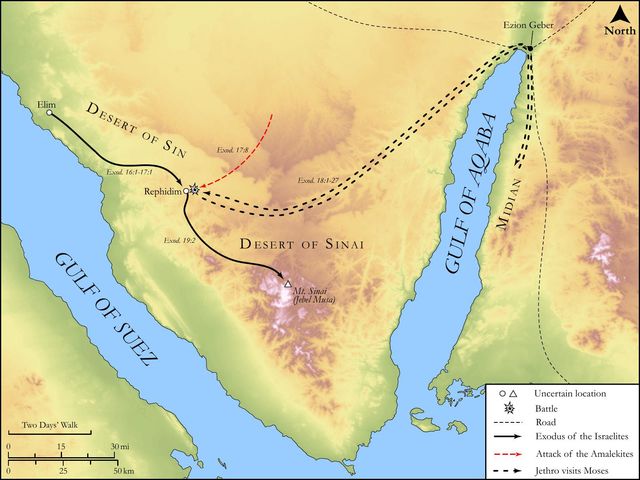
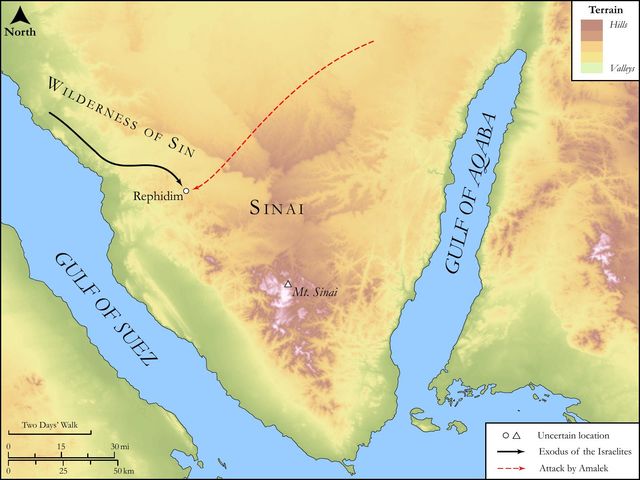
The Amalekites were a nomadic, predatory people, traditionally understood as descendants of Esau's grandson, Amalek, as recorded in Genesis 36:12. Their attack on Israel in Rephidim was particularly treacherous and cowardly. Israel was still recovering from the arduous journey out of Egypt, comprising a vast multitude, including women, children, and the elderly, who were likely trailing at the rear of the camp. The Amalekites typically preyed on the weak and vulnerable, and their assault on the exhausted Israelite stragglers, as later condemned in Deuteronomy 25:17-18, demonstrated a profound lack of hospitality and a direct challenge to God's chosen people. Rephidim itself was a crucial waypoint, likely a wadi or oasis, strategically important for access to the Sinai peninsula. This unprovoked aggression initiated a long-standing, bitter conflict between Israel and Amalek, establishing Amalek as a persistent enemy of God's people throughout biblical history.
Key Themes
ShowHideExodus 17:8 contributes significantly to several major theological and narrative themes within the book of Exodus and the broader Pentateuch. It introduces the theme of divine warfare and God's role as Israel's champion, transitioning from miraculous deliverance (e.g., the Red Sea crossing in Exodus 14) to active combat against terrestrial foes. This verse also highlights the theme of testing and obedience, as Israel's faith, recently tested by thirst, is now challenged by an external threat that demands reliance on God for victory. Furthermore, it establishes the archetypal enemy motif, where Amalek represents a persistent, insidious opposition to God's people and His redemptive purposes, a theme that reverberates throughout Israel's history and is later underscored by divine decree in Exodus 17:14.
Exposition and Analysis
ShowHideKey Word Analysis
ShowHideThis name refers to a tribal group, likely descended from Esau's grandson. In this context, "Amalek" signifies more than just a specific people; it represents an unprovoked, insidious, and persistent enemy. Their attack on the vulnerable Israelites, immediately after God's miraculous provision, marks them as an adversary of God's redemptive purposes, setting a precedent for their later designation as an enemy to be utterly destroyed (Deuteronomy 25:19).
Derived from the primitive root H3898, meaning "to feed on; figuratively, to consume; by implication, to battle (as destruction)." This verb indicates a direct, intentional, and organized military engagement, not merely a skirmish or a minor conflict. The use of this strong verb emphasizes the severity and deliberate nature of the Amalekite aggression, highlighting that Israel was thrust into a full-scale battle.
This place name, plural of the masculine of the same as H7508, possibly means "ballusters" or "places of rest/support." Its significance here is geographical and situational. It was a critical, strategic location on the journey to Mount Sinai, and its name ironically contrasts with the conflict that erupted there. The location underscores Israel's vulnerability in the wilderness and the suddenness of the attack in a place where they might have expected respite.
Verse Breakdown
ShowHide"¶ Then came Amalek,"
This opening phrase signals a sudden and decisive action, marking a dramatic shift in the narrative. The "¶" (pilcrow) in the KJV indicates a new paragraph or section, emphasizing the transition from internal issues (grumbling for water) to an external threat. The arrival of Amalek is presented as an uninvited, aggressive intrusion into Israel's journey, highlighting the unexpected and unprovoked nature of the conflict.
"and fought with Israel"
This clause explicitly states the nature of the encounter: a direct military engagement. It signifies that the Amalekites initiated hostilities against the entire nation of Israel, not just a small contingent. This was Israel's first experience of warfare as a unified, liberated people, testing their reliance on God's protection in a new and profound way, and forcing them to confront an enemy with physical force.
"in Rephidim."
The specific location grounds the event in Israel's physical journey. Rephidim, a place where they had just experienced God's miraculous provision of water, now becomes the site of their first major battle. This juxtaposition underscores the reality that divine blessing and provision do not preclude the necessity of spiritual and physical conflict, and that challenges can arise even in places of expected rest.
Literary Devices
ShowHideExodus 17:8 employs several significant literary devices that enrich its meaning. Juxtaposition is prominent, as the verse immediately follows the narrative of God's miraculous provision of water from the rock, creating a stark contrast between divine care and human aggression. This highlights the continuous nature of trials Israel faced, shifting from internal discontent to external warfare. Foreshadowing is also evident; this initial conflict with Amalek sets the stage for a long-standing enmity between the two peoples, foreshadowing future battles and God's ultimate command to utterly blot out Amalek's remembrance, as later detailed in Exodus 17:14 and Deuteronomy 25:17-19. Furthermore, Amalek functions as a symbol of persistent, insidious opposition to God's people and His redemptive plan, representing the forces that seek to hinder spiritual progress and undermine faith. This symbolic representation extends throughout biblical history, culminating in figures like Haman in the book of Esther.
Theological and Thematic Connections
ShowHideExodus 17:8 introduces the critical theme of spiritual warfare and the reality of external opposition to God's people. Just as Israel, having just experienced miraculous provision, faced an unprovoked attack, believers today can expect challenges even after experiencing divine grace. This encounter underscores that the journey of faith is not merely one of internal growth and divine blessing, but also of contending with forces that actively oppose God's purposes. It highlights God's role as the divine warrior who fights for His people, even when they are vulnerable, and calls for active participation in the battle through faith and obedience. The enduring enmity with Amalek also serves as a theological illustration of the persistent nature of evil that seeks to thwart God's plan and the necessity of divine judgment against such forces.
Reflection and Application
ShowHideExodus 17:8 serves as a potent reminder for believers that the spiritual journey is rarely a smooth, uninterrupted path of ease. Even after experiencing profound divine provision and overcoming internal struggles, we can anticipate unexpected external attacks. Just as Amalek preyed on the weary and vulnerable, spiritual adversaries often target us when we feel complacent, exhausted, or have just received a blessing. This verse calls us to vigilance, recognizing that the Christian life involves continuous spiritual warfare. Our response, however, is not to despair but to rely on God's strength and leadership, knowing that He is our divine warrior. It encourages us to be prepared, to stand firm in faith, and to engage in the battle not in our own strength, but in the power of the One who fights for us, trusting that He will provide the means for victory.
Questions for Reflection
ShowHideFAQ
ShowHideWhy was Amalek's attack considered so egregious and worthy of perpetual enmity?
ShowHideAmalek's attack was considered uniquely heinous for several reasons, as further elaborated in Deuteronomy 25:17-18. First, it was an unprovoked assault on a people who were not seeking conflict but were merely passing through. Second, and most significantly, the Amalekites specifically targeted the weak, the weary, and the stragglers at the rear of the Israelite camp, including women, children, and the elderly. This demonstrated a profound lack of human decency and hospitality, violating ancient customs of safe passage. Spiritually, their attack was seen as a direct challenge to God Himself, as Israel was under divine protection and guidance. By attacking God's chosen people, especially at their most vulnerable, Amalek set themselves up as an archetypal enemy of God's redemptive plan, leading to God's solemn oath to "blot out the remembrance of Amalek from under heaven" (Exodus 17:14).
Christ-Centered Fulfillment
ShowHideExodus 17:8, while detailing a historical battle, finds profound Christ-centered fulfillment in the New Testament. The Amalekites, as an insidious and persistent enemy attacking the vulnerable, foreshadow the spiritual adversaries that oppose God's people in every age: sin, death, and the demonic forces. Just as Israel required a divinely appointed leader like Joshua to fight the physical battle and Moses to intercede on the mountain with uplifted hands, so too does humanity require a divine champion and intercessor. Jesus Christ is our ultimate Joshua, leading us in the spiritual battle against our true enemies, having already triumphed over principalities and powers through His cross, disarming them and making a public spectacle of them (Colossians 2:14-15). Furthermore, Christ is our greater Moses, whose hands were lifted on the cross, not merely in intercession, but in ultimate sacrifice, securing our decisive victory over sin and death. His finished work on Calvary is the decisive blow against all spiritual Amaleks, ensuring that while we may face battles in this life, the ultimate victory is already ours through Him, making us "more than conquerors" (Romans 8:37). He continuously intercedes for us as our High Priest, able to save completely those who come to God through Him (Hebrews 7:25), empowering us to overcome every spiritual foe.