


Numbers 11:28
Bible text: King James Version (1769 Blayney text) · Public domain
Bible text: Berean Standard Bible · Public domain
Bible text: American Standard Version (1901) · Public domain
Bible text: World English Bible, Messianic edition · Public domain
Bible text: Geneva Bible (1599) · Public domain
Bible text: Young's Literal Translation · Public domain
- וַיַּעַןvai·Ya·'anand he answeredH6030Conj-w ¦ V-Qal-ConsecImperf-3msVerb Qal Consecutive Imperfect 3rd Singular Masculineוַandיַּעַןhe answered
- יְהוֹשֻׁעַye·ho·Shu·a'JoshuaH3091N-proper-mNoun Proper Masculine
- בִּןbin[the] son ofH1121N-mscNoun Singular Masculine Construct
- נוּןNunNunH5126N-proper-mNoun Proper Masculine
- מְשָׁרֵתme·sha·Ret[the] servant ofH8334V-Piel-Prtcpl-msVerb Piel Participle Singular Masculine Construct
- מֹשֶׁהmo·ShehMosesH4872N-proper-mNoun Proper Masculine
- מִבְּחֻרָיוmi·be·chu·Ravfrom his youth<s>H979Prep-m ¦ N-mpc ¦ 3msNoun Plural Masculine Constructמִfromבְּחֻרָיyouth<s>וhis
- וַיֹּאמַרvai·yo·Marand he saidH559Conj-w ¦ V-Qal-ConsecImperf-3msVerb Qal Consecutive Imperfect 3rd Singular Masculineוַandיֹּאמַרhe said
- אֲדֹנִי'a·do·Nimy O lordH113N-msc ¦ 1csNoun Singular Masculine ConstructאֲדֹנִO lordיmy
- מֹשֶׁהmo·ShehMosesH4872N-proper-mNoun Proper Masculine
- כְּלָאֵםke·la·'Emrestrain themH3607V-Qal-Imp-2ms ¦ 3mpVerb Qal Imperative 2nd Singular Masculineכְּלָאֵrestrainםthem
English is a literal word-by-word gloss of the Hebrew, not the KJV's wording. Why?
This is the original text the KJV's translators worked from — each Hebrew word with its own literal English meaning in this verse, prepared by scholars at Tyndale House, Cambridge. The KJV translates whole sentences, not word by word, so its wording differs: one Hebrew word can become several English words, and the KJV may choose “the LORD” where the gloss reads “Yahweh”. Both are faithful — they answer different questions. For the KJV's own rendering, switch to the KJV text.
Details
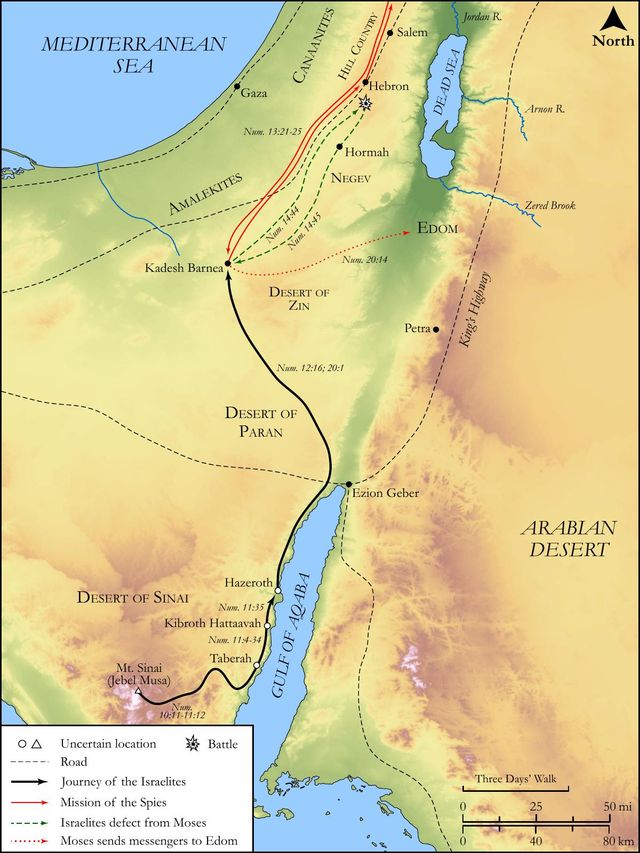
See on the biblical-era map
Study this verse
Public-domain commentary
Matthew Henry
From his Commentary on the Whole Bible. Henry comments on passages, not single verses — this entry covers Numbers 11:24–30. His three-level outline is real structure in the source text, so it is rendered as structure.
We have here the performance of God's word to Moses, that he should have help in the government of Israel.
I.Here is the case of the seventy privy-counsellors in general.
Moses, though a little disturbed by the tumult of the people, yet was thoroughly composed by the communion he had with God, and soon came to himself again. And according as the matter was concerted,
1.He did his part; he presented the seventy elders before the Lord, round the tabernacle (Num 11:24), that they might there stand ready to receive the grace of God, in the place where he manifested himself, and that the people also might be witnesses of their solemn call. Note, Those that expect favour from God must humbly offer themselves and their service to him.
2.God was not wanting to do his part. He gave of his Spirit to the seventy elders (Num 11:25), which enabled those whose capacities and education set them but on a level with their neighbours of a sudden to say and do that which was extraordinary, and which proved them to be actuated by divine inspiration: they prophesied, and did not cease all that day, and (some think) only that day. They discoursed to the people of the things of God, and perhaps commented upon the law they had lately received with admirable clearness, and fulness, and readiness, and aptness of expression, so that all who heard them might see and say that God was with them of a truth; see Co1 14:24, Co1 14:25. Thus, long afterwards, Saul was marked for the government by the gift of prophecy, which came upon him for a day and a night, Sa1 10:6, Sa1 10:11. When Moses was to fetch Israel out of Egypt, Aaron was appointed to be his prophet, Exo 7:1. But, now that God had called Aaron to other work, in his room Moses has seventy prophets to attend him. Note, Those are fittest to rule in God's Israel that are well acquainted with divine things and are apt to teach to edification.
II.Here is the particular case of two of them, Eldad and Medad, probably two brothers.
1.They were nominated by Moses to be assistants in the government, but they went not out unto the tabernacle as the rest did, Num 11:26. Calvin conjectures that the summons was sent them, but that it did not find them, they being somewhere out of the way; so that, though they were written, yet they were not called. Most think that they declined coming to the tabernacle out of an excess of modesty and humility; being sensible of their own weakness and unworthiness, they desired to be excused from coming into the government. Their principle was their praise, but their practice in not obeying orders was their fault.
2.The Spirit of God found them out in the camp, where they were hidden among the stuff, and there they prophesied, that is, they exercised their gift of praying, preaching, and praising God, in some private tent. Note, The Spirit of God is not tied to the tabernacle, but, like the wind, blows where he listeth, Joh 3:8. Whither can we go from that Spirit? There was a special providence in it that these two should be absent, for thus it appeared that it was indeed a divine Spirit which the elders were actuated by, and that Moses gave them not that Spirit, but God himself. They modestly declined preferment, but God forced it upon them; nay, they have the honour of being named, which the rest have not: for those that humble themselves shall be exalted, and those are most fit for government who are least ambitious of it.
3.Information of this was given to Moses (Num 11:27): "Eldad and Medad do prophesy in the camp; there is a conventicle in such a tent, and Eldad and Medad are holding forth there, from under the inspection and presidency of Moses, and out of the communion of the rest of the elders." Whoever the person was that brought the tidings, he seems to have looked upon it as an irregularity.
4.Joshua moved to have them silenced: My lord Moses, forbid them, Num 11:28. It is probable that Joshua himself was one of the seventy, which made him the more jealous for the honour of their order. He takes it for granted that they were not under any necessitating impulse, for the spirit of the prophets is subject to the prophets, and therefore he would have them either not to prophesy at all or to come to the tabernacle and prophesy in concert with the rest. He does not desire that they should be punished for what they had done, but only restrained for the future. This motion he made from a good principle, not out of any personal dislike to Eldad and Medad, but out of an honest zeal for that which he apprehended to be the unity of the church, and concern for the honour of God and Moses.
5.Moses rejected the motion, and reproved him that made it (v. 29): "Enviest thou for my sake? Thou knowest not what manner of spirit thou art of." Though Joshua was Moses's particular friend and confidant, though he said this out of a respect to Moses, whose honour he was very loth to see lessened by the call of those elders, yet Moses reproves him, and in him all that show such a spirit.
(1.)We must not secretly grieve at the gifts, graces, and usefulness of others. It was the fault of John's disciples that they envied Christ's honour because it shaded their master's, Joh 3:26, etc.
(2.)We must not be transported into heats against the weaknesses and infirmities of others. Granting that Eldad and Medad were guilty of an irregularity, yet Joshua was too quick and too warm upon them. Our zeal must always be tempered with the meekness of wisdom: the righteousness of God needs not the wrath of man, Jam 1:20.
(3.)We must not make even the best and most useful men heads of a party. Paul would not have his name made use of to patronise a faction, Co1 1:12, Co1 1:13.
(4.)We must not be forward to condemn and silence those that differ from us, as if they did not follow Christ because they do not follow him with us, Mar 9:38. Shall we reject those whom Christ has owned, or restrain any from doing good because they are not in every thing of our mind? Moses was of another spirit; so far from silencing these two, and quenching the Spirit in them, he wished all the Lord's people were prophets, that is, that he would put his Spirit upon them. Not that he would have any set up for prophets that were not duly qualified, or that he expected that the Spirit of prophecy should be made thus common; but thus he expresses the love and esteem he had for all the Lord's people, the complacency he took in the gifts of others, and how far he was from being displeased at Eldad and Medad's prophesying from under his eye. Such an excellent spirit as this blessed Paul was of, rejoicing that Christ was preached, though it was by those who therein intended to add affliction to his bonds, Phi 1:16. We ought to be pleased that God is served and glorified, and good done, though to the lessening of our credit and the credit of our way.
6.The elders, now newly ordained, immediately entered upon their administration (Num 11:30); when their call was sufficiently attested by their prophesying, they went with Moses to the camp, and applied themselves to business. Having received the gift, they ministered the same as good stewards. And now Moses was pleased that he had so many to share with him in his work and honour. And,
(1.)Let the testimony of Moses be credited by those who desire to be in power, that government is a burden. It is a burden of care and trouble to those who make conscience of the duty of it; and to those who do not it will prove a heavier burden in the day of account, when they fall under the doom of the unprofitable servant that buried his talent.
(2.)Let the example of Moses be imitated by those that are in power; let them not despise the advice and assistance of others, but desire it, and be thankful for it, not coveting to monopolize wisdom and power. In the multitude of counsellors there is safety.
Historical interpretation
Historical reception
1 surviving comment on this verse from the historical church.
Joshua, the son of Nun and successor of Moses, was amazed, and coming to Moses said to him, Have you heard that Eldad and Medad are prophesying? They were called and did not come forward; “Moses, my lord, stop them.” I cannot forbid them, he said, for the grace is from heaven. So far am I from forbidding them that I consider it a favor. But I think you have not spoken thus in envy. Do not be overzealous on my account, because they have prophesied, and you do not yet prophesy. Await the proper time. “Would that all the people of the Lord might prophesy, whenever the Lord shall give them his spirit.”
Continue studying Numbers 11:28 across the web’s major study libraries — every link below opens this exact verse, chapter, or book on the destination site.
Read & Compare
 BibleGatewayThis verse in more than 200 translations and 70 languages.
 Bible.comThe YouVersion reader — hundreds of translations, reading plans, and highlights.
 ESV.orgCrossway's official English Standard Version reader.
 NET BibleThe NET translation with 60,000+ translators' notes on every rendering decision.
 STEP BibleTyndale House's free study tool — original text, vocabulary, and scholarly resources.
 BibliaLogos Bible Software's free web reader.
 USCCBThe New American Bible (Revised Edition) with the U.S. bishops' study notes.
Commentaries
 BibleHub CommentariesDozens of classic commentaries on this verse, gathered on one page.
 StudyLightMore than 100 commentary sets — the largest collection on the web.
 BibleRefPlain-English commentary on what this verse means, verse by verse.
 Enduring WordDavid Guzik's free commentary on this chapter, widely used by Bible teachers.
 Bible Study ToolsVerse commentary alongside Greek and Hebrew study aids.
Original Language & Research
- BibleHub InterlinearThe verse word by word — original language, transliteration, and English.
- BibleHub LexiconEvery word's original-language definition and Strong's entry.
 Blue Letter BibleDeep-study tools — Strong's numbers, concordance, and word studies.
 SefariaThe Hebrew text with Rashi and centuries of Jewish commentary.
Sermons, Hymns & Audio


TrulyRandomVerse is not affiliated with these sites and doesn’t control their content. They’re linked because they’re genuinely useful.
Summary
Numbers 11:28 captures a pivotal moment of zealous concern from Joshua, Moses' devoted attendant, during an extraordinary outpouring of God's Spirit in the wilderness. Witnessing Eldad and Medad prophesying spontaneously within the camp, outside the designated gathering at the Tabernacle, Joshua urgently appeals to Moses to forbid them, driven by a protective impulse for Moses' unique authority and the established order. This brief exchange sets the stage for Moses' profound and magnanimous response, highlighting the tension between human expectations of divine protocol and God's sovereign, unconstrained work.
Context
ShowHideLiterary Context
This verse is deeply embedded within the narrative of Numbers 11. The chapter opens with the Israelites' incessant grumbling against the Lord and Moses, expressing a longing for the varied diet they had in Egypt, despising the manna God provided (Numbers 11:4-6). Overwhelmed by the people's complaints and the immense burden of leadership, Moses himself cries out to God, expressing his despair and desire for death rather than continuing to bear the people alone (Numbers 11:10-15). In response, God instructs Moses to gather seventy elders of Israel at the Tent of Meeting, promising to take some of the Spirit that was upon Moses and place it upon them, enabling them to share the burden of the people (Numbers 11:16-17). When the Spirit rested upon the seventy elders, they prophesied, though it was not a continuous state (Numbers 11:24-25). Crucially, two men, Eldad and Medad, who were listed among the seventy but had remained in the camp, also began to prophesy. It is this unexpected, "unauthorized" manifestation of the Spirit that prompts Joshua's immediate and protective reaction, as recorded here.
Historical & Cultural Context
The setting is the Israelite wilderness journey, a period of formative national identity and the establishment of the Mosaic covenant. Moses' role as the primary prophet and mediator between God and Israel was unparalleled, and the Tabernacle served as the central locus of divine presence and authorized worship. In this nascent theocracy, order and adherence to divine instruction were paramount for the stability of the community. Joshua, as Moses' personal attendant and future successor (Deuteronomy 34:9), would have been acutely aware of the importance of Moses' unique authority and the established protocols. His concern likely stemmed from a desire to preserve what he perceived as the proper channels for divine revelation and to protect Moses' singular leadership from what appeared to be an irregular or challenging act. The concept of prophecy at this time was often spontaneous and Spirit-driven, but typically associated with recognized figures or specific sacred spaces.
Key Themes
ShowHideThis verse contributes significantly to several overarching themes in the book of Numbers and beyond. Firstly, it powerfully illustrates the Divine Sovereignty of the Spirit, demonstrating that God's Spirit is not confined by human expectations, structures, or geographical locations. The Spirit falls where God wills, not just where humans convene or authorize. Secondly, it highlights the theme of Leadership and Authority, presenting a tension between the desire for order and control (Joshua's perspective) and a more expansive, humble vision of God's work (Moses' perspective in the subsequent verse). Moses' response in Numbers 11:29 becomes a profound lesson in magnanimous leadership. Thirdly, the incident underscores the nature of Spiritual Gifts and their manifestation, showing that God can empower individuals with gifts like prophecy, even outside conventional or anticipated channels. Finally, it touches on Zeal and Loyalty, showcasing Joshua's deep devotion to Moses, albeit expressed through a potentially misguided attempt to limit God's work.
Exposition and Analysis
ShowHideKey Word Analysis
ShowHideThis term (H1121) denotes a direct descendant, but in a broader sense, it can also refer to one who builds or upholds the family name, or someone in a relationship of belonging or association. In this context, "Joshua the son of Nun" establishes his lineage and identity within the Israelite community, grounding his persona.
This word (H8334) is a primitive root meaning "to attend as a menial or worshipper," or "to minister unto." It highlights Joshua's dedicated role as Moses' personal attendant, signifying a close, intimate, and loyal relationship of service. His position as Moses' shârath implies not just a functional role, but a deep commitment and proximity to Moses' leadership.
This primitive root (H3607) means "to restrict, by act (hold back or in) or word (prohibit)." Joshua's urgent imperative "forbid them" reflects his immediate desire for Moses to intervene and stop Eldad and Medad. It conveys his strong conviction that their prophesying is out of order and needs to be suppressed, underscoring his protective and perhaps territorial posture regarding Moses' authority and the established divine protocol.
Verse Breakdown
ShowHide"And Joshua the son of Nun, the servant of Moses, [one] of his young men"
This opening clause meticulously identifies the speaker, emphasizing his lineage, his established role as Moses' personal attendant, and his close association as one of Moses' trusted "young men" (H979, bᵉchurôwth, referring to youth collectively). This detailed introduction serves to explain the source of the urgent interjection: it comes from someone deeply invested in Moses' leadership and the established order, someone who has been trained to protect and uphold it. Joshua's position makes his concern both understandable and significant.
"answered and said, My lord Moses, forbid them"
This presents Joshua's direct and impassioned plea. The phrase "answered and said" indicates an immediate reaction to the news of Eldad and Medad's prophesying. Addressing Moses as "My lord Moses" (H113, ʼâdôwn, meaning sovereign or master) shows profound respect for his authority while simultaneously making a strong appeal for him to exercise that authority. The imperative "forbid them" (H3607, kâlâʼ) is a clear, unambiguous command, revealing Joshua's conviction that these men are acting inappropriately and must be stopped. His concern is not merely about the act of prophesying but about its context—outside the designated assembly and potentially undermining the established spiritual hierarchy.
Literary Devices
ShowHideThe passage employs several effective literary devices. Dialogue is central, as Joshua's direct speech to Moses immediately conveys his alarm and protective impulse, setting up the dramatic tension that Moses' response will resolve. Joshua's character functions as a foil to Moses; his zealous, perhaps narrow, view of authority contrasts sharply with Moses' expansive and humble desire for the Spirit to be poured out on all God's people in the very next verse. There is an element of irony present: Joshua, who himself will later be filled with the Spirit and lead Israel, initially seeks to restrict the Spirit's manifestation in others. This highlights the human tendency to try and control divine activity. The narrative also uses suspense, as the reader is left to anticipate Moses' reaction to Joshua's urgent request, which is then revealed in the subsequent verse as remarkably magnanimous.
Theological and Thematic Connections
ShowHideNumbers 11:28 serves as a powerful theological lesson on the nature of God's Spirit and the proper posture of leadership. It challenges the human tendency to confine God's work within preconceived structures or to limit divine activity to specific individuals or locations. Joshua's reaction, while born of loyalty, reveals a common human inclination to protect established order and authority, sometimes at the expense of recognizing God's sovereign and expansive work. Moses' subsequent response (in Numbers 11:29) elevates the discussion, demonstrating that true spiritual leadership rejoices in the widespread outpouring of God's Spirit, even when it occurs in unexpected ways or through unconventional channels. This incident underscores that God's anointing is not exclusive to humanly appointed hierarchies, but flows according to His divine will, often surprising those who seek to control or contain it.
Reflection and Application
ShowHideJoshua's fervent plea in Numbers 11:28 offers a timeless lesson for believers and leaders today. It challenges us to examine our own attitudes when God chooses to work in unexpected ways or through individuals outside our conventional expectations. Are we quick to "forbid them" when God's Spirit moves in unconventional settings or through people we deem unqualified? True spiritual maturity, as demonstrated by Moses, involves a humble openness to God's sovereign work, rejoicing when His Spirit empowers others, even if it means relinquishing some perceived control or stepping outside our comfort zones. This passage encourages us to cultivate a heart that desires the widespread manifestation of God's power and gifts, rather than seeking to limit or monopolize them. It calls us to discern genuine spiritual activity, not by its adherence to human protocol, but by its alignment with God's truth and its fruitfulness for His kingdom.
Questions for Reflection
ShowHideFAQ
ShowHideWhy was Joshua so concerned about Eldad and Medad prophesying in the camp?
ShowHideJoshua's concern stemmed primarily from his deep loyalty to Moses and his understanding of established order. He likely perceived Eldad and Medad's prophesying outside the designated gathering at the Tent of Meeting as a challenge to Moses' unique prophetic authority or as a breach of protocol. In his zeal, he wanted to protect Moses' leadership and ensure that divine manifestations occurred through the proper, recognized channels. He may have feared that such "unauthorized" prophecy could lead to disorder or undermine Moses' singular role as God's chosen leader.
What does this incident teach us about God's Spirit?
ShowHideThis incident profoundly teaches us about the sovereignty and freedom of God's Spirit. Despite human attempts to organize or contain it, the Spirit operates according to God's will, not human rules or locations. Eldad and Medad, though not physically present at the Tent of Meeting with the other elders, still received the Spirit and prophesied, demonstrating that God's power is not limited by human structures or geographical boundaries. It underscores that God can pour out His Spirit on whomever He chooses, wherever they are, to accomplish His purposes.
How does Moses' response (in the next verse, Numbers 11:29) contrast with Joshua's?
ShowHideMoses' response in Numbers 11:29 stands in stark contrast to Joshua's protective and restrictive impulse. While Joshua wanted to "forbid them," Moses magnanimously declared, "Would that all the Lord's people were prophets, that the Lord would put His Spirit upon them!" Moses' attitude reveals a profound humility and a desire for the widespread outpouring of God's Spirit, rather than a concern for his own authority or the maintenance of strict human protocols. He rejoiced in God's work, even when it was outside his direct control, showcasing a truly kingdom-minded perspective.
Christ-Centered Fulfillment
ShowHideThe incident in Numbers 11:28-29, with Joshua's protective zeal and Moses' expansive vision, powerfully foreshadows the ultimate outpouring of God's Spirit in the new covenant, centered on Christ. While Joshua sought to restrict the Spirit to a select few and a specific location, Moses' wish for "all the Lord's people" to be prophets finds its glorious fulfillment in Jesus Christ. Jesus, the true Lamb of God who takes away the sin of the world, promised His disciples that He would send the Helper, the Holy Spirit, after His ascension. This promise culminated on the Day of Pentecost, as described in Acts 2, where the Holy Spirit was poured out not just on a select group of elders, but on all believers—men and women, young and old—just as the prophet Joel had foretold. In Christ, the Spirit is no longer limited to prophets, priests, or kings, nor to the Tabernacle or Temple, but indwells every believer, empowering them for witness and service (Acts 1:8). The New Covenant, inaugurated by Christ's sacrifice, establishes a direct, personal relationship with God for all who believe, with the Spirit writing God's law on their hearts (Jeremiah 31:33-34). Thus, Moses' magnanimous wish becomes a reality in the church, the body of Christ, where every member is gifted by the Spirit for the common good (1 Corinthians 12:7).