


Numbers 11:25
Bible text: King James Version (1769 Blayney text) · Public domain
Bible text: King James Version with Strong's numbers · Public domain
Bible text: Berean Standard Bible · Public domain
Bible text: American Standard Version (1901) · Public domain
Bible text: World English Bible, Messianic edition · Public domain
Bible text: Geneva Bible (1599) · Public domain
Bible text: Young's Literal Translation · Public domain
- וַיֵּרֶדvai·Ye·redand he came downH3381Conj-w ¦ V-Qal-ConsecImperf-3msVerb Qal Consecutive Imperfect 3rd Singular Masculineוַandיֵּרֶדhe came down
- יְהוָהYah·wehYahwehH3068N-properNoun Proper Title
- בֶּעָנָןbe·'a·Nanin the cloudH6051Prep-b ¦ N-msNoun Singular Masculine Absoluteבֶּin theעָנָןcloud
- וַיְדַבֵּרvay·da·Berand he spokeH1696Conj-w ¦ V-Piel-ConsecImperf-3msVerb Piel Consecutive Imperfect 3rd Singular Masculineוַandיְדַבֵּרhe spoke
- אֵלָיו'e·Lavto himH413Prep ¦ 3msPreposition Definiteאֵלָיtoוhim
- וַיָּאצֶלvai·Ya·tzeland he sharedH680Conj-w ¦ V-Qal-ConsecImperf-3msVerb Qal Consecutive Imperfect 3rd Singular Masculineוַandיָּאצֶלhe shared
- מִןminsome ofH4480PrepPreposition
- הָרוּחַha·Ru·achthe spiritH7307Art ¦ N-fsNoun Singular Feminine Absoluteהָtheרוּחַspirit
- אֲשֶׁר'a·SherwhichH834RelParticle Relative
- עָלָיו'a·Lav[was] on himH5921Prep ¦ 3msPreposition Definiteעָלָי[was] onוhim
- וַיִּתֵּןvai·yi·Tenand he put [it]H5414Conj-w ¦ V-Qal-ConsecImperf-3msVerb Qal Consecutive Imperfect 3rd Singular Masculineוַandיִּתֵּןhe put [it]
- עַל'alonH5921PrepPreposition
- שִׁבְעִיםshiv·'ImseventyH7657Adj-mpAdjective Numerical Plural Masculine Absolute
- אִישׁ'ishmanH376N-msNoun Singular Masculine Absolute
- הַזְּקֵנִיםha·ze·ke·Nimthe eldersH2205Art ¦ Adj-mpAdjective Plural Masculine Absoluteהַtheזְּקֵנִיםelders
- וַיְהִיvay·Hiand it wasH1961Conj-w ¦ V-Qal-ConsecImperf-3msVerb Qal Consecutive Imperfect 3rd Singular Masculineוַandיְהִיit was
- כְּנוֹחַke·No·achwhen restedH5117Prep-k ¦ V-Qal-InfVerb Qal Infinitive Constructכְּwhenנוֹחַrested
- עֲלֵיהֶם'a·lei·Hemon themH5921Prep ¦ 3mpPreposition Definiteעֲלֵיonהֶםthem
- הָרוּחַha·Ru·achthe spiritH7307Art ¦ N-fsNoun Singular Feminine Absoluteהָtheרוּחַspirit
- וַיִּתְנַבְּאוּvai·yit·na·be·'Uand they prophesiedH5012Conj-w ¦ V-Hithpael-ConsecImperf-3mpVerb Hithpael Consecutive Imperfect 3rd Plural Masculineוַandיִּתְנַבְּאוּthey prophesied
- וְלֹאve·Lo'and notH3808Conj-w ¦ NegParticle Negativeוְandלֹאnot
- יָסָפוּya·Sa·futhey repeatedH3254V-Qal-Perf-3cpVerb Qal Perfect 3rd Plural common gender
English is a literal word-by-word gloss of the Hebrew, not the KJV's wording. Why?
This is the original text the KJV's translators worked from — each Hebrew word with its own literal English meaning in this verse, prepared by scholars at Tyndale House, Cambridge. The KJV translates whole sentences, not word by word, so its wording differs: one Hebrew word can become several English words, and the KJV may choose “the LORD” where the gloss reads “Yahweh”. Both are faithful — they answer different questions. For the KJV's own rendering, switch to the KJV text.
Details
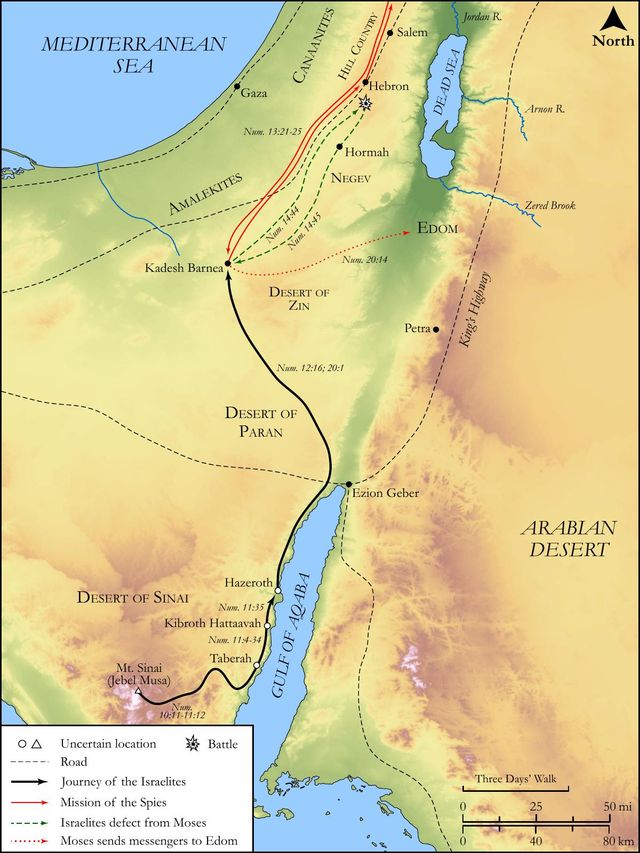
See on the biblical-era map
Study this verse
Public-domain commentary
Matthew Henry
From his Commentary on the Whole Bible. Henry comments on passages, not single verses — this entry covers Numbers 11:24–30. His three-level outline is real structure in the source text, so it is rendered as structure.
We have here the performance of God's word to Moses, that he should have help in the government of Israel.
I.Here is the case of the seventy privy-counsellors in general.
Moses, though a little disturbed by the tumult of the people, yet was thoroughly composed by the communion he had with God, and soon came to himself again. And according as the matter was concerted,
1.He did his part; he presented the seventy elders before the Lord, round the tabernacle (Num 11:24), that they might there stand ready to receive the grace of God, in the place where he manifested himself, and that the people also might be witnesses of their solemn call. Note, Those that expect favour from God must humbly offer themselves and their service to him.
2.God was not wanting to do his part. He gave of his Spirit to the seventy elders (Num 11:25), which enabled those whose capacities and education set them but on a level with their neighbours of a sudden to say and do that which was extraordinary, and which proved them to be actuated by divine inspiration: they prophesied, and did not cease all that day, and (some think) only that day. They discoursed to the people of the things of God, and perhaps commented upon the law they had lately received with admirable clearness, and fulness, and readiness, and aptness of expression, so that all who heard them might see and say that God was with them of a truth; see Co1 14:24, Co1 14:25. Thus, long afterwards, Saul was marked for the government by the gift of prophecy, which came upon him for a day and a night, Sa1 10:6, Sa1 10:11. When Moses was to fetch Israel out of Egypt, Aaron was appointed to be his prophet, Exo 7:1. But, now that God had called Aaron to other work, in his room Moses has seventy prophets to attend him. Note, Those are fittest to rule in God's Israel that are well acquainted with divine things and are apt to teach to edification.
II.Here is the particular case of two of them, Eldad and Medad, probably two brothers.
1.They were nominated by Moses to be assistants in the government, but they went not out unto the tabernacle as the rest did, Num 11:26. Calvin conjectures that the summons was sent them, but that it did not find them, they being somewhere out of the way; so that, though they were written, yet they were not called. Most think that they declined coming to the tabernacle out of an excess of modesty and humility; being sensible of their own weakness and unworthiness, they desired to be excused from coming into the government. Their principle was their praise, but their practice in not obeying orders was their fault.
2.The Spirit of God found them out in the camp, where they were hidden among the stuff, and there they prophesied, that is, they exercised their gift of praying, preaching, and praising God, in some private tent. Note, The Spirit of God is not tied to the tabernacle, but, like the wind, blows where he listeth, Joh 3:8. Whither can we go from that Spirit? There was a special providence in it that these two should be absent, for thus it appeared that it was indeed a divine Spirit which the elders were actuated by, and that Moses gave them not that Spirit, but God himself. They modestly declined preferment, but God forced it upon them; nay, they have the honour of being named, which the rest have not: for those that humble themselves shall be exalted, and those are most fit for government who are least ambitious of it.
3.Information of this was given to Moses (Num 11:27): "Eldad and Medad do prophesy in the camp; there is a conventicle in such a tent, and Eldad and Medad are holding forth there, from under the inspection and presidency of Moses, and out of the communion of the rest of the elders." Whoever the person was that brought the tidings, he seems to have looked upon it as an irregularity.
4.Joshua moved to have them silenced: My lord Moses, forbid them, Num 11:28. It is probable that Joshua himself was one of the seventy, which made him the more jealous for the honour of their order. He takes it for granted that they were not under any necessitating impulse, for the spirit of the prophets is subject to the prophets, and therefore he would have them either not to prophesy at all or to come to the tabernacle and prophesy in concert with the rest. He does not desire that they should be punished for what they had done, but only restrained for the future. This motion he made from a good principle, not out of any personal dislike to Eldad and Medad, but out of an honest zeal for that which he apprehended to be the unity of the church, and concern for the honour of God and Moses.
5.Moses rejected the motion, and reproved him that made it (v. 29): "Enviest thou for my sake? Thou knowest not what manner of spirit thou art of." Though Joshua was Moses's particular friend and confidant, though he said this out of a respect to Moses, whose honour he was very loth to see lessened by the call of those elders, yet Moses reproves him, and in him all that show such a spirit.
(1.)We must not secretly grieve at the gifts, graces, and usefulness of others. It was the fault of John's disciples that they envied Christ's honour because it shaded their master's, Joh 3:26, etc.
(2.)We must not be transported into heats against the weaknesses and infirmities of others. Granting that Eldad and Medad were guilty of an irregularity, yet Joshua was too quick and too warm upon them. Our zeal must always be tempered with the meekness of wisdom: the righteousness of God needs not the wrath of man, Jam 1:20.
(3.)We must not make even the best and most useful men heads of a party. Paul would not have his name made use of to patronise a faction, Co1 1:12, Co1 1:13.
(4.)We must not be forward to condemn and silence those that differ from us, as if they did not follow Christ because they do not follow him with us, Mar 9:38. Shall we reject those whom Christ has owned, or restrain any from doing good because they are not in every thing of our mind? Moses was of another spirit; so far from silencing these two, and quenching the Spirit in them, he wished all the Lord's people were prophets, that is, that he would put his Spirit upon them. Not that he would have any set up for prophets that were not duly qualified, or that he expected that the Spirit of prophecy should be made thus common; but thus he expresses the love and esteem he had for all the Lord's people, the complacency he took in the gifts of others, and how far he was from being displeased at Eldad and Medad's prophesying from under his eye. Such an excellent spirit as this blessed Paul was of, rejoicing that Christ was preached, though it was by those who therein intended to add affliction to his bonds, Phi 1:16. We ought to be pleased that God is served and glorified, and good done, though to the lessening of our credit and the credit of our way.
6.The elders, now newly ordained, immediately entered upon their administration (Num 11:30); when their call was sufficiently attested by their prophesying, they went with Moses to the camp, and applied themselves to business. Having received the gift, they ministered the same as good stewards. And now Moses was pleased that he had so many to share with him in his work and honour. And,
(1.)Let the testimony of Moses be credited by those who desire to be in power, that government is a burden. It is a burden of care and trouble to those who make conscience of the duty of it; and to those who do not it will prove a heavier burden in the day of account, when they fall under the doom of the unprofitable servant that buried his talent.
(2.)Let the example of Moses be imitated by those that are in power; let them not despise the advice and assistance of others, but desire it, and be thankful for it, not coveting to monopolize wisdom and power. In the multitude of counsellors there is safety.
Historical interpretation
Historical reception
1 surviving comment on this verse from the historical church.
This Spirit descended upon the seventy elders in Moses’ day. My object is to prove that he knew all things and worked according to his will. The seventy elders were chosen: “The Lord then came down in the cloud, and taking some of the spirit that was on Moses, he bestowed it on the seventy elders.” It was not that the Spirit was divided, but his gifts were distributed according to the vessels and the capacity of the recipients. Now there were sixty-eight present, and they prophesied. Eldad and Medad were not present. To make it clear that it was not Moses who bestowed the gift but the Spirit who wrought, Eldad and Medad, who had been called but had not yet presented themselves, also prophesied.
Continue studying Numbers 11:25 across the web’s major study libraries — every link below opens this exact verse, chapter, or book on the destination site.
Read & Compare
 BibleGatewayThis verse in more than 200 translations and 70 languages.
 Bible.comThe YouVersion reader — hundreds of translations, reading plans, and highlights.
 ESV.orgCrossway's official English Standard Version reader.
 NET BibleThe NET translation with 60,000+ translators' notes on every rendering decision.
 STEP BibleTyndale House's free study tool — original text, vocabulary, and scholarly resources.
 BibliaLogos Bible Software's free web reader.
 USCCBThe New American Bible (Revised Edition) with the U.S. bishops' study notes.
Commentaries
 BibleHub CommentariesDozens of classic commentaries on this verse, gathered on one page.
 StudyLightMore than 100 commentary sets — the largest collection on the web.
 BibleRefPlain-English commentary on what this verse means, verse by verse.
 Enduring WordDavid Guzik's free commentary on this chapter, widely used by Bible teachers.
 Bible Study ToolsVerse commentary alongside Greek and Hebrew study aids.
Original Language & Research
- BibleHub InterlinearThe verse word by word — original language, transliteration, and English.
- BibleHub LexiconEvery word's original-language definition and Strong's entry.
 Blue Letter BibleDeep-study tools — Strong's numbers, concordance, and word studies.
 SefariaThe Hebrew text with Rashi and centuries of Jewish commentary.
Sermons, Hymns & Audio


TrulyRandomVerse is not affiliated with these sites and doesn’t control their content. They’re linked because they’re genuinely useful.
Summary
Numbers 11:25 details a profound moment in Israel's wilderness journey, illustrating God's compassionate and decisive response to Moses' overwhelming burden of leadership. In a dramatic manifestation of divine presence, the LORD descends in a cloud, communicates directly with Moses, and supernaturally transfers a portion of the Spirit that rested upon Moses to seventy chosen elders. This divine empowerment is immediately and publicly authenticated as the elders begin to prophesy, a clear sign of their God-given authority and enablement for shared leadership, thereby alleviating Moses' solitary responsibility and ensuring the spiritual and administrative stability of the Israelite community.
Context
ShowHideLiterary Context
Numbers 11:25 is strategically placed within a narrative arc of escalating Israelite discontent and God's sovereign provision. The chapter opens with the people's complaining, which provokes divine judgment by fire (Numbers 11:1-3). This is swiftly followed by their intense craving for meat, leading them to despise the manna and lament their wilderness diet (Numbers 11:4-9). Moses, burdened by the people's incessant grumbling and his own weariness, pours out his despair to God, expressing his inability to bear the immense responsibility alone (Numbers 11:10-15). In response, God instructs Moses to gather seventy elders, men of proven reputation, to share the leadership load (Numbers 11:16-17). Verse 25 records the miraculous fulfillment of this divine promise, detailing the supernatural impartation of the Spirit. This event directly precedes the miraculous provision of quail (Numbers 11:31-32), which, while meeting their craving, also brings severe judgment due to their persistent rebellion. Thus, this pivotal moment establishes a more distributed leadership structure, crucial for the ongoing governance and spiritual health of the nascent nation.
Historical & Cultural Context
The setting is the arduous wilderness journey, a period of immense challenge for the fledgling nation of Israel, recently delivered from Egyptian bondage. Leading an estimated two million people through a harsh desert environment, managing their constant complaints, administering justice, and guiding them spiritually was an impossible task for any single individual, even one as divinely appointed as Moses. In Israel, elders (Hebrew: zakenim) were recognized as respected community leaders, judges, and advisors, embodying wisdom, experience, and authority. God's instruction to select seventy elders, therefore, aligns with an established and understood structure of governance, though the divine empowerment described in this verse was uniquely supernatural. The "cloud" (Hebrew: anan) is a pervasive and powerful motif throughout the Exodus and wilderness narratives, consistently symbolizing God's tangible presence, guidance, and communication, as seen from the pillar of cloud that led Israel to the cloud that filled the tabernacle. This public manifestation of God's presence and the Spirit's transfer served to publicly authenticate the elders' new roles before the entire congregation, leaving no doubt as to their divine appointment.
Key Themes
ShowHideThis verse powerfully underscores several key themes pervasive in the book of Numbers and the broader Pentateuch. Firstly, it highlights Divine Empowerment, demonstrating unequivocally that God Himself equips those He calls for service, providing the necessary spiritual enablement for leadership. This is not a humanly derived ability but a supernatural impartation. Secondly, it emphasizes Shared Leadership and Delegation, showcasing God's design for a distributed model of authority rather than a singular, overburdened leader. This principle was previously foreshadowed in Jethro's wise counsel to Moses and becomes a foundational aspect of Israel's governance, ensuring sustainability and resilience. Thirdly, the immediate manifestation of Prophetic Authentication through the elders' prophesying serves as an undeniable sign of God's anointing, validating their authority and legitimacy before the people. This public display removes any ambiguity about their divine selection. Finally, the narrative reveals God's Responsive Provision, illustrating His attentiveness to the distress of His servants and His willingness to provide supernatural solutions to human limitations, even amidst the people's persistent grumbling and Moses' own weariness, as deeply explored throughout Numbers chapter 11.
Exposition and Analysis
ShowHideKey Word Analysis
ShowHideVerse Breakdown
ShowHide"And the LORD came down in a cloud, and spake unto him,"
This clause immediately establishes the direct, personal, and visible nature of God's intervention. The "cloud" is the quintessential symbol of God's manifest presence (the Shekinah glory), signifying His immediate and tangible involvement in human affairs. His speaking "unto him" (Moses) underscores the intimate covenantal relationship and direct communication between God and His chosen leader, setting the stage for the miraculous event that follows and emphasizing the divine initiative.
"and took of the spirit that [was] upon him, and gave [it] unto the seventy elders:"
This is the core action of divine distribution and empowerment. The phrase "took of" (Hebrew: ʼâtsal) is crucial; it signifies a sharing or replication of the divine anointing, not a diminution or depletion of Moses' own spiritual endowment. This act highlights God's sovereignty over His Spirit and His infinite capacity to empower multiple individuals for His purposes, demonstrating His commitment to equipping His chosen leaders for the immense task of governing Israel. It's a divine act of delegation and enablement.
"and it came to pass, [that], when the spirit rested upon them, they prophesied, and did not cease."
This clause describes the immediate, observable, and authenticating effect of the Spirit's impartation. The "resting" (Hebrew: nûwach) of the Spirit signifies a settled, empowering, and abiding presence. The elders' act of "prophesying" (Hebrew: nâbâʼ) served as a public, undeniable validation of their divine appointment and the Spirit's presence. The phrase "and did not cease" (Hebrew: yâçaph) implies a sustained, perhaps even ecstatic, outpouring of prophetic utterance, confirming the authenticity and power of the Spirit's work among them for that period, serving as a clear sign to the entire congregation.
Literary Devices
ShowHideNumbers 11:25 employs several powerful literary devices to convey its profound theological message. Symbolism is prominent, with the "cloud" serving as a potent symbol of God's immediate and visible presence, a motif consistently used throughout the Pentateuch to denote divine revelation and guidance. The "spirit" itself is a powerful symbol of divine empowerment and anointing, representing God's active force at work in human lives. The narrative also utilizes Divine Intervention, where God directly and supernaturally acts to resolve a human crisis, showcasing His omnipotence, His compassionate responsiveness to His people's needs, and His attentiveness to His servant's distress. Furthermore, the immediate and public manifestation of the elders' prophesying serves as a form of Authentication, a clear and undeniable sign to the entire community that these individuals have been divinely chosen and equipped, thereby legitimizing their new leadership roles. The narrative's progression from Moses' lament to God's supernatural provision demonstrates a clear Cause and Effect relationship, highlighting God's faithful response to the challenges faced by His people and their leaders.
Theological and Thematic Connections
ShowHideNumbers 11:25 stands as a foundational text for understanding the nature of divine empowerment and distributed spiritual authority within God's people. It reveals that God's Spirit is not limited to a single individual but can be poured out upon many, enabling them for specific tasks and ministries. This event foreshadows the broader, more pervasive outpouring of the Holy Spirit promised in the Old Testament prophets and fully realized in the New Covenant. It demonstrates God's commitment to equipping His church with the necessary spiritual gifts and leadership for its mission, ensuring that the burden of ministry is shared and that His people are adequately led and ministered to. The Spirit's manifestation through prophecy also highlights the ongoing importance of divine communication and authentication in the life of God's people, affirming God's active presence among them.
Reflection and Application
ShowHideNumbers 11:25 offers profound lessons for contemporary believers and leaders, reminding us that true leadership in God's kingdom is not meant to be a solitary burden but a shared responsibility, empowered by the Holy Spirit. When we feel overwhelmed by the demands of ministry, family, or life, this passage encourages us to seek God's provision for help and to recognize that He often provides through the empowerment of others within the community of faith. It challenges us to embrace delegation and shared leadership, recognizing the diverse gifts and callings God places upon His people. Just as the Spirit enabled the elders to prophesy, God continues to equip believers today with spiritual gifts for the edification of the church, the advancement of His kingdom, and the flourishing of His people. We are called to discern, nurture, and humbly utilize these gifts in submission to God's will, trusting that His Spirit will provide all that is necessary for the tasks He sets before us, fostering a community where burdens are shared and divine power is manifested through many.
Questions for Reflection
ShowHideFAQ
ShowHideWas Moses' spirit diminished by God taking "of the spirit that was upon him" and giving it to the elders?
ShowHideNo, the text explicitly states God "took of the spirit," not "took away the spirit." The Hebrew word used, ʼâtsal (H680), means "to separate" or "to set aside," implying a portion or essence was drawn off, not that Moses' own spiritual endowment was lessened. This signifies a sharing or replication of the divine anointing, not a reduction or depletion of Moses' spiritual authority or power. Moses remained the preeminent leader and prophet in Israel, continuing to communicate directly with God and lead the people. This act powerfully demonstrates God's infinite capacity to empower multiple individuals without diminishing His work in any one person. It highlights the abundance of God's Spirit, which can be distributed to many for His purposes without being lessened.
What was the nature of the "prophesying" that the elders engaged in?
ShowHideThe term "prophesied" (Hebrew: nâbâʼ, H5012) in this context likely refers to an ecstatic, Spirit-induced utterance, a spontaneous outpouring of divine inspiration. It may have involved speaking words of praise, exhortation, or declarations of God's greatness, rather than necessarily foretelling future events. This act served as a public, undeniable sign of divine authentication, confirming that the Spirit of God had indeed come upon them and that they were now divinely appointed for their new roles. It was a powerful, temporary manifestation that validated their authority before the entire congregation, much like the Spirit's initial manifestations in other biblical accounts, such as Saul's prophesying when the Spirit of God came upon him.
Why did God choose seventy elders specifically?
ShowHideThe number seventy holds significant symbolic weight in Scripture, often representing completeness, totality, or a representative body. For example, there were seventy nations listed in Genesis 10, symbolizing the whole of humanity. Later, Jesus appointed seventy-two disciples (some manuscripts say seventy) to preach, extending His mission beyond the twelve. In Israelite tradition, the Sanhedrin, the supreme Jewish council, was composed of seventy or seventy-one members. While the exact reason for "seventy" is not explicitly stated, it likely signifies a comprehensive and representative body of leaders chosen from among the tribes of Israel, sufficient to share the immense burden of governance and justice with Moses, reflecting a divinely appointed, complete administrative structure.
Christ-Centered Fulfillment
ShowHideNumbers 11:25, with its dramatic portrayal of the Spirit's distribution, finds its ultimate and glorious fulfillment in the person and work of Jesus Christ and the outpouring of the Holy Spirit in the New Covenant. While the Spirit's anointing in the Old Testament was often selective and temporary, resting upon prophets, priests, and kings for specific tasks, Jesus is the one upon whom the Spirit rests permanently and without measure, as affirmed in John 3:34. He is the ultimate Spirit-bearer, the one who baptizes with the Holy Spirit and fire, as prophesied by John the Baptist in Matthew 3:11. The partial and temporary outpouring on the seventy elders in the wilderness foreshadows the universal and abiding indwelling of the Holy Spirit in all believers after Christ's ascension. On the day of Pentecost, as prophesied by Joel in Joel 2:28-29, the Spirit was poured out on all flesh (see Acts 2:17), empowering not just a select few leaders, but every believer to be a witness for Christ (as commanded in Acts 1:8) and to exercise spiritual gifts for the building up of the church (as described in 1 Corinthians 12:7). This New Covenant reality, inaugurated by Christ's death and resurrection, signifies that the Spirit's empowering presence is no longer limited to a tent of meeting or a select group of elders, but dwells within every follower of Jesus Christ, enabling them for ministry, witness, and a life of holiness, fulfilling the deepest longings for God's pervasive presence among His people.