


Joel 2:29
Bible text: King James Version (1769 Blayney text) · Public domain
Bible text: Berean Standard Bible · Public domain
Bible text: American Standard Version (1901) · Public domain
Bible text: World English Bible, Messianic edition · Public domain
Bible text: Geneva Bible (1599) · Public domain
Bible text: Young's Literal Translation · Public domain
- וְגַםve·Gamand alsoH1571Conj-w ¦ AdvAdverbוְandגַםalso
- עַל'alonH5921PrepPreposition
- הָעֲבָדִיםha·'a·va·Dimthe [male] servantsH5650Art ¦ N-mpNoun Plural Masculine Absoluteהָtheעֲבָדִים[male] servants
- וְעַלve·'aland onH5921Conj-w ¦ PrepPrepositionוְandעַלon
- הַשְּׁפָחוֹתha·she·fa·Chotthe female servantsH8198Art ¦ N-fpNoun Plural Feminine Absoluteהַtheשְּׁפָחוֹתfemale servants
- בַּיָּמִיםbai·ya·Mimin the daysH3117Prep-b ¦ N-mpNoun Plural Masculine Absoluteבַּin theיָּמִיםdays
- הָהֵמָּהha·He·mah<the> thoseH1992Art ¦ Pro-3mpPronoun Personal 3rd Plural Masculineהָ<the>הֵמָּהthose
- אֶשְׁפּוֹךְ'esh·PokhI will pour outH8210V-Qal-Imperf-1csVerb Qal Imperfect 1st Singular common gender
- אֶת'et<obj.>H853DirObjMParticle Object Indicator
- רוּחִיru·Chimy spiritH7307N-csc ¦ 1fsNoun Singular common gender Constructרוּחִspiritיmy
English is a literal word-by-word gloss of the Hebrew, not the KJV's wording. Why?
This is the original text the KJV's translators worked from — each Hebrew word with its own literal English meaning in this verse, prepared by scholars at Tyndale House, Cambridge. The KJV translates whole sentences, not word by word, so its wording differs: one Hebrew word can become several English words, and the KJV may choose “the LORD” where the gloss reads “Yahweh”. Both are faithful — they answer different questions. For the KJV's own rendering, switch to the KJV text.
Details
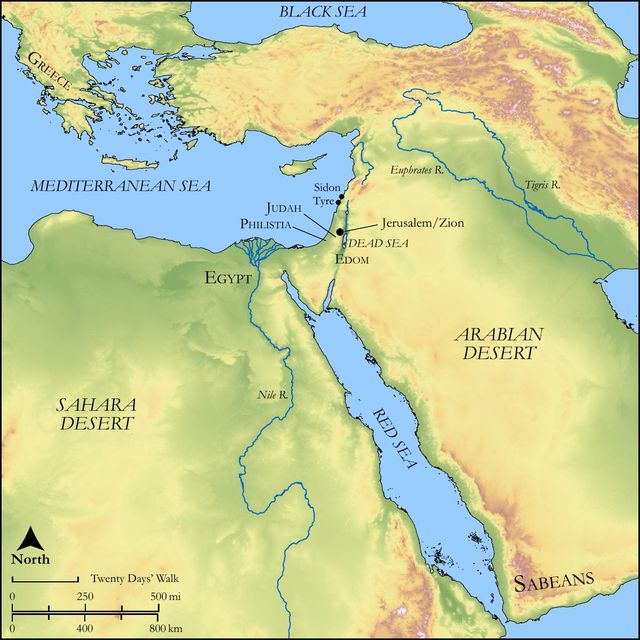
See on the biblical-era map
Study this verse
Public-domain commentary
Matthew Henry
From his Commentary on the Whole Bible. Henry comments on passages, not single verses — this entry covers Joel 2:28–32. His three-level outline is real structure in the source text, so it is rendered as structure.
The promises of corn, and wine, and oil, in the foregoing verses, would be very acceptable to a wasted country; but here we are taught that we must not rest in those things. God has reserved some better things for us, and these verses have reference to those better things, both the kingdom of grace and the kingdom of glory, with the happiness of true believers in both. We are here told,
I.How the kingdom of grace shall be introduced by a plentiful effusion of the Spirit, (Joe 2:28, Joe 2:29).
We are not at a loss about the meaning of this promise, nor in doubt what it refers to and wherein it had its accomplishment, for the apostle Peter has given us an infallible explication and application of it, assuring us that when the Spirit was poured out upon the apostles, on the day of Pentecost (Act 2:1, etc.), that was the very thing which was spoken of here by the prophet Joel, Joe 2:16, Joe 2:17. That was the gift of the Spirit, which, according to this prediction, was to come, and we are not to look for any other, any more than for another accomplishment of the promise of the Messiah. Now,
1.The blessing itself here promised is the pouring out of the Spirit of God, his gifts, graces, and comforts, which the blessed Spirit is the author of. We often read in the Old Testament of the Spirit of the Lord coming by drops, as it were, upon the judges and prophets whom God raised up for extraordinary services; but now the Spirit shall be poured out plentifully in a full stream, as was promised with an eye to gospel-times, Isa 44:3. I will pour my Spirit upon thy seed.
2.The time fixed for this is afterwards; after the fulfilling of the foregoing promises this shall be fulfilled. St. Peter expounds this of the last days, the days of the Messiah, by whom the world was to have its last revelation of the divine will and grace in the last days of the Jewish church, a little before its dissolution.
3.The extent of this blessing, in respect of the persons on whom it shall be bestowed. The Spirit shall be poured out upon all flesh, not as hitherto upon Jews only, but upon Gentiles also; for in Christ there is no distinction between Jew and Greek, Rom 10:11, Rom 10:12. Hitherto divine revelation was confined to the seed of Abraham, none but those of the land of Israel had the Spirit of prophecy; but, in the last days, all flesh shall see the glory of God (Isa 40:5) and shall come to worship before him, Isa 66:23. The Jews understand it of all flesh in the land of Israel, and Peter himself did not fully understand it as speaking of the Gentiles till he saw it accomplished in the descent of the Holy Ghost upon Cornelius and his friends, who were Gentiles (Act 10:44, Act 10:45), which was but a continuation of the same gift which was bestowed on the day of Pentecost. The Spirit shall be poured out upon all flesh, that is, upon all those whose hearts are made hearts of flesh, soft and tender, and so prepared to receive the impressions and influences of the Holy Ghost. Upon all flesh, that is, upon some of all sorts of men; the gifts of the Spirit shall not be so sparing, or so much confined, as they have been, but shall be more general and diffusive of themselves.
(1.)The Spirit shall be poured out upon some of each sex. Not your sons only, but your daughters, shall prophesy; we read of four sisters in one family that were prophetesses, Act 21:9. Not the parents only, but the children, shall be filled with the Spirit, which intimates the continuance of this gift for some ages successively in the church.
(2.)Upon some of each age: "Your old men, who are past their vigour and whose spirits begin to decay, your young men, who have yet but little acquaintance with and experience of divine things, shall yet dream dreams and see visions;" God will reveal himself by dreams and visions both to the young and old.
(3.)Upon those of the meanest rank and condition, even upon the servants and the handmaids. The Jewish doctors say, Prophecy does not reside on any but such as are wise, valiant, and rich, not upon the soul of a poor man, or a man in sorrow. But in Christ Jesus there is neither bond nor free, Gal 3:28. There were many that were called being servants (Co1 7:21), but that was no obstruction to their receiving the Holy Ghost.
(4.)The effect of this blessing: They shall prophesy; they shall receive new discoveries of divine things, and that not for their own use only, but for the benefit of the church. They shall interpret scripture, and speak of things secret, distant, and future, which by the utmost sagacities of reason, and their natural powers, they could not have any insight into nor foresight of. By these extraordinary gifts the Christian church was first founded and set up, and the scriptures were written, and the ministry settled, by which, with the ordinary operations and influences of the Spirit, it was to be afterwards maintained and kept up.
II.How the kingdom of glory shall be introduced by the universal change of nature, Joe 2:30, Joe 2:31.
The pouring out of the Spirit will be very comfortable to the righteous; but let the unrighteous hear this, and tremble. There is a great and terrible day of the Lord coming, which shall be ushered in with wonders in heaven and earth, blood, and fire, and pillars of smoke, the turning of the sun into darkness and the moon into blood. This is to have its full accomplishment (as the learned Dr. Pocock thinks) in the day of judgment, at the end of time, before which these signs will be performed in the letter of them, yet so that it was accomplished in part in the death of Christ (which is called the judgment of this world, when the earth quaked and the sun was darkened, and a great and terrible day it was), and more fully in the destruction of Jerusalem, which was a type and figure of the general judgment, and before which there were many amazing prodigies, besides the convulsions of states and kingdoms prophesied of under the figurative expressions of turning the sun into darkness and the moon into blood, and the wars and rumours of wars, and distress of nations, which our Saviour spoke of as the beginning of these sorrows, Mat 24:6, Mat 24:7. But before the last judgment there will be wonders indeed in heaven and earth, the dissolution of both, without a metaphor. The judgments of God upon a sinful world, and the frequent destruction of wicked kingdoms by fire and sword, are prefaces to and presages of the judgment of the world in the last day. Those on whom the Spirit is poured out shall foresee and foretel that great and terrible day of the Lord, and expound the wonders in heaven and earth that go before it; for, as to his first coming, so to his second, all the prophets did and do bear witness, Rev 10:7.
III.The safety and happiness of all true believers both in the first and second coming of Jesus Christ, Joe 2:32.
This speaks of particular persons, for to them the New Testament has more respect, and less to kingdoms and nations, than the Old. Now observe here,
1.That there is a salvation wrought out. Though the day of the Lord will be great and terrible, yet in Mount Zion and in Jerusalem there shall be deliverance from the terror of it. It is the day of the Lord, the day of his judgment, who knows how to separate between the precious and the vile. In the everlasting gospel, which went from Zion, in the church of the first-born typified by Mount Zion, and which is the Jerusalem that is from above, there is deliverance; a way of escaping the wrath to come is found out and laid open. Christ is himself not only the Saviour, but the salvation; he is so to the ends of the earth. This deliverance, laid up for us in the covenant of grace, is in performance of the promises made to the fathers. There shall be deliverance, as the Lord has said. See Luk 1:72. Note, This is ground of comfort and hope to sinners, that, whatever danger there is in their case, there is also deliverance, deliverance for them, if it be not their own fault. And, if we would share in this deliverance, we must ourselves apply to the gospel - Zion, to God's Jerusalem.
2.That there is a remnant interested in this salvation, and for whom the deliverance is wrought. It is in that remnant (that is, among them) that the deliverance is, or in their souls and spirits; there are the earnests and evidences of it. Christ in you, the hope of glory. They are called a remnant, because they are but a few in comparison with the multitudes that are left to perish; a little remnant but a chosen one, a remnant according to the election of grace. And here we are told who they are that shall be delivered in the great day.
(1.)Those that sincerely call upon God: Whosoever shall call upon the name of the Lord, whether Jew or Gentile (for the apostle so expounds it, Rom 10:13, where he lays this down as the great rule of the gospel by which we must all be judged), shall be delivered. This calling on God supposes knowledge of him, faith in him, desire towards him, dependence on him, and, as an evidence of the sincerity of all this, a conscientious obedience to him; for, without that, crying Lord, Lord, will not stand us in any stead. Note, It is the praying remnant that shall be the saved remnant. And it will aggravate the ruin of those who perish that they might have been saved on such easy terms.
(2.)Those that are effectually called to God. The deliverance is sure to the remnant whom the Lord shall call, not only with the common call of the gospel, with which many are called that are not chosen, but with a special call into the fellowship of Jesus Christ, whom the Lord predestinates, or prepares, so the Chaldee. St. Peter borrows this phrase, Act 2:39. Note, Those only shall be delivered in the great day that are now effectually called from sin to God, from self to Christ, from things below to things above.
Historical interpretation
Eight Centuries of Reception
15 surviving comments on this verse. Each one is dated, so this reads as a timeline rather than a list.
Select a marker to jump to its quote. Markers stagger vertically where authors wrote within a few decades of each other.
For Moses describeth the righteousness which is of the law, That the man which doeth those things shall live by them. But the righteousness which is of faith speaketh on this wise, Say not in thine heart, Who shall ascend into heaven? (that is, to bring Christ down from above:) Or, Who shall descend into the deep? (that is, to bring up Christ again from the dead.) But what saith it? The word is nigh thee, even in thy mouth, and in thy heart: that is, the word of faith, which we preach; That if thou shalt confess with thy mouth the Lord Jesus, and shalt believe in thine heart that God hath raised him from the dead, thou shalt be saved. For with the heart man believeth unto righteousness; and with the mouth confession is made unto salvation. For the scripture saith, Whosoever believeth on him shall not be ashamed. For there is no difference between the Jew and the Greek: for the same Lord over all is rich unto all that call upon him. For whosoever shall call upon the name of the Lord shall be saved. [Joel 2:28-32]
And when the day of Pentecost was fully come, they were all with one accord in one place. And suddenly there came a sound from heaven as of a rushing mighty wind, and it filled all the house where they were sitting. And there appeared unto them cloven tongues like as of fire, and it sat upon each of them. And they were all filled with the Holy Ghost, and began to speak with other tongues, as the Spirit gave them utterance. And there were dwelling at Jerusalem Jews, devout men, out of every nation under heaven. Now when this was noised abroad, the multitude came together, and were confounded, because that every man heard them speak in his own language. And they were all amazed and marvelled, saying one to another, Behold, are not all these which speak Galilaeans? And how hear we every man in our own tongue, wherein we were born? Parthians, and Medes, and Elamites, and the dwellers in Mesopotamia, and in Judaea, and Cappadocia, in Pontus, and Asia, Phrygia, and Pamphylia, in Egypt, and in the parts of Libya about Cyrene, and strangers of Rome, Jews and proselytes, Cretes and Arabians, we do hear them speak in our tongues the wonderful works of God. And they were all amazed, and were in doubt, saying one to another, What meaneth this? Others mocking said, These men are full of new wine. But Peter, standing up with the eleven, lifted up his voice, and said unto them, Ye men of Judaea, and all ye that dwell at Jerusalem, be this known unto you, and hearken to my words: For these are not drunken, as ye suppose, seeing it is but the third hour of the day. But this is that which was spoken by the prophet Joel; And it shall come to pass in the last days, saith God,I will pour out of my Spirit upon all flesh: and your sons and your daughters shall prophesy, and your young men shall see visions, and your old men shall dream dreams: And on my servants and on my handmaidens I will pour out in those days of my Spirit; and they shall prophesy: And I will show wonders in heaven above, and signs in the earth beneath; blood, and fire, and vapour of smoke: The sun shall be turned into darkness, and the moon into blood, before that great and notable day of the Lord come: And it shall come to pass, that whosoever shall call on the name of the Lord shall be saved. [Joel 2:28-32] Ye men of Israel, hear these words; Jesus of Nazareth, a man approved of God among you by miracles and wonders and signs, which God did by him in the midst of you, as ye yourselves also know: Him, being delivered by the determinate counsel and foreknowledge of God, ye have taken, and by wicked hands have crucified and slain: Whom God hath raised up, having loosed the pains of death: because it was not possible that he should be holden of it.
I have already said, and do again say, that it had been prophesied that this would be done by Him after His ascension to heaven. It is accordingly said, 'He ascended on high, He led captivity captive, He gave gifts unto the sons of men.' And again, in another prophecy it is said: 'And it shall come to pass after this, I will pour out My Spirit on all flesh, and on My servants, and on My handmaids, and they shall prophesy.'
We declare, then, that dreams are inflicted on us mainly by demons, although they sometimes turn out true and favorable to us. When, however, with the deliberate aim after evil, of which we have just spoken, they assume a flattering and captivating style, they show themselves proportionately vain, and deceitful, and obscure, and wanton, and impure. And no wonder that the images partake of the character of the realities. But from God—who has promised, indeed, “to pour out the grace of the Holy Spirit upon all flesh, and has ordained that his servants and his handmaids should see visions as well as utter prophecies”—must all those visions be regarded as emanating. [Those visions] may be compared with the actual grace of God, as being honest, holy, prophetic, inspired, instructive, inviting to virtue, the bountiful nature of which causes them to overflow even to the profane, since God, with grand impartiality, “sends his showers and sunshine on the just and on the unjust.”
You hold to the Scriptures in which the flesh is disparaged; receive also those in which it is ennobled. You read whatever passage abases it. Now direct your eyes also to that which elevates it. “All flesh is grass.” Well, but Isaiah was not content to say only this; he also declared, “All flesh shall see the salvation of God.” Then notice what God says in Genesis: “My spirit shall not remain among these men, because they are flesh”; but then he is also heard saying by Joel, “I will pour out of my Spirit upon all flesh.” Even the apostle ought not to be known for any one statement in which he is inclined to reproach the flesh. Admittedly he says that “in his flesh dwells no good thing” and “they who are in the flesh cannot please God,” because “the flesh lusts against the Spirit.” Yet in these and similar assertions that he makes, it is not the substance of the flesh, but its actions, which are censured. Moreover, we shall elsewhere take occasion to remark that no reproaches can fairly be cast upon the flesh without tending also to the castigation of the soul, which compels the flesh to do its bidding. However, let me meanwhile add that in the same passage Paul “carries about in his body the marks of the Lord Jesus.” He also forbids our body to be profaned, since it is “the temple of God.” He makes our bodies “the members of Christ.” And he exhorts us to exalt and “glorify God in our body.” If, therefore, the humiliations of the flesh do not prevent its resurrection, why wouldn’t its high prerogatives avail to bringing it about? It better suits the character of God to restore to salvation what for a while he rejected, than to surrender to perditions what he once approved.
Next, well-ordered reason and the authority of our faith bid us (in the words and the writings of our Lord set down in orderly fashion) to believe, after these things, also in the Holy Spirit, who was in the times past promised to the church and duly bestowed at the appointed, favorable moment. He was promised by the prophet Joel but bestowed through Christ. “In the last days,” says the prophet, “I will pour out from my spirit upon my servants and handmaids.” And the Lord himself said, “Receive the Holy Spirit. If you forgive the sins of any, they are forgiven; if you retain the sins of any, they are retained.”
Since, therefore, he has forsaken his people, he has also left his temple desolate, and rent the veil of the temple, and took from them the Holy Spirit, for says he, “Behold, your house is left unto you desolate.” And he has bestowed upon you, the converted of the Gentiles, spiritual grace, as he says by Joel: “ ‘And it shall come to pass after these things,’ says God, ‘that I will pour out of my Spirit upon all flesh; and your sons shall prophesy, and your daughters shall see visions, and your old men shall dream dreams.’ ” For God has taken away all the power and efficacy of his Word and such like visitations from that people, and he has transferred it to you, the converted of the Gentiles. For on this account the devil himself is very angry with the holy church of God. He is removed to you and has raised against you adversities, seditions, and reproaches, schisms and heresies.
And if you would receive a testimony also, “listen,” he says. “But this is that which was spoken by the prophet Joel: ‘And it shall come to pass after this, says God, I will pour forth of my Spirit’ ”—and this word, ‘I will pour forth,’ implied a rich gift; ‘for God gives not the Spirit by measure for the Father loves the Son, and has given all things into his hand’; and he has given him the power also of bestowing the grace of the all-holy Spirit on whomever he will—“I will pour forth of my Spirit upon all flesh, and your sons and your daughters shall prophesy;” and afterward, “Yea, and on my servants and on my handmaidens I will pour out in those days of my Spirit, and they shall prophesy.” The Holy Spirit is no respecter of persons, for he seeks not dignities but piety of soul. Let neither the rich be puffed up nor the poor be dejected, but only let each prepare himself for reception of the heavenly gift.
But that the Spirit is the Arbiter of the Divine Counsel, you may know even from this. For when above we showed that the Holy Spirit was the Lord of baptism, and read that baptism is the counsel of God, as you read, "But the Pharisees despised the counsel of God, not being baptized of Him," it is quite clear that as there can be no baptism without the Spirit, so, too, the counsel of God is not without the Spirit. And that we may know more completely that the Spirit is Power, we ought to know that He was promised when the Lord said: "I will pour out of My Spirit upon all flesh." He, then, Who was promised to us is Himself Power, as in the Gospel the same Son of God declared when He said: "And I will send the promise of the Father upon you, but do you remain in the city until ye be endued with power from on high."
But of what creature can it be said that it fills all things, as is written of the Holy Spirit: "I will pour My Spirit upon all flesh." This cannot be said of an Angel. Lastly, Gabriel himself, when sent to Mary, said: "Hail, full of grace," plainly declaring the grace of the Spirit which was in her, because the Holy Spirit had come upon her, and she was about to have her womb full of grace with the heavenly Word.
On unessential points one must not spend many words. And besides, the sequel is enough to bear him out on this point, so now the discourse is for all in common. “ ‘But this is that which was spoken by the prophet Joel, and it shall come to pass in the last days,’ says the Lord God.” Nowhere as yet the name of Christ or his promise, but the promise is that of the Father.
(Verse 28 and following) And it shall come to pass afterward, that I will pour out my Spirit on all flesh;your sons and your daughters shall prophesy, your old men shall dream dreams, and your young men shall see visions.Even on the male and female servants in those days I will pour out my Spirit.And I will show wonders in the heavens and on the earth, blood and fire and columns of smoke.The sun shall be turned to darkness, and the moon to blood, before the great and awesome day of the Lord comes. And it shall come to pass that everyone who calls upon the name of the Lord shall be saved. Acts 2:17-19: 'And it shall come to pass in the last days, says God, that I will pour out my Spirit on all flesh; your sons and your daughters shall prophesy, your old men shall dream dreams, your young men shall see visions; and also on My menservants and on My maidservants I will pour out My Spirit in those days; and I will show wonders in heaven above and signs in the earth beneath: blood and fire and vapor of smoke.' The sun will be turned into darkness, and the moon into blood, before the great and illustrious day of the Lord comes. And it will be, that everyone who calls on the name of the Lord will be saved. The blessed apostle Peter explained this passage fulfilled at the time of the Lord's passion, when the Holy Spirit descended on the believers on the day of Pentecost, and they spoke in tongues as the Spirit gave them utterance, so that those present marveled and said, 'Are not all these who are speaking Galileans? And how is it that we hear, each in our own native language?' Parthians, Medes, and Elamites, and others; some were saying, 'What does this mean?' But others were mocking and saying, 'They are filled with new wine.' Then Peter stood up with the eleven, raised his voice, and declared to them: 'Men of Judea and all who live in Jerusalem, let this be known to you, and listen carefully to my words. These people are not drunk, as you suppose, for it is only nine o'clock in the morning. No, this is what was spoken through the prophet Joel: ' And it shall come to pass afterward, says the Lord: I will pour out my Spirit on all flesh; your sons and your daughters shall prophesy, and your old men shall dream dreams, and your young men shall see visions. And also on the male and female servants in those days I will pour out my Spirit. And I will show wonders in the heavens and on the earth, blood and fire and columns of smoke. The sun shall be turned to darkness, and the moon to blood, before the great and awesome day of the Lord comes. And it shall come to pass that everyone who calls on the name of the Lord shall be saved. For in Mount Zion and in Jerusalem there shall be those who escape, as the Lord has said, and among the survivors shall be those whom the Lord calls. From the beginning, therefore, until the place where it is written: 'Great is the day of the Lord and very terrible, and who can endure it?' it is a threat and description of what the Lord will inflict upon the sinful people. But from the place where we read: 'Return to me with all your heart, with fasting, weeping, and mourning,' until the place where it says: 'Why do they say among the peoples, "Where is their God?"' it is the exhortation of the Lord, calling for repentance after punishment and affliction. Again, from that place which follows: The Lord was zealous for his land and spared his people, and the Lord answered and said, even to the place where it is written: And my people shall not be put to shame forever, the promise of things to come is that they should await the good after they have repented. And after many things which it is now tedious to recount, these things also are said in the promise, which we now endeavor to explain: I will pour out my spirit upon all flesh, and your sons and daughters shall prophesy, and the rest. I seem to myself to have saved the text of the conversation from the beginning up to this point. It is a great labor how what follows should be connected to what we are now discussing. Another [person] says what was generally promised in the last times is now partly completed. And because the apostles felt the reward of future [events] at the first coming of the Lord, they mentioned certain offerings and first fruits of miracles that had been fulfilled, so that until what is perfect comes, we would feel what had previously come in part. But another asserts that it is an apostolic tradition, according to what is written about a holy man: 'He will dispense his words in judgment' (Ps. CXI, 5): so that whatever useful things they saw to be for the listeners and not contradicting what is present, they would strengthen them with testimonies from another time, not that they would exploit the simplicity and ignorance of the listeners, as the impious Porphyrius calumniates, but according to the apostle Paul, they would preach at the right time, and at the wrong time (II Tim. IV). And the following is the rule of the prophets: whatever the Jews in the last times promise themselves carnally, they would say was fulfilled spiritually in the first coming of the Lord and Savior: especially since both they and we say that the promises were to be fulfilled in Christ, only differing in this, that they contend for future things, while we maintain that they have already happened: about which more should be discussed in what follows. But every flesh on which the Lord promises to pour out His Spirit, that is the flesh about which Isaiah speaks: And all flesh shall see the salvation of God (Isaiah 40:5). Therefore, the salvation of God cannot be seen unless the Holy Spirit is poured out. And whoever claims to believe in Christ, without believing in the Holy Spirit, will not have the eyes of perfect faith. Hence, in the Acts of the Apostles, those who had been baptized with the baptism of John, in the one who was to come, that is, in the name of the Lord Jesus, are re-baptized when they respond to Paul's question: 'But did you receive the Holy Spirit?' (Acts 19). Indeed, they receive true baptism, because without the Holy Spirit and the mystery of the Trinity, whatever is received into one or the other person is imperfect. But indeed, not everyone who receives the Holy Spirit will immediately have spiritual grace; but through the outpouring of the Holy Spirit, they will obtain different graces (I Cor. XII). Some will receive prophecy, like sons and daughters who are of greater merit; others will have dreams, like the elderly of advanced age; others will have visions, like the young who have conquered evil. However, servants and handmaids who still have the spirit of fear, and not of love, because perfect love casts out fear, will not have prophecy, dreams, or visions; but, content with the outpouring of the Holy Spirit, they will possess only the grace of faith and salvation. Then the Lord will give signs in the sky and on earth: in the sky, because the sun will turn into darkness, and the moon into blood; on earth, because the earth will shake so violently and unusually that tombs will be opened and rocks will be split. And what he says, blood and vapors, or the vapor of smoke, that blood is the one of which we read in the Psalms: That your foot may be dipped in blood (Psalm 47:24). And in Isaiah: How red are your garments (Isaiah 63:2)! And when, after striking the side of the Savior, the Roman soldier poured out mixed water (John 19). And the fire of the Holy Spirit, which descended from heaven, as we read in the Acts of the Apostles: Tongues as of fire appeared to them, and it sat on each one of them, and they were filled with the Holy Spirit and began to speak in different tongues, as the Holy Spirit gave them utterance (Acts 2:3-4). This is the fire that the Lord came to send upon the earth, and before he suffered, he desired it to burn in his disciples (Luke 12). Fire is of a double nature: it has light for those who believe; it has darkness and punishment for unbelievers, who are called the fumes of smoke. This smoke is very bitter, which blinded the eyes of the Jews, as we read in the proverbs: 'As smoke is harmful to the eyes, and an unripe grape to the teeth, so is wickedness to those who use it' (Prov. X, 26). Isaiah also speaks about this smoke in a great vision, in which the blindness of the Jews was foretold: 'And the threshold has moved, and the house is filled with smoke.' Then it follows: Go, and tell this people: You shall indeed hear, but not understand; and you shall indeed see, but not perceive. For the heart of this people has grown dull, and their ears are hard of hearing (Isaiah VI, 9, 10). The sun also turns into darkness when it does not dare to see its hanging Lord, and the moon into blood, which we may believe happened according to history and was passed over in silence by the evangelists. For not everything that Jesus did is recorded, and if every single thing were written, I do not think that even the world itself could contain the books that would be written (John XXI). Certainly, when the sun was obscured in darkness, it was not because it had turned to darkness itself, but because it had brought darkness upon the world: thus, the moon was not turned to blood, but it condemned the Jews covered in horror of blasphemies and denial of Christ with the eternal testimony of its blood, saying: 'His blood be upon us, and upon our children' (Matthew 27:25). These are all things that are described as future before the great and terrible day of the Lord comes. But this day of the Lord is to be believed as either great and terrible of the resurrection, or certainly, after a long time, a day of judgment, which is truly great and terrible. But since it follows: And it shall be, everyone who shall call upon the name of the Lord shall be saved, and the apostle Paul refers this to the time of the Lord's passion, it is more to be understood of the day of resurrection. For he says in writing to the Romans: There is no distinction between Jew and Greek. For the same Lord is rich unto all that call upon him. For whosoever shall call upon the name of the Lord shall be saved. But how shall they call on him in whom they have not believed? Or how shall they believe in him of whom they have not heard? And how shall they hear without a preacher? And how shall they preach, except they be sent? (Rom. 10:12-15) And when it is said, Whosoever shall call upon the name of the Lord shall be saved, let us not lightly esteem it, for although the same apostle writes: No man can say that Jesus is the Lord, but by the Holy Ghost. (1 Cor. 12:3) Yet we must understand that to say this is not a matter of mere words, but of heartfelt faith. For everyone who calls on the name of the Lord will be saved. So Paul and Sosthenes write to the Church of God which is in Corinth: Sanctified in Christ Jesus, called saints, together with all those who call upon the name of our Lord Jesus Christ (I Cor. 1): according to what we read in the Psalms: Moses and Aaron among his priests, and Samuel among those who call upon his name. They called upon the Lord, and he answered them; he spoke to them in the pillar of cloud (Ps. 99:9). So if it is written about the believing Corinthians, and about Moses and Aaron and Samuel, that they invoked the name of the Lord, let us believe that this grace is not for beginners but for those who have reached perfection. The word 'effusion', which is said in Hebrew Esphoch (), and which all have translated similarly, shows the abundance of the gift, that it has not descended upon a few Prophets (as it once did in the Old Testament), but upon all who believe in the name of the Savior, the gifts of the Holy Spirit: not just on this one or that one, but on all flesh. For there is no distinction between Jew and Greek, slave and free, male and female; for we are all one in Christ. (Romans 10). Therefore, Agabus prophesied in Caesarea (Acts 21), and there were many prophets in Antioch. The Apostle commands that if one person is prophesying and another has a revelation, the first should keep silent. (1 Corinthians 14). We also read that the four daughters of Philip the evangelist prophesied. (Acts 21). Even the old men saw visions, as when Paul, an old man, heard a man from Macedonia saying to him: 'Come over to Macedonia and help us.' (Acts 16:9). And all the young men who stood forth strong in Christ, and fought the Lord's battles, saw visions, with the Lord fulfilling his promises: I multiply visions, and I am likened to the hands of the prophets (Hosea 10:12).
Blessed Peter used this text in speaking to Jews on the occasion of the descent of the Holy Spirit. And rightly so, since the law contained a shadow of all things to come, whereas the people were granted care owing to the expectation of what would appear at the coming of Christ the Lord. What happened in their time was all insignificant and like a shadow, so that the account was given with use of hyperbole rather than containing facts. The reality of the account was found to be realized in the time of Christ the Lord, when everything was important and awesome, novel and really baffling, surpassing what had happened under the law to the greatest extent imaginable.
If we believe this, it is necessary that that proclamation of the blessed John the Baptist, which attributed to Christ a singular gift of the Spirit and one without measure, be interpreted. I refer to the statement “[God] does not ration his gift of the Spirit.” Since our ancestors too in us receive a measure of this gift, they profess that in Christ there abides the fullness of the Holy Spirit. For the blessed Ambrose, in the first book on the Holy Spirit, among other things, says, “I will pour out of my Spirit.” He did not say “my Spirit,” but “of my Spirit,” for we cannot take the fullness of the Holy Spirit, but we receive so much as our master divides of his own according to his will. Therefore, Saint Ambrose, showing that we receive not the fullness but of the fullness of the Spirit, that he may show that Christ has received the entire fullness of the Spirit, a little while after this says, “So too, the Father says that he pours out of the Holy Spirit upon all flesh; for he did not pour him forth entirely, but what he poured forth abounded for all.”
“I will pour out my spirit on all flesh.” In the first instance he talks about Ezekiel, Daniel, Haggai, Zechariah and other prophets whose names are not mentioned. In addition, “your daughters” will sing and intone psalms in happiness, as well as the rest of the people. This means I will openly reveal to you my fondness and will largely pour it onto you. Therefore these words follow: “My Spirit abides among you,” and also, “My spirit shall not abide in man forever, for he is flesh.” But the truth of these words is found in Christ and in the apostles, as well as in the prophets and in the righteous ones, who were filled with the Spirit, and in the daughters of Philip. Recall Peter, who testifies when he preaches to the Jews: “This is,” he says, “what Joel predicted.” Then the words: “The sun shall be turned to darkness and the moon to blood.” He talks according to the state of mind of those who are plunged into their afflictions.
Continue studying Joel 2:29 across the web’s major study libraries — every link below opens this exact verse, chapter, or book on the destination site.
Read & Compare
 BibleGatewayThis verse in more than 200 translations and 70 languages.
 Bible.comThe YouVersion reader — hundreds of translations, reading plans, and highlights.
 ESV.orgCrossway's official English Standard Version reader.
 NET BibleThe NET translation with 60,000+ translators' notes on every rendering decision.
 STEP BibleTyndale House's free study tool — original text, vocabulary, and scholarly resources.
 BibliaLogos Bible Software's free web reader.
 USCCBThe New American Bible (Revised Edition) with the U.S. bishops' study notes.
Commentaries
 BibleHub CommentariesDozens of classic commentaries on this verse, gathered on one page.
 StudyLightMore than 100 commentary sets — the largest collection on the web.
 BibleRefPlain-English commentary on what this verse means, verse by verse.
 Enduring WordDavid Guzik's free commentary on this chapter, widely used by Bible teachers.
 Bible Study ToolsVerse commentary alongside Greek and Hebrew study aids.
Original Language & Research
- BibleHub InterlinearThe verse word by word — original language, transliteration, and English.
- BibleHub LexiconEvery word's original-language definition and Strong's entry.
 Blue Letter BibleDeep-study tools — Strong's numbers, concordance, and word studies.
 SefariaThe Hebrew text with Rashi and centuries of Jewish commentary.
Sermons, Hymns & Audio


TrulyRandomVerse is not affiliated with these sites and doesn’t control their content. They’re linked because they’re genuinely useful.
Summary
Joel 2:29 stands as a pivotal prophetic declaration within the book of Joel, expanding upon the promise of God's Spirit being poured out "upon all flesh" (Joel 2:28). This verse specifically highlights the universal reach of this divine outpouring, extending the Spirit's empowerment and presence to those of the lowest standing in Israel—namely, male and female servants. It underscores God's profound desire for universal spiritual access, transcending social hierarchies and demonstrating His impartial love and intention to equip all His people for His purposes in a future, unprecedented era.
Context
ShowHideLiterary Context
Joel 2:29 is an integral part of a profound prophetic oracle found in Joel 2:28-32. This passage immediately follows a vivid description of a devastating locust plague, interpreted as a divine judgment, and a fervent call to national repentance and fasting. In response to the people's lament and turning back to God, the Lord promises not only agricultural and economic restoration but, more significantly, a spiritual renewal of unprecedented scale. Verse 28 declares the Spirit will be poured out "upon all flesh," and verse 29 specifically elaborates on this by including "servants and handmaids," demonstrating the breadth of this promise. The subsequent verses describe signs in the heavens and the ultimate deliverance of those who call upon the Lord, framing the Spirit's outpouring as a foundational element of God's redemptive plan for the end times.
Historical & Cultural Context
In ancient Israelite society, "servants" (male) and "handmaids" (female) occupied the lowest rung of the social ladder. They were often bondservants, sometimes acquired through debt, war, or birth, and their status was akin to property, with limited rights and social standing. Prophetic inspiration and direct divine revelation were typically associated with prophets, priests, and kings—figures of high authority and specific calling. The idea that God's Spirit would be poured out on all people, including these overlooked groups, was revolutionary and counter-cultural. It challenged the prevailing social stratification and the exclusive nature of spiritual privilege, signaling a radical shift in God's interaction with humanity, where social status would no longer be a barrier to divine empowerment.
Key Themes
ShowHideThis verse powerfully contributes to several key themes within Joel and the broader prophetic tradition. Foremost is the theme of Divine Sovereignty and Restoration, where God, in His mercy, responds to repentance with abundant blessing, not just material but spiritual. It highlights Universal Access to God's Presence, breaking down traditional barriers and democratizing spiritual experience, foreshadowing the New Covenant era where the Spirit indwells all believers, as seen in Jeremiah 31:33-34. The concept of Prophetic Empowerment is also central, as the Spirit's outpouring enables all recipients to engage in prophetic acts, visions, and dreams, fulfilling Moses's ancient desire that "all the Lord's people were prophets" (Numbers 11:29). Finally, it underscores the Eschatological Hope, pointing to a future "day of the Lord" where God's transformative presence would be fully manifested, bringing about ultimate salvation and judgment.
Exposition and Analysis
ShowHideKey Word Analysis
ShowHideThis term refers to a bondman or servant, indicating individuals in a subservient or dependent position. In Israel, these were often the lowest social class, highlighting the universal reach of God's promise. The Spirit's outpouring transcends social hierarchy.
This is the feminine equivalent of "servant," denoting a female slave or bondmaid. Its inclusion alongside "servants" emphasizes that God's Spirit is poured out impartially, upon the handmaids as upon the servants, the lowliest members of the household.
A multifaceted term, rûwach can mean wind, breath, or the active, life-giving power of God. In this context, it refers to the divine Spirit, the very essence and active presence of God. When God's rûwach is poured out, it signifies His dynamic, empowering, and revelatory force, enabling individuals to prophesy, receive visions, and experience direct communion with the divine.
Verse Breakdown
ShowHide"And also upon the servants"
This phrase directly extends the promise from the preceding verse (Joel 2:28), which speaks of the Spirit being poured out "upon all flesh." By specifically naming "servants," the prophecy emphasizes that no social class, no matter how lowly, will be excluded from this divine outpouring. It challenges the societal norms where spiritual privilege was often reserved for the elite.
"and upon the handmaids"
The explicit mention of "handmaids" further reinforces the universal reach of God's promise. It ensures that women, who also held a subordinate position in ancient patriarchal societies, are equally recipients of the Spirit's empowerment. This highlights God's impartiality and His intention to use both men and women for His purposes: "your sons and your daughters shall prophesy" (2:28).
"in those days"
This temporal phrase points to a specific future era, often understood eschatologically as the "last days" or the Messianic age. It signifies a period marked by God's intensified activity and the fulfillment of His redemptive purposes, distinguishing this universal outpouring from previous, more limited manifestations of the Spirit.
"will I pour out my spirit"
This culminating declaration signifies God's sovereign act of generously bestowing His divine presence and power. The verb "pour out" (Hebrew: shâphak) implies an abundant, overflowing, and comprehensive release, not a meager or restricted one. "My spirit" refers to the Holy Spirit, the life-giving, empowering, and revelatory aspect of God Himself, indicating a profound and intimate communion between God and His people that would enable them to prophesy, see visions, and experience divine revelation directly.
Literary Devices
ShowHideJoel 2:29 employs several powerful literary devices to convey its transformative message. Universal reach is a central thematic device, powerfully underscored by the explicit mention of "servants and handmaids," which serves as a Synecdoche for all despised or overlooked individuals. By naming these specific, low-status groups, the prophet implies that if the Spirit is poured out on them, then truly it is available to everyone, regardless of social standing, gender, or background. The phrase "will I pour out my spirit" uses Metaphor to describe the abundant and generous nature of God's gift, likening the Spirit's descent to a copious liquid being poured from a vessel, emphasizing its overwhelming fullness and widespread availability rather than a mere sprinkling. This imagery also carries an element of Hyperbole, stressing the unprecedented scale and generosity of this divine act, far exceeding any prior limited manifestations of the Spirit. Together, these devices amplify the radical and revolutionary nature of God's promise, painting a picture of a future where divine empowerment is universally accessible.
Theological and Thematic Connections
ShowHideJoel 2:29 stands as a profound theological statement on the nature of God's redemptive plan and the accessibility of His divine presence. It reveals a God who transcends human social constructs and desires an intimate, empowering relationship with all humanity, not just a select few. This prophecy radically democratizes spiritual access, challenging the ancient notion that divine inspiration was limited to a priestly or prophetic elite. It anticipates a new covenant era where the Spirit of God would indwell and empower believers from every walk of life, enabling them to participate directly in God's mission. This universal outpouring of the Spirit is not merely for personal spiritual experience but for the equipping of God's people for service, witness, and the manifestation of His kingdom on earth, ultimately pointing to the transformative power of God's grace that breaks down all barriers.
Reflection and Application
ShowHideJoel 2:29 offers immense encouragement and profound implications for believers today. It reminds us that the Holy Spirit, the very power and presence of God, is not reserved for a select few, but is generously poured out upon all who believe in Christ, regardless of their background, social status, or perceived abilities. This means that every follower of Jesus, from the most prominent leader to the quietest servant, is indwelt by the Spirit and empowered for God's purposes. It challenges us to recognize the divine potential within ourselves and in others, fostering a deep appreciation for the diverse ways the Spirit manifests through every member of the body of Christ. This verse calls us to embrace our spiritual gifts, to listen for God's voice, and to participate actively in His kingdom work, knowing that the same Spirit who empowered prophets of old now resides within us, enabling us to live lives of purpose, witness, and spiritual vitality in a world desperately in need of God's transformative presence.
Questions for Reflection
ShowHideFAQ
ShowHideWhat does "in those days" refer to in Joel 2:29?
ShowHideThe phrase "in those days" (Hebrew: yôwm) is a key temporal marker in prophetic literature, pointing to a future, significant period. In the context of Joel, it refers to the "day of the Lord," which encompasses both judgment and salvation. The New Testament, particularly through Peter's sermon on the Day of Pentecost, interprets "in those days" as inaugurating the era of the New Covenant, the Christian dispensation, where the Holy Spirit is universally available to all believers. This period began with the resurrection of Christ and the outpouring of the Spirit, as recorded in Acts 2, and it continues until Christ's return, signifying the "last days" of God's redemptive plan before the consummation of His kingdom.
Christ-Centered Fulfillment
ShowHideJoel 2:29 finds its ultimate and glorious fulfillment in the person and work of Jesus Christ, and the subsequent outpouring of the Holy Spirit on the Day of Pentecost. Jesus, as the promised Messiah, inaugurated the New Covenant, making possible the universal access to God's Spirit prophesied by Joel. Before His ascension, Jesus promised His disciples that He would send the Helper, the Spirit of Truth, who would dwell with them and in them (John 14:16-17). This promise was dramatically realized in Acts 2, where Peter explicitly quotes Joel's prophecy, declaring that the miraculous events of Pentecost—the speaking in tongues, the boldness of the disciples—were the direct fulfillment of Joel's words. Through Christ's atoning sacrifice and resurrection, the barrier between God and humanity was removed, allowing God's Spirit to be poured out not just on prophets or kings, but on "all flesh," including male and female, Jew and Gentile, slave and free (Galatians 3:28). Thus, Joel 2:29 is a powerful Old Testament foreshadowing of the New Covenant reality, where every believer in Jesus Christ is indwelt and empowered by the Holy Spirit, becoming a temple of God (1 Corinthians 6:19), equipped to live a life of witness and service for the glory of God.