


Joel 2:30
Bible text: King James Version (1769 Blayney text) · Public domain
Bible text: Berean Standard Bible · Public domain
Bible text: American Standard Version (1901) · Public domain
Bible text: World English Bible, Messianic edition · Public domain
Bible text: Geneva Bible (1599) · Public domain
Bible text: Young's Literal Translation · Public domain
- וְנָתַתִּיve·na·ta·Tiand I will putH5414Conj-w ¦ V-Qal-ConsecPerf-1csVerb Qal Consecutive Perfect 1st Singular common genderוְandנָתַתִּיI will put
- מוֹפְתִיםmof·TimwondersH4159N-mpNoun Plural Masculine Absolute
- בַּשָּׁמַיִםba·sha·Ma·yimin the heavensH8064Prep-b ¦ N-mpNoun Plural Masculine Absoluteבַּin theשָּׁמַיִםheavens
- וּבָאָרֶץu·va·'A·retzand on the earthH776Conj-w ¦ Prep-b ¦ N-fsNoun Singular Feminine Absoluteוּandבָon theאָרֶץearth
- דָּםdambloodH1818N-msNoun Singular Masculine Absolute
- וָאֵשׁva·'Eshand fireH784Conj-w ¦ N-csNoun Singular common gender Absoluteוָandאֵשׁfire
- וְתִימֲרוֹתve·ti·ma·Rotand columns ofH8490Conj-w ¦ N-fpcNoun Plural Feminine Constructוְandתִימֲרוֹתcolumns of
- עָשָׁן'a·ShansmokeH6227N-msNoun Singular Masculine Absolute
English is a literal word-by-word gloss of the Hebrew, not the KJV's wording. Why?
This is the original text the KJV's translators worked from — each Hebrew word with its own literal English meaning in this verse, prepared by scholars at Tyndale House, Cambridge. The KJV translates whole sentences, not word by word, so its wording differs: one Hebrew word can become several English words, and the KJV may choose “the LORD” where the gloss reads “Yahweh”. Both are faithful — they answer different questions. For the KJV's own rendering, switch to the KJV text.
Details
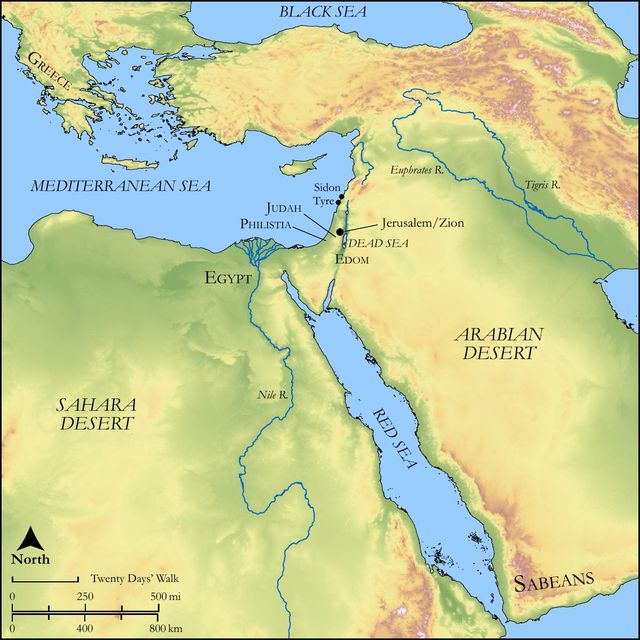
See on the biblical-era map
Study this verse
Public-domain commentary
Matthew Henry
From his Commentary on the Whole Bible. Henry comments on passages, not single verses — this entry covers Joel 2:28–32. His three-level outline is real structure in the source text, so it is rendered as structure.
The promises of corn, and wine, and oil, in the foregoing verses, would be very acceptable to a wasted country; but here we are taught that we must not rest in those things. God has reserved some better things for us, and these verses have reference to those better things, both the kingdom of grace and the kingdom of glory, with the happiness of true believers in both. We are here told,
I.How the kingdom of grace shall be introduced by a plentiful effusion of the Spirit, (Joe 2:28, Joe 2:29).
We are not at a loss about the meaning of this promise, nor in doubt what it refers to and wherein it had its accomplishment, for the apostle Peter has given us an infallible explication and application of it, assuring us that when the Spirit was poured out upon the apostles, on the day of Pentecost (Act 2:1, etc.), that was the very thing which was spoken of here by the prophet Joel, Joe 2:16, Joe 2:17. That was the gift of the Spirit, which, according to this prediction, was to come, and we are not to look for any other, any more than for another accomplishment of the promise of the Messiah. Now,
1.The blessing itself here promised is the pouring out of the Spirit of God, his gifts, graces, and comforts, which the blessed Spirit is the author of. We often read in the Old Testament of the Spirit of the Lord coming by drops, as it were, upon the judges and prophets whom God raised up for extraordinary services; but now the Spirit shall be poured out plentifully in a full stream, as was promised with an eye to gospel-times, Isa 44:3. I will pour my Spirit upon thy seed.
2.The time fixed for this is afterwards; after the fulfilling of the foregoing promises this shall be fulfilled. St. Peter expounds this of the last days, the days of the Messiah, by whom the world was to have its last revelation of the divine will and grace in the last days of the Jewish church, a little before its dissolution.
3.The extent of this blessing, in respect of the persons on whom it shall be bestowed. The Spirit shall be poured out upon all flesh, not as hitherto upon Jews only, but upon Gentiles also; for in Christ there is no distinction between Jew and Greek, Rom 10:11, Rom 10:12. Hitherto divine revelation was confined to the seed of Abraham, none but those of the land of Israel had the Spirit of prophecy; but, in the last days, all flesh shall see the glory of God (Isa 40:5) and shall come to worship before him, Isa 66:23. The Jews understand it of all flesh in the land of Israel, and Peter himself did not fully understand it as speaking of the Gentiles till he saw it accomplished in the descent of the Holy Ghost upon Cornelius and his friends, who were Gentiles (Act 10:44, Act 10:45), which was but a continuation of the same gift which was bestowed on the day of Pentecost. The Spirit shall be poured out upon all flesh, that is, upon all those whose hearts are made hearts of flesh, soft and tender, and so prepared to receive the impressions and influences of the Holy Ghost. Upon all flesh, that is, upon some of all sorts of men; the gifts of the Spirit shall not be so sparing, or so much confined, as they have been, but shall be more general and diffusive of themselves.
(1.)The Spirit shall be poured out upon some of each sex. Not your sons only, but your daughters, shall prophesy; we read of four sisters in one family that were prophetesses, Act 21:9. Not the parents only, but the children, shall be filled with the Spirit, which intimates the continuance of this gift for some ages successively in the church.
(2.)Upon some of each age: "Your old men, who are past their vigour and whose spirits begin to decay, your young men, who have yet but little acquaintance with and experience of divine things, shall yet dream dreams and see visions;" God will reveal himself by dreams and visions both to the young and old.
(3.)Upon those of the meanest rank and condition, even upon the servants and the handmaids. The Jewish doctors say, Prophecy does not reside on any but such as are wise, valiant, and rich, not upon the soul of a poor man, or a man in sorrow. But in Christ Jesus there is neither bond nor free, Gal 3:28. There were many that were called being servants (Co1 7:21), but that was no obstruction to their receiving the Holy Ghost.
(4.)The effect of this blessing: They shall prophesy; they shall receive new discoveries of divine things, and that not for their own use only, but for the benefit of the church. They shall interpret scripture, and speak of things secret, distant, and future, which by the utmost sagacities of reason, and their natural powers, they could not have any insight into nor foresight of. By these extraordinary gifts the Christian church was first founded and set up, and the scriptures were written, and the ministry settled, by which, with the ordinary operations and influences of the Spirit, it was to be afterwards maintained and kept up.
II.How the kingdom of glory shall be introduced by the universal change of nature, Joe 2:30, Joe 2:31.
The pouring out of the Spirit will be very comfortable to the righteous; but let the unrighteous hear this, and tremble. There is a great and terrible day of the Lord coming, which shall be ushered in with wonders in heaven and earth, blood, and fire, and pillars of smoke, the turning of the sun into darkness and the moon into blood. This is to have its full accomplishment (as the learned Dr. Pocock thinks) in the day of judgment, at the end of time, before which these signs will be performed in the letter of them, yet so that it was accomplished in part in the death of Christ (which is called the judgment of this world, when the earth quaked and the sun was darkened, and a great and terrible day it was), and more fully in the destruction of Jerusalem, which was a type and figure of the general judgment, and before which there were many amazing prodigies, besides the convulsions of states and kingdoms prophesied of under the figurative expressions of turning the sun into darkness and the moon into blood, and the wars and rumours of wars, and distress of nations, which our Saviour spoke of as the beginning of these sorrows, Mat 24:6, Mat 24:7. But before the last judgment there will be wonders indeed in heaven and earth, the dissolution of both, without a metaphor. The judgments of God upon a sinful world, and the frequent destruction of wicked kingdoms by fire and sword, are prefaces to and presages of the judgment of the world in the last day. Those on whom the Spirit is poured out shall foresee and foretel that great and terrible day of the Lord, and expound the wonders in heaven and earth that go before it; for, as to his first coming, so to his second, all the prophets did and do bear witness, Rev 10:7.
III.The safety and happiness of all true believers both in the first and second coming of Jesus Christ, Joe 2:32.
This speaks of particular persons, for to them the New Testament has more respect, and less to kingdoms and nations, than the Old. Now observe here,
1.That there is a salvation wrought out. Though the day of the Lord will be great and terrible, yet in Mount Zion and in Jerusalem there shall be deliverance from the terror of it. It is the day of the Lord, the day of his judgment, who knows how to separate between the precious and the vile. In the everlasting gospel, which went from Zion, in the church of the first-born typified by Mount Zion, and which is the Jerusalem that is from above, there is deliverance; a way of escaping the wrath to come is found out and laid open. Christ is himself not only the Saviour, but the salvation; he is so to the ends of the earth. This deliverance, laid up for us in the covenant of grace, is in performance of the promises made to the fathers. There shall be deliverance, as the Lord has said. See Luk 1:72. Note, This is ground of comfort and hope to sinners, that, whatever danger there is in their case, there is also deliverance, deliverance for them, if it be not their own fault. And, if we would share in this deliverance, we must ourselves apply to the gospel - Zion, to God's Jerusalem.
2.That there is a remnant interested in this salvation, and for whom the deliverance is wrought. It is in that remnant (that is, among them) that the deliverance is, or in their souls and spirits; there are the earnests and evidences of it. Christ in you, the hope of glory. They are called a remnant, because they are but a few in comparison with the multitudes that are left to perish; a little remnant but a chosen one, a remnant according to the election of grace. And here we are told who they are that shall be delivered in the great day.
(1.)Those that sincerely call upon God: Whosoever shall call upon the name of the Lord, whether Jew or Gentile (for the apostle so expounds it, Rom 10:13, where he lays this down as the great rule of the gospel by which we must all be judged), shall be delivered. This calling on God supposes knowledge of him, faith in him, desire towards him, dependence on him, and, as an evidence of the sincerity of all this, a conscientious obedience to him; for, without that, crying Lord, Lord, will not stand us in any stead. Note, It is the praying remnant that shall be the saved remnant. And it will aggravate the ruin of those who perish that they might have been saved on such easy terms.
(2.)Those that are effectually called to God. The deliverance is sure to the remnant whom the Lord shall call, not only with the common call of the gospel, with which many are called that are not chosen, but with a special call into the fellowship of Jesus Christ, whom the Lord predestinates, or prepares, so the Chaldee. St. Peter borrows this phrase, Act 2:39. Note, Those only shall be delivered in the great day that are now effectually called from sin to God, from self to Christ, from things below to things above.
Historical interpretation
Four Centuries of Reception
8 surviving comments on this verse. Each one is dated, so this reads as a timeline rather than a list.
Select a marker to jump to its quote. Markers stagger vertically where authors wrote within a few decades of each other.
For Moses describeth the righteousness which is of the law, That the man which doeth those things shall live by them. But the righteousness which is of faith speaketh on this wise, Say not in thine heart, Who shall ascend into heaven? (that is, to bring Christ down from above:) Or, Who shall descend into the deep? (that is, to bring up Christ again from the dead.) But what saith it? The word is nigh thee, even in thy mouth, and in thy heart: that is, the word of faith, which we preach; That if thou shalt confess with thy mouth the Lord Jesus, and shalt believe in thine heart that God hath raised him from the dead, thou shalt be saved. For with the heart man believeth unto righteousness; and with the mouth confession is made unto salvation. For the scripture saith, Whosoever believeth on him shall not be ashamed. For there is no difference between the Jew and the Greek: for the same Lord over all is rich unto all that call upon him. For whosoever shall call upon the name of the Lord shall be saved. [Joel 2:28-32]
And when the day of Pentecost was fully come, they were all with one accord in one place. And suddenly there came a sound from heaven as of a rushing mighty wind, and it filled all the house where they were sitting. And there appeared unto them cloven tongues like as of fire, and it sat upon each of them. And they were all filled with the Holy Ghost, and began to speak with other tongues, as the Spirit gave them utterance. And there were dwelling at Jerusalem Jews, devout men, out of every nation under heaven. Now when this was noised abroad, the multitude came together, and were confounded, because that every man heard them speak in his own language. And they were all amazed and marvelled, saying one to another, Behold, are not all these which speak Galilaeans? And how hear we every man in our own tongue, wherein we were born? Parthians, and Medes, and Elamites, and the dwellers in Mesopotamia, and in Judaea, and Cappadocia, in Pontus, and Asia, Phrygia, and Pamphylia, in Egypt, and in the parts of Libya about Cyrene, and strangers of Rome, Jews and proselytes, Cretes and Arabians, we do hear them speak in our tongues the wonderful works of God. And they were all amazed, and were in doubt, saying one to another, What meaneth this? Others mocking said, These men are full of new wine. But Peter, standing up with the eleven, lifted up his voice, and said unto them, Ye men of Judaea, and all ye that dwell at Jerusalem, be this known unto you, and hearken to my words: For these are not drunken, as ye suppose, seeing it is but the third hour of the day. But this is that which was spoken by the prophet Joel; And it shall come to pass in the last days, saith God,I will pour out of my Spirit upon all flesh: and your sons and your daughters shall prophesy, and your young men shall see visions, and your old men shall dream dreams: And on my servants and on my handmaidens I will pour out in those days of my Spirit; and they shall prophesy: And I will show wonders in heaven above, and signs in the earth beneath; blood, and fire, and vapour of smoke: The sun shall be turned into darkness, and the moon into blood, before that great and notable day of the Lord come: And it shall come to pass, that whosoever shall call on the name of the Lord shall be saved. [Joel 2:28-32] Ye men of Israel, hear these words; Jesus of Nazareth, a man approved of God among you by miracles and wonders and signs, which God did by him in the midst of you, as ye yourselves also know: Him, being delivered by the determinate counsel and foreknowledge of God, ye have taken, and by wicked hands have crucified and slain: Whom God hath raised up, having loosed the pains of death: because it was not possible that he should be holden of it.
The Lord has already foretold that the signs of the dissolution of the universe will appear in the sun and moon and stars: “the sun shall be turned to blood, and the moon will not give its light.” These are the signs of the consummation of the world.
For just as man is said to perish, according to the text, “The just perishes, and no one takes it to heart,” and this is said, though the resurrection is expected, so we look for a resurrection of the heavens. “The sun will be turned to darkness, and the moon to blood.” Let the converts from the Manichaeans be instructed and no longer make the luminaries their gods or impiously think that this sun that is darkened is Christ. Listen to the Lord’s words: “Heaven and earth will pass away, but my words will not pass away,” for the master’s creatures are less precious than his words.
(Verse 28 and following) And it shall come to pass afterward, that I will pour out my Spirit on all flesh;your sons and your daughters shall prophesy, your old men shall dream dreams, and your young men shall see visions.Even on the male and female servants in those days I will pour out my Spirit.And I will show wonders in the heavens and on the earth, blood and fire and columns of smoke.The sun shall be turned to darkness, and the moon to blood, before the great and awesome day of the Lord comes. And it shall come to pass that everyone who calls upon the name of the Lord shall be saved. Acts 2:17-19: 'And it shall come to pass in the last days, says God, that I will pour out my Spirit on all flesh; your sons and your daughters shall prophesy, your old men shall dream dreams, your young men shall see visions; and also on My menservants and on My maidservants I will pour out My Spirit in those days; and I will show wonders in heaven above and signs in the earth beneath: blood and fire and vapor of smoke.' The sun will be turned into darkness, and the moon into blood, before the great and illustrious day of the Lord comes. And it will be, that everyone who calls on the name of the Lord will be saved. The blessed apostle Peter explained this passage fulfilled at the time of the Lord's passion, when the Holy Spirit descended on the believers on the day of Pentecost, and they spoke in tongues as the Spirit gave them utterance, so that those present marveled and said, 'Are not all these who are speaking Galileans? And how is it that we hear, each in our own native language?' Parthians, Medes, and Elamites, and others; some were saying, 'What does this mean?' But others were mocking and saying, 'They are filled with new wine.' Then Peter stood up with the eleven, raised his voice, and declared to them: 'Men of Judea and all who live in Jerusalem, let this be known to you, and listen carefully to my words. These people are not drunk, as you suppose, for it is only nine o'clock in the morning. No, this is what was spoken through the prophet Joel: ' And it shall come to pass afterward, says the Lord: I will pour out my Spirit on all flesh; your sons and your daughters shall prophesy, and your old men shall dream dreams, and your young men shall see visions. And also on the male and female servants in those days I will pour out my Spirit. And I will show wonders in the heavens and on the earth, blood and fire and columns of smoke. The sun shall be turned to darkness, and the moon to blood, before the great and awesome day of the Lord comes. And it shall come to pass that everyone who calls on the name of the Lord shall be saved. For in Mount Zion and in Jerusalem there shall be those who escape, as the Lord has said, and among the survivors shall be those whom the Lord calls. From the beginning, therefore, until the place where it is written: 'Great is the day of the Lord and very terrible, and who can endure it?' it is a threat and description of what the Lord will inflict upon the sinful people. But from the place where we read: 'Return to me with all your heart, with fasting, weeping, and mourning,' until the place where it says: 'Why do they say among the peoples, "Where is their God?"' it is the exhortation of the Lord, calling for repentance after punishment and affliction. Again, from that place which follows: The Lord was zealous for his land and spared his people, and the Lord answered and said, even to the place where it is written: And my people shall not be put to shame forever, the promise of things to come is that they should await the good after they have repented. And after many things which it is now tedious to recount, these things also are said in the promise, which we now endeavor to explain: I will pour out my spirit upon all flesh, and your sons and daughters shall prophesy, and the rest. I seem to myself to have saved the text of the conversation from the beginning up to this point. It is a great labor how what follows should be connected to what we are now discussing. Another [person] says what was generally promised in the last times is now partly completed. And because the apostles felt the reward of future [events] at the first coming of the Lord, they mentioned certain offerings and first fruits of miracles that had been fulfilled, so that until what is perfect comes, we would feel what had previously come in part. But another asserts that it is an apostolic tradition, according to what is written about a holy man: 'He will dispense his words in judgment' (Ps. CXI, 5): so that whatever useful things they saw to be for the listeners and not contradicting what is present, they would strengthen them with testimonies from another time, not that they would exploit the simplicity and ignorance of the listeners, as the impious Porphyrius calumniates, but according to the apostle Paul, they would preach at the right time, and at the wrong time (II Tim. IV). And the following is the rule of the prophets: whatever the Jews in the last times promise themselves carnally, they would say was fulfilled spiritually in the first coming of the Lord and Savior: especially since both they and we say that the promises were to be fulfilled in Christ, only differing in this, that they contend for future things, while we maintain that they have already happened: about which more should be discussed in what follows. But every flesh on which the Lord promises to pour out His Spirit, that is the flesh about which Isaiah speaks: And all flesh shall see the salvation of God (Isaiah 40:5). Therefore, the salvation of God cannot be seen unless the Holy Spirit is poured out. And whoever claims to believe in Christ, without believing in the Holy Spirit, will not have the eyes of perfect faith. Hence, in the Acts of the Apostles, those who had been baptized with the baptism of John, in the one who was to come, that is, in the name of the Lord Jesus, are re-baptized when they respond to Paul's question: 'But did you receive the Holy Spirit?' (Acts 19). Indeed, they receive true baptism, because without the Holy Spirit and the mystery of the Trinity, whatever is received into one or the other person is imperfect. But indeed, not everyone who receives the Holy Spirit will immediately have spiritual grace; but through the outpouring of the Holy Spirit, they will obtain different graces (I Cor. XII). Some will receive prophecy, like sons and daughters who are of greater merit; others will have dreams, like the elderly of advanced age; others will have visions, like the young who have conquered evil. However, servants and handmaids who still have the spirit of fear, and not of love, because perfect love casts out fear, will not have prophecy, dreams, or visions; but, content with the outpouring of the Holy Spirit, they will possess only the grace of faith and salvation. Then the Lord will give signs in the sky and on earth: in the sky, because the sun will turn into darkness, and the moon into blood; on earth, because the earth will shake so violently and unusually that tombs will be opened and rocks will be split. And what he says, blood and vapors, or the vapor of smoke, that blood is the one of which we read in the Psalms: That your foot may be dipped in blood (Psalm 47:24). And in Isaiah: How red are your garments (Isaiah 63:2)! And when, after striking the side of the Savior, the Roman soldier poured out mixed water (John 19). And the fire of the Holy Spirit, which descended from heaven, as we read in the Acts of the Apostles: Tongues as of fire appeared to them, and it sat on each one of them, and they were filled with the Holy Spirit and began to speak in different tongues, as the Holy Spirit gave them utterance (Acts 2:3-4). This is the fire that the Lord came to send upon the earth, and before he suffered, he desired it to burn in his disciples (Luke 12). Fire is of a double nature: it has light for those who believe; it has darkness and punishment for unbelievers, who are called the fumes of smoke. This smoke is very bitter, which blinded the eyes of the Jews, as we read in the proverbs: 'As smoke is harmful to the eyes, and an unripe grape to the teeth, so is wickedness to those who use it' (Prov. X, 26). Isaiah also speaks about this smoke in a great vision, in which the blindness of the Jews was foretold: 'And the threshold has moved, and the house is filled with smoke.' Then it follows: Go, and tell this people: You shall indeed hear, but not understand; and you shall indeed see, but not perceive. For the heart of this people has grown dull, and their ears are hard of hearing (Isaiah VI, 9, 10). The sun also turns into darkness when it does not dare to see its hanging Lord, and the moon into blood, which we may believe happened according to history and was passed over in silence by the evangelists. For not everything that Jesus did is recorded, and if every single thing were written, I do not think that even the world itself could contain the books that would be written (John XXI). Certainly, when the sun was obscured in darkness, it was not because it had turned to darkness itself, but because it had brought darkness upon the world: thus, the moon was not turned to blood, but it condemned the Jews covered in horror of blasphemies and denial of Christ with the eternal testimony of its blood, saying: 'His blood be upon us, and upon our children' (Matthew 27:25). These are all things that are described as future before the great and terrible day of the Lord comes. But this day of the Lord is to be believed as either great and terrible of the resurrection, or certainly, after a long time, a day of judgment, which is truly great and terrible. But since it follows: And it shall be, everyone who shall call upon the name of the Lord shall be saved, and the apostle Paul refers this to the time of the Lord's passion, it is more to be understood of the day of resurrection. For he says in writing to the Romans: There is no distinction between Jew and Greek. For the same Lord is rich unto all that call upon him. For whosoever shall call upon the name of the Lord shall be saved. But how shall they call on him in whom they have not believed? Or how shall they believe in him of whom they have not heard? And how shall they hear without a preacher? And how shall they preach, except they be sent? (Rom. 10:12-15) And when it is said, Whosoever shall call upon the name of the Lord shall be saved, let us not lightly esteem it, for although the same apostle writes: No man can say that Jesus is the Lord, but by the Holy Ghost. (1 Cor. 12:3) Yet we must understand that to say this is not a matter of mere words, but of heartfelt faith. For everyone who calls on the name of the Lord will be saved. So Paul and Sosthenes write to the Church of God which is in Corinth: Sanctified in Christ Jesus, called saints, together with all those who call upon the name of our Lord Jesus Christ (I Cor. 1): according to what we read in the Psalms: Moses and Aaron among his priests, and Samuel among those who call upon his name. They called upon the Lord, and he answered them; he spoke to them in the pillar of cloud (Ps. 99:9). So if it is written about the believing Corinthians, and about Moses and Aaron and Samuel, that they invoked the name of the Lord, let us believe that this grace is not for beginners but for those who have reached perfection. The word 'effusion', which is said in Hebrew Esphoch (), and which all have translated similarly, shows the abundance of the gift, that it has not descended upon a few Prophets (as it once did in the Old Testament), but upon all who believe in the name of the Savior, the gifts of the Holy Spirit: not just on this one or that one, but on all flesh. For there is no distinction between Jew and Greek, slave and free, male and female; for we are all one in Christ. (Romans 10). Therefore, Agabus prophesied in Caesarea (Acts 21), and there were many prophets in Antioch. The Apostle commands that if one person is prophesying and another has a revelation, the first should keep silent. (1 Corinthians 14). We also read that the four daughters of Philip the evangelist prophesied. (Acts 21). Even the old men saw visions, as when Paul, an old man, heard a man from Macedonia saying to him: 'Come over to Macedonia and help us.' (Acts 16:9). And all the young men who stood forth strong in Christ, and fought the Lord's battles, saw visions, with the Lord fulfilling his promises: I multiply visions, and I am likened to the hands of the prophets (Hosea 10:12).
Blessed Peter used this text in speaking to Jews on the occasion of the descent of the Holy Spirit. And rightly so, since the law contained a shadow of all things to come, whereas the people were granted care owing to the expectation of what would appear at the coming of Christ the Lord. What happened in their time was all insignificant and like a shadow, so that the account was given with use of hyperbole rather than containing facts. The reality of the account was found to be realized in the time of Christ the Lord, when everything was important and awesome, novel and really baffling, surpassing what had happened under the law to the greatest extent imaginable.
True is the word of Scripture that says, “I will turn the sun into darkness and the moon into blood.” It demonstrates that he is the Lord of the luminaries and of their lightening and darkening. This stands as a reproach to the sun worshipers and the moon worshipers. And there is no way for the moon to descend into the earth, as it has been claimed by magicians. It is God who commands the moon’s light to appear bloody and its features demonic. The magicians prattle that they will cause the moon to descend—an impossibility! They imagine that something greater than many worlds can be contained in one little threshing floor and that one without breasts can be milked. And how many numberless thousands upon thousands of magicians are there on earth! If each one of them independently were capable of making the moon descend, it would never be allowed to ascend to the heavens. But that it never descends is clear because no one sees it descending or ascending. And if you are patient, you will become aware that right there, having become darkened, the moon becomes luminous little by little until entirely it is restored.
The people, then, call this day “the new sun,” and although they say that it is new, yet they also show that it is old. This world’s sun—which undergoes eclipse, is shut out by walls and is hidden by clouds—I would call old. I would call old the sun that is subject to vanity, is fearful of corruption and dreads the judgment. For it is written, “The sun will be changed into darkness and the moon into blood.” Old, indeed, would I call that which is implicated in human crimes, does not flee adulteries, does not turn aside from murder and, although it does not wish to be in the midst of the human race when some offense is perpetrated, stands here alone among all the evil deeds. Therefore, inasmuch as it has been shown to be old, we have discovered that nothing is new but Christ the Lord, of whom it is written, “The Sun of justice will rise upon you” and of whom the prophet also says in the person of sinners, “The sun has not risen upon us, and the light of justice has not shone upon us.” For when the whole world was oppressed by the darkness of the devil and the gloom brought on by sin was laying hold of the world, at the last age—that is to say, when night had already fallen—this sun deigned to bring forth the rising of his birth. At first, before the light—that is, before the Sun of justice shone—he sent the oracle of the prophets as a kind of dawning, as it is written: “I sent my prophets before the light.” But afterwards he himself burst forth with his rays—that is, with the brightness of his apostles—and shed upon the earth a light of truth such that no one would stumble into the devil’s darkness.
Continue studying Joel 2:30 across the web’s major study libraries — every link below opens this exact verse, chapter, or book on the destination site.
Read & Compare
 BibleGatewayThis verse in more than 200 translations and 70 languages.
 Bible.comThe YouVersion reader — hundreds of translations, reading plans, and highlights.
 ESV.orgCrossway's official English Standard Version reader.
 NET BibleThe NET translation with 60,000+ translators' notes on every rendering decision.
 STEP BibleTyndale House's free study tool — original text, vocabulary, and scholarly resources.
 BibliaLogos Bible Software's free web reader.
 USCCBThe New American Bible (Revised Edition) with the U.S. bishops' study notes.
Commentaries
 BibleHub CommentariesDozens of classic commentaries on this verse, gathered on one page.
 StudyLightMore than 100 commentary sets — the largest collection on the web.
 BibleRefPlain-English commentary on what this verse means, verse by verse.
 Enduring WordDavid Guzik's free commentary on this chapter, widely used by Bible teachers.
 Bible Study ToolsVerse commentary alongside Greek and Hebrew study aids.
Original Language & Research
- BibleHub InterlinearThe verse word by word — original language, transliteration, and English.
- BibleHub LexiconEvery word's original-language definition and Strong's entry.
 Blue Letter BibleDeep-study tools — Strong's numbers, concordance, and word studies.
 SefariaThe Hebrew text with Rashi and centuries of Jewish commentary.
Sermons, Hymns & Audio


TrulyRandomVerse is not affiliated with these sites and doesn’t control their content. They’re linked because they’re genuinely useful.
Summary
Joel 2:30 stands as a pivotal prophetic declaration within the book of Joel, foretelling dramatic disturbances in the heavens and on the earth that will precede the awe-inspiring and terrifying "Day of the Lord." This verse, embedded within a larger prophecy of judgment, repentance, and restoration, vividly portrays God's ultimate sovereignty and His direct intervention in the natural order, signaling a profound shift in history and the culmination of His divine plan.
Context
ShowHideLiterary Context
Joel 2:30 is situated within a broader prophetic oracle that transitions from a devastating locust plague, interpreted as a metaphor for divine judgment, to a fervent call for national repentance. Following the promise of agricultural restoration and, more significantly, the unprecedented outpouring of God's Spirit upon all humanity (Joel 2:28-29), this verse introduces the cataclysmic signs that will herald the coming "Day of the Lord." It serves as a bridge, connecting the immediate spiritual renewal with the ultimate eschatological climax, emphasizing the solemnity and inescapable nature of God's final intervention. The sequence moves from judgment (locusts) to grace (Spirit) to ultimate judgment/vindication (signs in the heavens), framing the entire prophecy as a call to prepare for God's sovereign acts.
Historical & Cultural Context
The book of Joel is notoriously difficult to date, but its message resonates with the common belief among the nations that natural phenomena were divine communication. In a predominantly agrarian society, events like plagues, droughts, or unusual celestial displays were often interpreted as direct messages or warnings from the gods. For the Israelites, such occurrences were understood as manifestations of Yahweh's power, either in judgment or blessing. The imagery of "blood, fire, and pillars of smoke" would have evoked powerful associations with warfare, divine wrath, and theophanic manifestations, reminiscent of God's appearance at Mount Sinai (Exodus 19:18) or the destruction of Sodom and Gomorrah (Genesis 19:24-28). This context underscores the profound impact these prophesied signs would have had on the original audience, signaling an event of unparalleled divine intervention.
Key Themes
ShowHideJoel 2:30 contributes significantly to several overarching themes within the book and broader biblical theology. Firstly, it powerfully reinforces the theme of Divine Sovereignty and Manifestation, showcasing God's absolute control over creation and His intention to reveal His presence through undeniable signs in both the celestial and terrestrial realms. Secondly, it is a cornerstone for the theme of Eschatological Signs, providing specific imagery that would become emblematic of the "Day of the Lord"—a recurring prophetic motif signifying a period of divine judgment and salvation. These dramatic phenomena—"blood, and fire, and pillars of smoke"—are not merely random occurrences but divinely orchestrated portents signifying a critical transition in human history, often associated with the establishment of God's kingdom and the final reckoning. Lastly, the verse highlights Disturbances in the Heavens and the Earth, emphasizing the universal and inescapable scope of God's impending actions. The involvement of "the heavens and in the earth" underscores that no corner of creation will be untouched by the Lord's return, ensuring that His coming will be witnessed by all, as seen in later prophetic visions like those in Matthew 24:29 and Revelation 6:12.
Exposition and Analysis
ShowHideKey Word Analysis
ShowHideThis verb, rendered "shew" in the KJV, is H5414 in Strong's Concordance and is a primitive root with an exceptionally broad range of meaning, encompassing "to give," "put," "make," "appoint," "bestow," and "perform." In the context of Joel 2:30, "shew" implies that God will actively cause or bring forth these wonders. It's not a passive observation but an intentional, divine act of manifestation, underscoring His direct agency in orchestrating these wonders in the heavens and on the earth.
The Hebrew word H4159, môwphêth, refers to a "miracle," "sign," or "omen." It denotes something conspicuous, often awe-inspiring or terrifying, that serves to confirm a divine message or action. In this verse, these "wonders" are not mere natural events but supernatural occurrences, portents designed by God to signify His presence, power, and the imminence of the "Day of the Lord." They are unmistakable indicators of divine intervention.
dâm, primarily refers to "blood" as that which, when shed, causes death. Figuratively, especially in the plural, it signifies "bloodshed" or "bloody-guiltiness." In the context of apocalyptic imagery, "blood" can symbolize widespread violence, war, death, or even a literal reddening of the heavens or earth, indicating a profound disruption and the severity of divine judgment. Its inclusion alongside fire and smoke suggests a scene of intense conflict and destruction.
Verse Breakdown
ShowHide"And I will shew wonders in the heavens and in the earth"
This opening clause establishes God's direct agency ("I will shew") in orchestrating extraordinary, supernatural events ("wonders"). The scope of these wonders is universal, encompassing both the celestial realm ("in the heavens") and the terrestrial ("and in the earth"). This indicates that the signs will be undeniable and visible to all, signaling a comprehensive divine intervention that transcends normal natural phenomena.
"blood, and fire"
These two elements are presented as specific manifestations of the "wonders." "Blood" can be interpreted literally as a reddening of the sky or earth, or symbolically as widespread violence, war, and bloodshed that precedes or accompanies the "Day of the Lord." "Fire" often symbolizes divine judgment, purification, or destructive power. Together, "blood, and fire" evoke intense imagery of conflict, devastation, and the consuming wrath of God.
"and pillars of smoke"
The final element, "pillars of smoke," further intensifies the imagery of destruction and upheaval. "Pillars" (H8490, tîymârâh) suggests a rising column, often associated with smoke from burning cities, sacrifices, or volcanic activity. This imagery reinforces the sense of widespread conflagration, devastation, and perhaps even the lingering aftermath of divine judgment, painting a picture of a world dramatically altered by God's powerful intervention.
Literary Devices
ShowHideJoel 2:30 is rich in Apocalyptic Imagery, a characteristic feature of prophetic literature that uses vivid, often symbolic, and cataclysmic descriptions to depict future events, particularly those related to the end times or divine judgment. The mention of "wonders," "blood," "fire," and "pillars of smoke" creates a powerful, almost cinematic, vision of upheaval in the heavens and the earth. Symbolism is paramount; "blood" can symbolize war, violence, or a literal reddening of the moon or sky; "fire" represents divine judgment, purification, or destruction; and "pillars of smoke" evoke images of burning cities or widespread devastation. These elements are not necessarily to be interpreted solely as literal occurrences but as potent symbols conveying the magnitude and severity of God's impending actions. The cumulative effect of these images also employs Hyperbole, exaggerating natural phenomena to emphasize the extraordinary and terrifying nature of the "Day of the Lord," ensuring the prophet's message leaves an indelible impression on the audience.
Theological and Thematic Connections
ShowHideJoel 2:30 profoundly underscores God's absolute sovereignty over creation and history, revealing His intention to manifest His power through undeniable signs preceding the "Day of the Lord." These disturbances in the heavens and on the earth serve as divine heralds, signaling a critical juncture in salvation history where God will intervene decisively in human affairs. The imagery of blood, fire, and smoke connects to themes of divine judgment, purification, and the ultimate consummation of God's redemptive plan. The verse teaches that God's coming will be unmistakable, demanding attention and response from all humanity, and that His justice will be as evident as His mercy.
Reflection and Application
ShowHideJoel 2:30 serves as a powerful reminder of God's ultimate control over all creation and His unwavering commitment to His divine purposes, which include both judgment and redemption. For believers, this prophecy encourages a posture of vigilance and readiness for the Lord's return, knowing that these dramatic signs will precede His glorious appearing. It calls us to live with an eternal perspective, understanding that world events are not random but are unfolding within God's sovereign plan. Furthermore, the severity of the prophesied signs underscores the seriousness of God's justice and the urgent need for repentance and reliance on His mercy, which is abundantly offered through the outpouring of His Spirit. Understanding these prophetic signs helps us to view current global affairs through a biblical lens, recognizing that God is actively working out His purposes in history, prompting us to share the good news of salvation and live lives that honor Him.
Questions for Reflection
ShowHideFAQ
ShowHideAre the "wonders in the heavens and in the earth" described in Joel 2:30 meant to be interpreted literally or symbolically?
ShowHideThe interpretation of the "wonders" in Joel 2:30—"blood, and fire, and pillars of smoke"—often involves a combination of literal and symbolic understanding, reflecting the nature of apocalyptic prophecy. While these descriptions could point to actual, dramatic celestial and terrestrial phenomena (e.g., volcanic eruptions, meteor showers, or atmospheric disturbances that cause the sky to appear bloody or fiery), they also carry profound symbolic weight. "Blood" can symbolize widespread violence and war, "fire" represents divine judgment and purification, and "smoke" can signify the aftermath of destruction or God's consuming presence. The Apostle Peter, in Acts 2:19-20, quotes Joel 2:30-31 in the context of the outpouring of the Holy Spirit, suggesting that the prophecy has both an immediate spiritual fulfillment (the Spirit's work) and a future, more literal, eschatological fulfillment preceding the "great and notable Day of the Lord." Therefore, it's best to view these as divinely orchestrated signs that are both literally impactful and deeply symbolic of God's decisive intervention in history.
Christ-Centered Fulfillment
ShowHideJoel 2:30, with its dramatic portrayal of signs in the heavens and on the earth, finds its ultimate Christ-centered fulfillment in both the first and second comings of Jesus. The Apostle Peter, on the Day of Pentecost, famously quotes Joel 2:28-32 in Acts 2:17-21, applying the prophecy of the Spirit's outpouring to the immediate events. However, Peter also includes the signs in the heavens of Joel 2:30-31, "the sun shall be turned into darkness, and the moon into blood, before that great and notable day of the Lord come," indicating that while the Spirit's outpouring was a partial fulfillment, the full scope of Joel's prophecy, particularly the terrifying signs, still awaits a future culmination connected to Christ's return. Jesus Himself speaks of similar disturbances in the heavens preceding His second coming in the Olivet Discourse, stating in Matthew 24:29-30 that the sun shall be darkened, and "the moon shall not give her light, and the stars shall fall from heaven, and the powers of the heavens shall be shaken: And then shall appear the sign of the Son of man in heaven." The "blood, and fire, and pillars of smoke" of Joel 2:30 thus foreshadow the dramatic, undeniable manifestation of God's power that will accompany Christ's glorious return, serving as a universal sign that the King of Kings, the Lamb of God, is coming to establish His eternal kingdom, judge the living and the dead, and bring about the new heavens and new earth (Revelation 21:1). These signs ultimately point to Jesus as the sovereign Lord over creation and history, whose return will be heralded by unmistakable divine wonders.