


Numbers 12:5
- וַיֵּרֶדvai·Ye·redand he came downH3381Conj-w ¦ V-Qal-ConsecImperf-3msVerb Qal Consecutive Imperfect 3rd Singular Masculineוַandיֵּרֶדhe came down
- יְהוָהYah·wehYahwehH3068N-properNoun Proper Title
- בְּעַמּוּדbe·'a·Mudin a pillar ofH5982Prep-b ¦ N-mscNoun Singular Masculine Constructבְּinעַמּוּדa pillar of
- עָנָן'a·NancloudH6051N-msNoun Singular Masculine Absolute
- וַיַּעֲמֹדvai·ya·'a·Modand he stoodH5975Conj-w ¦ V-Qal-ConsecImperf-3msVerb Qal Consecutive Imperfect 3rd Singular Masculineוַandיַּעֲמֹדhe stood
- פֶּתַחPe·tach[the] entrance ofH6607N-mscNoun Singular Masculine Construct
- הָאֹהֶלha·'O·helthe tentH168Art ¦ N-msNoun Singular Masculine Absoluteהָtheאֹהֶלtent
- וַיִּקְרָאvai·yik·Ra'and he summonedH7121Conj-w ¦ V-Qal-ConsecImperf-3msVerb Qal Consecutive Imperfect 3rd Singular Masculineוַandיִּקְרָאhe summoned
- אַהֲרֹן'a·ha·RonAaronH175N-proper-mNoun Proper Masculine
- וּמִרְיָםu·mir·Yamand MiriamH4813Conj-w ¦ N-proper-fNoun Proper FeminineוּandמִרְיָםMiriam
- וַיֵּצְאוּvai·ye·tze·'Uand they went outH3318Conj-w ¦ V-Qal-ConsecImperf-3mpVerb Qal Consecutive Imperfect 3rd Plural Masculineוַandיֵּצְאוּthey went out
- שְׁנֵיהֶםshe·nei·Hemboth of themH8147Adj-cdc ¦ 3mpAdjective Numerical Dual common gender Constructשְׁנֵיboth ofהֶםthem
English is a literal word-by-word gloss of the Hebrew, not the KJV's wording. Why?
This is the original text the KJV's translators worked from — each Hebrew word with its own literal English meaning in this verse, prepared by scholars at Tyndale House, Cambridge. The KJV translates whole sentences, not word by word, so its wording differs: one Hebrew word can become several English words, and the KJV may choose “the LORD” where the gloss reads “Yahweh”. Both are faithful — they answer different questions. For the KJV's own rendering, switch to the KJV text.
Details
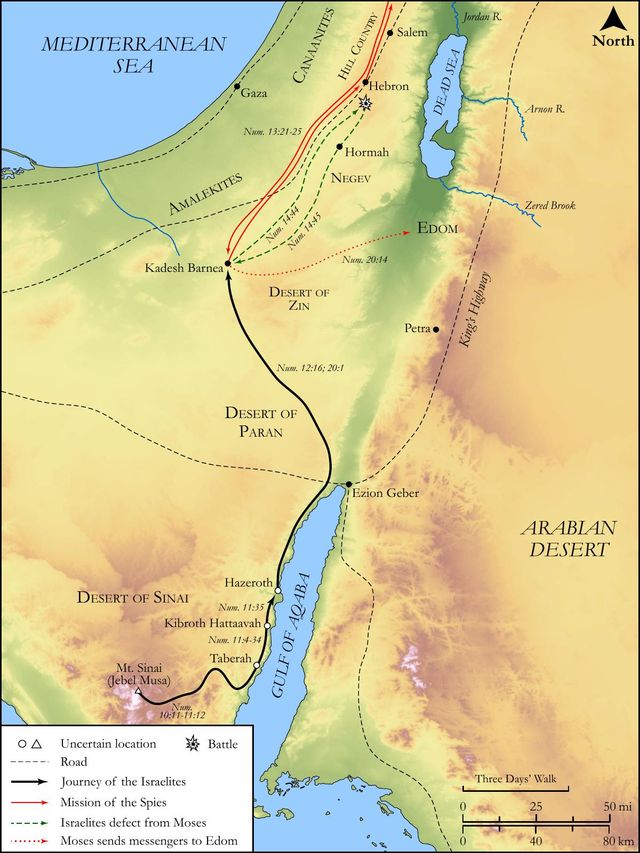
See on the biblical-era map
Study this verse
Public-domain commentary
Matthew Henry
From his Commentary on the Whole Bible. Henry comments on passages, not single verses — this entry covers Numbers 12:4–9. His four-level outline is real structure in the source text, so it is rendered as structure.
Moses did not resent the injury done him, nor complain of it to God, nor make any appeal to him; but God resented it. He hears all we say in our passion, and is a swift witness of our hasty speeches, which is a reason why we should resolutely bridle our tongues, that we speak not ill of others, and why we should patiently stop our ears, and not take notice of it, if others speak ill of us. I heard not, for thou wilt hear, Psa 38:13-15. The more silent we are in our own cause the more is God engaged to plead it. The accused innocent needs to say little if he knows the judge himself will be his advocate.
I.The cause is called, and the parties are summoned forthwith to attend at the door of the tabernacle, Num 12:4, Num 12:5.
Moses had often shown himself jealous for God's honour, and now God showed himself jealous for his reputation; for those that honour God he will honour, nor will he ever be behind-hand with any that appear for him. Judges of old sat in the gate of the city to try causes, and so on this occasion the shechinah in the cloud of glory stood at the door of the tabernacle, and Aaron and Miriam, as delinquents, were called to the bar.
II.Aaron and Miriam were made to know that great as they were they must not pretend to be equal to Moses, nor set up as rivals with him, v. 6-8. Were they prophets of the Lord? Of Moses it might be truly said, He more.
1.It was true that God put a great deal of honour upon the prophets. However men mocked them and misused them, they were the favourites and intimates of heaven. God made himself known to them, either by dreams when they were asleep or by visions when they were awake, and by them made himself known to others. And those are happy, those are great, truly great, truly happy, to whom God makes himself known, Now he does it not by dreams and visions, as of old, but by the Spirit of wisdom and revelation, who makes known those things to babes which prophets and kings desired to see and might not. Hence in the last days, the days of the Messiah, the sons and daughters are said to prophesy (Joe 2:28), because they shall be better acquainted with the mysteries of the kingdom of grace than even the prophets themselves were; see Heb 1:1, Heb 1:2.
2.Yet the honour put upon Moses was far greater (Num 12:7): My servant Moses is not so, he excels them all. To recompense Moses for his meekly and patiently bearing the affronts which Miriam and Aaron gave him, God not only cleared him, but praised him; and took that occasion to give him an encomium which remains upon record to his immortal honour; and thus shall those that are reviled and persecuted for righteousness' sake have a great reward in heaven, Christ will confess them before his Father and the holy angels.
(1.)Moses was a man of great integrity and tried fidelity. He is faithful in all my house. This is put first in his character, because grace excels gifts, love excels knowledge, and sincerity in the service of God puts a greater honour upon a man and recommends him to the divine favour more than learning, abstruse speculations, and an ability to speak with tongues. This is that part of Moses's character which the apostle quotes when he would show that Christ was greater than Moses, making it out that he was so in this chief instance of his greatness; for Moses was faithful only as a servant, but Christ as a son, Heb 3:2, Heb 3:5, Heb 3:6. God entrusted Moses to deliver his mind in all things to Israel; Israel entrusted him to treat for them with God; and he was faithful to both. He said and did every thing in the management of that great affair as became an honest good man, that aimed at nothing else but the honour of God and the welfare of Israel.
(2.)Moses was therefore honoured with clearer discoveries of God's mind, and a more intimate communion with God, than any other prophet whatsoever. He shall,
[1.]Hear more from God than any other prophet, more clearly and distinctly: With him will I speak mouth to mouth, or face to face (Exo 30:11), as a man speaks to his friend, whom he discourses with freely and familiarly, and without any confusion or consternation, such as sometimes other prophets were under; as Ezekiel, and John himself, when God spoke to them. By other prophets God sent to his people reproofs, and predictions of good or evil, which were properly enough delivered in dark speeches, figures, types, and parables; but by Moses he gave laws to his people, and the institution of holy ordinances, which could by no means be delivered by dark speeches, but must be expressed in the plainest and most intelligible manner.
[2.]He shall see more of God than any other prophet: The similitude of the Lord shall behold, as he hath seen it in Horeb, when God proclaimed his name before him. Yet he saw only the similitude of the Lord, angels and glorified saints always behold the face of our Father. Moses had the spirit of prophecy in a way peculiar to himself, and which set him far above all other prophets; yet he that is least in the kingdom of heaven is greater than he, much more does our Lord Jesus infinitely excel him, Heb 3:1, etc.
Now let Miriam and Aaron consider who it was that they insulted: Were you not afraid to speak against my servant Moses? Against my servant, against Moses? so it runs in the original. "How dare you abuse any servant of mine, especially such a servant as Moses, who is a friend, a confidant, and steward of the house?" How durst they speak to the grief and reproach of one whom God had so much to say in commendation of? Might they not expect that God would resent it, and take it as an affront to himself? Note, We have reason to be afraid of saying or doing any thing against the servants of God; it is at our peril if we do, for God will plead their cause, and reckon that what touches them touches the apple of his eye. It is a dangerous thing to offend Christ's little ones, Mat 18:6. Those are presumptuous indeed that are not afraid to speak evil of dignities, Pe2 2:10.
III.God, having thus shown them their fault and folly, next shows them his displeasure (Num 12:9):
The anger of the Lord was kindled against them, of which perhaps some sensible indications were given in the change of the colour of the cloud, or some flashes of lightning from it. But indeed it was indication enough of his displeasure that he departed, and would not so much as hear their excuse, for he needed not, understanding their thoughts afar off; and thus he would show that he was displeased. Note, The removal of God's presence from us is the surest and saddest token of God's displeasure against us. Woe unto us if he depart; and he never departs till we by our sin and folly drive him from us.
Continue studying Numbers 12:5 across the web’s major study libraries — every link below opens this exact verse, chapter, or book on the destination site.
Read & Compare
 BibleGatewayThis verse in more than 200 translations and 70 languages.
 Bible.comThe YouVersion reader — hundreds of translations, reading plans, and highlights.
 ESV.orgCrossway's official English Standard Version reader.
 NET BibleThe NET translation with 60,000+ translators' notes on every rendering decision.
 STEP BibleTyndale House's free study tool — original text, vocabulary, and scholarly resources.
 BibliaLogos Bible Software's free web reader.
 USCCBThe New American Bible (Revised Edition) with the U.S. bishops' study notes.
Commentaries
 BibleHub CommentariesDozens of classic commentaries on this verse, gathered on one page.
 StudyLightMore than 100 commentary sets — the largest collection on the web.
 BibleRefPlain-English commentary on what this verse means, verse by verse.
 Enduring WordDavid Guzik's free commentary on this chapter, widely used by Bible teachers.
 Bible Study ToolsVerse commentary alongside Greek and Hebrew study aids.
Original Language & Research
- BibleHub InterlinearThe verse word by word — original language, transliteration, and English.
- BibleHub LexiconEvery word's original-language definition and Strong's entry.
 Blue Letter BibleDeep-study tools — Strong's numbers, concordance, and word studies.
 SefariaThe Hebrew text with Rashi and centuries of Jewish commentary.
Sermons, Hymns & Audio


TrulyRandomVerse is not affiliated with these sites and doesn’t control their content. They’re linked because they’re genuinely useful.
Summary
Numbers 12:5 vividly portrays a direct and dramatic divine intervention as the Lord descends in the pillar of cloud, taking a decisive stand at the entrance of the Tabernacle to summon Aaron and Miriam. This pivotal moment serves as God's immediate and public response to their challenge against Moses's unique prophetic authority, unequivocally affirming His chosen leader and demonstrating His unwavering commitment to the established divine order within Israel, transforming a human dispute into a profound display of divine presence and judgment.
Context
ShowHideLiterary Context
This verse marks the climactic moment of God's swift and personal intervention in the dispute between Miriam and Aaron and their brother, Moses. The preceding verses, Numbers 12:1-2, reveal their initial complaint regarding Moses's Cushite wife, which quickly escalates into a direct challenge to his exclusive prophetic standing: "Hath the LORD indeed spoken only by Moses? hath he not spoken also by us?" (Numbers 12:2). Crucially, Numbers 12:3 interjects a profound statement about Moses's unparalleled meekness, underscoring that he did not defend himself. Instead, the narrative emphasizes God's immediate and unsolicited response: "And the LORD spake suddenly unto Moses, and unto Aaron, and unto Miriam" (Numbers 12:4). This divine initiative sets the stage for the awe-inspiring theophany described in verse 5, where God Himself descends to address the rebellion directly.
Historical & Cultural Context
The events of Numbers unfold during Israel's forty-year wilderness sojourn, a period defined by the tangible and continuous presence of God. The pillar of cloud by day and fire by night was not merely a guide but the visible manifestation of God's dwelling among His people, resting prominently over the Tabernacle, which served as the central hub of Israelite worship and the locus of divine-human encounter (Exodus 40:34-38). In the ancient Near East, challenging a divinely appointed leader, particularly one who functioned as a mediator between God and the community, was perceived as a direct affront to the deity who commissioned them. Aaron, as the high priest, and Miriam, as a prophetess, held positions of significant spiritual authority, making their rebellion against Moses's unique office an especially grave transgression that threatened the very fabric of Israel's divinely ordained hierarchy and communal order.
Key Themes
ShowHideNumbers 12:5 powerfully encapsulates several foundational themes within the Pentateuch and the book of Numbers. Foremost is the theme of Divine Presence and Immanence, as God physically manifests Himself to intervene directly in human affairs, making His reality undeniable. Secondly, it underscores God's Defense of His Chosen Leaders, demonstrating His personal investment in upholding the authority He delegates and His readiness to vindicate His faithful servants, especially those, like Moses, who exemplify humility. Thirdly, the incident highlights the Accountability of All, Even Leaders, before God; Aaron and Miriam, despite their high status, are not exempt from divine scrutiny and judgment. This entire episode profoundly reinforces the overarching theme of Divine Authority and Order within the covenant community of Israel, emphasizing that rebellion against God's appointed structures is rebellion against God Himself.
Exposition and Analysis
ShowHideKey Word Analysis
ShowHideFrom הָיָה; (the) self-Existent or Eternal; Jehovah, Jewish national name of God; Jehovah, the Lord. This refers to the covenant name of God, YHWH, emphasizing His eternal, self-existent nature and His intimate relationship with Israel. His direct action in this verse underscores His personal involvement and sovereign authority over His people and their leaders.
A primitive root; to descend (literally, to go downwards; or conventionally to a lower region, as the shore, a boundary, the enemy, etc.; or figuratively, to fall); causatively, to bring down (in all the above applications). The verb "came down" signifies a deliberate, purposeful descent from God's usual position above the Tabernacle. It implies a direct, immediate, and personal intervention, moving from a guiding presence to a confrontational one, signaling the gravity of the situation and God's intent to engage directly.
A primitive root; to stand, in various relations (literal and figurative, intransitive and transitive); abide (behind), appoint, arise, cease, confirm, continue, dwell, be employed, endure, establish, leave, make, ordain, be (over), place, (be) present (self), raise up, remain, repair, [phrase] serve, set (forth, over, -tle, up), (make to, make to be at a, with-) stand (by, fast, firm, still, up), (be at a) stay (up), tarry. The act of "standing" denotes a firm, authoritative, and fixed posture. It conveys God's unyielding resolve and His unchallengeable presence. By standing at the Tabernacle door, God assumes the position of a judge or one issuing a solemn decree, ready to execute judgment and affirm His divine order.
Verse Breakdown
ShowHide"And the LORD came down in the pillar of the cloud"
This clause describes a dramatic theophany, a visible manifestation of God. The "pillar of the cloud" was the constant and most recognizable symbol of God's presence, guidance, and protection for Israel since the Exodus. Its descent from its usual position above the Tabernacle indicates God's direct, immediate, and personal intervention into the human conflict, signaling a moment of profound divine seriousness and direct communication.
"and stood [in] the door of the tabernacle"
The Tabernacle door was the sacred entrance to the dwelling place of God, the site of communion and sacrifice. God's deliberate positioning here emphasizes the sanctity of His presence and the severity of the transgression. It functions as a divine summons to a court, bringing the accused directly before the divine Judge at the very threshold of His holy habitation, highlighting the affront to His sacred space and authority.
"and called Aaron and Miriam: and they both came forth"
This is a direct, personal summons from God Himself, bypassing any human intermediary. The fact that God calls them by name underscores their individual accountability and the personal nature of their offense against His chosen servant. Their immediate "coming forth" signifies their prompt obedience, likely born of awe and fear in the face of such a powerful and undeniable divine manifestation, setting the stage for God's direct rebuke and subsequent judgment.
Literary Devices
ShowHideNumbers 12:5 is rich in literary devices that amplify its theological weight and dramatic impact. The most prominent is Theophany, the visible manifestation of God, specifically through the "pillar of the cloud." This physical appearance transforms the abstract concept of divine presence into a tangible, awe-inspiring reality, underscoring God's immanence and active involvement in human affairs. The setting at the "door of the tabernacle" functions as potent Symbolism, representing the sacred boundary between the holy and the profane, and serving as the designated place of divine encounter, judgment, and revelation. The suddenness and directness of God's intervention, particularly after Moses's meekness, create a sense of Dramatic Irony, as Miriam and Aaron, who questioned Moses's unique access to God, are now themselves directly confronted by the very God they claimed spoke through them as well. The entire scene is imbued with Foreshadowing, subtly hinting at the severe consequences that will inevitably follow for challenging God's established order and His divinely appointed leadership.
Theological and Thematic Connections
ShowHideThis verse profoundly illustrates God's active sovereignty and His unwavering commitment to upholding the authority He delegates. It serves as a powerful reminder that challenging God's chosen leaders is not merely a human dispute but an act of rebellion against God Himself. The Lord's immediate and visible intervention demonstrates His personal investment in the spiritual order of His people and His readiness to defend His servants, particularly those characterized by humility like Moses. This divine defense highlights that true authority flows from God, not from human ambition or perceived status, and that rebellion against it carries severe consequences, even for those in high positions within the community.
Reflection and Application
ShowHideNumbers 12:5 stands as a timeless and profound reminder of God's active presence and His unwavering commitment to maintaining divine order within His community. It compels us to critically examine our own attitudes towards spiritual authority, recognizing that those in leadership, while fallible human beings, are often placed in their roles by divine appointment. Our respect for their office, therefore, becomes a reflection of our respect for God's sovereign hand. This passage calls us to cultivate humility, to trust God's choices in leadership, and to prioritize reconciliation and support over divisive criticism and rebellion. It also offers immense assurance that God is a steadfast defender of the meek and will ultimately vindicate those who are unjustly maligned, while simultaneously holding all individuals, regardless of their position or status, accountable for their actions and words. Ultimately, this dramatic encounter invites us to live in reverent awe of a God who is both intimately present in our affairs and supremely just in His judgments.
Questions for Reflection
ShowHideFAQ
ShowHideWhy did God choose to appear in the pillar of the cloud specifically for this confrontation?
ShowHideGod chose to appear in the pillar of the cloud because it was the most recognizable, consistent, and undeniable symbol of His presence, guidance, and authority among the Israelites throughout their wilderness journey. By descending in this familiar and awe-inspiring manifestation, God made His intervention undeniably immediate and personal, leaving no doubt that the summons and subsequent judgment came directly from Him. It transformed what might have been perceived as a hidden grievance into a public, divine reckoning, underscoring the extreme gravity of challenging His chosen leader at the very heart of the community's visible relationship with Him, as seen in its role in guiding Israel (e.g., Exodus 13:21-22).
What was the significance of God standing at the "door of the tabernacle"?
ShowHideThe "door of the tabernacle" was the primary entrance to the holy place where God's presence dwelt among His people. It was the designated meeting point between God and Israel, where sacrifices were offered, and divine pronouncements were often made. God's choice to stand at this specific, sacred location signified that the challenge against Moses was not merely a personal dispute but a direct affront to God's holy presence and the divine order established within His sanctuary. It served as a summons to a divine court, emphasizing the sacredness of the space and the profound seriousness of the sin being addressed, similar to how the glory of the Lord filled the Tabernacle in Exodus 40:34-35, making it a place of ultimate divine authority.
Christ-Centered Fulfillment
ShowHideNumbers 12:5, with its dramatic portrayal of God's direct intervention to defend His chosen servant, Moses, against rebellion, powerfully foreshadows the ultimate vindication and absolute authority of Jesus Christ. Just as the Lord descended in the pillar of cloud to stand at the Tabernacle door, so too did God manifest Himself fully and intimately in the person of Jesus, the Word made flesh, who tabernacled among us. While Moses was a faithful servant in God's house, bearing witness to what would be spoken later (Hebrews 3:5), Christ is the divine Son over God's house (Hebrews 3:6), the ultimate Prophet, Priest, and King whose authority is supreme and eternally unchallenged by any human or spiritual power. The divine defense of Moses against those who questioned his unique prophetic office anticipates God the Father's ultimate vindication of Jesus through His glorious resurrection, powerfully demonstrating that Jesus truly is the Son of God with power. Furthermore, just as Aaron and Miriam were called to account at the Tabernacle door, all humanity will ultimately stand before Christ, who is the appointed judge of the living and the dead, at the final judgment. The seriousness with which God addressed rebellion against Moses underscores the even greater seriousness of rejecting Christ, the Lamb of God who takes away the sin of the world, and the ultimate, saving authority He embodies.