


Numbers 12:3
Bible text: King James Version (1769 Blayney text) · Public domain
Bible text: Berean Standard Bible · Public domain
Bible text: American Standard Version (1901) · Public domain
Bible text: World English Bible, Messianic edition · Public domain
Bible text: Geneva Bible (1599) · Public domain
Bible text: Young's Literal Translation · Public domain
- וְהָאִישׁve·ha·'Ishand the manH376Conj-w ¦ Art ¦ N-msNoun Singular Masculine Absoluteוְandהָtheאִישׁman
- מֹשֶׁהmo·ShehMosesH4872N-proper-mNoun Proper Masculine
- עָנָיוa·nav[was] humbleH6035Adj-msAdjective Singular Masculine Absolute
- מְאֹדme·'OdveryH3966Adj-msAdjective Numerical Singular Masculine Absolute
- מִכֹּלmi·Kolmore than everyH3605Prep-m ¦ N-mscNoun Singular Masculine Constructמִmore thanכֹּלevery
- הָאָדָםha·'a·Dam<the> personH120Art ¦ N-msNoun Singular Masculine Absoluteהָ<the>אָדָםperson
- אֲשֶׁר'a·SherwhoH834RelParticle Relative
- עַל'al[was] onH5921PrepPreposition
- פְּנֵיpe·Nei[the] surface ofH6440N-mpcNoun Plural Masculine Construct
- הָאֲדָמָהha·'a·da·Mahthe groundH127Art ¦ N-fsNoun Singular Feminine Absoluteהָtheאֲדָמָהground
English is a literal word-by-word gloss of the Hebrew, not the KJV's wording. Why?
This is the original text the KJV's translators worked from — each Hebrew word with its own literal English meaning in this verse, prepared by scholars at Tyndale House, Cambridge. The KJV translates whole sentences, not word by word, so its wording differs: one Hebrew word can become several English words, and the KJV may choose “the LORD” where the gloss reads “Yahweh”. Both are faithful — they answer different questions. For the KJV's own rendering, switch to the KJV text.
Details
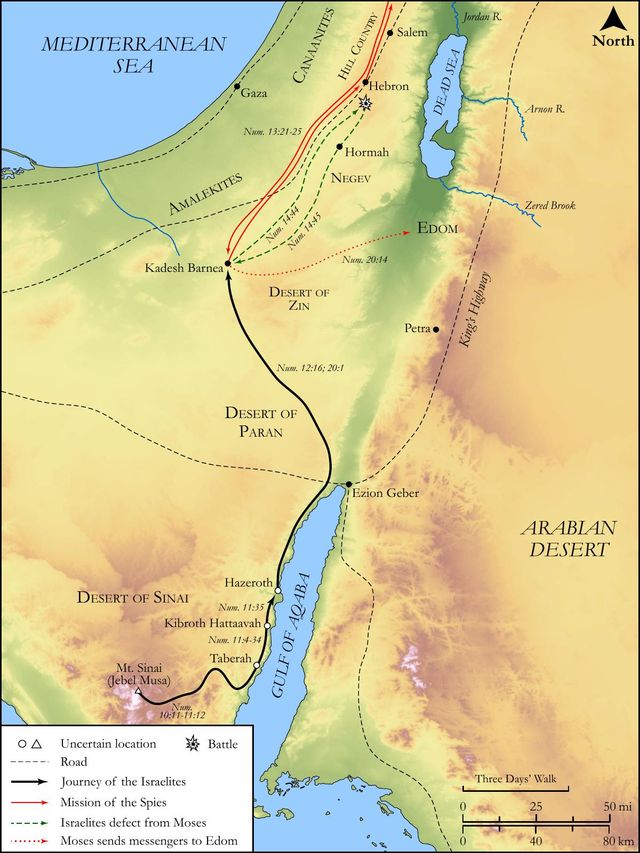
See on the biblical-era map
Study this verse
Public-domain commentary
Matthew Henry
From his Commentary on the Whole Bible. Henry comments on passages, not single verses — this entry covers Numbers 12:1–3.
Here is, I. The unbecoming passion of Aaron and Miriam: they spoke against Moses, Num 12:1. If Moses, that received so much honour from God, yet received so many slights and affronts from men, shall any of us think such trials either strange or hard, and be either provoked or discouraged by them? But who would have thought that disturbance should be created to Moses, 1. From those that were themselves serious and good; nay, that were eminent in religion, Miriam a prophetess, Aaron the high priest, both of them joint-commissioners with Moses for the deliverance of Israel? Mic 6:4, I sent before thee Moses, Aaron, and Miriam. 2. From those that were his nearest relations, his own brother and sister, who shone so much by rays borrowed from him? Thus the spouse complains (Sol 1:6), My mother's children were angry with me; and quarrels among relations are in a special manner grievous. A brother offended is harder to be won than a strong city. Yet this helps to confirm the call of Moses, and shows that his advancement was purely by the divine favour, and not by any compact or collusion with his kindred, who themselves grudged his advancement. Neither did many of our Saviour's kindred believe on him, Joh 7:5. It should seem that Miriam began the quarrel, and Aaron, not having been employed or consulted in the choice of the seventy elders, was for the present somewhat disgusted, and so was the sooner drawn in to take his sister's part. It would grieve one to see the hand of Aaron in so many trespasses, but it shows that the law made men priests who had infirmity. Satan prevailed first with Eve, and by her with Adam; see what need we have to take heed of being drawn into quarrels by our relations, for we know not how great a matter a little fire may kindle. Aaron ought to have remembered how Moses stood his friend when God was angry with him for making the golden calf (Deu 9:20), and not to have rendered him evil for good. Two things they quarrelled with Moses about: - (1.) About his marriage: some think a late marriage with a Cushite or Arabian; others because of Zipporah, whom on this occasion they called, in scorn, an Ethiopian woman, and who, they insinuated, had too great an influence upon Moses in the choice of these seventy elders. Perhaps there was some private falling out between Zipporah and Miriam, which occasioned some hot words, and one peevish reflection introduced another, till Moses and Aaron came to be interested. (2.) About his government; not the mismanagement of it, but the monopolizing of it (Num 12:2): "Hath the Lord spoken only by Moses? Must he alone have the choice of the persons on whom the spirit of prophecy shall come? Hath he not spoken also by us? Might not we have had a hand in that affair, and preferred our friends, as well as Moses his?" They could not deny that God had spoken by Moses, but it was plain he had sometimes spoken also by them; and that which they intended was to make themselves equal with him, though God had so many ways distinguished him. Note, Striving to be greatest is a sin which easily besets disciples themselves, and it is exceedingly sinful. Even those that are well preferred are seldom pleased if others be better preferred. Those that excel are commonly envied.
II.The wonderful patience of Moses under this provocation.
The Lord heard it (Num 12:2), but Moses himself took no notice of it, for (Num 12:3) he was very meek. He had a great deal of reason to resent the affront; it was ill-natured and ill-timed, when the people were disposed to mutiny, and had lately given him a great deal of vexation with their murmurings, which would be in danger of breaking out again when thus headed and countenanced by Aaron and Miriam; but he, as a deaf man, heard not. When God's honour was concerned, as in the case of the golden calf, no man more zealous than Moses; but, when his own honour was touched, no man more meek: as bold as a lion in the cause of God, but as mild as a lamb in his own cause. God's people are the meek of the earth (Zep 2:3), but some are more remarkable than others for this grace, as Moses, who was thus fitted for the work he was called to, which required all the meekness he had and sometimes more. And sometimes the unkindness of our friends is a greater trial of our meekness than the malice of our enemies. Christ himself records his own meekness (Mat 11:29, I am meek and lowly in heart), and the copy of meekness which Christ has set was without a blot, but that of Moses was not.
Historical interpretation
Fifteen Centuries of Reception
5 surviving comments on this verse. Each one is dated, so this reads as a timeline rather than a list.
Select a marker to jump to its quote. Markers stagger vertically where authors wrote within a few decades of each other.
Moreover, Moses himself, in spite of all the great and splendid achievements of faith and patience that are recorded of him, was never so highly praised by God as on this occasion when he took the Ethiopian wife. It is said of him, in reference to this: “Moses was a man exceeding meek above all men that are upon earth.”
[Macrina replied,] It is said of Moses that he was superior to anger and desire. History testifies that he was the “meekest” of men. An incapacity for anger is shown through mildness and an aversion to wrath. He desired none of the things toward which the desiring element in many people is directed. This would not have been so if these qualities had been natural to him and logically in keeping with his essence, for it is not possible for that which is unnatural to remain in the essence. Moses, you see, was true to his essence and not involved in desire and anger, which are in addition to our nature and not our nature itself, for nature is truly that in which being has its essence.
To learn the power of gentleness and restraint, and how virtue alone suffices to render the person who practices it devotedly worthy of those ineffable encomiums, listen to the eulogy bestowed to blessed Moses. The crown was awarded him for this reason: “Moses was the mildest of all people on the earth,” Scripture says. Do you see the greatness of the encomium, which conferred on him equality of esteem with the whole human race—or, rather, gave him precedence over all humankind?
What was the characteristic of Moses of old? “Moses was the meekest of all men on earth.” One would not be wrong in describing this other Moses [i.e., Christ] in these same terms, for certainly the meekest of spirits is with him, being related to him by consubstantiality. In those days Moses stretched forth his hands to heaven and brought down the bread of angels, manna. This second Moses stretches forth his hands to heaven and brings down the food of eternal life. Moses struck the rock and made streams of water flow. This second Moses touches the table, strikes the spiritual board and makes the fountains of the Spirit gush forth. Consequently the table, like the fountain, lies in the middle, in order that the flocks may surround the fountain on every side and enjoy the benefit of the saving waters.
Exceeding meek: Moses being the meekest of men, would not contend for himself; therefore, God inspired him to write here his own defence: and the Holy Spirit, whose dictate he wrote, obliged him to declare the truth, though it was so much to his own praise.
Continue studying Numbers 12:3 across the web’s major study libraries — every link below opens this exact verse, chapter, or book on the destination site.
Read & Compare
 BibleGatewayThis verse in more than 200 translations and 70 languages.
 Bible.comThe YouVersion reader — hundreds of translations, reading plans, and highlights.
 ESV.orgCrossway's official English Standard Version reader.
 NET BibleThe NET translation with 60,000+ translators' notes on every rendering decision.
 STEP BibleTyndale House's free study tool — original text, vocabulary, and scholarly resources.
 BibliaLogos Bible Software's free web reader.
 USCCBThe New American Bible (Revised Edition) with the U.S. bishops' study notes.
Commentaries
 BibleHub CommentariesDozens of classic commentaries on this verse, gathered on one page.
 StudyLightMore than 100 commentary sets — the largest collection on the web.
 BibleRefPlain-English commentary on what this verse means, verse by verse.
 Enduring WordDavid Guzik's free commentary on this chapter, widely used by Bible teachers.
 Bible Study ToolsVerse commentary alongside Greek and Hebrew study aids.
Original Language & Research
- BibleHub InterlinearThe verse word by word — original language, transliteration, and English.
- BibleHub LexiconEvery word's original-language definition and Strong's entry.
 Blue Letter BibleDeep-study tools — Strong's numbers, concordance, and word studies.
 SefariaThe Hebrew text with Rashi and centuries of Jewish commentary.
Sermons, Hymns & Audio


TrulyRandomVerse is not affiliated with these sites and doesn’t control their content. They’re linked because they’re genuinely useful.
Summary
Numbers 12:3 is a profound parenthetical statement by the divine narrator, revealing Moses' unparalleled and exceptional meekness. This inspired commentary on Moses' character, strategically placed amidst Miriam and Aaron's challenge to his authority and unique relationship with God, provides the essential theological explanation for God's swift, decisive, and personal intervention to defend His chosen servant. It underscores that Moses' leadership was not rooted in self-assertion or human ambition, but in a deep, humble dependence on God, making him a uniquely pure and effective vessel for divine action and revelation.
Context
ShowHideLiterary Context
This verse functions as a crucial authorial interjection, a divinely inspired aside that immediately follows Miriam and Aaron's direct challenge to Moses' authority and his marriage to a Cushite woman in Numbers 12:1-2. Their audacious questioning, "Hath the LORD indeed spoken only by Moses? hath he not spoken also by us?" (Numbers 12:2), sets the stage for a profound theological drama. The parenthetical declaration of Moses' extraordinary meekness in Numbers 12:3 serves as the interpretive key, explaining why God intervened so directly and powerfully on Moses' behalf. It highlights that Moses, in his humility, did not defend himself, thereby leaving his vindication entirely to the Lord. The subsequent narrative in Numbers 12:4-10 then details God's immediate appearance, His authoritative affirmation of Moses' unique prophetic relationship, and His swift judgment upon Miriam.
Historical & Cultural Context
The book of Numbers chronicles Israel's arduous and often rebellious journey through the wilderness, a period marked by frequent challenges to God's authority and His appointed leadership. Moses, as God's chosen mediator of the covenant and the leader of millions, bore immense spiritual and administrative responsibility, constantly facing the grumbling and disobedience of the people. In Israel, challenges to a leader's authority, especially from within his own family or inner circle, were highly significant and often led to destabilizing power struggles, as when Absalom rose against his father David. The mention of Moses' Cushite wife (Numbers 12:1) likely served as a convenient pretext for Miriam and Aaron's deeper challenge to Moses' spiritual authority, reflecting potential cultural biases against foreign marriages or a desire to elevate their own prophetic standing. This incident underscores the unique nature of God's direct and intimate communication with Moses, setting him apart from other prophets, as later elaborated in God's own words in Numbers 12:6-8.
Key Themes
ShowHideThe preeminent theme highlighted by this verse is Moses' unparalleled meekness and profound humility. In biblical terms, "meekness" (Hebrew: ʿānāw) is not weakness or timidity, but rather a robust strength under divine control, a deep dependence on God, and a spirit that does not seek self-vindication but trusts God for justice. This characteristic made Moses uniquely suited to lead a rebellious people and to commune directly with God, as illuminated by God's direct speech to Moses "mouth to mouth" in Numbers 12:8. This verse also powerfully introduces the theme of divine vindication: precisely because Moses did not defend himself against Miriam and Aaron's accusations, God Himself stepped in to defend His servant's honor and authority, demonstrating that when His chosen ones humble themselves, He will fight their battles. Furthermore, it speaks to the nature of authentic leadership, showing that true authority derives from God and is often characterized by humility, dependence, and a willingness to suffer rather than self-assertion or human ambition, a principle echoed throughout the narratives of faithful leaders in the Old Testament, such as David in 1 Samuel 24.
Exposition and Analysis
ShowHideKey Word Analysis
ShowHideThis word (אִישׁ, H376) refers to a human being, an individual male person. Its inclusion here emphasizes that Moses, despite his extraordinary divine calling and unique relationship with God, was still a man, subject to the same human frailties and challenges as others. Yet, it is precisely this man, Moses, who possessed an unparalleled quality of meekness.
The Hebrew word (מְאֹד, H3966) functions as an intensive or superlative. When used as an adverb, as it is here, it means "exceedingly," "greatly," or "utterly." Its presence before "meek" elevates Moses' meekness from a mere quality to an extraordinary, superlative characteristic, emphasizing that his humility was not just present but was exceptional, distinguishing him above all others.
This crucial Hebrew word (עָנָו, H6035) describes Moses' character. It does not imply weakness, timidity, or a lack of courage. Instead, ʻânâv signifies humility, lowliness, and a deep submission to God's will. It describes one who is "depressed" or "afflicted" (in a figurative sense of being brought low), yet responds with patience and trust in God rather than self-defense or retaliation. It embodies strength under control, a willingness to suffer injustice, and a profound dependence on divine power rather than human might. This quality made Moses uniquely receptive to God's voice and uniquely capable of leading a challenging people without succumbing to pride or abusing his immense power.
Verse Breakdown
ShowHide"(Now the man Moses was very meek"
This opening phrase, enclosed in parentheses, immediately signals an authoritative authorial comment, providing essential insight into Moses' character from a divine perspective. The addition of "very" (מְאָד, məʾôd) intensifies the description, emphasizing that Moses' meekness was not merely present but exceptional, distinguishing him profoundly. This statement is not a boast by Moses but a divinely inspired assessment, crucial for understanding God's subsequent intervention. It highlights a core spiritual disposition that allowed Moses to remain God's pure vessel.
"above all the men which were upon the face of the earth.)"
This hyperbolic statement underscores the unparalleled nature of Moses' humility and profound dependence on God. It is a spiritual assessment, not a social, political, or physical one. It sets him apart as uniquely qualified for the direct and intimate relationship he shared with Yahweh, highlighting a spiritual disposition rarely found among humanity. This extraordinary meekness is presented as the foundational reason for God's immediate and decisive defense of Moses' authority, as his humility meant he would not defend himself.
Literary Devices
ShowHideThe verse employs several significant literary devices that enhance its meaning and impact. The most prominent is Parenthesis, where the narrator inserts an explanatory comment directly into the narrative flow. This authorial aside provides crucial interpretive information, guiding the reader's understanding of the events that immediately precede and follow. It functions as a divine commentary, revealing the underlying spiritual reason for God's intervention. Hyperbole is also evident in the phrase "above all the men which were upon the face of the earth," which is an intentional exaggeration used to emphasize the extraordinary and unparalleled nature of Moses' meekness. This is not meant to be taken literally as a quantifiable comparison, but rather to highlight the unique spiritual disposition that set Moses apart as uniquely suited for his role. Finally, the verse functions as a direct Narrative Interjection or Authorial Commentary, where the omniscient narrator steps out of the immediate action to offer a theological explanation, ensuring the reader grasps the divine perspective on Moses' character and the subsequent divine response, reinforcing the divine approval of Moses' leadership.
Theological and Thematic Connections
ShowHideNumbers 12:3 presents meekness not merely as a personal trait but as a preeminent virtue and a divine qualification for leadership, serving as a catalyst for God's direct intervention. It illustrates a profound theological principle: true strength and authority in God's kingdom are found not in self-assertion, human might, or the defense of one's own honor, but in humble submission to God and a willingness to trust Him for vindication. Moses' character here foreshadows the ideal servant of God, demonstrating that those who do not seek their own glory or defend their own position are precisely the ones God chooses to uphold and through whom He works most powerfully. This principle resonates throughout Scripture, emphasizing that humility before God often precedes divine exaltation and defense, and is a prerequisite for receiving God's grace and wisdom.
Reflection and Application
ShowHideMoses' unparalleled meekness in Numbers 12:3 offers profound and challenging lessons for believers today. In a world that often equates strength with assertiveness, self-promotion, and the ability to defend one's own rights and reputation, this verse calls us to embrace a counter-cultural virtue. Meekness, as exemplified by Moses, means cultivating a spirit that is not quick to take offense, not eager to retaliate, and not reliant on its own power, wisdom, or cleverness to navigate conflict. Instead, it is a spirit profoundly dependent on God, willing to suffer injustice, and trusting Him for ultimate vindication. This kind of humility allows us to be more receptive to God's will, more patient and gracious with others, and ultimately, more effective and pure vessels for His purposes, knowing that our battles are ultimately His to fight and that His honor is paramount.
Questions for Reflection
ShowHideFAQ
ShowHideWhy is this verse parenthetical?
ShowHideThe verse is parenthetical because it serves as an authorial interjection, a divinely inspired commentary on Moses' character. It is not part of the direct narrative flow of Miriam and Aaron's complaint or God's immediate response. Instead, it provides crucial background information and theological insight, explaining why God intervened so swiftly and decisively on Moses' behalf. It reveals that Moses' unique meekness meant he would not, and indeed did not, defend himself against the accusations, thus necessitating God's direct vindication of His chosen leader and the preservation of His divine order.
Does "meek" in the Bible mean weak or timid?
ShowHideNo, the biblical concept of "meekness" (Hebrew: ʿānāw) is far from weakness or timidity; it is a profound spiritual strength. It describes a humble and patient spirit that relies on God rather than self-assertion. It implies a willingness to endure hardship or injustice without retaliation, trusting God for justice and vindication. Moses, despite this characteristic, was a powerful leader who confronted Pharaoh, led millions through the wilderness, and stood boldly before God. His meekness was precisely what enabled him to be such a strong, pure, and receptive vessel for God's will, demonstrating that true power is found in dependence on God.
How does Moses' meekness relate to his leadership?
ShowHideMoses' meekness was fundamental to his leadership. It meant he was not driven by personal ambition, pride, or a desire for self-glory, but by a profound submission to God's will and a deep concern for God's people. This humility made him uniquely receptive to divine instruction and allowed him to mediate between a holy God and a rebellious people without seeking his own honor. Because he did not defend himself when challenged by Miriam and Aaron, God Himself stepped in to defend his authority, demonstrating that true leadership is rooted in character, divine appointment, and humble dependence, not human power or self-promotion. This also explains why God chose to speak to Moses "mouth to mouth" (Numbers 12:8).
Christ-Centered Fulfillment
ShowHideMoses, the meekest man on earth, stands as a profound Old Testament type pointing to the ultimate and perfect embodiment of meekness in Jesus Christ. While Moses' meekness qualified him to lead Israel and mediate the Old Covenant, Jesus is the Lamb of God who takes away the sin of the world, the one who perfectly fulfilled the ideal of meekness. Jesus Himself declared, "Take my yoke upon you, and learn of me; for I am meek and lowly in heart, and ye shall find rest unto your souls." Unlike Moses, who was a servant, Jesus is the Son, who, though being in the form of God, thought it not robbery to be equal with God: But made himself of no reputation, and took upon him the form of a servant, and was made in the likeness of men, humbling Himself even to the point of death on a cross. His meekness was not a passive weakness but an active, powerful submission to the Father's will, even unto suffering and death, as prophesied in Isaiah 53:7. Jesus' entire earthly ministry, from washing His disciples' feet to His silent endurance before His accusers (Matthew 26:62-63), perfectly exemplifies the strength under control that defines biblical meekness. He is the greater Moses, leading His people not through a wilderness to a promised land, but through sin and death to eternal life, all through the power of His humble, self-sacrificial love and perfect obedience to God's will.