


Numbers 12:4
Bible text: King James Version (1769 Blayney text) · Public domain
Bible text: King James Version with Strong's numbers · Public domain
Bible text: Berean Standard Bible · Public domain
Bible text: American Standard Version (1901) · Public domain
Bible text: World English Bible, Messianic edition · Public domain
Bible text: Geneva Bible (1599) · Public domain
Bible text: Young's Literal Translation · Public domain
- וַיֹּאמֶרvai·Yo·merand he saidH559Conj-w ¦ V-Qal-ConsecImperf-3msVerb Qal Consecutive Imperfect 3rd Singular Masculineוַandיֹּאמֶרhe said
- יְהוָהYah·wehYahwehH3068N-properNoun Proper Title
- פִּתְאֹםpit·'OmsuddenlyH6597AdvAdverb
- אֶל'eltoH413PrepPreposition
- מֹשֶׁהmo·ShehMosesH4872N-proper-mNoun Proper Masculine
- וְאֶלve·'eland toH413Conj-w ¦ PrepPrepositionוְandאֶלto
- אַהֲרֹן'a·ha·RonAaronH175N-proper-mNoun Proper Masculine
- וְאֶלve·'eland toH413Conj-w ¦ PrepPrepositionוְandאֶלto
- מִרְיָםmir·YamMiriamH4813N-proper-fNoun Proper Feminine
- צְאוּtze·'Ucome outH3318V-Qal-Imp-2mpVerb Qal Imperative 2nd Plural Masculine
- שְׁלָשְׁתְּכֶםshe·la·she·te·KhemO [the] three of youH7969Adj-fsc ¦ 2mpAdjective Numerical Singular Feminine ConstructשְׁלָשְׁתְּO [the] three ofכֶםyou
- אֶל'eltoH413PrepPreposition
- אֹהֶל'O·hel[the] tent ofH168N-mscNoun Singular Masculine Construct
- מוֹעֵדmo·'EdmeetingH4150N-msNoun Singular Masculine Absolute
- וַיֵּצְאוּvai·ye·tze·'Uand they went outH3318Conj-w ¦ V-Qal-ConsecImperf-3mpVerb Qal Consecutive Imperfect 3rd Plural Masculineוַandיֵּצְאוּthey went out
- שְׁלָשְׁתָּםshe·la·she·Tam[the] three of themH7969Adj-fsc ¦ 3mpAdjective Numerical Singular Feminine Constructשְׁלָשְׁתָּ[the] three ofםthem
English is a literal word-by-word gloss of the Hebrew, not the KJV's wording. Why?
This is the original text the KJV's translators worked from — each Hebrew word with its own literal English meaning in this verse, prepared by scholars at Tyndale House, Cambridge. The KJV translates whole sentences, not word by word, so its wording differs: one Hebrew word can become several English words, and the KJV may choose “the LORD” where the gloss reads “Yahweh”. Both are faithful — they answer different questions. For the KJV's own rendering, switch to the KJV text.
Details
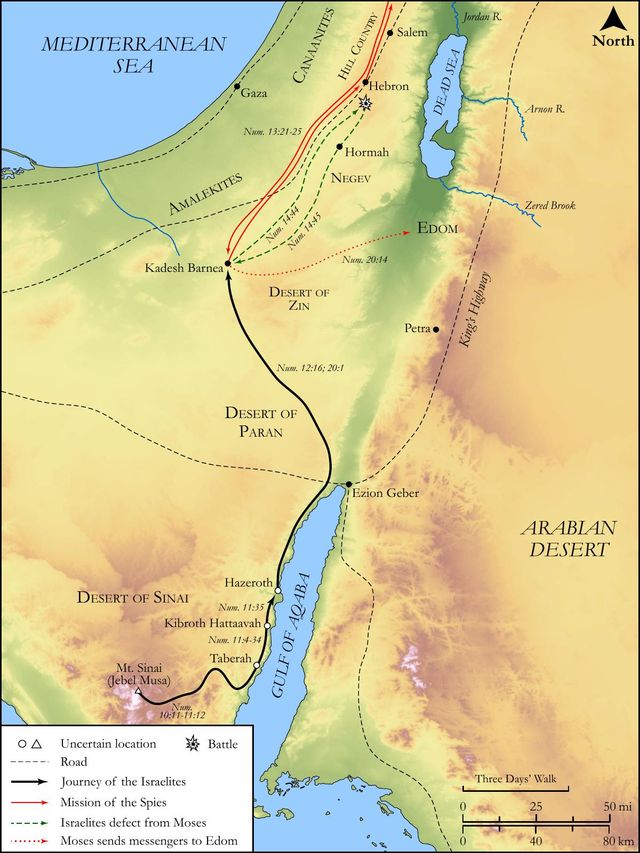
See on the biblical-era map
Study this verse
Public-domain commentary
Matthew Henry
From his Commentary on the Whole Bible. Henry comments on passages, not single verses — this entry covers Numbers 12:4–9. His four-level outline is real structure in the source text, so it is rendered as structure.
Moses did not resent the injury done him, nor complain of it to God, nor make any appeal to him; but God resented it. He hears all we say in our passion, and is a swift witness of our hasty speeches, which is a reason why we should resolutely bridle our tongues, that we speak not ill of others, and why we should patiently stop our ears, and not take notice of it, if others speak ill of us. I heard not, for thou wilt hear, Psa 38:13-15. The more silent we are in our own cause the more is God engaged to plead it. The accused innocent needs to say little if he knows the judge himself will be his advocate.
I.The cause is called, and the parties are summoned forthwith to attend at the door of the tabernacle, Num 12:4, Num 12:5.
Moses had often shown himself jealous for God's honour, and now God showed himself jealous for his reputation; for those that honour God he will honour, nor will he ever be behind-hand with any that appear for him. Judges of old sat in the gate of the city to try causes, and so on this occasion the shechinah in the cloud of glory stood at the door of the tabernacle, and Aaron and Miriam, as delinquents, were called to the bar.
II.Aaron and Miriam were made to know that great as they were they must not pretend to be equal to Moses, nor set up as rivals with him, v. 6-8. Were they prophets of the Lord? Of Moses it might be truly said, He more.
1.It was true that God put a great deal of honour upon the prophets. However men mocked them and misused them, they were the favourites and intimates of heaven. God made himself known to them, either by dreams when they were asleep or by visions when they were awake, and by them made himself known to others. And those are happy, those are great, truly great, truly happy, to whom God makes himself known, Now he does it not by dreams and visions, as of old, but by the Spirit of wisdom and revelation, who makes known those things to babes which prophets and kings desired to see and might not. Hence in the last days, the days of the Messiah, the sons and daughters are said to prophesy (Joe 2:28), because they shall be better acquainted with the mysteries of the kingdom of grace than even the prophets themselves were; see Heb 1:1, Heb 1:2.
2.Yet the honour put upon Moses was far greater (Num 12:7): My servant Moses is not so, he excels them all. To recompense Moses for his meekly and patiently bearing the affronts which Miriam and Aaron gave him, God not only cleared him, but praised him; and took that occasion to give him an encomium which remains upon record to his immortal honour; and thus shall those that are reviled and persecuted for righteousness' sake have a great reward in heaven, Christ will confess them before his Father and the holy angels.
(1.)Moses was a man of great integrity and tried fidelity. He is faithful in all my house. This is put first in his character, because grace excels gifts, love excels knowledge, and sincerity in the service of God puts a greater honour upon a man and recommends him to the divine favour more than learning, abstruse speculations, and an ability to speak with tongues. This is that part of Moses's character which the apostle quotes when he would show that Christ was greater than Moses, making it out that he was so in this chief instance of his greatness; for Moses was faithful only as a servant, but Christ as a son, Heb 3:2, Heb 3:5, Heb 3:6. God entrusted Moses to deliver his mind in all things to Israel; Israel entrusted him to treat for them with God; and he was faithful to both. He said and did every thing in the management of that great affair as became an honest good man, that aimed at nothing else but the honour of God and the welfare of Israel.
(2.)Moses was therefore honoured with clearer discoveries of God's mind, and a more intimate communion with God, than any other prophet whatsoever. He shall,
[1.]Hear more from God than any other prophet, more clearly and distinctly: With him will I speak mouth to mouth, or face to face (Exo 30:11), as a man speaks to his friend, whom he discourses with freely and familiarly, and without any confusion or consternation, such as sometimes other prophets were under; as Ezekiel, and John himself, when God spoke to them. By other prophets God sent to his people reproofs, and predictions of good or evil, which were properly enough delivered in dark speeches, figures, types, and parables; but by Moses he gave laws to his people, and the institution of holy ordinances, which could by no means be delivered by dark speeches, but must be expressed in the plainest and most intelligible manner.
[2.]He shall see more of God than any other prophet: The similitude of the Lord shall behold, as he hath seen it in Horeb, when God proclaimed his name before him. Yet he saw only the similitude of the Lord, angels and glorified saints always behold the face of our Father. Moses had the spirit of prophecy in a way peculiar to himself, and which set him far above all other prophets; yet he that is least in the kingdom of heaven is greater than he, much more does our Lord Jesus infinitely excel him, Heb 3:1, etc.
Now let Miriam and Aaron consider who it was that they insulted: Were you not afraid to speak against my servant Moses? Against my servant, against Moses? so it runs in the original. "How dare you abuse any servant of mine, especially such a servant as Moses, who is a friend, a confidant, and steward of the house?" How durst they speak to the grief and reproach of one whom God had so much to say in commendation of? Might they not expect that God would resent it, and take it as an affront to himself? Note, We have reason to be afraid of saying or doing any thing against the servants of God; it is at our peril if we do, for God will plead their cause, and reckon that what touches them touches the apple of his eye. It is a dangerous thing to offend Christ's little ones, Mat 18:6. Those are presumptuous indeed that are not afraid to speak evil of dignities, Pe2 2:10.
III.God, having thus shown them their fault and folly, next shows them his displeasure (Num 12:9):
The anger of the Lord was kindled against them, of which perhaps some sensible indications were given in the change of the colour of the cloud, or some flashes of lightning from it. But indeed it was indication enough of his displeasure that he departed, and would not so much as hear their excuse, for he needed not, understanding their thoughts afar off; and thus he would show that he was displeased. Note, The removal of God's presence from us is the surest and saddest token of God's displeasure against us. Woe unto us if he depart; and he never departs till we by our sin and folly drive him from us.
Continue studying Numbers 12:4 across the web’s major study libraries — every link below opens this exact verse, chapter, or book on the destination site.
Read & Compare
 BibleGatewayThis verse in more than 200 translations and 70 languages.
 Bible.comThe YouVersion reader — hundreds of translations, reading plans, and highlights.
 ESV.orgCrossway's official English Standard Version reader.
 NET BibleThe NET translation with 60,000+ translators' notes on every rendering decision.
 STEP BibleTyndale House's free study tool — original text, vocabulary, and scholarly resources.
 BibliaLogos Bible Software's free web reader.
 USCCBThe New American Bible (Revised Edition) with the U.S. bishops' study notes.
Commentaries
 BibleHub CommentariesDozens of classic commentaries on this verse, gathered on one page.
 StudyLightMore than 100 commentary sets — the largest collection on the web.
 BibleRefPlain-English commentary on what this verse means, verse by verse.
 Enduring WordDavid Guzik's free commentary on this chapter, widely used by Bible teachers.
 Bible Study ToolsVerse commentary alongside Greek and Hebrew study aids.
Original Language & Research
- BibleHub InterlinearThe verse word by word — original language, transliteration, and English.
- BibleHub LexiconEvery word's original-language definition and Strong's entry.
 Blue Letter BibleDeep-study tools — Strong's numbers, concordance, and word studies.
 SefariaThe Hebrew text with Rashi and centuries of Jewish commentary.
Sermons, Hymns & Audio


TrulyRandomVerse is not affiliated with these sites and doesn’t control their content. They’re linked because they’re genuinely useful.
Summary
Numbers 12:4 records the Lord's immediate and decisive intervention in response to the challenge posed by Miriam and Aaron against Moses' unique prophetic authority and leadership. This verse marks a pivotal moment where God, without prompting from Moses, summons the three siblings to the Tabernacle, setting the stage for a dramatic divine confrontation and the unambiguous vindication of His chosen servant. It underscores the gravity with which God views insubordination against those He has appointed and the sanctity of His divine order, demonstrating His active and sovereign defense of His chosen leader.
Context
ShowHideLiterary Context
Numbers 12:4 immediately follows the account of Miriam and Aaron's criticism of Moses in Numbers 12:1-2. Their challenge was twofold: questioning Moses' marriage to a Cushite woman and, more significantly, challenging his exclusive prophetic access to God, asking, "Hath the LORD indeed spoken only by Moses? hath he not spoken also by us?" This direct challenge to Moses' unique mediatorial role is crucial, as it strikes at the heart of God's established leadership structure. Numbers 12:3 then interjects a parenthetical note highlighting Moses' unparalleled meekness, implying that Moses himself did not defend his position or complain to God. Thus, the "sudden" intervention of the LORD in verse 4 is a direct, unprompted divine response, emphasizing God's personal stake in upholding His chosen leader and His divine order. This sets the stage for the dramatic display of divine authority and judgment that follows in Numbers 12:5-10.
Historical & Cultural Context
The events of Numbers 12 unfold during Israel's journey through the wilderness, a period marked by frequent murmuring and challenges to Moses' leadership, as seen throughout the book of Numbers. The Israelite camp was meticulously organized around the Tabernacle, which served as the central dwelling place of God's presence and the primary locus of divine communication, worship, and judgment. In Israel, challenging a divinely appointed leader was seen as challenging the LORD who appointed him, as Moses told the people, "your murmurings are not against us, but against the LORD," carrying severe implications for societal and religious order. Moses, Aaron, and Miriam held distinct, God-ordained roles: Moses as the supreme prophet and leader, Aaron as the high priest, and Miriam as a prophetess and leader among the women (Exodus 15:20). Their high status made their rebellion particularly egregious, as it could easily destabilize the entire community's respect for divine authority. The command to appear at the Tabernacle signifies a formal, public, and sacred summons for a divine hearing and pronouncement of judgment.
Key Themes
ShowHideNumbers 12:4 contributes significantly to several key themes within the book of Numbers and the Pentateuch. Foremost is the theme of Divine Authority and Sovereignty, demonstrating that God Himself actively defends His chosen servants and will not tolerate insubordination against His established order. This highlights the absolute nature of God's authority and His direct involvement in the affairs of His people. Another crucial theme is The Uniqueness of Moses' Prophetic Office. While God did speak through other prophets, Numbers 12:6-8 explicitly clarifies that Moses had a unique, face-to-face relationship with God, distinct from other prophetic revelations. The verse also touches upon Accountability of Leaders, showing that even high-ranking figures like Aaron and Miriam are subject to divine scrutiny and judgment when they overstep their bounds or challenge God's appointed leadership. Finally, the Sanctity of the Tabernacle as the place of divine encounter, revelation, and judgment is reinforced, establishing it as the ultimate court for resolving disputes concerning God's will and authority.
Exposition and Analysis
ShowHideKey Word Analysis
ShowHideThis adverb (H6597) conveys an abrupt, instantaneous, or unexpected action. Its use here emphasizes the urgency and severity of God's response to Miriam and Aaron's challenge. It was not a gradual revelation or a delayed reaction, but an immediate, unprovoked divine summons, indicating the extreme gravity with which God viewed their insubordination. This suddenness highlights God's active and decisive involvement in defending His chosen leader, bypassing any human mediation or complaint.
This noun (H168) refers to a tent, specifically the portable sanctuary where God met with Moses and manifested His presence among the Israelites. It was the central place of worship, revelation, and judgment. The command to come to the Tabernacle signifies that the dispute would be settled directly in the presence of God, where His glory resided and His judgments were pronounced. This sacred space was where God manifested His will and power, making the summons a formal divine court.
This noun (H4150) means "appointment," "fixed time or season," or by implication, "an assembly (as convened for a definite purpose)." When combined with "Tabernacle" (ʼôhel môwʻêd), it forms the "Tent of Meeting" or "Tent of Appointment," signifying the designated place where God met with His people and where they assembled for divine purposes. The summons to the "tabernacle of the congregation" thus underscores that this was a divinely appointed meeting for a specific, solemn purpose – a divine tribunal.
Verse Breakdown
ShowHide"And the LORD spake suddenly unto Moses, and unto Aaron, and unto Miriam"
This opening clause emphasizes the direct and immediate nature of God's intervention. The inclusion of Moses, alongside Aaron and Miriam, signifies that God was addressing all three parties involved in the unfolding drama. While Moses was the subject of the criticism, he was also the primary recipient of God's revelation, and his presence was required for the divine pronouncement. The "suddenly" underscores the divine initiative and the gravity of the situation, highlighting God's swift and unprompted response.
"Come out ye three unto the tabernacle of the congregation."
This is a direct, imperative command from the LORD, a divine summons. The urgency implied by "Come out" indicates a non-negotiable directive. By commanding all three to come to the Tabernacle, God was calling them to His immediate presence for a direct confrontation and resolution of the conflict. This was not a private meeting but a public, formal summons to the sacred place where God's glory was most visibly manifested, signifying a divine judgment.
"And they three came out."
This final clause demonstrates the immediate and unquestioning obedience of Moses, Aaron, and Miriam to the divine command. Despite their internal conflict and Miriam and Aaron's prior insubordination, their shared reverence for God's direct word compelled them to comply without hesitation. Their prompt compliance sets the stage for the powerful divine rebuke and vindication that follows, highlighting the absolute authority of God's summons over even the most prominent leaders of Israel.
Literary Devices
ShowHideNumbers 12:4 employs several potent literary devices that heighten its dramatic impact and theological significance. The most prominent is Divine Intervention, where God directly and abruptly steps into a human conflict, demonstrating His active sovereignty and personal involvement in the affairs of His people. The use of the adverb "suddenly" enhances the dramatic effect, emphasizing the unexpected and immediate nature of God's action, underscoring His omnipotence and swift justice. There is also a strong element of Dramatic Irony at play: Miriam and Aaron challenge Moses' unique access to God, only to be immediately summoned by God Himself to His direct presence for judgment, thereby conclusively proving Moses' unique relationship and God's exclusive favor towards him. The Symbolism of the Tabernacle is crucial; it is not merely a physical tent but the sacred locus of God's presence, authority, and judgment, making the summons to it profoundly significant as a divine court. Finally, the verse serves as a form of Foreshadowing, hinting at the severe consequences that will follow for those who challenge God's chosen leadership, setting up the subsequent narrative of Miriam's leprosy and the clear demonstration of God's wrath against insubordination.
Theological and Thematic Connections
ShowHideNumbers 12:4 powerfully illustrates the theological truth that God is not a distant deity but one who actively engages with His people and meticulously defends His divine order. It underscores the sacredness of God-given authority and the severe consequences of challenging it, particularly when such challenges stem from envy, pride, or a desire for greater influence. This passage teaches that true authority is derived from God alone, and to undermine His chosen servants is, in essence, to undermine God Himself. It also highlights God's unwavering faithfulness to those He has called, demonstrating His willingness to personally vindicate them when they are unjustly attacked, even when they themselves remain silent, as Moses did. The immediate and public nature of God's intervention serves as a clear warning against factionalism and insubordination within the community of faith, emphasizing the importance of unity and submission under God's appointed leadership for the well-being of the entire covenant community.
Reflection and Application
ShowHideNumbers 12:4 offers profound lessons for believers today concerning respect for spiritual authority, the dangers of envy, and the assurance of God's vindication. In a world often characterized by skepticism, a tendency to question authority, and the rapid spread of criticism, this passage serves as a potent reminder that God Himself establishes leadership within His church and community. While accountability and discernment are crucial, the passage warns against the destructive nature of murmuring, backbiting, and challenging leaders out of personal ambition, jealousy, or a critical spirit rather than genuine concern for truth and righteousness, pursued through proper channels. It calls us to cultivate humility, to pray for those in authority, and to trust that God is fully capable of defending His faithful servants and correcting any wrongs. When we are tempted to criticize or undermine, we are invited to consider if our motives align with God's will or if they are rooted in the same pride and envy that afflicted Miriam and Aaron. Ultimately, it encourages us to submit to God's divine order, recognizing that His ways are higher than our own and that He defends His own.
Questions for Reflection
ShowHideFAQ
ShowHideWhy did God intervene so immediately and directly in this situation?
ShowHideGod intervened "suddenly" and directly because the challenge by Miriam and Aaron was not merely a personal slight against Moses, but a direct affront to God's unique appointment and authority vested in Moses. Moses was not just a leader, but God's primary prophet and mediator for Israel, speaking with God "mouth to mouth" (Numbers 12:8). Questioning Moses' authority was tantamount to questioning God's own choice and wisdom. Such a challenge, if left unaddressed, could destabilize the entire divine order within Israel, leading to chaos and further rebellion. God's immediate action demonstrated the extreme gravity of the offense and served as a clear, unmistakable vindication of Moses, preventing any lingering doubt about his divine mandate. It also showed that God Himself would defend His servant, as Moses' meekness (Numbers 12:3) meant he would not defend himself.
What was the significance of the command to come to the Tabernacle of the congregation?
ShowHideThe Tabernacle of the congregation (or Tent of Meeting) was the sacred central point of Israel's worship and the place where God's presence visibly resided in the pillar of cloud. It was where God met with Moses to deliver His laws and instructions to the people (Exodus 25:22). By summoning Moses, Aaron, and Miriam to this specific location, God was making the confrontation undeniably divine and public. It was a formal, judicial summons to God's own court, ensuring that the verdict would be perceived as coming directly from Him, with undeniable authority and gravity. This setting underscored the sacredness of the matter and the seriousness of challenging divine authority within the very presence of God, emphasizing that the dispute was ultimately with God Himself.
Christ-Centered Fulfillment
ShowHideNumbers 12:4, while rooted in the Old Covenant, finds its ultimate Christ-centered fulfillment in the person and work of Jesus. Moses, as God's uniquely chosen prophet and mediator, serves as a significant type of Christ, foreshadowing the greater Prophet to come, as noted in Deuteronomy 18:15. Just as Moses faced challenges to his authority and divine appointment, Jesus, the greater Moses, frequently encountered opposition and questioning of His divine claims and unique relationship with the Father (John 8:48-59 and Matthew 21:23-27). However, God the Father consistently vindicated Jesus' authority, not through a sudden summons to a physical Tabernacle, but through the ultimate divine intervention of the resurrection (Acts 2:24) and ascension, seating Him at His right hand (Philippians 2:9-11). The Tabernacle, where God met with His people, foreshadows Christ Himself, who is the true "Tabernacle" or "dwelling place" of God among humanity, for in Him "the Word became flesh and dwelt among us" (John 1:14). In Jesus, we meet God directly, and His authority is supreme and unquestionable, for He is the Son in whom God has spoken His final and complete word (Hebrews 1:1-3). The Father's defense of Moses prefigures His perfect and eternal vindication of His beloved Son, who is the ultimate embodiment of God's authority and presence, and through whom all authority in heaven and on earth has been given (Matthew 28:18).