


Numbers 12:2
Bible text: King James Version (1769 Blayney text) · Public domain
Bible text: Berean Standard Bible · Public domain
Bible text: American Standard Version (1901) · Public domain
Bible text: World English Bible, Messianic edition · Public domain
Bible text: Geneva Bible (1599) · Public domain
Bible text: Young's Literal Translation · Public domain
- וַיֹּאמְרוּvai·yo·me·Ruand they saidH559Conj-w ¦ V-Qal-ConsecImperf-3mpVerb Qal Consecutive Imperfect 3rd Plural Masculineוַandיֹּאמְרוּthey said
- הֲרַקha·Rak¿ onlyH7535Interrog ¦ AdvAdverbהֲ¿רַקonly
- אַךְ'akhonlyH389AdvAdverb
- בְּמֹשֶׁהbe·mo·Shehby MosesH4872Prep-b ¦ N-proper-mNoun Proper MasculineבְּbyמֹשֶׁהMoses
- דִּבֶּרdi·Berhas he spokenH1696V-Piel-Perf-3msVerb Piel Perfect 3rd Singular Masculine
- יְהוָהYah·wehYahwehH3068N-properNoun Proper Title
- הֲלֹאha·Lo'¿ notH3808Interrog ¦ NegParticle Negativeהֲ¿לֹאnot
- גַּםgamalsoH1571AdvAdverb
- בָּנוּBa·nuby <the> usPrep-b ¦ 1cpSuffix Personal 1st Plural common genderבָּby <the>נוּus
- דִבֵּרdi·Berhas he spokenH1696V-Piel-Perf-3msVerb Piel Perfect 3rd Singular Masculine
- וַיִּשְׁמַעvai·yish·Ma'and he heardH8085Conj-w ¦ V-Qal-ConsecImperf-3msVerb Qal Consecutive Imperfect 3rd Singular Masculineוַandיִּשְׁמַעhe heard
- יְהוָהYah·wehYahwehH3068N-properNoun Proper Title
English is a literal word-by-word gloss of the Hebrew, not the KJV's wording. Why?
This is the original text the KJV's translators worked from — each Hebrew word with its own literal English meaning in this verse, prepared by scholars at Tyndale House, Cambridge. The KJV translates whole sentences, not word by word, so its wording differs: one Hebrew word can become several English words, and the KJV may choose “the LORD” where the gloss reads “Yahweh”. Both are faithful — they answer different questions. For the KJV's own rendering, switch to the KJV text.
Details
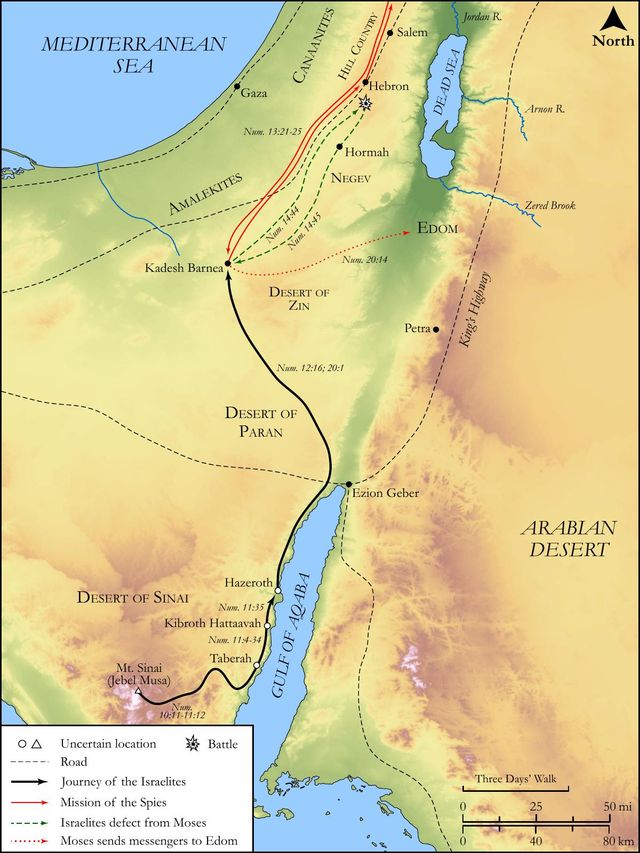
See on the biblical-era map
Study this verse
Public-domain commentary
Matthew Henry
From his Commentary on the Whole Bible. Henry comments on passages, not single verses — this entry covers Numbers 12:1–3.
Here is, I. The unbecoming passion of Aaron and Miriam: they spoke against Moses, Num 12:1. If Moses, that received so much honour from God, yet received so many slights and affronts from men, shall any of us think such trials either strange or hard, and be either provoked or discouraged by them? But who would have thought that disturbance should be created to Moses, 1. From those that were themselves serious and good; nay, that were eminent in religion, Miriam a prophetess, Aaron the high priest, both of them joint-commissioners with Moses for the deliverance of Israel? Mic 6:4, I sent before thee Moses, Aaron, and Miriam. 2. From those that were his nearest relations, his own brother and sister, who shone so much by rays borrowed from him? Thus the spouse complains (Sol 1:6), My mother's children were angry with me; and quarrels among relations are in a special manner grievous. A brother offended is harder to be won than a strong city. Yet this helps to confirm the call of Moses, and shows that his advancement was purely by the divine favour, and not by any compact or collusion with his kindred, who themselves grudged his advancement. Neither did many of our Saviour's kindred believe on him, Joh 7:5. It should seem that Miriam began the quarrel, and Aaron, not having been employed or consulted in the choice of the seventy elders, was for the present somewhat disgusted, and so was the sooner drawn in to take his sister's part. It would grieve one to see the hand of Aaron in so many trespasses, but it shows that the law made men priests who had infirmity. Satan prevailed first with Eve, and by her with Adam; see what need we have to take heed of being drawn into quarrels by our relations, for we know not how great a matter a little fire may kindle. Aaron ought to have remembered how Moses stood his friend when God was angry with him for making the golden calf (Deu 9:20), and not to have rendered him evil for good. Two things they quarrelled with Moses about: - (1.) About his marriage: some think a late marriage with a Cushite or Arabian; others because of Zipporah, whom on this occasion they called, in scorn, an Ethiopian woman, and who, they insinuated, had too great an influence upon Moses in the choice of these seventy elders. Perhaps there was some private falling out between Zipporah and Miriam, which occasioned some hot words, and one peevish reflection introduced another, till Moses and Aaron came to be interested. (2.) About his government; not the mismanagement of it, but the monopolizing of it (Num 12:2): "Hath the Lord spoken only by Moses? Must he alone have the choice of the persons on whom the spirit of prophecy shall come? Hath he not spoken also by us? Might not we have had a hand in that affair, and preferred our friends, as well as Moses his?" They could not deny that God had spoken by Moses, but it was plain he had sometimes spoken also by them; and that which they intended was to make themselves equal with him, though God had so many ways distinguished him. Note, Striving to be greatest is a sin which easily besets disciples themselves, and it is exceedingly sinful. Even those that are well preferred are seldom pleased if others be better preferred. Those that excel are commonly envied.
II.The wonderful patience of Moses under this provocation.
The Lord heard it (Num 12:2), but Moses himself took no notice of it, for (Num 12:3) he was very meek. He had a great deal of reason to resent the affront; it was ill-natured and ill-timed, when the people were disposed to mutiny, and had lately given him a great deal of vexation with their murmurings, which would be in danger of breaking out again when thus headed and countenanced by Aaron and Miriam; but he, as a deaf man, heard not. When God's honour was concerned, as in the case of the golden calf, no man more zealous than Moses; but, when his own honour was touched, no man more meek: as bold as a lion in the cause of God, but as mild as a lamb in his own cause. God's people are the meek of the earth (Zep 2:3), but some are more remarkable than others for this grace, as Moses, who was thus fitted for the work he was called to, which required all the meekness he had and sometimes more. And sometimes the unkindness of our friends is a greater trial of our meekness than the malice of our enemies. Christ himself records his own meekness (Mat 11:29, I am meek and lowly in heart), and the copy of meekness which Christ has set was without a blot, but that of Moses was not.
Historical interpretation
Historical reception
1 surviving comment on this verse from the historical church.
So then in the book of Numbers we find Moses taking an Ethiopian wife—that is to say, one who is dark or black. Because of her Mary and Aaron speak ill of him and say with indignation, “Has the Lord spoken to Moses only? Has he not also spoken to us?” Now on careful consideration the narrative here seems to lack coherence. What has their saying “Has the Lord spoken to Moses only? Has he not also spoken to us?” to do with their indignation about the Ethiopian woman? If that was the trouble, they ought to have said, “Moses, you should not have taken an Ethiopian wife and one of the seed of Ham. You should have married one of your own race and of the house of Levi.” They say not a word about this. They say instead, “Has the Lord spoken to Moses only? Has he not also spoken to us?” Rather, it seems to me that in so saying they understood the thing Moses had done more in terms of the mystery. They saw Moses—that is, the spiritual law—entering now into wedlock and union with the church that is gathered together from among the Gentiles. This is the reason, apparently, why Mary [Miriam], who typified the forsaken synagogue, and Aaron, who stood for the priesthood according to the flesh, seeing their kingdom taken away from them and given to a nation bringing forth the fruits thereof, say, “Has the Lord spoken to Moses only? Has he not also spoken to us?”
Continue studying Numbers 12:2 across the web’s major study libraries — every link below opens this exact verse, chapter, or book on the destination site.
Read & Compare
 BibleGatewayThis verse in more than 200 translations and 70 languages.
 Bible.comThe YouVersion reader — hundreds of translations, reading plans, and highlights.
 ESV.orgCrossway's official English Standard Version reader.
 NET BibleThe NET translation with 60,000+ translators' notes on every rendering decision.
 STEP BibleTyndale House's free study tool — original text, vocabulary, and scholarly resources.
 BibliaLogos Bible Software's free web reader.
 USCCBThe New American Bible (Revised Edition) with the U.S. bishops' study notes.
Commentaries
 BibleHub CommentariesDozens of classic commentaries on this verse, gathered on one page.
 StudyLightMore than 100 commentary sets — the largest collection on the web.
 BibleRefPlain-English commentary on what this verse means, verse by verse.
 Enduring WordDavid Guzik's free commentary on this chapter, widely used by Bible teachers.
 Bible Study ToolsVerse commentary alongside Greek and Hebrew study aids.
Original Language & Research
- BibleHub InterlinearThe verse word by word — original language, transliteration, and English.
- BibleHub LexiconEvery word's original-language definition and Strong's entry.
 Blue Letter BibleDeep-study tools — Strong's numbers, concordance, and word studies.
 SefariaThe Hebrew text with Rashi and centuries of Jewish commentary.
Sermons, Hymns & Audio


TrulyRandomVerse is not affiliated with these sites and doesn’t control their content. They’re linked because they’re genuinely useful.
Summary
Numbers 12:2 records the audacious challenge by Miriam and Aaron against Moses, questioning the unique nature of God's communication with him and asserting their own prophetic standing. This challenge, expressed through the rhetorical questions "Hath the LORD indeed spoken only by Moses? hath he not spoken also by us?", immediately follows their criticism of Moses's Cushite wife, revealing an underlying current of jealousy and a desire for shared authority. The verse culminates with the potent declaration, "And the LORD heard [it]," a pivotal statement signaling God's immediate and active awareness of their murmuring and His impending divine intervention to defend His chosen servant and uphold His established order.
Context
ShowHideLiterary Context
This verse is the narrative fulcrum of Numbers 12, immediately following Miriam and Aaron's initial criticism of Moses's Cushite wife in Numbers 12:1. While the stated reason for their discontent is Moses's marriage, Numbers 12:2 reveals the deeper, more serious issue: a direct challenge to Moses's unparalleled prophetic authority and leadership. The narrative quickly escalates from their private murmuring to God's swift and decisive response, as He summons all three to the Tabernacle in Numbers 12:4-5, emphatically defends Moses's unique relationship with Him in Numbers 12:6-8, and then punishes Miriam with leprosy in Numbers 12:9-10. This incident is a stark reminder of the sanctity of God's chosen leadership and the severe consequences of challenging His divine appointments within the broader narrative of Israel's wilderness journey, which is frequently punctuated by episodes of rebellion and divine judgment, often with severe repercussions.
Historical & Cultural Context
In ancient Israel, prophetic authority was understood as a direct conduit of divine will, making the prophet a crucial link between God and His people. Moses held an utterly unique and supreme position as God's primary mediator, lawgiver, and leader, a status explicitly affirmed in Numbers 12:8 and later emphasized in Deuteronomy 34:10. However, Miriam was also recognized as a prophetess (Exodus 15:20), and Aaron served as the high priest and Moses's divinely appointed spokesman (Exodus 4:14-16). Their challenge, therefore, was not from external adversaries but from within Moses's closest family and leadership circle, making their rebellion particularly egregious and a direct affront to God's established hierarchy. Their rhetorical question, "Hath the LORD indeed spoken only by Moses?", reflects a desire to elevate their own status to parity with Moses, likely fueled by a sense of entitlement given their significant roles in the Exodus and the formative years of the nation.
Key Themes
ShowHideThe central theme of Numbers 12 is the uniqueness and inviolability of Moses's prophetic calling and God's unwavering defense of His chosen leader. Miriam and Aaron's challenge highlights the insidious dangers of envy and pride within leadership, demonstrating how personal ambition and a desire for recognition can lead to direct opposition against God's established order. The concluding phrase, "And the LORD heard [it]," underscores God's omniscience and active sovereignty, revealing His immediate and complete awareness of all human words, intentions, and actions, especially those that undermine His divine authority. This incident also serves as a powerful illustration of divine justice and accountability, as God swiftly intervenes to correct the rebellion and uphold the integrity of His leadership structure, reinforcing the profound principle that challenging God's appointed servants is tantamount to challenging God Himself, a truth echoed in 1 Samuel 8:7.
Exposition and Analysis
ShowHideKey Word Analysis
ShowHideThis primitive root (H559) is a broad verb meaning "to say," used with great latitude. In this context, it refers to the direct verbalization of Miriam and Aaron's challenge. Their "saying" is not merely casual speech but an intentional articulation of doubt and a claim to authority, signifying a deliberate act of questioning Moses's unique position before God. The choice of this general verb emphasizes the simple, direct nature of their spoken rebellion.
This primitive root (H1696) signifies a direct, intentional act of communication, often used in the context of divine revelation or authoritative pronouncement. When Miriam and Aaron ask, "Hath the LORD indeed spoken only by Moses?", they are questioning the exclusivity and nature of God's prophetic utterance. They are not merely asking if God has communicated, but if He has spoken in the authoritative, revelatory sense only through Moses, implying that their own prophetic experiences should grant them equal standing and access to divine counsel.
The verb (H8085) in "And the LORD heard [it]" is profoundly significant. While it literally means "to hear," in biblical Hebrew, shâmaʻ often implies much more than passive auditory perception. It conveys attentive listening, understanding, and frequently, an intention to respond or act. When God "hears" in this context, it signals His immediate and complete awareness of the words spoken, the intent behind them, and His readiness to intervene and address the situation decisively. It is not merely an observation but a prelude to divine action and judgment.
Verse Breakdown
ShowHide"And they said"
This refers specifically to Miriam and Aaron, Moses's older sister and brother, who held prominent positions of leadership and spiritual influence within Israel. Their collective voice here signifies a unified challenge from within Moses's closest circle, making the rebellion particularly grievous.
"Hath the LORD indeed spoken only by Moses?"
This is a rhetorical question designed to challenge Moses's unique and seemingly exclusive access to God's direct revelation. It expresses their doubt and resentment towards Moses's unparalleled authority, suggesting that God's communication might not be as singular as it appeared, thereby undermining his leadership.
"hath he not spoken also by us?"
This second rhetorical question is a direct assertion of their own prophetic credentials and a claim to an equal or at least comparable level of divine inspiration and authority. Miriam was a prophetess (Exodus 15:20) and Aaron was God's spokesman to Pharaoh (Exodus 7:1), so they felt justified in their claim to divine communication, seeking to elevate themselves.
"And the LORD heard [it]."
This is a crucial and sobering statement. It immediately shifts the focus from the human challenge to God's divine awareness. It signifies that God was not distant or unaware of their words, but intimately present and attentive to their murmuring and the challenge to His appointed leader. This hearing is the precursor to His swift and just intervention, highlighting His omniscience and active sovereignty.
Literary Devices
ShowHideNumbers 12:2 employs several potent literary devices that amplify its dramatic and theological impact. The core of Miriam and Aaron's challenge is presented through Rhetorical Questions ("Hath the LORD indeed spoken only by Moses? hath he not spoken also by us?"). These questions are not posed to elicit information but to express doubt, challenge authority, and assert their own perceived rights, thereby revealing their underlying discontent, envy, and ambition. The concluding phrase, "And the LORD heard [it]," utilizes Anthropomorphism, attributing a human sense (hearing) to God. This device makes God's presence and active involvement more relatable and immediate to the human reader, emphasizing His omniscience, attentiveness to the affairs of His people, and His personal engagement with their words and intentions. Furthermore, this concluding statement functions as powerful Foreshadowing, signaling that God's hearing is not passive but will inevitably lead to a divine response and intervention, setting the stage for the dramatic judgment and vindication of Moses that follow in the subsequent verses.
Theological and Thematic Connections
ShowHideNumbers 12:2 serves as a profound theological statement on the nature of divine authority, the sanctity of God's chosen leadership, and the dangers of human pride and envy. It underscores the principle that challenging God's appointed servants is a direct challenge to God Himself, as they act as His representatives. While God can and does speak through many individuals, He also establishes unique roles and relationships within His divine order, and to undermine these is to disrupt the very structure He has ordained. The immediate divine recognition ("And the LORD heard [it]") highlights God's active involvement in the lives of His people, His omniscience regarding their words and intentions, and His unwavering commitment to defending His own honor and the integrity of His leadership structure. This incident is a powerful warning against the destructive nature of jealousy and the critical importance of humility and submission to God's sovereign will, even when His ways seem to elevate others above us.
Reflection and Application
ShowHideNumbers 12:2 offers timeless lessons for believers concerning respect for spiritual authority, the insidious nature of envy, and the comforting yet sobering reality of God's omniscience. In an age where authority is often questioned and challenged, this passage reminds us that God Himself establishes leadership within His church and community. While healthy accountability and discerning critique are vital, challenges rooted in personal ambition, jealousy, or a desire for greater influence can be spiritually dangerous and are ultimately seen by God as a direct affront to His wisdom and sovereignty. We are called to cultivate humility, recognizing that God distributes gifts and callings as He wills, and to rejoice in the unique roles and anointings of others rather than coveting them. The phrase "And the LORD heard [it]" serves as a powerful reminder that our words, thoughts, and the intentions of our hearts are fully known to God. This truth should inspire both reverence and comfort: reverence, knowing that our criticisms and murmuring do not escape His notice; and comfort, knowing that He is also intimately attentive to our prayers, our struggles, and is a faithful defender of the humble and those who walk in His appointed paths.
Questions for Reflection
ShowHideFAQ
ShowHideWhy did Miriam and Aaron question Moses's authority, especially since they were also leaders?
ShowHideMiriam and Aaron questioned Moses's authority primarily due to jealousy and a desire for greater personal influence, rather than a genuine concern for theological accuracy or Moses's conduct regarding his Cushite wife mentioned in Numbers 12:1. While Miriam was a prophetess (Exodus 15:20) and Aaron was the high priest and Moses's spokesman (Exodus 4:14-16), they perceived Moses's unique relationship with God and his unparalleled leadership role as a slight to their own significant positions. Their rhetorical question, "Hath the LORD indeed spoken only by Moses? hath he not spoken also by us?" (Numbers 12:2), reveals their ambition to be on equal footing with Moses, failing to recognize the distinct and supreme nature of Moses's calling as God's chosen mediator for the entire nation. Their challenge was a usurpation of divine order.
What was so unique about Moses's relationship with God compared to other prophets?
ShowHideGod Himself clarifies the profound uniqueness of Moses's relationship in Numbers 12:6-8. While God speaks to other prophets through indirect means such as visions and dreams, He spoke to Moses "face to face, as a man speaks to his friend" (Exodus 33:11) and "mouth to mouth, even apparently, and not in dark speeches" (Numbers 12:8). Moses was uniquely privileged to see the "similitude of the LORD," implying a more direct, unmediated, and intimate communion than any other prophet experienced. This unparalleled intimacy and clarity of communication set Moses apart as God's most trusted and faithful servant "in all his house" (Numbers 12:7; Hebrews 3:2), making his prophetic authority singular and supreme for the Old Covenant.
Christ-Centered Fulfillment
ShowHideNumbers 12:2, with its account of the challenge to Moses's unique authority, profoundly foreshadows the ultimate challenge to the supreme and singular authority of Jesus Christ. Moses, as God's faithful servant and the preeminent prophet and mediator of the Old Covenant, pointed forward to the greater Prophet and Mediator of the New Covenant. Just as Miriam and Aaron questioned Moses's singular relationship with God, so too did many in Israel question and reject Jesus's divine claims and unparalleled authority, asking, "Is not this the carpenter's son?" (Matthew 13:55) or "By what authority doest thou these things?" (Matthew 21:23). Yet, Jesus is not merely a prophet among many; He is the Word made flesh (John 1:14), the one through whom God has spoken His final and most complete revelation (Hebrews 1:1-2). The Father Himself testified to Jesus's unique Sonship and supreme authority, declaring from heaven, "This is my beloved Son, in whom I am well pleased; hear ye him" (Matthew 17:5). While God heard Miriam and Aaron's challenge to Moses and responded with judgment, He perfectly vindicated His Son, Jesus, through His resurrection and exaltation, establishing Him as Lord and Christ (Acts 2:36), the ultimate and unchallenged authority to whom all must submit, for "all authority in heaven and on earth has been given to me" (Matthew 28:18).