


1 Samuel 10:11
Bible text: King James Version (1769 Blayney text) · Public domain
Bible text: King James Version with Strong's numbers · Public domain
Bible text: Berean Standard Bible · Public domain
Bible text: American Standard Version (1901) · Public domain
Bible text: World English Bible, Messianic edition · Public domain
Bible text: Geneva Bible (1599) · Public domain
Bible text: Young's Literal Translation · Public domain
- וַיְהִיvay·Hiand it wasH1961Conj-w ¦ V-Qal-ConsecImperf-3msVerb Qal Consecutive Imperfect 3rd Singular Masculineוַandיְהִיit was
- כָּלkoleveryH3605N-mscNoun Singular Masculine Construct
- יוֹדְעוֹyod·'O[one who] knew himH3045V-Qal-Prtcpl-ms ¦ 3msVerb Qal Participle Singular Masculine Constructיוֹדְע[one who] knewוֹhim
- מֵאִתְּמוֹלme·'i·te·Molfrom yesterdayH865Prep-m ¦ N-msNoun Singular Masculine Absoluteמֵfromאִתְּמוֹלyesterday
- שִׁלְשׁוֹםshil·Shomthree days agoH8032N-msNoun Singular Masculine Absolute
- וַיִּרְאוּvai·yir·'Uand they sawH7200Conj-w ¦ V-Qal-ConsecImperf-3mpVerb Qal Consecutive Imperfect 3rd Plural Masculineוַandיִּרְאוּthey saw
- וְהִנֵּהve·hi·Nehand there!H2009Conj-w ¦ PrtParticle Interjectionוְandהִנֵּהthere!
- עִם'imwithH5973PrepPreposition
- נְבִאִיםne·vi·'ImprophetsH5030N-mpNoun Plural Masculine Absolute
- נִבָּאni·Ba'[he is] prophesyingH5012V-Niphal-Prtcpl-msVerb Niphal Participle Singular Masculine Absolute
- וַיֹּאמֶרvai·Yo·merand it saidH559Conj-w ¦ V-Qal-ConsecImperf-3msVerb Qal Consecutive Imperfect 3rd Singular Masculineוַandיֹּאמֶרit said
- הָעָםha·'Amthe peopleH5971Art ¦ N-msNoun Singular Masculine Absoluteהָtheעָםpeople
- אִישׁ'isheachH376N-msNoun Singular Masculine Absolute
- אֶל'eltoH413PrepPreposition
- רֵעֵהוּre·'E·huhis neighborH7453N-msc ¦ 3msNoun Singular Masculine Constructרֵעֵneighborהוּhis
- מַהmahwhat?H4100InterrogPronoun Interrogative
- זֶּהzehthisH2088PrtParticle Demonstrative
- הָיָהha·Yahhas it happenedH1961V-Qal-Perf-3msVerb Qal Perfect 3rd Singular Masculine
- לְבֶןle·vento [the] son ofH1121Prep-l ¦ N-mscNoun Singular Masculine Constructלְtoבֶן[the] son of
- קִישׁKishKishH7027N-proper-mNoun Proper Masculine
- הֲגַםha·Gam¿ alsoH1571Interrog ¦ AdvAdverbהֲ¿גַםalso
- שָׁאוּלsha·'Ul[is] SaulH7586N-proper-mNoun Proper Masculine
- בַּנְּבִיאִיםba·ne·vi·'Imamong the prophetsH5030Prep-b ¦ N-mpNoun Plural Masculine Absoluteבַּamong theנְּבִיאִיםprophets
English is a literal word-by-word gloss of the Hebrew, not the KJV's wording. Why?
This is the original text the KJV's translators worked from — each Hebrew word with its own literal English meaning in this verse, prepared by scholars at Tyndale House, Cambridge. The KJV translates whole sentences, not word by word, so its wording differs: one Hebrew word can become several English words, and the KJV may choose “the LORD” where the gloss reads “Yahweh”. Both are faithful — they answer different questions. For the KJV's own rendering, switch to the KJV text.
Details
See on the biblical-era map
Study this verse
Public-domain commentary
Matthew Henry
From his Commentary on the Whole Bible. Henry comments on passages, not single verses — this entry covers 1 Samuel 10:9–16. His four-level outline is real structure in the source text, so it is rendered as structure.
Saul has now taken his leave of Samuel, much amazed, we may well suppose, at what has been done to him, almost ready to question whether he be awake or no, and whether it be not all a dream. Now here we are told,
I.What occurred by the way, Sa1 10:9.
Those signs which Samuel had given him came to pass very punctually; but that which gave him the greatest satisfaction of all was this, he found immediately that God had given him another heart. A new fire was kindled in his breast, such as he had never before been acquainted with: seeking the asses is quite out of his mind, and he thinks of nothing but fighting the Philistines, redressing the grievances of Israel, making laws, administering justice, and providing for the public safety; these are the things that now fill his head. He finds himself raised to such a pitch of boldness and bravery as he never thought he should be conscious of. He has no longer the heart of a husbandman, which is low, and mean, and narrow, and concerned only about his corn and cattle; but the heart of a statesman, a general, a prince. Whom God calls to any service he will make fit for it. If he advance to another station, he will give another heart, to those who sincerely desire to serve him with their power.
II.What occurred when he came near home.
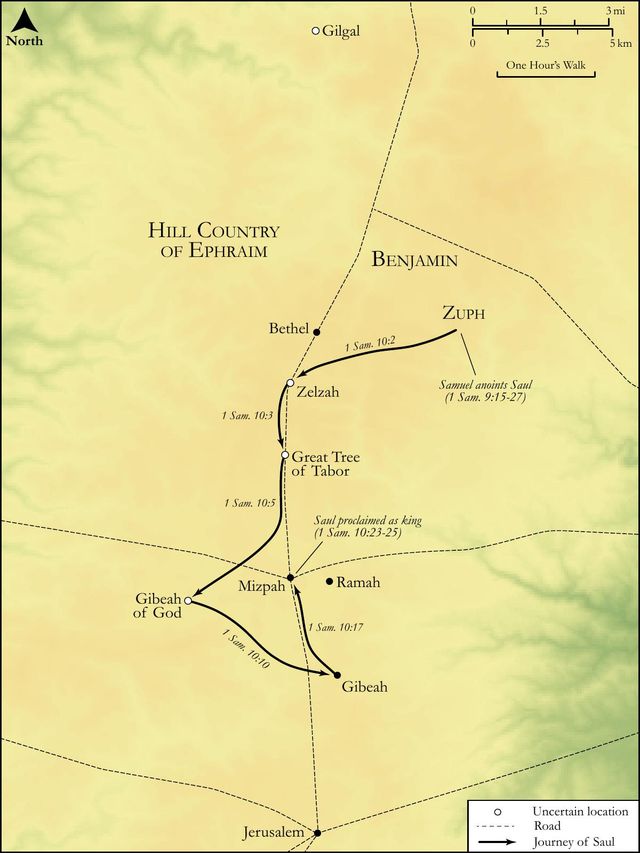
They came to the hill (Sa1 10:10), that is, to Gibeah, or Geba, which signifies a hill, and so the Chaldee here takes it as a proper name; he met with the prophets as Samuel had told him, and the Spirit of God came upon him, strongly and suddenly (so the word signifies), but not so as to rest and abide upon him. It came on so as to go off quickly. However, for the present, it had a strange effect upon him; for he immediately joined with the prophets in their devotion, and that with as much decorum and as great a transport of affection as any of them: He prophesied among them. Now,
1.His prophesying was publicly taken notice of, Sa1 10:11, Sa1 10:12. He was now among his acquaintance, who, when they saw him among the prophets, called one another to come and see a strange sight. This would prepare them to accept him as a king, though one of themselves, when they had seen how God had advanced him to the honour of a prophet. The seventy elders prophesied before they were made judges, Num 11:25. Now,
(1.)They all wondered to see Saul among the prophets: What is this that has come to the son of Kish? Though this school of the prophets was near his father's house, yet he had never associated with them, nor shown them any respect, perhaps had sometimes spoken slightly of them; and now to see him prophesying among them was a surprise to them, as it was long after when his namesake, in the New Testament, preached that gospel which he had before persecuted, Act 9:21. Where God gives another heart it will soon show itself.
(2.)One of them, that was wiser than the rest, asked, "Who is their father, or instructor? Is is not God? Are they not all taught of him? Do they not all owe their gifts to him? And is he limited? Cannot he make Saul a prophet, as well as any of them, if he please?" Or, "Is not Samuel their father?" Under God, he was so; and Saul had now lately been with him, which, by his servant, he might know. No marvel for him to prophesy who lay last night under Samuel's roof.
(3.)It became a proverb, commonly used in Israel, when they would express their wonder at a bad man's either becoming good, or at least being found in good company, Is Saul among the prophets? Note, Saul among the prophets is a wonder to a proverb. Let not the worst be despaired of, yet let not an external show of devotion, and a sudden change for the present, be too much relied on; for Saul among the prophets was Saul still.
2.His being anointed was kept private. When he had done prophesying,
(1.)It should seem he uttered all his words before the Lord, and recommended the affair to his favour, for he went straight to the high place (Sa1 10:13), to give God thanks for his mercies to him and to pray for the continuance of those mercies. But,
(2.)He industriously concealed from his relations what had passed. His uncle, who met with him either at the high place or as soon as he came home, examined him, Sa1 10:14. Saul owned, for his servant knew it, that they had been with Samuel, and that he told them the asses were found, but said not a word of the kingdom, Sa1 10:14, Sa1 10:15. This was an instance,
[1.]Of his humility. Many a one would have been so elated with this surprising elevation as to proclaim it upon the house-top. But Saul, though he might please himself with it in his own breast, did not pride himself in it among his neighbours. The heirs of the kingdom of glory are well enough pleased that the world knows them not, Jo1 3:1.
[2.]Of his prudence. Had he been forward to proclaim it, he would have been envied, and he knew not what difficulty that might have created him. Samuel had communicated it to him as a secret, and he knows how to keep counsel. Thus it appears that he had another heart, a heart fit for government.
[3.]Of his dependence upon God. He does not go about to make an interest for himself, but leaves it to God to carry on his own work by Samuel, and, for his own part, sits still, to see how the matter will fall.
Historical interpretation
Five Centuries of Reception
2 surviving comments on this verse. Each one is dated, so this reads as a timeline rather than a list.
Select a marker to jump to its quote. Markers stagger vertically where authors wrote within a few decades of each other.
It is possible for an evil spirit to influence a person. The spirit of God later turned Saul into another man, that is, into a prophet, when people said, “What is this that has happened to the son of Kish? Is Saul also among the prophets?” But the evil spirit also turned him into another man, in other words, into a renegade. For some time Judas was numbered among the chosen [apostles], even becoming the keeper of the purse. He was then not yet a traitor, but he was dishonest. Later, the devil entered into his soul.Therefore, if neither the spirit of God nor the devil enters into the soul of man at the birth of the soul, then the soul must exist separately before the accession of either spirit. If it exists alone, then it is simple and uncompounded in substance and it breathes simply as a result of the substance which it received from God.
And all those who knew Him yesterday and the day before, etc. Jesus, teaching in His homeland, many hearing were astonished at His doctrine, saying: Whence has this man these things? And what wisdom is this which is given to Him, that such mighty works are performed by His hands? Is not this the carpenter, the son of Mary, the brother of James and Joseph, and Judas and Simon? Are not His sisters here with us? And they were offended in Him. And Jesus said to them: A prophet is not without honor, except in his own country, and among his own kin, and in his own house (Matthew 13).
Continue studying 1 Samuel 10:11 across the web’s major study libraries — every link below opens this exact verse, chapter, or book on the destination site.
Read & Compare
 BibleGatewayThis verse in more than 200 translations and 70 languages.
 Bible.comThe YouVersion reader — hundreds of translations, reading plans, and highlights.
 ESV.orgCrossway's official English Standard Version reader.
 NET BibleThe NET translation with 60,000+ translators' notes on every rendering decision.
 STEP BibleTyndale House's free study tool — original text, vocabulary, and scholarly resources.
 BibliaLogos Bible Software's free web reader.
 USCCBThe New American Bible (Revised Edition) with the U.S. bishops' study notes.
Commentaries
 BibleHub CommentariesDozens of classic commentaries on this verse, gathered on one page.
 StudyLightMore than 100 commentary sets — the largest collection on the web.
 BibleRefPlain-English commentary on what this verse means, verse by verse.
 Enduring WordDavid Guzik's free commentary on this chapter, widely used by Bible teachers.
 Bible Study ToolsVerse commentary alongside Greek and Hebrew study aids.
Original Language & Research
- BibleHub InterlinearThe verse word by word — original language, transliteration, and English.
- BibleHub LexiconEvery word's original-language definition and Strong's entry.
 Blue Letter BibleDeep-study tools — Strong's numbers, concordance, and word studies.
 SefariaThe Hebrew text with Rashi and centuries of Jewish commentary.
Sermons, Hymns & Audio


TrulyRandomVerse is not affiliated with these sites and doesn’t control their content. They’re linked because they’re genuinely useful.
Summary
1 Samuel 10:11 recounts a moment of profound public astonishment as Saul, newly anointed as Israel's first king, is witnessed prophesying among a company of prophets. This unexpected and Spirit-empowered transformation of a man previously known for his ordinary background prompted those familiar with him to exclaim in bewilderment, "Is Saul also among the prophets?" This question quickly became a proverbial expression, highlighting the surprising and undeniable evidence of divine anointing and the dramatic, visible manifestation of God's sovereign choice and empowering grace.
Context
ShowHideLiterary Context
This verse is the climactic fulfillment of Samuel's prophetic words to Saul following his private anointing as king in 1 Samuel 10:1. Samuel had foretold a series of signs, including that Saul would meet a company of prophets descending from the high place, and that "the Spirit of the Lord will come mightily upon you, and you shall prophesy with them and be turned into another man" (1 Samuel 10:6). The preceding verses, 1 Samuel 10:9-10, explicitly state that "God gave him another heart" and "the Spirit of God rushed upon him," leading directly to the public display described in verse 11. This public manifestation served as crucial validation of Saul's divine appointment, transitioning his anointing from a private act to a visible confirmation of God's hand upon him, thereby preparing the nation for his official presentation as king to all Israel at Mizpah (1 Samuel 10:17-27).
Historical & Cultural Context
In ancient Israel, prophecy was a dynamic and often ecstatic phenomenon, distinct from the priestly or kingly offices. Companies or "schools" of prophets, frequently associated with figures like Samuel, existed as communities dedicated to spiritual pursuit, characterized by worship, music, and inspired utterances (1 Samuel 19:20). Saul, however, originated from the tribe of Benjamin, a relatively small and unremarkable tribe, and from a family not traditionally associated with prophetic or priestly lineage. He was initially introduced as a humble, physically impressive young man searching for his father's lost donkeys (1 Samuel 9:1-2). His sudden, public immersion in ecstatic prophetic activity would have been profoundly unexpected and even shocking to his acquaintances, challenging their preconceived notions of who could be a vessel for divine inspiration. This visible, public transformation was vital in a culture that relied on tangible signs of divine favor and authority to legitimize leadership.
Key Themes
ShowHideThis verse powerfully illuminates several central themes. Firstly, it underscores divine election and empowerment, showcasing God's sovereign ability to choose and equip individuals for His purposes, irrespective of their background, social standing, or prior disposition. Saul's transformation highlights God's unexpected ways, demonstrating that He often works through those least anticipated, thereby challenging human wisdom and societal norms. The profound astonishment of the people emphasizes the supernatural nature of the Spirit's work, which can dramatically alter a person's character, capabilities, and public perception. Furthermore, the public nature of Saul's prophecy serves as a public confirmation of God's choice, validating his anointing and preparing the people to accept him as their divinely appointed king, a theme that resonates later when Saul again prophesies in 1 Samuel 19:24.
Exposition and Analysis
ShowHideKey Word Analysis
ShowHideThis verb signifies more than mere intellectual acquaintance; it implies a deep, personal familiarity or recognition. When the text states "all that knew him beforetime," it refers to those who had intimate knowledge of Saul's ordinary life, his family, his character, and his lack of prior association with prophetic activity. Their "knowing" him makes their astonishment at his transformation all the more profound, as it directly contradicts their established understanding of his identity.
This primitive root describes the act of speaking or singing by divine inspiration. It encompasses not only foretelling the future but also speaking forth God's message, praise, or truth in an ecstatic, Spirit-empowered manner. In this context, Saul's "prophesying" indicates a profound spiritual experience where he was overcome by the Spirit of God, joining the company of prophets in their fervent, Spirit-led expressions. It was a visible, audible manifestation of God's presence and power working through him, confirming Samuel's prophecy.
Derived from the verb "nâbâʼ," this noun refers to an inspired person, one who speaks for God. In this period, "companies of prophets" (or "sons of the prophets") were groups of individuals who lived together, often under the guidance of a senior prophet like Samuel, dedicating themselves to spiritual disciplines and receiving divine inspiration. Saul's inclusion "among the prophets" signifies his sudden and unexpected integration into this spiritual community, not by training or lineage, but by direct divine anointing and the empowering presence of the Spirit.
Verse Breakdown
ShowHide"And it came to pass, when all that knew him beforetime saw that, behold, he prophesied among the prophets,"
This opening clause sets the scene for the dramatic event. "All that knew him beforetime" emphasizes the familiar acquaintances of Saul, those who were intimately aware of his ordinary, non-prophetic life as "the son of Kish." Their "seeing" him "prophesy among the prophets" signifies a public, undeniable, and highly unusual display of spiritual activity. The interjection "behold" (Hebrew, hinneh) serves to draw the reader's attention to the suddenness and profound unexpectedness of this sight, highlighting the radical shift in Saul's demeanor and actions. This observation fulfills Samuel's earlier prophecy, confirming God's hand upon Saul.
"then the people said one to another, What [is] this [that] is come unto the son of Kish?"
This part captures the immediate, bewildered reaction of the onlookers. Their question is one of utter astonishment and disbelief, reflecting their struggle to reconcile the ordinary Saul they knew—a humble farmer's son from Benjamin (referring to his father, Kish, H7027)—with the Spirit-filled prophet now before their eyes. This rhetorical question conveys their perplexity and the extraordinary nature of the event, indicating that Saul's transformation was truly remarkable and defied their expectations based on his lineage (H1121, "son").
"[Is] Saul also among the prophets?"
This is the culmination of their surprise, becoming a widely recognized proverbial saying. The question is rhetorical, expressing profound incredulity and implying that Saul was the least likely person they would ever expect to see participating in such prophetic activity. This phrase became a well-known proverb (reappearing later in 1 Samuel 19:24), signifying a surprising or unexpected transformation, or someone acting entirely out of character, especially in a divinely inspired or otherwise remarkable manner.
Literary Devices
ShowHideThe passage powerfully employs Rhetorical Question through the exclamations, "What is this that is come unto the son of Kish? Is Saul also among the prophets?" These questions are not posed to elicit information but to express the profound astonishment, incredulity, and bewilderment of the onlookers. They effectively underscore the unexpected nature of Saul's transformation and the undeniable divine power at work. Furthermore, the phrase "Is Saul also among the prophets?" functions as a Proverbial Saying, indicating that this event was so striking and memorable that it entered the common lexicon, used to describe any surprising or uncharacteristic display of spiritual or unusual behavior. There is also a strong element of Irony and Contrast at play, as the ordinary, unassuming "son of Kish" is dramatically contrasted with the extraordinary, Spirit-filled prophet, highlighting God's ability to choose and empower unlikely individuals, subverting human expectations.
Theological and Thematic Connections
ShowHide1 Samuel 10:11 powerfully illustrates God's sovereign election and the transformative power of His Spirit. It demonstrates that God's choice is not limited by human lineage, social standing, or prior experience, but is based purely on His divine purpose and will. The Spirit of God is shown to be capable of radically changing an individual, equipping them with gifts and abilities far beyond their natural capacity, thereby confirming God's anointing and validating His chosen leader. This event served as a public sign to Israel that Saul's appointment was indeed from the Lord, instilling a sense of awe and wonder at God's mysterious and unpredictable ways, which often defy human logic.
Reflection and Application
ShowHideThe profound astonishment of those who knew Saul serves as a timeless reminder that God's ways are often beyond our comprehension and expectations. Just as Saul, the unassuming "son of Kish," was suddenly empowered to prophesy, so too can God choose and equip anyone for His purposes, regardless of their background, past mistakes, or perceived limitations. This challenges us to look beyond superficial appearances and human qualifications, recognizing that the Holy Spirit can transform and use the most unexpected individuals for His glory. It encourages us to remain open to God's surprising work in our own lives and in the lives of others, fostering humility and a deeper reliance on His power rather than our own abilities or societal norms. We are called to embrace the divine empowerment that enables us to participate in God's redemptive work, even when it feels outside our comfort zone or natural gifting, trusting that God's anointing makes the impossible possible.
Questions for Reflection
ShowHideFAQ
ShowHideWhat does "prophesied among the prophets" mean in this context?
ShowHideIn this context, "prophesied among the prophets" (Hebrew: naba') refers to Saul being overcome by the Spirit of God and joining a company of prophets in their ecstatic, inspired utterances. This was not necessarily about foretelling specific future events, but rather about speaking forth under divine inspiration, often involving fervent praise, prayer, or spontaneous declarations of God's truth. It signifies a profound spiritual experience where Saul was visibly and audibly transformed by the Holy Spirit, demonstrating God's hand upon him and fulfilling Samuel's prophecy from 1 Samuel 10:6. This public display served to validate his divine appointment as king.
Why was the question "Is Saul also among the prophets?" so significant?
ShowHideThe question "Is Saul also among the prophets?" became a proverbial saying in Israel because it perfectly captured the profound astonishment and incredulity of the people. Saul was from an ordinary, non-prophetic family in the tribe of Benjamin (1 Samuel 9:1-2), not known for spiritual fervor or association with prophetic circles. His sudden, public display of prophecy was completely unexpected and challenged everyone's assumptions about who God would choose and empower. The phrase highlights God's sovereign and often surprising choice of individuals, demonstrating that His Spirit can transform anyone for His purposes, regardless of their background or previous disposition. It reappears later in 1 Samuel 19:24, underscoring its lasting impact as a proverb.
Christ-Centered Fulfillment
ShowHideWhile 1 Samuel 10:11 describes the Spirit's temporary empowering of Saul for a specific kingly task, it powerfully foreshadows the ultimate and permanent indwelling of the Holy Spirit available to all believers through Christ. Saul's transformation, though dramatic and divinely ordained for his kingly role, was external and conditional, eventually departing from him due to disobedience (1 Samuel 16:14). In stark contrast, Jesus Christ, as the ultimate Prophet, King, and Priest, was fully anointed by the Spirit without measure (John 3:34), and His anointing was eternal. His life, atoning death, and glorious resurrection paved the way for the outpouring of the Holy Spirit at Pentecost (Acts 2:1-4), permanently indwelling all who believe in Him. The astonishment at Saul's prophecy points to the even greater wonder of God choosing ordinary individuals—not just kings or prophets, but all who confess Christ—to be filled with His Spirit, enabling them to bear witness to Him (Acts 1:8) and to live transformed lives, reflecting the very character of Christ (Galatians 5:22-23). Thus, Saul's experience, while unique to his calling, serves as a shadow of the glorious reality of the Spirit's work in the new covenant, making every believer a "son of God" empowered for His purposes, no longer prompting the question, "Is Saul also among the prophets?" but rather, "Are we not all empowered by the Spirit of Christ?"