


1 Samuel 19:20
Bible text: King James Version (1769 Blayney text) · Public domain
Bible text: King James Version with Strong's numbers · Public domain
Bible text: Berean Standard Bible · Public domain
Bible text: American Standard Version (1901) · Public domain
Bible text: World English Bible, Messianic edition · Public domain
Bible text: Geneva Bible (1599) · Public domain
Bible text: Young's Literal Translation · Public domain
- וַיִּשְׁלַחvai·yish·Lachand he sentH7971Conj-w ¦ V-Qal-ConsecImperf-3msVerb Qal Consecutive Imperfect 3rd Singular Masculineוַandיִּשְׁלַחhe sent
- שָׁאוּלsha·'UlSaulH7586N-proper-mNoun Proper Masculine
- מַלְאָכִיםmal·'a·KhimmessengersH4397N-mpNoun Plural Masculine Absolute
- לָקַחַתla·Ka·chatto fetchH3947Prep-l ¦ V-Qal-InfVerb Qal Infinitive Constructלָtoקַחַתfetch
- אֶת'et<obj.>H853DirObjMParticle Object Indicator
- דָּוִדda·VidDavidH1732N-proper-mNoun Proper Masculine
- וַיַּרְאvai·Yar'and he sawH7200Conj-w ¦ V-Qal-ConsecImperf-3msVerb Qal Consecutive Imperfect 3rd Singular Masculineוַandיַּרְאhe saw
- אֶת'et<obj.>H853DirObjMParticle Object Indicator
- לַהֲקַתla·ha·Kat[the] company ofH3862N-fscNoun Singular Feminine Construct
- הַנְּבִיאִיםha·ne·vi·'Imthe prophetsH5030Art ¦ N-mpNoun Plural Masculine Absoluteהַtheנְּבִיאִיםprophets
- נִבְּאִיםni·be·'ImprophesyingH5012V-Niphal-Prtcpl-mpVerb Niphal Participle Plural Masculine Absolute
- וּשְׁמוּאֵלu·she·mu·'Eland SamuelH8050Conj-w ¦ N-proper-mNoun Proper MasculineוּandשְׁמוּאֵלSamuel
- עֹמֵד'o·Med[was] standingH5975V-Qal-Prtcpl-msVerb Qal Participle Singular Masculine Absolute
- נִצָּבni·TzavchiefH5324V-Niphal-Prtcpl-msVerb Niphal Participle Singular Masculine Absolute
- עֲלֵיהֶם'a·lei·Hemover themH5921Prep ¦ 3mpPreposition Definiteעֲלֵיoverהֶםthem
- וַתְּהִיva·te·Hiand it wasH1961Conj-w ¦ V-Qal-ConsecImperf-3fsVerb Qal Consecutive Imperfect 3rd Singular Feminineוַandתְּהִיit was
- עַל'alonH5921PrepPreposition
- מַלְאֲכֵיmal·'a·Khei[the] messengers ofH4397N-mpcNoun Plural Masculine Construct
- שָׁאוּלsha·'UlSaulH7586N-proper-mNoun Proper Masculine
- רוּחַRu·ach[the] spirit ofH7307N-fscNoun Singular Feminine Construct
- אֱלֹהִים'E·lo·HimGodH430N-mpNoun Plural Masculine Absolute
- וַיִּתְנַבְּאוּvai·yit·na·be·'Uand they prophesiedH5012Conj-w ¦ V-Hithpael-ConsecImperf-3mpVerb Hithpael Consecutive Imperfect 3rd Plural Masculineוַandיִּתְנַבְּאוּthey prophesied
- גַּםgamalsoH1571AdvAdverb
- הֵמָּהHe·mahtheyH1992Pro-3mpPronoun Personal 3rd Plural Masculine
English is a literal word-by-word gloss of the Hebrew, not the KJV's wording. Why?
This is the original text the KJV's translators worked from — each Hebrew word with its own literal English meaning in this verse, prepared by scholars at Tyndale House, Cambridge. The KJV translates whole sentences, not word by word, so its wording differs: one Hebrew word can become several English words, and the KJV may choose “the LORD” where the gloss reads “Yahweh”. Both are faithful — they answer different questions. For the KJV's own rendering, switch to the KJV text.
Details
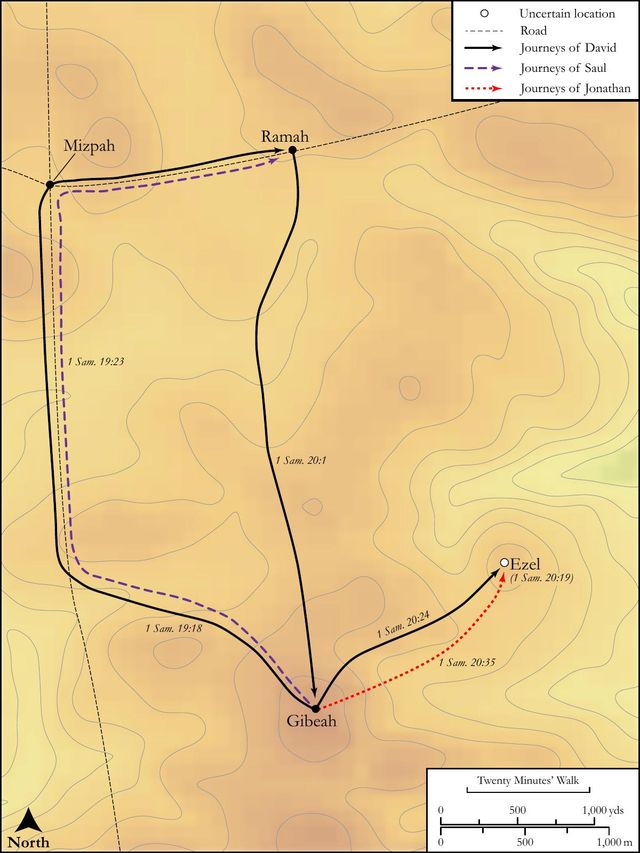
See on the biblical-era map
Study this verse
Public-domain commentary
Matthew Henry
From his Commentary on the Whole Bible. Henry comments on passages, not single verses — this entry covers 1 Samuel 19:18–24. His two-level outline is real structure in the source text, so it is rendered as structure.
Here is, I. David's place of refuge. Having got away in the night from his own house, he fled not to Bethlehem to his relations, nor to any of the cities of Israel that had caressed and cried him up, to make an interest in them for his own preservation; but he ran straight to Samuel and told him all that Saul had done to him, Sa1 19:18. 1. Because Samuel was the man that had given him assurance of the crown, and his faith in that assurance now beginning to fail, and he being ready to say in his haste (or in his flight, as some read it, Psa 116:11), All men are liars ("not only Saul that promised me my life, but Samuel himself that promised me the throne"), whither should he go but to Samuel, for such encouragements, in this day of distress, as would support his faith? In flying to Samuel he made God his refuge, trusting in the shadow of his wings; where else can a good man think himself safe? 2. Because Samuel, as a prophet, was best able to advise him what to do in this day of his distress. In the psalm he penned the night before he had lifted up his prayer to God, and now he takes the first opportunity of waiting upon Samuel to receive direction and instruction from God. If we expect answers of peace to our prayers, we must have our ears open to God's word. 3. Because with Samuel there was a college of prophets with whom he might join in praising God, and the pleasure of this exercise would be the greatest relief imaginable to him in his present distress. He met with little rest or satisfaction in Saul's court, and therefore went to seek it in Samuel's church. And, doubtless, what little pleasure is to be had in this world those have it that live a life of communion with God; to this David retired in the time of trouble, Psa 27:4-6.
II.David's protection in this place:
He and Samuel went and dwelt (or lodged) in Naioth, where the school of the prophets was, in Ramah, as in a privileged place, for the Philistines themselves would not disturb that meeting, Sa1 10:10. But Saul, having notice of it by some of his spies (Sa1 19:19), sent officers to seize David, Sa1 19:20. When they did not bring him he sent more; when they returned not he sent the third time (Sa1 19:21), and, hearing no tidings of these, he went himself, Sa1 19:22. So impatient was he in his thirst after David's blood, so restless to compass his design against him, that, though baffled by one providence after another, he could not perceive that David was under the special protection of Heaven. It was below the king to go himself on such an errand as this; but persecutors will stoop to any thing, and stick at nothing, to gratify their malice. Saul lays aside all public business to hunt David. How was David delivered, now that he was just ready to fall (like his own lamb formerly) into the mouth of the lions? Not as he delivered his lamb, by slaying the lion, or, as Elijah was delivered, by consuming the messengers with fire from heaven, but by turning the lions for the present into lambs.
1.When the messengers came into the congregation where David was among the prophets the Spirit of God came upon them, and they prophesied, that is, they joined with the rest in praising God. Instead of seizing David, they themselves were seized. And thus, (1.) God secured David; for either they were put into such an ecstasy by the spirit of prophecy that they could not think of any thing else, and so forgot their errand and never minded David, or they were by it put, for the present, into so good a frame that they could not entertain the thought of doing so bad a thing.
2.He put an honour upon the sons of the prophets and the communion of saints, and showed how he can, when he pleases, strike an awe upon the worst of men, by the tokens of his presence in the assemblies of the faithful, and force them to acknowledge that God is with them of a truth, Co1 14:24, Co1 14:25. See also the benefit of religious societies, and what good impressions may be made by them on minds that seemed unapt to receive such impressions. And where may the influences of the Spirit be expected but in the congregations of the saints? (3.) He magnified his power over the spirits of men. He that made the heart and tongue can manage both to serve his own purposes. Balaam prophesied the happiness of Israel, whom he would have cursed; and some of the Jewish writers think these messengers prophesied the advancement of David to the throne of Israel.
2.Saul himself was likewise seized with the spirit of prophecy before he came to the place. One would have thought that so bad a man as he was in no danger of being turned into a prophet; yet, when God will take this way of protecting David, even Saul had no sooner come (as bishop Hall expresses it) within smell of the smoke of Naioth but he prophesies, as his messengers did, Sa1 19:23. He stripped off his royal robe and warlike habiliments, because they were either too fine or too heavy for this service, and fell into a trance as it should seem, or into a rapture, which continued all that day and night. The saints at Damascus were delivered from the range of the New Testament Saul by a change wrought on his spirit, but of another nature from this. This was only amazing, but that sanctifying - this for a day, that for ever. Note, Many have great gifts and yet no grace, prophesy in Christ's name and yet are disowned by him, Mat 7:22, Mat 7:23. Now the proverb recurs, Is Saul among the prophets? See Sa1 10:12. Then it was different from what it had been, but now contrary. He is rejected of God, and actuated by an evil spirit, and yet among the prophets.
Historical interpretation
Fifteen Centuries of Reception
5 surviving comments on this verse. Each one is dated, so this reads as a timeline rather than a list.
Select a marker to jump to its quote. Markers stagger vertically where authors wrote within a few decades of each other.
Now, it seems to me that fortuitous circumstance also is sometimes the cause of prophesying, as is true in the present case of Caiaphas. He was high priest of that year [in which] Jesus was to die for the people that the whole nation might not perish. For although others were high priests … no one prophesies except the high priest of the year in which Jesus was to suffer.And it was fortuitous circumstance that caused the messengers of Saul to prophesy when they were sent to David, along with Saul himself. For it is as if the fact that they were seeking David became the cause of their prophecy, such as it was, as has been recorded.
For by the arguments by which he [Eunomius] endeavors to destroy the truth, he is often himself unwittingly drawn into an advocacy of the very doctrines against which he is contending. Some such thing the history tells us concerning Saul … when moved with wrath against the prophets, he was overcome by grace and was found as one of the inspired (the Spirit of prophecy willing, as I suppose, to instruct the apostate by means of himself) whence the surprising nature of the event became a proverb … history records such an expression by way of wonder, “Is Saul also among the prophets?”
For all who do not love God are strangers, are antichrists. And though they come to the churches, they cannot be numbered among the children of God. That fountain of life does not belong to them. To have baptism is possible even for a bad person; to prophesy is possible even for a bad person. We find that king Saul prophesied: he was persecuting holy David, yet he was filled with the spirit of prophecy and began to prophesy.
The book of Kings [Samuel] gives us an example about prophecy. Saul was the persecutor of David. When he was persecuting him, he sent guards to drag him away to punishment, and those who were sent to bring David to be slain found him among the prophets; and Samuel was there too.… So he had fled to the place where besides Samuel, the most distinguished of all the prophets, there were also many other prophets. Pushing their way among them, while they were prophesying, came the emissaries of Saul, to drag him off, as I said, to death. The spirit of God leaped upon them and they began to prophesy, having come to lead a holy and just man of God to the execution block and snatch him away from among the prophets. They were suddenly filled with the spirit of God and turned into prophets. It’s possible this happened because of their innocence; after all, they hadn’t come of their own accord to arrest him but had been sent by their king. And perhaps they had indeed come to the place where David was but weren’t going to do what Saul had told them to; perhaps they too were intending to stay there. Because such things even happen today. Sometimes a bailiff is sent by high authority to drag somebody out of the church; he dare not act against God, and in order not to face execution himself he stays there, in the place he was sent, to haul someone out of it. So you could say, pleasantly surprised and relieved, that these men suddenly became prophets because they were innocent; the very gift of prophecy bore witness to their innocence. They came because they were sent, but they weren’t going to do what that bad man had told them to. Let us believe that about them.Others were sent; the Spirit of God leaped on them too, and they too began to prophesy. Let’s count them too with the first lot as being quite innocent. A third lot were sent; the same happened to them too; let them all be innocent. When they delayed and what Saul had ordered wasn’t done, he came himself. Was he too innocent? Was he also sent by some authority, and not ill-intentioned of his own free will? Yet the Spirit of God leaped on him too, and he began to prophesy. There you are, Saul is prophesying, he has the gift of prophecy, but he has not got charity. He has become a kind of instrument to be touched by the Spirit, not one to be cleansed by the Spirit. The Spirit of God, you see, touches some hearts to set them prophesying, and yet does not cleanse them.… And so the Spirit of God did not cleanse Saul the persecutor, but all the same it touched him to make him prophesy.
Caiaphas, the chief priest, was a persecutor of Christ; and yet he uttered a prophecy when he said, “It is right and proper that one man should die, and not the whole nation perish.” The Evangelist went on to explain this as a prophecy and said, “He did not, however, say this of himself, but being high priest, he prophesied.” Caiaphas prophesied, Saul prophesied; they had the gift of prophecy, but they didn’t have charity. Did Caiaphas have charity, considering he persecuted the Son of God, who was brought to us by charity? Did Saul have charity, who persecuted the one by whose hand he had been delivered from his enemies, so that he was guilty not only of envy but also of ingratitude? So we have proved that it is possible for you to have prophesy and not to have charity. But prophecy does you no good, according to the apostle: “If I do not have charity,” he says, “I am nothing.” He doesn’t say, “Prophesy is nothing,” or “Faith is nothing,” but “I myself am nothing, if I don’t have charity.” So while he has great gifts, he is nothing; although he has great gifts, he is nothing; because these great gifts which he has, he doesn’t have to his benefit but to his condemnation. It isn’t a great thing to have great gifts; but it is a great thing to use great gifts well; but you don’t use them well if you haven’t got charity. The fact is, it is only a good will that uses anything well; but there cannot be a good will where charity is not to be found.
Prophesying: That is, singing praises to God by a divine impulse. God was pleased on this occasion that both Samuel's messengers and himself should experience the like impulse, that he might understand, by this instance of the divine power, how vain are the designs of man against him whom God protects.
Continue studying 1 Samuel 19:20 across the web’s major study libraries — every link below opens this exact verse, chapter, or book on the destination site.
Read & Compare
 BibleGatewayThis verse in more than 200 translations and 70 languages.
 Bible.comThe YouVersion reader — hundreds of translations, reading plans, and highlights.
 ESV.orgCrossway's official English Standard Version reader.
 NET BibleThe NET translation with 60,000+ translators' notes on every rendering decision.
 STEP BibleTyndale House's free study tool — original text, vocabulary, and scholarly resources.
 BibliaLogos Bible Software's free web reader.
 USCCBThe New American Bible (Revised Edition) with the U.S. bishops' study notes.
Commentaries
 BibleHub CommentariesDozens of classic commentaries on this verse, gathered on one page.
 StudyLightMore than 100 commentary sets — the largest collection on the web.
 BibleRefPlain-English commentary on what this verse means, verse by verse.
 Enduring WordDavid Guzik's free commentary on this chapter, widely used by Bible teachers.
 Bible Study ToolsVerse commentary alongside Greek and Hebrew study aids.
Original Language & Research
- BibleHub InterlinearThe verse word by word — original language, transliteration, and English.
- BibleHub LexiconEvery word's original-language definition and Strong's entry.
 Blue Letter BibleDeep-study tools — Strong's numbers, concordance, and word studies.
 SefariaThe Hebrew text with Rashi and centuries of Jewish commentary.
Sermons, Hymns & Audio


TrulyRandomVerse is not affiliated with these sites and doesn’t control their content. They’re linked because they’re genuinely useful.
Summary
1 Samuel 19:20 vividly portrays a pivotal moment in King Saul's relentless pursuit of David, where divine intervention dramatically thwarts Saul's malicious intent. As Saul dispatches messengers to apprehend David at Naioth in Ramah, they encounter Samuel leading a company of prophets in worship. Unexpectedly, the Spirit of God powerfully comes upon these messengers, compelling them to prophesy alongside the prophets, rendering them incapable of fulfilling their mission. This miraculous event underscores God's sovereign protection over David and the irresistible, transformative power of His Spirit to redirect human will and frustrate wicked schemes.
Context
ShowHideLiterary Context
This verse is situated within a highly dramatic and escalating conflict between King Saul and David, a narrative thread that dominates the latter half of 1 Samuel. Following David's victories and burgeoning popularity, Saul's deep-seated jealousy and paranoia intensify, leading to repeated, violent attempts on David's life, as seen in Saul's attempts to spear David in 1 Samuel 18:10-11 and 1 Samuel 19:9-10. David has just narrowly escaped Saul's reach and fled to Samuel in Naioth, a recognized prophetic center in Ramah, seeking refuge and spiritual counsel. Saul's desperate determination to capture David leads him to dispatch no less than three successive groups of messengers, each met with the same divine intervention, culminating in Saul's own journey to Naioth and a similar, even more profound, experience. The narrative emphasizes God's unwavering commitment to His chosen king, David, despite Saul's increasingly irrational and violent opposition, highlighting the futility of human efforts against divine decree.
Historical & Cultural Context
The mention of "Naioth in Ramah" refers to a specific location associated with a "company of prophets" (Hebrew: lahăqâh), often understood as a community or "school" of prophets. These were organized groups who lived together under the leadership of a prominent prophet, such as Samuel, dedicating themselves to spiritual training, worship, and prophetic utterance. Their activities frequently involved music, ecstatic worship, and speaking under the direct influence of the Spirit of God. The concept of the "Spirit of God" coming "upon" individuals was a recognized phenomenon in ancient Israel, typically empowering them for specific tasks, leadership, or prophetic declarations, as exemplified by judges like Samson (Judges 14:6) or even King Saul himself in his early days (1 Samuel 10:6). This context underscores that the Spirit's influence was a powerful, often overwhelming, and external force that could compel actions beyond one's own will or even original intent, demonstrating divine sovereignty.
Key Themes
ShowHideThis verse powerfully illustrates several overarching themes within the book of 1 Samuel and the broader biblical narrative. Firstly, it underscores Divine Protection and Sovereignty, demonstrating God's active and direct involvement in safeguarding His anointed servant, David, against the malicious intentions of King Saul. Despite Saul's escalating efforts, God repeatedly intervenes, rendering human schemes futile when they oppose His divine will. Secondly, it highlights the Irresistible Power of the Spirit of God. The Spirit is portrayed not merely as an internal conviction but as an external, compelling force that can override human agency, even in those with hostile intentions, redirecting them from their mission. This miraculous intervention foreshadows the Spirit's later, more dramatic impact on Saul himself in 1 Samuel 19:23-24. Thirdly, the narrative emphasizes God's Frustration of Evil Intentions, showing that no human power, even that of a king, can thwart God's ultimate plan for His chosen one. This repeated divine intervention serves as a powerful testament to God's control over human history and His faithfulness to His covenant purposes.
Exposition and Analysis
ShowHideKey Word Analysis
ShowHideFrom an unused root meaning "to dispatch as a deputy," this term refers to individuals sent on a specific errand or mission. While often used for divine angels, here it denotes human agents dispatched by King Saul. The irony lies in these messengers, sent with the express purpose of seizing David, being themselves seized by a divine force, rendering them unable to complete their king's command. Their transformation highlights the unexpected and overwhelming nature of the Spirit's intervention.
A primitive root meaning "to prophesy," i.e., speak (or sing) by inspiration (in prediction or simple discourse). In this context, "prophesying" does not primarily refer to foretelling the future but describes an ecstatic state of inspired utterance, praise, or worship under the powerful influence of the Holy Spirit. This could involve singing, dancing, or speaking forth praises to God, often in a communal setting. For Saul's messengers, it was a sudden, involuntary spiritual experience that rendered them incapable of fulfilling their violent task, demonstrating the Spirit's power to momentarily transform even hostile individuals.
This term refers to "wind; by resemblance breath, i.e., a sensible (or even violent) exhalation; figuratively, life, anger, unsubstantiality; by extension, a region of the sky; by resemblance spirit, but only of a rational being (including its expression and functions)." In the Old Testament, the "Spirit of God" (often rûwach ʼĕlôhîym) signifies the active, dynamic presence and power of God. Here, the Spirit's descent upon the messengers is a clear manifestation of divine power, directly intervening in human affairs to protect David and thwart Saul's wicked designs. It signifies God's direct and personal involvement in the unfolding drama, acting as a divine force that overrides human will.
Verse Breakdown
ShowHide"And Saul sent messengers to take David:"
This opening clause establishes Saul's malicious intent and his active, calculated pursuit of David. It highlights the king's determination to eliminate his perceived rival, setting the stage for the divine counter-action. Saul's action is a deliberate, calculated move to capture David, reflecting his spiraling jealousy and paranoia, and signifies a direct challenge to God's chosen one.
"and when they saw the company of the prophets prophesying, and Samuel standing [as] appointed over them,"
This describes the scene encountered by Saul's messengers upon arriving at Naioth. The "company of the prophets" (Hebrew: lahăqâh) indicates an established community engaged in intense spiritual activity, likely communal worship, praise, and ecstatic utterance. Samuel's presence, standing "as appointed" (Hebrew: nâtsab, meaning "stationed, set over") over them, signifies the legitimacy and divine authority of this prophetic group, making it a sacred space where God's Spirit was actively at work. The sight of this spiritual fervor is the immediate catalyst for the subsequent divine intervention, marking the boundary of God's protected space.
"the Spirit of God was upon the messengers of Saul, and they also prophesied."
This is the climactic moment of divine intervention and the turning point of the verse. Instead of seizing David, the messengers are overwhelmed by the same Spirit that animated the prophets. The phrase "was upon" (Hebrew: hâyâ ʻal) denotes a powerful, external, and compelling anointing or visitation. As a result, they are compelled to "prophesy," meaning they join in the ecstatic worship or inspired utterance, rendering them unable to complete their mission. This demonstrates God's sovereign ability to disarm adversaries and protect His chosen one by spiritual means, showcasing His power to override human will and redirect human actions.
Literary Devices
ShowHideThe passage masterfully employs several literary devices to convey its theological message. Irony is profoundly prominent, as Saul's agents, sent with the express purpose of capturing David, are instead "captured" by the Spirit of God, rendering them utterly ineffective. Their mission of violence is subverted by an unexpected spiritual outpouring, highlighting the futility of human opposition to divine will. This dramatic turn of events is a clear instance of Divine Intervention, serving as a recurring narrative device throughout the story of David's rise, emphasizing God's active hand in shaping history and protecting His chosen. The Repetition of Saul sending messengers (three times, followed by Saul himself) creates a powerful pattern of escalating divine frustration, building narrative tension and underscoring the absolute futility of human opposition against God's will. This also functions as Foreshadowing, preparing the reader for Saul's own similar, yet more profound, encounter with the Spirit in the subsequent verses (1 Samuel 19:23-24). The narrative's use of these devices effectively communicates God's sovereignty and His unwavering commitment to His purposes.
Theological and Thematic Connections
ShowHide1 Samuel 19:20 powerfully illustrates God's sovereign protection over His anointed and the irresistible nature of His Spirit. It reveals that no human scheme, however well-planned or forcefully executed, can thwart God's divine purpose. The Spirit of God is shown as an active, dynamic agent, capable of intervening directly in human affairs, even to the point of overriding the will of those hostile to God's chosen. This event serves as a profound reminder that God is not a passive observer but an active participant in the lives of His people, capable of turning the intentions of adversaries into instruments for His glory or rendering them powerless. This divine intervention underscores the futility of fighting against God's will and provides immense encouragement for those who trust in His unfailing providence, affirming that His plans will ultimately prevail despite all opposition.
Reflection and Application
ShowHideThis passage offers profound encouragement for believers facing opposition, persecution, or seemingly insurmountable challenges. It reminds us that God's protection is not limited to conventional means but can manifest in unexpected, even miraculous, ways. When human adversaries seem to hold all the power, 1 Samuel 19:20 points us to the ultimate sovereignty of God, whose Spirit can disarm, redirect, or even transform those who seek to do harm. It calls us to trust implicitly in God's active involvement in our lives, knowing that He is able to turn the tables on our enemies and ensure His purposes prevail. Our role is to remain faithful, like David, seeking refuge in God's presence, even when the path ahead seems fraught with peril, confident that His divine hand is at work, orchestrating deliverance and demonstrating His glory. This narrative invites us to surrender our anxieties to the One who holds all power, recognizing that His Spirit is sufficient to overcome every obstacle.
Questions for Reflection
ShowHideFAQ
ShowHideWhat does it mean that the messengers "prophesied" and why was it significant?
ShowHideIn this context, "prophesying" (Hebrew: nâbâʼ) does not necessarily mean foretelling the future. Instead, it refers to an ecstatic state of inspired praise, worship, or utterance under the powerful influence of the Holy Spirit. It could involve singing, dancing, or speaking forth praises to God in a communal setting, as was common among prophetic companies like the one led by Samuel at Naioth. The significance lies in the fact that these messengers, sent by King Saul with the hostile intent to capture David, were instead overwhelmed by the Spirit of God upon encountering Samuel and the company of prophets. This involuntary spiritual experience rendered them incapable of fulfilling their violent mission, demonstrating the irresistible power of God's Spirit to override human will and thwart wicked designs. It was a clear sign of divine intervention, protecting David and frustrating Saul's plans, highlighting God's sovereignty over human intentions, as also seen when Saul himself would later prophesy in 1 Samuel 19:23-24.
Christ-Centered Fulfillment
ShowHideThe divine protection of David in 1 Samuel 19:20, orchestrated by the irresistible power of the Spirit of God, profoundly foreshadows the ultimate protection and triumph of God's greater Anointed One, Jesus Christ. David, though a king chosen by God, was merely a type of the true King who would come, the Messiah. Just as God thwarted Saul's relentless attempts to destroy His chosen servant David, so too did God ultimately secure the victory of His Son, Jesus, against all human and demonic opposition. The Spirit's power to disarm hostile intentions in the Old Testament points to the Spirit's transformative work in the New Covenant, empowering believers and convicting the world of sin, righteousness, and judgment (John 16:8). The same Spirit who came upon the messengers and caused them to prophesy is the Spirit who descended upon Jesus at His baptism (Luke 3:22), empowered His earthly ministry (Luke 4:18), and was poured out on the church at Pentecost, enabling the spread of the Gospel (Acts 2:1-4). Ultimately, the futility of Saul's efforts against David prefigures the utter futility of all human and spiritual forces attempting to thwart God's redemptive plan through Christ's death and resurrection. The victory secured by the Spirit in David's life finds its ultimate and eternal fulfillment in the triumph of the Lamb of God, who forever reigns over all opposition and whose kingdom will have no end (Revelation 17:14).