


1 Samuel 16:14
Bible text: King James Version (1769 Blayney text) · Public domain
Bible text: Berean Standard Bible · Public domain
Bible text: American Standard Version (1901) · Public domain
Bible text: World English Bible, Messianic edition · Public domain
Bible text: Geneva Bible (1599) · Public domain
Bible text: Young's Literal Translation · Public domain
- וְרוּחַve·Ru·achand [the] spirit ofH7307Conj-w ¦ N-fscNoun Singular Feminine Constructוְandרוּחַ[the] spirit of
- יְהוָהYah·wehYahwehH3068N-properNoun Proper Title
- סָרָהSa·rahit departedH5493V-Qal-Perf-3fsVerb Qal Perfect 3rd Singular Feminine
- מֵעִםme·'Imfrom withH5973Prep-m ¦ PrepPrepositionמֵfromעִםwith
- שָׁאוּלsha·'UlSaulH7586N-proper-mNoun Proper Masculine
- וּבִעֲתַתּוּu·vi·'a·Ta·tuand it terrified himH1204Conj-w ¦ V-Piel-ConsecPerf-3fs ¦ 3msVerb Piel Consecutive Perfect 3rd Singular Feminineוּandבִעֲתַתּit terrifiedוּhim
- רוּחַRu·acha spiritH7307N-fsNoun Singular Feminine Absolute
- רָעָהra·'AhevilH7451Adj-fsAdjective Singular Feminine Absolute
- מֵאֵתme·'Etfrom withH854Prep-m ¦ PrepPrepositionמֵfromאֵתwith
- יְהוָהYah·wehYahwehH3068N-properNoun Proper Title
English is a literal word-by-word gloss of the Hebrew, not the KJV's wording. Why?
This is the original text the KJV's translators worked from — each Hebrew word with its own literal English meaning in this verse, prepared by scholars at Tyndale House, Cambridge. The KJV translates whole sentences, not word by word, so its wording differs: one Hebrew word can become several English words, and the KJV may choose “the LORD” where the gloss reads “Yahweh”. Both are faithful — they answer different questions. For the KJV's own rendering, switch to the KJV text.
Details
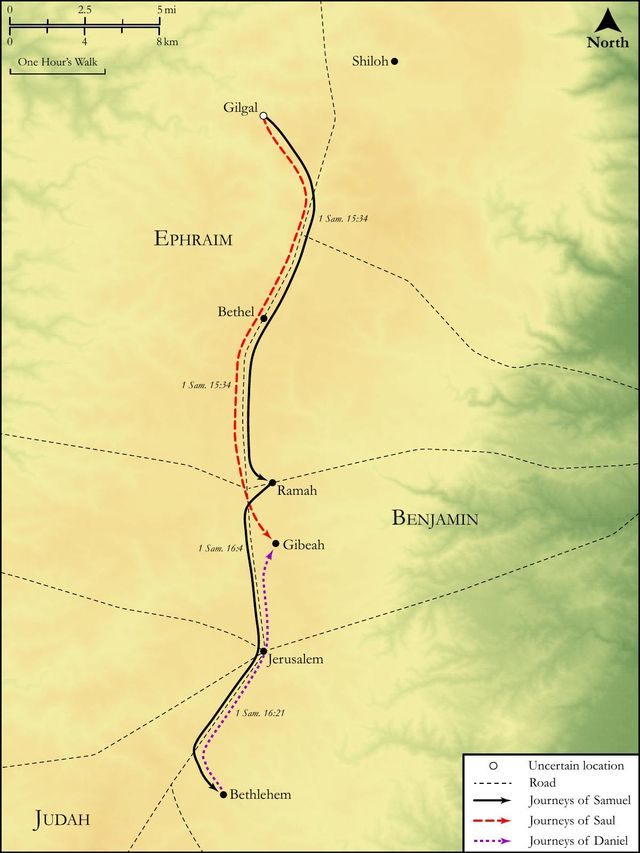
See on the biblical-era map
Study this verse
Public-domain commentary
Matthew Henry
From his Commentary on the Whole Bible. Henry comments on passages, not single verses — this entry covers 1 Samuel 16:14–23. His four-level outline is real structure in the source text, so it is rendered as structure.
We have here Saul falling and David rising.
I.Here is Saul made a terror to himself (Sa1 16:14):
The Spirit of the Lord departed from him. He having forsaken God and his duty, God, in a way of righteous judgment, withdrew from him those assistances of the good Spirit with which he was directed, animated, and encouraged in his government and wars. He lost all his good qualities. This was the effect of his rejecting God, and an evidence of his being rejected by him. Now God took his mercy from Saul (as it is expressed, Sa2 7:15); for, when the Spirit of the Lord departs from us, all good goes. When men grieve and quench the Spirit, by wilful sin, he departs, and will not always strive. The consequence of this was that an evil spirit from God troubled him. Those that drive the good Spirit away from the do of course become prey to the evil spirit. If God and his grace do not rule us, sin and Satan will have possession of us. The devil, by the divine permission, troubled and terrified Saul, by means of the corrupt humours of his body and passions of his mind. He grew fretful, and peevish, and discontented, timorous and suspicious, ever and anon starting and trembling; he was sometimes, says Josephus, as if he had been choked or strangled, and a perfect demoniac by fits. This made him unfit for business, precipitate in his counsels, the contempt of his enemies, and a burden to all about him.
II.Here is David made a physician to Saul, and by this means brought to court, a physician that helped him against the worst of diseases, when none else could. David was newly appointed privately to the kingdom. It would be of use to him to go to court and see the world; and here his doing so is brought about for him without any contrivance of his own or his friends. Note, Those whom God designs for any service his providence shall concur with his grace to prepare and qualify for it. Saul is distempered; his servants have the honesty and courage to tell him what his distemper is (Sa1 16:15), an evil spirit, not by chance but from God and his providence, troubleth thee. Now,
1.The means they all advised him to for his relief was music (Sa1 16:16): "Let us have a cunning player on the harp to attend thee." How much better friends had they been to him if they had advised him, since the evil spirit was from the Lord, to give all diligence to make his peace with God by true repentance, to send for Samuel to pray with him and to intercede with God for him! then might he not only have had some present relief, but the good Spirit would have returned to him. But their project is to make him merry, and so cure him. Many whose consciences are convinced and startled are for ever ruined by such methods as these, which drown all care of the soul in the delights of sense. Yet Saul's servants did not amiss to send for music as a help to cheer up the spirits, if they had but withal sent for a prophet to give him good counsel. And (as bishop Hall observes) it was well they did not send for a witch or diviner, by his enchantments to cast out the evil spirit, which has been the abominably wicked practice of some that have worn the Christian name, who consult the devil in their distresses and make hell their refuge. It will be no less than a miracle of divine grace if those who thus agree with Satan ever break off from him again.
2.One of his servants recommended David to him, as a fit person to be employed in the use of these means, little imagining that he was the man whom Samuel meant when he told Saul of a neighbour of his, better than he, who should have the kingdom, Sa1 15:28. It is a very high character which the servant of Saul's here gives of David (Sa1 16:18), that he was not only fit for his purpose as a comely person and skilful in playing, but a man of courage and conduct, a mighty valiant man, and prudent in all matters, fit to be further preferred, and (which crowned his character) the Lord is with him. By this it appears that though David, after he was anointed, returned to his country business, and there remained on his head no marks of the oil, so careful was he to keep that secret, yet the workings of the Spirit signified by the oil could not be hid, but made him shine in obscurity, so that all his neighbours observed with wonder the great improvements of his mind on a sudden. David, even in his shepherd's garb, has become an oracle, a champion, and every thing that is great. His fame reached the court soon, for Saul was inquisitive after such young men, Sa1 14:52. When the Spirit of God comes upon a man he will make his face to shine.
3.David is hereupon sent for to court. And it seems,
(1.)His father was very willing to part with him, sent him very readily, and a present with him to Saul, Sa1 16:20. The present was, according to the usage of those times, bread and wine (compare, Sa1 10:3, Sa1 10:4), therefore acceptable because expressive of the homage and allegiance of him that sent it. Probably Jesse, who knew what his son David was designed for, was aware that Providence was herein fitting him for it, and therefore he would not force Providence by sending him to court uncalled, yet he followed Providence very cheerfully when he saw it plainly putting him into the way of preferment. Some suggest that when Jesse received that message, Send me David thy son, he began to be afraid that Saul had got some intimation of his being anointed, and sent for him to do him a mischief, and therefore Jesse sent a present to pacify him; but it is probable that the person, whoever he was, that brought the message, gave him an account on what design he was sent for.
(2.)Saul became very kind to him (Sa1 16:21), loved him greatly, and designed to make him his armour-bearer, and (contrary to the manner of the king, Sa1 8:11) asked his father's leave to keep him in his service (Sa1 16:22): Let David, I pray thee, stand before me. And good reason he had to respect him, for he did him a great deal of service with his music, Sa1 16:23. Only his instrumental music with his harp is mentioned, but it should seem, by the account Josephus gives, that he added vocal music to it, and sung hymns, probably divine hymns, songs of praise, to his harp. David's music was Saul's physic.
[1.]Music has a natural tendency to compose and exhilarate the mind, when it is disturbed and saddened. Elisha used it for the calming of his spirits, Kg2 3:15. On some it has a greater influence and effect than on others, and, probably, Saul was one of those. Not that it charmed the evil spirit, but it made his spirit sedate, and allayed those tumults of the animal spirits by which the devil had advantage against him. The beams of the sun (it is the learned Bochart's comparison) cannot be cut with a sword, quenched with water, or blown out with wind, but, by closing the window-shutters, they may be kept out of the chamber. Music cannot work upon the devil, but it may shut up the passages by which he has access to the mind.
[2.]David's music was extraordinary, and in mercy to him, that he might gain a reputation at court, as one that had the Lord with him. God made his performances in music more successful, in this case, than those of others would have been. Saul found, even after he had conceived an enmity to David, that no one else could do him the same service (Kg2 19:9, Kg2 19:10), which was a great aggravation of his outrage against him. It is a pity that music, which may be so serviceable to the good temper of the mind, should ever be abused by any to the support of vanity and luxury, and made an occasion of drawing the heart away from God and serious things: if this be to any the effect of it, it drives away the good Spirit, not the evil spirit.
Historical interpretation
Sixteen Centuries of Reception
7 surviving comments on this verse. Each one is dated, so this reads as a timeline rather than a list.
Select a marker to jump to its quote. Markers stagger vertically where authors wrote within a few decades of each other.
The devil has power that might be called his own, only over such as no longer belong to God, the heathen whom he considers once for all as a drop in a bucket, as dust on the threshing floor, as spittle in the mouth—and, as such, totally handed over to the devil as a quite useless possession.Otherwise, he may do nothing by his own right, against those who dwell in the house of God, because the cases that are noted in Scripture show us when—that is, for what reasons—he may touch them. The right to tempt a person is granted to the devil, either for the sake of a trial, as in the texts cited above, whether God or the devil initiates the plan, or for the purpose of the reprobation of a sinner, who is handed over to the devil as to an executioner. This was the case with Saul. “The spirit of the Lord departed from Saul, and an evil spirit from the Lord troubled and stifled him.” Again, it may happen in order to humble a person, as Paul tells us that there was given him a thorn, a messenger of Satan, to buffet him, and even this sort of thing is not permitted for the humiliation of holy ones through torment of the flesh, unless it be done so that their power to resist may be perfected in weakness.
I will instruct you of that which is written, that the Spirit is not at every time found with those that receive it. For it is written about Saul, that the Holy Spirit, which he received when he was anointed, departed from him, because he grieved it, and God sent to him instead of it a vexing spirit. And whenever he was afflicted by the evil spirit, David used to play upon the harp, and the Holy Spirit, which David received when he was anointed, would come, and the evil spirit that was vexing Saul would flee from before it. So the Holy Spirit that David received was not found with him at every time. As long as he was playing the harp, then it used to come.
Therefore, when a person falls from the Spirit for any wickedness, if he repents after his fall, the grace remains irrevocably to the one who is willing; otherwise he who has fallen is no longer in God (because that Holy Spirit and Paraclete which is in God has deserted him), but this sinner shall be in him to whom he has subjected himself, as took place in Saul’s instance; for the Spirit of God departed from him and an evil spirit was afflicting him.
Again, that you may be sure that God curbs the spirit of pride, recall how the good spirit of God departed from Saul and an evil spirit troubled him. Holy Writ says, “And an evil spirit of God troubled him,” a spirit from God. Does God, then, have an evil spirit? Not at all. God had withdrawn so that afterwards an evil spirit might trouble Saul. In that sense, the spirit of God is called evil. Finally, holy David, knowing that God could take away the spirit of princes, entreats him, “And do not take your holy spirit from me.”
But the Spirit of the Lord departed from Saul, etc. As the proclamation of Christ increased, the grace of the Spirit soon deserted the hearts of the faithless Jews, and incited them with impious fury to persecute his name; and this the Lord permitted by just judgment, so that the tested ones might be made manifest in the Church, and the wicked, by their deserving merits, might be plunged further into the depths of their own malice.
Behold, the evil spirit of God agitates you, etc. The apostles said to the Jews, desiring in all things to serve their salvation: See and recognize how evil the spirit is, which, because of your fault, has been sent by the Lord against your minds, to oppose the name of his only begotten Son, and has led you to conspire against him: yet now, having performed penitence for your errors, flee to the aid of the life-giving wood, where the innocent limbs of the same spotless Lamb of God and our Lord Jesus Christ are stretched out. For we seek, that is, we will obtain for you, faith by explaining it more fully if you wish, that man, very well known to us but still unknown to you, endowed with singular knowledge among men, who by the saving wood of his cross knows how to put to flight all the deadly weapons of the harmful adversary: so that whenever the devil begins to move you to envy against the grace of the Gospel, under the shadow of the law, the memory of the Lord’s passion may be present, and may soon restrain your hearts from furious intention.
From the Lord: An evil spirit, by divine permission, and for his punishment, either possessed or obsessed him.
Continue studying 1 Samuel 16:14 across the web’s major study libraries — every link below opens this exact verse, chapter, or book on the destination site.
Read & Compare
 BibleGatewayThis verse in more than 200 translations and 70 languages.
 Bible.comThe YouVersion reader — hundreds of translations, reading plans, and highlights.
 ESV.orgCrossway's official English Standard Version reader.
 NET BibleThe NET translation with 60,000+ translators' notes on every rendering decision.
 STEP BibleTyndale House's free study tool — original text, vocabulary, and scholarly resources.
 BibliaLogos Bible Software's free web reader.
 USCCBThe New American Bible (Revised Edition) with the U.S. bishops' study notes.
Commentaries
 BibleHub CommentariesDozens of classic commentaries on this verse, gathered on one page.
 StudyLightMore than 100 commentary sets — the largest collection on the web.
 BibleRefPlain-English commentary on what this verse means, verse by verse.
 Enduring WordDavid Guzik's free commentary on this chapter, widely used by Bible teachers.
 Bible Study ToolsVerse commentary alongside Greek and Hebrew study aids.
Original Language & Research
- BibleHub InterlinearThe verse word by word — original language, transliteration, and English.
- BibleHub LexiconEvery word's original-language definition and Strong's entry.
 Blue Letter BibleDeep-study tools — Strong's numbers, concordance, and word studies.
 SefariaThe Hebrew text with Rashi and centuries of Jewish commentary.
Sermons, Hymns & Audio


TrulyRandomVerse is not affiliated with these sites and doesn’t control their content. They’re linked because they’re genuinely useful.
Summary
1 Samuel 16:14 marks a pivotal and tragic shift in the narrative of King Saul, immediately following the divine anointing of David. This verse profoundly illustrates God's sovereign judgment upon Saul for his persistent disobedience, signifying the definitive withdrawal of God's empowering Spirit from him. In its place, an "evil spirit from the LORD" is permitted to trouble him, leading to severe spiritual and psychological torment. It starkly contrasts Saul's spiritual decline with David's burgeoning anointing, setting the stage for the divinely orchestrated transition of kingship and underscoring the grave consequences of rebellion against divine commands.
Context
ShowHideLiterary Context
This verse is strategically positioned directly after the anointing of David by Samuel in 1 Samuel 16:13. The immediate juxtaposition creates a powerful spiritual contrast: as the Spirit of the LORD comes mightily upon David, it simultaneously departs from Saul. This follows a series of divine rejections of Saul due to his escalating disobedience, particularly his failure to utterly destroy the Amalekites as commanded by God, culminating in Samuel's declaration that God had torn the kingdom from him (1 Samuel 15:23). Earlier in his reign, the Spirit had powerfully come upon Saul, transforming him and empowering him for leadership (1 Samuel 10:6). The departure of the Spirit here signifies the finality of God's rejection and the spiritual end of Saul's effective reign, even while he physically remains king. This spiritual shift is the direct cause of Saul's subsequent erratic behavior and the eventual rise of David.
Historical & Cultural Context
In ancient Israel, kingship was understood as a divinely appointed office, often accompanied by a charismatic anointing of the Spirit of the LORD, which empowered the king for his duties, including military leadership and wise governance. This "Spirit of the LORD" was not necessarily a permanent indwelling as understood in the New Covenant, but rather a dynamic, empowering presence that could be given and, as seen here, withdrawn. The concept of an "evil spirit from the LORD" must be understood within a strict monotheistic framework where God is ultimately sovereign over all forces, both good and seemingly adverse. This does not imply God is the author of evil, but that He can permit or even direct adverse spiritual forces as instruments of judgment or discipline for His purposes, distinct from pagan polytheistic beliefs where malevolent spirits operated independently of a supreme deity. Saul's subsequent erratic behavior, paranoia, and fits of rage reflect the historical understanding of such spiritual torment as a divine consequence.
Key Themes
ShowHideThe primary themes illuminated by 1 Samuel 16:14 include Divine Sovereignty and Judgment, emphasizing God's ultimate authority over human leaders and His ability to withdraw His favor and empowering presence when His commands are disregarded. The subsequent "evil spirit from the LORD troubled him" highlights God's dominion even over spiritual forces, using them (or permitting them) as instruments of consequence for sin. This is intrinsically linked to the theme of Consequences of Disobedience, as Saul's spiritual and mental torment is presented as a direct result of his rebellion against God's commands, particularly his actions detailed in 1 Samuel 13 and 1 Samuel 15. His internal turmoil reflects his external forfeiture of God's blessing and anointing, serving as a powerful warning about the severe repercussions of persistent sin and unrepentance. Finally, this verse is central to the theme of Transition of Power, spiritually marking the end of Saul's effective reign and signifying God's transfer of divine endorsement and authority to His chosen successor, David, who is anointed in 1 Samuel 16:13.
Exposition and Analysis
ShowHideKey Word Analysis
ShowHideThis verb (H5493) signifies a complete and decisive removal or turning away. It implies a definitive cessation of the Spirit's empowering presence, rather than a temporary absence. For Saul, this "departure" was not merely a loss of feeling but a withdrawal of divine enablement and favor, marking the end of his legitimate spiritual authority and effectiveness as king in God's eyes. The root suggests a turning off or away, indicating God's intentional disengagement from Saul's reign.
The Hebrew term rûwach (H7307) is rich in meaning, encompassing "wind," "breath," and "spirit." In this context, "Spirit of the LORD" refers to God's active, empowering, and sanctifying presence, which enabled Saul to prophesy and lead Israel. Its departure signifies the removal of this divine empowerment, leaving Saul vulnerable and exposed. Conversely, the "evil spirit" is also a rûwach, indicating a spiritual entity, but one that is malignant and serves as an instrument of divine judgment, demonstrating that even adverse spiritual forces are under God's ultimate control.
This verb (H1204) means to fear, affright, or cause sudden alarm and agitation. It denotes a deep psychological and emotional disturbance, far beyond mere annoyance. The "evil spirit" did not just bother Saul; it profoundly tormented him, leading to fits of rage, paranoia, and deep melancholy, directly impacting his mental and emotional stability and, consequently, his ability to rule effectively. This term highlights the severity and pervasive nature of the affliction Saul experienced.
Verse Breakdown
ShowHide"But the Spirit of the LORD departed from Saul"
This clause signifies a momentous spiritual shift. The "Spirit of the LORD" represents the divine anointing and empowering presence that had previously enabled Saul to lead Israel (1 Samuel 10:6). Its departure is a direct consequence of Saul's persistent disobedience and rebellion against God's commands, particularly his failure to obey fully in the war against the Amalekites (1 Samuel 15). This withdrawal indicates God's definitive rejection of Saul as His chosen king, removing the divine favor and enablement necessary for his rule. It is a stark demonstration of God's sovereignty over human leadership and the severe spiritual repercussions of unfaithfulness, leaving Saul spiritually vulnerable and exposed.
"and an evil spirit from the LORD troubled him."
This second clause reveals the immediate and dire consequence of the Spirit's departure. The "evil spirit" (Hebrew: rûwach ra'ah) is not an independent demonic entity acting outside of God's control, but rather a spiritual agent permitted or even sent by God as an instrument of divine judgment and discipline. It caused Saul profound mental and emotional anguish, manifesting as fits of rage, paranoia, and deep depression. This torment was a direct, internal reflection of Saul's spiritual state and God's displeasure, serving as a punitive measure and further evidence of his unsuitability for kingship. It underscores God's absolute sovereignty, even over forces that bring affliction, demonstrating that all things ultimately serve His purposes, even the internal turmoil of a disobedient king.
Literary Devices
ShowHideThe passage employs several potent literary devices to convey its profound theological message. Juxtaposition is paramount, as 1 Samuel 16:14 immediately follows 1 Samuel 16:13, where "the Spirit of the LORD came mightily upon David from that day forward." This creates a stark, dramatic contrast between the two kings, highlighting God's transfer of favor and anointing from the disobedient Saul to the chosen David. Foreshadowing is also evident, as Saul's internal torment and erratic behavior foreshadow his eventual downfall, tragic end, and the complete loss of his kingdom. The "evil spirit" is a harbinger of the chaos and instability that will define the remainder of his reign, leading to his eventual death in 1 Samuel 31. Furthermore, the narrative employs Divine Sovereignty as a pervasive theme, not just a theological concept. The phrase "from the LORD" emphasizes God's active role in both empowering and withdrawing, and even in sending or permitting the "evil spirit," underscoring His ultimate control over all events and spiritual forces. This subtly incorporates Irony, as Saul, once divinely chosen and empowered, is now tormented by a spirit permitted by the very God he disobeyed, highlighting the tragic consequences of his rebellion and the reversal of his fortunes.
Theological and Thematic Connections
ShowHideThis verse powerfully articulates several core theological truths. It underscores God's absolute sovereignty, demonstrating that His Spirit and even adverse spiritual forces operate under His ultimate control and for His divine purposes. The departure of the Spirit from Saul is a vivid illustration of the consequences of persistent disobedience and rebellion against God's revealed will. It teaches that divine favor and empowerment are not unconditional or permanent for those who refuse to walk in obedience. Furthermore, the "evil spirit from the LORD" highlights a facet of divine judgment, where internal torment and psychological distress can be a direct result or instrument of God's discipline, leading to a profound spiritual and mental decline. This passage serves as a sobering reminder that while God is gracious, He is also just, and His holiness demands a response of faithful obedience from those He calls to leadership and relationship. It reveals that God's judgment can manifest not only externally but also internally, affecting one's very being.
Reflection and Application
ShowHideThe tragic account of Saul in 1 Samuel 16:14 offers profound and enduring lessons for believers today. It serves as a stark warning about the spiritual and psychological toll of persistent disobedience and unrepentance. While the direct experience of an "evil spirit from the LORD" may be unique to Saul's context, the principle remains: rebellion against God's will can lead to a withdrawal of His empowering presence and a descent into internal turmoil, anxiety, and spiritual barrenness. This passage calls us to a radical commitment to obedience, reminding us that God values a surrendered heart more than outward religious performance. It also encourages us to recognize God's sovereignty even in difficult circumstances, understanding that He can permit or use adverse situations, or even internal struggles, for His righteous purposes, whether for discipline, refinement, or to expose the true state of our hearts. Ultimately, it compels us to seek a continuous, humble reliance on God's Spirit for guidance, strength, and inner peace, recognizing that true well-being flows from a vibrant, obedient relationship with Him. We are called to cultivate a heart that is quick to repent and eager to obey, lest we, like Saul, forfeit the joy and peace of God's abiding presence.
Questions for Reflection
ShowHideFAQ
ShowHideDid God directly send an evil demon to torment Saul?
ShowHideThe phrase "evil spirit from the LORD" (Hebrew: ruach ra'ah me'et YHWH) indicates that this spirit originated from or was permitted by God. This does not necessarily mean God is the author of evil, nor does it imply a demon in the New Testament sense of an independent entity bent on pure destruction. Rather, in the Old Testament, God is presented as sovereign over all forces, including those that bring affliction or judgment. This "evil spirit" acted as an agent of divine discipline, causing Saul profound mental and emotional distress, likely manifesting as paranoia, fits of rage, and deep melancholy. It was a direct consequence of Saul's persistent disobedience and God's withdrawal of His empowering Spirit, serving as a punitive measure to highlight his unsuitability for kingship. God, in His sovereignty, can use or permit even adverse circumstances and spiritual forces to achieve His righteous purposes of judgment, discipline, or the advancement of His plan, as seen in the transition from Saul to David and the anointing of David in 1 Samuel 16:13.
What is the significance of the Spirit of the LORD "departing" from Saul?
ShowHideThe departure of the Spirit of the LORD from Saul signifies the withdrawal of God's special anointing and empowering presence that had enabled him to lead Israel as king (1 Samuel 10:6). In the Old Testament context, the Spirit often came upon individuals for specific tasks or periods, empowering them for leadership, prophecy, or battle. Its departure from Saul was a direct consequence of his repeated acts of disobedience and rebellion against God's commands, particularly his failure to fully obey in the war against the Amalekites (1 Samuel 15). This withdrawal marked God's definitive rejection of Saul as king in His eyes, signaling the end of divine favor and enablement for his reign. It's crucial to distinguish this from the permanent indwelling of the Holy Spirit promised to believers under the New Covenant, which is a seal of salvation and an abiding presence (Ephesians 1:13-14).
Christ-Centered Fulfillment
ShowHideThe tragic narrative of Saul's spiritual decline and the departure of the Spirit from him finds its ultimate resolution and perfect fulfillment in Jesus Christ. Saul, the first king of Israel, failed due to his disobedience and pride, leading to the withdrawal of God's empowering presence and subsequent torment. In stark contrast, Jesus is the perfectly obedient King, the true Son of David, upon whom the Spirit of the LORD descended at His baptism and remained permanently and without measure (John 1:32; John 3:34). Unlike Saul, whose reign ended in despair and divine rejection, Jesus' kingship is eternal, established through His perfect obedience, even to death on the cross (Philippians 2:8). Through His atoning sacrifice and resurrection, Christ secures for His people a new covenant where the Holy Spirit is not merely an empowering presence that can depart, but an indwelling seal and guarantee of their inheritance (Ephesians 1:13-14). Saul's torment highlights the brokenness of humanity and the need for a perfect mediator and king. Jesus, as the Lamb of God, takes away the sin of the world (John 1:29) and, as the resurrected Lord, pours out His Spirit upon all who believe, granting them new hearts and His Spirit within, enabling them to walk in His statutes and obey His laws (Ezekiel 36:26-27). Thus, Saul's failure points forward to Christ, who provides a permanent, Spirit-empowered relationship with God, free from the threat of the Spirit's departure due to sin, because our standing is secured in His perfect righteousness and the eternal covenant He inaugurated (Hebrews 8:6).