


1 Samuel 14:52
Bible text: King James Version (1769 Blayney text) · Public domain
Bible text: King James Version with Strong's numbers · Public domain
Bible text: Berean Standard Bible · Public domain
Bible text: American Standard Version (1901) · Public domain
Bible text: World English Bible, Messianic edition · Public domain
Bible text: Geneva Bible (1599) · Public domain
Bible text: Young's Literal Translation · Public domain
- וַתְּהִיva·te·Hiand it wasH1961Conj-w ¦ V-Qal-ConsecImperf-3fsVerb Qal Consecutive Imperfect 3rd Singular Feminineוַandתְּהִיit was
- הַמִּלְחָמָהha·mil·cha·Mahthe warH4421Art ¦ N-fsNoun Singular Feminine Absoluteהַtheמִּלְחָמָהwar
- חֲזָקָהcha·za·KahsevereH2389Adj-fsAdjective Singular Feminine Absolute
- עַל'alonH5921PrepPreposition
- פְּלִשְׁתִּיםpe·lish·Tim[the] PhilistinesH6430N-mpNoun Gentilic Plural Masculine Absolute
- כֹּלkolallH3605N-mscNoun Singular Masculine Construct
- יְמֵיye·Mei[the] days ofH3117N-mpcNoun Plural Masculine Construct
- שָׁאוּלsha·'UlSaulH7586N-proper-mNoun Proper Masculine
- וְרָאָהve·ra·'Ahand he sawH7200Conj-w ¦ V-Qal-ConsecPerf-3msVerb Qal Consecutive Perfect 3rd Singular Masculineוְandרָאָהhe saw
- שָׁאוּלsha·'UlSaulH7586N-proper-mNoun Proper Masculine
- כָּלkoleveryH3605N-mscNoun Singular Masculine Construct
- אִישׁ'ishmanH376N-mscNoun Singular Masculine Construct
- גִּבּוֹרgi·bOrmightyH1368N-msNoun Singular Masculine Absolute
- וְכָלve·kholand everyH3605Conj-w ¦ N-mscNoun Singular Masculine Constructוְandכָלevery
- בֶּןbenson ofH1121N-mscNoun Singular Masculine Construct
- חַיִלCha·yilstrengthH2428N-msNoun Singular Masculine Absolute
- וַיַּאַסְפֵהוּvai·ya·'as·Fe·huand he gathered himH622Conj-w ¦ V-Qal-ConsecImperf-3ms ¦ 3msVerb Qal Consecutive Imperfect 3rd Singular Masculineוַandיַּאַסְפֵhe gatheredהוּhim
- אֵלָיו'e·Lavto himselfH413Prep ¦ 3msPreposition Definiteאֵלָיtoוhimself
English is a literal word-by-word gloss of the Hebrew, not the KJV's wording. Why?
This is the original text the KJV's translators worked from — each Hebrew word with its own literal English meaning in this verse, prepared by scholars at Tyndale House, Cambridge. The KJV translates whole sentences, not word by word, so its wording differs: one Hebrew word can become several English words, and the KJV may choose “the LORD” where the gloss reads “Yahweh”. Both are faithful — they answer different questions. For the KJV's own rendering, switch to the KJV text.
Details
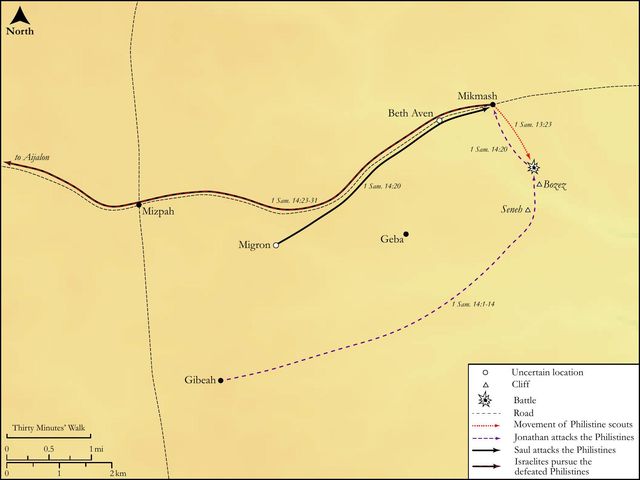
See on the biblical-era map
Study this verse
Public-domain commentary
Matthew Henry
From his Commentary on the Whole Bible. Henry comments on passages, not single verses — this entry covers 1 Samuel 14:47–52.
Here is a general account of Saul's court and camp. 1. Of his court and family, the names of his sons and daughters (Sa1 14:49), and of his wife and his cousin-german that was general of his army, Sa1 14:50. There is mention of another wife of Saul's (Sa2 21:8), Rizpah, a secondary wife, and of the children he had by her. 2. Of his camp and military actions. (1.) How he levied his army: When he saw any strong valiant man, that was remarkably fit for service, he took him unto him (Sa1 14:52), as Samuel had told them the manner of the king would be (Sa1 8:11); and, if he must have a standing army, it was his prudence to fill it up with the ablest men he could make choice of. (2.) How he employed his army. He guarded his country against the insults of its enemies on every side, and prevented their incursions, Sa1 14:47, Sa1 14:48. It is supposed that he acted only defensively against those that used to invade the borders of Israel; and withersoever he turned himself, as there was occasion, he vexed them, by checking and disappointing them. But the enemies he struggled most with were the Philistines, with whom he had sore war all his days, Sa1 14:52. He had little reason to be proud of his royal dignity, nor had any of his neighbours cause to envy him, for he had little enjoyment of himself after he took the kingdom. He could not vex his enemies without some vexation to himself, such thorns are crowns quilted with.
Historical interpretation
Historical reception
1 surviving comment on this verse from the historical church.
There was indeed a mighty war against the Philistines, etc. The primary cause of the mighty war against the Philistines was this, because Saul was gathering all the strong and fit men for battle to himself. For if the king himself were not encircled by the hand of a stronger military, by no means would he be terrifying to the neighboring enemies, nor would he powerfully incite them to war; but as in the former times Israel had served them most disgracefully without any hope of freedom; thus surely, thus in the Church, all who are dissolved from good works, nor are endowed with the army of spiritual virtues; because being idle and neglectful we sin, we pay the enemy's tributes of evil conversation with weak languor from the hostile ones. But when we recover from servitude to sin, we resume the hope of victory, the enemy rises, and attacks us with more frequent and sharper stings of temptations, so that if possible, he may recall us to the servitude of crimes; or, if not possible, at least avenge by fiercely raging the injury of his own contempt. But let us pass from our morals to view the allegorical deeds of the ancients; and in the very beginning of the nascent Church, the more the stronger and more fit men for spiritual battle Christ was gathering to himself, the more spoils of souls at that time and they were frequently taking from unclean spirits; but also they were enduring greater struggles of martyrdom from the same.
Continue studying 1 Samuel 14:52 across the web’s major study libraries — every link below opens this exact verse, chapter, or book on the destination site.
Read & Compare
 BibleGatewayThis verse in more than 200 translations and 70 languages.
 Bible.comThe YouVersion reader — hundreds of translations, reading plans, and highlights.
 ESV.orgCrossway's official English Standard Version reader.
 NET BibleThe NET translation with 60,000+ translators' notes on every rendering decision.
 STEP BibleTyndale House's free study tool — original text, vocabulary, and scholarly resources.
 BibliaLogos Bible Software's free web reader.
 USCCBThe New American Bible (Revised Edition) with the U.S. bishops' study notes.
Commentaries
 BibleHub CommentariesDozens of classic commentaries on this verse, gathered on one page.
 StudyLightMore than 100 commentary sets — the largest collection on the web.
 BibleRefPlain-English commentary on what this verse means, verse by verse.
 Enduring WordDavid Guzik's free commentary on this chapter, widely used by Bible teachers.
 Bible Study ToolsVerse commentary alongside Greek and Hebrew study aids.
Original Language & Research
- BibleHub InterlinearThe verse word by word — original language, transliteration, and English.
- BibleHub LexiconEvery word's original-language definition and Strong's entry.
 Blue Letter BibleDeep-study tools — Strong's numbers, concordance, and word studies.
 SefariaThe Hebrew text with Rashi and centuries of Jewish commentary.
Sermons, Hymns & Audio


TrulyRandomVerse is not affiliated with these sites and doesn’t control their content. They’re linked because they’re genuinely useful.
Summary
First Samuel 14:52 provides a succinct yet profound summary of King Saul's entire reign, characterizing it as a period of relentless and severe conflict against the Philistines. It also highlights Saul's consistent and pragmatic strategy for national defense: personally identifying and recruiting every physically strong and valiantly capable man into his service, thereby attempting to build a formidable human army to counter Israel's most persistent and powerful adversary.
Context
ShowHideLiterary Context
This verse serves as a concluding summary to a chapter that details a significant, if not decisive, victory for Israel over the Philistines, primarily spearheaded by Jonathan, Saul's son. The preceding narrative in 1 Samuel 14 showcases instances of divine intervention and Jonathan's faith-filled initiative, often contrasting sharply with Saul's impulsive and sometimes misguided leadership. However, verse 52 immediately tempers any notion of a definitive end to the conflict, clarifying that the war was "sore" and persisted "all the days of Saul." This statement sets the stage for the ongoing, defining struggle that characterizes Saul's kingship, ultimately culminating in his death at the hands of the Philistines in 1 Samuel 31. It also implicitly contrasts Saul's human-centric approach to military building with the earlier reliance on God's miraculous deliverance seen in figures like Gideon or even Jonathan's initial charge against the Philistines.
Historical & Cultural Context
The Philistines were a formidable military and political power among the nations round about, having settled along the coastal plain of Canaan. They were part of the "Sea Peoples" migration and possessed superior military technology, particularly their monopoly on ironworking, which is explicitly mentioned in 1 Samuel 13:19-22. This technological advantage meant that Israelites were often disarmed or dependent on Philistine smiths for sharpening tools, effectively limiting their ability to wage war. Israel, as a nascent monarchy, was transitioning from a tribal confederacy to a centralized kingdom, necessitating a standing army. Saul's reign was largely defined by the existential threat posed by the Philistines, who constantly encroached upon Israelite territory and sought to maintain their dominance. His personal recruitment strategy reflects the urgent need to build a professional fighting force capable of resisting such a powerful and technologically advanced enemy, a stark reality for the newly established kingdom.
Key Themes
ShowHideThe verse underscores several key themes prevalent in 1 Samuel. Firstly, the theme of Persistent Warfare highlights the relentless nature of the conflict with the Philistines, which was not a series of isolated skirmishes but a defining, continuous struggle throughout Saul's rule. This constant external pressure profoundly shaped the early Israelite monarchy and its leadership. Secondly, it introduces the theme of Saul's Pragmatic Leadership, demonstrating his proactive, hands-on approach to national defense by personally seeking out and recruiting the most capable individuals. This practical, human-resource-focused method reveals his reliance on military might. Thirdly, and most significantly, the verse implicitly contributes to the overarching theme of Reliance on Human Strength vs. Divine Sovereignty. While building an army is a king's duty, Saul's consistent emphasis on "strong man" and "valiant man" often foreshadows his later failures, where his reliance on his own judgment and human power superseded his dependence on God, ultimately leading to his rejection as king, as detailed in 1 Samuel 15:23. This tension between human effort and divine enablement is central to the book's theological message.
Exposition and Analysis
ShowHideKey Word Analysis
ShowHideDerived from the root meaning "to be strong," châzâq here describes the nature of the war as "hard," "violent," or "severe." It conveys an intensity and difficulty that made the conflict a constant, demanding drain on Israel's resources and resilience. This was not a minor inconvenience but a fundamental, existential struggle that required significant effort and endurance.
This term refers to a battle or, more broadly, warfare. Coupled with châzâq, it emphasizes a state of continuous, intense military engagement. The phrase "sore war" thus paints a picture of a relentless, defining conflict that permeated every aspect of Saul's reign, demanding constant vigilance and military preparedness from the nascent kingdom.
The Hebrew word gibbôwr denotes a mighty man, a warrior, a hero, or a champion. It signifies someone of exceptional physical prowess, courage, and military capability. Saul was not just looking for any man, but for individuals who stood out due to their inherent strength, physical power, and ability to fight effectively on the battlefield. This highlights Saul's focus on raw, individual military potential.
The Hebrew word chayil is rich in meaning, encompassing strength, ability, wealth, and military force. When applied to a person, it signifies competence, valor, and effectiveness in action. A chayil man is not only physically strong but also courageous, capable, and successful in warfare. Saul sought men who possessed not only physical might but also the proven ability and spirit necessary for sustained warfare, indicating a desire for a highly effective and professional fighting force.
Verse Breakdown
ShowHide"And there was sore war against the Philistines all the days of Saul:"
This opening clause immediately establishes the defining characteristic of Saul's kingship. His entire reign, from its inception to its tragic end, was marked by a severe and unceasing conflict with the Philistines. This was not an occasional skirmish but a constant, draining struggle that shaped national policy, military strategy, and the very identity of the nascent monarchy. It highlights the persistent external threat that Israel faced and the primary challenge Saul was called to address as king, underscoring the relentless nature of the Philistine menace.
"and when Saul saw any strong man, or any valiant man, he took him unto him."
This second clause reveals Saul's personal and pragmatic approach to building his army. Instead of relying solely on tribal levies or a conscripted force, Saul personally scouted for and recruited individuals who exhibited exceptional physical strength (gibbôwr) or proven valor and competence (chayil). This indicates a king deeply involved in the military affairs of his kingdom, actively seeking out the best and most capable warriors to form the backbone of his fighting force against the formidable Philistines. It underscores his reliance on human might and strategic, hands-on recruitment, reflecting his pragmatic leadership style.
Literary Devices
ShowHideThe verse employs several literary devices to convey its message with impactful brevity. It functions as a Summary Statement, encapsulating the entire military climate of Saul's reign and his consistent response to it, providing a concise overview of a protracted and defining period. The phrase "all the days of Saul" acts as a form of Hyperbole or Generalization, emphasizing the pervasive and relentless nature of the conflict, suggesting it was an ever-present reality rather than intermittent battles, underscoring its defining impact. There is also an implicit Contrast at play, subtly setting up the tension between human reliance and divine dependence, a major theological theme throughout 1 Samuel. While not explicitly stated here, Saul's consistent recruitment of "strong" and "valiant" men foreshadows his tendency to trust in human power and military might, often at the expense of full obedience to God, which ultimately leads to his downfall. This subtle Foreshadowing is crucial for understanding the tragic trajectory of Saul's kingship and the broader theological message of the book.
Theological and Thematic Connections
ShowHideThe constant "sore war" against the Philistines during Saul's reign serves as a powerful metaphor for the persistent spiritual battles believers face in every generation. Just as ancient Israel needed a king to lead them in physical warfare, humanity requires a divine King to lead in the spiritual conflict against sin, death, and the forces of darkness. Saul's strategy of recruiting "strong" and "valiant" men highlights a natural human tendency to rely on visible strength, human ingenuity, and impressive capabilities to overcome challenges. While such qualities are valuable and divinely given, the narrative of Saul's eventual failure underscores a crucial theological truth: ultimate victory and true security do not come from human might alone, but from unwavering trust in God's sovereign power and His chosen means of deliverance. The Lord does not need a multitude or superior weaponry to grant victory; His strength is made perfect in weakness, and He often uses the weak and foolish to confound the strong.
Reflection and Application
ShowHideThis verse invites us to reflect on the "sore wars" we face in our own lives, whether they are personal struggles against sin, societal challenges, or spiritual conflicts with unseen forces. Like Saul, we are often tempted to identify and rely solely on our own "strong men" or "valiant men"—our intellect, our financial resources, our influential connections, our sheer willpower, or our impressive talents—to overcome these adversaries. While diligence and utilizing our God-given abilities are commendable and necessary, the deeper lesson from Saul's story is the critical importance of discerning where our ultimate trust lies. Do we, like Saul, primarily look to human strength and strategic prowess, or do we, like Jonathan in the earlier part of the chapter, step out in faith, trusting that "nothing can hinder the Lord from saving by many or by few" (1 Samuel 14:6)? True strength for the believer is found not in self-reliance, but in humble, unwavering dependence on God, who equips us for every battle and fights on our behalf, often in ways we least expect.
Questions for Reflection
ShowHideFAQ
ShowHideWhy were the Philistines such a persistent and formidable enemy for Israel during Saul's reign?
ShowHideThe Philistines were a constant threat due to several critical factors. Geographically, they occupied the fertile coastal plain, which was strategically vital and bordered Israelite territory, leading to frequent territorial disputes and encroachment. Militarily, they possessed superior technology, particularly their monopoly on iron weapons and tools, which gave them a significant advantage over the bronze-age Israelites, as explicitly highlighted in 1 Samuel 13:19-22. Culturally, they were a well-organized, urbanized society with a sophisticated military structure, unlike the more loosely confederated Israelite tribes before the monarchy. Their presence represented an existential threat to Israel's national identity and independence, making the conflict a defining and relentless feature of Saul's entire reign.
Was Saul's strategy of recruiting strong and valiant men inherently wrong from a biblical perspective?
ShowHideSaul's strategy of recruiting strong and valiant men was not inherently wrong in itself; a king is expected to provide for the defense of his nation and build a capable army. The problem lay not in the act of recruitment, but in the potential for it to become a primary reliance that overshadowed trust in God. Throughout 1 Samuel, Saul's actions often reveal a pattern of prioritizing human wisdom, military might, and popular approval over divine command and spiritual dependence. While a king should certainly utilize the resources and people God provides, the narrative subtly critiques Saul's tendency to place ultimate confidence in human strength rather than in the Lord, who alone grants true victory, as powerfully demonstrated by Jonathan's earlier faith-filled attack against the Philistine garrison in 1 Samuel 14:6.
Christ-Centered Fulfillment
ShowHideSaul's reign, defined by "sore war" and his reliance on recruiting "strong" and "valiant" men, ultimately foreshadows the inadequacy of human kingship and human strength in achieving ultimate and lasting victory. While Saul fought physical battles against earthly enemies, the true and ultimate "sore war" is the spiritual battle against sin, death, and the powers of darkness. This is a war that no human king, no matter how strong or valiant his recruits, could ever win. This points us to the true King, Jesus Christ. Unlike Saul, who gathered men of physical prowess, Jesus calls and equips His disciples not based on their earthly strength, valor, or impressive human qualifications, but on their willingness to follow Him in faith and humility, relying on the transformative power of the Holy Spirit (Acts 1:8). His kingdom is not built on military might or human armies, but on sacrificial love and divine authority. The decisive victory Christ achieves is not through a conventional "sore war" but through His crucifixion and resurrection, where He disarmed the spiritual rulers and authorities (Colossians 2:15) and triumphed over death itself (1 Corinthians 15:54-57). He is the true Lamb of God who takes away the sin of the world (John 1:29), conquering the ultimate enemy not by human strength, but by divine weakness made perfect in His self-giving sacrifice, offering eternal peace and victory to all who trust in Him (Romans 5:1).