


1 Samuel 8:1
- וַיְהִיvay·Hiand it wasH1961Conj-w ¦ V-Qal-ConsecImperf-3msVerb Qal Consecutive Imperfect 3rd Singular Masculineוַandיְהִיit was
- כַּאֲשֶׁרka·'a·Sher<just> whenH834Prep-k ¦ RelParticle Relativeכַּ<just>אֲשֶׁרwhen
- זָקֵןza·Kenhe was oldH2204V-Qal-Perf-3msVerb Qal Perfect 3rd Singular Masculine
- שְׁמוּאֵלshe·mu·'ElSamuelH8050N-proper-mNoun Proper Masculine
- וַיָּשֶׂםvai·Ya·semand he madeH7760Conj-w ¦ V-Qal-ConsecImperf-3msVerb Qal Consecutive Imperfect 3rd Singular Masculineוַandיָּשֶׂםhe made
- אֶת'et<obj.>H853DirObjMParticle Object Indicator
- בָּנָיוba·Navhis sonsH1121N-mpc ¦ 3msNoun Plural Masculine Constructבָּנָיsonsוhis
- שֹׁפְטִיםsho·fe·TimjudgesH8199V-Qal-Prtcpl-mpVerb Qal Participle Plural Masculine Absolute
- לְיִשְׂרָאֵלle·Yis·ra·'Elfor IsraelH3478Prep-l ¦ N-properNoun Proper LocationלְforיִשְׂרָאֵלIsrael
English is a literal word-by-word gloss of the Hebrew, not the KJV's wording. Why?
This is the original text the KJV's translators worked from — each Hebrew word with its own literal English meaning in this verse, prepared by scholars at Tyndale House, Cambridge. The KJV translates whole sentences, not word by word, so its wording differs: one Hebrew word can become several English words, and the KJV may choose “the LORD” where the gloss reads “Yahweh”. Both are faithful — they answer different questions. For the KJV's own rendering, switch to the KJV text.
Details
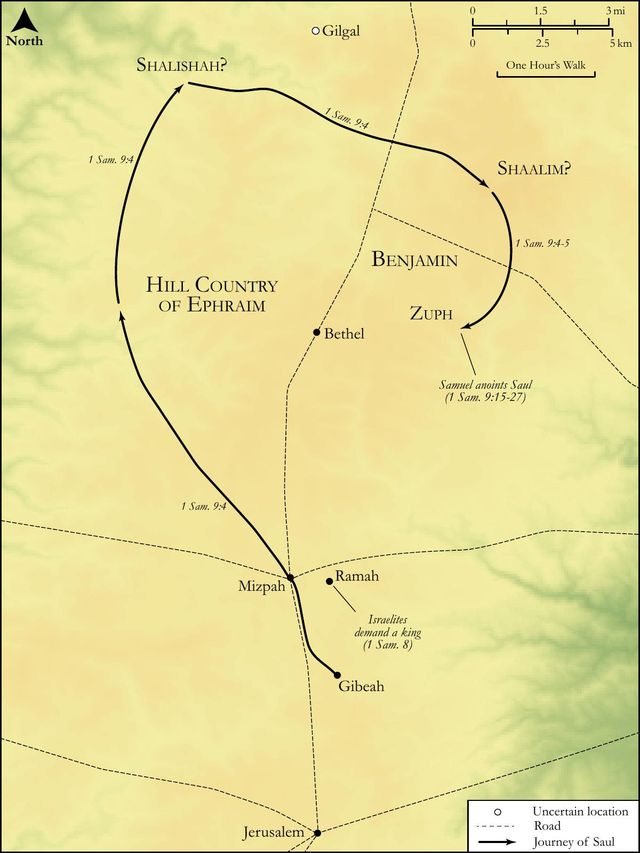
See on the biblical-era map
Study this verse
Public-domain commentary
Matthew Henry
From his Commentary on the Whole Bible. Henry comments on passages, not single verses — this entry covers 1 Samuel 8:1–3.
Two sad things we find here, but not strange things: - 1. A good and useful man growing old and unfit for service (Sa1 8:1): Samuel was old, and could not judge Israel, as he had done. He is not reckoned to be past sixty years of age now, perhaps not so much; but he was a man betimes, was full of thoughts and cared when he was a child, which perhaps hastened the infirmities of age upon him. The fruits that are the first ripe keep the worst. He had spent his strength and spirits in the fatigue of public business, and now, if he think to shake himself as at other times, he finds he is mistaken: old age has cut his hair. Those that are in the prime of their time ought to be busy in doing the work of life: for, as they go into years, they will find themselves less disposed to it and less able for it. 2. The children of a good man turning aside, and not treading in his steps. Samuel had given his sons so good an education, and they had given him such good hopes of their doing well, and gained such a reputation in Israel, that he made them judges, assistants to him awhile, and afterwards deputies under him at Beersheeba, which lay remote from Ramah, Sa1 8:2. Probably the southern countries petitioned for their residence there, that they might not be necessitated to travel far with their causes. We have reason to think that Samuel gave them their commissions, not because they were his sons (he had no ambition to entail the government upon his family, any more than Gideon had), but because, for aught that yet appeared, they were men very fit for the trust; and none so proper to ease the aged judge, and take some of the burden off him, as (coeteris paribus - other things being equal) his own sons, who no doubt were respected for their good father's sake, and, having such an advantage at setting out, might soon have been great if they had but been good. But, alas! his sons walked not in his ways (Sa1 8:3), and, when their character was the reverse of his, their relation to so good a man, which otherwise would have been their honour, was really their disgrace. Degeneranti genus opprobrium - A good extraction is a reproach to him that degenerates from it. Note, Those that have the most grace themselves cannot give grace to their children. It has often been the grief of good men to see their posterity, instead of treading in their steps, trampling upon them, and, as Job speaks, marring their path. Nay, many that have begun well, promised fair, and set out in the right path, so that their parents and friends have had great hopes of them, yet afterwards have turned aside to by-paths, and been the grief of those of whom they should have been the joy. When Samuel's sons were made judges, and settled at a distance form him, then they discovered themselves. Thus, (1.) Many that have been well educated, and have conducted themselves well while they were under their parents' eye, when they have gone abroad into the world and set up for themselves have proved bad. Let none therefore be secure either of themselves or theirs, but depend on divine grace. (2.) Many that have done well in a state of meanness and subjection have been spoiled by preferment and power. Honours change men's minds, and too often for the worse. It does not appear that Samuel's sons were so profane and vicious as Eli's sons; but, whatever they were in other respects, they were corrupt judges, they turned aside after lucre, after the mammon of unrighteousness, so the Chaldee reads it. Note, The love of money is the root of all evil. It is pernicious in any, but especially in judges. Samuel had taken no bribes (Job 12:3), but his sons had, though, no doubt, he warned them against it when he made them judges; and then they perverted judgment. In determining controversies, they had an eye to the bribe, not to the law, and enquired who bid highest, not who had right on his side. It is sad with a people when the public justice that should do them right, being perverted, does them the greatest wrong.
Continue studying 1 Samuel 8:1 across the web’s major study libraries — every link below opens this exact verse, chapter, or book on the destination site.
Read & Compare
 BibleGatewayThis verse in more than 200 translations and 70 languages.
 Bible.comThe YouVersion reader — hundreds of translations, reading plans, and highlights.
 ESV.orgCrossway's official English Standard Version reader.
 NET BibleThe NET translation with 60,000+ translators' notes on every rendering decision.
 STEP BibleTyndale House's free study tool — original text, vocabulary, and scholarly resources.
 BibliaLogos Bible Software's free web reader.
 USCCBThe New American Bible (Revised Edition) with the U.S. bishops' study notes.
Commentaries
 BibleHub CommentariesDozens of classic commentaries on this verse, gathered on one page.
 StudyLightMore than 100 commentary sets — the largest collection on the web.
 BibleRefPlain-English commentary on what this verse means, verse by verse.
 Enduring WordDavid Guzik's free commentary on this chapter, widely used by Bible teachers.
 Bible Study ToolsVerse commentary alongside Greek and Hebrew study aids.
Original Language & Research
- BibleHub InterlinearThe verse word by word — original language, transliteration, and English.
- BibleHub LexiconEvery word's original-language definition and Strong's entry.
 Blue Letter BibleDeep-study tools — Strong's numbers, concordance, and word studies.
 SefariaThe Hebrew text with Rashi and centuries of Jewish commentary.
Sermons, Hymns & Audio


TrulyRandomVerse is not affiliated with these sites and doesn’t control their content. They’re linked because they’re genuinely useful.
Summary
1 Samuel 8:1 marks a pivotal moment in Israel's history, signaling the twilight of the era of the judges and initiating the complex, often tumultuous, transition towards monarchy. This verse establishes the immediate context for the people's subsequent demand for a king, rooted in Samuel's advanced age and, more significantly, the moral failings of his appointed sons, thereby setting the stage for a profound shift in Israel's divinely ordained leadership structure.
Context
ShowHideLiterary Context
This verse immediately follows a period of significant spiritual revival and national deliverance under Samuel's faithful leadership, particularly highlighted in 1 Samuel 7, where Israel repented and defeated the Philistines at Mizpah. Samuel, having served as both prophet and judge, had brought a measure of stability and spiritual order after centuries of cyclical apostasy and oppression described in the Book of Judges. The narrative here shifts from Samuel's triumphant leadership to the looming question of succession, setting up the direct cause for the people's subsequent demand for a king, detailed beginning in 1 Samuel 8:4-5. This verse thus acts as a crucial bridge, concluding the era of the judges and initiating the events that lead to the establishment of the monarchy.
Historical & Cultural Context
In ancient Near Eastern societies, it was common for leadership, especially within a family, to be passed down hereditarily. While the judges in Israel were typically charismatic, divinely-appointed deliverers rather than hereditary rulers, Samuel's attempt to establish his sons as judges reflects a natural human inclination towards succession and stability. However, Israel's unique covenant relationship with God meant that their leadership was meant to be theocratic, with God as their ultimate King. The surrounding nations were monarchies, and Israel's desire to "be like all the nations" (1 Samuel 8:5) was a significant cultural pressure. This verse, therefore, highlights the tension between Israel's unique divine calling and their tendency to conform to the practices of their neighbors, particularly as the era of temporary, divinely-raised judges drew to a close.
Key Themes
ShowHideThis verse introduces several crucial themes that permeate the subsequent narrative. Firstly, it underscores the theme of leadership transition and succession, revealing the challenges inherent in passing on spiritual and political authority, especially when the successors lack the integrity of their predecessors. Secondly, it highlights the nature of godly leadership, emphasizing that true authority is not merely inherited but requires personal righteousness, justice, and faithfulness to God, a stark contrast to the corruption of Samuel's sons later detailed in 1 Samuel 8:3. Thirdly, it marks the end of an era, signifying the close of the period of the "judges" (Hebrew: shofetim), who were charismatic leaders raised by God to deliver and govern Israel, as seen throughout the Book of Judges. This sets the irreversible trajectory towards the establishment of a monarchy, which would define Israel's political and spiritual landscape for centuries to come.
Exposition and Analysis
ShowHideKey Word Analysis
ShowHideMeaning "heard of God," this name encapsulates Samuel's prophetic calling and his role as one who hears and speaks for God. In this context, his personal identity as "heard of God" stands in stark contrast to the actions of his sons, whose unrighteousness would lead the people to seek a different form of leadership, indirectly rejecting God's direct rule through His chosen prophet.
This term, derived from a primitive root meaning "to be old," signifies Samuel's advanced age. While often associated with wisdom and respect in ancient cultures, here it also implies a natural decline in vigor and the necessity of considering succession. Samuel's old age becomes the immediate, human catalyst for his decision to appoint his sons, creating a perceived vacuum in leadership that needs to be filled.
This word, meaning "a son (as a builder of the family name)," refers to Samuel's biological offspring. The expectation in ancient societies was that sons would carry on the family legacy and authority. However, the subsequent narrative reveals that Samuel's sons, despite their familial connection, failed to uphold the righteous character and integrity necessary for their appointed roles, thereby undermining the very "building of the family name" in a spiritual and ethical sense.
Derived from a primitive root meaning "to judge," this term refers to individuals who pronounced sentence, vindicated, punished, and governed. In Israel, the shofetim were divinely appointed charismatic leaders who delivered Israel from oppression and administered justice. Samuel's act of making his sons "judges" indicates an attempt to establish a hereditary succession for an office that was traditionally non-dynastic and divinely initiated, highlighting a deviation from the established pattern of God's direct appointment.
Verse Breakdown
ShowHide"And it came to pass"
This common transitional phrase in biblical narrative simply indicates the unfolding of events, serving as a narrative marker to introduce the next significant development in the story. It signals a shift from the previous narrative of Samuel's faithful leadership to a new, critical phase in Israel's history.
"when Samuel was old"
This clause establishes the temporal setting and the primary human motivation for the subsequent action. Samuel's age is presented as the immediate reason for his decision to delegate authority, highlighting the natural progression of life and the necessity of planning for the future of leadership, particularly in a period without a clear, divinely ordained succession plan for the judgeship.
"that he made his sons judges over Israel"
This is the core action of the verse. Samuel, acting within his authority as the reigning judge and prophet, formally appointed his sons to positions of significant power and responsibility. This decision, however, would prove to be deeply problematic, as their subsequent corruption would directly lead to the people's demand for a king, fundamentally altering Israel's governmental structure and ushering in a new era.
Literary Devices
ShowHideThe verse employs several subtle but significant literary devices. Foreshadowing is prominent, as Samuel's aging and the appointment of his sons immediately hint at the impending end of the era of the judges and the dramatic shift towards a monarchy. This seemingly benign act sets the stage for the major conflict of the chapter. There is also an element of irony, as Samuel, a paragon of righteous leadership and a faithful servant who delivered Israel from external threats, inadvertently sets in motion the events that lead to a rejection of God's direct rule, largely due to the failings within his own family. The narrative also uses juxtaposition, subtly contrasting the exemplary character of Samuel, implicitly understood from previous chapters, with the unworthiness of his sons, which will be explicitly detailed in the verses that follow, creating a tension that drives the plot forward.
Theological and Thematic Connections
ShowHideThis verse profoundly illustrates the tension between divine ideal and human reality. While God intended for Israel to be a unique theocracy, led by Him through judges and prophets, the human element of leadership often fell short. Samuel's decision, though perhaps well-intentioned, reflects a human attempt to secure succession in a way that ultimately proved flawed, highlighting the pervasive issue of human sinfulness and the difficulty of transmitting spiritual integrity across generations. It underscores that even the most godly parents cannot guarantee the righteousness of their children, especially when placed in positions of power. This failure, however, does not thwart God's ultimate plan but rather serves as a catalyst, demonstrating God's sovereignty even amidst human failings, as He uses these events to guide Israel towards the establishment of a monarchy, which itself would eventually point to the need for a perfect, divine King.
Reflection and Application
ShowHideThe appointment of Samuel's sons as judges serves as a timeless and sobering reminder of the critical importance of character in leadership. It challenges us to look beyond lineage, reputation, or even good intentions, and to prioritize integrity, righteousness, and faithfulness to God in those we entrust with authority, whether in the church, community, or family. This narrative also speaks to the complexities of parental influence; while Samuel was a devoted prophet and judge, his sons' actions underscore that true faith and character cannot be inherited but must be personally cultivated. For believers today, this verse prompts us to discern carefully who we follow and to pray for leaders who genuinely embody the values of justice, humility, and service. It also encourages us to trust in God's overarching sovereignty, recognizing that even when human plans falter or human leaders fail, God remains faithful to His purposes, often using such moments of crisis to refine His people and advance His kingdom.
Questions for Reflection
ShowHideFAQ
ShowHideWhy did Samuel appoint his sons as judges if they were later found to be corrupt?
ShowHideThe text of 1 Samuel 8:1 states that Samuel appointed his sons when he was old, implying a natural concern for succession and the continuity of leadership. It was a common cultural practice in the ancient Near East for leadership to pass within families, even if the office of judge was not strictly hereditary. While their corruption is explicitly detailed in 1 Samuel 8:3, it is not stated that Samuel was fully aware of the extent of their unrighteousness at the precise moment of their appointment, or perhaps he held out hope that they would mature into their roles. His decision likely stemmed from a desire to ensure stability for Israel in his declining years. However, the subsequent revelation of their unrighteousness highlights the limitations of human judgment and the challenge of discerning true character, even for a prophet as devoted as Samuel. This situation ultimately served as the catalyst for the people's demand for a king, demonstrating that God can use even human failings to advance His larger redemptive plan.
Christ-Centered Fulfillment
ShowHideThe narrative of Samuel's aging and the failure of his sons to uphold righteous leadership in 1 Samuel 8:1 powerfully foreshadows the ultimate need for a perfect, incorruptible King. The period of the judges, characterized by cycles of sin, oppression, and temporary deliverance, along with the subsequent era of human kings, frequently demonstrated the inherent flaws and limitations of human leadership. From the initial failure of Samuel's sons to the eventual corruption and unfaithfulness of many of Israel's kings, the Old Testament repeatedly points to the profound need for a leader who is not subject to human frailty, sin, or mortality. This yearning for a flawless ruler finds its complete and glorious fulfillment in Jesus Christ. He is the eternal King, whose kingdom is not of this world (John 18:36), and whose reign is marked by perfect righteousness, justice, and unending peace (Isaiah 9:6-7). Unlike Samuel's sons, who "turned aside after lucre, and took bribes, and perverted judgment" (1 Samuel 8:3), Jesus, the Lamb of God, perfectly fulfilled all righteousness and offered Himself as the ultimate sacrifice, establishing a new covenant of grace (Hebrews 9:15). He is the true Judge who always renders righteous judgment (John 5:27), the Prophet who perfectly reveals God's will (Deuteronomy 18:18), and the King who rules with absolute integrity, ensuring that His people will never again be left without a faithful shepherd (Matthew 2:6). The human failures highlighted in 1 Samuel 8:1 thus serve as a dark backdrop against which the radiant glory and perfect leadership of Christ shine ever brighter.