


1 Samuel 7:17
Bible text: King James Version (1769 Blayney text) · Public domain
Bible text: Berean Standard Bible · Public domain
Bible text: American Standard Version (1901) · Public domain
Bible text: World English Bible, Messianic edition · Public domain
Bible text: Geneva Bible (1599) · Public domain
Bible text: Young's Literal Translation · Public domain
- וּתְשֻׁבָתוֹu·te·shu·va·Toand his returnH8666Conj-w ¦ N-fsc ¦ 3msNoun Singular Feminine Constructוּandתְשֻׁבָתreturnוֹhis
- הָרָמָתָהha·ra·Ma·tah[was] <the> Ramah towardsH7414Art ¦ N-proper ¦ SfxNoun Proper Locationהָ[was] <the>רָמָתָRamahהtowards
- כִּיkiforH3588PrtParticle Conditional
- שָׁםsham[was] thereH8033AdvAdverb
- בֵּיתוֹbei·Tohis houseH1004N-msc ¦ 3msNoun Singular Masculine Constructבֵּיתhouseוֹhis
- וְשָׁםve·Shamand thereH8033Conj-w ¦ AdvAdverbוְandשָׁםthere
- שָׁפָטsha·Fathe judgedH8199V-Qal-Perf-3msVerb Qal Perfect 3rd Singular Masculine
- אֶת'et<obj.>H853DirObjMParticle Object Indicator
- יִשְׂרָאֵלYis·ra·'ElIsraelH3478N-properNoun Proper Location
- וַיִּבֶןvai·yi·venand he builtH1129Conj-w ¦ V-Qal-ConsecImperf-3msVerb Qal Consecutive Imperfect 3rd Singular Masculineוַandיִּבֶןhe built
- שָׁםshamthereH8033AdvAdverb
- מִזְבֵּחַmiz·Be·achan altarH4196N-msNoun Singular Masculine Absolute
- לַיהוָהla·Yah·wehto YahwehH3068Prep-l ¦ N-properNoun Proper TitleלַtoיהוָהYahweh
English is a literal word-by-word gloss of the Hebrew, not the KJV's wording. Why?
This is the original text the KJV's translators worked from — each Hebrew word with its own literal English meaning in this verse, prepared by scholars at Tyndale House, Cambridge. The KJV translates whole sentences, not word by word, so its wording differs: one Hebrew word can become several English words, and the KJV may choose “the LORD” where the gloss reads “Yahweh”. Both are faithful — they answer different questions. For the KJV's own rendering, switch to the KJV text.
Details
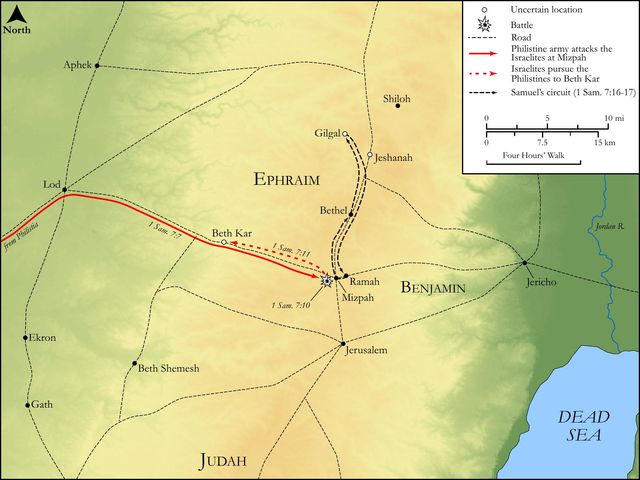
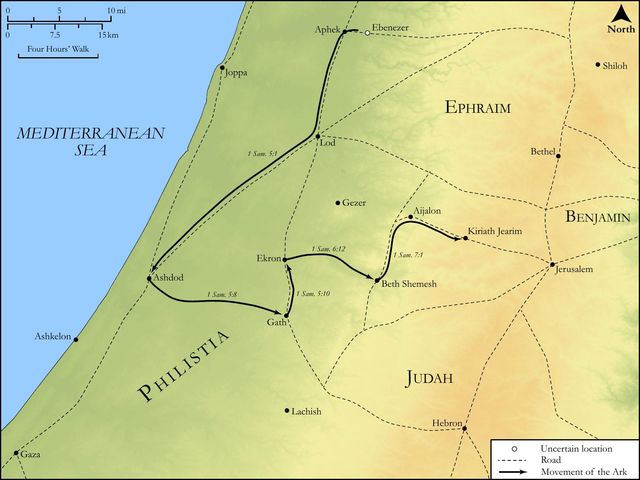
See on the biblical-era maps
Study this verse
Public-domain commentary
Matthew Henry
From his Commentary on the Whole Bible. Henry comments on passages, not single verses — this entry covers 1 Samuel 7:13–17.
We have here a short account of the further good services that Samuel did to Israel. Having parted them from their idols, and brought them home to their God, he had put them into a capacity of receiving further benefits by his ministry. Having prevailed in that, he becomes, in other instances, a great blessing to them; yet, writing it himself, he is brief in the relation. We are not told here, but it appears (Ch2 35:18) that in the days of Samuel the prophet the people of Israel kept the ordinance of the passover with more than ordinary devotion, notwithstanding the distance of the ark and the desolations of Shiloh. Many good offices, no doubt, he did for Israel, but here we are only told how instrumental he was, 1. In securing the public peace (Sa1 7:13): "In his days the Philistines came no more into the coast of Israel, made no inroads or incursions upon them; they perceived that God now fought for Israel and that his hand was against the Philistines, and this kept them in awe, and restrained the remainder of their wrath." Samuel was a protector and deliverer to Israel, not by dint of sword, as Gideon, nor by strength of arm, as Samson, but by the power of prayer to God and carrying on a work of reformation among the people. Religion and piety are the best securities of a nation. 2. In recovering the public rights, Sa1 7:14. By his influence Israel had the courage to demand the cities which the Philistines had unjustly taken from them and had long detained; and the Philistines, not daring to contend with one that had so great an interest in heaven, tamely yielded to the demand, and restored (some think) even Ekron and Gath, two of the capital cities, though afterwards they retook them; others think some small towns that lay between Ekron and Gath, which were forced out of the Philistines' hands. This they got by their reformation and religion, they got ground of their enemies and got forward in their affairs. It is added, There was peace between Israel and the Amorites, that is, the Canaanites, the remains of the natives. Not that Israel made any league with them, but they were quiet, and not so mischievous to Israel as they had sometimes been. Thus when a man's ways please the Lord he maketh even his enemies to be at peace with him and give him no disturbance, Pro 16:7. 3. In administering public justice (Sa1 7:15, Sa1 7:16): He judged Israel; as a prophet he taught them their duty and reproved them for their sins, which is called judging, Eze 20:4; Eze 22:2. Moses judged Israel when he made them know the statutes of God and his laws (Exo 18:16); and thus Samuel judged them to the last, even after Saul was made king; so he promised them then, when Saul was inaugurated (Sa1 12:23), I will not cease to teach you the good and the right way. As a magistrate, he received appeals from the inferior courts and gave judgment upon them, tried causes and determined them, tried prisoners and acquitted or condemned them, according to the law. This he did all his days, till he grew old and past service, and resigned to Saul; and afterwards he exercised authority when application was made to him; nay, he judged even Agag, and Saul himself. But when he was in his prime he rode the circuit, for the convenience of the country, at least of that part of it which lay most under his influence. He kept courts at Beth-el, Gilgal, and Mizpeh, all in the tribe of Benjamin; but his constant residence was at Ramah, his father's city, and there he judged Israel, thither they resorted to him from all parts with their complaints, Sa1 7:17. 4. In keeping up the public exercises of religion; for there, where he lived, he built an altar to the Lord, not in contempt of the altar that was at Nob, or Gibeon, or wherever the tabernacle was; but divine justice having laid Sholoh waste, and no other place being yet chosen for them to bring their offerings to (Deu 12:11), he looked upon the law which confined them to one place to be for the present suspended, and therefore, being a prophet, and under divine direction, he did as the patriarchs did, he built an altar where he lived, both for the use of his own family and for the good of the country that resorted to it. Great men should use their wealth, power, and interest, for the keeping up of religion in the places where they live.
Historical interpretation
Historical reception
1 surviving comment on this verse from the historical church.
And he returned to Ramathia, etc. The Lord returned to heaven in body by ascending once, the office of His dispensation having been completed; he returns daily in divine presence, by which he always and everywhere reaches entirety from end to end strongly, and arranges all things sweetly. For there is the flesh that he assumed for us and glorified; there is the hall of the blessed and of angels and men; there is the habitation promised to us by God, a house not made by hand, eternal in the heavens. Whence Ramathia is rightly called his height; and there, placed in body, he himself judges the Church, either chastising those still wandering on earth, until he leads them to the heavenly, or distributing worthy seats to those already dwelling with him according to merits, where in the house of his Father he has many mansions (John XIII), knowing that the Father has given all things into his hands, and has given him authority to execute judgment (John V). There also within the veil of heaven and the eternal holy of holies, he was building an altar for the hearts of the heavenly citizens to the Father. From this, the fire of his charity being ignited, the incense of everlasting praise rises, saying, Holy, holy, holy Lord God of hosts, the whole earth is full of his glory (Isaiah VI). And again: Salvation to our God, who sits upon the throne, and to the Lamb (Revelation VII); and other such things, which being brought thither in the Spirit, the beloved disciple heard, to be often repeated and always remembered. Thus far may it suffice to have briefly indicated in the first book of our exposition the change from the old priesthood to the new, prefigured in the guise of Heli and Samuel, so that we may freely investigate from another beginning the wider mysteries of the changing kingdom, which were prefigured through Saul and David, relying not on our ingenuity, but depending on the help of him through all things, to whom the whole Scripture of prophecy serves, whose kingdom shall have no end, and is a priest forever according to the order of Melchizedek.
Continue studying 1 Samuel 7:17 across the web’s major study libraries — every link below opens this exact verse, chapter, or book on the destination site.
Read & Compare
 BibleGatewayThis verse in more than 200 translations and 70 languages.
 Bible.comThe YouVersion reader — hundreds of translations, reading plans, and highlights.
 ESV.orgCrossway's official English Standard Version reader.
 NET BibleThe NET translation with 60,000+ translators' notes on every rendering decision.
 STEP BibleTyndale House's free study tool — original text, vocabulary, and scholarly resources.
 BibliaLogos Bible Software's free web reader.
 USCCBThe New American Bible (Revised Edition) with the U.S. bishops' study notes.
Commentaries
 BibleHub CommentariesDozens of classic commentaries on this verse, gathered on one page.
 StudyLightMore than 100 commentary sets — the largest collection on the web.
 BibleRefPlain-English commentary on what this verse means, verse by verse.
 Enduring WordDavid Guzik's free commentary on this chapter, widely used by Bible teachers.
 Bible Study ToolsVerse commentary alongside Greek and Hebrew study aids.
Original Language & Research
- BibleHub InterlinearThe verse word by word — original language, transliteration, and English.
- BibleHub LexiconEvery word's original-language definition and Strong's entry.
 Blue Letter BibleDeep-study tools — Strong's numbers, concordance, and word studies.
 SefariaThe Hebrew text with Rashi and centuries of Jewish commentary.
Sermons, Hymns & Audio


TrulyRandomVerse is not affiliated with these sites and doesn’t control their content. They’re linked because they’re genuinely useful.
Summary
Samuel's consistent return to Ramah, his personal residence, served as the stable epicenter of his multifaceted ministry as judge and prophet, from which he regularly administered justice throughout Israel and where he established a permanent altar, signifying a renewed commitment to Yahweh worship and solidifying Ramah as a vital spiritual and judicial hub in a period of national restoration following years of Philistine oppression and spiritual decline.
Context
ShowHideLiterary Context
This verse concludes the narrative of Samuel's early judgeship, following the significant victory at Mizpah described in 1 Samuel 7:7-12. It immediately follows 1 Samuel 7:15-16, which details Samuel's regular circuit of judging Israel from year to year, visiting Bethel, Gilgal, and Mizpah. Verse 17 brings the focus back to Samuel's home base, emphasizing its centrality to his ongoing leadership. This section marks a crucial turning point from the chaotic and decentralized period of the Judges to a more stable, divinely-guided leadership under Samuel, setting the stage for the eventual monarchy.
Historical & Cultural Context
Israel in Samuel's time was undergoing a significant transition from the decentralized tribal system of the Judges to the unified monarchy. The period was marked by widespread spiritual apostasy, as seen in passages like Judges 2:11-13, severe Philistine oppression, beginning around Judges 13:1, and the disruption of central worship, evidenced by the Ark of the Covenant's capture and subsequent return (as detailed in 1 Samuel 4-6). Samuel, uniquely, combined the roles of prophet, priest, and judge, providing desperately needed spiritual and civil leadership. Building an altar in a specific location like Ramah, while the tabernacle's status at Shiloh was diminished after the Ark's capture and likely destruction, signifies a legitimate, albeit localized, center for Yahweh worship, emphasizing Samuel's prophetic authority and the people's renewed devotion after the repentance at Mizpah.
Key Themes
ShowHideThis verse powerfully underscores several key themes. First, Dedicated Leadership, as Samuel's consistent return to Ramah highlights his unwavering commitment and stability in providing spiritual and judicial guidance for Israel, contrasting sharply with the sporadic and often self-serving leadership of earlier judges. Second, Centrality of Worship and Justice, with Ramah serving as a dual hub where both divine law was administered and genuine worship of Yahweh was practiced, symbolizing a return to order and divine governance. The building of the altar specifically reinforces the theme of Spiritual Renewal, marking a tangible expression of Israel's renewed covenant relationship with God after a period of widespread idolatry and demonstrating the importance of acknowledging God's presence in all aspects of national life and leadership.
Exposition and Analysis
ShowHideKey Word Analysis
ShowHideThis term refers to a dwelling but carries broader implications of family, household, and even a place of permanence or origin. In this context, Samuel's "house" in Ramah signifies not merely his personal residence but the established base from which his authority and influence emanated, anchoring his national ministry in a fixed, familiar location.
This primitive root means "to judge, i.e., pronounce sentence (for or against)." By implication, it extends to governing, vindicating, or punishing. Samuel's role as judge encompassed not just legal arbitration but comprehensive leadership, including delivering Israel from oppression and guiding the nation according to God's laws, functioning as a divinely appointed civil and spiritual authority.
An altar is a structure specifically designed for offering sacrifices. In the Old Testament, altars were central to worship, symbolizing communion, atonement, and devotion to God. Samuel's construction of an altar at Ramah, distinct from the central sanctuary, underscores a legitimate, prophetic act of worship and a focal point for Israel's renewed commitment to Yahweh during a period of spiritual transition and disruption.
Verse Breakdown
ShowHide"And his return [was] to Ramah; for there [was] his house;"
This initial clause establishes Ramah as Samuel's permanent dwelling and the consistent hub of his operations. The phrase "his return" (H8666, tᵉshûwbâh, meaning "a recurrence of time or place") emphasizes the regularity and stability of his presence there. Unlike the more nomadic lifestyle of some earlier judges, Samuel's rootedness in Ramah provided a constant, reliable anchor for the nation, signifying that his leadership was firmly grounded in his personal life and home.
"and there he judged Israel;"
This clause highlights Ramah's function as the primary seat of justice and governance. While Samuel conducted a circuit to other cities (1 Samuel 7:16), Ramah was the consistent location where he administered justice, resolved disputes, and provided spiritual and civil guidance. This made Ramah a central administrative hub for the nation, where God's law was applied and national order maintained under Samuel's authority.
"and there he built an altar unto the LORD."
This final, profound action signifies Ramah's role as a spiritual center. The construction of an altar (H4196, mizbêach) was a public declaration of God's sovereignty and a tangible expression of renewed worship. In a time when the central sanctuary system was disrupted and idolatry had been rampant, Samuel's building of an altar at his home base underscored the importance of pure Yahweh worship (H3068, Yᵉhôvâh) and served as a visible symbol of Israel's renewed covenant relationship with God, making Ramah a legitimate and vital spiritual focal point for the nation.
Literary Devices
ShowHideThe verse employs several effective literary devices that underscore its message. The prominent use of Repetition is evident in the repeated phrase "and there" ("and there was his house; and there he judged Israel; and there he built an altar"). This anaphoric repetition powerfully emphasizes Ramah's multifaceted importance as Samuel's personal dwelling, judicial seat, and spiritual hub. It creates a strong sense of stability and permanence, contrasting sharply with the previous period of instability in Israel and highlighting the fixed, reliable nature of Samuel's righteous leadership. The act of building an altar serves as potent Symbolism, representing Israel's renewed commitment to Yahweh worship and Samuel's pivotal role as a prophetic leader guiding the nation back to God. Furthermore, the combination of "judged Israel" and "built an altar" can be interpreted as a form of Merism, encompassing the totality of Samuel's leadership—both civil and spiritual—from his home base. This literary technique indicates a comprehensive and holistic approach to national restoration under divine guidance, where justice and worship are inextricably linked.
Theological and Thematic Connections
ShowHideThis verse encapsulates the essence of faithful leadership, demonstrating how personal devotion, administrative responsibility, and public worship are inextricably linked. Samuel's consistent return to Ramah and his establishment of an altar there underscore the biblical principle that effective governance and societal well-being are rooted in a vibrant relationship with God. It reflects a period of national repentance and spiritual renewal, where the people, led by Samuel, turned back to Yahweh, leading to divine favor and peace. The altar at Ramah serves as a powerful reminder that true authority and stability flow from God's presence and that prioritizing worship is foundational to both individual and communal flourishing, even in times of transition or disruption to established religious practices.
Reflection and Application
ShowHideSamuel's example in 1 Samuel 7:17 offers profound lessons for contemporary believers. His consistent return to Ramah, his home base, highlights the critical need for establishing spiritual anchors in our own lives—a consistent place, time, or practice where we intentionally connect with God, renew our faith, and seek His guidance. This "home base" provides stability and direction amidst life's demands and distractions, serving as a spiritual wellspring from which we draw strength for our daily walk. Furthermore, Samuel seamlessly integrated his administrative duties as judge with his spiritual devotion, building an altar where he lived and worked. This challenges us to integrate our faith into all aspects of our lives—our work, family, community involvement, and decision-making—allowing God's principles to guide every action and decision, rather than compartmentalizing our spiritual life. The act of building an altar underscores the enduring importance of prioritizing worship, reminding us to create intentional spaces and opportunities, both personally and communally, where we honor God, express gratitude, and seek His face. This foundational devotion is essential for a thriving relationship with the Lord and for exercising godly influence in our spheres of life, reflecting God's order and presence in a chaotic world.
Questions for Reflection
ShowHideFAQ
ShowHideWhy did Samuel build an altar at Ramah, given that there was a central sanctuary (e.g., Shiloh or later Nob/Gibeon)?
ShowHideSamuel's act of building an altar at Ramah, while seemingly a deviation from the Deuteronomic command for a single central sanctuary (as articulated in Deuteronomy 12:5-7), must be understood within the specific historical and spiritual context of his time. The central sanctuary system had been severely disrupted. The Ark of the Covenant had been captured by the Philistines and, upon its return, was not brought back to Shiloh, which appears to have been destroyed or at least abandoned as a primary worship site (as prophesied and referenced in Jeremiah 7:12). In this period of transition and spiritual disarray, God often allowed for legitimate, localized altars, particularly when established by prophets or divinely appointed leaders for specific purposes, such as calling the people to repentance or marking a significant divine intervention. Samuel, acting as both prophet and judge, established this altar at his home base as a focal point for renewed Yahweh worship and a place where he could seek God's guidance for the nation, signifying a legitimate spiritual center in the absence of a fully functional central sanctuary. It was a practical and divinely sanctioned response to the spiritual needs of the people, demonstrating a return to God's presence and worship in a time of national rebuilding.
Christ-Centered Fulfillment
ShowHideSamuel's consistent return to Ramah, his home and the stable center of his judging and worship, powerfully foreshadows the ultimate "home" and eternal center of all things in Jesus Christ. Just as Ramah became the stable hub for Israel's spiritual and judicial life under Samuel, Christ is the ultimate and eternal dwelling place of God, the one in whom "all the fullness of God was pleased to dwell" (Colossians 1:19). Samuel, as a judge, brought order and justice, but Christ is the righteous judge who perfectly executes God's justice and mercy, reconciling humanity to God through His sacrifice (John 5:27 and Romans 3:25-26). The altar Samuel built at Ramah, a place of sacrifice and communion with God, points forward to the definitive and perfect sacrifice of Jesus on the cross, which forever atoned for sin and established a new covenant, making direct access to God possible for all who believe (Hebrews 9:11-14 and Hebrews 10:19-22). Thus, Samuel's ministry, rooted in a specific place of worship and justice, serves as a shadow of Christ, the true and eternal Altar, Judge, and Dwelling Place, who brings ultimate peace, reconciliation, and spiritual renewal to all who come to Him.