


1 Samuel 19:18
Bible text: King James Version (1769 Blayney text) · Public domain
Bible text: King James Version with Strong's numbers · Public domain
Bible text: Berean Standard Bible · Public domain
Bible text: American Standard Version (1901) · Public domain
Bible text: World English Bible, Messianic edition · Public domain
Bible text: Geneva Bible (1599) · Public domain
Bible text: Young's Literal Translation · Public domain
- וְדָוִדve·da·Vidand DavidH1732Conj-w ¦ N-proper-mNoun Proper MasculineוְandדָוִדDavid
- בָּרַחba·Rachhe fledH1272V-Qal-Perf-3msVerb Qal Perfect 3rd Singular Masculine
- וַיִּמָּלֵטvai·yi·ma·Letand he escapedH4422Conj-w ¦ V-Niphal-ConsecImperf-3msVerb Niphal Consecutive Imperfect 3rd Singular Masculineוַandיִּמָּלֵטhe escaped
- וַיָּבֹאvai·ya·Vo'and he wentH935Conj-w ¦ V-Qal-ConsecImperf-3msVerb Qal Consecutive Imperfect 3rd Singular Masculineוַandיָּבֹאhe went
- אֶל'eltoH413PrepPreposition
- שְׁמוּאֵלshe·mu·'ElSamuelH8050N-proper-mNoun Proper Masculine
- הָרָמָתָהha·ra·Ma·tah<the> Ramah towardsH7414Art ¦ N-proper ¦ SfxNoun Proper Locationהָ<the>רָמָתָRamahהtowards
- וַיַּגֶּדvai·Ya·gedand he toldH5046Conj-w ¦ V-Hiphil-ConsecImperf-3msVerb Hiphil Consecutive Imperfect 3rd Singular Masculineוַandיַּגֶּדhe told
- לוֹloto <the> himPrep-l ¦ 3msSuffix Personal 3rd Singular Masculineלto <the>וֹhim
- אֵת'et<obj.>H853DirObjMParticle Object Indicator
- כָּלkolallH3605N-msNoun Singular Masculine Absolute
- אֲשֶׁר'a·SherthatH834RelParticle Relative
- עָשָׂה'a·sahhe had doneH6213V-Qal-Perf-3msVerb Qal Perfect 3rd Singular Masculine
- לוֹloto <the> himPrep-l ¦ 3msSuffix Personal 3rd Singular Masculineלto <the>וֹhim
- שָׁאוּלsha·'UlSaulH7586N-proper-mNoun Proper Masculine
- וַיֵּלֶךְvai·Ye·lekhand he wentH1980Conj-w ¦ V-Qal-ConsecImperf-3msVerb Qal Consecutive Imperfect 3rd Singular Masculineוַandיֵּלֶךְhe went
- הוּאhu'heH1931Pro-3msPronoun Personal 3rd Singular Masculine
- וּשְׁמוּאֵלu·she·mu·'Eland SamuelH8050Conj-w ¦ N-proper-mNoun Proper MasculineוּandשְׁמוּאֵלSamuel
- וַיֵּשְׁבוּvai·ye·she·Vuand they dweltH3427Conj-w ¦ V-Qal-ConsecImperf-3mpVerb Qal Consecutive Imperfect 3rd Plural Masculineוַandיֵּשְׁבוּthey dwelt
- בְּנָיוֹתbe·noitat NaiothH5121Prep-b ¦ N-properNoun Proper LocationבְּatנָיוֹתNaioth
English is a literal word-by-word gloss of the Hebrew, not the KJV's wording. Why?
This is the original text the KJV's translators worked from — each Hebrew word with its own literal English meaning in this verse, prepared by scholars at Tyndale House, Cambridge. The KJV translates whole sentences, not word by word, so its wording differs: one Hebrew word can become several English words, and the KJV may choose “the LORD” where the gloss reads “Yahweh”. Both are faithful — they answer different questions. For the KJV's own rendering, switch to the KJV text.
Details
See on the biblical-era map
Study this verse
Public-domain commentary
Matthew Henry
From his Commentary on the Whole Bible. Henry comments on passages, not single verses — this entry covers 1 Samuel 19:18–24. His two-level outline is real structure in the source text, so it is rendered as structure.
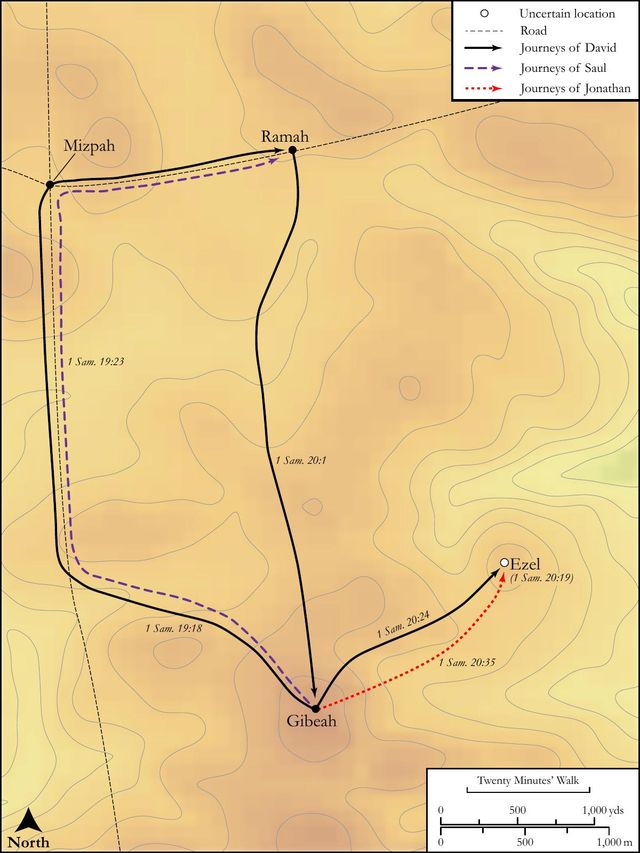
Here is, I. David's place of refuge. Having got away in the night from his own house, he fled not to Bethlehem to his relations, nor to any of the cities of Israel that had caressed and cried him up, to make an interest in them for his own preservation; but he ran straight to Samuel and told him all that Saul had done to him, Sa1 19:18. 1. Because Samuel was the man that had given him assurance of the crown, and his faith in that assurance now beginning to fail, and he being ready to say in his haste (or in his flight, as some read it, Psa 116:11), All men are liars ("not only Saul that promised me my life, but Samuel himself that promised me the throne"), whither should he go but to Samuel, for such encouragements, in this day of distress, as would support his faith? In flying to Samuel he made God his refuge, trusting in the shadow of his wings; where else can a good man think himself safe? 2. Because Samuel, as a prophet, was best able to advise him what to do in this day of his distress. In the psalm he penned the night before he had lifted up his prayer to God, and now he takes the first opportunity of waiting upon Samuel to receive direction and instruction from God. If we expect answers of peace to our prayers, we must have our ears open to God's word. 3. Because with Samuel there was a college of prophets with whom he might join in praising God, and the pleasure of this exercise would be the greatest relief imaginable to him in his present distress. He met with little rest or satisfaction in Saul's court, and therefore went to seek it in Samuel's church. And, doubtless, what little pleasure is to be had in this world those have it that live a life of communion with God; to this David retired in the time of trouble, Psa 27:4-6.
II.David's protection in this place:
He and Samuel went and dwelt (or lodged) in Naioth, where the school of the prophets was, in Ramah, as in a privileged place, for the Philistines themselves would not disturb that meeting, Sa1 10:10. But Saul, having notice of it by some of his spies (Sa1 19:19), sent officers to seize David, Sa1 19:20. When they did not bring him he sent more; when they returned not he sent the third time (Sa1 19:21), and, hearing no tidings of these, he went himself, Sa1 19:22. So impatient was he in his thirst after David's blood, so restless to compass his design against him, that, though baffled by one providence after another, he could not perceive that David was under the special protection of Heaven. It was below the king to go himself on such an errand as this; but persecutors will stoop to any thing, and stick at nothing, to gratify their malice. Saul lays aside all public business to hunt David. How was David delivered, now that he was just ready to fall (like his own lamb formerly) into the mouth of the lions? Not as he delivered his lamb, by slaying the lion, or, as Elijah was delivered, by consuming the messengers with fire from heaven, but by turning the lions for the present into lambs.
1.When the messengers came into the congregation where David was among the prophets the Spirit of God came upon them, and they prophesied, that is, they joined with the rest in praising God. Instead of seizing David, they themselves were seized. And thus, (1.) God secured David; for either they were put into such an ecstasy by the spirit of prophecy that they could not think of any thing else, and so forgot their errand and never minded David, or they were by it put, for the present, into so good a frame that they could not entertain the thought of doing so bad a thing.
2.He put an honour upon the sons of the prophets and the communion of saints, and showed how he can, when he pleases, strike an awe upon the worst of men, by the tokens of his presence in the assemblies of the faithful, and force them to acknowledge that God is with them of a truth, Co1 14:24, Co1 14:25. See also the benefit of religious societies, and what good impressions may be made by them on minds that seemed unapt to receive such impressions. And where may the influences of the Spirit be expected but in the congregations of the saints? (3.) He magnified his power over the spirits of men. He that made the heart and tongue can manage both to serve his own purposes. Balaam prophesied the happiness of Israel, whom he would have cursed; and some of the Jewish writers think these messengers prophesied the advancement of David to the throne of Israel.
2.Saul himself was likewise seized with the spirit of prophecy before he came to the place. One would have thought that so bad a man as he was in no danger of being turned into a prophet; yet, when God will take this way of protecting David, even Saul had no sooner come (as bishop Hall expresses it) within smell of the smoke of Naioth but he prophesies, as his messengers did, Sa1 19:23. He stripped off his royal robe and warlike habiliments, because they were either too fine or too heavy for this service, and fell into a trance as it should seem, or into a rapture, which continued all that day and night. The saints at Damascus were delivered from the range of the New Testament Saul by a change wrought on his spirit, but of another nature from this. This was only amazing, but that sanctifying - this for a day, that for ever. Note, Many have great gifts and yet no grace, prophesy in Christ's name and yet are disowned by him, Mat 7:22, Mat 7:23. Now the proverb recurs, Is Saul among the prophets? See Sa1 10:12. Then it was different from what it had been, but now contrary. He is rejected of God, and actuated by an evil spirit, and yet among the prophets.
Historical interpretation
Fourteen Centuries of Reception
6 surviving comments on this verse. Each one is dated, so this reads as a timeline rather than a list.
Select a marker to jump to its quote. Markers stagger vertically where authors wrote within a few decades of each other.
Therefore let us not be ashamed to flee, for this flight is a glorious one, to flee from the face of sin.… Thus did David, too, flee from the face of King Saul, and from the face of Absalom. Indeed, in his flight he brought about an increase of holiness, for he spared a treacherous assailant and sought after a parricide.
Moreover the perfect soul turns away from matter, shuns and rejects everything that is excessive or inconstant or wicked, and neither sees nor approaches this earthly defilement and corruption. It is attentive to things divine but shuns earthly matter. But its flight is not to depart from the earth but to remain on earth, to hold to justice and temperance, to renounce the vices in material goods, not their use. Holy David fled from the face of Saul, not indeed to depart from the earth but to turn away from the contagion of a cruel, disobedient and treacherous man. He fled, cleaving to God, just as he himself said, “My soul has stuck fast to you.”
David was allotted the kingdom of the Israelites in place of Saul. He was a humble, innocent and gentle exile, yet he was for a long time tormented by [Saul’s] unjust persecution.… Whoever upon hearing these things begins to strive after humility and innocence and to drive pride and envy from his heart, has, as it were, found a draught of the clearest water, by which he may be refreshed. But if he recognizes that Saul signifies those who persecute, and David signifies Christ and the church; and if he recognizes that on account of the [persecutors’] lack of faith, both their material and spiritual sovereignty has been destroyed, while the reign of Christ and the church will always remain; [with this understanding] he will perceive a cup of wine made from the water, for he will know that he is reading not only about that king but about his own life and reign, where before he read [the story] as if it were an ancient history about others.
David, however, fleeing, was saved, etc. Ramathaim meaning heights, Naioth interpreted as beauty, which is a place in Ramah. Therefore, with Saul's messengers seeing only the image and goatskin in David's bed, David himself fleeing is saved; and with the Jews during the time of the Lord’s death arguing among themselves that he was a deceiver, and not truly innocent and just, but was crucified for his crime, the Lord, who was confined in the tomb, mighty arising from death, appears in the heights of life, with immortal glory to the disciples, saying: Because thus it is written, and thus it was necessary for the Christ to suffer and to rise from the dead (Luke 24); and he goes, and dwells in the beauty of the everlasting kingdom, which is in heaven. The Church has gone after him in hope both in soul and body, and thus will be with the Lord always.
It was announced to Saul by those saying, Behold, David is in Naioth in Ramah, etc. Which also concerning the second messengers, as well as the third, are related in similar order. It was announced to the Jews by the apostles and the disciples of the apostles that the Lord Jesus Christ, after his passion, resurrection, and ascension, sitting at the right hand of the Father, reigns exalted in heaven. But they immediately sent three of their former faith and religion, but now of their impiety and perfidy, namely priests, scribes, and Pharisees, to take away his confession from the believers who were persecuting; all of these persecutors, although bearing the mind of unbelievers, however, where disputing up to the statements of the prophets, to which the apostles with the revelation of the spiritual intelligence of Christ preside, they themselves also protesting these things written by the divine Spirit, simultaneously both loving them with the faithful and believing, though not even understanding, they were singing.
Najoth: It was probably a school or college of prophets, in or near Ramath under the direction of Samuel.
Continue studying 1 Samuel 19:18 across the web’s major study libraries — every link below opens this exact verse, chapter, or book on the destination site.
Read & Compare
 BibleGatewayThis verse in more than 200 translations and 70 languages.
 Bible.comThe YouVersion reader — hundreds of translations, reading plans, and highlights.
 ESV.orgCrossway's official English Standard Version reader.
 NET BibleThe NET translation with 60,000+ translators' notes on every rendering decision.
 STEP BibleTyndale House's free study tool — original text, vocabulary, and scholarly resources.
 BibliaLogos Bible Software's free web reader.
 USCCBThe New American Bible (Revised Edition) with the U.S. bishops' study notes.
Commentaries
 BibleHub CommentariesDozens of classic commentaries on this verse, gathered on one page.
 StudyLightMore than 100 commentary sets — the largest collection on the web.
 BibleRefPlain-English commentary on what this verse means, verse by verse.
 Enduring WordDavid Guzik's free commentary on this chapter, widely used by Bible teachers.
 Bible Study ToolsVerse commentary alongside Greek and Hebrew study aids.
Original Language & Research
- BibleHub InterlinearThe verse word by word — original language, transliteration, and English.
- BibleHub LexiconEvery word's original-language definition and Strong's entry.
 Blue Letter BibleDeep-study tools — Strong's numbers, concordance, and word studies.
 SefariaThe Hebrew text with Rashi and centuries of Jewish commentary.
Sermons, Hymns & Audio


TrulyRandomVerse is not affiliated with these sites and doesn’t control their content. They’re linked because they’re genuinely useful.
Summary
1 Samuel 19:18 chronicles David's urgent flight from King Saul's escalating, murderous jealousy, marking a critical turning point in his life. Having narrowly escaped multiple attempts on his life, David seeks immediate refuge and spiritual counsel with the revered prophet Samuel in Ramah. Their subsequent retreat to Naioth, a communal residence for prophets, underscores David's profound reliance on divine guidance and spiritual authority over military might, highlighting God's providential protection and the significance of finding sanctuary within a community devoted to God amidst severe persecution.
Context
ShowHideLiterary Context
This verse is strategically placed within a dramatic and intensifying narrative arc detailing King Saul's descent into paranoia and his relentless, murderous pursuit of David. Immediately preceding this, David had miraculously escaped Saul's spear for the second time, as recorded in 1 Samuel 19:9-10. Following this, David's wife, Michal, Saul's own daughter, bravely defied her father by deceiving his messengers, enabling David's escape through a window, as detailed in 1 Samuel 19:11-17. David's flight to Samuel in Ramah represents a deliberate and strategic move away from the treacherous political machinations of Saul's court and towards a spiritual haven. The events immediately succeeding this verse, where Saul and his messengers are supernaturally overcome by the Spirit of God at Naioth, as described in 1 Samuel 19:20-24, further emphasize the unique spiritual nature of this refuge and God's direct, miraculous intervention in protecting His anointed. This entire narrative arc powerfully contrasts Saul's declining, Spirit-bereft kingship with David's unwavering reliance on God's Spirit and His appointed prophet, Samuel, who had initially anointed David as the future king in 1 Samuel 16:13.
Historical & Cultural Context
Ramah held significant importance as Samuel's hometown and a prominent center of prophetic activity in ancient Israel. The concept of "schools of prophets" or communal prophetic residences, such as Naioth, was a recognized phenomenon in this period, serving as vital centers for spiritual training, worship, and the cultivation of prophetic gifts under the guidance of a senior prophet. In a culture where seeking refuge with a respected elder or spiritual authority was a common and accepted practice for individuals facing persecution or injustice, David's choice to go directly to Samuel was both culturally appropriate and profoundly significant from a spiritual perspective. It symbolized a deliberate shift from the chaotic and perilous political realm of Saul's court to a place of spiritual order, divine protection, and moral authority. These prophetic communities often functioned as counter-cultural spaces, emphasizing unwavering devotion to Yahweh amidst the pervasive political instability and social turmoil characteristic of the early monarchy.
Key Themes
ShowHideThis verse powerfully contributes to several overarching themes that are central to the book of 1 Samuel. Firstly, it vividly underscores Divine Providence and Protection, as David's series of miraculous escapes and his divinely guided path to Samuel unequivocally demonstrate God's unwavering care for His anointed one, even when he faces the most intense and life-threatening persecution. Secondly, it highlights the paramount importance of Seeking Godly Counsel and Refuge, emphasizing that in times of extreme distress, turning to trusted spiritual authorities and finding sanctuary within a faithful community is not merely advisable but absolutely essential. David's deliberate choice to go to Samuel, a prophet, rather than seeking a military stronghold or a political alliance, speaks volumes about his spiritual priorities and his deep trust in God's plan. Finally, the mention of Naioth in this verse serves as a crucial Foreshadowing of the Power of the Prophetic Spirit, which would soon manifest in a remarkable and undeniable way, demonstrating God's sovereign control over even the most hostile human intentions, ultimately protecting David and frustrating Saul's relentless pursuit, as seen later in 1 Samuel 19:20-24.
Exposition and Analysis
ShowHideKey Word Analysis
ShowHideThis word (H1272) is a primitive root meaning "to bolt, i.e. figuratively, to flee suddenly." It conveys a sense of urgent, rapid escape, emphasizing David's desperate need to get away from immediate danger. The term highlights the suddenness and necessity of his departure, underscoring the life-threatening nature of Saul's pursuit.
This word (H3427) is a primitive root meaning "to sit down (specifically as judge, in ambush, in quiet); by implication, to dwell, to remain." In this context, it signifies a more than temporary stay, implying a settling or abiding. David and Samuel's decision to "dwell" in Naioth suggests a period of sustained residence and finding a measure of stability and quiet within the prophetic community, contrasting sharply with David's previous hurried movements.
This term (H5121), derived from a root meaning "residence," refers to a specific place or complex of "dwellings" in Ramah. It is not merely a geographical location but denotes a communal living arrangement, likely a "school of prophets" or a prophetic community under Samuel's leadership. Its significance lies in its function as a spiritual sanctuary and a center of divine presence and prophetic power, providing a haven of divine order and protection amidst the political chaos and spiritual decline of Saul's reign.
Verse Breakdown
ShowHide"So David fled, and escaped,"
This opening phrase immediately establishes the high stakes and urgency of David's situation. The verbs "fled" and "escaped" vividly convey the culmination of a series of narrow deliverances from Saul's murderous intent. It highlights David's desperate need for safety and underscores that his survival was not by chance, but by divine intervention, setting the stage for his reliance on God's chosen prophet.
"and came to Samuel to Ramah,"
David's immediate destination reveals his spiritual priorities and deep trust. Rather than seeking political asylum or military protection from a powerful ally, he sought counsel and refuge with Samuel, the revered prophet who had anointed him as the future king. Ramah, Samuel's hometown, was a known center of prophetic activity, making it a logical and spiritually significant choice for David to find solace and guidance.
"and told him all that Saul had done to him."
This act signifies David's profound trust in Samuel and his desperate need for spiritual guidance and validation. Sharing the full extent of Saul's irrational jealousy and murderous persecution was not merely recounting events; it was an appeal for wisdom, prayer, and understanding from God's appointed representative in a time of profound distress, confusion, and fear for his life. It speaks to the importance of transparently sharing one's burdens with trusted spiritual mentors.
"And he and Samuel went and dwelt in Naioth."
This final clause indicates a more permanent, albeit temporary, relocation. Their decision to "dwell" in Naioth signifies a deliberate retreat into a spiritual haven. This prophetic community provided David with a place of respite, spiritual refreshment, and protection, where he could find strength and solidarity amidst a community devoted to God, away from the immediate, volatile threat of Saul's madness. It underscores the importance of communal spiritual life as a refuge.
Literary Devices
ShowHideThe narrative of 1 Samuel 19:18 employs several potent literary techniques to enhance its meaning and foreshadow future events. There is clear Foreshadowing in the establishment of Naioth as a place of powerful prophetic activity; this setting prepares the reader for the dramatic events that immediately follow, where Saul himself, and his messengers, are overcome by the Spirit of God there, ultimately frustrating his pursuit of David. The situation also presents a poignant Irony: David, the hunted, finds refuge and spiritual strength in a community dedicated to God and His Spirit, while Saul, the hunter and the reigning king, is later humbled and disarmed by the very Spirit he seeks to suppress and whose chosen one he attempts to destroy. Furthermore, Naioth itself functions as powerful Symbolism, representing a spiritual sanctuary and a place of divine order and protection against the encroaching chaos, madness, and violence of Saul's reign. It serves as a stark contrast to the politically charged and dangerous environment from which David has fled, highlighting the security found in God's presence.
Theological and Thematic Connections
ShowHideDavid's desperate flight to Samuel and their subsequent dwelling in Naioth is a profound theological statement about seeking God's refuge and counsel in times of extreme duress. It powerfully underscores the divine protection afforded to God's anointed and highlights the indispensable role of spiritual community in navigating life's most perilous challenges. This act of prioritizing spiritual authority and guidance over worldly solutions demonstrates David's unwavering faith and reliance on God's sovereign plan, even when facing mortal danger. The narrative also sets the stage for a profound demonstration of God's sovereign power over human kings and their malicious intentions, as seen in Saul's subsequent encounters with the Spirit at Naioth, where God Himself intervenes to protect His chosen one and frustrate the plans of the wicked.
Reflection and Application
ShowHideDavid's desperate flight to Samuel and the prophetic community of Naioth offers profound and enduring lessons for believers today. In our own lives, when we inevitably face overwhelming opposition, personal crises, or spiritual attacks—our "Saul" moments—our first and most critical instinct should be to turn to God for refuge and guidance, just as David did. This means actively seeking wise counsel from godly mentors and spiritual authorities, immersing ourselves deeply in the Word of God, and finding strength, protection, and accountability within a vibrant, supportive spiritual community. The church, as the living body of Christ, is designed to be our modern-day Naioth, a sacred space of spiritual formation, encouragement, and divine presence where we can find solace, truth, and strength amidst the storms and uncertainties of life. Trusting wholeheartedly in God's providence and consistently prioritizing spiritual wisdom over fleeting worldly solutions will always lead us to the true sanctuary and the path of divine blessing.
Questions for Reflection
ShowHideFAQ
ShowHideWhat was Naioth, and why was it significant?
ShowHideNaioth (Hebrew: נָיוֹת, Nâvîyth'), meaning "dwellings" or "habitations," was likely a communal residence or a "school of prophets" located in Ramah, Samuel's hometown. It served as a vital center for prophetic training, worship, and communal life under Samuel's leadership. Its significance lies in its role as a spiritual sanctuary and a place where the Spirit of God powerfully manifested, as evidenced by the extraordinary events that unfold when Saul and his messengers pursue David there, described in 1 Samuel 19:20-24. It represented a haven of divine order and spiritual authority amidst the political chaos and spiritual decline that characterized Saul's reign, providing a safe and divinely protected haven for David.
Why did David choose to go to Samuel in Ramah?
ShowHideDavid's decision to flee directly to Samuel in Ramah was profoundly significant and deeply spiritual. Samuel was the prophet who had anointed David as the future king of Israel, as recorded in 1 Samuel 16:13, making him a spiritual father figure and a direct representative of God's will. In a time of extreme danger and distress from King Saul, David sought not just physical refuge but crucially, spiritual counsel, validation, and protection from a trusted spiritual authority. His choice underscored his profound reliance on divine guidance and God's providential care rather than solely on human military or political strategies, demonstrating his unwavering faith that God would protect His anointed and fulfill His promises.
What is the meaning of David telling Samuel "all that Saul had done to him"?
ShowHideDavid's act of confiding fully in Samuel was far more than a mere recounting of events; it was an act of seeking spiritual discernment, profound comfort, and perhaps even divine intervention. By telling Samuel "all that Saul had done to him," David was laying bare the full extent of Saul's irrational jealousy and murderous intent, seeking a prophetic interpretation of his dire circumstances and reaffirming his trust in God's overarching plan through Samuel. This open and vulnerable communication highlights the immense importance of seeking wise, godly counsel from trusted spiritual individuals in times of personal crisis and intense persecution, allowing spiritual mentors to provide guidance and support rooted in divine wisdom and prophetic insight.
Christ-Centered Fulfillment
ShowHideThe narrative of David's desperate flight to Samuel and his subsequent refuge in Naioth profoundly foreshadows the life and ministry of Jesus Christ, the ultimate Anointed One and the true King of Israel. Just as David, God's chosen king, was unjustly persecuted by the reigning earthly authority (Saul) and forced to flee to a spiritual sanctuary, so too was Jesus relentlessly pursued, rejected, and ultimately crucified by the religious and political powers of His day, as prophesied in Isaiah 53:3. Yet, in His suffering, Jesus consistently relied on His Heavenly Father, often withdrawing to solitary places of prayer and spiritual communion, as seen in Luke 5:16, demonstrating His absolute dependence on divine guidance and protection. Christ is our ultimate "Naioth," the true refuge and counselor to whom we flee in times of distress and persecution. He is the Great High Priest who fully understands our weaknesses and temptations, having experienced them Himself, yet without sin, as declared in Hebrews 4:15. Through Him, we can confidently approach the throne of grace to receive mercy and find grace to help in our time of need, as encouraged in Hebrews 4:16. The church, as the living body of Christ and His continuing presence on earth, becomes a spiritual "Naioth" for believers today—a community of refuge, spiritual formation, and divine presence, where we find safety, truth, and the sustaining power of God's Spirit, just as David found solace and protection among the prophets.