


1 Samuel 19:17
Bible text: King James Version (1769 Blayney text) · Public domain
Bible text: King James Version with Strong's numbers · Public domain
Bible text: Berean Standard Bible · Public domain
Bible text: American Standard Version (1901) · Public domain
Bible text: World English Bible, Messianic edition · Public domain
Bible text: Geneva Bible (1599) · Public domain
Bible text: Young's Literal Translation · Public domain
- וַיֹּאמֶרvai·Yo·merand he saidH559Conj-w ¦ V-Qal-ConsecImperf-3msVerb Qal Consecutive Imperfect 3rd Singular Masculineוַandיֹּאמֶרhe said
- שָׁאוּלsha·'UlSaulH7586N-proper-mNoun Proper Masculine
- אֶל'eltoH413PrepPreposition
- מִיכַלmi·KhalMichalH4324N-proper-fNoun Proper Feminine
- לָמָּהLa·mah<to> why?H4100Prep-l ¦ InterrogPronoun Interrogativeלָ<to>מָּהwhy?
- כָּכָהka·khahthusH3602AdvAdverb
- רִמִּיתִנִיri·mi·Ti·nihave you deceived meH7411V-Piel-Perf-2fs ¦ 1csVerb Piel Perfect 2nd Singular Feminineרִמִּיתִhave you deceivedנִיme
- וַתְּשַׁלְּחִיva·te·sha·le·Chiand you have let goH7971Conj-w ¦ V-Piel-ConsecImperf-2fsVerb Piel Consecutive Imperfect 2nd Singular Feminineוַandתְּשַׁלְּחִיyou have let go
- אֶת'et<obj.>H853DirObjMParticle Object Indicator
- אֹיְבִי'o·ye·Vimy enemyH341V-Qal-Prtcpl-ms ¦ 1csVerb Qal Participle Singular Masculine Constructאֹיְבִenemyיmy
- וַיִּמָּלֵטvai·yi·ma·Letand he has escapedH4422Conj-w ¦ V-Niphal-ConsecImperf-3msVerb Niphal Consecutive Imperfect 3rd Singular Masculineוַandיִּמָּלֵטhe has escaped
- וַתֹּאמֶרva·To·merand she saidH559Conj-w ¦ V-Qal-ConsecImperf-3fsVerb Qal Consecutive Imperfect 3rd Singular Feminineוַandתֹּאמֶרshe said
- מִיכַלmi·KhalMichalH4324N-proper-fNoun Proper Feminine
- אֶל'eltoH413PrepPreposition
- שָׁאוּלsha·'UlSaulH7586N-proper-mNoun Proper Masculine
- הוּאhu'heH1931Pro-3msPronoun Personal 3rd Singular Masculine
- אָמַר'a·Marhe saidH559V-Qal-Perf-3msVerb Qal Perfect 3rd Singular Masculine
- אֵלַי'e·Laito meH413Prep ¦ 1csPreposition Definiteאֵלַtoיme
- שַׁלְּחִנִיsha·le·Chi·nilet go meH7971V-Piel-Imp-2fs ¦ 1csVerb Piel Imperative 2nd Singular Feminineשַׁלְּחִlet goנִיme
- לָמָהla·Mah<to> why?H4100Prep-l ¦ InterrogPronoun Interrogativeלָ<to>מָהwhy?
- אֲמִיתֵךְ'a·mi·Tekhwill I kill youH4191V-Hiphil-Imperf-1cs ¦ 2fsVerb Hiphil Imperfect 1st Singular common genderאֲמִיתֵwill I killךְyou
English is a literal word-by-word gloss of the Hebrew, not the KJV's wording. Why?
This is the original text the KJV's translators worked from — each Hebrew word with its own literal English meaning in this verse, prepared by scholars at Tyndale House, Cambridge. The KJV translates whole sentences, not word by word, so its wording differs: one Hebrew word can become several English words, and the KJV may choose “the LORD” where the gloss reads “Yahweh”. Both are faithful — they answer different questions. For the KJV's own rendering, switch to the KJV text.
Details
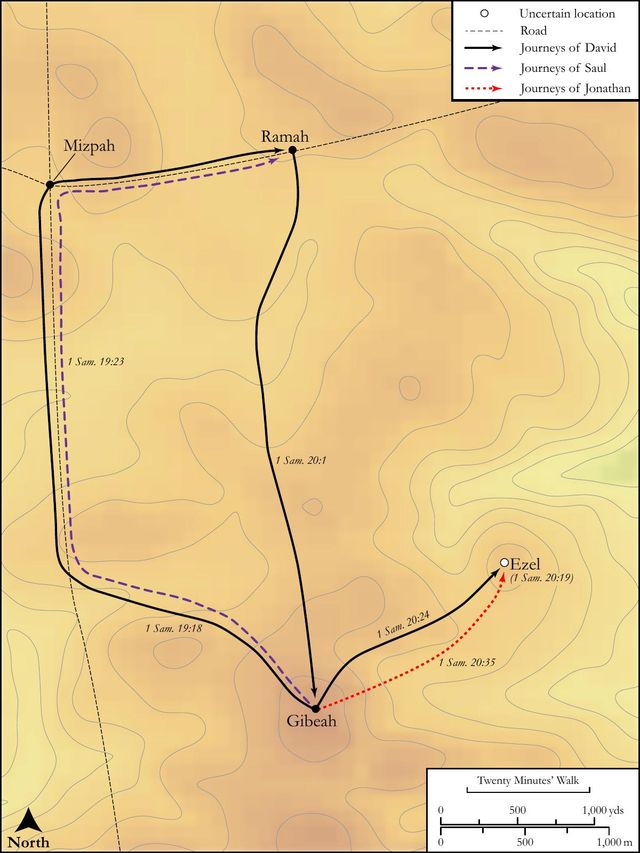
See on the biblical-era map
Study this verse
Public-domain commentary
Matthew Henry
From his Commentary on the Whole Bible. Henry comments on passages, not single verses — this entry covers 1 Samuel 19:11–17. His two-level outline is real structure in the source text, so it is rendered as structure.
Here is, I. Saul's further design of mischief to David. When David had escaped the javelin, supposing he went straight to his own house, as indeed he did, Saul sent some of his guards after him to lay wait at the door of his house, and to assassinate him in the morning as soon as he stirred out, Sa1 19:11. Josephus says the design was to seize him and to hurry him before a court of justice that was ordered to condemn him and put him to death as a traitor; but we are here told it was a shorter way they were to take with him: they were ordered to slay him. Well might David complain that his enemies were bloody men, as he did in the psalm which he penned at this time, and upon this occasion (Ps. 59), when Saul sent, and they watched the house to kill him. See Sa1 19:2, Sa1 19:3, and Sa1 19:7. He complains that swords were in their lips.
II.David's wonderful deliverance out of this danger.
Michal was the instrument of it, whom Saul gave him to be a snare to him, but she proved to be his protector and helper. Often is the devil out-shot with his own bow. How Michal came to know the danger her husband was in does not appear; perhaps she had notice sent her from court, or rather was herself aware of the soldiers about the house, when they were going to bed, though they kept so still and silent that they said, Who dost hear? which David takes notice of, Psa 59:7. She, knowing her father's great indignation at David, soon suspected the design, and bestirred herself for her husband's safety.
1.She got David out of the danger. She told him how imminent the peril was (Sa1 19:11): Tomorrow thou wilt be slain. As Josephus paraphrases it, she told him that if the sun saw him there next morning it would never see him more; and then put him in a way of escape. David himself was better versed in the art of fighting than of flying, and had it been lawful it would have been easy for him to have cleared his house, by dint of sword, from those that haunted it; but Michal let him down through a window (Sa1 19:12), all the doors being guarded; and so he fled and escaped. And now it was that, either in his own closet before he went or in the hiding-place to which he fled, he penned that fifty-ninth Psalm, which shows that, in his fright and hurry, his mind was composed, and, in this great danger, his faith was strong and fixed on God; and, whereas the plot was to slay him in the morning, he speaks there with the greatest assurance (Sa1 19:16), I will sing aloud of thy mercy in the morning.
2.She practised a deception upon Saul and those whom he employed to be the instruments of his cruelty. When the doors of the house were opened in the morning, and David did not appear, the messengers would search the house for him, and did so. But Michal told them he was sick in bed (Sa1 19:14), and, if they would not believe her, they might see, for (Sa1 19:13) she had put a wooden image in the bed, and wrapped it up close and warm as if it had been David asleep, not in a condition to be spoken to; the goats' hair about the image was to resemble David's hair, the better to impose upon them. Michal can by no means be justified in telling a lie, and covering it thus with a cheat. God's truth needed not her lie. But she intended hereby to keep Saul in suspense for a while, that David might have some time to secure himself, not doubting but those messengers would pursue him if they found he had gone. The messengers had so much humanity as not to offer him any disturbance when they heard he was sick; for to those that are in this misery pity should be shown; but Saul, when he heard it, gave positive orders that he should be brought to him sick or well: Bring him to me in the bed, that I may slay him, Sa1 19:15. It was base and barbarous thus to triumph over a sick man; and to vow the death of one who for aught that he knew was dying by the hand of nature. So earnestly did he thirst after his blood, and so greedy was his revenge, that he could not be pleased to see him dead, unless he himself was the death of him; though awhile ago he had said, Let not my hand be upon him. Thus when men lay the reins on the neck of their passions they grow more and more outrageous. When the messengers were sent again, the cheat was discovered, Sa1 19:16. But by this time it was to be hoped that David was safe, and therefore Michal was not then much concerned at the discovery. Saul chid her for helping David to escape (Sa1 19:17): Why hast thou deceived me so? What a base spirit was Saul of, to expect that, because Michal was his daughter, she must therefore betray her own husband to him unjustly. Ought she not to forsake and forget her father and her father's house, to cleave to her husband? Those that themselves will be held by no bonds of reason or religion are ready to think that others should as easily break those bonds. In answer to Saul's chiding, Michal is not so careful of her husband's reputation as she had been of his person, when she makes this her excuse: He said, Let me go, why should I kill thee? As her insinuating that she would have hindered his flight was false (it was she that put him upon it and furthered it), so it was an unjust unworthy reflection upon him to suggest that he threatened to kill her if she would not let him go, and might confirm Saul in his rage against him. David was far from being so barbarous a man and so imperious a husband, so brutish in his resolves and so haughty in his menaces, as she here represented him. But David suffered both from friends and foes, and so did the son of David.
Historical interpretation
Three Centuries of Reception
3 surviving comments on this verse. Each one is dated, so this reads as a timeline rather than a list.
Select a marker to jump to its quote. Markers stagger vertically where authors wrote within a few decades of each other.
Now Michal’s name means “reign,” because sin reigned over our nature up to that time. And at the very time he himself was born, he [the Lord in the figure of David] went out through a window. And the window indicates the return to the light again of the one who made himself known to those sitting in darkness and the shadow of death.And his image is seen on the bed. For the angel says to those seeking the Lord in the tomb, “Why do you seek the living with the dead? He is not here; he is risen.” “Behold the place” in which he lay. Those seeking the Lord saw the tomb in which he was buried empty of the body of the one they were seeking. Only the burial sheets were in it. We think, therefore, that the image of David on the bed signifies the resurrection of the Lord in the tomb, through which the true averting of our death through expiatory sacrifice occurs.
And not in war only, but also in peace the need of deceit may be found, not merely in reference to the affairs of the state but also in private life, in the dealings of husband with wife and wife with husband, son with father, friend with friend, and also children with a parent. For the daughter of Saul would not have been able to rescue her husband out of Saul’s hands except by deceiving her father. And her brother, wishing to save him whom she had rescued when he was again in danger, made use of the same weapon as the wife.
And Saul said to Michal, Why have you deceived me thus? etc. The unbelieving Jews said to the early Church: Why, having neglected our traditions, did you prefer to believe in Jesus and confess that by rising He put our guards to flight? To which she replied: Because He, she said, threatens not just me, but all who refuse to believe in Him and confess these things, with eternal death.
Continue studying 1 Samuel 19:17 across the web’s major study libraries — every link below opens this exact verse, chapter, or book on the destination site.
Read & Compare
 BibleGatewayThis verse in more than 200 translations and 70 languages.
 Bible.comThe YouVersion reader — hundreds of translations, reading plans, and highlights.
 ESV.orgCrossway's official English Standard Version reader.
 NET BibleThe NET translation with 60,000+ translators' notes on every rendering decision.
 STEP BibleTyndale House's free study tool — original text, vocabulary, and scholarly resources.
 BibliaLogos Bible Software's free web reader.
 USCCBThe New American Bible (Revised Edition) with the U.S. bishops' study notes.
Commentaries
 BibleHub CommentariesDozens of classic commentaries on this verse, gathered on one page.
 StudyLightMore than 100 commentary sets — the largest collection on the web.
 BibleRefPlain-English commentary on what this verse means, verse by verse.
 Enduring WordDavid Guzik's free commentary on this chapter, widely used by Bible teachers.
 Bible Study ToolsVerse commentary alongside Greek and Hebrew study aids.
Original Language & Research
- BibleHub InterlinearThe verse word by word — original language, transliteration, and English.
- BibleHub LexiconEvery word's original-language definition and Strong's entry.
 Blue Letter BibleDeep-study tools — Strong's numbers, concordance, and word studies.
 SefariaThe Hebrew text with Rashi and centuries of Jewish commentary.
Sermons, Hymns & Audio


TrulyRandomVerse is not affiliated with these sites and doesn’t control their content. They’re linked because they’re genuinely useful.
Summary
1 Samuel 19:17 captures the intense confrontation between King Saul and his daughter Michal, following her ingenious deception to secure her husband David's escape. Consumed by rage and paranoia, Saul demands an explanation for Michal's betrayal, accusing her of aiding his "enemy." Michal, with quick wit, fabricates a story that David threatened her life if she did not assist his flight, a desperate lie designed to deflect Saul's wrath and protect herself while maintaining David's safety. This pivotal moment underscores the escalating conflict within Saul's own household and the lengths to which individuals go to protect those they love amidst a tyrannical regime.
Context
ShowHideLiterary Context
This verse immediately follows Michal's extraordinary actions detailed in 1 Samuel 19:11-16. Saul, having repeatedly attempted to kill David (e.g., 1 Samuel 18:11 and 1 Samuel 19:10), sends messengers to David's house to seize him. Michal, demonstrating remarkable courage and ingenuity, places a household idol (teraphim) in David's bed, covers it with goat's hair, and claims David is sick. When Saul's messengers return after being initially turned away, Saul insists they bring David to him in his bed. Upon discovering the ruse, Saul's fury erupts, leading directly to the confrontation with Michal in verse 17. This incident is a crucial part of the larger narrative of David's flight from Saul, highlighting the divine protection over David and the increasing desperation of Saul.
Historical & Cultural Context
The narrative unfolds in a period of transition for Israelite kingship, from Saul's flawed rule to David's divinely appointed reign. Saul's behavior reflects the dangers of a monarch unchecked by divine counsel and consumed by personal jealousy, a stark contrast to the ideal king envisioned in Deuteronomy. Michal's use of "teraphim" (household idols) is notable; while often associated with idolatry or divination, they could also function as household gods or even property deeds among some of the nations round about, suggesting a complex religious landscape. Her actions also highlight the initiative, albeit limited, that women could exercise within patriarchal structures, especially those of royal lineage. The concept of "enemy" here is deeply personal and political, reflecting Saul's view of David not just as a rival but as a threat to his very existence, fueled by an evil spirit from the Lord (1 Samuel 16:14).
Key Themes
ShowHideThe passage powerfully illustrates several key themes. Deception and Loyalty are central, as Michal faces an impossible choice between her duty to her father, the king, and her loyalty to her husband, David. Her decision to deceive Saul underscores her deep commitment to David, even at great personal risk, revealing the complex moral landscape characters navigate under duress. This act of deception, while morally questionable, serves a higher purpose within the narrative: the protection of God's anointed. Another prominent theme is Saul's Escalating Paranoia and Tyranny. His question, "Why hast thou deceived me so, and sent away mine enemy?", powerfully illustrates his deteriorating mental state and his obsession with eliminating David, whom he now unequivocally labels as his "enemy." This relentless pursuit of David, driven by jealousy and fear, showcases the destructive nature of unchecked power and a heart hardened against God's will, a theme that runs throughout the book of 1 Samuel. Finally, the theme of Divine Providence and Protection is subtly at play. While Michal's actions are human, they are part of a larger divine plan to protect David, the anointed future king. God often uses various means, including unexpected human choices and even morally ambiguous acts, to ensure His purposes are fulfilled, aligning with the broader narrative of God's protective hand over David throughout his trials and escapes.
Exposition and Analysis
ShowHideKey Word Analysis
ShowHideThe verb רָמָה (râmâh') means "to hurl," "to shoot," or figuratively, "to delude or betray (as if causing to fall)." In this context, it signifies a deliberate act of misleading or betraying. Saul uses this term as a direct accusation against Michal, highlighting his profound sense of personal injury and the perceived violation of his kingly authority by his own daughter. Michal's action is indeed a calculated deception, but one born out of a desperate loyalty to her husband and a fierce determination to save his life from her father's murderous intent.
The noun אֹיֵב (ʼôyêb') refers to an adversary, foe, or enemy. Saul's labeling of David as his "enemy" is profoundly significant. David, at this point, has committed no treasonous act against Saul; he has served him loyally, defeated Goliath, and married his daughter. Saul's perception of David as an "enemy" reveals the depth of his paranoia and jealousy, and his complete misunderstanding of God's sovereign plan. This distorted view foreshadows the long period of David's flight and persecution, a time when David consistently refuses to act as Saul's actual enemy.
The primitive root מוּת (mûwth') means "to die" literally or figuratively, and causatively, "to kill." In Michal's fabricated quote, "Let me go; why should I kill thee?", this word is a clever manipulation. By putting these words in David's mouth, Michal plays on Saul's own violent tendencies and reputation for impulsive aggression. She implies that David, a formidable warrior, would have used fatal force against her if she had not complied, making her actions appear to be a matter of self-preservation rather than deliberate defiance of her father. This lie is strategically designed to deflect Saul's wrath and justify her actions in his eyes.
Verse Breakdown
ShowHide"And Saul said unto Michal, Why hast thou deceived me so, and sent away mine enemy, that he is escaped?"
Saul's opening question is a direct, accusatory challenge, laden with anger and a deep sense of personal betrayal. The emphasis on "me so" underscores his feeling of being personally wronged and humiliated by his own daughter. His immediate identification of David as "mine enemy" reveals the depth of his animosity and his distorted view of David, whom God had chosen and anointed. The phrase "sent away... that he is escaped" highlights Saul's immense frustration at being outmaneuvered and the failure of his latest attempt to capture David, further fueling his rage.
"And Michal answered Saul, He said unto me, Let me go; why should I kill thee?"
Michal's response is a brilliant, quick-witted fabrication. She does not deny helping David escape, but she skillfully reframes her actions as coerced. By quoting David as threatening her life ("why should I kill thee?"), she presents herself as a victim of circumstance rather than a willing accomplice. This lie is effective because it aligns with Saul's own violent character (he had thrown javelins at David) and provides him with a plausible, albeit false, explanation that saves Michal from his immediate wrath and further protects David by justifying his flight as a necessary escape from a perceived threat.
Literary Devices
ShowHideThe passage employs several potent literary devices. Dialogue is central, driving the narrative forward and revealing character. Saul's accusatory question immediately establishes his rage and paranoia, while Michal's quick, fabricated response showcases her intelligence, loyalty, and desperation. Irony is deeply woven into the scene: Saul's own daughter deceives him to protect the man he considers his "enemy," who is, in fact, God's chosen king. The irony is compounded by Michal's lie, which attributes a threat of violence to David, subtly playing on Saul's own reputation for impulsive aggression. Furthermore, the use of Foreshadowing is evident; this incident is one of many escapes for David, continually highlighting God's protective hand over him and hinting at the long and arduous journey David must undertake before ascending to the throne. The entire episode functions as a microcosm of the larger conflict between Saul and David, characterized by Saul's relentless pursuit and David's miraculous deliverances.
Theological and Thematic Connections
ShowHideThis passage, while depicting human deception, serves as a powerful testament to God's sovereign protection over His chosen instruments. Michal's loyalty to David, expressed through a morally ambiguous act, becomes a means through which God's larger purpose for David's life is preserved. It highlights that God can work through imperfect human choices and circumstances—even those involving sin like lying—to achieve His perfect will, though this does not condone the sin itself. The narrative emphasizes the stark contrast between Saul's escalating paranoia and God's unwavering faithfulness to David, the anointed king. It reminds us that even when human plots and schemes seem to dominate, there is an overarching divine hand guiding events toward a predetermined end.
Reflection and Application
ShowHideThe confrontation between Saul and Michal offers profound insights into the complexities of loyalty, the destructive nature of unchecked jealousy, and the mysterious ways of divine providence. Michal's agonizing choice between her father and her husband forces us to consider situations where our allegiances are divided and difficult ethical decisions must be made. While the Bible does not endorse deception, it presents Michal's act as a desperate measure to save a life, prompting us to reflect on the nuances of moral action under duress. Saul's spiraling paranoia serves as a stark warning against allowing bitterness and envy to consume us, demonstrating how such emotions can blind us to truth and lead to destructive behavior. Ultimately, the passage encourages us to trust in God's sovereign hand, even when circumstances are chaotic and human actions are flawed. It reminds us that God is capable of working through unexpected means to protect His people and advance His purposes, inviting us to find peace in His ultimate control, even amidst life's most challenging dilemmas.
Questions for Reflection
ShowHideFAQ
ShowHideWas Michal's lie justifiable given the circumstances?
ShowHideThe Bible describes Michal's lie without explicitly endorsing it as morally right. From a human perspective, her actions were a desperate attempt to save her husband's life from her murderous father, a situation of extreme duress. She chose loyalty to her husband over obedience to her tyrannical father, who was actively seeking to kill God's anointed. While the Bible consistently teaches against lying (Proverbs 12:22), it also presents instances where individuals, acting under extraordinary circumstances, engage in deception to protect life (e.g., the Hebrew midwives in Exodus 1:15-21 or Rahab in Joshua 2:1-7). The narrative's focus is less on the moral rectitude of the lie itself and more on God's providential protection of David through various means, including Michal's ingenuity. It highlights the complexities of living faithfully in a fallen world, where perfect choices are not always available.
What was the "teraphim" that Michal used, and why was it in David's house?
ShowHideThe "teraphim" (Hebrew: תְּרָפִים) were household idols or cultic images, often associated with divination or family protection among the nations round about. Their exact nature and function varied, sometimes being small figurines and other times life-sized. In this instance, Michal uses a teraphim large enough to resemble a human form in David's bed, covered with goat's hair (perhaps for the head or hair) and clothing, to create a convincing dummy of a sick David. The presence of teraphim in David's house is somewhat puzzling, given his later devotion to Yahweh. Some scholars suggest they might have been part of Michal's dowry or family heirlooms from Saul's household, reflecting a syncretistic religious practice not uncommon even among Israelites at the time. Others propose they were simply household objects with no specific religious significance for David, merely used by Michal as a convenient prop. Regardless of their exact spiritual significance to David or Michal, their practical use here was purely for deception, serving as a critical tool in David's escape.
Christ-Centered Fulfillment
ShowHideThe relentless persecution of David by Saul, and David's miraculous deliverances, find their ultimate fulfillment in the life of Jesus Christ. David, the anointed king, hunted by the reigning monarch, foreshadows Christ, the true King, who was hounded by earthly authorities and religious leaders. Just as David was supernaturally protected by God through various means—including the quick thinking of Michal in 1 Samuel 19:17—Jesus too experienced divine protection and miraculous escapes from those who sought to kill Him before His appointed time (John 7:30, John 8:59). The "enemy" Saul perceived in David ultimately points to Satan, the true enemy of God's people, whom Christ definitively conquered on the cross (Colossians 2:15). Moreover, Michal's loyalty to David, even at great personal risk, can be seen as a faint echo of the ultimate love and self-sacrifice displayed by Christ, who laid down His life for His "bride," the Church (Ephesians 5:25). David's journey of suffering before glory, divinely orchestrated and protected, serves as a powerful type of Christ's path to ultimate victory and eternal reign, assuring believers that our King, too, has been preserved through every trial to bring about our salvation.