


1 Samuel 28:3
Bible text: King James Version (1769 Blayney text) · Public domain
Bible text: King James Version with Strong's numbers · Public domain
Bible text: Berean Standard Bible · Public domain
Bible text: American Standard Version (1901) · Public domain
Bible text: World English Bible, Messianic edition · Public domain
Bible text: Geneva Bible (1599) · Public domain
Bible text: Young's Literal Translation · Public domain
- וּשְׁמוּאֵלu·she·mu·'Eland SamuelH8050Conj-w ¦ N-proper-mNoun Proper MasculineוּandשְׁמוּאֵלSamuel
- מֵתMethe had diedH4191V-Qal-Perf-3msVerb Qal Perfect 3rd Singular Masculine
- וַיִּסְפְּדוּvai·yis·pe·duand they had mournedH5594Conj-w ¦ V-Qal-ConsecImperf-3mpVerb Qal Consecutive Imperfect 3rd Plural Masculineוַandיִּסְפְּדוּthey had mourned
- לוֹlofor <the> himPrep-l ¦ 3msSuffix Personal 3rd Singular Masculineלfor <the>וֹhim
- כָּלkolallH3605N-mscNoun Singular Masculine Construct
- יִשְׂרָאֵלYis·ra·'ElIsraelH3478N-properNoun Proper Location
- וַיִּקְבְּרֻהוּvai·yik·be·Ru·huand they had buried himH6912Conj-w ¦ V-Qal-ConsecImperf-3mp ¦ 3msVerb Qal Consecutive Imperfect 3rd Plural Masculineוַandיִּקְבְּרֻthey had buriedהוּhim
- בָרָמָהva·ra·Mahin <the> RamahH7414Prep-b ¦ N-properNoun Proper Locationבָin <the>רָמָהRamah
- וּבְעִירוֹu·ve·'i·Ro<and> in his own cityH5892Conj-w ¦ Prep-b ¦ N-fsc ¦ 3msNoun Singular Feminine Constructוּ<and>בְinעִירown cityוֹhis
- וְשָׁאוּלve·sha·'Uland SaulH7586Conj-w ¦ N-proper-mNoun Proper MasculineוְandשָׁאוּלSaul
- הֵסִירhe·Sirhe had removedH5493V-Hiphil-Perf-3msVerb Hiphil Perfect 3rd Singular Masculine
- הָאֹבוֹתha·'o·Votthe necromancersH178Art ¦ N-fpNoun Plural Feminine Absoluteהָtheאֹבוֹתnecromancers
- וְאֶתve·'Etand <obj.>H853Conj-w ¦ DirObjMParticle Object Indicatorוְandאֶת<obj.>
- הַיִּדְּעֹנִיםhai·yi·de·'o·Nimthe soothsayersH3049Art ¦ N-mpNoun Plural Masculine Absoluteהַtheיִּדְּעֹנִיםsoothsayers
- מֵהָאָרֶץme·ha·'A·retzfrom the landH776Prep-m ¦ Art ¦ N-fsNoun Singular Feminine Absoluteמֵfromהָtheאָרֶץland
English is a literal word-by-word gloss of the Hebrew, not the KJV's wording. Why?
This is the original text the KJV's translators worked from — each Hebrew word with its own literal English meaning in this verse, prepared by scholars at Tyndale House, Cambridge. The KJV translates whole sentences, not word by word, so its wording differs: one Hebrew word can become several English words, and the KJV may choose “the LORD” where the gloss reads “Yahweh”. Both are faithful — they answer different questions. For the KJV's own rendering, switch to the KJV text.
Details
See on the biblical-era map
Study this verse
Public-domain commentary
Matthew Henry
From his Commentary on the Whole Bible. Henry comments on passages, not single verses — this entry covers 1 Samuel 28:1–6. His two-level outline is real structure in the source text, so it is rendered as structure.
Here is, I. The design of the Philistines against Israel. They resolved to fight them, Sa1 28:1. If the Israelites had not forsaken God, there would have been no Philistines remaining to molest them; if Saul had not forsaken him, they would by this time have been put out of all danger by them. The Philistines took an opportunity to make this attempt when they had David among them, whom they feared more than Saul and all his forces.
II.The expectation Achish had of assistance from David in this war, and the encouragement David gave him to expect it:
"Thou shalt go with me to battle," says Achish. "If I protect thee, I may demand service from thee;" and he will think himself happy if he may have such a man as David on his side, who prospered whithersoever he went. David gave him an ambiguous answer: "We will see what will be done; it will be time enough to talk of that hereafter; but surely thou shalt know what thy servant can do" (Sa1 28:2), that is, "I will consider in what post I may be best able to serve thee, if thou wilt but give me leave to choose it." Thus he keeps himself free from a promise to serve him and yet keeps up his expectation of it; for Achish took it in no other sense than as an engagement to assist him, and promised him, thereupon, that he would make him captain of the guards, protector, or prime-minister of state.
III.The drawing of the armies, on both sides, into the field (Sa1 28:4):
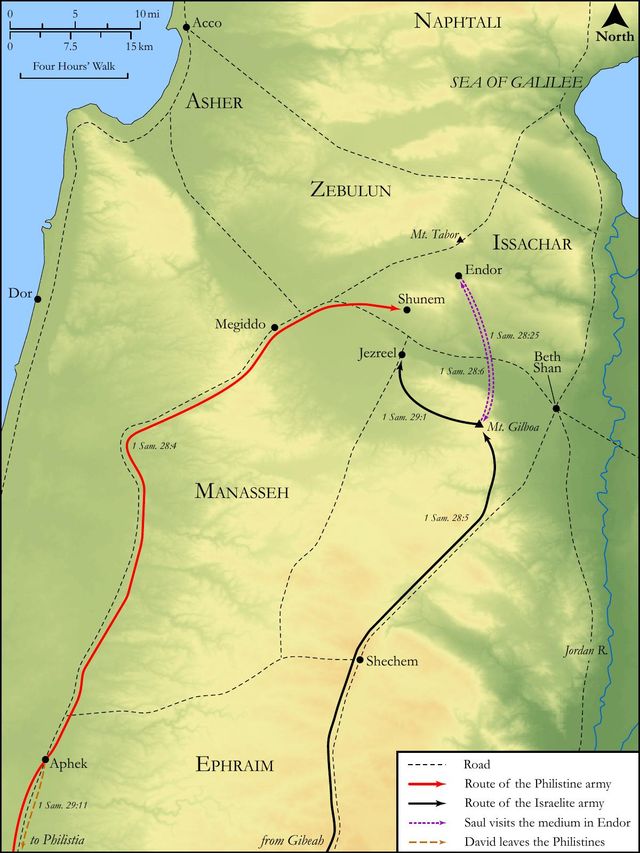
The Philistines pitched in Shunem, which was in the tribe of Issachar, a great way north from their country. The land of Israel, it seems, was ill-guarded, when the Philistines could march their army into the very heart of the country. Saul, while he pursued David, left his people naked and exposed. On some of the adjacent mountains of Gilboa Saul mustered his forces, and prepared to engage the Philistines, which he had little heart to do now that the Spirit of the Lord had departed from him.
IV.The terror Saul was in, and the loss he was at, upon this occasion:
He saw the host of the Philistines, and by his own view of them, and the intelligence his spies brought him, he perceived they were more numerous, better armed, and in better heart, than his own were, which made him afraid, so that his heart greatly trembled, Sa1 28:5. Had he kept close to God, he needed not have been afraid at the sight of an army of Philistines; but now that he had provoked God to forsake him his interest failed, his armies dwindled and looked mean, and, which was worse, his spirits failed him, his heart sunk within him, a guilty conscience made him tremble at the shaking of a leaf. Now he remembered the guilty blood of the Amalekites which he had spared, and the innocent blood of the priests which he had spilt. His sins were set in order before his eyes, which put him into confusion, embarrassed all his counsels, robbed him of all his courage, and produced in him a certain fearful looking for of judgment and fiery indignation. Note, Troubles are terrors to the children of disobedience. In this distress Saul enquired of the Lord, Sa1 28:6. Need drives those to God who in the day of their prosperity slighted his oracles and altars. Lord, in trouble have they visited thee, Isa 26:16. Did ever any seek the Lord and not find him? Yes, Saul did; the Lord answered him not, took no notice either of his petitions or of his enquiries; gave him no directions what to do, nor any encouragement to hope that he would be with him. Should he be enquired of at all by such a one as Saul? Eze 14:3. No, he could not expect an answer of peace, for,
1.He enquired in such a manner that it was as if he had not enquired at all. Therefore it is said (Ch1 10:14), He enquired not of the Lord; for he did it faintly and coldly, and with a secret design, if God did not answer him, to consult the devil. He did not enquire in faith, but with a double unstable mind.
2.He enquired of the Lord when it was too late, when the days of his probation were over and he was finally rejected. Seek the Lord while he may be found, for there is a time when he will not be found.
3.He had forfeited the benefit of all the methods of enquiry. Could he that hated and persecuted Samuel and David, who were both prophets, expect to be answered by prophets? Could he that had slain the high priest, expect to be answered by Urim? Or could he that had sinned away the Spirit of grace, expect to be answered by dreams? No. Be not deceived, God is not mocked.
V.The mention of some things that had happened a good while ago, to introduce the following story, Sa1 28:3.
1.The death of Samuel. Samuel was dead, which made the Philistines the more bold and Saul the more afraid; for, had Samuel been alive, Saul probably thought that his presence and countenance, his good advice and good prayers, would have availed him in his distress.
2.Saul's edict against witchcraft. He had put the laws in execution against those that had familiar spirits, who must not be suffered to live, Exo 22:18. Some think that he did this in the beginning of his reign, while he was under Samuel's influence; others think that it was lately done, for it is spoken of here (Sa1 28:9) as a late edict. Perhaps when Saul was himself troubled with an evil spirit he suspected that he was bewitched, and, for that reason, cut off all that had familiar spirits. Many seem zealous against sin, when they themselves are any way hurt by it (they will inform against swearers if they swear at them, or against drunkards if in their drink they abuse them), who otherwise have no concern for the glory of God, nor any dislike of sin as sin. However it was commendable in Saul thus to use his power for the terror and restraint of these evil-doers. Note, Many seem enemies to sin in others, while they indulge it in themselves. Saul will drive the devil out of his kingdom, and yet harbour him in his heart, by envy and malice.
Historical interpretation
Three Centuries of Reception
3 surviving comments on this verse. Each one is dated, so this reads as a timeline rather than a list.
Select a marker to jump to its quote. Markers stagger vertically where authors wrote within a few decades of each other.
As has been said already, the sacred record, like a faithful mirror, has no flattery in its portraits and either itself passes sentence upon human actions as worthy of approval or disapproval or leaves the reader to do so. And not only does it distinguish people as blameworthy or praiseworthy, but it also takes notice of cases where the blameworthy deserved praise, and the praiseworthy blame. Thus, although Saul was blameworthy, it was not the less praiseworthy in him to examine so carefully who had eaten food during the curse and to pronounce the stern sentence in obedience to the commandment of God. So, too, he was right in banishing those that had familiar spirits and wizards out of the land. And although David was praiseworthy, we are not called on to approve or imitate his sins, which God rebukes by the prophet.
And Saul removed all the magicians, etc. Magicians and soothsayers, the first of whom, commonly called sorcerers, use blood and sacrifices, and often touch the bodies of the dead, following (whom other translations call enchanters) accomplish their work with words; all these soothsayers and idolatries of the Gentiles are mystically designated, whom the people of the Jews, although more wise in earthly things than heavenly, removed completely at this time. For no one now dares to worship Baalim, or Astaroth, or any other monsters of the Gentiles, although they are not perfectly faithful to the Lord.
Now, Samuel was dead, etc. Josephus narrates that this happened two years before the death of Saul, writing thus (Antiq. VI, 14): "Saul reigned, with Samuel living for eighteen years, and for another two years after his death." Indeed, earlier in the order of history, the death and burial of Samuel are described in nearly the same words; but it is recapitulated here so that the necessity that prompted Saul to seek out the necromancer might be recalled to the readers. However, mystically, the death of Samuel, with the Lord suffering, indicates the cessation of the legal figures as well as the prophets, which foretold His future incarnation. The mourning of Israel signifies that not without great sorrow could the carnal ones be separated from the old institutions of the Lord. I believe that all of Israel, which was able to see the desolation of the temple of Jerusalem and the land of promise—both of which were given to the fathers as a type of heavenly grace—could not at all withhold their lamentation and tears. The burial, which took place after the death and mourning, signifies that time when the faithful Jews altogether ceased from the observation of legal shadows. For it is known that for a considerable time the early Church observed Jewish customs, until the evangelical doctrine gradually prevailed, and it itself completely abstained from legal observation. And fittingly, Samuel is buried in Ramah, his city where he was born, which is interpreted as "exalted": because the same Church of Christ, which once gave forth the beginnings of prophecy, concluded the fulfilled figures of prophecy with honorable devotion, as if they were the limbs of the dead Samuel.
Continue studying 1 Samuel 28:3 across the web’s major study libraries — every link below opens this exact verse, chapter, or book on the destination site.
Read & Compare
 BibleGatewayThis verse in more than 200 translations and 70 languages.
 Bible.comThe YouVersion reader — hundreds of translations, reading plans, and highlights.
 ESV.orgCrossway's official English Standard Version reader.
 NET BibleThe NET translation with 60,000+ translators' notes on every rendering decision.
 STEP BibleTyndale House's free study tool — original text, vocabulary, and scholarly resources.
 BibliaLogos Bible Software's free web reader.
 USCCBThe New American Bible (Revised Edition) with the U.S. bishops' study notes.
Commentaries
 BibleHub CommentariesDozens of classic commentaries on this verse, gathered on one page.
 StudyLightMore than 100 commentary sets — the largest collection on the web.
 BibleRefPlain-English commentary on what this verse means, verse by verse.
 Enduring WordDavid Guzik's free commentary on this chapter, widely used by Bible teachers.
 Bible Study ToolsVerse commentary alongside Greek and Hebrew study aids.
Original Language & Research
- BibleHub InterlinearThe verse word by word — original language, transliteration, and English.
- BibleHub LexiconEvery word's original-language definition and Strong's entry.
 Blue Letter BibleDeep-study tools — Strong's numbers, concordance, and word studies.
 SefariaThe Hebrew text with Rashi and centuries of Jewish commentary.
Sermons, Hymns & Audio


TrulyRandomVerse is not affiliated with these sites and doesn’t control their content. They’re linked because they’re genuinely useful.
Summary
1 Samuel 28:3 serves as a pivotal transitional verse, meticulously establishing the dire spiritual and political landscape that compels King Saul's subsequent desperate and illicit actions. It first chronicles the deeply mourned passing of Samuel, Israel's revered prophet and judge, marking the definitive end of an era characterized by direct prophetic guidance. Immediately following this profound loss, the text ironically highlights Saul's earlier, seemingly righteous, initiative to purge the land of those who practiced divination and consulted familiar spirits, a detail that sharply contrasts with his impending, flagrant violation of this very prohibition in his ultimate moment of spiritual and military crisis.
Context
ShowHideLiterary Context
This verse strategically positions itself as a crucial narrative hinge, immediately preceding the climactic and tragic account of King Saul's final, desperate attempt to seek divine guidance through forbidden means. Samuel's death, meticulously documented here, leaves Saul bereft of the legitimate prophetic voice he once had, a voice he had largely disregarded throughout his reign. The narrative's deliberate inclusion of Saul's prior expulsion of mediums and wizards creates a profound and poignant irony, directly foreshadowing his own egregious violation of this very law in the subsequent verses of 1 Samuel 28. This narrative sequence masterfully emphasizes the escalating spiritual decline of Saul, culminating in his abandonment of God's explicit commands in the face of an overwhelming Philistine threat, a crisis vividly detailed in 1 Samuel 28:4-5.
Historical & Cultural Context
Within ancient Israel, the practices of divination, necromancy, and consulting "familiar spirits" were not merely frowned upon but were explicitly and vehemently forbidden by Mosaic Law, as unequivocally stated in Deuteronomy 18:10-12. These prohibitions served to fundamentally distinguish Israel from the surrounding pagan nations, where such occult practices were commonplace and deeply integrated into religious life. Samuel, whose passing is noted in this verse, had been an monumental figure in Israel's history—serving as the last judge, a preeminent prophet, and the divine instrument for anointing both Saul and David. His death thus marked the conclusion of a profoundly significant era of direct prophetic guidance and moral authority, leaving a palpable void in the spiritual leadership of the nation. Saul's initial purge of these forbidden practitioners, while outwardly appearing pious, may have been a superficial act of political expediency or a fleeting moment of obedience, given his consistent pattern of self-reliance and outright disobedience throughout his turbulent reign, vividly illustrated in instances such as 1 Samuel 13:8-14 and 1 Samuel 15:1-23.
Key Themes
ShowHideThis verse powerfully contributes to the development of several overarching themes woven throughout the book of 1 Samuel. Firstly, it starkly highlights The Void of Legitimate Divine Counsel, as Samuel's death removes the primary human conduit for God's direct word to Israel and, more acutely, to Saul, who had already experienced God's profound silence due to his persistent rebellion (1 Samuel 28:6). Secondly, the verse underscores Saul's Deepening Spiritual Decline and Hypocrisy. His earlier act of expelling mediums, while superficially commendable, is dramatically revealed as a superficial, external conformity when contrasted with his desperate and immediate turn to the very practices he once condemned. This tragic inconsistency powerfully illustrates the inherent danger of external religious observance divorced from genuine internal transformation and heart-felt devotion. Finally, the verse unequivocally reinforces the Unwavering Condemnation of Occult Practices. By explicitly mentioning "familiar spirits" and "wizards," the text reiterates the severe and absolute biblical stance against any attempt to bypass God's sovereignty or to seek knowledge and guidance from sources other than Him, emphasizing that such acts are an abomination and an affront to the divine.
Exposition and Analysis
ShowHideKey Word Analysis
ShowHideFrom the same root as "father" (אָב), this term refers to a mumble or hollow sound, akin to the sound from a water skin. It denotes a necromancer or ventriloquist, someone who claims to communicate with the dead, often through a spirit believed to be that of a deceased person. In the biblical context, it signifies a direct and severe violation of God's command against seeking guidance from spirits other than Him, as explicitly seen in Leviticus 19:31.
Derived from the root "to know" (יָדַע), this term describes individuals who claim to possess special, secret knowledge, often acquired through occult or forbidden means. These practitioners were believed to have insight into hidden matters, frequently through divination or magic, practices God explicitly forbade for His people, distinguishing Israel from the pagan nations round about.
This primitive root means "to turn off," "remove," or "withdraw." In this context, it describes Saul's decisive action of expelling or eliminating those who practiced forbidden forms of divination from the land. This act, while outwardly compliant with Mosaic law, is later revealed to be an act of superficial obedience rather than genuine spiritual transformation, given Saul's subsequent desperate turn to such practices.
Verse Breakdown
ShowHide"Now Samuel was dead, and all Israel had lamented him, and buried him in Ramah, even in his own city."
This opening clause establishes a profound national loss and marks a significant turning point in Israel's history. Samuel, who served as the last judge, a pivotal prophet who anointed both Saul and David, and a consistent voice for God, is now gone. His death is met with widespread and deep mourning across all Israel, underscoring his immense spiritual and political influence. His burial in his hometown of Ramah signifies a definitive end to his earthly ministry and physical presence, leaving a spiritual void that King Saul, in particular, would feel acutely, especially given his prior rejection of Samuel's counsel.
"And Saul had put away those that had familiar spirits, and the wizards, out of the land."
This second clause presents a stark contrast and masterfully sets up the tragic irony that permeates the ensuing narrative of 1 Samuel 28. It serves as a crucial reminder to the reader that Saul, at some earlier point in his reign, had outwardly conformed to God's law by purging the land of forbidden occult practitioners. This act, on its surface, would have been perceived as a righteous enforcement of the Mosaic covenant. However, the deliberate placement of this detail immediately before Saul's desperate and illicit turn to a medium dramatically reveals the superficiality or political expediency of his earlier action, highlighting the deep-seated inconsistency and ultimately rebellious nature of his heart.
Literary Devices
ShowHideThe verse effectively employs Juxtaposition by placing the profound national mourning for Samuel's death directly alongside the seemingly pious act of Saul's purge of occultists. This deliberate arrangement creates a powerful and tragic Irony, as Saul's past outward obedience to the law against divination stands in stark, hypocritical contrast to his desperate future actions within the very same chapter. The mention of Samuel's death also functions as a potent Foreshadowing, signaling the profound spiritual void and the absence of legitimate divine counsel that will inevitably drive Saul to seek forbidden and condemned means of guidance. Furthermore, the narrative utilizes Ellipsis by not explicitly detailing why Saul performed the purge, allowing the discerning reader to infer the likely political motivation or superficial nature of his obedience, especially when viewed against the backdrop of his subsequent spiritual collapse and ultimate rejection of God.
Theological and Thematic Connections
ShowHide1 Samuel 28:3 powerfully illustrates the severe consequences of spiritual declension and the inherent dangers of seeking guidance outside of God's divinely ordained means. Samuel's death creates a profound void of legitimate prophetic authority, but Saul's prior, seemingly righteous act of expelling mediums highlights a critical theological truth: outward conformity to religious law, when divorced from genuine inward devotion and obedience to God, is ultimately futile and self-deceptive. When God's legitimate voice is rejected, or when He appears silent due to unrepentant sin, humanity often resorts to illicit and divinely condemned practices in moments of desperation. This verse unequivocally underscores God's absolute sovereignty and His exclusive right to reveal truth, condemning all attempts to bypass Him through divination, necromancy, or any form of occult practice as an abomination and a profound turning away from the true, living source of all wisdom, power, and life.
Reflection and Application
ShowHideThis verse offers a sobering and profound reflection on the nature of true faith, the perils of spiritual desperation, and the deceptive allure of forbidden shortcuts. King Saul's tragic trajectory, from outwardly expelling mediums to desperately seeking one himself, serves as a stark and timeless warning: external acts of piety, while commendable in themselves, hold little spiritual value if the heart is not genuinely and fully committed to God. When legitimate avenues for divine guidance seem closed, or when God appears to be silent, our natural human inclination might be to seek "shortcuts" or forbidden knowledge, driven by fear or a desire for control. However, the narrative of Saul powerfully reminds us that such paths lead only to deeper spiritual bondage, further alienation from God, and ultimately, destruction. Instead, believers are called to cultivate a steadfast and unwavering trust in God's sovereignty, even in His silence, diligently seeking Him through fervent prayer, through His revealed Word, and through the wise counsel of His Spirit-filled people. Our response to crisis and uncertainty should always be to draw closer to the Lord, not to stray into practices He condemns, trusting implicitly that His wisdom and timing are perfect, even when they are not immediately apparent or when His answers differ from our expectations.
Questions for Reflection
ShowHideFAQ
ShowHideWhy was Samuel's death so significant for Israel and for Saul?
ShowHideSamuel was not merely a prophet but also the last of the judges, a spiritual anchor, and the divine instrument through whom God had established the monarchy in Israel, anointing both Saul and David. His death, recorded in 1 Samuel 28:3, left a profound void, removing a consistent, legitimate voice of God from the land. For Saul, who had already fallen out of God's favor and was experiencing divine silence (as noted in 1 Samuel 28:6), Samuel's absence meant the loss of his last human recourse for divine counsel, pushing him to desperate and ultimately forbidden measures.
What does "familiar spirits" mean, and why was it forbidden?
ShowHideThe King James Version's "familiar spirits" translates the Hebrew word 'ob, which refers to a spirit, often believed to be the ghost of a dead person, that communicates through a medium. This practice is known as necromancy, the attempt to consult the dead. It was strictly forbidden in Israel (e.g., Deuteronomy 18:10-12) because it bypassed God as the sole legitimate source of divine revelation, sought knowledge from demonic or deceptive entities, and was a direct affront to God's sovereignty, holiness, and the exclusive covenant relationship He desired with His people.
Was Saul's earlier purge of mediums and wizards a sign of true repentance or piety?
ShowHideWhile Saul's act of expelling those with familiar spirits and wizards (mentioned in 1 Samuel 28:3) outwardly conformed to God's law, the subsequent narrative in 1 Samuel 28:7-19 reveals that it was likely not a sign of genuine, heart-deep repentance or piety. His immediate and desperate turn to a medium when God remained silent indicates that his earlier obedience was superficial, perhaps politically motivated to appear righteous, rather than stemming from a transformed heart truly devoted to the Lord. It highlights the tragic inconsistency and hypocrisy of his faith, demonstrating a pattern of external compliance without internal transformation.
Christ-Centered Fulfillment
ShowHideThe tragic narrative of Saul's spiritual decline and his desperate turn to forbidden practices in 1 Samuel 28:3 finds its ultimate resolution and perfect fulfillment in the person and work of Jesus Christ. Saul's desperate search for a word from God through a medium underscores humanity's profound and inherent need for divine guidance, a need that Saul, having tragically rejected God's legitimate prophets and Spirit, could never genuinely meet. In stark contrast, Jesus is the ultimate and perfect Prophet, the very Word of God incarnate, through whom God speaks clearly, definitively, and exhaustively to humanity (Hebrews 1:1-2). Unlike the deceptive "familiar spirits" and "wizards" whom Saul both expelled and then tragically sought, Christ perfectly casts out all evil spirits by His own inherent authority (e.g., Mark 1:27), demonstrating His supreme and unchallenged power over all dark forces and spiritual deception. Furthermore, Saul's inability to access God's presence highlights the insurmountable barrier of sin that separated him. Jesus, through His once-for-all atoning sacrifice on the cross, serves as our Great High Priest, providing perpetual, direct, and confident access to the Father's throne of grace (Hebrews 4:14-16). He is the true source of all wisdom, life, and genuine spiritual guidance, fulfilling all legitimate prophecy and offering a relationship with God that does not depend on human intermediaries or forbidden practices, but solely on saving faith in Him (John 14:6).