


1 Samuel 25:1
Bible text: King James Version (1769 Blayney text) · Public domain
Bible text: King James Version with Strong's numbers · Public domain
Bible text: Berean Standard Bible · Public domain
Bible text: American Standard Version (1901) · Public domain
Bible text: World English Bible, Messianic edition · Public domain
Bible text: Geneva Bible (1599) · Public domain
Bible text: Young's Literal Translation · Public domain
- וַיָּמָתvai·Ya·motand he diedH4191Conj-w ¦ V-Qal-ConsecImperf-3msVerb Qal Consecutive Imperfect 3rd Singular Masculineוַandיָּמָתhe died
- שְׁמוּאֵלshe·mu·'ElSamuelH8050N-proper-mNoun Proper Masculine
- וַיִּקָּבְצוּvai·yi·ka·ve·Tzuand they gathered togetherH6908Conj-w ¦ V-Niphal-ConsecImperf-3mpVerb Niphal Consecutive Imperfect 3rd Plural Masculineוַandיִּקָּבְצוּthey gathered together
- כָלkholallH3605N-mscNoun Singular Masculine Construct
- יִשְׂרָאֵלYis·ra·'ElIsraelH3478N-properNoun Proper Location
- וַיִּסְפְּדוּvai·yis·pe·duand they mournedH5594Conj-w ¦ V-Qal-ConsecImperf-3mpVerb Qal Consecutive Imperfect 3rd Plural Masculineוַandיִּסְפְּדוּthey mourned
- לוֹlofor <the> himPrep-l ¦ 3msSuffix Personal 3rd Singular Masculineלfor <the>וֹhim
- וַיִּקְבְּרֻהוּvai·yik·be·Ru·huand they buried himH6912Conj-w ¦ V-Qal-ConsecImperf-3mp ¦ 3msVerb Qal Consecutive Imperfect 3rd Plural Masculineוַandיִּקְבְּרֻthey buriedהוּhim
- בְּבֵיתוֹbe·vei·Toat his houseH1004Prep-b ¦ N-msc ¦ 3msNoun Singular Masculine Constructבְּatבֵיתhouseוֹhis
- בָּרָמָהba·ra·Mahin <the> RamahH7414Prep-b ¦ N-properNoun Proper Locationבָּin <the>רָמָהRamah
- וַיָּקָםvai·Ya·komand he aroseH6965Conj-w ¦ V-Qal-ConsecImperf-3msVerb Qal Consecutive Imperfect 3rd Singular Masculineוַandיָּקָםhe arose
- דָּוִדda·VidDavidH1732N-proper-mNoun Proper Masculine
- וַיֵּרֶדvai·Ye·redand he went downH3381Conj-w ¦ V-Qal-ConsecImperf-3msVerb Qal Consecutive Imperfect 3rd Singular Masculineוַandיֵּרֶדhe went down
- אֶל'eltoH413PrepPreposition
- מִדְבַּרmid·Bar[the] wilderness ofH4057N-mscNoun Singular Masculine Construct
- פָּארָןpa·RanParanH6290N-properNoun Proper Location
English is a literal word-by-word gloss of the Hebrew, not the KJV's wording. Why?
This is the original text the KJV's translators worked from — each Hebrew word with its own literal English meaning in this verse, prepared by scholars at Tyndale House, Cambridge. The KJV translates whole sentences, not word by word, so its wording differs: one Hebrew word can become several English words, and the KJV may choose “the LORD” where the gloss reads “Yahweh”. Both are faithful — they answer different questions. For the KJV's own rendering, switch to the KJV text.
Details
See on the biblical-era map
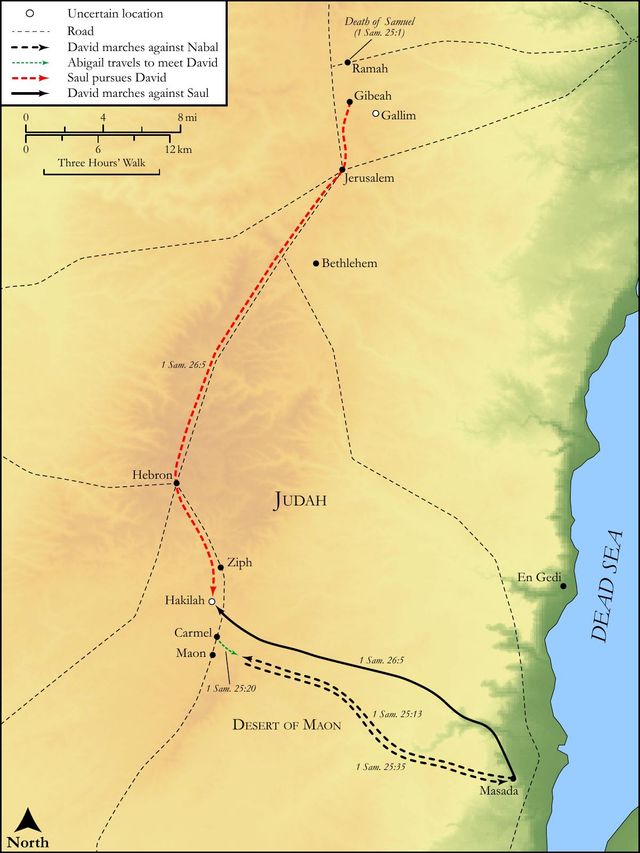
Study this verse
Public-domain commentary
Matthew Henry
From his Commentary on the Whole Bible. Henry comments on passages, not single verses — this entry covers 1 Samuel 25:1.
We have here a short account of Samuel's death and burial. 1. Though he was a great man, and one that was admirably well qualified for public service, yet he spent the latter end of his days in retirement and obscurity, not because he was superannuated (for he knew how to preside in a college of the prophets, Sa1 19:20), but because Israel had rejected him, for which God thus justly chastised them, and because his desire was to be quiet and to enjoy himself and his God in the exercises of devotion now in his advanced years, and in this desire God graciously indulged him. Let old people be willing to rest themselves, though it look like burying themselves alive. 2. Though he was a firm friend to David, for which Saul hated him, as also for dealing plainly with him, yet he died in peace even in the worst of the days of the tyranny of Saul, who, he sometimes feared, would kill him, Sa1 16:2. Though Saul loved him not, yet he feared him, as Herod did John, and feared the people, for all knew him to be a prophet. Thus is Saul restrained from hurting him. 3. All Israel lamented him; and they had reason, for they had all a loss in him. His personal merits commanded this honour to be done him at his death. His former services to the public, when he judged Israel, made this respect to his name and memory a just debt; it would have been very ungrateful to have withheld it. The sons of the prophets had lost the founder and president of their college, and whatever weakened them was a public loss. But that was not all: Samuel was a constant intercessor for Israel, prayed daily for them, Joh 12:23. If he go, they part with the best friend they have. The loss is the more grievous at this juncture when Saul has grown so outrageous and David is driven from his country; never more need of Samuel than now, yet now he is removed. We will hope that the Israelites lamented Samuel's death the more bitterly because they remembered against themselves their own sin and folly in rejecting him and desiring a king. Note, (1.) Those have hard hearts who can bury their faithful ministers with dry eyes, who are not sensible of the loss of those who have prayed for them and taught them the way of the Lord. (2.) When God's providence removes our relations and friends from us we ought to be humbled for our misconduct towards them while they were with us. 4. They buried him, not in the school of the prophets at Naioth, but in his own house (or perhaps in the garden pertaining to it) at Ramah, where he was born. 5. David, thereupon, went down to the wilderness of Paran, retiring perhaps to mourn the more solemnly for the death of Samuel. Or, rather, because now that he had lost so good a friend, who was (and he hoped would be) a great support to him, he apprehended his danger to be greater than ever, and therefore withdrew to a wilderness, out of the limits of the land of Israel; and now it was that he dwelt in the tents of Kedar, Psa 120:5. In some parts of this wilderness of Paran Israel wandered when they came out of Egypt. The place would bring to mind God's care concerning them, and David might improve that for his own encouragement, now in his wilderness-state.
Historical interpretation
Historical reception
2 surviving comments on this verse. Each one is dated, so this reads as a timeline rather than a list.
(I Reg. XXV.) Samuel died, etc. The shadow predicting truth to come waned with the dawning Gospel, nor could the people be removed from the rites of the customary ceremonies without sorrow, which they did not doubt had been established by the institution of the divine law. Hence James, speaking to the apostle Paul, said: “You see, brother, how many thousands of Jews have believed, and they are all zealous for the law” (Acts 21). Yet, as the custom of Judaizing gradually ceased in the Church, just as the prophet's lifeless members were removed from human view, they were laid in their house in Ramah, that is, in a high place; because while the sacraments of the law had ceased to be celebrated outwardly, all began to be sought, understood, and tested inwardly in Christ and the Church. Indeed, the prophet’s house is the church of the believers, and this is situated in that high place, of which it is written: “And the Most High has established her” (Psalm 86). And elsewhere: “For he is exalted” (Isaiah 2).
But David arose and went down to the wilderness of Paran. Paran is interpreted as wild ass, or fruitful, or their fierceness. Therefore, with the type of prophecy ceasing, and with Rama, that is in Christ, as it is said, and the Church fulfilled, Judea being left behind, the truth of faith has deigned to approach the nations long wild and of untamed spirit, but now about to be fruitful with the fruit of justice. And not only because of its wild or fierce name, but also because of its fierce and savage inhabitants, Paran is most fittingly suitable to signify the nations. For Scripture narrates that Ishmael, from whom the Saracens descend, lived in the wilderness of Paran, he concerning whom it is said: "Cast out the bondwoman and her son; for the son of the bondwoman shall not be heir with the son of the free woman" (Gen. XXI). The son of the free woman, that is, the people renewed by spiritual grace, dreading the turbulent neighborhood, complains, saying: "Woe is me, that my sojourning is prolonged, I have dwelt among the tents of Kedar" (Psalm CXIX), and so forth, until the end of the psalm, which describe the Saracens as special adversaries of the Church in a general manner. But so that Christ might call also the sons of the bondwoman, that is, the people serving this world, to freedom, and make them sons of the promise like Isaac, He descended to the wilderness of Paran, that is, the humbled hearts of the Gentiles, and infused them with the grace of His mercy.
Continue studying 1 Samuel 25:1 across the web’s major study libraries — every link below opens this exact verse, chapter, or book on the destination site.
Read & Compare
 BibleGatewayThis verse in more than 200 translations and 70 languages.
 Bible.comThe YouVersion reader — hundreds of translations, reading plans, and highlights.
 ESV.orgCrossway's official English Standard Version reader.
 NET BibleThe NET translation with 60,000+ translators' notes on every rendering decision.
 STEP BibleTyndale House's free study tool — original text, vocabulary, and scholarly resources.
 BibliaLogos Bible Software's free web reader.
 USCCBThe New American Bible (Revised Edition) with the U.S. bishops' study notes.
Commentaries
 BibleHub CommentariesDozens of classic commentaries on this verse, gathered on one page.
 StudyLightMore than 100 commentary sets — the largest collection on the web.
 BibleRefPlain-English commentary on what this verse means, verse by verse.
 Enduring WordDavid Guzik's free commentary on this chapter, widely used by Bible teachers.
 Bible Study ToolsVerse commentary alongside Greek and Hebrew study aids.
Original Language & Research
- BibleHub InterlinearThe verse word by word — original language, transliteration, and English.
- BibleHub LexiconEvery word's original-language definition and Strong's entry.
 Blue Letter BibleDeep-study tools — Strong's numbers, concordance, and word studies.
 SefariaThe Hebrew text with Rashi and centuries of Jewish commentary.
Sermons, Hymns & Audio


TrulyRandomVerse is not affiliated with these sites and doesn’t control their content. They’re linked because they’re genuinely useful.
Summary
1 Samuel 25:1 marks a profound and pivotal transition in Israel's history, simultaneously announcing the death of Samuel, the last of the Judges and a foundational prophet, and detailing the widespread national mourning for him. In stark juxtaposition, the verse immediately shifts focus to David, who, still a fugitive from King Saul, departs for the desolate wilderness of Paran. This concise yet weighty verse signifies the formal close of the era of the Judges, the passing of an indispensable leader, and the continued, often isolated, progression of God's sovereign plan for the establishment of the monarchy through David.
Context
ShowHideLiterary Context
This verse serves as a crucial hinge point in the unfolding narrative of 1 Samuel. It immediately follows the intense account of David's continued flight from Saul, culminating in Saul's pursuit of David in the wilderness of Engedi where David, demonstrating remarkable restraint, mercifully spares Saul's life (1 Samuel 24). Samuel's death, though seemingly a standalone announcement, profoundly impacts David's situation, removing a key spiritual mentor, intercessor, and a figure who had provided a degree of stability in a tumultuous era. The abrupt transition from national mourning to David's solitary movement underscores the ongoing tension and the precariousness of David's position, setting the stage for his subsequent interactions with Nabal and Abigail in the chapters that follow (1 Samuel 25). It highlights that even as one era closes with the passing of a great leader, God's plan continues to unfold through the next appointed figure, emphasizing divine continuity amidst human change.
Historical & Cultural Context
Samuel was an extraordinary and singular figure in Israelite history, bridging the period of the Judges and the monarchy. He functioned as a prophet, priest, and judge, chosen by God from birth (1 Samuel 3). His lifelong ministry was characterized by unwavering faithfulness, integrity, and direct communication with God, including the anointing of both Saul (1 Samuel 10:1) and David (1 Samuel 16:13). His death would have been a monumental event for the nation, akin to the passing of Moses or Joshua. The gathering of "all the Israelites" and their widespread lamentation reflect the deep cultural practice of public mourning for significant figures, emphasizing Samuel's immense spiritual and political authority. Ramah, Samuel's hometown and place of burial, was a significant spiritual center where he had judged Israel in a circuit that included Bethel, Gilgal, and Mizpah (1 Samuel 7:17). The wilderness of Paran, located south of Judah and extending towards the Sinai, was a vast, desolate, and dangerous region, often used as a refuge for those fleeing persecution, as seen in the wanderings of Israel after departing Sinai (Numbers 10:12).
Key Themes
ShowHideThis verse encapsulates several critical themes that resonate throughout 1 Samuel and beyond. First, it powerfully signifies the end of an era, marking the formal close of the period dominated by the Judges and the transition to the monarchy, even as the rightful king, David, is not yet on the throne. Second, it underscores the theme of national reverence and profound loss, as the widespread lamentation for Samuel highlights his immense impact and the void left by his departure from the scene. Third, the immediate shift to David's movement speaks to divine providence amidst human transition, demonstrating that God's overarching plan for Israel and for David's kingship continues to advance, unhindered by the passing of even the most indispensable human agents. Finally, David's retreat to the wilderness of Paran reinforces his ongoing precariousness and isolation as a fugitive, highlighting his continued reliance on God's protection in desolate circumstances and his preparation for future leadership through hardship.
Exposition and Analysis
ShowHideKey Word Analysis
ShowHideThis verb (H4191) signifies the physical cessation of life, but in a biblical context, it often carries profound theological weight, marking an end to one phase and the beginning of another. Samuel's death is not merely a biological event but a divinely orchestrated transition, formally closing the era of the Judges and clearing the way for the full establishment of the monarchy under God's chosen king. It implies a definitive conclusion to his earthly ministry, making way for the new order.
This word (H5594) describes a deep, public, and often ritualistic expression of grief, involving weeping, wailing, and beating the breasts, as was customary in Israel. The fact that "all the Israelites" gathered to lament Samuel underscores his immense stature and the national recognition of his faithful service. It signifies profound sorrow, respect, and the acknowledgment of a significant loss for the entire community, highlighting the void left by his departure.
"Midbâr" (H4057) refers to an uninhabited, often arid or semi-arid region, a place of desolation, but also historically a place of refuge and divine encounter. "Pâʼrân" (H6290) specifically names a vast desert region south of Judah, known for its harsh conditions and strategic remoteness. David's strategic move to this remote area emphasizes his continued need for security from Saul's relentless pursuit, highlighting his vulnerability and reliance on God's provision in isolated circumstances, much like the Israelites' journey through the wilderness.
Verse Breakdown
ShowHide"¶ And Samuel died;"
This concise statement delivers a momentous announcement, marking a significant turning point in Israelite history. Samuel, the prophet, judge, and spiritual anchor of Israel, has passed away. This event is not merely a biographical detail but a theological marker, signifying the end of an era—the period of the Judges—and the formal transition to the nascent monarchy. His death removes a key figure who had mediated between God and Israel, and crucially, between Saul and David, leaving a void that would profoundly impact the nation and David's journey.
"and all the Israelites were gathered together, and lamented him, and buried him in his house at Ramah."
This clause highlights the profound national impact of Samuel's death. The assembly of "all the Israelites" signifies a widespread, unified expression of grief, demonstrating the immense respect and love the nation held for their faithful leader. The act of lamentation, a public display of sorrow, underscores his significance and the depth of their loss. His burial "in his house at Ramah" suggests a personal, honored resting place, distinguishing him from kings buried in royal tombs, yet still affirming his revered status within his own community and among his people, a testament to his unique role and influence.
"And David arose, and went down to the wilderness of Paran."
In stark contrast to the solemn national mourning, the narrative immediately shifts to David's solitary, strategic movement. The phrase "arose" often denotes purposeful action and a change of scene. David's immediate departure for the "wilderness of Paran" signifies his ongoing fugitive status and his urgent need for a remote, secure location away from Saul's relentless pursuit. This movement emphasizes David's continued isolation and reliance on God's protection, even as the nation mourns the loss of the very man who anointed him king, underscoring the precariousness and divine guidance in his journey.
Literary Devices
ShowHideThe verse effectively employs Juxtaposition by placing the solemn, national event of Samuel's death and burial immediately beside David's solitary, urgent departure. This stark contrast highlights the divergent paths and circumstances of the nation and its future king, emphasizing the continuity of God's plan despite human transitions. The "wilderness of Paran" functions as powerful Symbolism, representing not only a literal place of refuge and harsh conditions but also David's spiritual journey of testing, dependence on God, and preparation for kingship in isolation. The entire verse also serves as Foreshadowing, as Samuel's departure clears the stage for David's eventual ascent to the throne, signaling that despite the loss of a pivotal figure, God's redemptive plan for Israel through the Davidic line will continue to unfold.
Theological and Thematic Connections
ShowHide1 Samuel 25:1 is a powerful reminder that God's sovereign plan transcends human leaders and their limitations. While Samuel was an indispensable figure, his death demonstrates that God's purposes are not contingent on any single individual. The passing of this great prophet, who anointed both Saul and David, signifies the formal close of the era of the Judges and the inevitable, divinely-ordained transition to the monarchy. This transition, though marked by national grief and David's continued hardship, underscores God's faithfulness to His covenant promises, continuing to work through His chosen instruments to establish His kingdom. It teaches us to honor faithful leaders while ultimately placing our trust in the unchanging God who raises them up and carries His work forward even after they are gone, ensuring His redemptive purposes are always achieved.
Reflection and Application
ShowHideThis verse offers profound lessons for navigating life's inevitable transitions and losses. Samuel's death reminds us that even the most influential and godly leaders are mortal, and their passing creates a void. Yet, the narrative assures us that God's work continues, often in unexpected ways, through new instruments and circumstances. We are called to honor and learn from those who have faithfully served, recognizing their invaluable contributions, but ultimately placing our trust not in human figures, but in the unchanging God who orchestrates all things. David's immediate response—moving to the wilderness—illustrates resilience in the face of loss and increased vulnerability. It challenges us to continue moving forward, trusting God's guidance for the next steps, even when familiar supports are removed or when circumstances push us into desolate places. This passage encourages us to embrace transitions with faith, knowing that God's sovereign plan will prevail, and His purposes for us and His kingdom will be accomplished, often in ways that require our complete dependence on Him.
Questions for Reflection
ShowHideFAQ
ShowHideWhy is Samuel's death so prominently featured at this point in the narrative?
ShowHideSamuel's death is prominently featured because it marks a pivotal theological and historical turning point. He was the last of the Judges, a prophet who anointed both Saul and David, and a spiritual anchor for Israel during a tumultuous period. His passing formally closes the era of the Judges and signifies the full transition towards the monarchy. It removes the last major figure of the old order, clearing the way for David, God's chosen king, to fully step into his role without the presence of the one who bridged the old and new covenants. This event also has significant implications for David, who loses a vital spiritual mentor and intercessor, forcing him to rely even more directly on God's guidance as he navigates his fugitive status and prepares for kingship. It underscores that while God uses human agents, His plan is ultimately sovereign and self-sustaining.
What is the significance of David going to the wilderness of Paran immediately after Samuel's death?
ShowHideDavid's immediate departure to the wilderness of Paran is highly significant for several reasons. Firstly, it underscores his continued status as a fugitive, relentlessly pursued by King Saul (1 Samuel 23:14). The wilderness of Paran, a vast and desolate region south of Judah, offered a remote and harsh environment, ideal for evading Saul's forces and securing his small band of followers. Secondly, it highlights David's increased vulnerability after Samuel's death; Samuel had been a source of spiritual counsel, a prophetic voice, and a figure of stability, and his absence likely increased David's sense of isolation and the urgency of finding a secure refuge. The wilderness, while a place of refuge, also symbolizes a period of testing, dependence on God, and preparation for his future role as king, much like Israel's wilderness wanderings before entering the Promised Land (Numbers 10:12). It demonstrates David's resilience and continued trust in God's leading, even in the most challenging and desolate circumstances.
Christ-Centered Fulfillment
ShowHide1 Samuel 25:1, while marking the end of Samuel's era and the continuation of David's journey, powerfully foreshadows the ultimate transition and fulfillment found in Jesus Christ. Samuel, as the last of the Judges and a great prophet who anointed kings, points to Christ as the ultimate Prophet (Deuteronomy 18:15), the perfect Judge (John 5:22), and the eternal King (Luke 1:32-33). Samuel's death, though a loss, paves the way for the full establishment of the monarchy through David, just as the passing of the Old Covenant order, with its prophets, judges, and sacrificial system, was necessary for the inauguration of the New Covenant through Christ's sacrificial death and resurrection (Hebrews 8:13). David's journey into the wilderness of Paran, marked by isolation, suffering, and reliance on God, mirrors Christ's own wilderness temptation (Matthew 4:1-11) and His path of suffering and rejection before His glorification. Ultimately, this verse reminds us that God's redemptive plan is unstoppable; even as human leaders depart, God raises up His chosen one—the Messiah—to establish an everlasting kingdom that will never pass away (Daniel 2:44) and whose reign brings true peace and justice.