


1 Samuel 24:22
Bible text: King James Version (1769 Blayney text) · Public domain
Bible text: Berean Standard Bible · Public domain
Bible text: American Standard Version (1901) · Public domain
Bible text: World English Bible, Messianic edition · Public domain
Bible text: Young's Literal Translation · Public domain
- וַיִּשָּׁבַעvai·yi·sha·Va'and he swore an oathH7650Conj-w ¦ V-Niphal-ConsecImperf-3msVerb Niphal Consecutive Imperfect 3rd Singular Masculineוַandיִּשָּׁבַעhe swore an oath
- דָּוִדda·VidDavidH1732N-proper-mNoun Proper Masculine
- לְשָׁאוּלle·sha·'Ulto SaulH7586Prep-l ¦ N-proper-mNoun Proper MasculineלְtoשָׁאוּלSaul
- וַיֵּלֶךְvai·Ye·lekhand he wentH1980Conj-w ¦ V-Qal-ConsecImperf-3msVerb Qal Consecutive Imperfect 3rd Singular Masculineוַandיֵּלֶךְhe went
- שָׁאוּלsha·'UlSaulH7586N-proper-mNoun Proper Masculine
- אֶל'eltoH413PrepPreposition
- בֵּיתוֹbei·Tohis houseH1004N-msc ¦ 3msNoun Singular Masculine Constructבֵּיתhouseוֹhis
- וְדָוִדve·da·Vidand DavidH1732Conj-w ¦ N-proper-mNoun Proper MasculineוְandדָוִדDavid
- וַאֲנָשָׁיוva·'a·na·Shavand his menH582Conj-w ¦ N-mpc ¦ 3msNoun Plural Masculine Constructוַandאֲנָשָׁיmenוhis
- עָלוּ'a·Luthey went upH5927V-Qal-Perf-3cpVerb Qal Perfect 3rd Plural common gender
- עַל'altoH5921PrepPreposition
- הַמְּצוּדָהha·me·tzu·Dahthe strongholdH4686Art ¦ N-fsNoun Singular Feminine Absoluteהַtheמְּצוּדָהstronghold
English is a literal word-by-word gloss of the Hebrew, not the KJV's wording. Why?
This is the original text the KJV's translators worked from — each Hebrew word with its own literal English meaning in this verse, prepared by scholars at Tyndale House, Cambridge. The KJV translates whole sentences, not word by word, so its wording differs: one Hebrew word can become several English words, and the KJV may choose “the LORD” where the gloss reads “Yahweh”. Both are faithful — they answer different questions. For the KJV's own rendering, switch to the KJV text.
Details
See on the biblical-era map
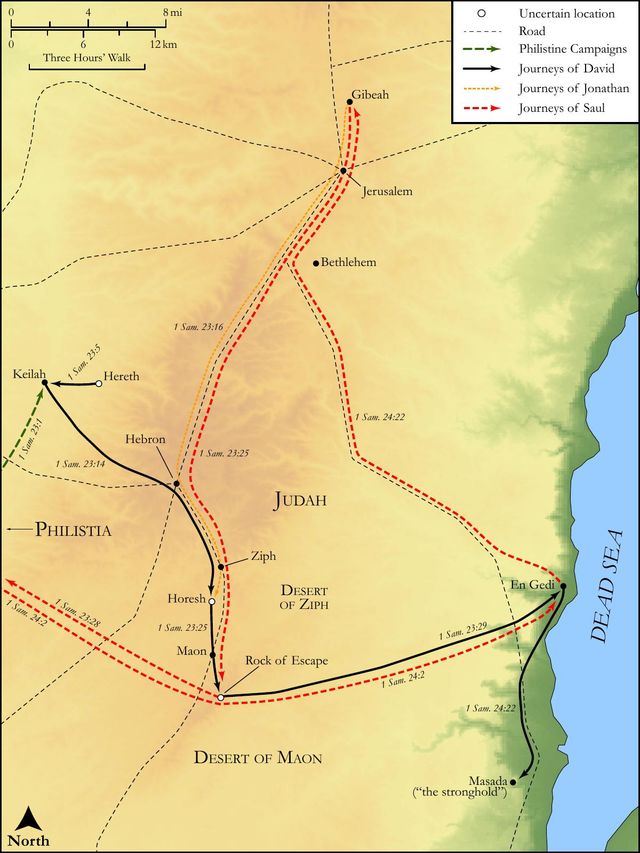
Study this verse
Public-domain commentary
Matthew Henry
From his Commentary on the Whole Bible. Henry comments on passages, not single verses — this entry covers 1 Samuel 24:16–22. His two-level outline is real structure in the source text, so it is rendered as structure.
Here we have,
I.Saul's penitent reply to David's speech.
It was strange that he had patience to hear him out, considering how outrageous he was against him, and how cutting David's discourse was. But God restrained him and his men; and we may suppose Saul struck with amazement at the singularity of the event, and much more when he found how much he had lain at David's mercy. His heart must have been harder than a stone if this had not affected him.
1.He melted into tears, and we will not suppose them to have been counterfeit but real expressions of his present concern at the sight of his own iniquity, so plainly proved upon him. He speaks as one quite overcome with David's kindness: Is this thy voice, my son David? And, as one that relented at the thought of his own folly and ingratitude, he lifted up his voice and wept, Sa1 24:16. Many mourn for their sins that do not truly repent of them, weep bitterly for them, and yet continue in love and league with them.
2.He ingenuously acknowledges David's integrity and his own iniquity (Sa1 24:17): Thou art more righteous than I. Now God made good to David that word on which he had caused him to hope, that he would bring forth his righteousness as the light, Psa 37:6. Those who take care to keep a good conscience may leave it to God to secure them the credit of it. This fair confession was enough to prove David innocent (even his enemy himself being judge), but not enough to prove Saul himself a true penitent. He should have said, Thou are righteous, but I am wicked; but the utmost he will own is this: Thou art more righteous than I. Bad men will commonly go no further than this in their confessions; they will own they are not so good as some others are; there are those that are better than they, and more righteous. He now owns himself under a mistake concerning David (Sa1 24:18): "Thou hast shown this day that thou art so far from seeking my hurt that thou hast dealt well with me." We are too apt to suspect others to be worse affected towards us then really they are, and than perhaps they are proved to be; and when, afterwards, our mistake is discovered, we should be forward to recall our suspicions, as Saul does here.
3.He prays God to recompense David for this his generous kindness to him. He owns that David's sparing him, when he had him in his power, was an uncommon and unparalleled instance of tenderness to an enemy; no man would have done the like; and therefore, either because he thought himself not able to give him a full recompence for so great a favour, or because he found himself not inclined to give him any recompence at all, he turns him over to God for his pay: The Lord reward thee good, Sa1 24:19. Poor beggars can do no less than pray for their benefactors, and Saul did no more.
4.He prophesies his advancement to the throne (Sa1 24:20): I know well that thou shalt surely be king. He knew it before, by the promise Samuel had made him of it compared with the excellent spirit that appeared in David, which highly aggravated his sin and folly in persecuting him as he did; he had as much reason to say concerning David as David concerning him, How can I put forth my hand against the Lord's anointed? But now he knew it by the interest he found David had in the people, the special providence of God in protecting him, and the generous kingly spirit he had now given a proof of in sparing his enemy. Now he knew it, that is, now that he was in a good temper he was willing to own that he knew it and to submit to the conviction of it. Note, Sooner or later, God will force even those that are of the synagogue of Satan to know and own those that he has loved, and to worship before their feet; for so is the promise, Rev 3:9. This acknowledgement which Saul made of David's incontestable title to the crown was a great encouragement to David himself and a support to his faith and hope.
5.He binds David with an oath hereafter to show the same tenderness of his seed and of his name as he had now shown of his person, Sa1 24:21. David had more reason to oblige Saul by an oath that he would not destroy him, yet he insists not on that (if the laws of justice and honour would not bind him, an oath would not), but Saul knew David to be a conscientious man, and would think his interests safe if he could get them secured by his oath. Saul by his disobedience had ruined his own soul, and never took care by repentance to prevent that ruin, and yet is very solicitous that his name might not be destroyed nor his seed cut off. However, David swore unto him, Sa1 24:22. Though he might be tempted, not only in revenge, but in prudence, to extirpate Saul's family, yet he binds himself not to do it, knowing that God could and would establish the kingdom to him and his, without the use of such bloody methods. This oath he afterwards religiously observed; he supported Mephibosheth, and executed those as traitors that slew Ishbosheth. The hanging up of seven of Saul's posterity, to atone for the destruction of the Gibeonites, was God's appointment, not David's act, and therefore not the violation of this oath.
II.Their parting in peace.
1.Saul, for the present, desisted from the persecution. He went home convinced, but not converted; ashamed of his envy of David, yet retaining in his breast that root of bitterness; vexed that, when at last he had found David, he could not at that time find in his heart to destroy him, as he had designed. God has many ways to tie the hands of persecutors, when he does not turn their hearts.
2.David continued to shift for his own safety. He knew Saul too well to trust him, and therefore got him up into the hold. It is dangerous venturing upon the mercy of a reconciled enemy. We read of those who believed in Christ, and yet he did not commit himself to them because he knew all men. Those that like David are innocent as doves must thus like him be wise as serpents.
Historical interpretation
Historical reception
1 surviving comment on this verse from the historical church.
So Saul went to his house, etc. The people of the Jews who were able to repent from their faithlessness through the teaching of the apostles went to work on the care of their inner salvation. On the other hand, the Lord himself and his preachers, knowing that many from the same people would wage wars against the faith, having left the lowly and earthly things, soon ascended to safer and higher places, that is, those who would rightly believe and firmly persevere, by illuminating the hearts of the Samaritans and nearby nations. This reading’s memory, and its spiritual reference to Christ, is taught by the title of the fifty-sixth Psalm, which is inscribed thus: To the end, do not destroy David, in the inscription of the title, when he fled from the face of Saul into the cave. Although it seems to be written about David in two words; it opens up in two others, because it truly signifies Christ entirely. That which says “Do not destroy David” seems to prohibit from destroying him, who had been prepared by the Lord’s promise for the kingdom, from the insidious enemy. And what it adds in the closure: When he fled from the face of Saul into the cave, it smiles upon the particular moment of time in which he was thought to be able to be destroyed. Nevertheless, what is placed in the beginning, to the end, forewarns that everything should be referred to him, who remains the perfection of all good things for us, because when we came to him, there is no longer any need to seek anything beyond. And what follows, in the inscription of the title, expresses the very title of the Lord’s passion, which Pilate wrote in Hebrew, Greek, and Latin; and which itself, in figure of an unshakeable kingdom, could not be destroyed by any reasoning or by him who wrote it. Therefore, the sense of this entire title is the same, commanding the Jews not to suspect that they can take away the glory of Christ, even when he is killed and buried: To the end, do not destroy David, in the inscription of the title, when he fled from the face of Saul into the cave, understand the psalm as sung to him who is the end of the law for righteousness to everyone who believes; so that you may seek not to destroy Christ by taking away or diminishing his kingdom, which is marked by the true inscription of the title, even when you see him enter the closed tomb through his death due to the impious harassing him; and indeed, the tomb’s closed doors were fled from the face of those pursuing him, so that they would have no power to pursue or even see him any longer. Moreover, that very psalm, according to the tenor of this same reading, openly and appropriately celebrates the Lord’s passion, burial, and resurrection, and also the faith of the Gentiles, which is mystically contained within the end of the present reading, where among other things about the triumphal passion: He gave, he says, those trampling me to reproach. (Psalm LVI). Of the burial and resurrection: He delivered my soul from the midst of the lions' whelps, I slept troubled. This trouble is better understood in his members who had not yet fully believed in his resurrection while he slept in the tomb. Likewise, of the resurrection: I will arise early. But concerning the Gentiles, inspired and cooperating to faith: I will confess to you among the peoples, O Lord, I will sing a psalm to you among the nations. And the damnation of the Jewish nation, which is marked by the cutting of Saul’s cloak in this reading, the aforementioned psalm describes this way: They dug a pit before my face, and they themselves fell into it.
Continue studying 1 Samuel 24:22 across the web’s major study libraries — every link below opens this exact verse, chapter, or book on the destination site.
Read & Compare
 BibleGatewayThis verse in more than 200 translations and 70 languages.
 Bible.comThe YouVersion reader — hundreds of translations, reading plans, and highlights.
 ESV.orgCrossway's official English Standard Version reader.
 NET BibleThe NET translation with 60,000+ translators' notes on every rendering decision.
 STEP BibleTyndale House's free study tool — original text, vocabulary, and scholarly resources.
 BibliaLogos Bible Software's free web reader.
 USCCBThe New American Bible (Revised Edition) with the U.S. bishops' study notes.
Commentaries
 BibleHub CommentariesDozens of classic commentaries on this verse, gathered on one page.
 StudyLightMore than 100 commentary sets — the largest collection on the web.
 BibleRefPlain-English commentary on what this verse means, verse by verse.
 Enduring WordDavid Guzik's free commentary on this chapter, widely used by Bible teachers.
 Bible Study ToolsVerse commentary alongside Greek and Hebrew study aids.
Original Language & Research
- BibleHub InterlinearThe verse word by word — original language, transliteration, and English.
- BibleHub LexiconEvery word's original-language definition and Strong's entry.
 Blue Letter BibleDeep-study tools — Strong's numbers, concordance, and word studies.
 SefariaThe Hebrew text with Rashi and centuries of Jewish commentary.
Sermons, Hymns & Audio


TrulyRandomVerse is not affiliated with these sites and doesn’t control their content. They’re linked because they’re genuinely useful.
Summary
1 Samuel 24:22 records the immediate aftermath of a deeply significant encounter between David and King Saul within the cave of En Gedi. Following David's remarkable act of mercy in sparing Saul's life, the verse details David's solemn oath to Saul, Saul's subsequent return to his royal residence, and David's prudent decision to withdraw with his men to a fortified stronghold. This pivotal moment encapsulates a temporary, fragile truce, highlighting David's unwavering integrity and continued strategic caution in the face of persistent, unpredictable threats from the reigning monarch.
Context
ShowHideLiterary Context
This verse serves as the concluding statement to the dramatic and emotionally charged narrative found in 1 Samuel 24. The preceding verses meticulously describe how David, while hiding in a cave, was presented with a clear and seemingly providential opportunity to eliminate Saul, his relentless persecutor. Instead of exacting revenge, David chose an act of profound restraint and mercy, merely cutting off a corner of Saul's robe. This act profoundly convicted Saul, leading him to acknowledge David's righteousness and future kingship, even prompting him to request an oath from David concerning the preservation of his lineage and name (1 Samuel 24:20-21). Verse 22 provides the immediate resolution to this specific confrontation, depicting the physical separation of the two parties after their intense and spiritually charged exchange. While offering a moment of apparent peace, it subtly sets the stage for the ongoing tension and Saul's eventual relapse into renewed hostility and pursuit, despite this significant interlude.
Historical & Cultural Context
In ancient Israel, oaths were not mere formalities but profoundly serious and legally binding commitments, often invoked with a solemn appeal to divine witness and enforcement. For David to swear such an oath to Saul, even as his tormentor, powerfully underscored his deep respect for God's anointed king and his unwavering commitment to covenant faithfulness and the sanctity of promises. The mention of "the hold" (Hebrew: mâtsûwd) is culturally significant, pointing to the strategic importance of natural strongholds—often caves or fortified rocky outcrops—within the rugged Judean wilderness. These locations provided essential refuge and defensible positions for individuals or groups facing external threats, serving as more than just hiding places but as strategic bases. David's continued reliance on such places reflects the precarious and often violent political landscape of the period, where loyalty was fluid, power struggles were common, and personal security was paramount. His choice to return to a "hold" indicates his astute awareness of the persistent danger posed by Saul's unpredictable nature, a reality that would define much of his life until Saul's death.
Key Themes
ShowHideThis concluding verse of 1 Samuel 24 contributes significantly to several overarching themes within the book of 1 Samuel. Firstly, it powerfully underscores David's integrity and faithfulness, demonstrating his unwavering trust in God's sovereign timing for his kingship, rather than resorting to human violence or political maneuvering against God's anointed, as vividly portrayed in his refusal to harm Saul (1 Samuel 24:4-7). Secondly, the narrative highlights the fleeting nature of Saul's repentance and emotional instability. His temporary acknowledgment of David's righteousness and the cessation of pursuit did not translate into a lasting change of heart, as evidenced by his renewed and relentless hostility in subsequent chapters (1 Samuel 26). Thirdly, David's strategic retreat to "the hold" emphasizes prudence and caution, illustrating the wisdom of not fully trusting an apparent truce from an unpredictable adversary. Finally, and perhaps most profoundly, the entire narrative, culminating in this verse, powerfully showcases God's sovereign protection and providence over David, guiding him through intense persecution toward his divinely appointed destiny as the future king of Israel.
Exposition and Analysis
ShowHideKey Word Analysis
ShowHideThis verb, derived from the root meaning "to seven oneself," signifies the act of taking an oath, often accompanied by a solemn appeal to a divine being to witness and enforce the promise. In Israel, an oath was a profoundly serious and legally binding commitment, particularly when made between a king and a subject, or concerning matters of succession or peace. David's oath to Saul, specifically concerning the preservation of Saul's lineage as requested in 1 Samuel 24:21, demonstrated his deep respect for God's covenant and his commitment to righteousness, even towards his persecutor.
This term broadly refers to a house, dwelling, or palace, often implying a settled abode or a return to one's established place. In this context, Saul's return "home" signifies his departure from the wilderness and his return to his royal court or personal residence, contrasting sharply with David's continued nomadic existence in the wilderness. It suggests a return to a place of comfort and authority for Saul, while David remains in a state of vigilance and displacement.
This term refers to a fortress, stronghold, or fortified place, often a natural rocky outcrop, a cave system, or a strategically defensible location. These "holds" were crucial for security in times of conflict, providing refuge and strategic advantage. For David, such a place was not merely a hiding spot but a base of operations and a symbol of his continued vigilance and reliance on defensive measures, even after a temporary peace. The term is also used metaphorically in the Psalms to describe God as a refuge or fortress (e.g., Psalm 18:2).
Verse Breakdown
ShowHide"And David sware unto Saul."
This clause formally concludes the intense dialogue and emotional reconciliation between David and Saul. Despite being the wronged party and having a clear opportunity for revenge, David honored Saul's request for an oath, promising not to cut off Saul's descendants or blot out his name. This act profoundly underscores David's remarkable integrity, his deep respect for the sanctity of an oath, and his deference to God's anointing on Saul, even when Saul acted unjustly. It demonstrates David's commitment to righteousness and God's timing above personal vengeance or political expediency.
"And Saul went home;"
This indicates Saul's departure from the cave and the immediate cessation of his pursuit of David. It suggests a temporary resolution to the conflict, brought about by Saul's emotional and temporary conviction regarding David's innocence and God's favor. Saul's return "home" implies a return to his royal seat or primary residence, leaving David in the wilderness. This moment provides a brief respite for David, though the broader narrative reveals it to be short-lived.
"but David and his men gat them up unto the hold."
This contrasting clause highlights David's continued prudence, strategic wisdom, and spiritual discernment. Despite Saul's emotional reconciliation and departure, David did not immediately return to a settled life or fully trust Saul's apparent change of heart. Instead, he and his men ascended to a fortified place, a "hold," signifying their ongoing need for security and vigilance. This decision reflects David's astute understanding of Saul's unpredictable and volatile character, recognizing that the threat, though momentarily paused, had not truly dissipated, and that continued caution was necessary for their survival.
Literary Devices
ShowHideThe verse employs several significant literary devices that enrich its meaning and foreshadow future events. Contrast is prominently featured, juxtaposing Saul's return "home" (implying a return to normalcy, comfort, and royal authority) with David's continued retreat to "the hold" (signifying ongoing danger, vigilance, and a life of displacement). This stark contrast effectively highlights the differing realities, mindsets, and spiritual states of the two men. There is also a strong element of foreshadowing in David's continued caution; his decision to remain in a stronghold implicitly warns the reader that Saul's "repentance" is not permanent or deeply transformative, anticipating the renewed and relentless pursuit that will occur in subsequent chapters (e.g., 1 Samuel 26). Finally, "the hold" functions as a powerful symbol of refuge and security, not only in a physical sense for David and his men but also, for the discerning reader, as a metaphorical representation of God's unwavering protection and faithfulness over David, echoing the frequent use of "fortress" or "stronghold" for God in David's later psalms.
Theological and Thematic Connections
ShowHide1 Samuel 24:22 powerfully illustrates the tension between human reconciliation and the ongoing reality of sin's influence, alongside the unwavering wisdom and integrity of God's chosen servant. David's profound act of integrity in swearing an oath to Saul, despite Saul's malicious intent and relentless persecution, underscores the biblical principle of respecting God-ordained authority and demonstrating radical mercy, even to those who seek to harm us. Yet, David's subsequent retreat to a stronghold reveals a profound spiritual discernment: true repentance is marked by lasting change and consistent behavior, not merely fleeting emotion or temporary remorse. This wisdom teaches believers to be gracious and forgiving, but also to exercise prudence and caution, recognizing that while we extend forgiveness, we must also protect ourselves from persistent patterns of harm and instability. Ultimately, the verse affirms God's protective hand over David, guiding him through perilous circumstances and demonstrating that His divine plans will prevail, regardless of human opposition or the unpredictable nature of adversaries.
Reflection and Application
ShowHideThis verse offers profound and practical lessons for believers navigating complex relationships, especially those marked by conflict, betrayal, or unpredictable behavior. David's actions demonstrate the delicate yet crucial balance between extending grace and exercising wisdom. We are called to embody Christ-like integrity, showing mercy, honoring our commitments, and trusting God to be our ultimate vindicator, even when others act unjustly towards us. However, David's decision to retreat to a stronghold, despite Saul's apparent change of heart, serves as a powerful reminder that while we are commanded to forgive, we must also exercise spiritual discernment. Not all expressions of remorse lead to genuine, lasting transformation, and prudence dictates that we protect ourselves from repeated patterns of harm or instability. Our ultimate "hold" and security is found in God alone, yet He also grants us wisdom and discernment to navigate earthly dangers and make wise decisions for our safety and well-being. This passage encourages us to live with unwavering integrity, discern with spiritual wisdom, and rely on God's sovereign protection in all aspects of our lives.
Questions for Reflection
ShowHideFAQ
ShowHideWhy did David still retreat to a stronghold if Saul went home?
ShowHideDavid's decision to retreat to a stronghold, despite Saul's apparent change of heart and departure, demonstrates his profound wisdom and discernment. While Saul had an emotional moment of clarity and acknowledged David's righteousness, his repentance was not a deep, transformative change of heart. David had experienced Saul's erratic and murderous behavior firsthand and understood that Saul's relentless pursuit was driven by a deep-seated jealousy and spiritual instability, not merely a misunderstanding. Therefore, David prudently recognized that the immediate threat had only temporarily subsided, not vanished. The "hold" offered strategic safety and a defensible position, reflecting David's continued need for vigilance against a king whose patterns of hostility were deeply entrenched, as evidenced by Saul's renewed pursuit of David later in 1 Samuel 26.
What was the nature of the oath David swore to Saul?
ShowHideAs detailed in 1 Samuel 24:21, Saul asked David to swear that he would not "cut off my seed after me, and that thou wilt not destroy my name out of my father's house." This was a common and grave concern for kings of that day, who often sought to eliminate potential rivals and their entire lineage to secure their own dynasty. David's oath was a solemn promise to preserve Saul's family line and reputation, even though Saul was actively trying to kill him. This act highlights David's remarkable integrity, his respect for the sanctity of an oath, and his belief that God, not human violence, would establish his kingdom and deal with Saul's house.
Christ-Centered Fulfillment
ShowHide1 Samuel 24:22, with David's integrity, profound mercy, and prudent retreat, profoundly foreshadows the person and redemptive work of Jesus Christ. David, God's anointed, refused to harm Saul, God's anointed, even when he had the perfect opportunity to seize power, trusting God's timing for the kingdom. This mirrors Christ's ultimate non-retaliation and perfect submission to the Father's will, even in the face of immense injustice, persecution, and the ultimate sacrifice of the cross. Jesus, the true King, did not seize power through worldly force but humbly endured suffering, trusting God to exalt Him (Philippians 2:5-8). David's extraordinary act of mercy towards his persecutor points to Christ's unparalleled mercy, who, while we were still His enemies, died for us to reconcile us to God (Romans 5:8). Furthermore, David's strategic retreat to "the hold" symbolizes the ultimate spiritual refuge found in Christ. He is our true "stronghold," our fortress, and our deliverer, to whom we flee for safety and security in a world hostile to God and His people (Psalm 91:2). Just as David patiently waited for God to establish his kingdom, Jesus patiently awaits the full manifestation of His glorious reign, having already secured victory through His suffering, death, and resurrection. His example teaches us to overcome evil with good, to trust in God's perfect timing, and to find our ultimate security and eternal refuge in Him alone (1 Peter 2:23).