


1 Samuel 23:14
Bible text: King James Version (1769 Blayney text) · Public domain
Bible text: King James Version with Strong's numbers · Public domain
Bible text: Berean Standard Bible · Public domain
Bible text: American Standard Version (1901) · Public domain
Bible text: World English Bible, Messianic edition · Public domain
Bible text: Geneva Bible (1599) · Public domain
Bible text: Young's Literal Translation · Public domain
- וַיֵּשֶׁבvai·Ye·shevand he dweltH3427Conj-w ¦ V-Qal-ConsecImperf-3msVerb Qal Consecutive Imperfect 3rd Singular Masculineוַandיֵּשֶׁבhe dwelt
- דָּוִדda·VidDavidH1732N-proper-mNoun Proper Masculine
- בַּמִּדְבָּרba·mid·Barin the wildernessH4057Prep-b ¦ N-msNoun Singular Masculine Absoluteבַּin theמִּדְבָּרwilderness
- בַּמְּצָדוֹתba·me·tza·Dotin the strongholdsH4679Prep-b ¦ N-fpNoun Plural Feminine Absoluteבַּin theמְּצָדוֹתstrongholds
- וַיֵּשֶׁבvai·Ye·shevand he dweltH3427Conj-w ¦ V-Qal-ConsecImperf-3msVerb Qal Consecutive Imperfect 3rd Singular Masculineוַandיֵּשֶׁבhe dwelt
- בָּהָרba·Harin the hill countryH2022Prep-b ¦ N-msNoun Singular Masculine Absoluteבָּin theהָרhill country
- בְּמִדְבַּרbe·mid·barin [the] wilderness ofH4057Prep-b ¦ N-mscNoun Singular Masculine Constructבְּinמִדְבַּר[the] wilderness of
- זִיףZifZiphH2128N-properNoun Proper Location
- וַיְבַקְשֵׁהוּvay·vak·She·huand he sought himH1245Conj-w ¦ V-Piel-ConsecImperf-3ms ¦ 3msVerb Piel Consecutive Imperfect 3rd Singular Masculineוַandיְבַקְשֵׁhe soughtהוּhim
- שָׁאוּלsha·'UlSaulH7586N-proper-mNoun Proper Masculine
- כָּלkolallH3605N-mscNoun Singular Masculine Construct
- הַיָּמִיםhai·ya·Mimthe daysH3117Art ¦ N-mpNoun Plural Masculine Absoluteהַtheיָּמִיםdays
- וְלֹאve·lo'and notH3808Conj-w ¦ NegParticle Negativeוְandלֹאnot
- נְתָנוֹne·ta·Nohe gave himH5414V-Qal-Perf-3ms ¦ 3msVerb Qal Perfect 3rd Singular Masculineנְתָנhe gaveוֹhim
- אֱלֹהִים'E·lo·HimGodH430N-mpNoun Plural Masculine Absolute
- בְּיָדוֹbe·ya·Doin his handH3027Prep-b ¦ N-csc ¦ 3msNoun Singular common gender Constructבְּinיָדhandוֹhis
English is a literal word-by-word gloss of the Hebrew, not the KJV's wording. Why?
This is the original text the KJV's translators worked from — each Hebrew word with its own literal English meaning in this verse, prepared by scholars at Tyndale House, Cambridge. The KJV translates whole sentences, not word by word, so its wording differs: one Hebrew word can become several English words, and the KJV may choose “the LORD” where the gloss reads “Yahweh”. Both are faithful — they answer different questions. For the KJV's own rendering, switch to the KJV text.
Details
See on the biblical-era map
Study this verse
Public-domain commentary
Matthew Henry
From his Commentary on the Whole Bible. Henry comments on passages, not single verses — this entry covers 1 Samuel 23:14–18. His two-level outline is real structure in the source text, so it is rendered as structure.
Here is, I. David absconding. He abode in a wilderness, in a mountain (Sa1 23:14), in a wood, Sa1 23:15. We must here, 1. Commend his eminent virtues, his humility, modesty, fidelity to his prince, and patient attendance on the providence of his God, that he did not draw up his forces against Saul, fight him in the field, or surprise him by some stratagem or other, and so avenge his own quarrel and that of the Lord's priests upon him, and put an end to his own troubles and the calamities of the country under Saul's tyrannical government. No, he makes no such attempt; he keeps God's way, waits God's time, and is content to secure himself in woods and wildernesses, though with some it might seem a reproach to that courage for which he had been famous. But, 2. We must also lament his hard fate, that an innocent man should be thus terrified and put in fear of his life, that a man of honour should be thus disgraced, a man of merit thus recompensed for his services, and a man that delighted in the service both of God and his country should be debarred from both and wrapped up in obscurity. What shall we say to this? Let it make us think the worse of this world, which often gives such bad treatment to its best men; let it reconcile even great and active men to privacy and restraint, if Providence make these their lot, for they were David's; and let it make us long for that kingdom where goodness shall for ever be in glory and holiness in honour, and the righteous shall shine as the sun, which cannot be put under a bushel.
II.Saul hunting him, as his implacable enemy.
He sought him every day, so restless was his malice, Sa1 23:14. He sought no less than his life, so cruel was his malice, Sa1 23:15. As it had been from the beginning, so it was now, and will be, he that is born after the flesh persecuteth him that is born after the spirit, Gal 4:29.
III.God defending him, as his powerful protector.
God delivered him not into Saul's hand, as Saul hoped (Sa1 23:7); and, unless God delivered him into his hand, he could not prevail against him, Joh 19:11.
IV.Jonathan comforting him as his faithful and constant friend.
True friends will find out means to get together. David, it is likely, appointed time and place for this interview, and Jonathan observed the appointment, though he exposed himself thereby to his father's displeasure, and, had it been discovered, it might have cost him his life. True friendship will not shrink from danger, but can easily venture, will not shrink from condescension, but can easily stoop, and exchange a palace for a wood, to serve a friend. The very sight of Jonathan was reviving to David; but, besides this, he said that to him which was very encouraging.
1.As a pious friend, he directed him to God, the foundation of his confidence and the fountain of his comfort: He strengthened his hand in God. David, though a strong believer, needed the help of his friends for the perfecting of what was lacking in his faith; and herein Jonathan was helpful to him, by reminding him of the promise of God, the holy oil wherewith he was anointed, the presence of God with him hitherto, and the many experiences he had had of God's goodness to him. Thus he strengthened his hands for action, by encouraging his heart, not in the creature, but in God. Jonathan was not in a capacity of doing any thing to strengthen him, but he assured him God would.
2.As a self-denying friend, he took a pleasure in the prospect of David's advancement to that honour which was his own birthright, Sa1 23:17. "Thou shalt live to be king, and I shall think it preferment enough to be next thee, near thee, though under thee, and will never pretend to be a rival with thee." This resignation which Jonathan made to David of his title would be a great satisfaction to him, and make his way much the more clear. This, he tells him, Saul knew very well, Jonathan having sometimes heard him say as much, whence it appears what a wicked man Saul was, to persecute one whom God favoured, and what a foolish man he was, in thinking to prevent that which God had determined and which would certainly come to pass. How could he disannul what God had purposed?
3.As a constant friend, he renewed his league of friendship with him. They made a covenant now, this third time, before the Lord, calling him to witness to it, Sa1 23:18. True love takes delight in repeating its engagements, giving and receiving fresh assurances of the firmness of the friendship. Our covenant with God should be often renewed, and therein our communion with him kept up. David and Jonathan now parted, and never came together again, that we find, in this world; for Jonathan said what he wished, not what he had ground to expect, when he promised himself that he should be next to David in his kingdom.
Historical interpretation
Historical reception
2 surviving comments on this verse. Each one is dated, so this reads as a timeline rather than a list.
David, however, stayed in the desert, etc. Christ, having dismissed those who receive faith only in word, rather takes up residence in the hearts of those who, in the aridity of the present age, thirst for God, the living fountain, awaiting the moment they may come and appear before the face of the Lord. He gladly remains in those whose high hearts are removed from worldly temptations and blissfully secluded in solitude, finding joy in the deficient germ and flower of virtues. For Ziph means flower or germ.
Yet Saul sought him every day, etc. From the beginning of time until the end, the wicked strive to remove Christ from the hearts of the pious, but He himself defends the pious so that they might never be overcome by the wicked, as He promised to remain with them all days even unto the end of the world (Matthew 28). And elsewhere it says: When you pass through the waters, I will be with you, and the rivers will not overwhelm you (Isaiah 43).
Continue studying 1 Samuel 23:14 across the web’s major study libraries — every link below opens this exact verse, chapter, or book on the destination site.
Read & Compare
 BibleGatewayThis verse in more than 200 translations and 70 languages.
 Bible.comThe YouVersion reader — hundreds of translations, reading plans, and highlights.
 ESV.orgCrossway's official English Standard Version reader.
 NET BibleThe NET translation with 60,000+ translators' notes on every rendering decision.
 STEP BibleTyndale House's free study tool — original text, vocabulary, and scholarly resources.
 BibliaLogos Bible Software's free web reader.
 USCCBThe New American Bible (Revised Edition) with the U.S. bishops' study notes.
Commentaries
 BibleHub CommentariesDozens of classic commentaries on this verse, gathered on one page.
 StudyLightMore than 100 commentary sets — the largest collection on the web.
 BibleRefPlain-English commentary on what this verse means, verse by verse.
 Enduring WordDavid Guzik's free commentary on this chapter, widely used by Bible teachers.
 Bible Study ToolsVerse commentary alongside Greek and Hebrew study aids.
Original Language & Research
- BibleHub InterlinearThe verse word by word — original language, transliteration, and English.
- BibleHub LexiconEvery word's original-language definition and Strong's entry.
 Blue Letter BibleDeep-study tools — Strong's numbers, concordance, and word studies.
 SefariaThe Hebrew text with Rashi and centuries of Jewish commentary.
Sermons, Hymns & Audio


TrulyRandomVerse is not affiliated with these sites and doesn’t control their content. They’re linked because they’re genuinely useful.
Summary
1 Samuel 23:14 vividly portrays the relentless persecution of David by King Saul, who daily sought to capture him in the desolate wilderness of Ziph. Despite David's precarious existence, constantly moving between natural strongholds, the verse culminates in a powerful declaration of divine sovereignty: God actively prevented David from falling into Saul's hands. This passage underscores God's unwavering protection over His anointed, ensuring His purposes for David's future kingship would not be thwarted by human malice.
Context
ShowHideLiterary Context
This verse is situated within a larger narrative arc (1 Samuel 19-31) detailing King Saul's increasingly irrational and obsessive pursuit of David, whom he perceives as a threat to his throne. Following David's anointing by Samuel in 1 Samuel 16, Saul's jealousy intensifies, driving David into a life of a fugitive. Immediately preceding this verse, David has just delivered the city of Keilah from the Philistines (1 Samuel 23:1-5), only to learn that the inhabitants would betray him to Saul (1 Samuel 23:6-13). This betrayal forces David to abandon the city and return to the wilderness, highlighting his constant vulnerability and the pervasive threat he faced. The narrative consistently emphasizes David's reliance on God for guidance and protection through the ephod, contrasting sharply with Saul's descent into spiritual darkness and paranoia.
Historical & Cultural Context
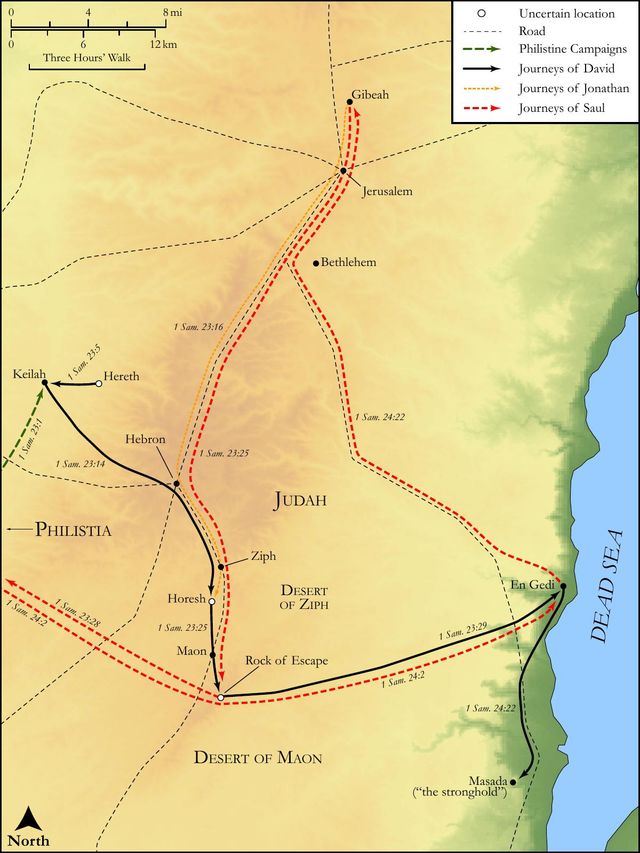
The "wilderness of Ziph" refers to a specific, rugged, and desolate region in the Judean wilderness, east of Hebron and south of Jerusalem. This area, characterized by wadis, caves, and rocky terrain, provided natural "strong holds" or inaccessible hiding places for fugitives. Such wilderness areas were often sparsely populated, making them ideal for evasion but also harsh environments for survival. David, leading a band of loyal followers, would have relied on these natural defenses and the support (or occasional betrayal) of local communities. King Saul, as the reigning monarch, commanded a standing army and resources, making his "daily" pursuit a significant and sustained military operation. The cultural context also includes the concept of divine anointing, where a king's legitimacy was believed to be divinely ordained. Saul's relentless pursuit of David was not just a political struggle but a direct defiance of God's revealed will, as David had been chosen by God to succeed him.
Key Themes
ShowHideThe central theme in 1 Samuel 23:14 is Divine Protection and Providence. Despite Saul's overwhelming power and relentless efforts, God actively intervenes to safeguard David, demonstrating His faithfulness to His covenant promises and His sovereign control over human events. This highlights God's commitment to His chosen one, ensuring that His plan for David to become king (as foretold in 1 Samuel 16:12-13) will be fulfilled. Another significant theme is Perseverance in Adversity. David's life during this period is a testament to enduring hardship, constant danger, and uncertainty, yet he continues to seek God's guidance and trust in His deliverance. Finally, the verse underscores Saul's Obsession and Decline. Saul's "daily" pursuit of David reveals the depth of his irrational hatred and paranoia, consuming him to the neglect of his kingly duties and further illustrating his spiritual and moral decay, a stark contrast to David's growing reliance on God.
Exposition and Analysis
ShowHideKey Word Analysis
ShowHideThis term (H4679) refers to a fastness, a covert of ambush, or a natural fortress. In David's context, it signifies the rugged, natural defenses of the Judean wilderness—caves, cliffs, and difficult terrain—that provided temporary refuge from Saul's forces. It speaks to David's reliance on the physical landscape for survival, yet ultimately points to God as his true stronghold.
This verb (H1245) is a primitive root meaning to search out (by any method, specifically in worship or prayer); by implication, to strive after; ask, beg, beseech, desire, enquire, get, make inquisition, procure, (make) request, require, seek (for). The phrase "sought him every day" emphasizes the relentless, obsessive, and unceasing nature of Saul's pursuit. It highlights the king's singular focus on eliminating David, demonstrating his deep-seated paranoia and hatred.
This primitive root (H5414) means to give, used with greatest latitude of application (put, make, etc.). When used with a negative, as "delivered him not into his hand," it literally means "God did not give him into his hand." This is a crucial theological statement. It is not that David merely escaped by his own cunning or strength, but that God Himself was the active agent, directly intervening to prevent David's capture. This underscores divine sovereignty and protection as the ultimate reason for David's safety.
Verse Breakdown
ShowHide"And David abode in the wilderness in strong holds"
This clause establishes David's fugitive status and his chosen method of survival. He is not in a settled city or a fortified military camp, but in the harsh, desolate wilderness, relying on natural, often temporary, hiding places. This paints a picture of vulnerability and constant movement, highlighting the precariousness of his existence.
"and remained in a mountain in the wilderness of Ziph."
This further specifies David's location, pinpointing the "wilderness of Ziph" and a "mountain" within it as a particular refuge. The repetition of "wilderness" reinforces the challenging and isolated nature of his existence, emphasizing the desolation and the extreme conditions he endured while constantly on the run.
"And Saul sought him every day"
This phrase vividly portrays the intensity and persistence of Saul's pursuit. It was not a sporadic effort but a continuous, daily hunt, reflecting Saul's consuming obsession and the relentless pressure David was under. This highlights the human adversary's determination and the overwhelming odds David faced.
"but God delivered him not into his hand."
This is the climactic and most significant clause of the verse. It shifts the focus from human action (Saul's seeking) to divine intervention. Despite Saul's persistence and David's vulnerability, God actively withheld David from Saul's grasp. This is the theological lynchpin, asserting God's sovereign protection as the ultimate reason for David's survival, overriding all human efforts and circumstances.
Literary Devices
ShowHideThe verse employs several powerful Literary Devices. Contrast is prominent, juxtaposing David's vulnerable state as a fugitive "in the wilderness in strong holds" with Saul's relentless "daily" pursuit, and ultimately, with God's unwavering and decisive protection. This highlights the vast disparity in power between David and Saul, making God's intervention all the more striking. The Repetition of "wilderness" emphasizes the harsh and desolate environment that defined David's existence during this period of flight. The explicit mention of God's action ("but God delivered him not") serves as a form of Divine Intervention, making God a direct actor in the narrative and underscoring His active role in human history. This statement also functions as Foreshadowing, assuring the reader that David's destiny as king, as promised by God, will indeed come to pass, despite the immediate dangers.
Theological and Thematic Connections
ShowHide1 Samuel 23:14 is a profound theological statement on divine providence and faithfulness. It teaches that even when human adversaries are relentless and circumstances seem overwhelmingly against God's chosen, His sovereign will prevails. David's survival is not attributed to his own cunning or strength, but explicitly to God's active intervention, demonstrating that God is the ultimate protector of His purposes and His people. This truth provides immense comfort and assurance, reminding believers that their safety and future are ultimately secured by God's unwavering hand, even in the face of severe trials and opposition.
Reflection and Application
ShowHideThis powerful verse offers profound encouragement for believers navigating their own "wilderness" seasons, facing relentless opposition, or enduring periods of intense trial. David's experience reminds us that even when our adversaries seem overwhelming, resourceful, and persistent, God's protection is real, active, and ultimately decisive. Our safety and future are not dependent on our own strength, the weakness of our adversaries, or the favorable turn of circumstances, but solely on God's sovereign will and His faithfulness to His promises. In moments of fear or despair, we are called to remember that the same God who preserved David from Saul's hand is actively at work in our lives, preserving His purposes and preparing us for His calling. We can trust in His unfailing refuge and strength, knowing that His plans for us cannot be thwarted by human malice or the schemes of the enemy.
Questions for Reflection
ShowHideFAQ
ShowHideWhat does "strong holds" refer to in this context?
ShowHideIn 1 Samuel 23:14, "strong holds" (Hebrew: mᵉtsad') refers to natural fortresses or inaccessible places, typically found in mountainous or rugged wilderness terrain. These were not man-made castles but natural caves, cliffs, and difficult-to-reach elevations that provided temporary refuge and defense for David and his men against Saul's pursuing army. The Judean wilderness, where Ziph was located, is characterized by such natural formations, making it an ideal, albeit harsh, hiding place for fugitives.
Why was Saul seeking David "every day"?
ShowHideSaul's relentless pursuit of David, described as "every day," underscores the depth of his paranoia, jealousy, and obsession. After God rejected Saul as king and chose David (as recounted in 1 Samuel 15 and 1 Samuel 16), Saul became consumed by a desire to eliminate David, whom he saw as a direct threat to his throne and legacy. This daily pursuit was not merely a political maneuver but a manifestation of his spiritual and psychological decline, highlighting his irrational hatred and his singular focus on destroying God's anointed.
What is the theological significance of "God delivered him not into his hand"?
ShowHideThis phrase is the theological climax of the verse, emphasizing divine sovereignty and protection. It explicitly states that David's survival was not due to his own cunning, the strength of his "strong holds," or any failure on Saul's part, but rather to God's direct intervention. The Hebrew verb implies that God actively withheld David from Saul's grasp. This signifies God's faithfulness to His promises (that David would be king), His control over human events, and His unwavering commitment to His chosen ones, even in the face of overwhelming opposition. It serves as a powerful declaration that God's purposes cannot be thwarted by human malice or power.
Christ-Centered Fulfillment
ShowHide1 Samuel 23:14, with its vivid portrayal of David's persecution and God's unwavering protection, finds profound Christ-centered fulfillment in the life and ministry of Jesus, the ultimate Son of David and the true King. Like David, Jesus experienced relentless opposition and persecution from those in power who sought to kill Him, as seen in the attempts by the religious leaders and Herod (Matthew 2:13-18). Yet, just as God "delivered him not into his hand" in David's case, so too was Jesus protected until "His hour had not yet come" (John 7:30). Jesus, too, retreated to wilderness places and mountains for refuge and prayer (Matthew 4:1-11; Mark 6:46), embodying a similar reliance on divine providence. Ultimately, while David was delivered from physical death to fulfill his earthly kingship, Jesus willingly submitted to death, not to be delivered from it, but to deliver humanity from sin and death itself (John 10:17-18). His resurrection is the ultimate "delivery," demonstrating God's supreme power over all adversaries, securing eternal life for all who believe, and establishing His eternal kingdom, fulfilling the promises made to David in a far grander, spiritual sense (Luke 1:32-33). Thus, David's deliverance foreshadows the greater deliverance found in Christ, who delivers us "from the dominion of darkness" into His marvelous light (Colossians 1:13).