


2 Timothy 3:11
- τοῖςtois<the>G3588T-DPMDefinite article Dative Plural Masculine
- διωγμοῖςdiōgmoispersecutionsG1375N-DPMNoun Dative Plural Masculine
- τοῖςtois<the>G3588T-DPNDefinite article Dative Plural Neuter
- παθήμασινpathēmasinsufferingsG3804N-DPNNoun Dative Plural Neuter
- οἷάhoiasuch asG3634K-NPNCorrelative pronoun Nominative Plural Neuter
- μοιmoito meG3165P-1DSPersonal pronoun Dative 1st Singular
- ἐγένετοegenetohappenedG1096V-2ADI-3SVerb 2nd Aorist Middle Deponent Indicative 3rd Singular
- ἐνeninG1722PREPPreposition
- ἈντιοχείᾳAntiocheiaAntiochG490N-DSF-LNoun Dative Singular Feminine Location
- ἐνeninG1722PREPPreposition
- ἸκονίῳIkoniōIconiumG2430N-DSN-LNoun Dative Singular Neuter Location
- ἐνeninG1722PREPPreposition
- Λύστροις·LustroisLystraG3082N-DPN-LNoun Dative Plural Neuter Location
- οἵουςoiouswhat manner ofG3634K-APMCorrelative pronoun Accusative Plural Masculine
- διωγμοὺςdiōgmouspersecutionsG1375N-APMNoun Accusative Plural Masculine
- ὑπήνεγκαhupēnegkaI endured!G5297V-AAI-1SVerb Aorist Active Indicative 1st Singular
- καὶkaiAnd yetG2532CONJConjunction
- ἐκekout ofG1537PREPPreposition
- πάντωνpantōnallG3956A-GPNAdjective Genitive Plural Neuter
- μεmemeG3165P-1ASPersonal pronoun Accusative 1st Singular
- ἐρρύσατοerrusatodeliveredG4506V-ANI-3SVerb Aorist Middle Or Passive Deponent Indicative 3rd Singular
- ὁhotheG3588T-NSMDefinite article Nominative Singular Masculine
- κύριοςkuriosLordG2962N-NSM-TNoun Nominative Singular Masculine Title
English is a literal word-by-word gloss of the Greek, not the KJV's wording. Why?
This is the original text the KJV's translators worked from — each Greek word with its own literal English meaning in this verse, prepared by scholars at Tyndale House, Cambridge. The KJV translates whole sentences, not word by word, so its wording differs: one Greek word can become several English words, and the KJV may choose “charity” where the gloss reads “love”. Both are faithful — they answer different questions. For the KJV's own rendering, switch to the KJV text.
Details
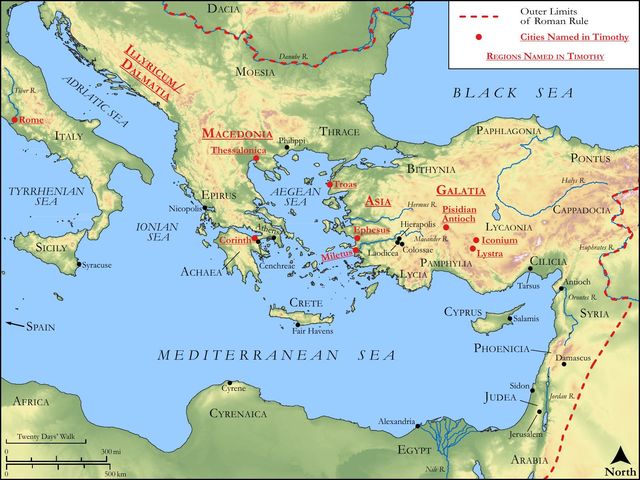
See on the biblical-era map

Study this verse
Public-domain commentary
Matthew Henry
From his Commentary on the Whole Bible. Henry comments on passages, not single verses — this entry covers 2 Timothy 3:10–17. His four-level outline is real structure in the source text, so it is rendered as structure.
Here the apostle, to confirm Timothy in that way wherein he walked,
I.Sets before him his own example, which Timothy had been an eye-witness of, having long attended Paul (Ti2 3:10):
Thou hast fully known my doctrine. The more fully we know the doctrine of Christ and the apostles, the more closely we shall cleave to it; the reason why many sit loose to it is because they do not fully know it. Christ's apostles had no enemies but those who did not know them, or not know them fully; those who knew them best loved and honoured them the most. Now what is it that Timothy had so fully known in Paul?
1.The doctrine that he preached. Paul kept back nothing from his hearers, but declared to them the whole counsel of God (Act 20:27), so that if it were not their own fault they might fully know it. Timothy had a great advantage in being trained up under such a tutor, and being apprised of the doctrine he preached.
2.He had fully known his conversation: Thou hast fully know my doctrine, and manner of life; his manner of life was of a piece with his doctrine, and did not contradict it. He did not pull down by his living what he built up by his preaching. Those ministers are likely to do good, and leave lasting fruits of their labours, whose manner of life agrees with their doctrine; as, on the contrary, those cannot expect to profit the people at all that preach well and live ill.
3.Timothy fully knew what was the great thing that Paul had in view, both in his preaching and in his conversation: "Thou hast known my purpose, what I drive at, how far it is from any worldly, carnal, secular design, and how sincerely I aim at the glory of God and the good of the souls of men." 4. Timothy fully knew Paul's good character, which he might gather from his doctrine, manner of life, and purpose; for he gave proofs of his faith (that is, of his integrity and fidelity, or his faith in Christ, his faith concerning another world, by which Paul lived), his long-suffering towards the churches to which he preached and over which he presided, his charity towards all men, and his patience. These were graces that Paul was eminent for, and Timothy knew it. 5. He knew that he had suffered ill for doing well (Ti2 3:11): "Thou hast fully known the persecutions and afflictions that came unto me" (he mentions those only which happened to him while Timothy was with him, at Antioch, at Iconium, at Lystra); "and therefore let it be no surprise to thee if thou suffer hard things, it is no more than I have endured before." 6. He knew what care God had taken of him: Notwithstanding out of them all the Lord delivered me; as he never failed his cause, so his God never failed him. Thou hast fully known my afflictions. When we know the afflictions of good people but in part, they are a temptation to us to decline that cause which they suffer for; when we know only the hardships they undergo for Christ, we may be ready to say, "We will renounce that cause that is likely to cost us so dear in the owning of it;" but when we fully know the afflictions, not only how they suffer, but how they are supported and comforted under their sufferings, then, instead of being discouraged, we shall be animated by them, especially considering that we are told before that we must count upon such things (Ti2 3:12): All that will live godly in Christ Jesus shall suffer persecution: not always alike; at that time those who professed the faith of Christ were more exposed to persecution than at other times; but at all times, more or less, those who will live godly in Christ Jesus shall suffer persecution. They must expect to be despised, and that their religion will stand in the way of their preferment; those who will live godly must expect it, especially those who will live godly in Christ Jesus, that is, according to the strict rules of the Christian religion, those who will wear the livery and bear the name of the crucified Redeemer. All who will show their religion in their conversation, who will not only be godly, but live godly, let them expect persecution, especially when they are resolute in it. Observe,
(1.)The apostle's life was very exemplary for three things: for his doctrine, which was according to the will of God; for his life, which was agreeable to his doctrine; and for his persecutions and sufferings.
(2.)Though his life was a life of great usefulness, yet it was a life of great sufferings; and none, I believe, came nearer to their great Master for eminent services and great sufferings than Paul: he suffered almost in every place; the Holy Ghost witnessed that bonds and afflictions did abide him, Act 20:23. Here he mentions his persecutions and afflictions at Antioch, at Iconium, at Lystra, besides what he suffered elsewhere.
(3.)The apostle mentions the Lord's delivering him out of them all, for Timothy's and our encouragement under sufferings.
(4.)We have the practice and treatment of true Christians: they live godly in Jesus Christ - this is their practice; and they shall suffer persecution - this is the usage they must expect in this world.
II.He warns Timothy of the fatal end of seducers, as a reason why he should stick closely to the truth as it is in Jesus:
But evil men and seducers shall wax worse and worse, etc., Ti2 3:13. Observe, As good men, by the grace of God, grow better and better, so bad men, through the subtlety of Satan and the power of their own corruptions, grow worse and worse. The way of sin is down-hill; for such proceed from bad to worse, deceiving and being deceived. Those who deceive others do but deceive themselves; those who draw others into error run themselves into more and more mistakes, and they will find it so at last, to their cost.
III.He directs him to keep close to a good education, and particularly to what he had learned out of the holy scriptures (Ti2 3:14, Ti2 3:15):
Continue thou in the things which thou hast learned. Note, It is not enough to learn that which is good, but we must continue in it, and persevere in it unto the end. Then are we Christ's disciples indeed, Joh 8:31. We should not be any more children, tossed to and fro, and carried about with every wind of doctrine, by the sleight of men and cunning craftiness, whereby they lie in wait to deceive, Eph 4:14. Be not carried about with divers and strange doctrines; for it is a good thing that the heart be established with grace, Heb 13:9. And for this reason we should continue in the things we have learned from the holy scriptures; not that we ought to continue in any errors and mistakes which we may have been led into, in the time of our childhood and youth (for these, upon an impartial enquiry and full conviction, we should forsake); but this makes nothing against our continuing in those things which the holy scriptures plainly assert, and which he that runs may read. If Timothy would adhere to the truth as he had been taught it, this would arm him against the snares and insinuations of seducers. Observe, Timothy must continue in the things which he had learned and had been assured of.
1.It is a great happiness to know the certainty of the things wherein we have been instructed (Luk 1:4); not only to know what the truths are, but to know that they are of undoubted certainty. What we have learned we must labour to be more and more assured of, that, being grounded in the truth, we may be guarded against error, for certainty in religion is of great importance and advantage: Knowing, (1.) "That thou hast had good teachers. Consider of whom thou hast learned them; not of evil men and seducers, but good men, who had themselves experienced the power of the truths they taught thee, and been ready to suffer for them, and thereby would give the fullest evidence of their belief of these truths." (2.) "Knowing especially the firm foundation upon which thou hast built, namely, that of the scripture (Ti2 3:15): That from a child thou hast known the holy scriptures."
2.Those who would acquaint themselves with the things of God, and be assured of them, must know the holy scriptures, for these are the summary of divine revelation.
3.It is a great happiness to know the holy scriptures from our childhood; and children should betimes get the knowledge of the scriptures. The age of children is the learning age; and those who would get true learning must get it out of the scriptures.
4.The scriptures we are to know are the holy scriptures; they come from the holy God, were delivered by holy men, contain holy precepts, treat of holy things, and were designed to make us holy and to lead us in the way of holiness to happiness; being called the holy scriptures, they are by this distinguished from profane writings of all sorts, and from those that only treat morality, and common justice and honesty, but do not meddle with holiness. If we would know the holy scriptures, we must read and search them daily, as the noble Bereans did, Act 17:11. They must not lie by us neglected, and seldom or never looked into. Now here observe,
(1.)What is the excellency of the scripture. It is given by inspiration of God (Ti2 3:16), and therefore is his word. It is a divine revelation, which we may depend upon as infallibly true. The same Spirit that breathed reason into us breathes revelation among us: For the prophecy came not in old time by the will of man, but holy men spoke as they were moved or carried forth by the Holy Ghost, Pe2 1:21. The prophets and apostles did not speak from themselves, but what they received of the Lord that they delivered unto us. That the scripture was given by inspiration of God appears from the majesty of its style, - from the truth, purity, and sublimity, of the doctrines contained in it, - from the harmony of its several parts, - from its power and efficacy on the minds of multitudes that converse with it, - from the accomplishment of many prophecies relating to things beyond all human foresight, - and from the uncontrollable miracles that were wrought in proof of its divine original: God also bearing them witness, both with signs and wonders, and with divers miracles and gifts of the Holy Ghost, according to his own will, Heb 2:4.
(2.)What use it will be of to us.
[1.]It is able to make us wise to salvation; that is, it is a sure guide in our way to eternal life. Note, Those are wise indeed who are wise to salvation. The scriptures are able to make us truly wise, wise for our souls and another world. "To make thee wise to salvation through faith." Observe, The scriptures will make us wise to salvation, if they be mixed with faith, and not otherwise, Heb 4:2. For, if we do not believe their truth and goodness, they will do us no good.
[2.]It is profitable to us for all the purposes of the Christian life, for doctrine, for reproof, for correction, for instruction in righteousness. It answers all the ends of divine revelation. It instructs us in that which is true, reproves us for that which is amiss, directs us in that which is good. It is of use to all, for we all need to be instructed, corrected, and reproved: it is of special use to ministers, who are to give instruction, correction, and reproof; and whence can they fetch it better than from the scripture?
[3.]That the man of God may be perfect, Ti2 3:17. The Christian, the minister, is the man of God. That which finishes a man of God in this world is the scripture. By it we are thoroughly furnished for every good work. There is that in the scripture which suits every case. Whatever duty we have to do, whatever service is required from us, we may find enough in the scriptures to furnish us for it.
(3.)On the whole we here see,
[1.]That the scripture has various uses, and answers divers ends and purposes: It is profitable for doctrine, for reproof, for correction of all errors in judgment and practice, and for instruction in righteousness.
[2.]The scripture is a perfect rule of faith and practice, and was designed for the man of God, the minister as well as the Christian who is devoted to God, for it is profitable for doctrine, etc.
[3.]If we consult the scripture, which was given by inspiration of God, and follow its directions, we shall be made men of God, perfect, and thoroughly furnished to every good work.
[4.]There is no occasion for the writings of the philosopher, nor for rabbinical fables, nor popish legends, nor unwritten traditions, to make us perfect men of God, since the scripture answers all these ends and purposes. O that we may love our Bibles more, and keep closer to them than ever! and then shall we find the benefit and advantage designed thereby, and shall at last attain the happiness therein promised and assured to us.
Historical interpretation
Six Centuries of Reception
4 surviving comments on this verse. Each one is dated, so this reads as a timeline rather than a list.
Select a marker to jump to its quote. Markers stagger vertically where authors wrote within a few decades of each other.
"But thou hast fully known my doctrine." Wherefore be strong; for thou wert not merely present, but didst follow closely. Here he seems to imply that the period had been long, in that he says, "Thou hast followed up my doctrine"; this refers to his discourse. "Manner of life"; this to his conduct. "Purpose"; this to his zeal, and the firmness of his soul. I did not say these things, he says, and not do them; nor was I a philosopher in words only. "Faith, longsuffering." He means, how none of these things troubled me. "Charity," which those men had not; "patience," nor yet this. Towards the heretics, he means, I show much longsuffering; "patience," that under persecution. "Persecutions, afflictions." There are two things that disquiet a teacher, the number of heretics, and men's wanting fortitude to endure sufferings. And yet he has said much about these, that such always have been, and always will be, and no age will be free from them, and that they will not be able to injure us, and that in the world there are vessels of gold and of silver. You see how he proceeds to discourse about his afflictions, "which came upon me at Antioch, at Iconium, at Lystra." Why has he selected these instances out of many? Because the rest was known to Timothy, and these perhaps were new events, and he does not mention the former ones, for he is not enumerating them particularly, for he is not actuated by ambition or vainglory, but he recounts them for the consolation of his disciple, not from ostentation. And here he speaks of Antioch in Pisidia, and Lystra, whence Timothy himself was. "What persecutions I endured." There was twofold matter of consolation, that I displayed a generous zeal, and that I was not forsaken. It cannot be said, that God abandoned me, but He rendered my crown more radiant. "What persecutions I endured: but out of them all the Lord delivered me."
Paul’s point in recalling these events is to show the divine help, thus adding spirit to the disciple.
He refers to the things which he suffered at Thecla.
But you followed my teaching, my conduct, my purpose, my faith, my patience, my love, my endurance, my persecutions, my sufferings, such as happened to me at Antioch, at Iconium, and at Lystra, what persecutions I endured; and out of them all the Lord rescued me.
Indeed, those are such, Paul said, but you know that mine are not of this kind. For you did not simply accompany me, but you followed closely, that is, you accompanied me for a long time, and you paid attention to all my teachings. Therefore, you must be steadfast in the state of moral teachings, unshakable, "followed my teaching." On the matters concerning doctrines.
my conduct. Concerning life. How I was led, Paul says, in the state.
my purpose. As to eagerness, and to the presence of the soul.
my faith. Preserved in dangers, which would not allow despair, but to believe in God that He would deliver.
my patience. Paul says, nothing of the trials was more grievous to me.
my endurance. Endurance towards persecutions.
such as happened to me. Not only was I persecuted, Paul says, but I also suffered. Then, furthermore, he goes through the trials in detail, making the disciple bolder by this. For continuous memory of the trials, he knows, encourages the soul. But he only mentions these things either because they are more recent or because they were known to Timothy, and this is more likely.
at Antioch. The trials are not listed by type. For the discourse does not see it as motivation, but as guidance for the disciple. And here Paul speaks two things suitable for encouragement. That I, he says, showed zeal, and God gave assistance. He indeed says Antioch in Pisidia.
— [OECUMENIUS] "at Lystra." I suppose that Paul said Lystra in the last place out of some misery, from which Timothy originated: as if he were to say: Surely, I suffered in frequent and populous cities what I endured; but why did I also suffer in Lystra? From there were found men who would afflict me in Lystra? [end of the excerpt by Oecumenius A f. 181v,; B f. 219r; G f. 308r] —
Continue studying 2 Timothy 3:11 across the web’s major study libraries — every link below opens this exact verse, chapter, or book on the destination site.
Read & Compare
 BibleGatewayThis verse in more than 200 translations and 70 languages.
 Bible.comThe YouVersion reader — hundreds of translations, reading plans, and highlights.
 ESV.orgCrossway's official English Standard Version reader.
 NET BibleThe NET translation with 60,000+ translators' notes on every rendering decision.
 STEP BibleTyndale House's free study tool — original text, vocabulary, and scholarly resources.
 BibliaLogos Bible Software's free web reader.
 USCCBThe New American Bible (Revised Edition) with the U.S. bishops' study notes.
Commentaries
 BibleHub CommentariesDozens of classic commentaries on this verse, gathered on one page.
 StudyLightMore than 100 commentary sets — the largest collection on the web.
 BibleRefPlain-English commentary on what this verse means, verse by verse.
 Enduring WordDavid Guzik's free commentary on this chapter, widely used by Bible teachers.
 Bible Study ToolsVerse commentary alongside Greek and Hebrew study aids.
Original Language & Research
- BibleHub InterlinearThe verse word by word — original language, transliteration, and English.
- BibleHub LexiconEvery word's original-language definition and Strong's entry.
 Blue Letter BibleDeep-study tools — Strong's numbers, concordance, and word studies.
 CNTR CollationThe earliest Greek manuscripts of this verse, collated letter by letter.
Sermons, Hymns & Audio


TrulyRandomVerse is not affiliated with these sites and doesn’t control their content. They’re linked because they’re genuinely useful.
Summary
In 2 Timothy 3:11, the Apostle Paul offers a profound personal testimony to his spiritual son, Timothy, recounting the severe persecutions and afflictions he endured in Antioch, Iconium, and Lystra. This verse serves as a powerful declaration of God's unwavering faithfulness and sovereign deliverance amidst life-threatening trials, providing a foundational model of perseverance and divine protection for all who follow Christ.
Context
ShowHideLiterary Context
This verse is situated within Paul's final epistle to Timothy, a deeply personal and pastoral letter written from prison. Immediately preceding 2 Timothy 3:11, Paul issues a solemn warning about the "perilous times" that will characterize the last days, describing a pervasive moral decay and spiritual apostasy (see 2 Timothy 3:1-9). In stark contrast to these ungodly individuals, Paul presents his own life and ministry as an exemplary pattern for Timothy to follow. Verse 10 explicitly states that Timothy has "fully known" Paul's doctrine, manner of life, purpose, faith, longsuffering, charity, and patience. Verse 11 then naturally extends this list, detailing the specific "persecutions, afflictions" Paul endured, thereby providing concrete evidence of his steadfastness and God's sustaining power in the face of intense opposition, preparing Timothy for similar challenges in his own ministry.
Historical & Cultural Context
The cities mentioned—Antioch (Pisidian Antioch), Iconium, and Lystra—were significant stops on Paul's first missionary journey, as recorded in the book of Acts (see Acts 13-14). In Pisidian Antioch, Paul and Barnabas faced intense opposition from Jewish leaders who incited prominent citizens and devout women, leading to their expulsion from the city (see Acts 13:50). In Iconium, a combined effort by both Jews and Gentiles sought to stone them (see Acts 14:5). The most severe incident occurred in Lystra, where Paul was actually stoned by a mob and dragged out of the city, presumed dead, only to miraculously recover and continue his ministry (see Acts 14:19-20). These were not minor inconveniences but life-threatening assaults, reflecting the profound hostility faced by early Christian missionaries from both religious and secular authorities who perceived their message as a threat to established social and religious orders. Paul's vivid recollection underscores the brutal reality of suffering for the Gospel in the Roman world.
Key Themes
ShowHideThis verse powerfully contributes to several overarching themes within 2 Timothy and the broader Pauline corpus. First, it highlights the theme of endurance in persecution, demonstrating that suffering is an expected, though difficult, component of faithful Christian living and ministry, particularly for those who proclaim the Gospel (as seen throughout Paul's ministry). Second, it emphasizes divine deliverance and faithfulness, asserting that despite the severity of the trials, "the Lord delivered me." This deliverance is not necessarily an absence of suffering, but God's active presence, preservation, and ultimate rescue through it, showcasing His sovereignty over all circumstances (a theme echoed in Psalm 34:19). Finally, the verse reinforces the theme of mentorship and apostolic example, as Paul uses his own experiences to equip and encourage Timothy, preparing him for the inevitable challenges of pastoral ministry and reminding him that God will also sustain him (a principle central to Paul's charge in 2 Timothy 2:2).
Exposition and Analysis
ShowHideKey Word Analysis
ShowHideFrom the root meaning "to chase" or "to pursue," this term refers to intense, often violent, and systematic harassment, oppression, or ill-treatment, specifically on account of one's beliefs or actions. In this context, it denotes the active and hostile pursuit by those seeking to harm or eliminate Paul due to his proclamation of the Christian message.
This word signifies "something undergone," encompassing hardship, suffering, pain, or calamity. It speaks to the negative experiences, both physical and emotional, that Paul endured as a direct result of the persecutions. It points to the internal and external distress caused by the hostile environment.
This verb, in its middle voice, conveys the idea of "to rush or draw (for oneself)," meaning to rescue, snatch away, or preserve from danger. It emphasizes God's active intervention and protective power, indicating that Paul's survival and continued ministry were not due to his own strength or cunning, but to the Lord's direct and decisive action to save him from mortal peril.
Verse Breakdown
ShowHide"Persecutions, afflictions, which came unto me at Antioch, at Iconium, at Lystra"
Paul begins by listing the types of suffering he faced, using two strong, overlapping terms: "persecutions" (active pursuit and oppression) and "afflictions" (the resulting hardship and pain). He then immediately grounds these general terms in specific, verifiable historical events by naming three cities on his first missionary journey. This specificity serves to validate his claims and to remind Timothy of the concrete, life-threatening nature of the trials Paul endured, which Timothy himself would have been aware of, having joined Paul later on this journey (see Acts 16:1-2).
"what persecutions I endured"
This phrase serves as a powerful rhetorical exclamation, emphasizing the sheer magnitude and intensity of the suffering. The word "what" (Greek, hoîos') here conveys a sense of "what sort of" or "how great," highlighting the extreme nature of the trials. Paul is not merely listing events but underscoring the profound personal cost and resilience required to "endure" (Greek, hypophérō', meaning to "bear from underneath" or "undergo hardship") such severe opposition.
"but out of them all the Lord delivered me"
This is the pivotal clause of the verse, introducing a dramatic contrast ("but") that shifts the focus from Paul's suffering to God's sovereign intervention. Despite the overwhelming nature of "all" these trials, Paul unequivocally attributes his survival and continued ministry to the direct action of "the Lord" (Greek, kýrios', signifying supreme authority and mastership). The verb "delivered" (Greek, rhýomai') powerfully conveys a rescue from danger, underscoring God's faithfulness to preserve His servant for His purposes. This declaration transforms the narrative from one of human suffering into a testament of divine power and faithfulness.
Literary Devices
ShowHidePaul employs several potent literary devices in this concise verse. The use of Anaphora or Repetition is evident in the double mention of "persecutions," first as a general category and then as a rhetorical exclamation ("what persecutions I endured"), which serves to underscore the pervasive and intense nature of the trials. The verse itself functions as a powerful Testimony or Autobiographical Narrative, where Paul offers his own life as a living example and proof of God's faithfulness. The most striking device is the sharp Contrast introduced by the conjunction "but." This conjunction creates a dramatic pivot, shifting the reader's focus from the overwhelming reality of suffering to the ultimate triumph of divine intervention. This contrast highlights the power of God over human adversity. Furthermore, the phrase "what persecutions I endured" can be seen as a form of Exclamation or Emphasis, conveying the profound depth of his experience in a way that mere enumeration cannot capture, inviting Timothy (and the reader) to grasp the severity of the trials.
Theological and Thematic Connections
ShowHideThis verse profoundly illustrates the biblical truth that faithful living and ministry often entail suffering, yet God's sovereign hand is always present to deliver His people. Paul's experience is a microcosm of the larger narrative of God's people throughout history, who have faced opposition for their faith but have consistently witnessed divine preservation. This deliverance is not always an immediate removal from the trial, but rather God's sustaining grace within it, His provision of strength to endure, or His ultimate rescue for His greater purposes. It underscores that God's faithfulness is not contingent on the absence of hardship, but is most gloriously displayed in the midst of it, transforming affliction into a platform for His power and glory. This truth encourages believers to persevere, knowing that their trials are not meaningless but are opportunities for God to demonstrate His unwavering commitment to them.
Reflection and Application
ShowHidePaul's testimony in 2 Timothy 3:11 serves as a timeless anchor for believers navigating a world often hostile to the Gospel. It reminds us that suffering for Christ is not an anomaly but a potential reality, uniting us with the experiences of apostles and prophets who have gone before us. This verse calls us to cultivate a robust faith that expects trials, yet simultaneously trusts in the unfailing power of God for deliverance. Our deliverance may manifest as supernatural rescue, as it did for Paul at Lystra, or it may be the inner strength to endure with joy, or the ultimate deliverance into eternal glory. The key is not the absence of struggle, but the presence of the Lord in every struggle. By reflecting on Paul's example, we are encouraged to fix our eyes not on the intensity of our "persecutions" and "afflictions," but on the steadfast character of "the Lord" who promises to be with us always, and to ultimately deliver us for His glory and our good.
Questions for Reflection
ShowHideFAQ
ShowHideWhy does Paul specifically name Antioch, Iconium, and Lystra?
ShowHidePaul names these specific cities to provide concrete, verifiable examples of the severe persecution he endured during his first missionary journey. Timothy himself would have been familiar with these events, having joined Paul's ministry later on this very journey (see Acts 16:1-3). By recalling these well-known and traumatic incidents—including being stoned and left for dead in Lystra (see Acts 14:19)—Paul underscores the authenticity and intensity of his suffering. This serves not only as a personal testimony but also as a powerful teaching tool, preparing Timothy for the inevitable hardships of faithful ministry and demonstrating God's consistent deliverance through them.
What does "the Lord delivered me" mean in this context? Does it mean Paul never suffered again?
ShowHide"The Lord delivered me" signifies God's active intervention and preservation of Paul's life and ministry through these specific, life-threatening events. It does not imply that Paul was immune to future suffering or that God always removes believers from all trials. Rather, it highlights God's faithfulness to sustain His servant for His purposes. In some cases, deliverance was a miraculous rescue (like recovering after being stoned in Lystra); in others, it was the provision of strength to endure, or the opening of a way of escape (as when he fled Iconium to avoid stoning, see Acts 14:6). Paul's later writings and eventual martyrdom clearly show that he continued to suffer for Christ (see 2 Corinthians 11:23-27). The deliverance here refers to God's specific acts of preservation in these particular instances, enabling Paul to continue his mission.
Christ-Centered Fulfillment
ShowHidePaul's testimony of suffering and divine deliverance in 2 Timothy 3:11 finds its ultimate Christ-centered fulfillment in the life, death, and resurrection of Jesus Christ. Just as Paul endured "persecutions, afflictions" for the sake of the Gospel, Christ Himself suffered the ultimate persecution and affliction, bearing the sins of humanity on the cross (see Isaiah 53:4-5). His journey to the cross, marked by rejection, betrayal, and physical torment, was the supreme act of endurance (see Hebrews 12:2). Yet, "out of them all," the Father "delivered" Him through the resurrection, conquering sin and death and establishing Him as Lord over all (see Acts 2:24). Thus, Paul's experience mirrors the pattern of Christ: suffering leading to ultimate vindication and triumph. For believers, our own experiences of persecution and affliction are not only endured by the Lord's power but also unite us with Christ's suffering, making us partakers of His redemptive work (see Philippians 3:10). Our ultimate deliverance, like Paul's, is secured in Christ's victory, culminating in our resurrection and eternal life with Him, where all tears will be wiped away (see Revelation 21:4).