


Acts 14:5
- ὡςhōsWhenG5613PRTParticle or Disjunctive
- δὲdethenG1161CONJConjunction
- ἐγένετοegenetothere wasG1096V-2ADI-3SVerb 2nd Aorist Middle Deponent Indicative 3rd Singular
- ὁρμὴhormēa rushG3730N-NSFNoun Nominative Singular Feminine
- τῶνtōnof theG3588T-GPNDefinite article Genitive Plural Neuter
- ἐθνῶνethnōnGentilesG1484N-GPNNoun Genitive Plural Neuter
- τεtebothG5037CONJConjunction
- καὶkaiandG2532CONJConjunction
- ἸουδαίωνIoudaiōnJewsG2453N-GPM-PGNoun Genitive Plural Masculine Person Gentilic
- σὺνsunwithG4862PREPPreposition
- τοῖςtoistheG3588T-DPMDefinite article Dative Plural Masculine
- ἄρχουσινarchousinrulersG758N-DPMNoun Dative Plural Masculine
- αὐτῶνautōnof themG846P-GPMPersonal pronoun Genitive Plural Masculine
- ὑβρίσαιhubrisaito mistreatG5195V-AANVerb Aorist Active Infinitive
- καὶkaiandG2532CONJConjunction
- λιθοβολῆσαιlithobolēsaito stoneG3036V-AANVerb Aorist Active Infinitive
- αὐτούςautousthemG846P-APMPersonal pronoun Accusative Plural Masculine
English is a literal word-by-word gloss of the Greek, not the KJV's wording. Why?
This is the original text the KJV's translators worked from — each Greek word with its own literal English meaning in this verse, prepared by scholars at Tyndale House, Cambridge. The KJV translates whole sentences, not word by word, so its wording differs: one Greek word can become several English words, and the KJV may choose “charity” where the gloss reads “love”. Both are faithful — they answer different questions. For the KJV's own rendering, switch to the KJV text.
Details
See on the biblical-era map
Study this verse
Public-domain commentary
Matthew Henry
From his Commentary on the Whole Bible. Henry comments on passages, not single verses — this entry covers Acts 14:1–7. His three-level outline is real structure in the source text, so it is rendered as structure.
In these verses we have,
I.The preaching of the gospel in Iconium, whither the apostles were forced to retire from Antioch.
As the blood of the martyrs has been the seed of the church, so the banishment of the confessors has helped to scatter that seed. Observe,
1.How they made the first offer of the gospel to the Jews in their synagogues; thither they went, not only as to a place of meeting, but as to a place of meeting with them, to whom, wherever they came, they were to apply themselves in the first place. Though the Jews at Antioch had used them barbarously, yet they did not therefore decline preaching the gospel to the Jews at Iconium, who perhaps might be better disposed. Let not those of any denomination be condemned in the gross, nor some suffer for others' faults; but let us do good to those who have done evil to us. Though the blood-thirsty hate the upright, yet the just seek their soul (Pro 29:10), seek the salvation of it.
2.How the apostles concurred herein. Notice is taken of this, that they went both together into the synagogue, to testify their unanimity and mutual affection, that people might say, See how they love one another, and might think the better of Christianity, and that they might strengthen one another's hands and confirm one another's testimony, and out of the mouth of two witnesses every word might be established. They did not go one one day and another another, nor one go at the beginning and the other some time after; but they went in both together.
II.The success of their preaching there:
They so spoke that a great multitude, some hundreds perhaps, if not thousands, both of the Jews and also of the Greeks, that is the Gentiles, believed. Observe here,
1.That the gospel was now preached to Jews and Gentiles together, and those of each denomination that believed came together into the church. In the close of the foregoing chapter it was preached first to the Jews, and some of them believed, and then to the Gentiles, and some of them believed; but here they are put together, being put upon the same level. The Jews have not so lost their preference as to be thrown behind, only the Gentiles are brought to stand upon even terms with them; both are reconciled to God in one body (Eph 2:16), and both together admitted into the church without distinction.
2.There seems to have been something remarkable in the manner of the apostles' preaching here, which contributed to their success: They so spoke that a great multitude believed - so plainly, so convincingly, with such an evidence and demonstration of the Spirit, and with such power; they so spoke, so warmly, so affectionately, and with such a manifest concern for the souls of men, that one might perceive they were not only convinced, but filled, with the things they spoke of, and that what they spoke came from the heart and therefore was likely to reach to the heart; they so spoke, so earnestly and so seriously, so boldly and courageously, that those who heard them could not but say that God was with them of a truth. Yet the success was not to be attributed to the manner of their preaching, but to the Spirit of God, who made use of that means.
III.The opposition that their preaching met with there, and the trouble that was created them; lest they should be puffed up with the multitude of their converts, there was given them this thorn in the flesh.
1.Unbelieving Jews were the first spring of their trouble here, as elsewhere (Act 14:2): they stirred up the Gentiles. The influence which the gospel had upon many of the Gentiles, and their embracing it, as it provoked some of the Jews to a holy jealousy and stirred them up to receive the gospel too (Rom 11:14), so it provoked others of them to a wicked jealousy, and exasperated them against the gospel. Thus as good instructions, so good examples, which to some are a savour of life unto life, to others are a savour of death unto death. See Co2 2:15, Co2 2:16.
2.Disaffected Gentiles, irritated by the unbelieving Jews, were likely to be the instruments of their trouble. The Jews, by false suggestions, which they were continually buzzing in the ears of the Gentiles, made their minds evil affected against the brethren, whom of themselves they were inclined to think favourably of. They not only took occasion in all companies, as it came in their way, but made it their business to go purposely to such as they had any acquaintance with, and said all that their wit or malice could invent to beget in them not only a mean but an ill opinion of Christianity, telling them how destructive it would certainly be to their pagan theology and worship; and, for their parts, they would rather be Gentiles than Christians. Thus they soured and embittered their spirits against both the converters and the converted. The old serpent did, by their poisonous tongues, infuse his venom against the seed of the woman into the minds of these Gentiles, and this was a root of bitterness in them, bearing gall and wormwood. It is no wonder if those who are ill affected towards good people wish ill to them, speak ill of them, and contrive ill against them; it is all owing to ill will. Ekakōsan, they molested and vexed the minds of the Gentiles (so some of the critics take it); they were continually teasing them with their impertinent solicitations. The tools of persecutors have a dog's life, set on continually.
IV.Their continuance in their work there, notwithstanding this opposition, and God's owning them in it, Act 14:3. We have here,
1.The apostles working for Christ, faithfully and diligently, according to the trust committed to them. Because the minds of the Gentiles were evil affected against them, one would think that therefore they should have withdrawn, and hastened out of the way, or, if they had preached, should have preached cautiously, for fear of giving further provocation to those who were already enough enraged. No; on the contrary, therefore they abode there a long time, speaking boldly in the Lord. The more they perceived the spite and rancour of the town against the new converts, the more they were animated to go on in their work, and the more needful they saw it to continue among them, to confirm them in the faith, and to comfort them. They spoke boldly, and were not afraid of giving offence to the unbelieving Jews. What God said to the prophet, with reference to the unbelieving Jews in his day, was now made good to the apostles: I have made thy face strong against their faces, Eze 3:7-9. But observe what it was that animated them: They spoke boldly in the Lord, in his strength, and trusting in him to bear them out; not depending upon any thing in themselves. They were strong in the Lord, and in the power of his might.
2.Christ working with the apostles, according to his promise, Lo, I am with you always. When they went on in his name and strength, he failed not to give testimony to the word of his grace. Note,
(1.)The gospel is a word of grace, the assurance of God's good will to us and the means of his good work in us. It is the word of Christ's grace, for it is in him alone that we find favour with God.
(2.)Christ himself has attested this word of grace, who is the Amen, the faithful witness; he has assured us that it is the word of God, and that we may venture our souls upon it. As it was said in general concerning the first preachers of the gospel that they had the Lord working with them, and confirming the word by signs following (Mar 16:20), so it is said particularly concerning the apostles here that the Lord confirmed their testimony, in granting signs and wonders to be done by their hands - in the miracles they wrought in the kingdom of nature - as well as the wonders done by their word, in the greater miracles wrought on men's minds by the power of divine grace. The Lord was with them, while they were with him, and abundance of good was done.
V.The division which this occasioned in the city (Act 14:4):
The multitude of the city was divided into two parties, and both active and vigorous. Among the rulers and persons of rank, and among the common people, there were some that held with the unbelieving Jews, and others that held with the apostles. Barnabas is here reckoned an apostle, though not one of the twelve, nor called in the extra-ordinary manner that Paul was, because set apart by special designation of the Holy Ghost to the service of the Gentiles. It seems, this business of the preaching of the gospel was so universally taken notice of with concern that every person, even of the multitude of the city, was either for it or against it; none stood neuter. "Either for us or for our adversaries, for God or Baal, for Christ or Beelzebub." 1. We may here see the meaning of Christ's prediction that he came not to send peace upon earth, but rather division, Luk 12:51-53. If all would have given in unanimously into his measures, there would have been universal concord; and, could men have agreed in this, there would have been no dangerous discord nor disagreement in other things; but, disagreeing here, the breach was wide as the sea. Yet the apostles must not be blamed for coming to Iconium, although before they came the city was united, and now it was divided; for it is better that part of the city go to heaven than all to hell. 2. We may here take the measures of our expectations; let us not think it strange if the preaching of the gospel occasion division, nor be offended at it; it is better to be reproached and persecuted as dividers for swimming against the stream than yield ourselves to be carried down the stream that leads to destruction. Let us hold with the apostles, and not fear those that hold with the Jews.
VI.The attempt made upon the apostles by their enemies.
Their evil affection against them broke out at length into violent outrages, Act 14:5. Observe,
1.Who the plotters were: Both the Gentiles and the Jews, with their rulers. The Gentiles and Jews were at enmity with one another, and yet united against Christians, like Herod and Pilate, Sadducees and Pharisees, against Christ; and like Gebal and Ammon and Amalek, of old, against Israel. If the church's enemies can thus unite for its destruction, shall not its friends, laying aside all personal feuds, unite for its preservation?
2.What the plot was. Having now got the rulers on their side, they doubted not but to carry their point, and their design was to use the apostles despitefully, to expose them to disgrace, and then to stone them, to put them to death; and thus they hoped to sink their cause. They aimed to take away both their reputation and their life, and this was all they had to lose which men could take from them, for they had neither lands nor goods.
VII.The deliverance of the apostles out of the hands of those wicked and unreasonable men, Act 14:6, Act 14:7.
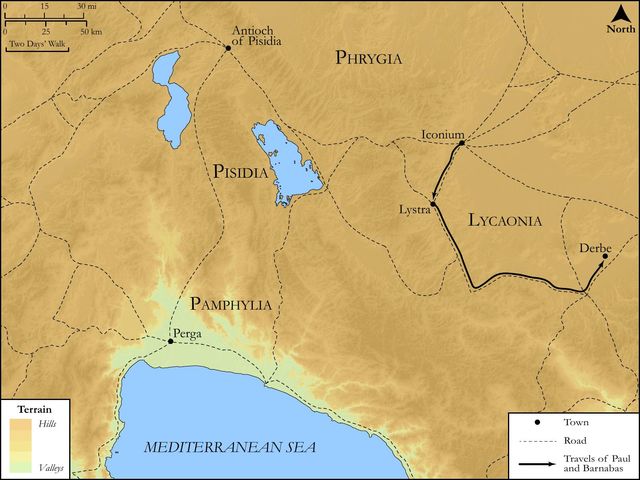
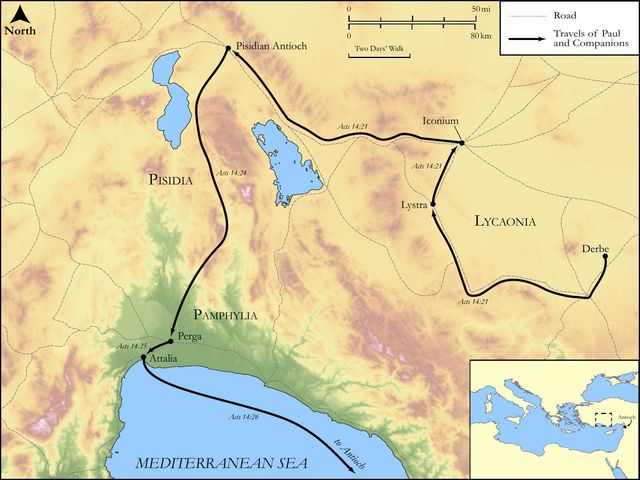
They got away, upon notice given them of the design against them, or the beginning of the attempt upon them, of which they were soon aware, and they made an honourable retreat (for it was not an inglorious flight) to Lystra and Derbe; and there,
1.They found safety. Their persecutors in Iconium were for the present satisfied that they were thrust out of their borders, and pursued them no further. God has shelters for his people in a storm; nay, he is, and will be, himself their hiding place.
2.They found work, and this was what they went for. When the door of opportunity was shut against them at Iconium, it was opened at Lystra and Derbe. To these cities they went, and there, and in the region that lieth round about, they preached the gospel. In times of persecution ministers may see cause to quit the spot, when yet they do not quit the work.
Historical interpretation
Two Centuries of Reception
3 surviving comments on this verse. Each one is dated, so this reads as a timeline rather than a list.
Select a marker to jump to its quote. Markers stagger vertically where authors wrote within a few decades of each other.
They went away into the country, not into the cities only. Observe both the simplicity of the Gentiles, and the malignity of the Jews. By their actions they showed that they were worthy to hear: they so honored them from the miracles only. The one sort honored them as gods, the other persecuted them as pestilent fellows: and those not only did not take offence at the preaching.
"And when there was an assault made both of the Gentiles, and also of the Jews with their rulers, to use them despitefully, and to stone them, they were ware of it, and fled unto Lystra and Derbe, cities of Lycaonia, and unto the region that lieth round about: and there they preached the Gospel." Again, as if they purposely wished to extend the preaching after it was increased, they once more sent them out. See on all occasions the persecutions working great good, and defeating the persecutors, and making the persecuted illustrious. For having come to Lystra, he works a great miracle, by raising the lame man.
"And when there was an assault made by the Gentiles and the Jews with their rulers," etc. When the people in the uproar that had been stirred up in Iconium tried to kill Paul and Barnabas, they fled to Lystra and Derbe and other regions of Lycaonia, and all the people there were converted to the Christian religion. In Lystra lay a certain man impotent in his feet from his mother's womb, to whom Paul, looking upon him, enjoined with a loud voice in front of everyone, in the name of Jesus Christ: "Stand on thy feet a healthy man." When the crowd in Lycaonia saw this, thinking that they were not men, but gods, they hastened to offer them sacrifices of cattle in their ancestral manner. Then Barnabas and Paul, rending their clothes, affirmed in every way that they were mortals like them, but that it was the Lord Christ who performed those things by his power, he who made the heaven, and the earth, and all things that are contained within their circumference. Calmed by means of this speech, the people were scarce stopped from the sacrifice that they had intended.
Continue studying Acts 14:5 across the web’s major study libraries — every link below opens this exact verse, chapter, or book on the destination site.
Read & Compare
 BibleGatewayThis verse in more than 200 translations and 70 languages.
 Bible.comThe YouVersion reader — hundreds of translations, reading plans, and highlights.
 ESV.orgCrossway's official English Standard Version reader.
 NET BibleThe NET translation with 60,000+ translators' notes on every rendering decision.
 STEP BibleTyndale House's free study tool — original text, vocabulary, and scholarly resources.
 BibliaLogos Bible Software's free web reader.
 USCCBThe New American Bible (Revised Edition) with the U.S. bishops' study notes.
Commentaries
 BibleHub CommentariesDozens of classic commentaries on this verse, gathered on one page.
 StudyLightMore than 100 commentary sets — the largest collection on the web.
 BibleRefPlain-English commentary on what this verse means, verse by verse.
 Enduring WordDavid Guzik's free commentary on this chapter, widely used by Bible teachers.
 Bible Study ToolsVerse commentary alongside Greek and Hebrew study aids.
Original Language & Research
- BibleHub InterlinearThe verse word by word — original language, transliteration, and English.
- BibleHub LexiconEvery word's original-language definition and Strong's entry.
 Blue Letter BibleDeep-study tools — Strong's numbers, concordance, and word studies.
 CNTR CollationThe earliest Greek manuscripts of this verse, collated letter by letter.
Sermons, Hymns & Audio


TrulyRandomVerse is not affiliated with these sites and doesn’t control their content. They’re linked because they’re genuinely useful.
Summary
Acts 14:5 captures a pivotal and dangerous moment in the early missionary endeavors of Paul and Barnabas in Iconium, revealing the intense and unified opposition they faced. As the Gospel message gained traction, a concerted effort emerged from both the local Jewish community and Gentile factions, including their respective leaders, to violently mistreat the apostles and ultimately execute them by stoning. This verse underscores the escalating hostility and the very real physical threats inherent in proclaiming the Christian faith in the ancient world.
Context
ShowHideLiterary Context
This verse immediately follows a period of significant success for Paul and Barnabas in Iconium, where they boldly proclaimed the Gospel in the synagogue, leading to a "great multitude both of the Jews and also of the Greeks believed" (Acts 14:1). However, the narrative quickly shifts to the opposition, as "the unbelieving Jews stirred up the Gentiles, and poisoned their minds against the brethren" (Acts 14:2). Despite this, Paul and Barnabas "abode long time speaking boldly in the Lord" (Acts 14:3), leading to a division in the city. Acts 14:5 describes the culmination of this growing tension, detailing the specific, violent plot against them, which then prompts their strategic retreat to Lystra and Derbe (Acts 14:6).
Historical & Cultural Context
Iconium was a significant city in the Roman province of Galatia (modern-day Turkey), situated on a major trade route. It possessed a diverse population of Jews and Gentiles, typical of many cities where Paul ministered. The synagogue served as a natural starting point for his evangelism, providing a platform to share Christ from the Old Testament Scriptures. The "rulers" mentioned likely refer to local Jewish leaders (elders of the synagogue) and possibly Gentile civic magistrates or influential citizens. Stoning was a prescribed method of execution for certain offenses under Jewish law (e.g., blasphemy, idolatry), but it was also a form of mob violence, often used to silence perceived threats or heretics. The fact that both Jews and Gentiles united in this plot is particularly noteworthy, as these groups often had strained relations. Their common opposition to the Christian message highlights the perceived radical nature of the apostles' teachings, which challenged both established Jewish traditions and pagan Roman societal norms.
Key Themes
ShowHideActs 14:5 powerfully contributes to several overarching themes in the book of Acts and the broader New Testament. It vividly illustrates the theme of Persecution and Opposition to the Gospel, demonstrating that the spread of Christianity was rarely without fierce resistance, fulfilling Jesus's warnings to His disciples about being hated for His name's sake (Matthew 10:22). The verse also highlights the Unity of Opposition, showing how disparate groups could coalesce against the perceived threat of the new faith, a pattern seen elsewhere in Acts, such as the combined efforts against Stephen (Acts 6:12). Furthermore, it underscores the theme of Divine Providence and Guidance, as the apostles were supernaturally aware of the plot, enabling their escape and the continuation of their mission, reinforcing the idea that God's plan would not be thwarted by human malice (Acts 14:6).
Exposition and Analysis
ShowHideKey Word Analysis
ShowHideThis word signifies a "violent impulse" or "onset." It suggests a sudden, aggressive, and premeditated attack, not a spontaneous outburst. This indicates a deliberate, organized plan to harm Paul and Barnabas, emphasizing the malicious intent behind the actions of the Jews and Gentiles.
This verb means "to exercise violence," "abuse," or "treat with insolence/outrage." It conveys a sense of not just physical harm, but also public humiliation, disgrace, and contempt. The intent was to degrade and shame the apostles, stripping them of their dignity and authority, in addition to inflicting physical pain.
A compound of "stone" (lithos) and "to throw" (ballō), meaning "to throw stones" or "lapidate." This term explicitly denotes an attempt at execution. Stoning was a brutal and often public form of capital punishment, signaling the extreme hatred and desire to completely eliminate the apostles and their message.
Verse Breakdown
ShowHide"And when there was an assault made"
This opening clause immediately establishes the gravity of the situation, indicating that a hostile and violent action was not merely contemplated but was actively being prepared or initiated. The passive voice ("was an assault made") highlights that the apostles were the targets of this aggressive maneuver, emphasizing their vulnerability to the mob's intent.
"both of the Gentiles, and also of the Jews with their rulers"
This crucial phrase identifies the diverse and unified nature of the opposition. It is significant that both major demographic groups—Gentiles and Jews—were involved, demonstrating a rare alliance forged in their shared animosity toward the Christian message. The inclusion of "their rulers" suggests that this was not merely a spontaneous mob action but had a degree of organization, authority, or at least tacit approval from influential figures within both communities, lending a chilling legitimacy to the plot.
"to use [them] despitefully, and to stone them"
This final clause explicitly states the dual and escalating intent of the conspirators. "To use them despitefully" (hybrizō) indicates a desire for public abuse, humiliation, and severe physical mistreatment short of death. This was designed to disgrace and deter. The ultimate aim, however, was "to stone them," which was an act of capital punishment, signifying a clear intent to kill the apostles and eradicate their influence permanently.
Literary Devices
ShowHideActs 14:5 employs several potent literary devices. There is clear Conflict, as the verse describes a direct and violent confrontation between the apostles and the unified opposition of Jews and Gentiles. This conflict is not merely ideological but escalates to a physical threat, demonstrating the high stakes of the early missionary work. The phrase also contains a strong element of Foreshadowing, particularly for Paul, who would later be stoned and left for dead in Lystra, the very next city they visit after escaping Iconium (Acts 14:19). This incident in Iconium thus serves as an early warning of the extreme dangers Paul and Barnabas would face. Furthermore, there is a subtle Irony in the "rulers" being involved in a plot that involves mob violence and an extra-legal execution, as those who are meant to uphold order and justice are instead orchestrating lawlessness. The parallel mention of "Gentiles, and also of the Jews" creates a form of Juxtaposition or Antithesis, highlighting the unusual unity of these typically disparate groups in their shared animosity towards the Gospel.
Theological and Thematic Connections
ShowHideActs 14:5 powerfully illustrates the biblical truth that faithful proclamation of the Gospel often invites intense opposition, a theme consistently woven throughout Scripture. The apostles' experience in Iconium echoes the suffering of the prophets of old and foreshadows the persecution faced by believers across history. This hostility is not merely against the messengers, but against the message itself, which challenges human autonomy, religious traditions, and worldly powers, calling for repentance and submission to Christ's Lordship. The verse reminds us that suffering for righteousness is an expected part of the Christian walk, a sign of fidelity to Christ rather than a deviation from His path.
Reflection and Application
ShowHideActs 14:5 serves as a stark reminder that the path of faithful discipleship and bold evangelism is rarely paved with ease. The apostles' experience in Iconium underscores the reality that proclaiming the truth of the Gospel can provoke strong, even violent, reactions from those whose worldview or vested interests are challenged by its message. For believers today, this means cultivating a spirit of resilience and preparedness, recognizing that opposition, whether in the form of social ostracization, verbal abuse, or more severe persecution, is a historical and ongoing reality for those who earnestly seek to live out and share their faith. It calls us to examine our own willingness to stand firm in the face of adversity, trusting in God's sovereign protection and guidance, and remembering that our ultimate reward is not found in worldly comfort but in Christ. The apostles' response—to escape and continue preaching elsewhere—demonstrates wisdom and perseverance, not cowardice, reminding us to discern when to stand and when to strategically retreat for the sake of the mission.
Questions for Reflection
ShowHideFAQ
ShowHideWhat prompted such a violent reaction against Paul and Barnabas in Iconium?
ShowHideThe violent reaction stemmed from a combination of factors. Paul and Barnabas had significant success in proclaiming the Gospel, leading many Jews and Greeks to believe (Acts 14:1). This success, however, also stirred up intense jealousy and animosity among "the unbelieving Jews," who actively "stirred up the Gentiles, and poisoned their minds against the brethren" (Acts 14:2). The message of Christ, which declared salvation through faith in a crucified Messiah and challenged the exclusivity of Jewish law, as well as the polytheism and idolatry of the Gentiles, was perceived as a direct threat to established religious, social, and cultural norms. This perceived threat, combined with the apostles' growing influence, culminated in a unified and violent plot to silence them.
What happened immediately after this plot was discovered?
ShowHideFortunately, Paul and Barnabas were made aware of the impending "assault" and "plot to use them despitefully, and to stone them." Rather than confronting the mob directly or passively awaiting their fate, they exercised wisdom and discretion. They "fled unto Lystra and Derbe, cities of Lycaonia, and unto the region that lieth round about" (Acts 14:6). This strategic retreat allowed them to escape the immediate danger and continue their missionary work in new areas, demonstrating that prudence and self-preservation, when guided by God's providence, are sometimes necessary for the continuation of the Gospel mission.
Christ-Centered Fulfillment
ShowHideActs 14:5, with its depiction of Paul and Barnabas facing a violent plot of abuse and stoning, powerfully echoes the pattern of suffering that culminates in Christ and is extended to His followers. Jesus Himself warned His disciples that they would be persecuted "for my name's sake" (Matthew 10:22) and that the world would hate them as it hated Him (John 15:18-20). The "despiteful use" and intent to "stone them" directly parallels the indignities and ultimate execution Christ endured, from the mocking and scourging by Roman soldiers (Matthew 27:27-31) to the calls for His crucifixion by a unified Jewish and Roman populace (John 19:15). The apostles' suffering is not merely a historical anecdote but a participation in the sufferings of Christ, fulfilling the prophetic words that Paul himself would "suffer many things for my name's sake" (Acts 9:16). Thus, the persecution in Iconium is a vivid reminder that the path of discipleship is a cruciform path, where fidelity to the Lamb of God often leads to opposition, mirroring the very experience of the One they proclaim, who was "despised and rejected by men" (Isaiah 53:3).