


2 Corinthians 2:16
Bible text: King James Version (1769 Blayney text) · Public domain
Bible text: King James Version with Strong's numbers · Public domain
Bible text: Berean Standard Bible · Public domain
Bible text: American Standard Version (1901) · Public domain
Bible text: World English Bible, Messianic edition · Public domain
Bible text: Geneva Bible (1599) · Public domain
Bible text: Young's Literal Translation · Public domain
- οἷςhoisto oneG3739R-DPMRelative pronoun Dative Plural Masculine
- μὲνmenindeedG3303PRTParticle or Disjunctive
- ὀσμὴosmēan odorG3744N-NSFNoun Nominative Singular Feminine
- θανάτουthanatoudeathG2288N-GSMNoun Genitive Singular Masculine
- εἰςeistoG1519PREPPreposition
- θάνατονthanatondeathG2288N-ASMNoun Accusative Singular Masculine
- οἷςhoisto oneG3739R-DPMRelative pronoun Dative Plural Masculine
- δὲdehoweverG1161CONJConjunction
- ὀσμὴosmēa fragranceG3744N-NSFNoun Nominative Singular Feminine
- ζωῆςzōēslifeG2222N-GSFNoun Genitive Singular Feminine
- εἰςeistoG1519PREPPreposition
- ζωήνzōēnlifeG2222N-ASFNoun Accusative Singular Feminine
- καὶkaiAndG2532CONJConjunction
- πρὸςprosforG4314PREPPreposition
- ταῦταtautathese thingsG3778D-APNDemonstrative pronoun Accusative Plural Neuter
- τίςtiswho [is]G5101I-NSMInterrogative pronoun Nominative Singular Masculine
- ἱκανός;hikanossufficient?G2425A-NSMAdjective Nominative Singular Masculine
English is a literal word-by-word gloss of the Greek, not the KJV's wording. Why?
This is the original text the KJV's translators worked from — each Greek word with its own literal English meaning in this verse, prepared by scholars at Tyndale House, Cambridge. The KJV translates whole sentences, not word by word, so its wording differs: one Greek word can become several English words, and the KJV may choose “charity” where the gloss reads “love”. Both are faithful — they answer different questions. For the KJV's own rendering, switch to the KJV text.
Details
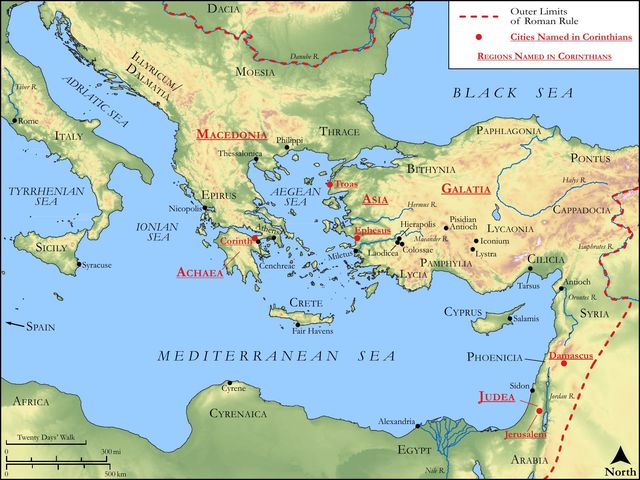
See on the biblical-era maps

Study this verse
Public-domain commentary
Matthew Henry
From his Commentary on the Whole Bible. Henry comments on passages, not single verses — this entry covers 2 Corinthians 2:12–17. His three-level outline is real structure in the source text, so it is rendered as structure.
After these directions concerning the excommunicated person the apostle makes a long digression, to give the Corinthians an account of his travels and labours for the furtherance of the gospel, and what success he had therein, declaring at the same time how much he was concerned for them in their affairs, how he had no rest in his spirit, when he found not Titus at Troas (Co2 2:13), as he expected, from whom he hoped to have understood more perfectly how it fared with them. And we find afterwards (Co2 7:5-7) that when the apostle had come into Macedonia he was comforted by the coming of Titus, and the information he gave him concerning them. So that we may look upon all that we read from this second chapter, v. 12, to ch. 7:5, as a kind of parenthesis. Observe here,
I.Paul's unwearied labour and diligence in his work, Co2 2:12, Co2 2:13.
He travelled from place to place, to preach the gospel. He went to Troas from Philippi by sea (Act 20:6), and thence he went to Macedonia; so that he was prevented from passing by Corinth, as he had designed, Co2 1:16. But, though he was prevented in his design as to the place of working, yet he was unwearied in his work.
II.His success in his work:
A great door was opened to him of the Lord, Co2 2:12. He had a great deal of work to do wherever he came, and had good success in his work; for God made manifest the savour of his knowledge by him in every place where he came. He had an opportunity to open the door of his mouth freely, and God opened the hearts of his hearers, as the heart of Lydia (Act 16:14), and the apostle speaks of this as a matter of thankfulness to God and of rejoicing to his soul: Thanks be to God, who always causeth us to triumph in Christ. Note,
1.A believer's triumphs are all in Christ. In ourselves we are weak, and have neither joy nor victory; but in Christ we may rejoice and triumph.
2.True believers have constant cause of triumph in Christ, for they are more than conquerors through him who hath loved them, Rom 8:37.
3.God causeth them to triumph in Christ. It is God who has given us matter for triumph, and hearts to triumph. To him therefore be the praise and glory of all.
4.The good success of the gospel is a good reason for a Christian's joy and rejoicing.
III.The comfort that the apostle and his companions in labour found, even when the gospel was not successful to the salvation of some who heard it, Co2 2:15-17. Here observe,
1.The different success of the gospel, and its different effects upon several sorts of persons to whom it is preached. The success is different; for some are saved by it, while others perish under it. Nor is this to be wondered at, considering the different effects the gospel has. For,
(1.)Unto some it is a savour of death unto death. Those who are willingly ignorant, and wilfully obstinate, disrelish the gospel, as men dislike an ill savour, and therefore they are blinded and hardened by it: it stirs up their corruptions, and exasperates their spirits. They reject the gospel, to their ruin, even to spiritual and eternal death.
(2.)Unto others the gospel is a savour of life unto life. To humble and gracious souls the preaching of the word is most delightful and profitable. As it is sweeter than honey to the taste, so it is more grateful than the most precious odours to the senses, and much more profitable; for as it quickened them at first, when they were dead in trespasses and sins, so it makes them more lively, and will end in eternal life.
2.The awful impressions this matter made upon the mind of the apostle, and should also make upon our spirits: Who is sufficient for these things? Co2 2:16. Tis hikanos - who is worthy to be employed in such weighty work, a work of such vast importance, because of so great consequence? Who is able to perform such a difficult work, that requires so much skill and industry? The work is great and our strength is small; yea, of ourselves we have no strength at all; all our sufficiency is of God. Note, If men did seriously consider what great things depend upon the preaching of the gospel, and how difficult the work of the ministry is, they would be very cautious how they enter upon it, and very careful to perform it well.
3.The comfort which the apostle had under this serious consideration,
(1.)Because faithful ministers shall be accepted of God, whatever their success be: We are, if faithful, unto God a sweet savour of Christ (Co2 2:15), in those who are saved and in those also who perish. God will accept of sincere intentions, and honest endeavours, though with many they are not successful. Ministers shall be accepted, and recompensed, not according to their success, but according to their fidelity. Though Israel be not gathered, yet shall I be glorious in the eyes of the Lord, Isa 49:5.
(2.)Because his conscience witnessed to his faithfulness, Co2 2:17. Though many did corrupt the word of God, yet the apostle's conscience witnessed to his fidelity. He did not mix his own notions with the doctrines and institutions of Christ; he durst not add to, nor diminish fRom. the word of God; he was faithful in dispensing the gospel, as he received it from the Lord, and had no secular turn to serve; his aim was to approve himself to God, remembering that his eye was always upon him; he therefore spoke and acted always as in the sight of God, and therefore in sincerity. Note, What we do in religion is not of God, does not come from God, will not reach to God, unless it be done in sincerity, as in the sight of God.
Historical interpretation
Historical reception
5 surviving comments on this verse. Each one is dated, so this reads as a timeline rather than a list.
Select a marker to jump to its quote. Markers stagger vertically where authors wrote within a few decades of each other.
To unbelievers the preaching of the cross is the smell of death. On hearing the Word of God they receive it as if it were a plague from which death knocks on the door. But to others it is the fragrance of life. To believers the Word of God is a messenger of eternal life. It affects them in accordance with their faith.
For so both fire, not only when it giveth light and when it purifieth gold, but even when it consumeth thorns, doth very greatly display its proper power, and so show itself to be fire: and Christ too herein also doth discover His own majesty when He "shall consume" Antichrist "with the breath of His mouth, and bring him to nought with the manifestation of His coming."
Seest thou to what a height he hath advanced the trials, terming them a triumph and a sweet savor and a sacrifice offered unto God. Then, whereas he said, "we are a sweet savor, even in them that perish," lest thou shouldest think that these too are acceptable, he added, "To the one a savor from death unto death, to the other a savor from life unto life."
For this sweet savor some so receive that they are saved, others so that they perish. So that should any one be lost, the fault is from himself: for both ointment is said to suffocate swine, and light (as I before observed,) to blind the weak. And such is the nature of good things; they not only correct what is akin to them, but also destroy the opposite: and in this way is their power most displayed.
"And who is sufficient for these things?"
Seeing he had uttered great things, that 'we are a sacrifice of Christ and a sweet savor, and are every where made to triumph,' he again useth moderation, referring all to God. Whence also he saith, "and who is sufficient for these things?" 'for all,' saith he, 'is Christ's, nothing our own.' Seest thou how opposite his language to the false Apostles'? For they indeed glory, as contributing somewhat from themselves unto the message: he, on the contrary, saith, he therefore glorieth, because he saith that nothing is his own. "For our glorying is this, the testimony of our conscience, that not in fleshly wisdom, but in the grace of God, we behaved ourselves in the world." And that which they considered it a glory to acquire, I mean the wisdom from without, he makes it his to take away. Whence also he here saith, "And who is sufficient for these things?" But if none are sufficient, that which is done is of grace.
Through an evil man divine providence can both punish and comfort. For the impiety of the Jews was the Jews’ downfall and yet provided salvation for the Gentiles. Again, divine providence through a good man can both condemn and help, as the apostle says: “To some we are the scent of life to life, but to others we are the scent of death to death.” But every tribulation is either a punishment of the impious or a testing of the just.… Further, peace and quiet from disruptive times can both profit the good and corrupt the evil.
Continue studying 2 Corinthians 2:16 across the web’s major study libraries — every link below opens this exact verse, chapter, or book on the destination site.
Read & Compare
 BibleGatewayThis verse in more than 200 translations and 70 languages.
 Bible.comThe YouVersion reader — hundreds of translations, reading plans, and highlights.
 ESV.orgCrossway's official English Standard Version reader.
 NET BibleThe NET translation with 60,000+ translators' notes on every rendering decision.
 STEP BibleTyndale House's free study tool — original text, vocabulary, and scholarly resources.
 BibliaLogos Bible Software's free web reader.
 USCCBThe New American Bible (Revised Edition) with the U.S. bishops' study notes.
Commentaries
 BibleHub CommentariesDozens of classic commentaries on this verse, gathered on one page.
 StudyLightMore than 100 commentary sets — the largest collection on the web.
 BibleRefPlain-English commentary on what this verse means, verse by verse.
 Enduring WordDavid Guzik's free commentary on this chapter, widely used by Bible teachers.
 Bible Study ToolsVerse commentary alongside Greek and Hebrew study aids.
Original Language & Research
- BibleHub InterlinearThe verse word by word — original language, transliteration, and English.
- BibleHub LexiconEvery word's original-language definition and Strong's entry.
 Blue Letter BibleDeep-study tools — Strong's numbers, concordance, and word studies.
 CNTR CollationThe earliest Greek manuscripts of this verse, collated letter by letter.
Sermons, Hymns & Audio


TrulyRandomVerse is not affiliated with these sites and doesn’t control their content. They’re linked because they’re genuinely useful.
Summary
In 2 Corinthians 2:16, the Apostle Paul articulates the profound and dual impact of his gospel ministry: for some, the message of Christ becomes an aroma leading to spiritual death and judgment, while for others, it is a fragrance that ushers in spiritual life and eternal salvation. This verse underscores the non-neutral nature of the gospel and culminates in Paul's humble rhetorical question, acknowledging that no human is inherently sufficient for a ministry with such eternal consequences, thereby pointing to divine enablement.
Context
ShowHideLiterary Context
This verse is a powerful culmination of Paul's discussion regarding the nature and impact of his apostolic ministry. Immediately preceding it, in 2 Corinthians 2:14, Paul introduces the vivid imagery of a Roman triumphal procession. He portrays God as leading him and his fellow apostles in triumph, spreading "the fragrance of the knowledge of Him in every place." This sets the stage for the "savour" (aroma/fragrance) metaphor in verse 16, explaining the two distinct outcomes of this pervasive spiritual aroma. Paul's confidence, despite suffering and opposition, is rooted in God's sovereign leading and the inherent power of the gospel itself, not in his own abilities. The rhetorical question at the end of 2 Corinthians 2:16 then serves as a bridge, leading into his subsequent discussion in 2 Corinthians 3 about the source of true sufficiency in ministry, which he clarifies is from God, not from human capabilities or external commendations.
Historical & Cultural Context
The metaphor of the "triumphal procession" (θρίαμβος, thriambos) would have been immediately recognizable to Paul's audience in Corinth, a major Roman city. A Roman triumph was a grand parade celebrating a victorious general and his army. Central to this procession was the burning of incense, which filled the air with a potent aroma. For the victorious general, his soldiers, and the Roman citizens, this fragrance symbolized triumph, glory, and life, signifying a successful campaign and the expansion of the empire. However, for the captives paraded in chains, destined for execution at the end of the procession, the very same aroma signified impending death, defeat, and judgment. Paul masterfully employs this dual symbolism to illustrate the contrasting effects of the gospel message. The pervasive "savour" of Christ, like the incense, is experienced by all, but its meaning and outcome are diametrically opposed depending on the spiritual state and response of the hearer.
Key Themes
ShowHideThe central themes of 2 Corinthians 2:16 are deeply interconnected with the broader theological landscape of the New Testament.
The Dual Impact of the Gospel
The verse powerfully asserts that the gospel of Jesus Christ is never neutral. It acts as a dividing line, producing diametrically opposite effects. For those who reject Christ, the gospel hardens their hearts and confirms their condemnation, becoming a "savour of death unto death." This echoes the sentiment in 1 Corinthians 1:18, where "the message of the cross is foolishness to those who are perishing." Conversely, for those who believe and embrace Christ, the same gospel brings spiritual life and leads to eternal life, acting as a "savour of life unto life." This transformative power is celebrated in Romans 1:16, where Paul declares the gospel to be "the power of God for salvation to everyone who believes."
The Seriousness of Proclaiming the Gospel
Paul's language underscores the immense weight and eternal consequences of ministry. Proclaiming the gospel is not a casual endeavor; it involves handling a message that determines eternal destinies. This highlights the profound responsibility of all who share the Christian message, emphasizing the need for faithfulness and integrity.
Divine Sufficiency in Ministry
The rhetorical question, "And who is sufficient for these things?" is not an expression of doubt but a profound declaration of human inadequacy. Paul recognizes that no human being, by natural ability or wisdom, is capable of wielding a message with such life-and-death implications. This humility sets the stage for his powerful declaration in 2 Corinthians 3:5-6, where he clarifies that "our sufficiency is from God, who has made us sufficient to be ministers of a new covenant." This theme emphasizes that true effectiveness in ministry flows from divine empowerment, not human strength.
Exposition and Analysis
ShowHideKey Word Analysis
ShowHideMeaning "fragrance (literally or figuratively)." This word is central to Paul's metaphor, drawing on the Roman triumphal procession. It signifies a pervasive, inescapable influence, much like a strong scent that fills the air and affects everyone who encounters it. The "savour" is not merely a passive smell but an active emanation of Christ's presence and the gospel's inherent power.
Meaning "death (literally or figuratively)." In this context, "death" refers not only to physical cessation but primarily to spiritual death—separation from God, leading to eternal condemnation. The repetition "death unto death" emphasizes a progression or intensification, indicating that the gospel, when rejected, confirms and deepens the hearer's already existing spiritual deadness, leading to ultimate spiritual demise.
Meaning "life (literally or figuratively)." This term signifies spiritual life, a vibrant, eternal relationship with God that begins at conversion and culminates in eternal glory. Like "death unto death," "life unto life" suggests a progression: the gospel brings initial spiritual life and continues to sustain and deepen that life, leading to eternal vitality in Christ.
Meaning "competent (as if coming in season), i.e. ample (in amount) or fit (in character)." Paul's rhetorical question, "And who is sufficient for these things?" uses this word to highlight the overwhelming nature of the task of gospel ministry. It emphasizes that human ability alone is utterly inadequate for a calling that carries such profound, eternal consequences, thereby pointing to the necessity of divine empowerment.
Verse Breakdown
ShowHide"To the one [we are] the savour of death unto death"
For those who are perishing, the very message of the gospel, proclaimed by Paul and his co-workers, becomes an aroma that signifies and hastens their spiritual demise. Like the incense for the Roman captives, the gospel, though inherently life-giving, becomes a catalyst for judgment for those who reject it. It seals their condemnation and confirms their state of spiritual deadness, leading them further into eternal separation from God.
"and to the other the savour of life unto life."
In stark contrast, for those who are being saved—those who respond in faith to the gospel—the same message is an aroma of life. It initiates spiritual life, regenerating their hearts and bringing them into a living relationship with God. This life is not static but progresses, leading them into deeper spiritual vitality and ultimately to eternal life in Christ. The gospel, for them, is the very breath of God, bringing healing and redemption.
"And who [is] sufficient for these things?"
Paul concludes with a profound rhetorical question. He is not expressing doubt in his calling or the gospel's power, but rather emphasizing the staggering weight and eternal implications of his ministry. No human being, by their own strength, wisdom, or merit, is inherently capable or "sufficient" to bear such a message that carries the power of life and death. This question humbly points beyond human ability to the divine source of true sufficiency, setting the stage for his subsequent theological reflections.
Literary Devices
ShowHidePaul masterfully employs several literary devices in 2 Corinthians 2:16 to convey his profound theological message. The most prominent is Metaphor, specifically the extended metaphor of the "aroma" or "savour" (Greek: osmḗ). This metaphor is rooted in the Roman triumphal procession (introduced in 2 Corinthians 2:14), where incense was burned, creating an aroma that signified triumph and life for the victors, but death and judgment for the captives. Paul applies this powerful image to the gospel, demonstrating how the same message has diametrically opposed effects based on the hearer's response. Closely related is Antithesis, the juxtaposition of contrasting ideas, seen vividly in "death unto death" versus "life unto life." This stark contrast highlights the absolute and non-neutral nature of the gospel's impact. Finally, Paul uses a Rhetorical Question ("And who is sufficient for these things?"). This is not a request for information but a powerful way to express a self-evident truth: no human is inherently capable of such a weighty ministry. It serves to emphasize Paul's humility and to direct the reader's attention to God as the sole source of true sufficiency, a theme he elaborates on in the subsequent chapter.
Theological and Thematic Connections
ShowHideThe profound truth of 2 Corinthians 2:16 resonates throughout biblical theology, affirming that the gospel is not merely information but a divine power that elicits an unavoidable, eternally significant response. It underscores God's sovereignty in salvation and judgment, revealing that the same message of grace, when rejected, becomes a catalyst for hardening and condemnation, not because God desires anyone to perish, but because human rebellion against truth inevitably leads to spiritual darkness. Conversely, for those who embrace it, the gospel is the very breath of God, bringing spiritual regeneration and an unfolding journey of life. This dual effect highlights the inherent holiness and justice of God, who offers salvation freely, but also holds humanity accountable for their response to His revealed truth.
Reflection and Application
ShowHide2 Corinthians 2:16 offers a sobering yet empowering perspective for every believer, particularly those engaged in sharing the gospel. It reminds us that the message we carry is not a trivial matter or a mere human opinion; it is a divine aroma with eternal consequences. This truth should instill in us a profound sense of humility, recognizing that any effectiveness in ministry is solely by God's power, not our own eloquence or wisdom. It also calls us to boldness and faithfulness in proclamation, knowing that the Spirit of God is at work, using our words to bring either life or judgment. We are not responsible for the outcome, but for the faithful delivery of the message. This verse encourages us to trust God with the results, understanding that the diverse responses to the gospel are part of His sovereign plan, and that even in rejection, His character is vindicated. Our calling is to be faithful conduits of Christ's fragrance, leaving the spiritual discernment and ultimate response to the Holy Spirit.
Questions for Reflection
ShowHideFAQ
ShowHideDoes this verse mean God intends for some people to perish?
ShowHideThis verse highlights the outcome of the gospel's proclamation, not necessarily God's desire for anyone to perish. The Bible is clear that God desires all people to come to repentance and knowledge of the truth (2 Peter 3:9). However, humanity's response to God's truth is not neutral. For those who harden their hearts and reject the light, the very truth that brings life to others becomes a confirmation of their existing spiritual deadness, leading to further condemnation. The "savour of death unto death" describes the inevitable consequence of rejecting the life-giving message of Christ, not a divine predetermination of their destruction without choice. God presents the choice, and the gospel reveals the heart's true condition.
What is the "savour" or "aroma" Paul is referring to?
ShowHideThe "savour" (Greek: osmḗ) refers to the pervasive and inescapable influence of Christ's presence and the gospel message itself. As explained in 2 Corinthians 2:14, Paul uses the metaphor of the incense burned during a Roman triumphal procession. This aroma filled the air and had a dual meaning: for the victors, it signified life and triumph; for the captives destined for execution, it signaled death. Similarly, the "aroma of Christ" is the pervasive reality of His person and work, made manifest through the preaching of the gospel. It is not merely a pleasant smell but a potent spiritual force that impacts everyone who encounters it, leading to either life or death depending on their response.
How can we be "sufficient for these things" if Paul implies no one is?
ShowHidePaul's rhetorical question, "And who is sufficient for these things?" is a profound statement of human inadequacy, not a declaration of impossibility for ministry. He is emphasizing that no human being, by their own strength, wisdom, or merit, is inherently capable of wielding a message with such eternal, life-or-death implications. However, this humility immediately sets the stage for his subsequent teaching in 2 Corinthians 3:5-6, where he clarifies: "Not that we are sufficient in ourselves to claim anything as coming from us, but our sufficiency is from God, who has made us sufficient to be ministers of a new covenant." Therefore, believers are "sufficient" for gospel ministry not by their own power, but by the empowering grace and Spirit of God who works through them. Our sufficiency is found in Christ and from God.
Christ-Centered Fulfillment
ShowHide2 Corinthians 2:16 finds its ultimate Christ-centered fulfillment in the person and work of Jesus Himself, who embodies the "savour" of both life and death. Jesus came into the world as the light, and His very presence and message became the dividing line for humanity. As John 3:19 declares, "This is the judgment: the light has come into the world, and people loved the darkness rather than the light because their works were evil." For those who embrace Him in faith, Jesus is the source of eternal life, fulfilling His promise in John 5:24 that "whoever hears my word and believes him who sent me has eternal life and will not be condemned." He is the resurrection and the life (John 11:25), and through His atoning sacrifice, He offers redemption and spiritual vitality. Conversely, for those who reject Him, Jesus becomes a stumbling block and a rock of offense (1 Peter 2:7-8), and His very coming seals their condemnation, as He Himself stated in John 12:48. Thus, Christ Himself is the ultimate "savour" – the one whose life, death, and resurrection bring either spiritual life or spiritual death, depending on humanity's response to Him. He is the one for whom Paul and all believers are called to be an aroma, spreading His fragrance throughout the world.