


Acts 13:46
- παρρησιασάμενοίparrēsiasamenoiHaving spoken boldlyG3955V-ADP-NPMVerb Aorist Middle Deponent Participle Nominative Plural Masculine
- τεtealsoG5037CONJConjunction
- ὁho<the>G3588T-NSMDefinite article Nominative Singular Masculine
- ΠαῦλοςPaulosPaulG3972N-NSM-PNoun Nominative Singular Masculine Individual
- καὶkaiandG2532CONJConjunction
- ὁho<the>G3588T-NSMDefinite article Nominative Singular Masculine
- ΒαρναβᾶςBarnabasBarnabasG921N-NSM-PNoun Nominative Singular Masculine Individual
- εἶπαν·eipansaidG2036V-2AAI-3PVerb 2nd Aorist Active Indicative 3rd Plural
- ὑμῖνhuminTo youG4771P-2DPPersonal pronoun Dative 2nd Plural
- ἦνēnit wasG1510V-IAI-3SVerb Imperfect Active Indicative 3rd Singular
- ἀναγκαῖονanagkaionnecessaryG316A-NSNAdjective Nominative Singular Neuter
- πρῶτονprōtonfirstG4413A-ASNAdjective Accusative Singular Neuter
- λαληθῆναιlalēthēnaito be spokenG2980V-APNVerb Aorist Passive Infinitive
- τὸνtontheG3588T-ASMDefinite article Accusative Singular Masculine
- λόγονlogonwordG3056N-ASMNoun Accusative Singular Masculine
- τοῦtou<the>G3588T-GSMDefinite article Genitive Singular Masculine
- θεοῦ·theouof GodG2316N-GSM-TNoun Genitive Singular Masculine Title
- ἐπειδὴepeidēbut sinceG1894CONJConjunction
- δὲdenowG1161CONJConjunction
- ἀπωθεῖσθεapōtheistheyou thrust awayG683V-PNI-2PVerb Present Middle Or Passive Deponent Indicative 2nd Plural
- αὐτὸνautonitG846P-ASMPersonal pronoun Accusative Singular Masculine
- καὶkaiandG2532CONJConjunction
- οὐκouknotG3756PRT-NNegative Particle Negative
- ἀξίουςaxiousworthyG514A-APMAdjective Accusative Plural Masculine
- κρίνετεkrineteyou judgeG2919V-PAI-2PVerb Present Active Indicative 2nd Plural
- ἑαυτοὺςhe'autousyourselvesG1438F-2APMReflexive pronoun Accusative 2nd Plural Masculine
- τῆςtēs<the>G3588T-GSFDefinite article Genitive Singular Feminine
- αἰωνίουaiōniouof eternalG166A-GSFAdjective Genitive Singular Feminine
- ζωῆςzōēslifeG2222N-GSFNoun Genitive Singular Feminine
- ἰδοὺidoubeholdG2400INJInterjection
- στρεφόμεθαstrephomethawe are turningG4762V-PPI-1PVerb Present Passive Indicative 1st Plural
- εἰςeistoG1519PREPPreposition
- τὰtatheG3588T-APNDefinite article Accusative Plural Neuter
- ἔθνηethnēGentilesG1484N-APNNoun Accusative Plural Neuter
English is a literal word-by-word gloss of the Greek, not the KJV's wording. Why?
This is the original text the KJV's translators worked from — each Greek word with its own literal English meaning in this verse, prepared by scholars at Tyndale House, Cambridge. The KJV translates whole sentences, not word by word, so its wording differs: one Greek word can become several English words, and the KJV may choose “charity” where the gloss reads “love”. Both are faithful — they answer different questions. For the KJV's own rendering, switch to the KJV text.
Details
See on the biblical-era map
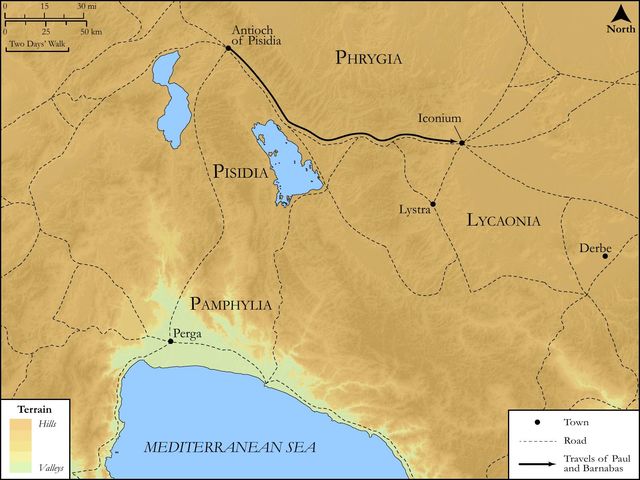
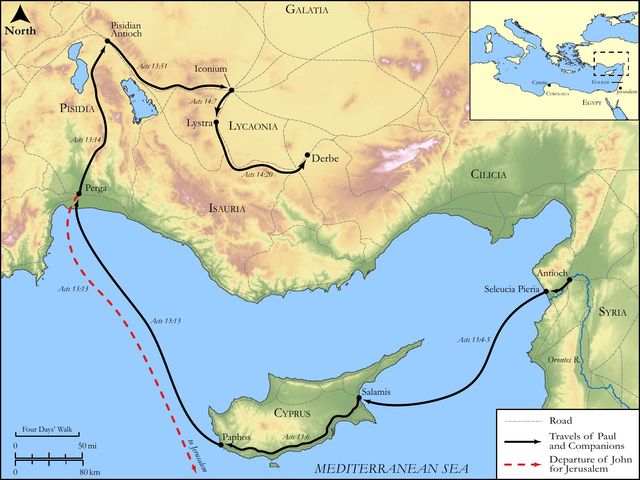
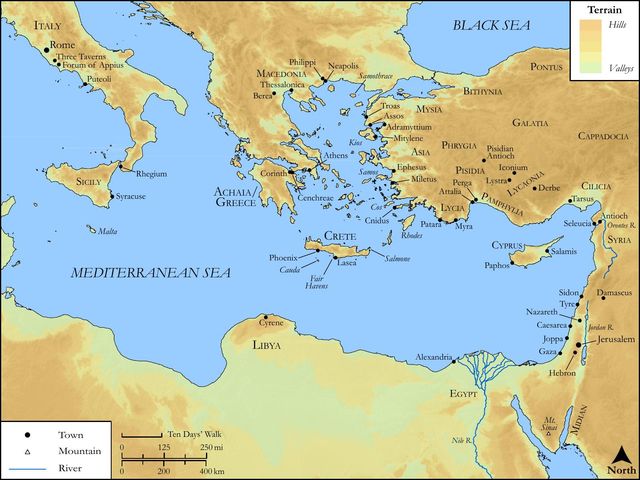
Study this verse
Public-domain commentary
Matthew Henry
From his Commentary on the Whole Bible. Henry comments on passages, not single verses — this entry covers Acts 13:42–52. His three-level outline is real structure in the source text, so it is rendered as structure.
The design of this story being to vindicate the apostles, especially Paul (as he doth himself at large, Rom. 11), from the reflections of the Jews upon him for preaching the gospel to the Gentiles, it is here observed that he proceeded therein with all the caution imaginable, and upon due consideration, of which we have here an instance.
I.There were some of the Jews that were so incensed against the preaching of the gospel, not to the Gentiles, but to themselves, that they would not bear to hear it, but went out of the synagogue while Paul was preaching (Act 13:42), in contempt of him and his doctrine, and to the disturbance of the congregation. It is probable they whispered among themselves, exciting one another to it, and did it by consent. Now this bespoke,
1.An open infidelity, as plain a profession of unbelief as coming to hear the gospel is of faith. They thus publicly avowed their contempt of Christ and of his doctrine and law, were not ashamed, neither could they blush; and they thus endeavoured to beget prejudices in the minds of others against the gospel; they went out to draw others to follow their pernicious ways.
2.An obstinate infidelity. They went out of the synagogue, not only to show that they did not believe the gospel, but because they were resolved they would not, and therefore got out of the hearing of those things that had a tendency to convince them. They stopped their ears like the deaf adder. Justly therefore was the gospel taken from them, when they first took themselves from it, and turned themselves out of the church before they were turned out of it. For it is certainly true that God never leaves any till they first leave him.
II.The Gentiles were as willing to hear the gospel as those rude and ill-conditioned Jews were to get out of the hearing of it:
They besought that these words, or words to this effect, might be preached to them the next sabbath; in the week between, so some take it; on the second and fifth days of the week, which in some synagogues were their lecture days. But it appears (Act 13:44) that it was the next sabbath day that they came together. They begged,
1.That the same offer might be made to them that was made to the Jews. Paul in this sermon had brought the word of salvation to the Jews and proselytes, but had taken no notice of the Gentiles; and therefore they begged that forgiveness of sins through Christ might be preached to them, as it was to the Jews. The Jews' leavings, nay, loathings, were their longings. This justifies Paul in his preaching to them, that he was invited to it, as Peter was sent for to Cornelius. Who could refuse to break the bread of life to those who begged so hard for it, and to give that to the poor at the door which the children at the table threw under their feet?
2.That the same instructions might be given to them. They had heard the doctrine of Christ, but did not understand it at the first hearing, nor could they remember all that they had heard, and therefore they begged it might be preached to them again. Note, It is good to have the word of Christ repeated to us. What we have heard we should desire to hear again, that it may take deep root in us, and the nail that is driven may be clenched and be as a nail in a sure place. To hear the same things should not be grievous, because it is safe, Phi 3:1. It aggravates the bad disposition of the Jews that the Gentiles desired to hear that often which they were not willing to hear once; and commends the good disposition of the Gentiles that they did not follow the bad example which the Jews set them.
III.There were some, nay, there were many, both of Jews and proselytes, that were wrought upon by the preaching of the gospel.
Those who aggravated the matter of the Jews' rejection by the preaching of the gospel, cried out, as is usual in such cases, "They have cast away, and cast off, all the people of God." "Nay," says Paul, "it is not so; for abundance of the Jews have embraced Christ, and are taken in;" himself for one, Rom 11:1, Rom 11:5. So it was here: Many of the Jews and religious proselytes followed Paul and Barnabas, and received further instructions and encouragement from them.
1.They submitted to the grace of God, and were admitted to the benefit and comfort of it, which is implied in their being exhorted to continue in it. They followed Paul and Barnabas; they became their disciples, or rather the disciples of Christ, whose agents they were. Those that join themselves to Christ will join themselves to his ministers, and follow them. And Paul and Barnabas, though they were sent to the Gentiles, yet bade those of the Jews welcome that were willing to come under their instructions, such hearty well-wishers were they to all the Jews and their friends, if they pleased.
2.They were exhorted and encouraged to persevere herein: Paul and Barnabas, speaking to them with all the freedom and friendship imaginable, persuaded them to continue in the grace of God, to hold fast that which they had received, to continue in their belief of the gospel of grace, their dependence upon the Spirit of grace, and their attendance upon the means of grace. And the grace of God shall not be wanting to those who thus continue in it.
IV.There was a cheerful attendance upon the preaching of the gospel the next sabbath day (Act 13:44):
Almost the whole city (the generality of whom were Gentiles) came together to hear the word of God.
1.It is probable that Paul and Barnabas were not idle in the week-days, but took all opportunities in the week between (as some think the Gentiles desired) to bring them acquainted with Christ, and to raise their expectations from him. They did a great deal of service to the gospel in private discourse and conversation, as well as in their public sermons. Wisdom cried in the chief places of concourse, and the opening of the gates, as well as in the synagogues, Pro 1:20, Pro 1:21.
2.This brought a vast concourse of people to the synagogue on the sabbath day. Some came out of curiosity, the thing being new; others longing to see what the Jews would do upon the second tender of the gospel to them; and many who had heard something of the word of God came to hear more, and to hear it, not as the word of men but as the word of God, by which we must be ruled and judged. Now this justified Paul in preaching to the Gentiles, that he met with the most encouraging auditors among them. There the fields were white to the harvest, and therefore why should he not there put in his sickle?
V.The Jews were enraged at this; and not only would not receive the gospel themselves, but were filled with indignation at those that crowded after it (Act 13:45): When the Jews saw the multitudes, and considered what an encouragement it was to Paul to go on in his work when he saw the people thus flying like doves to their windows, and what probability there was that among these multitudes some would be, without doubt, wrought upon, and probably the greater part, to embrace Christ - this filled them with envy.
1.They grudged the interest the apostles had in the people, were vexed to see the synagogue so full when they were going to preach. This was the same spirit that worked in the Pharisees towards Christ; they were cut to the heart when they saw the whole world go after him. When the kingdom of heaven was opened they not only would not go in themselves, but were angry with those that did.
2.They opposed the doctrine the apostles preached: They spoke against those things that were spoken by Paul, cavilled at them, started objections against them, finding some fault or other with every thing he said, contradicting and blaspheming; antelegon antilegontes - contradicting, they contradicted. They did it with the utmost spite and rage imaginable: they persisted in their contradiction, and nothing would silence them, they contradicted for contradiction-sake, and denied that which was most evident; and, when they could find no colour of objection, they broke out into ill language against Christ and his gospel, blaspheming him and it. From the language of the carnal man that receives not the things of the Spirit of God, and therefore contradicts them, they proceed to the language of incarnate devils, and blaspheme them. Commonly those who begin with contradicting end with blaspheming.
VI.The apostles hereupon solemnly and openly declare themselves discharged from their obligations to the Jews, and at liberty to bring the word of salvation to the Gentiles, even by the tacit consent of the Jews themselves. Never let the Jew lay the fault of the carrying of the kingdom of God to the Gentiles upon the apostles, for that complaint of theirs is for ever silenced by their own act and deed, for what they did here is for ever a bar to it. "Tender and refusal (we say) are good payment in law." The Jews had the tender of the gospel, and did refuse it, and therefore ought not to say any thing against the Gentiles having it. In declaring this, it is said (Act 13:46), Paul and Barnabas waxed bold, more bold than they had been while they were shy of looking favourably upon the Gentiles, for fear of giving offence to the Jews, and laying a stumbling-block in their way. Note, There is a time for the preachers of the gospel to show as much of the boldness of the lion as of the wisdom of the serpent and the harmlessness of the dove. When the adversaries of Christ's cause begin to be daring, it is not for its advocates to be timid. While there is any hope of working upon those that oppose themselves they must be instructed with meekness (Ti2 2:25); but, when that method has long been tried in vain, we must wax bold, and tell them what will be the issue of their opposition. The impudence of the enemies of the gospel, instead of frightening, should rather embolden its friends; for they are sure that they have a good cause, and they know in whom they have trusted to bear them out. Now Paul and Barnabas, having made the Jews a fair offer of gospel grace, here give them fair notice of their bringing it to the Gentiles, if by any means (as Paul says Rom 11:14) they might provoke them to emulation.
1.They own that the Jews were entitled to the first offer: "It was necessary that the word of God should first have been spoken to you, to whom the promise was made, to you of the lost sheep of the house of Israel, to whom Christ reckoned himself first sent." And his charge to the preachers of his gospel to begin at Jerusalem (Luk 24:47) was a tacit direction to all that went into other countries to begin with the Jews, to whom pertained the giving of the law, and therefore the preaching of the gospel. Let the children first be served, Mar 7:27.
2.They charge them with the refusal of it: "You put it from you; you will not accept of it; nay, you will not so much as bear the offer of it, but take it as an affront to you." If men put the gospel from them, God justly takes it from them; why should manna be given to those that loathe it and call it light bread, or the privileges of the gospel forced on those that put them away, and say, We have no part in David? Herein they judge themselves unworthy of everlasting life. In one sense we must all judge ourselves unworthy of everlasting life, for there is nothing in us, nor done by us, by which we can pretend to merit it, and we must be made sensible of this; but here the meaning is, "You discover, or make it to appear, that you are not meet for eternal life; you throw away all your claims and give up your pretensions to it; since you will not take it from his hands, into whose hand the Father has given it, krinete, you do, in effect, pass this judgment upon yourselves, and out of your own mouth you shall be judged; you will not have it by Christ, by whom alone it is to be had, and so shall your doom be, you shall not have it at all." 3. Upon this they ground their preaching the gospel to the uncircumcised: "Since you will not accept eternal life as it is offered, our way is plain, Lo, we turn to the Gentiles. If one will not, another will. If those that were first invited to the wedding-feast will not come, we must invite out of the highways and hedges those that will, for the wedding must be furnished with guests. If he that is next of kin will not do the kinsman's part, he must not complain that another will," Rut 4:4. 4. They justify themselves in this by a divine warrant (Act 13:47): "For so hath the Lord commanded us; the Lord Jesus gave us directions to witness to him in Jerusalem and Judea first, and after that to the utmost part of the earth, to preach the gospel to every creature, to disciple all nations." This is according to what was foretold in the Old Testament. When the Messiah, in the prospect of the Jews' infidelity, was ready to say, I have laboured in vain, he was told, to his satisfaction, that though Israel were not gathered, yet he should be glorious, that his blood should not be shed in vain, nor his purchase made in vain, nor his doctrine preached in vain, nor his Spirit sent in vain - "For I have set thee, not only raised thee up, but established thee, to be a light of the Gentiles, not only a shining light for a time, but a standing light, set thee for a light, that thou shouldst be for salvation unto the ends of the earth." Note,
(1.)Christ is not only the Saviour, but the salvation, is himself our righteousness, and life, and strength.
(2.)Wherever Christ is designed to be salvation, he is set up to be a light; he enlightens the understanding, and so saves the soul.
(3.)He is, and is to be, light and salvation to the Gentiles, to the ends of the earth. Those of every nation shall be welcome to him, some of every nation have heard of him (Rom 10:18), and all nations shall at length become his kingdom. This prophecy has had its accomplishment in part in the setting up of the kingdom of Christ in this island of ours, which lies, as it were, in the ends of the earth, a corner of the world, and shall be accomplished more and more when the time comes for the bringing in of the fulness of the Gentiles.
VII.The Gentiles cheerfully embraced that which the Jews scornfully rejected, Act 13:48, Act 13:49.
Never was land lost for want of heirs; through the fall of the Jews, salvation is come to the Gentiles: the casting off of them was the reconciling of the world, and the diminishing of them the riches of the Gentiles; so the apostle shows at large, Rom 11:11, Rom 11:12, Rom 11:15. The Jews, the natural branches, were broken off, and the Gentiles, that were branches of the wild olive, were thereupon grafted in, Rom 11:17, Rom 11:19. Now here we are told how the Gentiles welcomed this happy turn in their favour.
1.They took the comfort of it: When they heard this they were glad. It was good news to them that they might have admission into covenant and communion with God by a clearer, nearer, and better way than submitting to the ceremonial law, and being proselyted to the Jewish religion - that the partition-wall was taken down and they were as welcome to the benefits of the Messiah's kingdom as the Jews themselves, and might share in their promise, without coming under their yoke. This was indeed glad tidings of great joy to all people. Note, Our being put into a possibility of salvation, and a capacity for it, ought to be the matter of our rejoicing; when the Gentiles did but hear that the offers of grace should be made them, the word of grace preached to them, and the means of grace afforded them, they were glad. "Now there is some hope for us." Many grieve under doubts whether they have an interest in Christ or no, when they should be rejoicing that they have an interest in him; the golden sceptre is held out to them, and they are invited to come and touch the top of it.
2.They gave God the praise of it: They glorified the word of the Lord; that is, Christ (so some), the essential Word; they entertained a profound veneration for him, and expressed the high thoughts they had of him. Or, rather, the gospel; the more they knew of it, the more they admired it. Oh! what a light, what a power, what a treasure, does this gospel bring along with it! How excellent are its truths, its precepts, its promises! How far transcending all other institutions! How plainly divine and heavenly is its origin! Thus they glorified the word of the Lord, and it is this which he has himself magnified above all his name (Psa 138:2), and will magnify and make honourable, Isa 42:21. They glorified the word of the Lord,
(1.)Because now the knowledge of it was diffused and not confined to the Jews only. Note, It is the glory of the word of the Lord that the further it spreads the brighter it shines, which shows it to be not like the light of the candle, but like that of the sun when he goes forth in his strength.
(2.)Because now the knowledge of it was brought to them. Note, Those speak best of the honour of the word of the Lord that speak experimentally, that have themselves been subdued by its power, and comforted by its sweetness.
3.Many of them became, not only professors of the Christian faith, but sincerely obedient to the faith: As many as were ordained to eternal life believed. God by his Spirit wrought true faith in those for whom he had in his councils from everlasting designed a happiness to everlasting.
(1.)Those believed to whom God gave grace to believe, whom by a secret and mighty operation he brought into subjection to the gospel of Christ, and made willing in the day of his power. Those came to Christ whom the Father drew, and to whom the Spirit made the gospel call effectual. It is called the faith of the operation of God (Col 2:12), and is said to be wrought by the same power that raised up Christ, Eph 1:19, Eph 1:20.
(2.)God gave this grace to believe to all those among them who were ordained to eternal life (for whom he had predestinated, them he also called, Rom 8:30); or, as many as were disposed to eternal life, as many as had a concern about their eternal state, and aimed to make sure of eternal life, believed in Christ, in whom God hath treasured up that life (Jo1 5:11), and who is the only way to it; and it was the grace of God that wrought it in them. Thus all those captives, and those only, took the benefit of Cyrus's proclamation, whose spirit God had raised up to build the house of the Lord which is in Jerusalem, Ezr 1:5. Those will be brought to believe in Christ that by his grace are well disposed to eternal life, and make this their aim.
4.When they believed they did what they could to spread the knowledge of Christ and his gospel among their neighbours (Act 13:49): And the word of the Lord was published throughout all the region. When it was received with so much satisfaction in the chief city, it soon spread into all parts of the country. Those new converts were themselves ready to communicate to others that which they were so full of themselves. The Lord gave the word, and then great was the company of those that published it, Psa 68:11. Those that have become acquainted with Christ themselves will do what they can to bring others acquainted with him. Those in great and rich cities that have received the gospel should not think to engross it, as if, like learning and philosophy, it were only to be the entertainment of the more polite and elevated part of mankind, but should do what they can to get it published in the country among the ordinary sort of people, the poor and unlearned, who have souls to be saved as well as they.
VIII.Paul and Barnabas, having sown the seeds of a Christian church there, quitted the place, and went to do the like else-where.
We read not any thing of their working miracles here, to confirm their doctrine, and to convince people of the truth of it; for, though God then did ordinarily make use of that method of conviction, yet he could, when he pleased, do his work without it; and begetting faith by the immediate influence of his Spirit was itself the greatest miracle to those in whom it was wrought. Yet, it is probable that they did work miracles, for we find they did in the next place they came to, Act 14:3. Now here we are told,
1.How the unbelieving Jews expelled the apostles out of that country. They first turned their back upon them, and then lifted up the heel against them (Act 13:50): They raised persecution against Paul and Barnabas, excited the mob to persecute them in their way by insulting their persons as they went along the streets; excited the magistrates to persecute them in their way, by imprisoning and punishing them. When they could not resist the wisdom and spirit wherewith they spoke, they had recourse to these brutish methods, the last refuge of an obstinate infidelity. Satan and his agents are most exasperated against the preachers of the gospel when they see them go on successfully, and therefore then will be sure to raise persecution against them. Thus it has been the common lot of the best men in the world to suffer ill for doing well, to be persecuted instead of being preferred for the good services they have done to mankind. Observe,
(1.)What method the Jews took to give them trouble: They stirred up the devout and honourable women against them. They could not make any considerable interest themselves, but they applied to some ladies of quality in the city, that were well affected to the Jewish religion, and were proselytes of the gate, therefore called devout women. These, according to the genius of their sex, were zealous in their way, and bigoted; and it was easy, by false stories and misrepresentations, to incense them against the gospel of Christ, as if it had been destructive of all religion, of which really it is perfective. It is good to see honourable women devout, and well affected to religious worship: The less they have to do in the world, the more they should do for their souls, and the more time they should spend in communion with God; but it is sad when, under colour of devotion to God, they conceive an enmity to Christ, as those here mentioned. What! women persecutors! Can they forget the tenderness and compassion of their sex? What! honourable women! Can they thus stain their honour, and disgrace themselves, and do so mean a thing? But, which is strangest of all, devout women! Will they kill Christ's servants, and think therein they do God service? Let those therefore that have zeal see that it be according to knowledge. By these devout and honourable women they stirred up likewise the chief men of the city, the magistrates and the rulers, who had power in their hands and set them against the apostles, and they had so little consideration as to suffer themselves to be made the tools of this ill-natured party, who would neither go into the kingdom of heaven themselves nor suffer those who were entering to go in.
(2.)How far they carried it, so far that they expelled them out of their coasts; they banished them, ordered them to be carried, as we say, from constable to constable, till they were forced out of their jurisdiction; so that it was not by fear, but downright violence, that they were driven out. This was one method which the overruling providence of God took to keep the first planters of the church from staying too long at a place; as Mat 10:23, When they persecute you in one city flee to another, that thus you may the sooner go over the cities of Israel. This was likewise a method God took to make those that were well disposed the more warmly affected towards the apostles; for it is natural to us to pity those that are persecuted, to think the better of those that suffer when we know they suffer unjustly, and to be the more ready to help them. The expelling of the apostles out of their coasts made people inquisitive what evil they had done, and perhaps raised them more friends than conniving at them in their coasts would have done.
2.How the apostles abandoned and rejected the unbelieving Jews (Act 13:51): They shook off the dust of their feet against them. When they went out of the city they used this ceremony in the sight of those that sat in the gate; or, when they went out of the borders of their country, in the sight of those that were sent to see the country rid of them. Hereby,
(1.)They declared that they would have no more to do with them, would take nothing that was theirs; for they sought not theirs, but them. Dust they are, and let them keep their dust to themselves, it shall not cleave to them.
(2.)They expressed their detestation of their infidelity, and that, though they were Jews by birth, yet, having rejected the gospel of Christ, they were in their eyes no better than heathen and profane. As Jews and Gentiles, if they believe, are equally acceptable to God and good men; so, if they do not, they are equally abominable.
(3.)Thus they set them at defiance, and expressed their contempt of them and their malice, which they looked upon as impotent. It was as much as to say, "Do your worst, we do not fear you; we know whom we serve and whom we have trusted." (4.) Thus they left a testimony behind them that they had had a fair offer made them of the grace of the gospel, which shall be proved against them in the day of judgment. This dust will prove that the preachers of the gospel had been among them, but were expelled by them. Thus Christ had ordered them to do, and for this reason, Mat 10:14; Luk 9:5. When they left them, they came to Iconium, not so much for safety, as for work.
3.What frame they left the new converts in at Antioch (Act 13:52): The disciples, when they saw with what courage and cheerfulness Paul and Barnabas not only bore the indignities that were done them, but went on with their work notwithstanding, they were in like manner inspirited.
(1.)They were very cheerful. One would have expected that when Paul and Barnabas were expelled out of their coasts, and perhaps forbidden to return upon pain of death, the disciples would have been full of grief and full of fear, looking for no other than that, if the planters of Christianity go, the plantation would soon come to nothing; or that it would be their turn next to be banished the country, and to them it would be more grievous, for it was their own. But no; they were filled with joy in Christ, had such a satisfactory assurance of Christ's carrying on and perfecting his own work in them and among them, and that either he would screen them from trouble or bear them up under it, that all their fears were swallowed up in their believing joys.
(2.)They were courageous, wonderfully animated with a holy resolution to cleave to Christ, whatever difficulties they met with. This seems especially to be meant by their being filled with the Holy Ghost, for the same expression is used of Peter's boldness (Act 4:8), and Stephen's (Act 7:55), and Paul's, Act 13:9. The more we relish the comforts and encouragements we meet with in the power of godliness, and the fuller our hearts are of them, the better prepared we are to face the difficulties we meet with in the profession of godliness.
Historical interpretation
Two Centuries of Reception
6 surviving comments on this verse. Each one is dated, so this reads as a timeline rather than a list.
Select a marker to jump to its quote. Markers stagger vertically where authors wrote within a few decades of each other.
Therefore Paul and the apostles themselves, mindful of the precept of the Lord, bear this solemn testimony before Israel, which they had now filled with their doctrine-saying, "It was necessary that the word of God should have been first delivered to you; but seeing ye have rejected it, and have not thought yourselves worthy of eternal life, lo, we turn to the Gentiles." And from that time they turned their steps away, as those who went before them had laid it down, and departed into the way of the Gentiles, and entered into the cities of the Samaritans; so that, in very deed, their sound went forth into all the earth, and their words to the end of the world.
That the Gentiles should rather believe in Christ. In Genesis: "And the Lord God said unto Abraham, Go out from thy country, and from thy kindred, and from thy father's house, and go into that land which I shall show thee: and I will make of thee a great nation, and I will bless thee, and I will magnify thy name; and thou shalt be blessed: and I will bless him that blesseth thee, and I will curse him that curseth thee. and in thee shall all the tribes of the earth be blessed." On this same point in Genesis: "And Isaac blessed Jacob. Behold, the smell of my son is as the smell of a plentiful field which the Lord hath blessed: and God give thee of the dew of heaven, and of the fertility of the earth, abundance of corn, and wine, and oil: and peoples shall obey thee, and princes shall worship thee: and thou shalt be lord over thy brother, and the sons of thy father shall worship thee; and he that curseth thee shall be cursed, and he that blesseth thee shall be blessed." On this matter too in Genesis: "But when Joseph saw that his father placed his right hand on the head of Ephraim, it seemed displeasing to him: and Joseph laid hold of his father's hand, to lift it from the head of Ephraim on to the head of Manasseh. Moreover, Joseph said unto his father, Not so, my father: this is my first-born; place thy right hand upon his head. But he would not, and said, I know it, my son, I know it: and he also shall be a people, and he shall be exalted; but his younger brother shall be greater than he, and his seed shall become a multitude of nations." Moreover in Genesis: "Judah, thy brethren shall praise thee: thine hand shall be upon the back of thine enemies; the sons of thy father shall worship thee. Judah is a lion's whelp: from the slender twig, my son, thou hast ascended: thou layedst down and sleepedst as a lion, and as a lion's whelp. Who shall stir him up? There shalt not fail a prince from Judah, and a leader from his loins, until those things entrusted to him shall come; and he is the hope of the nations: binding his foal unto the vine, and his ass's colt unto the branch of the vine; he shall wash his garments in wine, and his clothing in the blood of the grape: terrible are his eyes with wine, and his teeth are whiter than milky," Hence in Numbers it is written concerning our people: "Behold, the people shall rise up as a lion-like people." In Deuteronomy: "Ye Gentiles shall be for the head; but this unbelieving people shall be for the tail." Also in Jeremiah: "Hear the sound of the trumpet. And they said, We will not hear: for this cause the nations shall hear, and they who shall feed their cattle among them." In the seventeenth Psalm: "Thou shalt establish me the head of the nations: a people whom I have not known have served me: at the hearing of the ear they have obeyed me." Concerning this very thing the Lord says in Jeremiah: "Before I formed thee in the belly, I knew thee; and before thou wentest forth from the womb, I sanctified thee, and established thee as a prophet among the nations." Also in Isaiah: "Behold, I have manifested him for a witness to the nations, a prince and a commander to the peoples." Also in the same: "Nations which have not known Thee shall call upon Thee; and peoples which were ignorant of Thee shall flee to Thee." In the same, moreover: "And in that day there shall be a root of Jesse, which shall rise to rule in all the nations; in Him shall the Gentiles hope: and His rest shall be honour." In the same again: "The land of Zebulon, and the land of Nephtalim, by the way of the sea, and ye others who inhabit the maritime places, and beyond Jordan of the nations. People that walk in darkness, behold yea great light; ye who dwell in the region of the shadow of death, the light shall shine upon you." Also in the same: "Thus saith the Lord God to Christ my Lord, whose right hand I hold, that the nations may hear Him; and I will break asunder the strength of kings, I will open before Him gates; and cities shall not be shut." Also in the same: "I come to gather together all nations and tongues; and they shall come, and see my glory. And I will send out over them a standard, and I will send those that are preserved among them to the nations which are afar off, which have not heard my name nor seen my glory; and they shall declare my glory to the nations." Also in the same: "And in all these things they are not converted; therefore He shall lift up a standard to the nations which are afar, and He will draw them from the end of the earth." Also in the same: "Those who had not been told of Him shall see, and they who have not heard shall understand." Also in the same: "I have been made manifest to those who seek me not: I have been formal of those who asked not after me. I said, Lo, here am I, to a nation that has not called upon my! name." Of this same thing, in the Acts of the Apostles, Paul says: "It was necessary that the word of God should first be shown to you; but since ye put it from you, and judged yourselves unworthy of eternal life, lo, we turn to the Gentiles: for thus said the Lord by the Scriptures, Behold, I have set Thee a light among the nations, that Thou shouldest be for salvation even to the ends of the earth."
Therefore God declares that nothing is unworthy of salvation or of entering the kingdom, nor, on the contrary, does he judge that humankind deserves damnation. Rather, we judge ourselves, through our freely committed malice, to be unworthy of eternal life and worthy of eternal damnation. Therefore the judgment is in ourselves as well as the lot of our future state.
"Then Paul and Barnabas waxed bold, and said, It was necessary that the word of God should first have been spoken to you: but seeing ye put it from you, and judge yourselves unworthy of everlasting life, lo, we turn to the Gentiles." Do you mark how by their contentious behavior they the more extended the preaching, and how the Apostles here gave themselves the more to the Gentiles, having by this very thing pleaded their justification, and made themselves clear of all blame with their own people at Jerusalem? See how by their "envy" they bring about great things, other than they looked for: they brought it about that the Apostles spake out boldly, and came to the Gentiles! For this is why he says, "And speaking out boldly, Paul and Barnabas said."
But see what boldness of speech! "It was necessary," he says, "that the word should have been spoken first to you, but since ye put it from you" - it is not put as affronting though it is in fact what they did in the case of the prophets: "Talk not to us," said they, "with talk": "but since ye put it from you" - it, he saith, not us: for the affront on your part is not to us. For that none may take it as an expression of their piety that he says, "Ye judge not yourselves worthy," therefore he first says, "Ye put it from you," and then, "We turn unto the Gentiles." The expression is full of gentleness. He does not say, We abandon you, but so that it is possible - he would say - that we may also turn hither again: and this too is not the consequence of the affront from you, "for so hath the Lord commanded us."
They were to go out to the Gentiles: but observe the boldness coming with measure: for if Peter pleaded in his justification, much more these needed a plea, none having called them there. But by saying "To you first," he showed that to those also it was their duty to preach, and in saying "Necessary," he showed that it was necessary to be preached to them also. "But since ye turn away from it" - he does not say, "Woe unto you," and "Ye are punished," but "We turn unto the Gentiles." With great gentleness is the boldness fraught! Also he does not say, "Ye are unworthy," but "Have judged yourselves unworthy. Lo, we turn unto the Gentiles."
Continue studying Acts 13:46 across the web’s major study libraries — every link below opens this exact verse, chapter, or book on the destination site.
Read & Compare
 BibleGatewayThis verse in more than 200 translations and 70 languages.
 Bible.comThe YouVersion reader — hundreds of translations, reading plans, and highlights.
 ESV.orgCrossway's official English Standard Version reader.
 NET BibleThe NET translation with 60,000+ translators' notes on every rendering decision.
 STEP BibleTyndale House's free study tool — original text, vocabulary, and scholarly resources.
 BibliaLogos Bible Software's free web reader.
 USCCBThe New American Bible (Revised Edition) with the U.S. bishops' study notes.
Commentaries
 BibleHub CommentariesDozens of classic commentaries on this verse, gathered on one page.
 StudyLightMore than 100 commentary sets — the largest collection on the web.
 BibleRefPlain-English commentary on what this verse means, verse by verse.
 Enduring WordDavid Guzik's free commentary on this chapter, widely used by Bible teachers.
 Bible Study ToolsVerse commentary alongside Greek and Hebrew study aids.
Original Language & Research
- BibleHub InterlinearThe verse word by word — original language, transliteration, and English.
- BibleHub LexiconEvery word's original-language definition and Strong's entry.
 Blue Letter BibleDeep-study tools — Strong's numbers, concordance, and word studies.
 CNTR CollationThe earliest Greek manuscripts of this verse, collated letter by letter.
Sermons, Hymns & Audio


TrulyRandomVerse is not affiliated with these sites and doesn’t control their content. They’re linked because they’re genuinely useful.
Summary
Acts 13:46 marks a pivotal moment in the early Christian mission, as Paul and Barnabas, empowered by the Holy Spirit, boldly declare a strategic shift in their evangelistic focus. Confronted by the rejection and blasphemy of many Jews in Pisidian Antioch, the apostles affirm God's initial priority for the gospel to be preached to the Jewish people, but in light of their self-condemnation and refusal of eternal life, they formally announce their intention to turn their full attention to the Gentiles, thus expanding the reach of God's redemptive plan to all nations.
Context
ShowHideLiterary Context
This verse serves as the climax and resolution to a significant episode in Paul's first missionary journey, specifically his ministry in Pisidian Antioch. Paul had just delivered a comprehensive sermon in the synagogue, tracing salvation history from Abraham to David, culminating in the resurrection of Jesus as the promised Savior (Acts 13:16-41). Initially, this message garnered a positive response, with many Jews and devout proselytes following Paul and Barnabas, eager to hear more (Acts 13:43). However, the following Sabbath brought intense opposition. When "almost the whole city" gathered to hear the word, some Jews, filled with envy, began to contradict and blaspheme Paul's teachings (Acts 13:44-45). Verse 46 is the apostles' decisive and Spirit-led response to this escalating hostility, marking a formal turning point in their missionary strategy for this region and setting a precedent for future endeavors.
Historical & Cultural Context
Pisidian Antioch was a significant Roman colony in the province of Galatia, strategically located on a major trade route. As a Roman colony, it enjoyed certain privileges and had a diverse population, including a substantial Jewish community with a synagogue, which served as the initial point of contact for Paul's evangelism. The Jewish people, as God's chosen covenant people, had historically been the recipients of God's revelation and promises. The expectation, rooted in Old Testament prophecy, was that the Messiah would come to Israel first. Paul, as a devout Jew and an apostle to the Gentiles, consistently followed this pattern of going "to the Jew first" (Romans 1:16). However, the repeated pattern of Jewish rejection of the Messiah and the gospel message, as seen here and elsewhere, necessitated a re-evaluation of missionary priorities, leading to the formal inclusion of Gentiles on a wider scale. This decision, while divinely ordained, was also a pragmatic response to the immediate cultural and religious landscape of the diaspora synagogues.
Key Themes
ShowHideActs 13:46 contributes significantly to several overarching themes in the book of Acts and Pauline theology. It powerfully illustrates the theme of Divine Priority and Human Responsibility, emphasizing that God's word was first offered to Israel, but their rejection carried severe consequences. This rejection, however, does not thwart God's plan but rather redirects it, highlighting the theme of God's Unstoppable Mission and Universal Salvation. The turning to the Gentiles underscores the inclusive nature of the gospel, fulfilling Old Testament prophecies about the nations coming to God (Isaiah 49:6). Furthermore, the apostles' "waxing bold" exemplifies the theme of Spirit-Empowered Witness, a recurring motif throughout Acts where believers are enabled to proclaim the truth fearlessly in the face of opposition (Acts 4:29-31). This verse also sets a crucial precedent for Paul's future missionary strategy, solidifying the shift towards Gentile evangelism that would define much of his apostolic ministry, as seen in later declarations in Acts 18:6 and Acts 28:28).
Exposition and Analysis
ShowHideKey Word Analysis
ShowHideThis word signifies speaking openly, freely, and with full confidence, often in public or before hostile audiences. It conveys a sense of courage and fearlessness, indicating that Paul and Barnabas were not intimidated by the opposition but rather spoke with divine authority and conviction, empowered by the Holy Spirit to declare a difficult truth.
Properly meaning "to distinguish" or "to decide," in this context, it carries the sense of making a judgment or decision about oneself. The Jews, by their actions of rejecting the gospel, implicitly or explicitly declared themselves unworthy of the eternal life offered through Christ. This is not a judgment imposed by Paul, but a self-condemnation enacted by their own refusal.
This term refers to "a race" or "a tribe," specifically a foreign or non-Jewish people, often implying pagan or non-covenant individuals. The turning "to the Gentiles" signifies a deliberate and formal shift in missionary focus from the Jewish synagogue to the broader non-Jewish population, marking a significant expansion of the gospel's reach beyond its initial, ethnically defined boundaries.
Verse Breakdown
ShowHide"Then Paul and Barnabas waxed bold, and said,"
This opening clause highlights the apostles' courageous and Spirit-empowered response to the intense opposition they faced. Their boldness (parrēsiázomai) was not reckless defiance but a divinely inspired confidence to speak truth in the face of escalating hostility and blasphemy from some in the Jewish community. It sets the tone for the profound declaration that follows.
"It was necessary that the word of God should first have been spoken to you:"
This statement affirms God's established order for the spread of the gospel, acknowledging the historical and theological priority of the Jewish people as the initial recipients of God's saving message. It underscores that Paul and Barnabas were acting in accordance with divine necessity and prophetic fulfillment, having faithfully offered the message to Israel first.
"but seeing ye put it from you, and judge yourselves unworthy of everlasting life,"
This clause presents the reason for the strategic shift. The phrase "put it from you" (apōthéomai) denotes a deliberate and active rejection, a pushing away of the divine offer. By this rejection, the Jewish audience implicitly or explicitly made a self-judgment, deeming themselves "unworthy" (áxios) of the "everlasting life" (aiṓnios zoḗ) offered through the gospel. This is a sobering indictment of their spiritual state, emphasizing human responsibility in accepting or rejecting God's grace.
"lo, we turn to the Gentiles."
This concluding declaration is a dramatic and pivotal pronouncement. "Lo" (idoú) draws immediate attention to the momentous nature of the statement. "We turn" (stréphō) signifies a complete reversal or reorientation of their missionary efforts. This is not a casual decision but a formal, apostolic declaration of intent to shift their primary evangelistic focus from the Jewish communities to the non-Jewish world, signaling the expansion of the gospel to all nations in fulfillment of God's universal redemptive plan.
Literary Devices
ShowHideActs 13:46 is rich in literary devices that amplify its significance. The phrase "waxed bold" employs Emotive Language and Hyperbole to convey the apostles' heightened courage and conviction in a moment of intense confrontation, emphasizing their divine empowerment. The structure of the statement, moving from divine necessity ("It was necessary") to human rejection ("ye put it from you") and culminating in a decisive action ("we turn to the Gentiles"), functions as a powerful Rhetorical Declaration. This declaration also serves as a Turning Point in the narrative of Acts, marking a formal and strategic shift in the early church's missionary endeavors from a primary focus on Jewish evangelism to a broader, more intentional outreach to the Gentiles. Furthermore, there is an element of Dramatic Irony in the Jewish community "judging themselves unworthy," as their rejection of the Messiah, intended to preserve their distinct identity, paradoxically opened the door for the inclusion of the very Gentiles they often disdained, thus fulfilling God's larger redemptive purpose.
Theological and Thematic Connections
ShowHideActs 13:46 is a watershed moment, illustrating the tension between God's particular covenant with Israel and His universal plan of salvation. Theologically, it underscores the principle that while God's word was first presented to His chosen people, their rejection does not nullify His purposes but rather redirects the flow of His grace. This turning to the Gentiles is not an abandonment of Israel, but an expansion of the divine invitation, demonstrating God's unwavering commitment to redeem humanity from every tribe, tongue, people, and nation. It highlights the profound truth that salvation is by grace through faith, accessible to all who respond, and that human rejection, while tragic, cannot ultimately thwart the sovereign will of God to bring His saving message to the ends of the earth. This event is a crucial step in the unfolding of the Great Commission, demonstrating the practical outworking of the gospel's global mandate.
Reflection and Application
ShowHideActs 13:46 offers profound insights for contemporary believers regarding God's mission, human responsibility, and courageous witness. It reminds us that while God initiates salvation and extends His gracious invitation, human beings bear the responsibility to respond. The sobering truth that individuals can "judge themselves unworthy of everlasting life" by rejecting the gospel serves as a powerful warning against apathy, pride, or deliberate unbelief. For the church today, this verse is a clarion call to embrace God's universal mission, recognizing that the gospel is for all people, regardless of background, ethnicity, or social standing. It challenges us to break down any self-imposed barriers to evangelism and to actively pursue the lost, just as Paul and Barnabas turned to the Gentiles. Furthermore, the apostles' "boldness" in the face of opposition is a model for us. In a world that may be indifferent or hostile to the Christian message, we are called to speak the truth of God's Word with courage, conviction, and compassion, trusting in the Holy Spirit's empowerment rather than human strength.
Questions for Reflection
ShowHideFAQ
ShowHideWas the turning to the Gentiles a complete abandonment of the Jews by Paul?
ShowHideNo, the turning to the Gentiles in Acts 13:46 was not a complete abandonment of the Jewish people by Paul. While it marked a strategic shift in primary focus due to widespread rejection in certain Jewish communities, Paul consistently maintained a deep love and concern for his kinsmen according to the flesh (Romans 9:1-5). He continued to preach in synagogues first whenever he entered a new city, as seen in Acts 14:1 and Acts 17:1-2. Paul's theological understanding, articulated most fully in Romans 9-11, reveals that he believed in a future restoration for Israel, and that the inclusion of the Gentiles would ultimately provoke Israel to jealousy, leading to their eventual salvation. The shift was more about missionary priority and strategy in response to current receptivity, rather than a permanent theological rejection of Israel.
Christ-Centered Fulfillment
ShowHideActs 13:46, while a declaration by Paul and Barnabas, finds its ultimate Christ-centered fulfillment in the universal scope of Jesus' redemptive work and His Great Commission. The "necessity" of the word being spoken first to the Jews reflects Christ's own ministry, which was primarily to "the lost sheep of the house of Israel" (Matthew 15:24). However, the rejection of the Messiah by many within Israel, tragically leading them to "judge themselves unworthy of everlasting life," ultimately paved the way for the full revelation of Christ as the Savior of all humanity. Jesus himself prophesied that the gospel would be preached "to all nations" (Matthew 24:14), and His death on the cross was not just for Israel but for "the sins of the whole world" (1 John 2:2). The apostles' turning to the Gentiles is thus a direct outworking of Christ's finished work and His command to make disciples of all nations (Matthew 28:19). It demonstrates that in Christ, the dividing wall between Jew and Gentile has been broken down (Ephesians 2:14), creating one new humanity united under the Lordship of Jesus, the Lamb of God who takes away the sin of the world, regardless of their ethnic origin (John 1:29).