


Mark 7:27
Bible text: King James Version (1769 Blayney text) · Public domain
Bible text: King James Version with Strong's numbers · Public domain
Bible text: Berean Standard Bible · Public domain
Bible text: American Standard Version (1901) · Public domain
Bible text: World English Bible, Messianic edition · Public domain
Bible text: Geneva Bible (1599) · Public domain
Bible text: Young's Literal Translation · Public domain
- ὁho<the>G3588T-NSMDefinite article Nominative Singular Masculine
- καὶkaiAndG2532CONJConjunction
- ἸησοῦςIēsousJesusG2424N-NSM-PNoun Nominative Singular Masculine Individual
- ἔλεγενelegenHe was sayingG3004V-IAI-3SVerb Imperfect Active Indicative 3rd Singular
- αὐτῇ·autēato herG846P-DSFPersonal pronoun Dative Singular Feminine
- ἄφεςaphesdo permitG863V-2AAM-2SVerb 2nd Aorist Active Imperative 2nd Singular
- πρῶτονprōtonfirstG4413A-ASNAdjective Accusative Singular Neuter
- χορτασθῆναιchortasthēnaito be satisfiedG5526V-APNVerb Aorist Passive Infinitive
- τὰtatheG3588T-APNDefinite article Accusative Plural Neuter
- τέκνα·teknachildrenG5043N-APNNoun Accusative Plural Neuter
- οὐounotG3756PRT-NNegative Particle Negative
- γάρgarforG1063CONJConjunction
- ἐστινestinit isG1510V-PAI-3SVerb Present Active Indicative 3rd Singular
- καλὸνkalongoodG2570A-NSNAdjective Nominative Singular Neuter
- λαβεῖνlabeinto takeG2983V-2AANVerb 2nd Aorist Active Infinitive
- τὸνtontheG3588T-ASMDefinite article Accusative Singular Masculine
- ἄρτονartonbreadG740N-ASMNoun Accusative Singular Masculine
- τῶνtōnof theG3588T-GPNDefinite article Genitive Plural Neuter
- τέκνωνteknōnchildrenG5043N-GPNNoun Genitive Plural Neuter
- καὶkaiandG2532CONJConjunction
- τοῖςtoisto theG3588T-DPNDefinite article Dative Plural Neuter
- κυναρίοιςkunarioisdogsG2952N-DPNNoun Dative Plural Neuter
- βαλεῖνbaleinto cast [it]G906V-2AANVerb 2nd Aorist Active Infinitive
English is a literal word-by-word gloss of the Greek, not the KJV's wording. Why?
This is the original text the KJV's translators worked from — each Greek word with its own literal English meaning in this verse, prepared by scholars at Tyndale House, Cambridge. The KJV translates whole sentences, not word by word, so its wording differs: one Greek word can become several English words, and the KJV may choose “charity” where the gloss reads “love”. Both are faithful — they answer different questions. For the KJV's own rendering, switch to the KJV text.
Details
See on the biblical-era maps
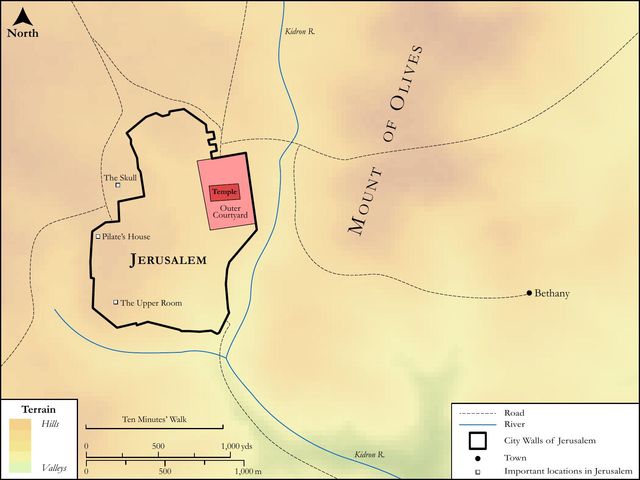
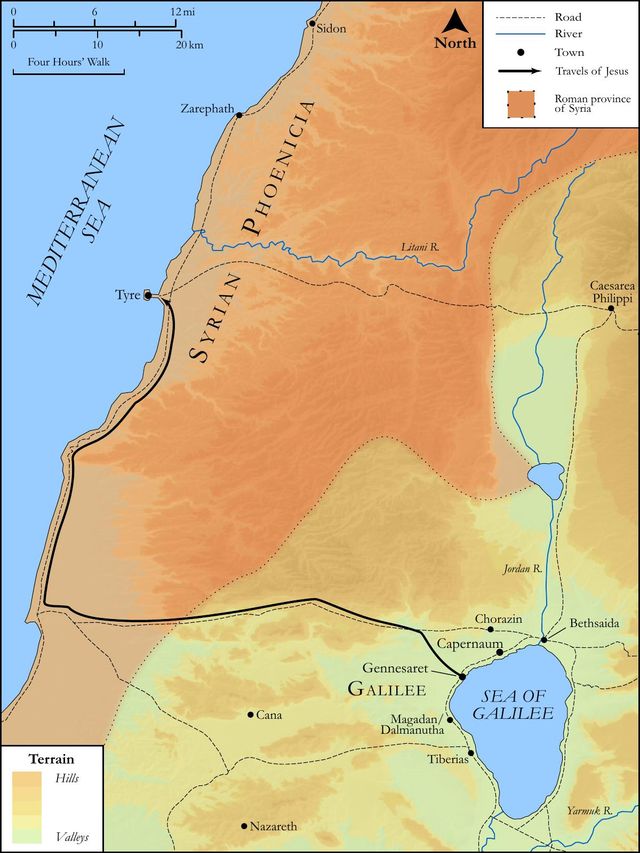
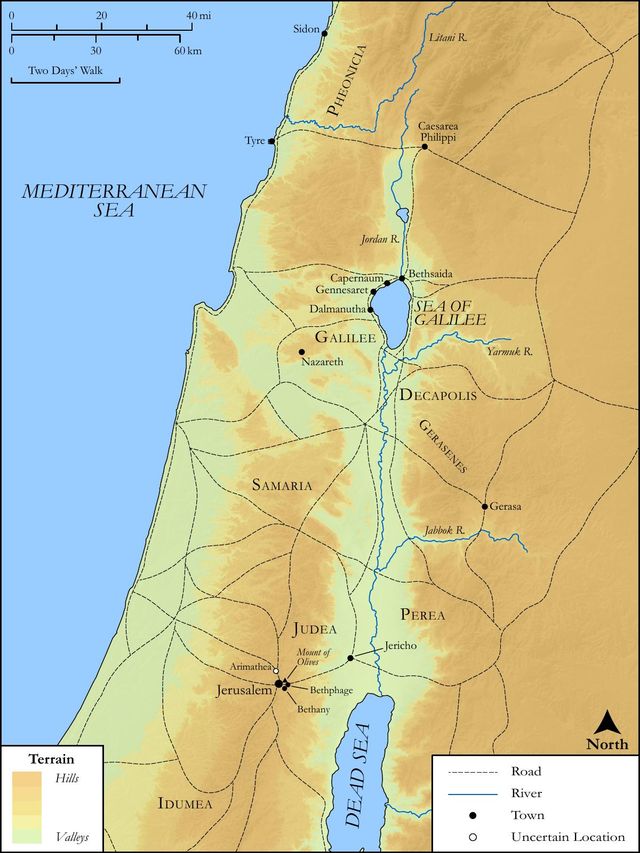
Study this verse
Public-domain commentary
Matthew Henry
From his Commentary on the Whole Bible. Henry comments on passages, not single verses — this entry covers Mark 7:24–30. His three-level outline is real structure in the source text, so it is rendered as structure.
See here, I. How humbly Christ was pleased to conceal himself. Never man was so cried up as he was in Galilee, and therefore, to teach us, though not to decline any opportunity of doing good, yet not to be fond of popular applause, he arose from thence, and went into the borders of Tyre and Sidon, where he was little known; and there he entered, not into a synagogue, or place of concourse, but into a private house, and he would have no man to know it; because it was foretold concerning him, He shall not strive nor cry, neither shall his voice be heard in the streets. Not but that he was willing to preach and heal here as well as in other places, but for this he would be sought unto. Note, As there is a time to appear, so there is a time to retire. Or, he would not be known, because he was upon the borders of Tyre and Sidon, among Gentiles, to whom he would not be so forward to show himself as to the tribes of Israel, whose glory he was to be.
II.How graciously he was pleased to manifest himself, notwithstanding.
Though he would not carry a harvest of miraculous cures into those parts, yet, it should seem, he came on purpose to drop a handful, to let fall this one which we have here an account of. He could not be hid; for, though a candle may be put under a bushel, the sun cannot. Christ was too well known to be long incognito - hid, any where; the oil of gladness which he was anointed with, like ointment of the right hand, would betray itself, and fill the house with its odours. Those that had only heard his fame, could not converse with him, but they would soon say, "This must be Jesus." Now observe,
1.The application made to him by a poor woman in distress and trouble. She was a Gentile, a Greek, a stranger to the commonwealth of Israel, an alien to the covenant of promise; she was by extraction a Syrophenician, and not in any degree proselyted to the Jewish religion; she had a daughter, a young daughter, that was possessed with the devil. How many and grievous are the calamities that young children are subject to! Her address was,
(1.)Very humble, pressing, and importunate; She heard of him, and came, and fell at his feet. Note, Those that would obtain mercy from Christ, must throw themselves at his feet; must refer themselves to him, humble themselves before him, and give up themselves to be ruled by him. Christ never put any from him, that fell at his feet, which a poor trembling soul may do, that has not boldness and confidence to throw itself into his arms.
(2.)It was very particular; she tells him what she wanted. Christ gave poor supplicants leave to be thus free with him; she besought him that he would cast forth the devil out of her daughter, Mar 7:26. Note, The greatest blessing we can ask of Christ for our children is, that he would break the power of Satan, that is, the power of sin, in their souls; and particularly, that he would cast forth the unclean spirit, that they may be temples of the Holy Ghost, and he may dwell in them.
2.The discouragement he gave to this address (Mar 7:27); He said unto her, "Let the children first be filled; let the Jews have all the miracles wrought for them, that they have occasion for, who are in a particular manner God's chosen people; and let not that which was intended for them, be thrown to those who are not of God's family, and who have not that knowledge of him, and interest in him, which they have, and who are as dogs in comparison of them, vile and profane, and who are as dogs to them, snarling at them, spiteful toward them, and ready to worry them." Note, Where Christ knows the faith of poor supplicants to be strong, he sometimes delights to try it, and put it to the stretch. But his saying, Let the children first be filled, intimates that there was mercy in reserve for the Gentiles, and not far off; for the Jews began already to be surfeited with the gospel of Christ, and some of them had desired him to depart out of their coasts. The children begin to play with their meat, and their leavings, their loathings, would be a feast for the Gentiles. The apostles went by this rule, Let the children first be filled, let the Jews have the first offer; and if their full souls loathe this honeycomb, Lo, we turn to the Gentiles!
3.The turn she gave to this word of Christ, which made against her, and her improvement of it, to make for her, Mar 7:28. She said, "Yes, Lord, I own it is true that the children's bread ought not to be cast to the dogs; but they were never denied the crumbs of that bread, nay it belongs to them, and they are allowed a place under the table, that they may be ready to receive them. I ask not for a loaf, no, nor for a morsel, only for a crumb; do not refuse me that." This she speaks, not as undervaluing the mercy, or making light of it in itself, but magnifying the abundance or miraculous cures with which she heard the Jews were feasted, in comparison with which a single cure was but as a crumb. Gentiles do not come in crowds, as the Jews do; I come alone. Perhaps she had heard of Christ's feeding five thousand lately at once, after which, even when they had gathered up the fragments, there could not but be some crumbs left for the dogs.
4.The grant Christ thereupon made of her request. Is she thus humble, thus earnest? For this saying, Go thy way, thou shalt have what thou camest for, the devil is gone out of thy daughter, Mar 7:29. This encourages us to pray and not to faint, to continue instant in prayer, not doubting but to prevail at last; the vision at the end shall speak, and not lie. Christ's saying that is was done, did it effectually, as at other times his saying, Let it be done; for (Mar 7:30) she came to her house, depending upon the word of Christ, that her daughter was healed, and so she found it, the devil was gone out. Note, Christ can conquer Satan at a distance; and it was not only when the demoniacs saw him, that they yielded to his power (as Mar 3:11), but when they saw him not, for the Spirit of the Lord is not bound, nor bounded. She found her daughter not in any toss or agitation, but very quietly laid on the bed, and reposing herself; waiting for her mother's return, to rejoice with her, that she was so finely well.
Historical interpretation
Eleven Centuries of Reception
11 surviving comments on this verse. Each one is dated, so this reads as a timeline rather than a list.
Select a marker to jump to its quote. Markers stagger vertically where authors wrote within a few decades of each other.
But if He wished to do so and could not, it appears as if His will was impotent; it is not possible however that our Saviour's will should not be fulfilled, nor can He will a thing, which He knows ought not be. Therefore when a thing has taken place, it may be asserted that He has willed it. But we should observe that this happened amongst the Gentiles, to whom it was not time to preach; nevertheless not to receive them, when they came to the faith of their own accord, would have been to grudge them the faith. So then it came to pass that the Lord was not made known by His disciples; others, however, who had seen Him entering the house, recognised Him, and it began to be known that He was there. His will therefore was that He should not be proclaimed by His own disciples, but that others should come to seek Him, and so it took place.
(ubi sup.) Lastly, the Canaanitish woman came in to Him, on hearing of Him; if she had not first submitted herself to the God of the Jews, she would not have obtained their benefit. Concerning her it continues: For a woman, whose daughter had an unclean spirit, as soon as she had heard of him, came in and fell at his feet.
Mystically however the Gentile woman, who prays for her daughter, is our mother the Church of Rome. Her daughter afflicted with a devil, is the barbarian western race, which by faith hath been turned from a dog into a sheep. She desires to take the crumbs of spiritual understanding, not the unbroken bread of the letter.
Those who possess the Holy Spirit search out “the deep places of God”—in other words, they attain the hidden secrets that surround prophecy. But it is forbidden to share holy things with dogs, as long as they remain wild. It is never appropriate to dilute the pure stream of divinity, the living water, for interests that are full of malice, disturbed persons, still without faith, who are unrestrained in barking at the hunt.
The like lesson He both inculcates by examples, and repeatedly handles in parables, when He says, "Doth a father take away bread from his children, and hand it to dogs? " and again, "Doth a father give his son a stone when he asks for bread? " For He thus shows what it is that sons expect from their father.
If God invariably listened to every supplicant equally, he might appear to us to act from some necessity rather than from his own free will.
(de Con. Evan. 2, 49) It appears however that some question about a discrepancy may be raised, because it is said that the Lord was in the house when the woman came to her, asking about her daughter. When, however, Matthew says that His disciples had suggested to Him, Send her away, for she crieth after us, (Matt. 15:23) he appears to imply nothing less than that the woman uttered supplicating cries after the Lord, as He walked. How then do we infer that she was in the house, except by gathering it from Mark, who says that she came in to Jesus, after having before said that He was in the house? But Matthew in that he says, He answered her not a word, gave us to understand that He went out, during that silence, from the house; thus too the other events are connected together, so that they now in no way disagree. It continues; But he said unto her, Let the children be first filled.
(Vict. Ant. e Cat. in Marc.) Tyre and Sidon were places of the Canaanites, therefore the Lord comes to them, not as to His own, but as to men, who had nothing in common with the fathers to whom the promise was made. And therefore He comes in such a way, that His coming should not be known to the Tyrians and Sidonians. Wherefore it continues: And entered in to a house, and would have no man know it. For the time had not come for His dwelling with the Gentiles and bringing them to the faith, for this was not to be, till after His cross and resurrection.
(Vict. Ant. e Cat. in Marc.) Now by this the Lord wished to show His disciples that He opened the door of faith even to the Gentiles, wherefore also the nation of the woman is described when it is added, The woman was a Gentile, a Syrophenician by nation, that is, from Syria of Phænice. It goes on: And she besought him that he would cast forth the devil out of her daughter.
(Vict. Ant. e Cat. in Marc.) These words He uttered not that there is in Him a deficiency of virtue, to prevent His ministering to all, but because His benefit, if ministered to both Jews and Gentiles who had no communication with each other, might be a cause of jealousy.
(Vict. Ant. e Cat. in Marc.) In like manner also to show the Jews that He did not confer healing on foreigners in the same degree as to them, and that by the discovery of the woman's faith, the unfaithfulness of the Jews might be the more laid bare. For the woman did not take it ill, but with much reverence assented to what the Lord had said. Wherefore it goes on, And she answered and said unto him, Truth, Lord, but the dogs under the table eat of the children's crumbs.
(Vict. Ant. e Cat. in Marc.) Her placing herself therefore in the rank of dogs is a mark of her reverence; as if she said, I hold it as a favour to be even in the position of a dog, and to eat not from another table, but from that of the Master himself.
(in Marc. 2, 30) Having entered also into the house, He commanded His disciples not to betray who He was to any one in this unknown region, that they, on whom He had bestowed the grace of healing, might learn by His example, as far as they could, to shrink from the glory of human praise in the showing forth of their miracles; yet they were not to cease from the pious work of virtue, when either the faith of the good justly deserved that miracles should be done, or the unfaithfulness of the wicked might necessarily compel them. For He Himself made known His entry into that place to the Gentile woman, and to whomsoever He would.
(ubi sup.) The time will come when even you who are Gentiles will obtain salvation; but it is right that first the Jews who deservedly are wont to be called by the name of children of God's ancient election, should be refreshed with heavenly bread, and that so at length, the food of life should be ministered to the Gentiles. There follows: For it is not meet to take the children's bread, and to cast it to the dogs.
(ubi sup.) On account then of the humble and faithful saying of her mother, the devil left the daughter; here is given a precedent for catechising and baptizing infants, seeing that by the faith and the confession of the parents, infants are freed in baptism from the devil, though they can neither have knowledge in themselves, or do either good or evil.
For it is not good to take the children's bread and throw it to the dogs. And she answered and said to him: Yes, Lord. For even the little dogs eat the crumbs that fall from the children’s table. The wondrous faith, patience, and humility of the Church under the persona of the Canaanite woman is being proclaimed. Faith, by which she believed that her daughter could be healed. Patience, by which she perseveres in prayers despite being ignored so many times (as Matthew writes). Humility, by which she compares herself not to dogs but to little dogs. She says, I know I do not deserve the children’s bread, nor can I take whole meals, nor sit at the table with the father; but I am content with the leftover scraps of the little dogs, so that by the humility of the crumbs I may come to the greatness of the whole bread. Wondrous reversal of things, once Israel was the son, not dogs, the order of names is changed due to the diversity of faith. Concerning them it is later said: Many dogs have surrounded me (Psalm 21). And: Beware of dogs, beware of evil workers, beware of the concision (Philippians 3). Concerning us, turned from the barking of blasphemous contradiction to the grace of piety, he himself says elsewhere: And I have other sheep that are not of this fold, I must bring them also, and they will listen to my voice (John 10). It must be noted indeed that the believing woman speaks mystically, because little dogs under the table eat from the children's crumbs. The table is indeed Holy Scripture, which provides us the bread of life. Thus the Church says from here: You prepared a table before me in the presence of my enemies (Psalm 22). The children's crumbs are the inner mysteries of the Scriptures, with which the hearts of the humble are usually refreshed. About which elsewhere it is promised to the holy Church, the Prophet saying of the Lord: He makes peace in your borders, and fills you with the finest of the wheat (Psalm 147). Therefore the little dogs do not eat crusts, but crumbs of the children's bread, because those converted to the faith who were despised among the nations seek not the surface of the letter in the Scriptures, but the marrow of spiritual senses by which they might be able to progress in good deeds. And this under the table of the masters, while humbly submitted to the word of the sacred discourse, they subject all their heart and body to fulfilling what is commanded, so that by means of the merit of due humility they may be raised to hope for the rewards promised by the Lord in heaven.
After that the Lord had finished His teaching concerning food, seeing that the Jews were incredulous, He enters into the country of the Gentiles, for the Jews being unfaithful, salvation turns itself to the Gentiles; wherefore it is said, And from thence he arose, and went into the borders of Tyre and Sidon.
(Pseudo-Aug. Quæst. e Vet. et Nov. Test. 77) Or else His reason for coming in secret was that the Jews should not find occasion of blame against Him, as if He had passed over to the unclean Gentiles. It goes on, But he could not be hid.
He calls the Gentiles dogs, as being thought wicked by the Jews; and He means by bread, the benefit which the Lord promised to the children, that is, to the Jews. The sense therefore is, that it is not right for the Gentiles first to be partakers of the benefit, promised principally to the Jews. The reason, therefore, why the Lord does not immediately hear, but delays His grace, is, that He may also show that the faith of the woman was firm, and that we may learn not at once to grow weary in prayer, but to continue earnest till we obtain.
As if she had said, The Jews have the whole of that bread which comes down from heaven, and Thy benefits also; I ask for the crumbs, that is, a small portion of the benefit.
Because therefore the woman answered with much wisdom, she obtained what she wanted; wherefore there follows, And he said unto her, &c. He said not, My virtue hath made thee whole, but for this saying, that is, for thy faith, which is shown by this saying, go thy way, the devil is gone out of thy daughter. It goes on, And when she was come into her house, she found her daughter laid upon the bed, and the devil gone out.
The soul of each of us also, when he falls into sin, becomes a woman; and this soul has a daughter who is sick, that is, evil actions; this daughter again has a devil, for evil actions arise from devils. Again, sinners are called dogs, being filled with uncleanness. For which reason we are not worthy to receive the bread of God, or to be made partakers of the immaculate mysteries of God; if however in humility, knowing ourselves to be dogs, we confess our sins, then the daughter, that is, our evil life, shall be healed.
(non occ. sed v. Summa 2, 2. Qu. 46. 1. et 1, 2. Qu. 1, 1) Or, foolishness consists in wrong thoughts concerning God; for it is opposed to wisdom, which is the knowledge of divine things. It goes on, All these evil things come from within, and defile the man. For whatsoever is in the power of a man, is imputed to him as a fault, because all such things proceed from the interior will, by which man is master of his own actions.
Continue studying Mark 7:27 across the web’s major study libraries — every link below opens this exact verse, chapter, or book on the destination site.
Read & Compare
 BibleGatewayThis verse in more than 200 translations and 70 languages.
 Bible.comThe YouVersion reader — hundreds of translations, reading plans, and highlights.
 ESV.orgCrossway's official English Standard Version reader.
 NET BibleThe NET translation with 60,000+ translators' notes on every rendering decision.
 STEP BibleTyndale House's free study tool — original text, vocabulary, and scholarly resources.
 BibliaLogos Bible Software's free web reader.
 USCCBThe New American Bible (Revised Edition) with the U.S. bishops' study notes.
Commentaries
 BibleHub CommentariesDozens of classic commentaries on this verse, gathered on one page.
 StudyLightMore than 100 commentary sets — the largest collection on the web.
 BibleRefPlain-English commentary on what this verse means, verse by verse.
 Enduring WordDavid Guzik's free commentary on this chapter, widely used by Bible teachers.
 Bible Study ToolsVerse commentary alongside Greek and Hebrew study aids.
Original Language & Research
- BibleHub InterlinearThe verse word by word — original language, transliteration, and English.
- BibleHub LexiconEvery word's original-language definition and Strong's entry.
 Blue Letter BibleDeep-study tools — Strong's numbers, concordance, and word studies.
 CNTR CollationThe earliest Greek manuscripts of this verse, collated letter by letter.
Sermons, Hymns & Audio


TrulyRandomVerse is not affiliated with these sites and doesn’t control their content. They’re linked because they’re genuinely useful.
Summary
Mark 7:27 presents a pivotal exchange between Jesus and a Syrophoenician woman, where Jesus initially articulates His primary mission to the Jewish people, metaphorically referring to them as "children" and His blessings as "bread." His statement, which seemingly places Gentiles ("dogs") outside this immediate divine provision, serves as a profound test of faith and simultaneously foreshadows the eventual, broader inclusion of all nations into the kingdom of God through the Gospel.
Context
ShowHideLiterary Context
This encounter in Mark 7 follows Jesus' extensive teaching on true defilement versus ceremonial impurity, where He challenges the rigid traditions of the Pharisees and scribes, emphasizing the heart's condition over external rituals (Mark 7:1-23). Immediately prior to this, Jesus withdraws to the region of Tyre and Sidon, Gentile territory, seeking a measure of privacy (Mark 7:24). The woman's persistent plea for her demon-possessed daughter's healing then sets the stage for Jesus' challenging, yet ultimately compassionate, response, directly demonstrating the principles of faith He has been teaching. This narrative serves as a bridge, illustrating how Jesus' ministry, while initially focused on Israel, begins to extend its reach beyond traditional boundaries, preparing the disciples for the future Gentile mission.
Historical & Cultural Context
Jesus' ministry was primarily directed toward the Jewish people, who were considered God's covenant nation. This priority is evident in His own words, such as His declaration that He was sent "only to the lost sheep of the house of Israel" (Matthew 15:24). The terms "children" and "dogs" in this context reflect the common Jewish understanding of their unique status as God's chosen people ("children of God") and the prevailing view of Gentiles as "dogs" – a derogatory term, though here softened by the diminutive "little dogs" or "house pets" (κυνάρια, kynárion). Tyre and Sidon were predominantly Gentile cities, deeply rooted in paganism, making Jesus' presence and interaction with a local woman there highly significant and culturally transgressive for many Jewish observers. This setting underscores the radical nature of the woman's faith and Jesus' ultimate willingness to extend grace beyond conventional boundaries.
Key Themes
ShowHideThe passage highlights several crucial themes. Firstly, it underscores the Divine Priority of Israel, affirming God's historical covenant with His chosen people and the initial focus of Jesus' earthly ministry on them. This aligns with the New Testament's teaching that the Gospel was to go "to the Jew first, and also to the Greek" (Romans 1:16). Secondly, the Metaphor of "Children's Bread" and "Dogs" is central. The "bread" symbolizes the spiritual and physical blessings of the Messiah's kingdom, including healing and salvation. The use of the diminutive "dogs" (κυνάρια, kynárion) rather than the harsher "wild dogs" (κύων, kyōn) is a subtle but profound softening of the analogy, hinting that Gentiles are not entirely excluded but rather await their turn for the "scraps" from the master's table. Finally, the interaction profoundly illustrates the theme of Testing and Revealing Faith. Jesus' challenging response is not a rejection but an invitation for the woman to demonstrate the depth and humility of her faith, which she remarkably does in the subsequent verse (Mark 7:28).
Exposition and Analysis
ShowHideKey Word Analysis
ShowHideFrom the base of τίκτω, meaning "to produce," this word refers to a child as one who is produced or born. In this context, it metaphorically refers to the Jewish people as the "children" of God's covenant, indicating their special relationship and priority in God's redemptive plan.
This term signifies that which is properly beautiful, good, valuable, or virtuous. Here, it conveys the idea of something being "proper," "right," or "fitting." Jesus states it is "not meet" (οὐ καλός, ou kalós) to take the children's bread, implying that it is not appropriate or orderly to divert the blessings primarily intended for Israel to others at this stage.
This is the neuter diminutive of κύων (kyōn), which refers to a wild or scavenging dog. By using kynárion, Jesus refers to "little dogs" or "house pets." This crucial linguistic choice significantly softens the analogy, distinguishing it from the more contemptuous "wild dogs" and implying that while Gentiles were outside the immediate "household" of Israel, they were not utterly without hope of receiving God's provision.
Verse Breakdown
ShowHide"But Jesus said unto her, Let the children first be filled:"
Jesus responds to the woman's plea by articulating the divine order of His earthly ministry. The phrase "Let the children first be filled" indicates that His primary mission, at that specific time, was directed towards the Jewish people, who were the "children" of the covenant. This highlights the historical and theological priority of Israel in God's redemptive plan, emphasizing that the blessings of the Messiah were first for them.
"for it is not meet to take the children's bread,"
This clause provides the reason for Jesus' initial statement. The "children's bread" symbolizes the spiritual and physical blessings, healing, and salvation that Jesus, as the Messiah, brought. To "take" this bread implies diverting these blessings from their intended primary recipients. Jesus asserts that it is not "meet" or proper to alter this established divine order.
"and to cast [it] unto the dogs."
This final phrase completes the analogy. The "dogs," specifically "little dogs" or "house pets" (κυνάρια), represent the Gentiles. To "cast" the bread to them signifies giving the primary covenant blessings to those outside the covenant community. While seemingly harsh, the use of the diminutive "dogs" subtly leaves room for the Gentiles to receive "scraps" or secondary blessings, foreshadowing their future inclusion.
Literary Devices
ShowHideThe passage employs several significant literary devices. Metaphor is central, as Jesus uses the imagery of "children," "bread," and "dogs" to represent the Jewish people, the blessings of the kingdom, and Gentiles, respectively. This Analogy effectively conveys the prevailing understanding of the divine order of salvation history. The use of the diminutive for "dogs" (κυνάρια) is a subtle yet powerful instance of Nuance, softening the potential harshness of the term and hinting at a future, more inclusive reality. Furthermore, Jesus' seemingly challenging statement functions as a Test of the woman's faith, inviting her to demonstrate humility and persistence, which she does remarkably in the subsequent verse, transforming the interaction into a profound display of grace.
Theological and Thematic Connections
ShowHideMark 7:27, while initially appearing to limit God's grace, ultimately serves as a profound theological statement about the unfolding of God's redemptive plan. It affirms God's historical commitment to Israel as His covenant people, through whom salvation would come. Yet, Jesus' use of the diminutive "little dogs" subtly hints at a broader, future inclusion of the Gentiles, suggesting that while Israel had the primary portion, there would be "crumbs" of grace for others. This passage underscores that God's plan is both orderly and expansive, beginning with Israel but always intended to reach "all the families of the earth" (Genesis 12:3). The woman's humble and insightful response then demonstrates that true faith, regardless of one's background, can access God's boundless mercy, even if it means receiving what seems like "scraps" from the master's table.
Reflection and Application
ShowHideMark 7:27, particularly when considered with the Syrophoenician woman's response, offers profound lessons for our spiritual journey. It challenges us to examine the depth and persistence of our own faith. Are we willing to humble ourselves and approach God, even when His answers seem to delay or challenge our expectations? The woman's unwavering trust, despite Jesus' seemingly harsh words, teaches us that genuine faith perseveres, believing in God's ultimate goodness and sovereign plan. Her example encourages us to persist in prayer, to approach the Lord with humility, and to trust that His grace is abundant and available to all who believe, regardless of their background or perceived standing. This narrative also reminds us that God's redemptive purposes unfold in stages, ultimately extending His blessings to all humanity, breaking down barriers and inviting everyone to partake in the "bread" of His kingdom.
Questions for Reflection
ShowHideFAQ
ShowHideWhy did Jesus use such a seemingly harsh term like "dogs" for Gentiles?
ShowHideWhile the term "dogs" (κύων, kyōn) was indeed a derogatory epithet used by Jews for Gentiles, Jesus deliberately used the diminutive form, κυνάρια (kynárion), which refers to "little dogs" or "house pets." This subtle but crucial linguistic choice softens the analogy considerably. It suggests that while Gentiles were not the primary recipients of the "children's bread" (the immediate blessings of His earthly ministry to Israel), they were not entirely excluded from God's provision. House pets, unlike wild scavengers, are part of the household, even if they eat scraps from under the table. This nuance foreshadows the eventual inclusion of Gentiles into God's family, implying that even the "crumbs" of God's grace are sufficient for salvation, as the woman herself recognized in Mark 7:28.
Does this passage imply that God's salvation is limited or exclusive to a certain group?
ShowHideNo, this passage does not imply that God's salvation is ultimately limited or exclusive. Instead, it highlights the order and priority of God's redemptive plan. Jesus' earthly ministry was primarily focused on the Jewish people, who were the "children" of the covenant, fulfilling the prophecies that salvation would come through Israel (Romans 9:4-5). However, the very interaction with the Syrophoenician woman, and Jesus' ultimate granting of her request, demonstrates that God's grace was always intended to extend beyond Israel. The "first" in "Let the children first be filled" implies that others would follow. This encounter, therefore, serves as a powerful foreshadowing of the inclusion of Gentiles into the Church, fulfilling the Abrahamic covenant that "all peoples on earth will be blessed through you" (Genesis 12:3). The New Testament consistently teaches that in Christ, the dividing wall between Jew and Gentile has been broken down (Ephesians 2:14), and salvation is offered to all who believe.
Christ-Centered Fulfillment
ShowHideMark 7:27, while initially presenting Jesus' focus on Israel's priority, finds its ultimate Christ-centered fulfillment in the expansive nature of the New Covenant established through His death and resurrection. Jesus, the true "bread of life" (John 6:35), came first to His own, the "children" of Israel, but His mission was always destined to transcend ethnic boundaries. The Syrophoenician woman's remarkable faith, which recognized that even the "crumbs" from the Messiah's table were sufficient for healing, prefigures the Gentile world's eager reception of the Gospel. In Christ, the old distinctions and priorities are transformed; the "children's bread" is now offered freely to all who believe, Jew and Gentile alike. Through His atoning sacrifice, Jesus broke down the dividing wall of hostility (Ephesians 2:14-16), making both "children" and "dogs" (in the old sense) one new humanity in Him. The Great Commission, "Go therefore and make disciples of all nations" (Matthew 28:19), is the full realization of the grace hinted at in this encounter, demonstrating that in Christ, there is "neither Jew nor Gentile, neither slave nor free, nor is there male and female, for you are all one in Christ Jesus" (Galatians 3:28). The "bread" of salvation is now universally available, and all who come to Him in faith, regardless of their former status, are filled.