


Mark 7:30
Bible text: King James Version (1769 Blayney text) · Public domain
Bible text: Berean Standard Bible · Public domain
Bible text: American Standard Version (1901) · Public domain
Bible text: World English Bible, Messianic edition · Public domain
Bible text: Geneva Bible (1599) · Public domain
Bible text: Young's Literal Translation · Public domain
- καὶkaiAndG2532CONJConjunction
- ἀπελθοῦσαapelthousahaving gone awayG565V-2AAP-NSFVerb 2nd Aorist Active Participle Nominative Singular Feminine
- εἰςeistoG1519PREPPreposition
- τὸνtontheG3588T-ASMDefinite article Accusative Singular Masculine
- οἶκονoikonhomeG3624N-ASMNoun Accusative Singular Masculine
- αὐτῆςautēsof herG846P-GSFPersonal pronoun Genitive Singular Feminine
- εὗρενheurenshe foundG2147V-2AAI-3SVerb 2nd Aorist Active Indicative 3rd Singular
- τὸtotheG3588T-ASNDefinite article Accusative Singular Neuter
- παιδίονpaidionchildG3813N-ASNNoun Accusative Singular Neuter
- βεβλημένονbeblēmenonlaidG906V-RPP-ASNVerb Perfect Passive Participle Accusative Singular Neuter
- ἐπὶepionG1909PREPPreposition
- τὴνtēntheG3588T-ASFDefinite article Accusative Singular Feminine
- κλίνηνklinēnbedG2825N-ASFNoun Accusative Singular Feminine
- καὶkaiandG2532CONJConjunction
- τὸtotheG3588T-ASNDefinite article Accusative Singular Neuter
- δαιμόνιονdaimoniondemonG1140N-ASNNoun Accusative Singular Neuter
- ἐξεληλυθόςexelēluthoshaving leftG1831V-2RAP-ASNVerb 2nd Perfect Active Participle Accusative Singular Neuter
English is a literal word-by-word gloss of the Greek, not the KJV's wording. Why?
This is the original text the KJV's translators worked from — each Greek word with its own literal English meaning in this verse, prepared by scholars at Tyndale House, Cambridge. The KJV translates whole sentences, not word by word, so its wording differs: one Greek word can become several English words, and the KJV may choose “charity” where the gloss reads “love”. Both are faithful — they answer different questions. For the KJV's own rendering, switch to the KJV text.
Details
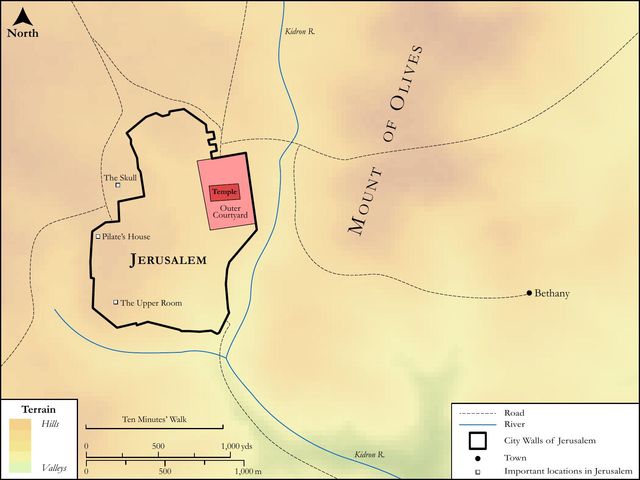
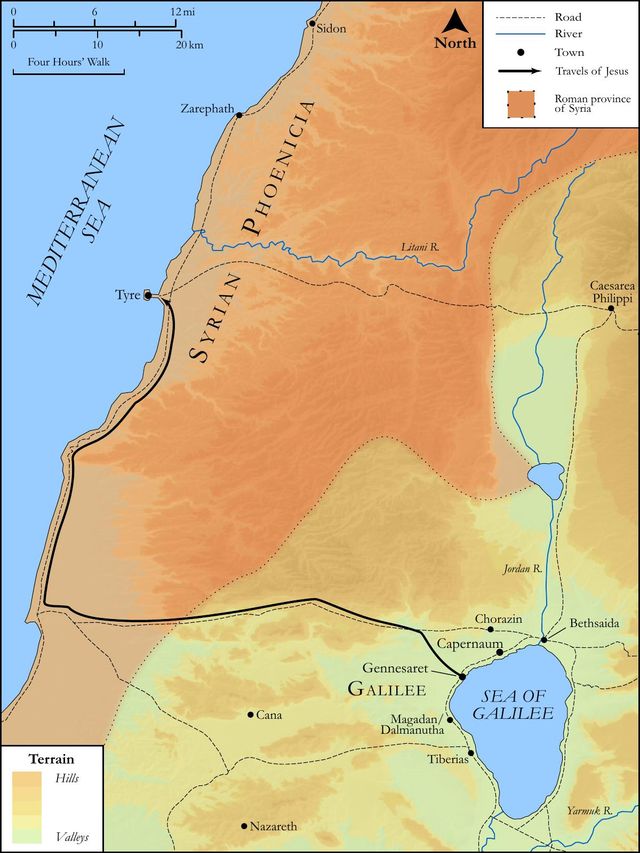
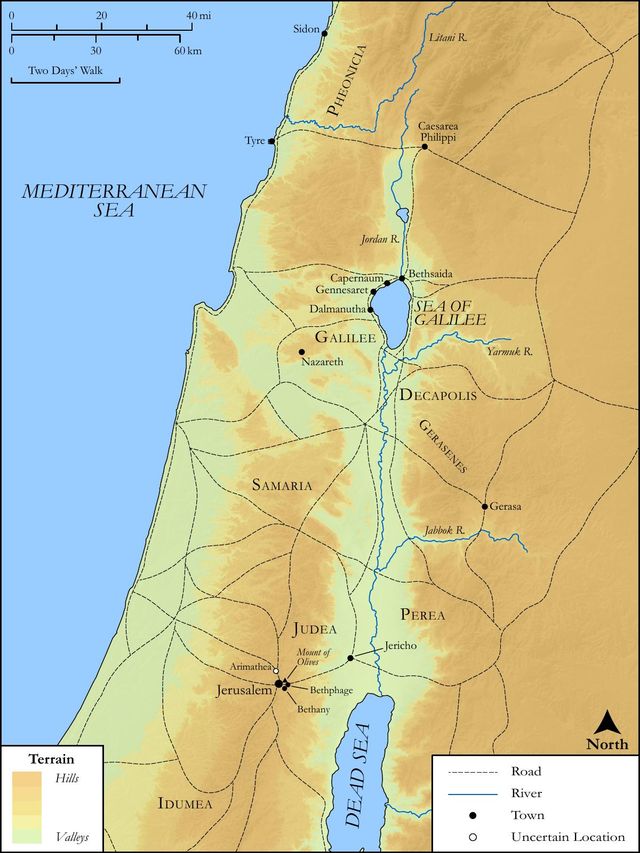
See on the biblical-era maps
Study this verse
Public-domain commentary
Matthew Henry
From his Commentary on the Whole Bible. Henry comments on passages, not single verses — this entry covers Mark 7:24–30. His three-level outline is real structure in the source text, so it is rendered as structure.
See here, I. How humbly Christ was pleased to conceal himself. Never man was so cried up as he was in Galilee, and therefore, to teach us, though not to decline any opportunity of doing good, yet not to be fond of popular applause, he arose from thence, and went into the borders of Tyre and Sidon, where he was little known; and there he entered, not into a synagogue, or place of concourse, but into a private house, and he would have no man to know it; because it was foretold concerning him, He shall not strive nor cry, neither shall his voice be heard in the streets. Not but that he was willing to preach and heal here as well as in other places, but for this he would be sought unto. Note, As there is a time to appear, so there is a time to retire. Or, he would not be known, because he was upon the borders of Tyre and Sidon, among Gentiles, to whom he would not be so forward to show himself as to the tribes of Israel, whose glory he was to be.
II.How graciously he was pleased to manifest himself, notwithstanding.
Though he would not carry a harvest of miraculous cures into those parts, yet, it should seem, he came on purpose to drop a handful, to let fall this one which we have here an account of. He could not be hid; for, though a candle may be put under a bushel, the sun cannot. Christ was too well known to be long incognito - hid, any where; the oil of gladness which he was anointed with, like ointment of the right hand, would betray itself, and fill the house with its odours. Those that had only heard his fame, could not converse with him, but they would soon say, "This must be Jesus." Now observe,
1.The application made to him by a poor woman in distress and trouble. She was a Gentile, a Greek, a stranger to the commonwealth of Israel, an alien to the covenant of promise; she was by extraction a Syrophenician, and not in any degree proselyted to the Jewish religion; she had a daughter, a young daughter, that was possessed with the devil. How many and grievous are the calamities that young children are subject to! Her address was,
(1.)Very humble, pressing, and importunate; She heard of him, and came, and fell at his feet. Note, Those that would obtain mercy from Christ, must throw themselves at his feet; must refer themselves to him, humble themselves before him, and give up themselves to be ruled by him. Christ never put any from him, that fell at his feet, which a poor trembling soul may do, that has not boldness and confidence to throw itself into his arms.
(2.)It was very particular; she tells him what she wanted. Christ gave poor supplicants leave to be thus free with him; she besought him that he would cast forth the devil out of her daughter, Mar 7:26. Note, The greatest blessing we can ask of Christ for our children is, that he would break the power of Satan, that is, the power of sin, in their souls; and particularly, that he would cast forth the unclean spirit, that they may be temples of the Holy Ghost, and he may dwell in them.
2.The discouragement he gave to this address (Mar 7:27); He said unto her, "Let the children first be filled; let the Jews have all the miracles wrought for them, that they have occasion for, who are in a particular manner God's chosen people; and let not that which was intended for them, be thrown to those who are not of God's family, and who have not that knowledge of him, and interest in him, which they have, and who are as dogs in comparison of them, vile and profane, and who are as dogs to them, snarling at them, spiteful toward them, and ready to worry them." Note, Where Christ knows the faith of poor supplicants to be strong, he sometimes delights to try it, and put it to the stretch. But his saying, Let the children first be filled, intimates that there was mercy in reserve for the Gentiles, and not far off; for the Jews began already to be surfeited with the gospel of Christ, and some of them had desired him to depart out of their coasts. The children begin to play with their meat, and their leavings, their loathings, would be a feast for the Gentiles. The apostles went by this rule, Let the children first be filled, let the Jews have the first offer; and if their full souls loathe this honeycomb, Lo, we turn to the Gentiles!
3.The turn she gave to this word of Christ, which made against her, and her improvement of it, to make for her, Mar 7:28. She said, "Yes, Lord, I own it is true that the children's bread ought not to be cast to the dogs; but they were never denied the crumbs of that bread, nay it belongs to them, and they are allowed a place under the table, that they may be ready to receive them. I ask not for a loaf, no, nor for a morsel, only for a crumb; do not refuse me that." This she speaks, not as undervaluing the mercy, or making light of it in itself, but magnifying the abundance or miraculous cures with which she heard the Jews were feasted, in comparison with which a single cure was but as a crumb. Gentiles do not come in crowds, as the Jews do; I come alone. Perhaps she had heard of Christ's feeding five thousand lately at once, after which, even when they had gathered up the fragments, there could not but be some crumbs left for the dogs.
4.The grant Christ thereupon made of her request. Is she thus humble, thus earnest? For this saying, Go thy way, thou shalt have what thou camest for, the devil is gone out of thy daughter, Mar 7:29. This encourages us to pray and not to faint, to continue instant in prayer, not doubting but to prevail at last; the vision at the end shall speak, and not lie. Christ's saying that is was done, did it effectually, as at other times his saying, Let it be done; for (Mar 7:30) she came to her house, depending upon the word of Christ, that her daughter was healed, and so she found it, the devil was gone out. Note, Christ can conquer Satan at a distance; and it was not only when the demoniacs saw him, that they yielded to his power (as Mar 3:11), but when they saw him not, for the Spirit of the Lord is not bound, nor bounded. She found her daughter not in any toss or agitation, but very quietly laid on the bed, and reposing herself; waiting for her mother's return, to rejoice with her, that she was so finely well.
Historical interpretation
Eight Centuries of Reception
6 surviving comments on this verse. Each one is dated, so this reads as a timeline rather than a list.
Select a marker to jump to its quote. Markers stagger vertically where authors wrote within a few decades of each other.
But if He wished to do so and could not, it appears as if His will was impotent; it is not possible however that our Saviour's will should not be fulfilled, nor can He will a thing, which He knows ought not be. Therefore when a thing has taken place, it may be asserted that He has willed it. But we should observe that this happened amongst the Gentiles, to whom it was not time to preach; nevertheless not to receive them, when they came to the faith of their own accord, would have been to grudge them the faith. So then it came to pass that the Lord was not made known by His disciples; others, however, who had seen Him entering the house, recognised Him, and it began to be known that He was there. His will therefore was that He should not be proclaimed by His own disciples, but that others should come to seek Him, and so it took place.
(ubi sup.) Lastly, the Canaanitish woman came in to Him, on hearing of Him; if she had not first submitted herself to the God of the Jews, she would not have obtained their benefit. Concerning her it continues: For a woman, whose daughter had an unclean spirit, as soon as she had heard of him, came in and fell at his feet.
Mystically however the Gentile woman, who prays for her daughter, is our mother the Church of Rome. Her daughter afflicted with a devil, is the barbarian western race, which by faith hath been turned from a dog into a sheep. She desires to take the crumbs of spiritual understanding, not the unbroken bread of the letter.
(Vict. Ant. e Cat. in Marc.) Tyre and Sidon were places of the Canaanites, therefore the Lord comes to them, not as to His own, but as to men, who had nothing in common with the fathers to whom the promise was made. And therefore He comes in such a way, that His coming should not be known to the Tyrians and Sidonians. Wherefore it continues: And entered in to a house, and would have no man know it. For the time had not come for His dwelling with the Gentiles and bringing them to the faith, for this was not to be, till after His cross and resurrection.
(Vict. Ant. e Cat. in Marc.) Now by this the Lord wished to show His disciples that He opened the door of faith even to the Gentiles, wherefore also the nation of the woman is described when it is added, The woman was a Gentile, a Syrophenician by nation, that is, from Syria of Phænice. It goes on: And she besought him that he would cast forth the devil out of her daughter.
(Vict. Ant. e Cat. in Marc.) These words He uttered not that there is in Him a deficiency of virtue, to prevent His ministering to all, but because His benefit, if ministered to both Jews and Gentiles who had no communication with each other, might be a cause of jealousy.
(Vict. Ant. e Cat. in Marc.) In like manner also to show the Jews that He did not confer healing on foreigners in the same degree as to them, and that by the discovery of the woman's faith, the unfaithfulness of the Jews might be the more laid bare. For the woman did not take it ill, but with much reverence assented to what the Lord had said. Wherefore it goes on, And she answered and said unto him, Truth, Lord, but the dogs under the table eat of the children's crumbs.
(Vict. Ant. e Cat. in Marc.) Her placing herself therefore in the rank of dogs is a mark of her reverence; as if she said, I hold it as a favour to be even in the position of a dog, and to eat not from another table, but from that of the Master himself.
(in Marc. 2, 30) Having entered also into the house, He commanded His disciples not to betray who He was to any one in this unknown region, that they, on whom He had bestowed the grace of healing, might learn by His example, as far as they could, to shrink from the glory of human praise in the showing forth of their miracles; yet they were not to cease from the pious work of virtue, when either the faith of the good justly deserved that miracles should be done, or the unfaithfulness of the wicked might necessarily compel them. For He Himself made known His entry into that place to the Gentile woman, and to whomsoever He would.
(ubi sup.) The time will come when even you who are Gentiles will obtain salvation; but it is right that first the Jews who deservedly are wont to be called by the name of children of God's ancient election, should be refreshed with heavenly bread, and that so at length, the food of life should be ministered to the Gentiles. There follows: For it is not meet to take the children's bread, and to cast it to the dogs.
(ubi sup.) On account then of the humble and faithful saying of her mother, the devil left the daughter; here is given a precedent for catechising and baptizing infants, seeing that by the faith and the confession of the parents, infants are freed in baptism from the devil, though they can neither have knowledge in themselves, or do either good or evil.
After that the Lord had finished His teaching concerning food, seeing that the Jews were incredulous, He enters into the country of the Gentiles, for the Jews being unfaithful, salvation turns itself to the Gentiles; wherefore it is said, And from thence he arose, and went into the borders of Tyre and Sidon.
(Pseudo-Aug. Quæst. e Vet. et Nov. Test. 77) Or else His reason for coming in secret was that the Jews should not find occasion of blame against Him, as if He had passed over to the unclean Gentiles. It goes on, But he could not be hid.
He calls the Gentiles dogs, as being thought wicked by the Jews; and He means by bread, the benefit which the Lord promised to the children, that is, to the Jews. The sense therefore is, that it is not right for the Gentiles first to be partakers of the benefit, promised principally to the Jews. The reason, therefore, why the Lord does not immediately hear, but delays His grace, is, that He may also show that the faith of the woman was firm, and that we may learn not at once to grow weary in prayer, but to continue earnest till we obtain.
As if she had said, The Jews have the whole of that bread which comes down from heaven, and Thy benefits also; I ask for the crumbs, that is, a small portion of the benefit.
Because therefore the woman answered with much wisdom, she obtained what she wanted; wherefore there follows, And he said unto her, &c. He said not, My virtue hath made thee whole, but for this saying, that is, for thy faith, which is shown by this saying, go thy way, the devil is gone out of thy daughter. It goes on, And when she was come into her house, she found her daughter laid upon the bed, and the devil gone out.
The soul of each of us also, when he falls into sin, becomes a woman; and this soul has a daughter who is sick, that is, evil actions; this daughter again has a devil, for evil actions arise from devils. Again, sinners are called dogs, being filled with uncleanness. For which reason we are not worthy to receive the bread of God, or to be made partakers of the immaculate mysteries of God; if however in humility, knowing ourselves to be dogs, we confess our sins, then the daughter, that is, our evil life, shall be healed.
(non occ. sed v. Summa 2, 2. Qu. 46. 1. et 1, 2. Qu. 1, 1) Or, foolishness consists in wrong thoughts concerning God; for it is opposed to wisdom, which is the knowledge of divine things. It goes on, All these evil things come from within, and defile the man. For whatsoever is in the power of a man, is imputed to him as a fault, because all such things proceed from the interior will, by which man is master of his own actions.
Continue studying Mark 7:30 across the web’s major study libraries — every link below opens this exact verse, chapter, or book on the destination site.
Read & Compare
 BibleGatewayThis verse in more than 200 translations and 70 languages.
 Bible.comThe YouVersion reader — hundreds of translations, reading plans, and highlights.
 ESV.orgCrossway's official English Standard Version reader.
 NET BibleThe NET translation with 60,000+ translators' notes on every rendering decision.
 STEP BibleTyndale House's free study tool — original text, vocabulary, and scholarly resources.
 BibliaLogos Bible Software's free web reader.
 USCCBThe New American Bible (Revised Edition) with the U.S. bishops' study notes.
Commentaries
 BibleHub CommentariesDozens of classic commentaries on this verse, gathered on one page.
 StudyLightMore than 100 commentary sets — the largest collection on the web.
 BibleRefPlain-English commentary on what this verse means, verse by verse.
 Enduring WordDavid Guzik's free commentary on this chapter, widely used by Bible teachers.
 Bible Study ToolsVerse commentary alongside Greek and Hebrew study aids.
Original Language & Research
- BibleHub InterlinearThe verse word by word — original language, transliteration, and English.
- BibleHub LexiconEvery word's original-language definition and Strong's entry.
 Blue Letter BibleDeep-study tools — Strong's numbers, concordance, and word studies.
 CNTR CollationThe earliest Greek manuscripts of this verse, collated letter by letter.
Sermons, Hymns & Audio


TrulyRandomVerse is not affiliated with these sites and doesn’t control their content. They’re linked because they’re genuinely useful.
Summary
Mark 7:30 provides the triumphant conclusion to Jesus' encounter with the Syrophoenician woman, detailing her return home to find her daughter completely healed and delivered from demonic oppression. This verse serves as a powerful testament to the efficacy of Jesus' word spoken from a distance, the profound impact of persistent faith, and the immediate, restorative power of divine intervention, confirming the complete fulfillment of Christ's declaration.
Context
ShowHideLiterary Context
This verse immediately follows Jesus' commendation of the Syrophoenician woman's faith and His declaration that the demon had left her daughter (Mark 7:29). The preceding narrative (Mark 7:24-29) is set in the Gentile region of Tyre, where Jesus had sought privacy. The woman, a Gentile, boldly approached Jesus despite cultural and religious barriers, pleading for her demon-possessed daughter. Jesus' initial response, using the analogy of "children's bread" and "dogs," tested her faith, but her humble and insightful reply ("even the dogs under the table eat of the children's crumbs") demonstrated a profound understanding of grace and a tenacious belief in His power. Mark 7:30 serves as the conclusive proof of Jesus' authority and the immediate, tangible result of His spoken word, validating the woman's faith and the truth of His promise.
Historical & Cultural Context
The setting in the region of Tyre and Sidon is significant as it places Jesus squarely in Gentile territory, outside the traditional Jewish heartland of Galilee and Judea. This context highlights the breaking down of ethnic and religious barriers, foreshadowing the universal reach of the Gospel. In Jewish society, interactions with Gentiles were often limited, and the Syrophoenician woman's direct approach to a Jewish rabbi was unusual. Demon possession was a recognized affliction in that day, often associated with severe physical and mental distress, and exorcisms were understood as powerful displays of spiritual authority. The act of a mother seeking healing for her child was a common and relatable plea, transcending cultural divides. The immediate healing "at her house" underscores the spiritual nature of the deliverance, not dependent on physical proximity or ritual.
Key Themes
ShowHideMark 7:30 powerfully reinforces several key themes prevalent in the Gospel of Mark. Foremost among these is the authority of Jesus over spiritual forces, demonstrated by the remote expulsion of the demon, echoing earlier accounts of His power over unclean spirits, as seen in the synagogue in Capernaum. Another crucial theme is the nature and power of faith, particularly persistent and humble faith, which Jesus commends and rewards, extending His grace beyond the traditional boundaries of Israel. This narrative also significantly contributes to the theme of Gentile inclusion in God's redemptive plan, showing Jesus' ministry extending to non-Jews and foreshadowing the universal scope of the Gospel message that would be proclaimed to all nations. Finally, the imagery of the daughter "laid upon the bed" beautifully conveys restoration and peace after torment, symbolizing the comprehensive healing and new life that Christ brings, a stark contrast to the chaos of demonic oppression.
Exposition and Analysis
ShowHideKey Word Analysis
ShowHideThis term refers to a demonic being or an evil spirit, distinct from Satan himself (who is referred to as Satanas or diabolos). Its use here emphasizes that the affliction was caused by a malevolent spiritual entity, highlighting the supernatural nature of the daughter's condition and the power required to overcome it. The immediate departure of the daimónion underscores Jesus' supreme authority over all such forces.
This verb signifies a complete and decisive departure or expulsion. It conveys the thoroughness of the deliverance, indicating that the demon did not merely recede or lessen its influence but was entirely cast out. This emphasizes the finality and effectiveness of Jesus' word, leaving no room for lingering effects or future re-infestation.
This word denotes a couch or bed, used for sleeping, sickness, or reclining. In this context, finding the daughter "laid upon the bed" suggests a state of rest, peace, and normalcy. It contrasts sharply with the previous torment and agitation associated with demon possession, symbolizing a return to health and tranquility, a complete restoration to her proper state.
Verse Breakdown
ShowHide"And when she was come to her house"
This clause describes the woman's journey home, an act of faith in itself. She believed Jesus' word (Mark 7:29) without immediate visible proof, trusting that the healing had already occurred. Her physical return to her dwelling signifies the place where the confirmation of that divine work would be revealed.
"she found the devil gone out"
This is the pivotal discovery. Upon entering her home, the mother's expectation, based on Jesus' promise, is met with reality. The "devil" (demon) had indeed departed, confirming the immediate and effective power of Jesus' command. This finding validates her faith and demonstrates Jesus' authority over spiritual forces, even from a distance.
"and her daughter laid upon the bed"
This final phrase paints a picture of complete restoration. The daughter, previously tormented and likely exhibiting chaotic behavior, is now found in a state of peaceful repose. "Laid upon the bed" implies a return to normalcy, rest, and health, signifying that the demonic oppression was not only gone but its effects were entirely reversed, bringing peace to both the child and the household.
Literary Devices
ShowHideMark 7:30 employs several powerful literary devices. The most prominent is Confirmation, as the verse explicitly validates Jesus' earlier declaration (Mark 7:29), providing a tangible and immediate proof of His divine authority and the efficacy of His word. This immediate fulfillment creates a sense of Dramatic Irony for the reader, who knows the outcome before the mother does, building anticipation for her discovery. The phrase "laid upon the bed" serves as potent Symbolism, representing not just physical rest but also the profound spiritual peace and restoration that accompanies deliverance from evil. The narrative also features Contrast between the daughter's previous state of torment and her newfound tranquility, highlighting the transformative power of Jesus. Furthermore, the remote healing underscores Jesus' Omnipotence, demonstrating His power is not limited by physical proximity.
Theological and Thematic Connections
ShowHideMark 7:30 profoundly illustrates the boundless nature of God's grace and power, extending beyond geographical and ethnic boundaries. It underscores that Jesus' authority over spiritual forces is absolute and His word is inherently efficacious, bringing about immediate and complete transformation. The woman's persistent faith, coupled with Jesus' compassionate response, foreshadows the universal invitation to salvation and healing available to all who believe, regardless of their background. This event serves as a powerful reminder that God's redemptive plan encompasses all humanity, offering freedom from spiritual bondage and ushering in a state of peace and restoration.
Reflection and Application
ShowHideMark 7:30 invites us to cultivate a radical trust in the unseen power of Jesus' word. Like the Syrophoenician woman, we are often called to believe in Christ's declarations and promises even when immediate physical evidence is absent. Her journey home, an act of faith, teaches us that obedience and trust in God's word, even before seeing the full manifestation, are crucial. This verse reminds us that God's power is not constrained by distance, circumstances, or our perceived unworthiness. It encourages us to approach Jesus with persistent, humble faith, knowing that He is compassionate and responsive to genuine need, regardless of our background. In our own lives, this means trusting that when Christ speaks a word of healing, deliverance, or peace, it is as good as done, and we can rest in the certainty of its fulfillment, moving forward in faith toward the confirmation of His work. It challenges us to identify areas where we need to trust Jesus' word more fully, even when the evidence is not yet visible.
Questions for Reflection
ShowHideFAQ
ShowHideWhat is the significance of the daughter being "laid upon the bed" after the demon left?
ShowHideThe detail that the daughter was "laid upon the bed" (Greek: klínē) after the demon departed is highly significant, symbolizing a complete and peaceful restoration. Before the exorcism, the daughter was demon-possessed, implying a state of torment, agitation, and likely a lack of rest or normal functioning. Finding her "laid upon the bed" suggests that she was no longer in distress but was now calm, at peace, and perhaps even sleeping soundly. This imagery conveys a return to normalcy, health, and tranquility, highlighting the comprehensive nature of Jesus' healing. It contrasts sharply with the chaos and suffering associated with her previous condition, emphasizing the profound peace and order that Christ's power brings. It's a visual confirmation of not just the demon's expulsion but also the full recovery of the child's well-being. This detail underscores the immediate and complete efficacy of Jesus' word, bringing not just deliverance but also rest and wholeness, as seen in other instances where Jesus brings peace to chaotic situations, such as calming the storm.
Christ-Centered Fulfillment
ShowHideMark 7:30, though a narrative of physical healing and demonic deliverance, profoundly points to Christ's ultimate work as the Redeemer and Restorer. The remote healing of the Syrophoenician woman's daughter foreshadows the spiritual deliverance Christ offers to all humanity, transcending physical proximity and ethnic boundaries. Just as the demon "gone out" brought peace to the daughter, Christ's death and resurrection decisively defeated the power of sin and Satan, liberating humanity from spiritual bondage. He is the one who casts out the "strong man" (Satan) and plunders his house, as He Himself taught in Mark 3:27. The daughter "laid upon the bed" symbolizes the peace and rest believers find in Christ, who offers true rest for our souls (Matthew 11:28-30) and reconciles us to God, bringing us into a state of spiritual wholeness and peace that "surpasses all understanding" (Philippians 4:7). This Gentile woman's faith and her daughter's restoration serve as a microcosm of the universal scope of the Gospel, demonstrating that Jesus' redemptive work extends to "whoever believes in Him" (John 3:16), offering deliverance from darkness and entrance into His marvelous light (1 Peter 2:9). He is the Lamb of God who takes away the sin of the world, bringing ultimate peace and restoration to all who come to Him by faith (John 1:29).