


Luke 9:5
- καὶkaiAndG2532CONJConjunction
- ὅσοιhosoias many asG3745K-NPMCorrelative pronoun Nominative Plural Masculine
- ἂνanmaybeG302PRTParticle or Disjunctive
- μὴmēnotG3361PRT-NNegative Particle Negative
- δέχωνταιdechōntaishall receiveG1209V-PNS-3PVerb Present Middle Or Passive Deponent Subjunctive 3rd Plural
- ὑμᾶςhumasyouG4771P-2APPersonal pronoun Accusative 2nd Plural
- ἐξερχόμενοιexerchomenoigoing forthG1831V-PNP-NPMVerb Present Middle Or Passive Deponent Participle Nominative Plural Masculine
- ἀπὸapofromG575PREPPreposition
- τῆςtēstheG3588T-GSFDefinite article Genitive Singular Feminine
- πόλεωςpoleōscityG4172N-GSFNoun Genitive Singular Feminine
- ἐκείνηςekeinēsthatG1565D-GSFDemonstrative pronoun Genitive Singular Feminine
- καὶkaiandG2532CONJConjunction
- τὸνtontheG3588T-ASMDefinite article Accusative Singular Masculine
- κονιορτὸνkoniortondustG2868N-ASMNoun Accusative Singular Masculine
- ἀπὸapofromG575PREPPreposition
- τῶνtōntheG3588T-GPMDefinite article Genitive Plural Masculine
- ποδῶνpodōnfeetG4228N-GPMNoun Genitive Plural Masculine
- ὑμῶνhumōnof youG4771P-2GPPersonal pronoun Genitive 2nd Plural
- ἀποτινάσσετεapotinassetedo shake offG660V-PAM-2PVerb Present Active Imperative 2nd Plural
- εἰςeisasG1519PREPPreposition
- μαρτύριονmarturiona testimonyG3142N-ASNNoun Accusative Singular Neuter
- ἐπ᾽ep᾽againstG1909PREPPreposition
- αὐτούςautousthemG846P-APMPersonal pronoun Accusative Plural Masculine
English is a literal word-by-word gloss of the Greek, not the KJV's wording. Why?
This is the original text the KJV's translators worked from — each Greek word with its own literal English meaning in this verse, prepared by scholars at Tyndale House, Cambridge. The KJV translates whole sentences, not word by word, so its wording differs: one Greek word can become several English words, and the KJV may choose “charity” where the gloss reads “love”. Both are faithful — they answer different questions. For the KJV's own rendering, switch to the KJV text.
Details
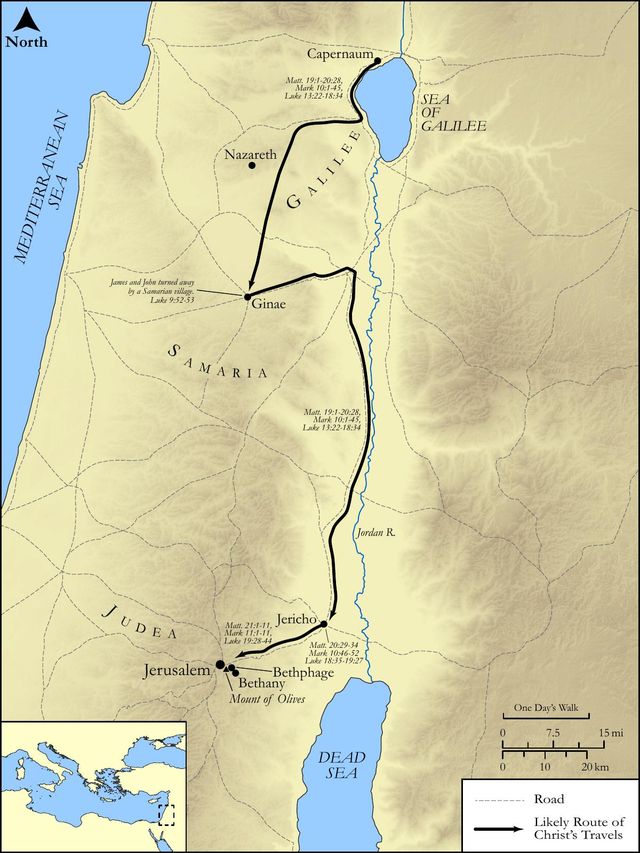
See on the biblical-era map


Study this verse
Public-domain commentary
Matthew Henry
From his Commentary on the Whole Bible. Henry comments on passages, not single verses — this entry covers Luke 9:1–9. His three-level outline is real structure in the source text, so it is rendered as structure.
We have here, I. The method Christ took to spread his gospel, to diffuse and enforce the light of it. He had himself travelled about, preaching and healing; but he could be only in one place at a time, and therefore now he sent his twelve disciples abroad, who by this time were pretty well instructed in the nature of the present dispensation, and able to instruct others and deliver to them what they had received from the Lord. Let them disperse themselves, some one way and some another, to preach the kingdom of God, as it was now about to be set up by the Messiah, to make people acquainted with the spiritual nature and tendency of it, and to persuade them to come into the interests and measures of it. For the confirming of their doctrine, because it was new and surprising, and very different from what they had been taught by the scribes and Pharisees, and because so much depended upon men's receiving, or not receiving it, he empowered them to work miracles (Luk 9:1, Luk 9:2): He gave them authority over all devils, to dispossess them, and cast them out, though ever so numerous, so subtle, so fierce, so obstinate. Christ designed a total rout and ruin to the kingdom of darkness, and therefore gave them power over all devils. He authorized and appointed them likewise to cure disease, and to heal the sick, which would make them welcome wherever they came, and not only convince people's judgments, but gain their affections. This was their commission. Now observe,
1.What Christ directed them to do, in prosecution of this commission at this time, when they were not to go far or be out long.
(1.)They must not be solicitous to recommend themselves to people's esteem by their outward appearance. Now that they begin to set up for themselves, they must have no dress, nor study to make any other figure than what they made while they followed him: they must go as they were, and not change their clothes, or so much as put on a pair of new shoes.
(2.)They must depend upon Providence, and the kindness of their friends, to furnish them with what was convenient for them. They must not take with them either bread or money, and yet believe they should not want. Christ would not have his disciples shy of receiving the kindnesses of their friends, but rather to expect them. Yet St. Paul saw cause not to go by this rule, when he laboured with his hands rather than be burdensome.
(3.)They must not change their lodgings, as suspecting that those who entertained them were weary of them; they have no reason to be so, for the ark is a guest that always pays well for its entertainment: "Whatsoever house ye enter into there abide (Luk 9:4), that people may know where to find you, that your friends may know you are not backward to serve them, and your enemies may know you are not ashamed nor afraid to face them; there abide till you depart out of that city; stay with those you are used to." (4.) They must put on authority, and speak warning to those who refused them as well as comfort to those that received them, Luk 9:5. "If there be any place that will not entertain you, if the magistrates deny you admission and threaten to treat you as vagrants, leave them, do not force yourselves upon them, nor run yourselves into danger among them, but at the same time bind them over to the judgment of God for it; shake off the dust of your feet for a testimony against them." This will, as it were, be produced in evidence against them, that the messengers of the gospel had been among them, to make them a fair offer of grace and peace, for this dust they left behind there; so that when they perish at last in their infidelity this will lay and leave their blood upon their own heads. Shake off the dust of your feet, as much as to say you abandon their city, and will have no more to do with them.
2.What they did, in prosecution of this commission (Luk 9:6): They departed from their Master's presence; yet, having still his spiritual presence with them, his eye and his arm going along with them, and, thus borne up in their work, they went through the towns, some or other of them, all the towns within the circuit appointed them, preaching the gospel, and healing every where. Their work was the same with their Master's, doing good both to souls and bodies.
II.We have here Herod's perplexity and vexation at this.
The communicating of Christ's power to those who were sent forth in his name, and acted by authority from him, was an amazing and convincing proof of his being the Messiah, above any thing else; that he could not only work miracles himself, but empower others to work miracles too, this spread his fame more than any thing, and made the rays of this Sun of righteousness the stronger by the reflection of them even from the earth, from such mean illiterate men as the apostles were, who had nothing else to recommend them, or to raise any expectations from them, but that they had been with Jesus, Act 4:13. When the country sees such as these healing the sick in the name of Jesus it gives it an alarm. Now observe,
1.The various speculations it raised among the people, who, though they thought not rightly, yet could not but think honourably, of our Lord Jesus, and that he was an extraordinary person, one come from the other world; that either John Baptist, who was lately persecuted and slain for the cause of God, or one of the old prophets, that had been persecuted and slain long since in that cause, was risen again, to be recompensed for his sufferings by this honour put upon him; or that Elias, who was taken alive to heaven in a fiery chariot, had appeared as an express from heaven, Luk 9:7, Luk 9:8.
2.The great perplexity it created in the mind of Herod: When he had heard of all that was done by Christ, his guilty conscience flew in his face, and he was ready to conclude with them that John was risen from the dead. He thought he had got clear of John, and should never be troubled with him any more, but, it seems, he is mistaken; either John is come to life again or here is another in his spirit and power, for God will never leave himself without witness. "What shall I do now?" saith Herod. "John have I beheaded, but who is this? Is he carrying on John's work, or is he come to avenge John's death? John baptized, but he does not; John did no miracle, but he does, and therefore appears more formidable than John." Note, Those who oppose God will find themselves more and more embarrassed. However, he desired to see him, whether he resembled John or no; but he might soon have been put out of this pain if he would but have informed himself of that which thousands knew, that Jesus preached, and wrought miracles, a great while before John was beheaded, and therefore could not be John raised from the dead. He desired to see him; and why did he not go and see him? Probably, because he thought it below him either to go to him or to send for him; he had enough of John Baptist, and cared not for having to do with any more such reprovers of sin. He desired to see him, but we do not find that ever he did, till he saw him at his bar, and then he and his men of war set him at nought, Luk 23:11. Had he prosecuted his convictions now, and gone to see him, who knows but a happy change might have ben wrought in him? But, delaying it now, his heart was hardened, and when he did see him he was as much prejudiced against him as any other.
Historical interpretation
Nine Centuries of Reception
11 surviving comments on this verse. Each one is dated, so this reads as a timeline rather than a list.
Select a marker to jump to its quote. Markers stagger vertically where authors wrote within a few decades of each other.
The beloved generates love, and the light immaterial the light inaccessible. "This is my beloved Son," He who, being manifested on earth and yet unseparated from the Father's bosom, was manifested, and yet did not appear. For the appearing is a different thing, since in appearance the baptizer here is superior to the baptized. For this reason did the Father send down the Holy Spirit from heaven upon Him who was baptized. For as in the ark of Noah the love of God toward man is signified by the dove, so also now the Spirit, descending in the form of a dove, bearing as it were the fruit of the olive, rested on Him to whom the witness was borne. For what reason? That the faithfulness of the Father's voice might be made known, and that the prophetic utterance of a long time past might be ratified. And what utterance is this? "The voice of the Lord (is) on the waters, the God of glory thundered; the Lord (is) upon many waters." And what voice? "This is my beloved Son, in whom I am well pleased." This is He who is named the son of Joseph, and (who is) according to the divine essence my Only-begotten. "This is my beloved Son"-He who is hungry, and yet maintains myriads; who is weary, and yet gives rest to the weary; who has not where to lay His head, and yet bears up all things in His hand; who suffers, and yet heals sufferings; who is smitten, and yet confers liberty on the world; who is pierced in the side, and yet repairs the side of Adam.
And that through them the whole race of mankind may be sought out, He not only gives them power to drive away evil spirits, but to cure all kind of diseases at His command; as it follows, And to cure diseases.
Wishing then that they should be free from the desire of wealth and the anxieties of life, He gave this injunction. He took it as a proof of their faith and courage, that when it was commanded them to lead a life of extreme poverty, they would not escape from what was ordered. For it was fitting that they should make a kind of bargain, receiving these saving virtues to recompense them for obedience to commands. And when He was making them soldiers of God, He girds them for battle against their enemies, by telling them to embrace poverty. For no soldier of God entangles himself in the affairs of a secular life. (2 Tim. 2:4.)
But when the Lord had girded His disciples as soldiers of God with divine virtue and wise admonitions, sending them to the Jews as teachers and physicians, they afterwards went forth, as it follows, And they departed, and went through the towns preaching the gospel, and healing every where.
(Orat. ii. 69.) Now in sending His disciples to preach, our Lord enjoined many things on them, the chief of which are, that they should be so virtuous, so constant, so temperate, and, to speak briefly, so heavenly, that no less through their manner of living than their words, the teaching of the Gospel might be spread abroad. And therefore were they sent with lack of money, and staves, and a single garment; He accordingly adds, And he said to them, Take nothing in the way, neither staves.
So the faith of the church must be sought first and foremost. If Christ is to dwell in a house, it undoubtedly must be chosen. But lest an unbelieving people or a heretical teacher deface its home, the church is commanded that the fellowship of heretics be avoided and the synagogue shunned. The dust is to be shaken off your feet lest when the dryness of barren unbelief crumbles the sole of your mind it is stained as if by a dry and sandy soil. A preacher of the gospel must take on himself the bodily weaknesses of a faithful people, so to speak. He must lift up and remove from his own soles worthless actions as if they were dust. For it is written: “Who is weak, and I am not weak?” Any church which rejects faith and does not possess the foundations of apostolic preaching is to be abandoned lest it be able to stain others with unbelief. The apostle also clearly affirmed this by saying “Reject a man that is a heretic after the first admonition.”
Of what kind then he ought to be who preaches the Gospel of the kingdom of God is marked out by these Gospel precepts; that is, he must not require the supports of secular aid; and clinging wholly to faith, he must believe that the less he requires those things, the more they will be supplied to him.
To those also who wish it, this place admits of being explained, so as to seem only to represent a spiritual temper of mind, which appears to have cast off as it were a certain covering of the body; not only rejecting power and despising wealth, but renouncing also the delights of the flesh itself.
He pronounces it to be foreign to the character of a preacher of the heavenly kingdom to run from house to house and change the rights of inviolable hospitality; but as the grace of hospitality is supposed to be offered, so also if they are not received the dust must be shaken off, and they are commanded to depart from the city; as it follows, And whosoever will not receive you when ye go out of that city, shake off the very dust from your feet for a testimony, &c.
Or it is a great return of hospitality which is here taught, i. e. that we should not only wish peace to our hosts, but also if any faults of earthly infirmity obscure them, they should be removed by receiving the footsteps of apostolical preaching.
This is a great vision. But if you wish to see it, remove the sandals from your feet. Remove every chain of sin. Remove the chains of the world. Leave behind earthly sandals. Jesus sent the apostles without sandals, without money, gold and silver, so that they would not carry earthly things with them. The one who seeks to do good is praised not for his sandals but for the swiftness and grace of his feet. The Scripture says, “How beautiful are the feet of those who preach the gospel of peace, of those who bring glad tidings of good things!” Therefore remove the sandals from your feet, that they may be beautiful for preaching the gospel.
(Hom. 22. in Matt.) But after that they had been sufficiently strengthened by His guidance, and had received competent proofs of His power, He sends them out, as it follows, And he sent them to preach the kingdom of God. And here we must remark, that they are not commissioned to speak of sensible things as Moses and the Prophets; for they promised a land and earthly goods, but these a kingdom, and whatsoever is contained in it.
(ubi sup.) Many things indeed He ordained hereby; first indeed it rendered the disciples unsuspected; secondly, it held them aloof from all care, so that they might give their whole study to the word; thirdly, it taught them their own proper virtue. But perhaps some one will say that the other things indeed are reasonable, but for what reason did He command them to have no scrip on their way, nor two coats, nor staff? In truth, because He wished to rouse them to all diligence, taking them away from all the cares of this life, that they might be occupied by the one single care of teaching.
For it is very improbable that those who despise the saving Word, and the Master of the household, will show themselves kind to His servants, and seek further blessings.
The dust is shaken off from the Apostles' feet as a testimony of their labours, that they entered into a city, and the apostolical preaching had reached to the inhabitants thereof. Or the dust is shaken off when they receive nothing (not even of the necessaries of life) from those who despised the Gospel.
But if any by treacherous negligence, or even from zeal, despise the word of God, their communion must be shunned, the dust of the feet must be shaken off, lest by their vain deeds which are to be compared to the dust, the footstep of a chaste mind be defiled.
And whoever will not receive you, as you go out from that city, even shake off the dust of your feet as a testimony against them. The dust is shaken off their feet in testimony of their labor, in that they have entered the city, and the apostolic preaching has reached them. Or the dust is shaken off so that they may accept nothing from them, not even what is necessary for sustenance, who have spurned the Gospel. Allegorically, those who humbly attend to the word, if they are obscured by the spots of earthly levity as men, are soon purified by those marks of the evangelical preaching which they receive. But those who scorn through unbelief, negligence, or even deliberate effort, are judged to have their communion to be avoided, their synagogue to be shunned, and the dust of their feet shaken off, lest the mind's chaste mark be stained by what is handled and compared to dust.
For He sends them out as very beggars, so that He would have them neither carry bread, nor any thing else of which men are generally in want.
Some also understand by the Apostles not carrying scrip, nor staff, nor two coats, that they must not lay up treasures, (which a scrip implies, collecting many things,) nor be angry and of a quarrelsome spirit, (which the staff signifies,) nor be false and of a double heart, (which is meant by the two coats.)
Continue studying Luke 9:5 across the web’s major study libraries — every link below opens this exact verse, chapter, or book on the destination site.
Read & Compare
 BibleGatewayThis verse in more than 200 translations and 70 languages.
 Bible.comThe YouVersion reader — hundreds of translations, reading plans, and highlights.
 ESV.orgCrossway's official English Standard Version reader.
 NET BibleThe NET translation with 60,000+ translators' notes on every rendering decision.
 STEP BibleTyndale House's free study tool — original text, vocabulary, and scholarly resources.
 BibliaLogos Bible Software's free web reader.
 USCCBThe New American Bible (Revised Edition) with the U.S. bishops' study notes.
Commentaries
 BibleHub CommentariesDozens of classic commentaries on this verse, gathered on one page.
 StudyLightMore than 100 commentary sets — the largest collection on the web.
 BibleRefPlain-English commentary on what this verse means, verse by verse.
 Enduring WordDavid Guzik's free commentary on this chapter, widely used by Bible teachers.
 Bible Study ToolsVerse commentary alongside Greek and Hebrew study aids.
Original Language & Research
- BibleHub InterlinearThe verse word by word — original language, transliteration, and English.
- BibleHub LexiconEvery word's original-language definition and Strong's entry.
 Blue Letter BibleDeep-study tools — Strong's numbers, concordance, and word studies.
 CNTR CollationThe earliest Greek manuscripts of this verse, collated letter by letter.
Sermons, Hymns & Audio


TrulyRandomVerse is not affiliated with these sites and doesn’t control their content. They’re linked because they’re genuinely useful.
Summary
In Jesus provides a clear and solemn directive to His twelve disciples as He sends them out on their mission: if a city or household refuses to welcome them or their message, they are to perform a symbolic act of shaking the dust from their feet. This action serves as a powerful "testimony against them," signifying a complete dissociation from the unrepentant and a warning of the spiritual consequences for rejecting the divine messengers and the Kingdom message they bear.
Context
ShowHideLiterary Context
This verse is situated within the broader narrative of Jesus empowering and commissioning His twelve disciples for ministry. Immediately preceding Luke 9:5, Jesus grants them "power and authority over all devils, and to cure diseases" and sends them "to preach the kingdom of God, and to heal the sick" (Luke 9:1-2). He provides specific instructions for their journey, emphasizing reliance on God's provision and a focus on the message rather than material comforts (Luke 9:3-4). Luke 9:5 anticipates the inevitable reality of rejection, offering a decisive protocol for dealing with such encounters. This instruction is also found in the parallel accounts of Matthew 10:14 and Mark 6:11. The broader context of Luke 9 highlights the unfolding of Jesus' ministry, the growing opposition He faces, and His preparation of the disciples for their future roles in spreading the gospel, even in the face of adversity.
Historical & Cultural Context
The act of "shaking off the dust from your feet" carried significant cultural weight in ancient Judaism. It was a common practice for Jews, upon returning from Gentile lands, to shake the dust from their sandals or clothes before re-entering Jewish territory. This was done to symbolically cleanse themselves from any defilement incurred by contact with non-Jewish soil, which was considered ritually unclean. By instructing His disciples to perform this very act when rejected by a Jewish city, Jesus was making a profound and shocking statement. He was essentially declaring that those Jewish communities or households that rejected the message of the Kingdom were, in their spiritual state, as unclean and separate from God's covenant people as Gentiles were considered physically. This gesture was not an act of personal anger or malice, but a solemn, public declaration that the messengers had fulfilled their duty, and the responsibility for the rejection, and its accompanying consequences, now rested entirely upon the rejecting party. It underscored the gravity of the message and the dire implications of its refusal.
Key Themes
ShowHideThis verse contributes to several key themes within Luke's Gospel and the broader biblical narrative. Firstly, it emphasizes Divine Authority and Mission: the disciples are not acting on their own accord but as authorized representatives of Jesus. To reject them is to reject the One who sent them, and ultimately, God Himself (Luke 10:16). Secondly, it highlights the Reality of Rejection: Jesus prepares His followers for the inevitable opposition and non-acceptance of the Kingdom message, acknowledging that divine truth will not be universally embraced. This serves to inoculate the disciples against discouragement. Thirdly, the Symbolic Action and Warning of shaking off dust serves as a powerful visual and spiritual declaration. It signifies a complete dissociation and a cessation of responsibility on the part of the messenger, leaving the hearers accountable. Lastly, it underscores the theme of Accountability and Testimony: the act functions "for a testimony against them," indicating that the message was offered, the opportunity presented, and the refusal noted, leaving the rejecting party without excuse before God's future judgment (Matthew 11:20-24). This also implicitly teaches Disciples' Detachment and Perseverance: the disciples are to move on, unburdened by the rejection, to continue their mission elsewhere, focusing on those who will receive the gospel.
Exposition and Analysis
ShowHideKey Word Analysis
ShowHideMeaning to accept, receive, or take. In this context, it signifies not merely physical reception into a home, but a spiritual acceptance of the messengers and, crucially, the message of the Kingdom they proclaimed. The refusal to "receive" implies a rejection of the divine truth and authority embodied by the disciples.
Meaning to brush off or shake off. This is a deliberate and decisive action, not a casual flick. It conveys a complete and final separation, a public disavowal of any further connection or responsibility for those who reject the message. It is an act of cleansing from the perceived defilement of unbelief.
Meaning something evidential, evidence given, or witness. The act of shaking off the dust is not an act of vengeance, but a solemn declaration of fact. It serves as irrefutable evidence that the gospel was presented and rejected, leaving the rejecting party without excuse and under the weight of their own decision before God.
Verse Breakdown
ShowHide"And whosoever will not receive you"
This clause anticipates the reality of non-acceptance, acknowledging that not all will welcome the disciples or their message. The refusal to "receive" encompasses both hospitality and, more importantly, the spiritual embrace of the Kingdom message. It highlights the free will of individuals to accept or reject divine truth.
"when ye go out of that city"
This specifies the timing and location for the prescribed action. The disciples are not to linger or persist indefinitely in a place of rejection. Instead, they are to depart, signaling the end of their responsibility for that particular community and its spiritual state.
"shake off the very dust from your feet"
This is the core directive, a powerful symbolic action rooted in Jewish custom. As explained in the context, it signifies a complete break and purification from the spiritual defilement of those who reject God's messengers and message. It is a public and visible declaration of disassociation.
"for a testimony against them"
This final phrase explains the purpose and consequence of the symbolic act. The shaking of the dust is not merely a personal expression of frustration, but a prophetic act. It serves as a witness or evidence against the rejecting city or household, indicating that they were given the opportunity to hear and respond to the Kingdom, but chose otherwise, thereby incurring divine judgment.
Literary Devices
ShowHideThe verse employs several significant literary devices. Symbolism is paramount, with the act of "shaking off the very dust from your feet" serving as a potent visual metaphor for spiritual separation and the cessation of responsibility. This action, deeply rooted in Jewish cultural practice, is recontextualized by Jesus to convey a severe judgment on those who reject the Kingdom message. The Imperative Mood is used in "shake off," conveying a direct command from Jesus, emphasizing the authority and necessity of this action. Furthermore, there is an implicit Antithesis between "receiving" the disciples and their message versus "not receiving" them, highlighting the stark choice presented to the hearers and the contrasting outcomes of acceptance versus rejection. The phrase "for a testimony against them" functions as a Legal Metaphor, casting the act as a form of evidence presented in a divine court, underscoring the accountability of those who refuse the gospel.
Theological and Thematic Connections
ShowHideThis instruction to shake off the dust is a profound theological statement on the nature of divine revelation, human responsibility, and the consequences of rejection. It underscores the ultimate authority of God's message and the seriousness of responding to it. The disciples, as emissaries of the Kingdom, bear a weighty responsibility to proclaim the truth, but they are not accountable for the reception of that truth. The act of shaking off the dust transfers the burden of responsibility entirely to the hearers, leaving them without excuse before God. It highlights that rejecting God's messengers is tantamount to rejecting God Himself, and such rejection carries eternal implications. This principle prepares believers for the reality of spiritual warfare and the necessity of focusing their efforts where the Spirit leads, rather than dwelling on unproductive resistance.
Reflection and Application
ShowHideLuke 9:5 offers timeless wisdom for believers engaged in sharing the gospel or living out their faith in a hostile world. It reminds us that our primary calling is faithfulness in proclamation, not guaranteed success in conversion. When faced with apathy, ridicule, or outright rejection, we are not to be consumed by despair or bitterness. Instead, we are instructed to symbolically "shake off the dust," which means releasing the burden of responsibility for another's choice, entrusting their judgment to God, and moving forward with the mission. This act is not one of anger or abandonment, but a recognition that we have fulfilled our duty and that the ultimate accountability rests with the hearer. It empowers us to persevere without being defiled or hindered by the negativity of unbelief, allowing us to continue faithfully proclaiming the good news to those who are open to receiving it, and maintaining our own spiritual purity and focus on Christ's mission.
Questions for Reflection
ShowHideFAQ
ShowHideDoes "shaking off the dust" mean we should stop praying for or caring about those who reject the gospel?
ShowHideNo, "shaking off the dust" does not mean abandoning care or prayer for those who reject the gospel. The act is primarily a symbolic declaration of the messenger's fulfilled responsibility and the transfer of accountability to the hearer. It is a recognition that the message has been delivered, and the consequences of rejection now rest with the individual or community. It frees the messenger from undue burden or defilement, allowing them to continue their mission elsewhere without being hindered by past rejections. The Bible consistently calls believers to love their enemies and pray for those who persecute them (Matthew 5:44). Therefore, while the immediate evangelistic effort in that specific context may cease, the call to compassion and intercession for all people remains.
Christ-Centered Fulfillment
ShowHideLuke 9:5 finds its ultimate Christ-centered fulfillment in several profound ways. Firstly, Jesus Himself was the supreme messenger of God, and He experienced the most profound rejection from "His own" (John 1:11). His instructions to the disciples foreshadow His own experience of being denied and ultimately crucified by those He came to save. The "testimony against them" that the disciples were to leave is ultimately fulfilled in Christ's own life, death, and resurrection, which stands as the definitive witness to humanity. Those who reject the Lamb of God, who takes away the sin of the world (John 1:29), reject the very source of life and salvation (John 14:6). The dust shaken off symbolizes the separation from those who refuse the light, pointing to the ultimate separation that will occur at the final judgment between those who received Christ and those who did not (Matthew 25:31-46). Thus, the disciples' actions, commanded by Christ, serve as a microcosm of the greater spiritual reality: the gospel is presented, a choice is offered, and the consequences of that choice are eternal, all centered on one's response to Jesus Christ, the one name under heaven given among men by which we must be saved (Acts 4:12).