


Luke 9:6
Bible text: King James Version (1769 Blayney text) · Public domain
Bible text: Berean Standard Bible · Public domain
Bible text: American Standard Version (1901) · Public domain
Bible text: World English Bible, Messianic edition · Public domain
Bible text: Geneva Bible (1599) · Public domain
Bible text: Young's Literal Translation · Public domain
- ἐξερχόμενοιexerchomenoiGoing forthG1831V-PNP-NPMVerb Present Middle Or Passive Deponent Participle Nominative Plural Masculine
- δὲdethenG1161CONJConjunction
- διήρχοντοdiērchontothey were passingG1330V-INI-3PVerb Imperfect Middle Or Passive Deponent Indicative 3rd Plural
- κατὰkatathroughG2596PREPPreposition
- τὰςtastheG3588T-APFDefinite article Accusative Plural Feminine
- κώμαςkōmasvillagesG2968N-APFNoun Accusative Plural Feminine
- εὐαγγελιζόμενοιeuangelizomenoievangelisingG2097V-PMP-NPMVerb Present Middle Participle Nominative Plural Masculine
- καὶkaiandG2532CONJConjunction
- θεραπεύοντεςtherapeuonteshealingG2323V-PAP-NPMVerb Present Active Participle Nominative Plural Masculine
- πανταχοῦpantachoueverywhereG3837ADVAdverb
English is a literal word-by-word gloss of the Greek, not the KJV's wording. Why?
This is the original text the KJV's translators worked from — each Greek word with its own literal English meaning in this verse, prepared by scholars at Tyndale House, Cambridge. The KJV translates whole sentences, not word by word, so its wording differs: one Greek word can become several English words, and the KJV may choose “charity” where the gloss reads “love”. Both are faithful — they answer different questions. For the KJV's own rendering, switch to the KJV text.
Details
See on the biblical-era maps

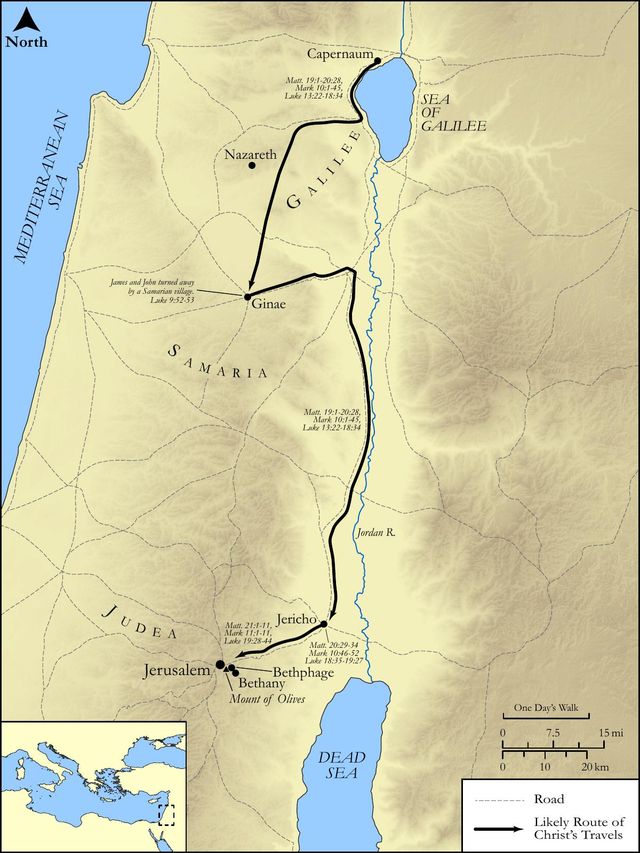
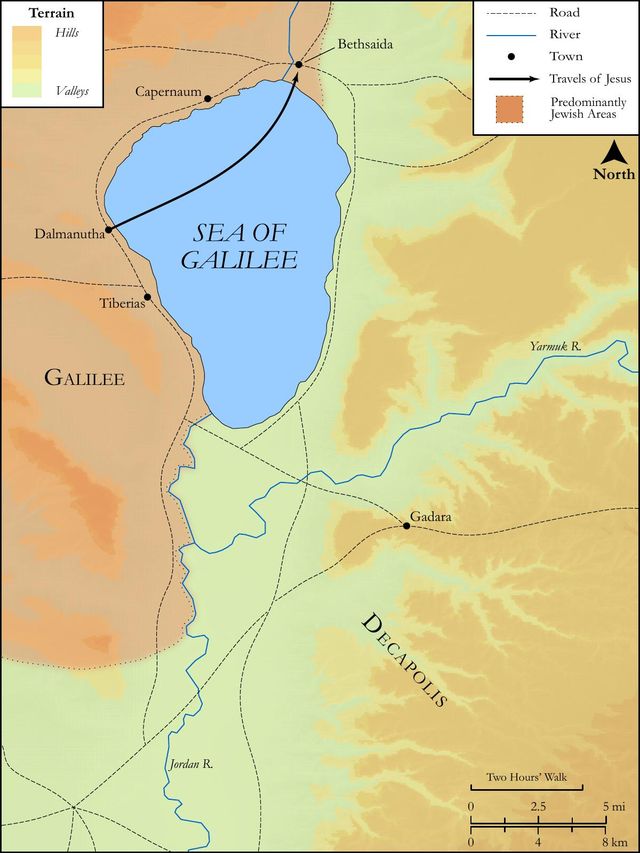
Study this verse
Public-domain commentary
Matthew Henry
From his Commentary on the Whole Bible. Henry comments on passages, not single verses — this entry covers Luke 9:1–9. His three-level outline is real structure in the source text, so it is rendered as structure.
We have here, I. The method Christ took to spread his gospel, to diffuse and enforce the light of it. He had himself travelled about, preaching and healing; but he could be only in one place at a time, and therefore now he sent his twelve disciples abroad, who by this time were pretty well instructed in the nature of the present dispensation, and able to instruct others and deliver to them what they had received from the Lord. Let them disperse themselves, some one way and some another, to preach the kingdom of God, as it was now about to be set up by the Messiah, to make people acquainted with the spiritual nature and tendency of it, and to persuade them to come into the interests and measures of it. For the confirming of their doctrine, because it was new and surprising, and very different from what they had been taught by the scribes and Pharisees, and because so much depended upon men's receiving, or not receiving it, he empowered them to work miracles (Luk 9:1, Luk 9:2): He gave them authority over all devils, to dispossess them, and cast them out, though ever so numerous, so subtle, so fierce, so obstinate. Christ designed a total rout and ruin to the kingdom of darkness, and therefore gave them power over all devils. He authorized and appointed them likewise to cure disease, and to heal the sick, which would make them welcome wherever they came, and not only convince people's judgments, but gain their affections. This was their commission. Now observe,
1.What Christ directed them to do, in prosecution of this commission at this time, when they were not to go far or be out long.
(1.)They must not be solicitous to recommend themselves to people's esteem by their outward appearance. Now that they begin to set up for themselves, they must have no dress, nor study to make any other figure than what they made while they followed him: they must go as they were, and not change their clothes, or so much as put on a pair of new shoes.
(2.)They must depend upon Providence, and the kindness of their friends, to furnish them with what was convenient for them. They must not take with them either bread or money, and yet believe they should not want. Christ would not have his disciples shy of receiving the kindnesses of their friends, but rather to expect them. Yet St. Paul saw cause not to go by this rule, when he laboured with his hands rather than be burdensome.
(3.)They must not change their lodgings, as suspecting that those who entertained them were weary of them; they have no reason to be so, for the ark is a guest that always pays well for its entertainment: "Whatsoever house ye enter into there abide (Luk 9:4), that people may know where to find you, that your friends may know you are not backward to serve them, and your enemies may know you are not ashamed nor afraid to face them; there abide till you depart out of that city; stay with those you are used to." (4.) They must put on authority, and speak warning to those who refused them as well as comfort to those that received them, Luk 9:5. "If there be any place that will not entertain you, if the magistrates deny you admission and threaten to treat you as vagrants, leave them, do not force yourselves upon them, nor run yourselves into danger among them, but at the same time bind them over to the judgment of God for it; shake off the dust of your feet for a testimony against them." This will, as it were, be produced in evidence against them, that the messengers of the gospel had been among them, to make them a fair offer of grace and peace, for this dust they left behind there; so that when they perish at last in their infidelity this will lay and leave their blood upon their own heads. Shake off the dust of your feet, as much as to say you abandon their city, and will have no more to do with them.
2.What they did, in prosecution of this commission (Luk 9:6): They departed from their Master's presence; yet, having still his spiritual presence with them, his eye and his arm going along with them, and, thus borne up in their work, they went through the towns, some or other of them, all the towns within the circuit appointed them, preaching the gospel, and healing every where. Their work was the same with their Master's, doing good both to souls and bodies.
II.We have here Herod's perplexity and vexation at this.
The communicating of Christ's power to those who were sent forth in his name, and acted by authority from him, was an amazing and convincing proof of his being the Messiah, above any thing else; that he could not only work miracles himself, but empower others to work miracles too, this spread his fame more than any thing, and made the rays of this Sun of righteousness the stronger by the reflection of them even from the earth, from such mean illiterate men as the apostles were, who had nothing else to recommend them, or to raise any expectations from them, but that they had been with Jesus, Act 4:13. When the country sees such as these healing the sick in the name of Jesus it gives it an alarm. Now observe,
1.The various speculations it raised among the people, who, though they thought not rightly, yet could not but think honourably, of our Lord Jesus, and that he was an extraordinary person, one come from the other world; that either John Baptist, who was lately persecuted and slain for the cause of God, or one of the old prophets, that had been persecuted and slain long since in that cause, was risen again, to be recompensed for his sufferings by this honour put upon him; or that Elias, who was taken alive to heaven in a fiery chariot, had appeared as an express from heaven, Luk 9:7, Luk 9:8.
2.The great perplexity it created in the mind of Herod: When he had heard of all that was done by Christ, his guilty conscience flew in his face, and he was ready to conclude with them that John was risen from the dead. He thought he had got clear of John, and should never be troubled with him any more, but, it seems, he is mistaken; either John is come to life again or here is another in his spirit and power, for God will never leave himself without witness. "What shall I do now?" saith Herod. "John have I beheaded, but who is this? Is he carrying on John's work, or is he come to avenge John's death? John baptized, but he does not; John did no miracle, but he does, and therefore appears more formidable than John." Note, Those who oppose God will find themselves more and more embarrassed. However, he desired to see him, whether he resembled John or no; but he might soon have been put out of this pain if he would but have informed himself of that which thousands knew, that Jesus preached, and wrought miracles, a great while before John was beheaded, and therefore could not be John raised from the dead. He desired to see him; and why did he not go and see him? Probably, because he thought it below him either to go to him or to send for him; he had enough of John Baptist, and cared not for having to do with any more such reprovers of sin. He desired to see him, but we do not find that ever he did, till he saw him at his bar, and then he and his men of war set him at nought, Luk 23:11. Had he prosecuted his convictions now, and gone to see him, who knows but a happy change might have ben wrought in him? But, delaying it now, his heart was hardened, and when he did see him he was as much prejudiced against him as any other.
Historical interpretation
Eight Centuries of Reception
8 surviving comments on this verse. Each one is dated, so this reads as a timeline rather than a list.
Select a marker to jump to its quote. Markers stagger vertically where authors wrote within a few decades of each other.
And that through them the whole race of mankind may be sought out, He not only gives them power to drive away evil spirits, but to cure all kind of diseases at His command; as it follows, And to cure diseases.
Wishing then that they should be free from the desire of wealth and the anxieties of life, He gave this injunction. He took it as a proof of their faith and courage, that when it was commanded them to lead a life of extreme poverty, they would not escape from what was ordered. For it was fitting that they should make a kind of bargain, receiving these saving virtues to recompense them for obedience to commands. And when He was making them soldiers of God, He girds them for battle against their enemies, by telling them to embrace poverty. For no soldier of God entangles himself in the affairs of a secular life. (2 Tim. 2:4.)
But when the Lord had girded His disciples as soldiers of God with divine virtue and wise admonitions, sending them to the Jews as teachers and physicians, they afterwards went forth, as it follows, And they departed, and went through the towns preaching the gospel, and healing every where.
(Orat. ii. 69.) Now in sending His disciples to preach, our Lord enjoined many things on them, the chief of which are, that they should be so virtuous, so constant, so temperate, and, to speak briefly, so heavenly, that no less through their manner of living than their words, the teaching of the Gospel might be spread abroad. And therefore were they sent with lack of money, and staves, and a single garment; He accordingly adds, And he said to them, Take nothing in the way, neither staves.
Of what kind then he ought to be who preaches the Gospel of the kingdom of God is marked out by these Gospel precepts; that is, he must not require the supports of secular aid; and clinging wholly to faith, he must believe that the less he requires those things, the more they will be supplied to him.
To those also who wish it, this place admits of being explained, so as to seem only to represent a spiritual temper of mind, which appears to have cast off as it were a certain covering of the body; not only rejecting power and despising wealth, but renouncing also the delights of the flesh itself.
He pronounces it to be foreign to the character of a preacher of the heavenly kingdom to run from house to house and change the rights of inviolable hospitality; but as the grace of hospitality is supposed to be offered, so also if they are not received the dust must be shaken off, and they are commanded to depart from the city; as it follows, And whosoever will not receive you when ye go out of that city, shake off the very dust from your feet for a testimony, &c.
Or it is a great return of hospitality which is here taught, i. e. that we should not only wish peace to our hosts, but also if any faults of earthly infirmity obscure them, they should be removed by receiving the footsteps of apostolical preaching.
Christ had the power to set the human race free from all these evils—not only the Romans but also the Persians and simply every race of barbarians. He succeeded in doing this with no force of arms, nor expenditure of money, nor by starting wars of conquest, nor by inflaming men to battle. He had only eleven men to start with, men who were undistinguished, without learning, ill-informed, destitute, poorly clad, without weapons, or sandals, men who had but a single tunic to wear.
(Hom. 22. in Matt.) But after that they had been sufficiently strengthened by His guidance, and had received competent proofs of His power, He sends them out, as it follows, And he sent them to preach the kingdom of God. And here we must remark, that they are not commissioned to speak of sensible things as Moses and the Prophets; for they promised a land and earthly goods, but these a kingdom, and whatsoever is contained in it.
(ubi sup.) Many things indeed He ordained hereby; first indeed it rendered the disciples unsuspected; secondly, it held them aloof from all care, so that they might give their whole study to the word; thirdly, it taught them their own proper virtue. But perhaps some one will say that the other things indeed are reasonable, but for what reason did He command them to have no scrip on their way, nor two coats, nor staff? In truth, because He wished to rouse them to all diligence, taking them away from all the cares of this life, that they might be occupied by the one single care of teaching.
The dust is shaken off from the Apostles' feet as a testimony of their labours, that they entered into a city, and the apostolical preaching had reached to the inhabitants thereof. Or the dust is shaken off when they receive nothing (not even of the necessaries of life) from those who despised the Gospel.
But if any by treacherous negligence, or even from zeal, despise the word of God, their communion must be shunned, the dust of the feet must be shaken off, lest by their vain deeds which are to be compared to the dust, the footstep of a chaste mind be defiled.
But they went out and went about the villages, preaching the gospel and healing everywhere. What the Apostles preached, or how they healed, Mark explains more fully. He says, they preached that people should repent, and anointed many sick people with oil, and healed them. James also says: Is anyone among you sick? Let them call the elders of the church to pray over them and anoint them with oil in the name of the Lord, and if they have sinned, they will be forgiven (Mark 6). Hence it is clear from the apostles themselves that this custom of the holy Church was handed down, that with the oil consecrated by pontifical blessing, the sick are anointed. They preached that people should repent; and above, He says, He sent them to preach the kingdom of God (1 Cor. 1). For evidently they preached both, according to the example of John the Baptist, or the Savior Himself: Repent, for the kingdom of heaven is near (Matt. 3). For to draw near to the gates of the heavenly kingdom is to repent of those five sins from which one had departed from God.
For He sends them out as very beggars, so that He would have them neither carry bread, nor any thing else of which men are generally in want.
Some also understand by the Apostles not carrying scrip, nor staff, nor two coats, that they must not lay up treasures, (which a scrip implies, collecting many things,) nor be angry and of a quarrelsome spirit, (which the staff signifies,) nor be false and of a double heart, (which is meant by the two coats.)
Continue studying Luke 9:6 across the web’s major study libraries — every link below opens this exact verse, chapter, or book on the destination site.
Read & Compare
 BibleGatewayThis verse in more than 200 translations and 70 languages.
 Bible.comThe YouVersion reader — hundreds of translations, reading plans, and highlights.
 ESV.orgCrossway's official English Standard Version reader.
 NET BibleThe NET translation with 60,000+ translators' notes on every rendering decision.
 STEP BibleTyndale House's free study tool — original text, vocabulary, and scholarly resources.
 BibliaLogos Bible Software's free web reader.
 USCCBThe New American Bible (Revised Edition) with the U.S. bishops' study notes.
Commentaries
 BibleHub CommentariesDozens of classic commentaries on this verse, gathered on one page.
 StudyLightMore than 100 commentary sets — the largest collection on the web.
 BibleRefPlain-English commentary on what this verse means, verse by verse.
 Enduring WordDavid Guzik's free commentary on this chapter, widely used by Bible teachers.
 Bible Study ToolsVerse commentary alongside Greek and Hebrew study aids.
Original Language & Research
- BibleHub InterlinearThe verse word by word — original language, transliteration, and English.
- BibleHub LexiconEvery word's original-language definition and Strong's entry.
 Blue Letter BibleDeep-study tools — Strong's numbers, concordance, and word studies.
 CNTR CollationThe earliest Greek manuscripts of this verse, collated letter by letter.
Sermons, Hymns & Audio


TrulyRandomVerse is not affiliated with these sites and doesn’t control their content. They’re linked because they’re genuinely useful.
Summary
Luke 9:6 succinctly describes the immediate and comprehensive response of the twelve apostles to Jesus' commissioning. Having been endowed with divine power and authority, they promptly embarked on their mission, traversing various towns to proclaim the good news of God's Kingdom and to minister to physical ailments through healing, thereby demonstrating the dual nature of their divinely empowered ministry: word and deed.
Context
ShowHideLiterary Context
This verse immediately follows Jesus' pivotal commissioning of the twelve disciples in Luke 9:1-5. In this preceding passage, Jesus grants them "power and authority over all devils, and to cure diseases" and provides specific instructions regarding their conduct and reliance on divine provision during their mission. He explicitly forbids them from taking money, extra clothing, or food, emphasizing a radical dependence on God and the hospitality of those who would receive their message. Their departure and actions in Luke 9:6 thus serve as the direct fulfillment and immediate obedience to this divine mandate, highlighting the urgency, simplicity, and focused nature of their task. The subsequent verses in Luke 9 continue to detail Jesus' ministry, including the feeding of the five thousand and Peter's confession, further establishing the apostles' role in extending His work.
Historical & Cultural Context
In first-century Galilee and Judea, itinerant teachers and healers were not uncommon, but the authority and message of Jesus' disciples set them apart. Their reliance on hospitality, as instructed by Jesus, was a common practice for travelers and religious figures in that culture, where receiving guests was a deeply ingrained social and religious obligation. The "towns" (Greek: kōmē) they visited were typically smaller, rural settlements, distinct from larger cities, suggesting a grassroots, pervasive evangelistic effort. The "gospel" they preached was revolutionary in its claims about the arrival of God's Kingdom through Jesus, challenging established religious norms and political expectations. Healing, in this context, was often seen as a sign of divine favor and authority, validating the messenger's claims and demonstrating the power of the God they proclaimed, resonating deeply with a populace often afflicted by various diseases and lacking modern medical care.
Key Themes
ShowHideLuke 9:6 powerfully encapsulates several key themes prevalent throughout Luke's Gospel and the broader New Testament. Foremost among these is Active Obedience and Mission, as the apostles' prompt departure and widespread activity underscore their immediate response to Jesus' command. This highlights the expansive nature of the Kingdom of God, which is not confined to one location but is to be proclaimed "every where." Another crucial theme is the Proclamation of the Gospel, which is central to their mission. This "good news" refers to the arrival of God's redemptive reign through Jesus Christ, a message of salvation and transformation that forms the core of Christian witness, as seen in Romans 1:16. Finally, the theme of Divine Power and Validation is evident in the accompanying acts of "healing every where." These miracles were not merely acts of compassion but served as tangible signs confirming the truth of their message and the divine authority by which they operated, mirroring Jesus' own ministry of word and deed (e.g., Luke 4:40). This dual ministry of preaching and demonstrating God's power is a hallmark of authentic Kingdom work.
Exposition and Analysis
ShowHideKey Word Analysis
ShowHideMeaning "to issue (literally or figuratively):--come (forth, out), depart (out of), escape, get out, go (abroad, away, forth, out, thence), proceed (forth), spread abroad." This word emphasizes the apostles' immediate and decisive action of leaving their current location to begin their mission. It conveys a sense of purposeful movement and initiation of their assigned task.
Meaning "to announce good news ('evangelize') especially the gospel:--declare, bring (declare, show) glad (good) tidings, preach (the gospel)." This term highlights the primary content of their message: the "good news" concerning God's redemptive plan through Jesus Christ. It signifies a public, authoritative proclamation of glad tidings, forming the core of their evangelistic endeavor.
Meaning "to wait upon menially, i.e. (figuratively) to adore (God), or (specially) to relieve (of disease):--cure, heal, worship." In this context, it specifically refers to the miraculous restoration of health. This word underscores the compassionate and powerful aspect of their ministry, demonstrating divine power and validating their message through tangible acts of mercy and restoration.
Verse Breakdown
ShowHide"And they departed, and went through the towns,"
This clause describes the apostles' immediate and widespread obedience to Jesus' commission. "Departed" signifies their prompt action, while "went through the towns" indicates the expansive scope of their mission, reaching various communities rather than remaining in one place. This highlights the active and itinerant nature of their ministry.
"preaching the gospel,"
This phrase identifies the core message and primary purpose of their journey. "Preaching the gospel" means proclaiming the "good news" of God's Kingdom, the arrival of salvation through Jesus Christ, and the call to repentance and faith. This was an oral proclamation, central to their evangelistic task.
"and healing every where."
This final clause describes the accompanying, validating acts of power. The apostles were not only proclaiming the message but also demonstrating its truth through miraculous healings. "Every where" emphasizes the pervasive nature of these signs, confirming their divine authority and the presence of God's power in their ministry across all the places they visited.
Literary Devices
ShowHideThe verse employs several literary devices to convey its meaning and impact. Parallelism is evident in the pairing of "preaching the gospel" and "healing every where," showcasing the dual nature of their ministry: the proclamation of the word and the demonstration of power through deeds. This structure emphasizes that the message and the miracles were inextricably linked, each validating the other. The use of action verbs such as "departed," "went," "preaching," and "healing" creates a dynamic and urgent tone, conveying the apostles' immediate and active response to Jesus' command. Furthermore, the phrase "every where" functions as a form of hyperbole or synecdoche, signifying a comprehensive and pervasive reach of their ministry, implying that their efforts covered a vast area and touched numerous lives, rather than literally every single spot on the map. This emphasizes the widespread impact and success of their mission.
Theological and Thematic Connections
ShowHideLuke 9:6 stands as a foundational text for understanding the nature of Christian ministry, echoing the pattern established by Jesus Himself. It reveals that authentic ministry is characterized by both the verbal proclamation of the "good news" and compassionate action that demonstrates God's power and love. The apostles' immediate obedience and their dual focus on preaching and healing underscore the holistic nature of the Kingdom of God, which addresses both spiritual and physical needs. This verse teaches that the message of salvation is not merely intellectual assent but is often accompanied by tangible expressions of divine power and care, validating the truth of the gospel and inviting people into a transformed life.
Reflection and Application
ShowHideLuke 9:6 serves as a timeless blueprint for believers today, calling us to active obedience and a holistic engagement with the world. Just as the apostles immediately responded to Jesus' call, we too are challenged to prompt and willing participation in God's mission, not delaying when the Spirit prompts. The core of our mission remains "preaching the gospel," which involves sharing the transformative truth of Jesus Christ through our words, testimonies, and lives. This is not limited to formal evangelism but extends to every interaction where we can embody and articulate the hope we have. Furthermore, the "healing every where" component reminds us that our faith should lead to tangible acts of compassion and service. While miraculous physical healings may not be universally distributed, the principle of ministering to human suffering, whether physical, emotional, or social, remains vital. We are called to be agents of God's love and power in our communities, demonstrating the reality of His Kingdom through practical care, justice, and mercy, always pointing to Christ as the ultimate source of healing and hope. Our lives, like those of the apostles, should be a seamless blend of proclaiming the word and demonstrating its truth through compassionate action.
Questions for Reflection
ShowHideFAQ
ShowHideWhat does "preaching the gospel" specifically mean in this context?
ShowHideIn this context, "preaching the gospel" (Greek: euangelízō) means proclaiming the "good news" concerning the arrival and nature of God's Kingdom through Jesus Christ. It encompasses the message of repentance, the forgiveness of sins, the power of God's rule, and the offer of salvation through faith in Jesus. It was a declaration that God's long-awaited plan of redemption was being fulfilled through Jesus' life, ministry, death, and resurrection. This message was central to Jesus' own ministry (e.g., Luke 4:43) and became the core of the apostles' commission.
Were the apostles able to heal everyone they encountered?
ShowHideThe phrase "healing every where" (Greek: pantachoû) indicates that their healing ministry was widespread and pervasive, occurring in all the places they went. While it doesn't necessarily mean they healed every single individual they encountered without exception, it strongly suggests that their ability to heal was consistently manifested wherever they proclaimed the gospel. This widespread demonstration of power served as undeniable evidence of God's presence and validation of their message, as seen in other accounts of the apostles' ministry (e.g., Acts 5:16).
Christ-Centered Fulfillment
ShowHideLuke 9:6, though describing the ministry of the apostles, profoundly points to Christ as the ultimate source and model of their mission. Their ability to "preach the gospel" and perform "healing every where" was not inherent to them but was a direct outflow of the "power and authority" Jesus had specifically granted them (as stated in Luke 9:1). Jesus Himself was the supreme Evangelist, proclaiming the good news of the Kingdom (e.g., Luke 4:18-19) and demonstrating God's power through countless acts of healing (e.g., Luke 6:17-19). The apostles' ministry, therefore, was a continuation and extension of Christ's own work, foreshadowing the global mission of the church empowered by the resurrected Christ through the Holy Spirit. Their "departing" and "going through the towns" prefigures the Great Commission to make disciples of all nations (Matthew 28:19-20), where believers are sent out in Christ's authority to proclaim His finished work on the cross and the new life He offers, accompanied by signs and wonders that confirm the word (Mark 16:20). Thus, Luke 9:6 is a testament to the ongoing, Christ-empowered mission to bring the holistic salvation of God's Kingdom to every corner of the earth.