


Luke 9:7
Bible text: King James Version (1769 Blayney text) · Public domain
Bible text: King James Version with Strong's numbers · Public domain
Bible text: Berean Standard Bible · Public domain
Bible text: American Standard Version (1901) · Public domain
Bible text: World English Bible, Messianic edition · Public domain
Bible text: Geneva Bible (1599) · Public domain
Bible text: Young's Literal Translation · Public domain
- ἬκουσενĒkousenHeard ofG191V-AAI-3SVerb Aorist Active Indicative 3rd Singular
- δὲdenowG1161CONJConjunction
- ἩρῴδηςHērōdēsHerodG2264N-NSM-PNoun Nominative Singular Masculine Individual
- ὁhotheG3588T-NSMDefinite article Nominative Singular Masculine
- τετραάρχηςtetraarchēsTetrarchG5076N-NSMNoun Nominative Singular Masculine
- τὰtathe [things]G3588T-APNDefinite article Accusative Plural Neuter
- γινόμεναginomenabeing doneG1096V-PNP-APNVerb Present Middle Or Passive Deponent Participle Accusative Plural Neuter
- ὑπ᾽hup᾽byG5259PREPPreposition
- αὐτοῦautouhimG846P-GSMPersonal pronoun Genitive Singular Masculine
- πάνταpantaallG3956A-APNAdjective Accusative Plural Neuter
- καὶkaiandG2532CONJConjunction
- διηπόρειdiēporeiwas perplexedG1280V-IAI-3SVerb Imperfect Active Indicative 3rd Singular
- διὰdiabecause ofG1223PREPPreposition
- τὸtotheG3588T-ASNDefinite article Accusative Singular Neuter
- λέγεσθαιlegesthaisayingG3004V-PPNVerb Present Passive Infinitive
- ὑπόhupobyG5259PREPPreposition
- τινωνtinōnsomeG5100X-GPMIndefinite pronoun Genitive Plural Masculine
- ὅτιhotithatG3754CONJConjunction
- ἸωάννηςIōannēsJohnG2491N-NSM-PNoun Nominative Singular Masculine Individual
- ἠγέρθηēgerthēhas been raisedG1453V-API-3SVerb Aorist Passive Indicative 3rd Singular
- ἐκekout fromG1537PREPPreposition
- νεκρῶνnekrōn[the] deadG3498A-GPMAdjective Genitive Plural Masculine
English is a literal word-by-word gloss of the Greek, not the KJV's wording. Why?
This is the original text the KJV's translators worked from — each Greek word with its own literal English meaning in this verse, prepared by scholars at Tyndale House, Cambridge. The KJV translates whole sentences, not word by word, so its wording differs: one Greek word can become several English words, and the KJV may choose “charity” where the gloss reads “love”. Both are faithful — they answer different questions. For the KJV's own rendering, switch to the KJV text.
Details
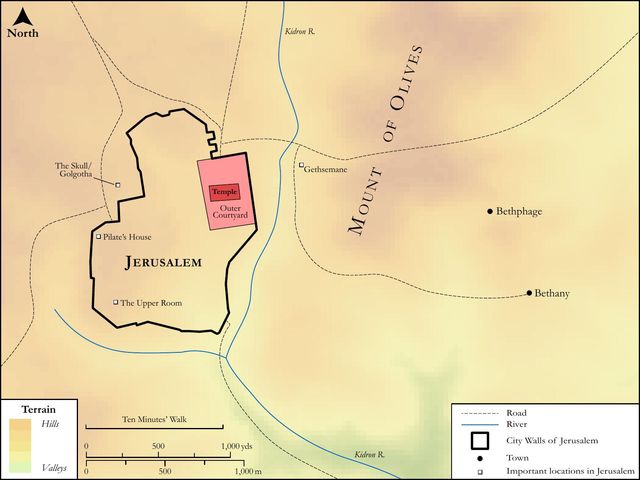
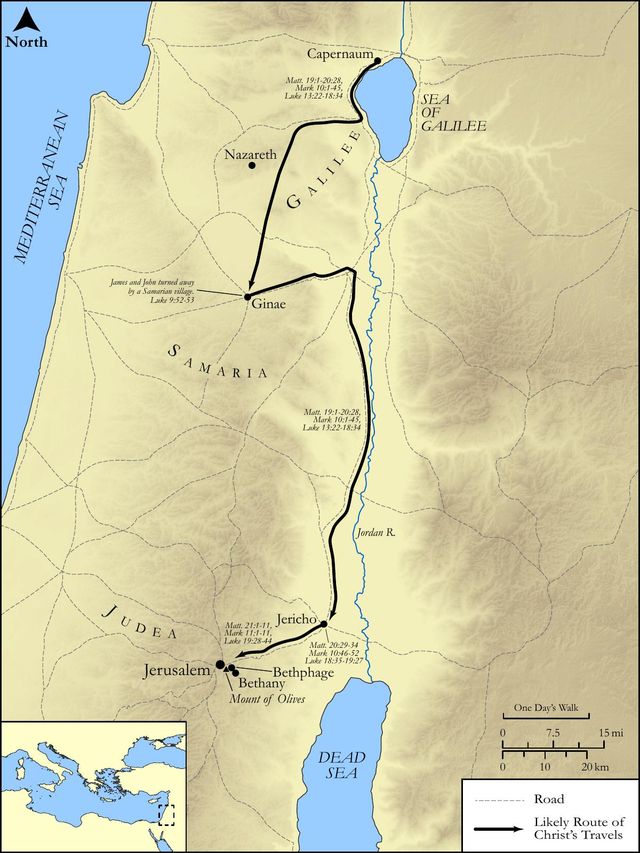
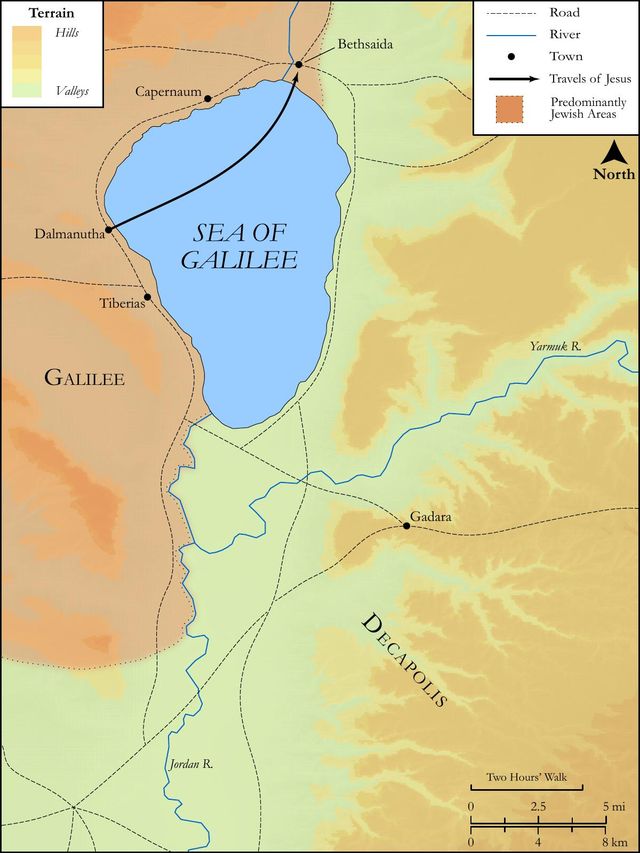
See on the biblical-era maps
Study this verse
Public-domain commentary
Matthew Henry
From his Commentary on the Whole Bible. Henry comments on passages, not single verses — this entry covers Luke 9:1–9. His three-level outline is real structure in the source text, so it is rendered as structure.
We have here, I. The method Christ took to spread his gospel, to diffuse and enforce the light of it. He had himself travelled about, preaching and healing; but he could be only in one place at a time, and therefore now he sent his twelve disciples abroad, who by this time were pretty well instructed in the nature of the present dispensation, and able to instruct others and deliver to them what they had received from the Lord. Let them disperse themselves, some one way and some another, to preach the kingdom of God, as it was now about to be set up by the Messiah, to make people acquainted with the spiritual nature and tendency of it, and to persuade them to come into the interests and measures of it. For the confirming of their doctrine, because it was new and surprising, and very different from what they had been taught by the scribes and Pharisees, and because so much depended upon men's receiving, or not receiving it, he empowered them to work miracles (Luk 9:1, Luk 9:2): He gave them authority over all devils, to dispossess them, and cast them out, though ever so numerous, so subtle, so fierce, so obstinate. Christ designed a total rout and ruin to the kingdom of darkness, and therefore gave them power over all devils. He authorized and appointed them likewise to cure disease, and to heal the sick, which would make them welcome wherever they came, and not only convince people's judgments, but gain their affections. This was their commission. Now observe,
1.What Christ directed them to do, in prosecution of this commission at this time, when they were not to go far or be out long.
(1.)They must not be solicitous to recommend themselves to people's esteem by their outward appearance. Now that they begin to set up for themselves, they must have no dress, nor study to make any other figure than what they made while they followed him: they must go as they were, and not change their clothes, or so much as put on a pair of new shoes.
(2.)They must depend upon Providence, and the kindness of their friends, to furnish them with what was convenient for them. They must not take with them either bread or money, and yet believe they should not want. Christ would not have his disciples shy of receiving the kindnesses of their friends, but rather to expect them. Yet St. Paul saw cause not to go by this rule, when he laboured with his hands rather than be burdensome.
(3.)They must not change their lodgings, as suspecting that those who entertained them were weary of them; they have no reason to be so, for the ark is a guest that always pays well for its entertainment: "Whatsoever house ye enter into there abide (Luk 9:4), that people may know where to find you, that your friends may know you are not backward to serve them, and your enemies may know you are not ashamed nor afraid to face them; there abide till you depart out of that city; stay with those you are used to." (4.) They must put on authority, and speak warning to those who refused them as well as comfort to those that received them, Luk 9:5. "If there be any place that will not entertain you, if the magistrates deny you admission and threaten to treat you as vagrants, leave them, do not force yourselves upon them, nor run yourselves into danger among them, but at the same time bind them over to the judgment of God for it; shake off the dust of your feet for a testimony against them." This will, as it were, be produced in evidence against them, that the messengers of the gospel had been among them, to make them a fair offer of grace and peace, for this dust they left behind there; so that when they perish at last in their infidelity this will lay and leave their blood upon their own heads. Shake off the dust of your feet, as much as to say you abandon their city, and will have no more to do with them.
2.What they did, in prosecution of this commission (Luk 9:6): They departed from their Master's presence; yet, having still his spiritual presence with them, his eye and his arm going along with them, and, thus borne up in their work, they went through the towns, some or other of them, all the towns within the circuit appointed them, preaching the gospel, and healing every where. Their work was the same with their Master's, doing good both to souls and bodies.
II.We have here Herod's perplexity and vexation at this.
The communicating of Christ's power to those who were sent forth in his name, and acted by authority from him, was an amazing and convincing proof of his being the Messiah, above any thing else; that he could not only work miracles himself, but empower others to work miracles too, this spread his fame more than any thing, and made the rays of this Sun of righteousness the stronger by the reflection of them even from the earth, from such mean illiterate men as the apostles were, who had nothing else to recommend them, or to raise any expectations from them, but that they had been with Jesus, Act 4:13. When the country sees such as these healing the sick in the name of Jesus it gives it an alarm. Now observe,
1.The various speculations it raised among the people, who, though they thought not rightly, yet could not but think honourably, of our Lord Jesus, and that he was an extraordinary person, one come from the other world; that either John Baptist, who was lately persecuted and slain for the cause of God, or one of the old prophets, that had been persecuted and slain long since in that cause, was risen again, to be recompensed for his sufferings by this honour put upon him; or that Elias, who was taken alive to heaven in a fiery chariot, had appeared as an express from heaven, Luk 9:7, Luk 9:8.
2.The great perplexity it created in the mind of Herod: When he had heard of all that was done by Christ, his guilty conscience flew in his face, and he was ready to conclude with them that John was risen from the dead. He thought he had got clear of John, and should never be troubled with him any more, but, it seems, he is mistaken; either John is come to life again or here is another in his spirit and power, for God will never leave himself without witness. "What shall I do now?" saith Herod. "John have I beheaded, but who is this? Is he carrying on John's work, or is he come to avenge John's death? John baptized, but he does not; John did no miracle, but he does, and therefore appears more formidable than John." Note, Those who oppose God will find themselves more and more embarrassed. However, he desired to see him, whether he resembled John or no; but he might soon have been put out of this pain if he would but have informed himself of that which thousands knew, that Jesus preached, and wrought miracles, a great while before John was beheaded, and therefore could not be John raised from the dead. He desired to see him; and why did he not go and see him? Probably, because he thought it below him either to go to him or to send for him; he had enough of John Baptist, and cared not for having to do with any more such reprovers of sin. He desired to see him, but we do not find that ever he did, till he saw him at his bar, and then he and his men of war set him at nought, Luk 23:11. Had he prosecuted his convictions now, and gone to see him, who knows but a happy change might have ben wrought in him? But, delaying it now, his heart was hardened, and when he did see him he was as much prejudiced against him as any other.
Historical interpretation
Ten Centuries of Reception
9 surviving comments on this verse. Each one is dated, so this reads as a timeline rather than a list.
Select a marker to jump to its quote. Markers stagger vertically where authors wrote within a few decades of each other.
Now some of the Jews thought that the destruction of Herod's army came from God, and that very justly, as a punishment of what he did against John, that was called the Baptist: for Herod slew him, who was a good man, and commanded the Jews to exercise virtue, both as to righteousness towards one another, and piety towards God, and so to come to baptism; for that the washing [with water] would be acceptable to him, if they made use of it, not in order to the putting away [or the remission] of some sins [only], but for the purification of the body; supposing still that the soul was thoroughly purified beforehand by righteousness. Now when [many] others came in crowds about him, for they were very greatly moved [or pleased] by hearing his words, Herod, who feared lest the great influence John had over the people might put it into his power and inclination to raise a rebellion, (for they seemed ready to do any thing he should advise,) thought it best, by putting him to death, to prevent any mischief he might cause, and not bring himself into difficulties, by sparing a man who might make him repent of it when it would be too late. Accordingly he was sent a prisoner, out of Herod's suspicious temper, to Macherus, the castle I before mentioned, and was there put to death. Now the Jews had an opinion that the destruction of this army was sent as a punishment upon Herod, and a mark of God's displeasure to him.
Again, that it was no new god which recommended by Christ, was dearly attested by the opinion of all men, because some maintained to Herod that Jesus was the Christ; others, that He was John; some, that He was Elias; and others, that He was one of the old prophetess. Now, whosoever of all these He might have been, He certainly was not raised up for the purpose of announcing another god after His resurrection.
But when the Lord had girded His disciples as soldiers of God with divine virtue and wise admonitions, sending them to the Jews as teachers and physicians, they afterwards went forth, as it follows, And they departed, and went through the towns preaching the gospel, and healing every where.
After the law has passed away, the food of the gospel begins to feed the hungry hearts of the people.… It was fitting that those whom he had healed from the pain of wounds he freed from hunger with spiritual nourishment. Thus none receives the food of Christ unless he was first healed, and the calling first heals those who are called to the feast. If one was lame, he received the ability to walk, so that he came. If one lacked the sight of his eyes, he could indeed not enter the house of the Lord, unless his sight was restored.
(Hom. 48. in Matt.) It was not till a long time had passed that Herod took notice of the things that were done by Jesus, (to show you the pride of a tyrant,) for he did not acknowledge them at first, as it is said, Now Herod heard, &c.
For sinners fear both when they know, and when they are ignorant; they are afraid of shadows, are suspicious about every thing, and are alarmed at the slightest noise. Such in truth is sin; when no one blames or finds fault, it betrays a man, when no one accuses it condemns, and makes the offender timid and backward. But the cause of fear is stated afterwards, in the words, Because that it was said of some.
(ubi sup.) When Herod then heard of the miracles which Jesus was performing, he says, John have I beheaded, which was not an expression of boasting, but by way of allaying his fears, and bringing his distracted soul to recollect that he had killed. And because he had beheaded John, he adds, but who is this.
(de Con. Ev. l. 2. c. 45.) Now Luke, though he keeps the same order in his narrative with Mark, docs not oblige us to believe that the course of events was the same. In these words too, Mark testifies only to the fact that others (not Herod) said that John had risen from the dead, but since Luke has mentioned Herod's perplexity, we must suppose either that after that perplexity, he confirmed in his own mind what was said by others, since he says to his servants, (as Matthew relates,) This is John the Baptist, he is risen from the dead, or these words of Matthew must have been uttered so as to signify that he was still doubting.
Now, Herod the tetrarch heard all that was done by Him, and he was perplexed, because it was said by some that John had risen from the dead. How great was the envy of the Jews, who, with fury of malice against the Lord, we are taught in almost every place of the Gospel. Behold John, of whom it was said that he performed no sign, yet they believed he could have risen from the dead without any witness; but Jesus, proven by God with powers and signs, at whose death the elements trembled, and whose resurrection and ascension were declared by angels, apostles, and men and women alike, they preferred to believe was not risen, but was stolen away secretly. Nor should it be thought to contradict that Luke recounts that Herod was perplexed because it was said by some that John had risen from the dead: when Matthew and Mark report that Herod himself, having heard of Jesus' fame, said to his servants, This is John the Baptist; he has risen from the dead, and that is why miraculous powers are at work in him (Matt. 14); but it must be understood that after this perplexity, he confirmed in his mind what was being said by others.
You see, our Lord provided encouragement for the multitude that was following him as the Passover, the Jews’ festival day, was drawing near. He did this by his words of salvation, together with the help of his cures. As another Evangelist wrote, he spoke to them about the kingdom of God and healed those who were in need of being cured. When his acts of teaching and healing were completed, he refreshed them most abundantly from a small amount of food.
Herod was the son of Herod the Great who slew the children, who was king, but this Herod was tetrarch. He inquired about Christ, who He was. Hence it follows, And he was perplexed.
For the Jews expected a resurrection of the dead to a fleshly life, eating and drinking, but those that rise again will not be concerned with the deeds of the flesh.
If John is alive and has risen from the dead, I shall know him when I see him; as it follows, And he sought to see him.
Continue studying Luke 9:7 across the web’s major study libraries — every link below opens this exact verse, chapter, or book on the destination site.
Read & Compare
 BibleGatewayThis verse in more than 200 translations and 70 languages.
 Bible.comThe YouVersion reader — hundreds of translations, reading plans, and highlights.
 ESV.orgCrossway's official English Standard Version reader.
 NET BibleThe NET translation with 60,000+ translators' notes on every rendering decision.
 STEP BibleTyndale House's free study tool — original text, vocabulary, and scholarly resources.
 BibliaLogos Bible Software's free web reader.
 USCCBThe New American Bible (Revised Edition) with the U.S. bishops' study notes.
Commentaries
 BibleHub CommentariesDozens of classic commentaries on this verse, gathered on one page.
 StudyLightMore than 100 commentary sets — the largest collection on the web.
 BibleRefPlain-English commentary on what this verse means, verse by verse.
 Enduring WordDavid Guzik's free commentary on this chapter, widely used by Bible teachers.
 Bible Study ToolsVerse commentary alongside Greek and Hebrew study aids.
Original Language & Research
- BibleHub InterlinearThe verse word by word — original language, transliteration, and English.
- BibleHub LexiconEvery word's original-language definition and Strong's entry.
 Blue Letter BibleDeep-study tools — Strong's numbers, concordance, and word studies.
 CNTR CollationThe earliest Greek manuscripts of this verse, collated letter by letter.
Sermons, Hymns & Audio


TrulyRandomVerse is not affiliated with these sites and doesn’t control their content. They’re linked because they’re genuinely useful.
Summary
Luke 9:7 marks a crucial point in Jesus' Galilean ministry, revealing that His widespread renown, characterized by powerful miracles and authoritative teaching, had reached the highest political authority in the region, Herod Antipas. This verse highlights Herod's profound perplexity and inner turmoil, as the rumors about Jesus' identity led him to fear that John the Baptist, whom he had executed, had risen from the dead, exposing his deep-seated guilt and the widespread misunderstanding surrounding Jesus' true nature.
Context
ShowHideLiterary Context
Luke 9:7 immediately follows Jesus' commissioning and sending out of the twelve disciples with power and authority to preach the kingdom of God and heal the sick (Luke 9:1-6). The disciples' mission amplified the scope and impact of Jesus' ministry, leading to an even greater public awareness of His work. The phrase "all that was done by him" (referring to Jesus) encompasses not only the disciples' activities but also the extensive miracles, healings, and authoritative teaching that Jesus Himself had performed throughout Galilee, as detailed in the preceding chapters (e.g., healing the paralytic in Luke 5:17-26, raising the widow's son in Luke 7:11-17, and calming the storm in Luke 8:22-25). Herod's reaction thus serves as a testament to the undeniable and far-reaching impact of Jesus' ministry.
Historical & Cultural Context
Herod Antipas, often referred to as "Herod the tetrarch," ruled over Galilee and Perea from 4 BCE to 39 CE. As a tetrarch, he governed one of the four divisions of his father Herod the Great's former kingdom, under the ultimate authority of the Roman Empire. His capital was Tiberias, a city on the Sea of Galilee. John the Baptist had publicly condemned Herod's unlawful marriage to Herodias, his brother Philip's wife, leading to John's imprisonment and subsequent execution at Herodias's instigation (Luke 3:19-20 and Mark 6:14-29). This act of injustice weighed heavily on Herod's conscience, making him susceptible to superstitious fears and irrational interpretations of Jesus' identity. The widespread rumors about Jesus reflect the fervent messianic expectations and prophetic hopes prevalent among the Jewish people at the time, leading many to speculate about the identity of this powerful new figure.
Key Themes
ShowHideThis verse contributes to several key themes within Luke's Gospel. Firstly, it highlights the growing recognition and impact of Jesus' ministry, demonstrating that His fame had transcended local boundaries and reached the highest political echelons, even those hostile to prophetic voices. Secondly, it underscores the theme of misconceptions about Jesus' identity, as various theories circulated among the populace, including the idea that He was John the Baptist or one of the Old Testament prophets (Luke 9:8). This sets the stage for Peter's confession of Jesus as the Christ later in the chapter (Luke 9:20). Finally, Herod's reaction powerfully illustrates the torment of a guilty conscience and the consequences of sin. His fear that John had risen from the dead reveals the psychological burden of his past actions, a theme that resonates with biblical teachings on judgment and accountability.
Exposition and Analysis
ShowHideKey Word Analysis
ShowHideThis primary verb signifies "to hear" in various senses, from simply perceiving sound to giving audience, understanding, or having something reported. In this context, Herod did not just passively hear a rumor; the widespread nature of Jesus' deeds meant the reports had come to his attention in a significant, undeniable way, demanding his consideration and response.
Derived from diá (through) and aporéō (to be at a loss), this word vividly describes Herod's state of being "thoroughly nonplussed," bewildered, or in great doubt. It conveys a deep mental agitation, an inability to find a way out of a dilemma, reflecting his profound inner turmoil and confusion regarding Jesus' identity and power, especially in light of his past actions concerning John the Baptist.
This verb means "to waken" or "to rouse," used transitively or intransitively. It encompasses literal resurrection from sleep, sitting, disease, or death, but also figuratively, rising from obscurity or inactivity. Here, it is used in the literal sense of resurrection from the dead, specifically concerning John the Baptist, highlighting the terrifying nature of Herod's fear and the supernatural claims being made about Jesus.
Verse Breakdown
ShowHide"Now Herod the tetrarch heard of all that was done by him"
This clause establishes the central figure, Herod Antipas, identified by his political title, "the tetrarch" (ruler of a fourth part of a region). It emphasizes the extensive reach of Jesus' ministry, indicating that the reports of His powerful deeds—miracles, healings, and authoritative teaching—had become so widespread and undeniable that they reached even the highest political authority in the region, compelling his attention.
"and he was perplexed"
This short, impactful clause reveals Herod's immediate emotional and mental state. The Greek word diaporéō signifies a deep state of bewilderment, being at a loss, or thoroughly nonplussed. It suggests a profound inner disturbance, a mind grappling with something it cannot comprehend or reconcile, indicating a significant challenge to his understanding and authority.
"because that it was said of some, that John was risen from the dead"
This final clause provides the specific reason for Herod's perplexity. The rumors circulating among "some" people directly linked Jesus to John the Baptist, specifically suggesting that John had been resurrected. This belief, born out of a mix of fear, superstition, and perhaps a guilty conscience, directly confronted Herod with the consequences of his past actions, particularly his unjust execution of John. The idea of John's resurrection would have been particularly terrifying to Herod, stirring up deep-seated guilt and fear of divine retribution.
Literary Devices
ShowHideLuke's concise narrative in this verse employs several literary devices. The use of Foreshadowing is evident, as Herod's fear of John's resurrection hints at the greater truth of Jesus' own future resurrection, though Herod tragically misunderstands it. The verse also employs Irony, as Herod, the powerful ruler, is utterly "perplexed" and tormented by a figure he perceives as a resurrected prophet, demonstrating the ultimate powerlessness of worldly authority against divine truth and a guilty conscience. The mention of "Herod the tetrarch" is a form of Metonymy, where the title represents the full weight of his political power and the historical context of his rule. Finally, the contrasting figures of the powerful Herod and the humble, yet profoundly impactful, Jesus create a subtle Juxtaposition, highlighting the different sources of authority and power at play in the narrative.
Theological and Thematic Connections
ShowHideLuke 9:7 serves as a powerful theological statement about the inescapable nature of truth and the pervasive influence of God's kingdom. Herod's perplexity is a direct consequence of his sin and a testament to the fact that even those in positions of power cannot ignore the divine activity unfolding around them. His fear of John's resurrection underscores the biblical principle that actions have consequences, and a guilty conscience, unaddressed, can lead to profound internal torment and irrational fears. The verse also highlights the broader theme in the Gospels of the world's struggle to comprehend and accept Jesus' true identity, often attempting to fit Him into pre-conceived notions rather than recognizing Him as the unique Son of God.
Reflection and Application
ShowHideLuke 9:7 offers profound insights for contemporary reflection. Herod's troubled conscience serves as a stark reminder that unconfessed sin and unaddressed guilt can lead to deep psychological distress and distorted perceptions of reality. His fear of John's resurrection, though based on a false premise about Jesus, reveals the torment that can plague a heart unwilling to repent. For us, this prompts an examination of our own consciences: are there unconfessed sins that are causing us inner turmoil or leading us to misinterpret God's work in our lives? Furthermore, the varied opinions about Jesus' identity in that era, including Herod's, challenge us to move beyond superficial understandings and truly grapple with who Jesus claimed to be and who the Scriptures declare Him to be—not merely a good teacher or prophet, but the Son of God, the Messiah. Our response to Jesus' identity profoundly shapes our lives and our eternal destiny.
Questions for Reflection
ShowHideFAQ
ShowHideWhy was Herod Antipas so perplexed by Jesus?
ShowHideHerod Antipas was perplexed because the widespread reports of Jesus' powerful deeds and teachings led him to fear that Jesus was John the Baptist, whom Herod had previously executed, risen from the dead. This fear was rooted in his guilty conscience over his unjust act against John, causing him deep mental agitation and confusion. The idea of John's resurrection would have been particularly terrifying to Herod, suggesting divine retribution for his sin.
What does "Herod the tetrarch" mean?
ShowHide"Herod the tetrarch" refers to Herod Antipas, who ruled over Galilee and Perea. A "tetrarch" (Greek tetrarches) literally means "ruler of a fourth part." This title indicates that his territory was one of four divisions of the kingdom previously ruled by his father, Herod the Great. While he held significant regional power, he was still subordinate to the Roman Emperor.
How does Luke 9:7 connect to John the Baptist's ministry?
ShowHideLuke 9:7 directly connects to John the Baptist's ministry by revealing Herod's deep-seated guilt and fear regarding John's execution. John had publicly condemned Herod's unlawful marriage (Luke 3:19-20), leading to his imprisonment and eventual beheading. The rumors that Jesus was John resurrected brought Herod's past sin to the forefront of his mind, demonstrating the lasting impact of John's prophetic witness even after his death.
Christ-Centered Fulfillment
ShowHideLuke 9:7, while focusing on Herod's earthly perplexity, subtly points toward Christ's ultimate triumph over death and the world's inability to fully grasp His divine identity. Herod's superstitious fear that John the Baptist had "risen from the dead" foreshadows the actual, glorious resurrection of Jesus Christ, which would definitively conquer sin and death (Romans 6:9). Unlike John, who was a prophet and a forerunner, Jesus is the Son of God, the source of life itself (John 1:4). Herod's inability to comprehend Jesus' true nature—reducing Him to a resurrected prophet—highlights humanity's persistent struggle to recognize God's unique revelation in Christ, a theme powerfully addressed in the New Testament (John 1:10-11). Ultimately, while Herod was tormented by a false resurrection, the true resurrection of Jesus offers peace, forgiveness, and eternal life to all who believe, transforming perplexity into profound understanding and fear into faith (1 Peter 1:3-5).