


Luke 9:8
Bible text: King James Version (1769 Blayney text) · Public domain
Bible text: Berean Standard Bible · Public domain
Bible text: American Standard Version (1901) · Public domain
Bible text: World English Bible, Messianic edition · Public domain
Bible text: Geneva Bible (1599) · Public domain
Bible text: Young's Literal Translation · Public domain
- ὑπόhupobyG5259PREPPreposition
- τινωνtinōnsomeG5100X-GPMIndefinite pronoun Genitive Plural Masculine
- δὲdealsoG1161CONJConjunction
- ὅτιhotithatG3754CONJConjunction
- ἨλίαςĒliasElijahG2243N-NSM-PNoun Nominative Singular Masculine Individual
- ἐφάνηephanēhad appearedG5316V-2API-3SVerb 2nd Aorist Passive Indicative 3rd Singular
- ἄλλωνallōnby othersG243A-GPMAdjective Genitive Plural Masculine
- δὲdealsoG1161CONJConjunction
- ὅτιhotithatG3754CONJConjunction
- προφήτηςprophētēsa prophetG4396N-NSMNoun Nominative Singular Masculine
- τιςtissomeoneG5100X-NSMIndefinite pronoun Nominative Singular Masculine
- τῶνtōnof theG3588T-GPMDefinite article Genitive Plural Masculine
- ἀρχαίωνarchaiōnancientsG744A-GPMAdjective Genitive Plural Masculine
- ἀνέστηanestēhad arisenG450V-2AAI-3SVerb 2nd Aorist Active Indicative 3rd Singular
English is a literal word-by-word gloss of the Greek, not the KJV's wording. Why?
This is the original text the KJV's translators worked from — each Greek word with its own literal English meaning in this verse, prepared by scholars at Tyndale House, Cambridge. The KJV translates whole sentences, not word by word, so its wording differs: one Greek word can become several English words, and the KJV may choose “charity” where the gloss reads “love”. Both are faithful — they answer different questions. For the KJV's own rendering, switch to the KJV text.
Details
See on the biblical-era maps

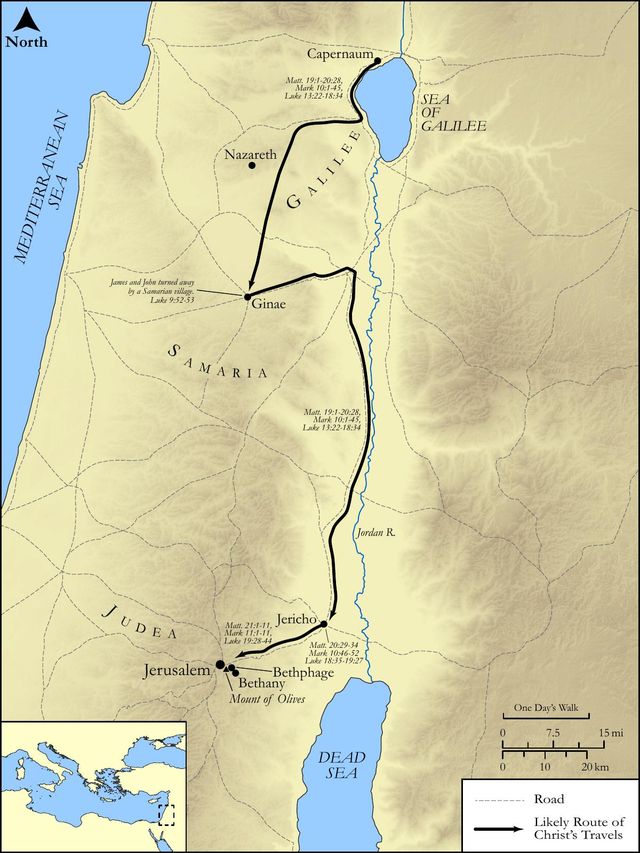
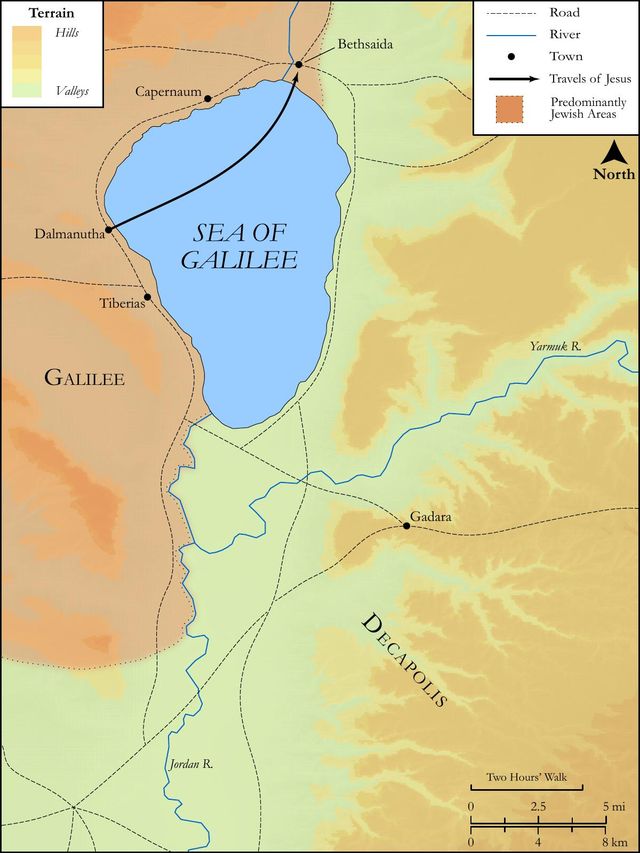
Study this verse
Public-domain commentary
Matthew Henry
From his Commentary on the Whole Bible. Henry comments on passages, not single verses — this entry covers Luke 9:1–9. His three-level outline is real structure in the source text, so it is rendered as structure.
We have here, I. The method Christ took to spread his gospel, to diffuse and enforce the light of it. He had himself travelled about, preaching and healing; but he could be only in one place at a time, and therefore now he sent his twelve disciples abroad, who by this time were pretty well instructed in the nature of the present dispensation, and able to instruct others and deliver to them what they had received from the Lord. Let them disperse themselves, some one way and some another, to preach the kingdom of God, as it was now about to be set up by the Messiah, to make people acquainted with the spiritual nature and tendency of it, and to persuade them to come into the interests and measures of it. For the confirming of their doctrine, because it was new and surprising, and very different from what they had been taught by the scribes and Pharisees, and because so much depended upon men's receiving, or not receiving it, he empowered them to work miracles (Luk 9:1, Luk 9:2): He gave them authority over all devils, to dispossess them, and cast them out, though ever so numerous, so subtle, so fierce, so obstinate. Christ designed a total rout and ruin to the kingdom of darkness, and therefore gave them power over all devils. He authorized and appointed them likewise to cure disease, and to heal the sick, which would make them welcome wherever they came, and not only convince people's judgments, but gain their affections. This was their commission. Now observe,
1.What Christ directed them to do, in prosecution of this commission at this time, when they were not to go far or be out long.
(1.)They must not be solicitous to recommend themselves to people's esteem by their outward appearance. Now that they begin to set up for themselves, they must have no dress, nor study to make any other figure than what they made while they followed him: they must go as they were, and not change their clothes, or so much as put on a pair of new shoes.
(2.)They must depend upon Providence, and the kindness of their friends, to furnish them with what was convenient for them. They must not take with them either bread or money, and yet believe they should not want. Christ would not have his disciples shy of receiving the kindnesses of their friends, but rather to expect them. Yet St. Paul saw cause not to go by this rule, when he laboured with his hands rather than be burdensome.
(3.)They must not change their lodgings, as suspecting that those who entertained them were weary of them; they have no reason to be so, for the ark is a guest that always pays well for its entertainment: "Whatsoever house ye enter into there abide (Luk 9:4), that people may know where to find you, that your friends may know you are not backward to serve them, and your enemies may know you are not ashamed nor afraid to face them; there abide till you depart out of that city; stay with those you are used to." (4.) They must put on authority, and speak warning to those who refused them as well as comfort to those that received them, Luk 9:5. "If there be any place that will not entertain you, if the magistrates deny you admission and threaten to treat you as vagrants, leave them, do not force yourselves upon them, nor run yourselves into danger among them, but at the same time bind them over to the judgment of God for it; shake off the dust of your feet for a testimony against them." This will, as it were, be produced in evidence against them, that the messengers of the gospel had been among them, to make them a fair offer of grace and peace, for this dust they left behind there; so that when they perish at last in their infidelity this will lay and leave their blood upon their own heads. Shake off the dust of your feet, as much as to say you abandon their city, and will have no more to do with them.
2.What they did, in prosecution of this commission (Luk 9:6): They departed from their Master's presence; yet, having still his spiritual presence with them, his eye and his arm going along with them, and, thus borne up in their work, they went through the towns, some or other of them, all the towns within the circuit appointed them, preaching the gospel, and healing every where. Their work was the same with their Master's, doing good both to souls and bodies.
II.We have here Herod's perplexity and vexation at this.
The communicating of Christ's power to those who were sent forth in his name, and acted by authority from him, was an amazing and convincing proof of his being the Messiah, above any thing else; that he could not only work miracles himself, but empower others to work miracles too, this spread his fame more than any thing, and made the rays of this Sun of righteousness the stronger by the reflection of them even from the earth, from such mean illiterate men as the apostles were, who had nothing else to recommend them, or to raise any expectations from them, but that they had been with Jesus, Act 4:13. When the country sees such as these healing the sick in the name of Jesus it gives it an alarm. Now observe,
1.The various speculations it raised among the people, who, though they thought not rightly, yet could not but think honourably, of our Lord Jesus, and that he was an extraordinary person, one come from the other world; that either John Baptist, who was lately persecuted and slain for the cause of God, or one of the old prophets, that had been persecuted and slain long since in that cause, was risen again, to be recompensed for his sufferings by this honour put upon him; or that Elias, who was taken alive to heaven in a fiery chariot, had appeared as an express from heaven, Luk 9:7, Luk 9:8.
2.The great perplexity it created in the mind of Herod: When he had heard of all that was done by Christ, his guilty conscience flew in his face, and he was ready to conclude with them that John was risen from the dead. He thought he had got clear of John, and should never be troubled with him any more, but, it seems, he is mistaken; either John is come to life again or here is another in his spirit and power, for God will never leave himself without witness. "What shall I do now?" saith Herod. "John have I beheaded, but who is this? Is he carrying on John's work, or is he come to avenge John's death? John baptized, but he does not; John did no miracle, but he does, and therefore appears more formidable than John." Note, Those who oppose God will find themselves more and more embarrassed. However, he desired to see him, whether he resembled John or no; but he might soon have been put out of this pain if he would but have informed himself of that which thousands knew, that Jesus preached, and wrought miracles, a great while before John was beheaded, and therefore could not be John raised from the dead. He desired to see him; and why did he not go and see him? Probably, because he thought it below him either to go to him or to send for him; he had enough of John Baptist, and cared not for having to do with any more such reprovers of sin. He desired to see him, but we do not find that ever he did, till he saw him at his bar, and then he and his men of war set him at nought, Luk 23:11. Had he prosecuted his convictions now, and gone to see him, who knows but a happy change might have ben wrought in him? But, delaying it now, his heart was hardened, and when he did see him he was as much prejudiced against him as any other.
Historical interpretation
Ten Centuries of Reception
6 surviving comments on this verse. Each one is dated, so this reads as a timeline rather than a list.
Select a marker to jump to its quote. Markers stagger vertically where authors wrote within a few decades of each other.
Now some of the Jews thought that the destruction of Herod's army came from God, and that very justly, as a punishment of what he did against John, that was called the Baptist: for Herod slew him, who was a good man, and commanded the Jews to exercise virtue, both as to righteousness towards one another, and piety towards God, and so to come to baptism; for that the washing [with water] would be acceptable to him, if they made use of it, not in order to the putting away [or the remission] of some sins [only], but for the purification of the body; supposing still that the soul was thoroughly purified beforehand by righteousness. Now when [many] others came in crowds about him, for they were very greatly moved [or pleased] by hearing his words, Herod, who feared lest the great influence John had over the people might put it into his power and inclination to raise a rebellion, (for they seemed ready to do any thing he should advise,) thought it best, by putting him to death, to prevent any mischief he might cause, and not bring himself into difficulties, by sparing a man who might make him repent of it when it would be too late. Accordingly he was sent a prisoner, out of Herod's suspicious temper, to Macherus, the castle I before mentioned, and was there put to death. Now the Jews had an opinion that the destruction of this army was sent as a punishment upon Herod, and a mark of God's displeasure to him.
But when the Lord had girded His disciples as soldiers of God with divine virtue and wise admonitions, sending them to the Jews as teachers and physicians, they afterwards went forth, as it follows, And they departed, and went through the towns preaching the gospel, and healing every where.
After the law has passed away, the food of the gospel begins to feed the hungry hearts of the people.… It was fitting that those whom he had healed from the pain of wounds he freed from hunger with spiritual nourishment. Thus none receives the food of Christ unless he was first healed, and the calling first heals those who are called to the feast. If one was lame, he received the ability to walk, so that he came. If one lacked the sight of his eyes, he could indeed not enter the house of the Lord, unless his sight was restored.
(Hom. 48. in Matt.) It was not till a long time had passed that Herod took notice of the things that were done by Jesus, (to show you the pride of a tyrant,) for he did not acknowledge them at first, as it is said, Now Herod heard, &c.
For sinners fear both when they know, and when they are ignorant; they are afraid of shadows, are suspicious about every thing, and are alarmed at the slightest noise. Such in truth is sin; when no one blames or finds fault, it betrays a man, when no one accuses it condemns, and makes the offender timid and backward. But the cause of fear is stated afterwards, in the words, Because that it was said of some.
(ubi sup.) When Herod then heard of the miracles which Jesus was performing, he says, John have I beheaded, which was not an expression of boasting, but by way of allaying his fears, and bringing his distracted soul to recollect that he had killed. And because he had beheaded John, he adds, but who is this.
You see, our Lord provided encouragement for the multitude that was following him as the Passover, the Jews’ festival day, was drawing near. He did this by his words of salvation, together with the help of his cures. As another Evangelist wrote, he spoke to them about the kingdom of God and healed those who were in need of being cured. When his acts of teaching and healing were completed, he refreshed them most abundantly from a small amount of food.
Herod was the son of Herod the Great who slew the children, who was king, but this Herod was tetrarch. He inquired about Christ, who He was. Hence it follows, And he was perplexed.
For the Jews expected a resurrection of the dead to a fleshly life, eating and drinking, but those that rise again will not be concerned with the deeds of the flesh.
If John is alive and has risen from the dead, I shall know him when I see him; as it follows, And he sought to see him.
Continue studying Luke 9:8 across the web’s major study libraries — every link below opens this exact verse, chapter, or book on the destination site.
Read & Compare
 BibleGatewayThis verse in more than 200 translations and 70 languages.
 Bible.comThe YouVersion reader — hundreds of translations, reading plans, and highlights.
 ESV.orgCrossway's official English Standard Version reader.
 NET BibleThe NET translation with 60,000+ translators' notes on every rendering decision.
 STEP BibleTyndale House's free study tool — original text, vocabulary, and scholarly resources.
 BibliaLogos Bible Software's free web reader.
 USCCBThe New American Bible (Revised Edition) with the U.S. bishops' study notes.
Commentaries
 BibleHub CommentariesDozens of classic commentaries on this verse, gathered on one page.
 StudyLightMore than 100 commentary sets — the largest collection on the web.
 BibleRefPlain-English commentary on what this verse means, verse by verse.
 Enduring WordDavid Guzik's free commentary on this chapter, widely used by Bible teachers.
 Bible Study ToolsVerse commentary alongside Greek and Hebrew study aids.
Original Language & Research
- BibleHub InterlinearThe verse word by word — original language, transliteration, and English.
- BibleHub LexiconEvery word's original-language definition and Strong's entry.
 Blue Letter BibleDeep-study tools — Strong's numbers, concordance, and word studies.
 CNTR CollationThe earliest Greek manuscripts of this verse, collated letter by letter.
Sermons, Hymns & Audio


TrulyRandomVerse is not affiliated with these sites and doesn’t control their content. They’re linked because they’re genuinely useful.
Summary
This verse encapsulates the widespread speculation and diverse opinions circulating among the people regarding Jesus' identity, which had reached the ears of King Herod. It specifically highlights two prominent theories: that Jesus was the prophet Elijah, believed by some to have reappeared, and by others, that He was one of the ancient prophets resurrected. These conjectures underscore the profound impact of Jesus' ministry and the public's struggle to comprehend His unique person and power within familiar categories.
Context
ShowHideLiterary Context
Luke 9:8 immediately follows a passage detailing King Herod's perplexity over reports of Jesus' miraculous works and the various public opinions about Him, including the belief that Jesus was John the Baptist risen from the dead (Luke 9:7). This verse specifically lists two other prevalent theories among the populace, demonstrating the widespread impact of Jesus' ministry and the public's struggle to understand His identity. The broader context of Luke 9 includes Jesus empowering His disciples for ministry (Luke 9:1-6), the feeding of the five thousand (Luke 9:10-17), and critically, Peter's confession of Jesus as the Christ (Luke 9:18-20), which directly addresses the very questions of identity raised in this verse.
Historical & Cultural Context
In first-century Judaism, there was a strong expectation of prophetic figures, particularly the return of Elijah, based on the prophecy in Malachi 4:5. Elijah was revered as a powerful prophet who did not die but was taken up to heaven, and his return was widely anticipated as a precursor to the Messiah's coming. Similarly, the idea of a prophet being "risen again" or a new prophet emerging in the spirit of the old ones (like Jeremiah or Isaiah) was a common way for people to interpret extraordinary spiritual manifestations, especially after a long period of perceived prophetic silence. The political backdrop involved Herod Antipas, a tetrarch under Roman authority, who had recently executed John the Baptist and was now deeply troubled by the emergence of another powerful spiritual leader, fearing potential unrest or divine retribution.
Key Themes
ShowHideThis verse contributes significantly to the theme of Misconceptions about Jesus' Identity, highlighting how people, even those witnessing His undeniable power, struggled to correctly identify Him, often attempting to fit Him into familiar prophetic molds rather than recognizing His unique divine nature. It also touches on the Anticipation of Elijah, a crucial element of Jewish eschatology, where the return of Elijah was seen as a sign of the Messiah's imminent arrival, as prophesied in Malachi 4:5. While John the Baptist came in the spirit and power of Elijah, Jesus was far greater than a prophet. Furthermore, the verse reflects the theme of Prophetic Continuity, suggesting a broader belief in God's ongoing communication through prophets, even if the specific application to Jesus was incomplete. Ultimately, these conjectures serve to underscore the profound and often misunderstood nature of Jesus' true messianic identity, which would later be revealed more fully, as seen in Luke 9:20.
Exposition and Analysis
ShowHideKey Word Analysis
ShowHideThis is the Greek transliteration of the Hebrew prophet Elijah. The strong expectation of Elijah's return was deeply rooted in Jewish eschatology, making it a natural, albeit incorrect, assumption for some regarding Jesus' identity. Elijah was known for his powerful miracles, confrontation with evil, and unique departure from earth, making him a fitting, though ultimately insufficient, comparison for Jesus in the popular imagination.
From a compound meaning "to speak before" or "to speak for." A prophet was understood as a foreteller, an inspired speaker, or one who declared God's will. The reference to "old prophets" (G744, archaîos) signifies figures from Israel's past like Isaiah, Jeremiah, or Elisha, known for their powerful ministries and divine messages. The people's association of Jesus with these figures demonstrates their recognition of His extraordinary spiritual authority and divine empowerment, even if they missed His unique status as the Son of God.
This verb means "to stand up," "to arise," or "to raise up (again)." In this context, it implies a resurrection from the dead. The idea that Jesus was a resurrected prophet suggests a belief in the continuation of God's work through His chosen servants, even beyond death. It also hints at the profound impact Jesus had, leading people to consider Him a figure of such magnitude that only a resurrection could explain His presence and power.
Verse Breakdown
ShowHide"And of some, that Elias had appeared;"
This clause reveals a significant segment of the population believed Jesus was the literal return of the prophet Elijah. This belief was fueled by the strong Jewish expectation, based on Malachi 4:5, that Elijah would precede the Messiah. The phrase "had appeared" (G5316, phaínō) suggests a sudden, manifest presence, consistent with a miraculous reappearance. This interpretation highlights the public's attempt to fit Jesus into a familiar, albeit incomplete, prophetic framework.
"and of others, that one of the old prophets was risen again."
This second theory indicates that another group of people believed Jesus was a resurrected prophet from antiquity, such as Isaiah or Jeremiah. This reflects a broader understanding that God could raise up powerful figures from the past to continue His work, or that a new prophet could emerge with the authority and power reminiscent of those great figures. This view, like the Elijah theory, acknowledges Jesus' extraordinary nature and divine authority but falls short of recognizing His unique identity as the Son of God and the promised Messiah.
Literary Devices
ShowHideLuke employs Conjecture and Speculation in this verse, presenting a snapshot of the popular opinions surrounding Jesus. This highlights the human tendency to categorize and explain the unknown based on familiar frameworks, even when confronted with something entirely new. There is also an element of Dramatic Irony, as the audience knows (or will soon know through Peter's confession and subsequent events) that Jesus is far more than a resurrected prophet or Elijah. The very questions posed by the people and Herod serve to underscore Jesus' unique and unparalleled identity, which is gradually revealed throughout Luke's Gospel. The use of Parallelism ("And of some... and of others...") effectively presents the two distinct, yet related, theories circulating among the populace.
Theological and Thematic Connections
ShowHideLuke 9:8 serves as a crucial theological pivot, illustrating the widespread human inability to fully grasp the divine identity of Jesus based solely on His miraculous works. While people recognized His extraordinary power and prophetic authority, they struggled to move beyond familiar categories of understanding, such as the return of Elijah or a resurrected ancient prophet. This passage underscores the truth that true understanding of Jesus comes not from popular opinion or human speculation, but from divine revelation, a theme powerfully demonstrated later in the chapter through Peter's confession. It highlights the unique, unparalleled nature of Jesus, who transcends all previous prophetic figures and stands as the ultimate fulfillment of God's redemptive plan.
Reflection and Application
ShowHideLuke 9:8 offers a profound opportunity for self-reflection on how we perceive Jesus today. Just as people in Jesus' time tried to fit Him into their preconceived notions of a prophet or a resurrected figure, we too can be tempted to define Jesus by our own expectations, cultural biases, or even limited theological frameworks. This passage challenges us to move beyond superficial understanding and popular opinion, urging us to seek a deeper, biblically grounded revelation of who Jesus truly is: not merely a great teacher, a moral example, or a historical figure, but the Son of God, the Messiah, and the Lord of all. Our faith must be rooted in the divine truth of His person and work, allowing Him to redefine our understanding rather than conforming Him to our own.
Questions for Reflection
ShowHideFAQ
ShowHideWhy did some people believe Jesus was Elijah?
ShowHideThe belief that Jesus was Elijah was deeply rooted in Jewish eschatological expectations, particularly from the prophecy in Malachi 4:5, which stated that Elijah would return before the "great and dreadful day of the Lord." Elijah was a revered prophet known for his powerful miracles, his confrontation with idolatry, and his unique ascension to heaven without dying. Given Jesus' extraordinary miracles, His authoritative teaching, and His challenge to the religious establishment, many people saw parallels with Elijah's ministry and concluded that He must be the promised forerunner to the Messiah. However, Jesus clarified that John the Baptist came in the spirit and power of Elijah, fulfilling that prophecy, while Jesus Himself was the Messiah.
Who were "the old prophets" that people thought Jesus might be?
ShowHide"The old prophets" refers to the great prophetic figures of Israel's past, such as Isaiah, Jeremiah, Ezekiel, or Elisha. These were individuals through whom God had spoken powerfully and performed mighty works. After a period of several centuries without a recognized prophet, the emergence of a figure like Jesus, who taught with authority and performed undeniable miracles, led some to believe that God was once again raising up a prophet in the mold of these ancient figures. The idea was that one of these revered prophets had been resurrected to continue God's work, signaling a new era of divine activity.
Christ-Centered Fulfillment
ShowHideLuke 9:8, while detailing the public's misconceptions about Jesus, paradoxically points towards His ultimate Christ-centered fulfillment. The very questions about whether Jesus was Elijah or a resurrected prophet underscore the profound impact He had and the deep-seated expectation for divine intervention in Israel. While these theories fell short of the truth, they implicitly acknowledged Jesus' unique connection to God and His role in salvation history. Jesus was not merely a prophet like Elijah, but the one whom Elijah foretold, the very Messiah whose coming was announced. He did not merely rise again like an "old prophet," but He is the resurrection and the life (John 11:25), the one who conquered death once for all. The people's confusion foreshadows the divine revelation that would come, culminating in Peter's confession of Jesus as "the Christ of God" (Luke 9:20), a truth later affirmed by Jesus' own resurrection and ascension, which established Him as Lord and Christ (Acts 2:36). Thus, the popular conjectures, though incomplete, served to highlight the unique and unparalleled nature of the One who would ultimately fulfill all prophecy and bring salvation.