


Mark 6:15
Bible text: King James Version (1769 Blayney text) · Public domain
Bible text: Berean Standard Bible · Public domain
Bible text: American Standard Version (1901) · Public domain
Bible text: World English Bible, Messianic edition · Public domain
Bible text: Geneva Bible (1599) · Public domain
Bible text: Young's Literal Translation · Public domain
- ἄλλοιalloiOthersG243A-NPMAdjective Nominative Plural Masculine
- ἔλεγονelegonwere sayingG3004V-IAI-3PVerb Imperfect Active Indicative 3rd Plural
- ὅτιhotithatG3754CONJConjunction
- ἨλίαςĒliasElijahG2243N-NSM-PNoun Nominative Singular Masculine Individual
- ἐστίν·estinHe isG1510V-PAI-3SVerb Present Active Indicative 3rd Singular
- ἄλλοιalloiOthersG243A-NPMAdjective Nominative Plural Masculine
- δὲdenowG1161CONJConjunction
- ἔλεγονelegonwere sayingG3004V-IAI-3PVerb Imperfect Active Indicative 3rd Plural
- ὅτιhotithatG3754CONJConjunction
- προφήτηςprophētēsA prophetG4396N-NSMNoun Nominative Singular Masculine
- ἐστίνestinisG1510V-PAI-3SVerb Present Active Indicative 3rd Singular
- ἢēorG2228CONJConjunction
- ὡςhōslikeG5613PRTParticle or Disjunctive
- εἷςheisoneG1520A-NSMAdjective Nominative Singular Masculine
- τῶνtōnof theG3588T-GPMDefinite article Genitive Plural Masculine
- προφητῶνprophētōnprophetsG4396N-GPMNoun Genitive Plural Masculine
English is a literal word-by-word gloss of the Greek, not the KJV's wording. Why?
This is the original text the KJV's translators worked from — each Greek word with its own literal English meaning in this verse, prepared by scholars at Tyndale House, Cambridge. The KJV translates whole sentences, not word by word, so its wording differs: one Greek word can become several English words, and the KJV may choose “charity” where the gloss reads “love”. Both are faithful — they answer different questions. For the KJV's own rendering, switch to the KJV text.
Details
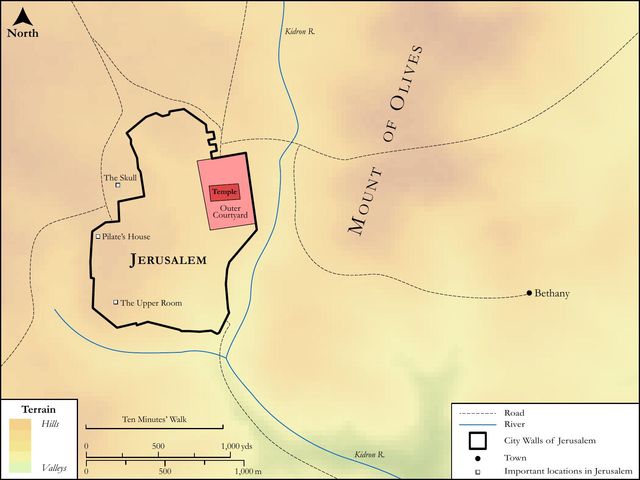
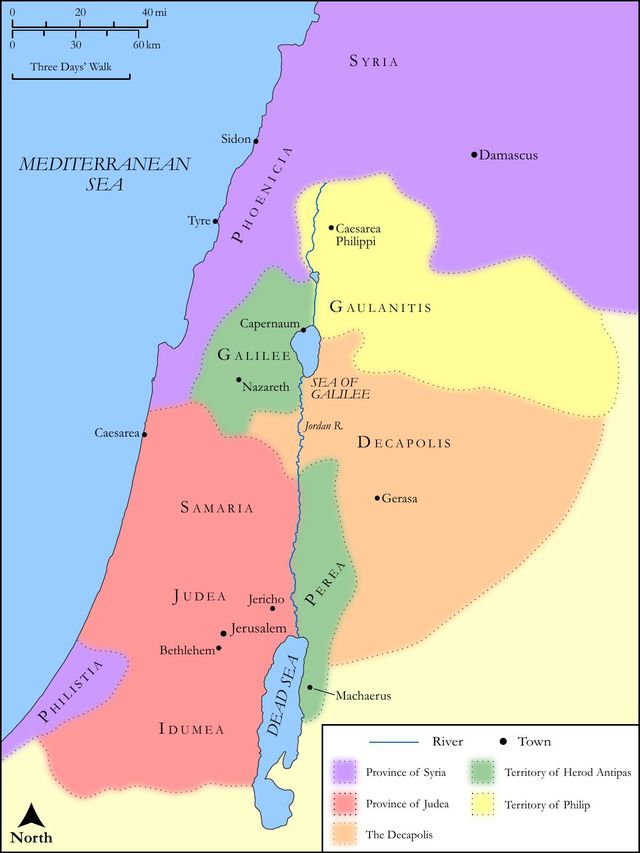
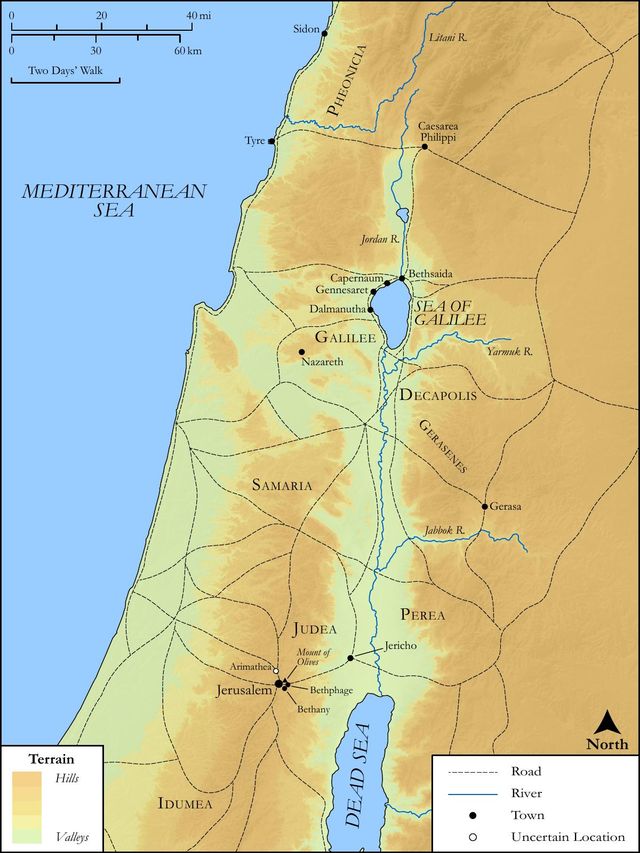
See on the biblical-era maps
Study this verse
Public-domain commentary
Matthew Henry
From his Commentary on the Whole Bible. Henry comments on passages, not single verses — this entry covers Mark 6:14–29. His four-level outline is real structure in the source text, so it is rendered as structure.
Here is, I. The wild notions that the people had concerning our Lord Jesus, Mar 6:15. His own countrymen could believe nothing great concerning him, because they knew his poor kindred; but others that were not under the power of that prejudice against him, were yet willing to believe any thing rather than the truth - that he was the Son of God, and the true Messias: they said, He is Elias, whom they expected; or, He is a prophet, one of the Old Testament prophets raised to life, and returned to this world; or as one of the prophets, a prophet now newly raised up, equal to those under the Old Testament.
II.The opinion of Herod concerning him.
He heard of his name and fame, of what he said and what he did; and he said, "It is certainly John Baptist, Mar 6:14. As sure as we are here, It is John, whom I beheaded, Mar 6:16. He is risen from the dead; and though while he was with us he did no miracle, yet, having removed for awhile to another world, he is come again with greater power, and now mighty works do show forth themselves in him."
Note, 1. Where there is an idle faith, there is commonly a working fancy. The people said, It is a prophet risen from the dead; Herod said, It is John Baptist risen from the dead. It seems by this, that the rising of a prophet from the dead, to do mighty works, was a thing expected, and was thought neither impossible nor improbable, and it was now readily suspected when it was not true; but afterward, when it was true concerning Christ, and a truth undeniably evidenced, yet then it was obstinately gainsaid and denied. Those who most wilfully disbelieve the truth, are commonly most credulous of errors and fancies.
2.They who fight against the cause of God, will find themselves baffled, even when they think themselves conquerors; they cannot gain their point, for the word of the Lord endures for ever. They who rejoiced when the witnesses were slain, fretted as much, when in three or four days they rose again in their successors, Rev 11:10, Rev 11:11. The impenitent unreformed sinner, that escapeth the sword of Jehu, shall Elisha slay.
3.A guilty conscience needs no accuser or tormentor but itself. Herod charges himself with the murder of John, which perhaps no one else dare charge him with; I beheaded him; and the terror of it made him imagine that Christ was John risen. He feared John while he lived, and now, when he thought he had got clear of him, fears him ten times worse when he is dead. One might as well be haunted with ghosts and furies, as with the horrors of an accusing conscience; those therefore who would keep an undisturbed peace, must keep an undefiled conscience, Act 24:16.
4.There may be the terrors of strong conviction, where there is not the truth of a saving conversion. This Herod, who had this notion concerning Christ, afterward sought to kill him (Luk 13:31), and did set him at nought (Luk 23:11); so that he will not be persuaded, though it be by one risen from the dead; no, not by a John the Baptist risen from the dead.
III.A narrative of Herod's putting John Baptist to death, which is brought in upon this occasion, as it was in Matthew. And here we may observe,
1.The great value and veneration which Herod had some time had for John Baptist, which is related only by this evangelist, Mar 6:20. Here we see what a great way a man may go toward grace and glory, and yet come short of both, and perish eternally.
(1.)He feared John, knowing that he was a just man, and a holy. It is possible that a man may have a great reverence for good men, and especially for good ministers, yea, and for that in them that is good, and yet himself be a bad man. Observe,
[1.]John was a just man, and a holy; to make a complete good man, both justice and holiness are necessary; holiness toward God, and justice toward men. John was mortified to this world, and so was a good friend both to justice and holiness.
[2.]Herod knew this, not only by common fame, but by personal acquaintance with him. Those that have but little justice and holiness themselves, may yet discern it with respect in others. And,
[3.]He therefore feared him, he honoured him. Holiness and justice command veneration, and many that are not good themselves, have respect for those that are.
(2.)He observed him; he sheltered him from the malice of his enemies (so some understand it); or, rather, he had a regard to his exemplary conversation, and took notice of that in him that was praiseworthy, and commended it in the hearing of those about him; he made it appear that he observed what John said and did.
(3.)He heard him preach; which was great condescension, considering how mean John's appearance was. To hear Christ himself preach in our streets will be but a poor plea in the great day, Luk 13:26.
(4.)He did many of those things which John in his preaching taught him. He was not only a hearer of the word, but in part a doer of the work. Some sins which John in his preaching reproved, he forsook, and some duties he bound himself to; but it will not suffice to do many things, unless we have respect to all the commandments.
(5.)He heard him gladly. He did not hear him with terror as Felix heard Paul, but heard him with pleasure. There is a flashy joy, which a hypocrite may have in hearing the word; Ezekiel was to his hearers as a lovely song (Eze 33:32); and the stony ground received the word with joy, Luk 8:13.
2.John's faithfulness to Herod, in telling him of his faults. Herod had married his brother Philip's wife, Mar 6:17. All the country, no doubt, cried shame on him for it, and reproached him for it; but John reproved him, told him plainly, It is not lawful for thee to have thy brother's wife. This was Herod's own iniquity, which he could not leave, when he did many things that John taught him; and therefore John tells him of this particularly. Though he were a king, he would not spare him, any more than Elijah did Ahab, when he said, Hast thou killed and also taken possession? Though John had an interest in him, and he might fear this plain-dealing would destroy his interest, yet he reproved him; for faithful are the wounds of a friend (Pro 27:6); and though there are some swine that will turn again, and rend those that cast pearls before them, yet, ordinarily, he that rebuketh a man (if the person reproved has any thing of the understanding of a man), afterwards shall find more favour than he that flattereth with his tongue, Pro 28:23. Though it was dangerous to offend Herod, and much more to offend Herodias, yet John would run the hazard rather than be wanting in his duty. Note, Those ministers that would be found faithful in the work of God, must not be afraid of the face of man. If we seek to please men, further than is for their spiritual good, we are not the servants of Christ.
3.The malice which Herodias bore to John for this (Mar 6:19); She had a quarrel with him, and would have killed him; but when she could not obtain that, she got him committed to prison, Mar 6:17. Herod respected him, till he touched him in his Herodias. Many that pretend to honour prophesying, are for smooth things only, and love good preaching, if it keep far enough from their beloved sin; but if that be touched, they cannot bear it. No marvel if the world hate those who testify of it that its works are evil. But it is better that sinners persecute ministers now for their faithfulness, than curse them eternally for their unfaithfulness.
4.The plot laid to take off John's head. I am apt to think that Herod was himself in the plot, notwithstanding his pretences to be displeased and surprised, and that the thing was concerted between him and Herodias; for it is said to be when a convenient day was come (Mar 6:21), fit for such a purpose.
(1.)There must be a ball at court, upon the king's birthday, and a supper prepared for his lords, high captains, and chief estates of Galilee.
(2.)To grace the solemnity, the daughter of Herodias must dance publicly, and Herod must take on him to be wonderfully charmed with her dancing; and if he be, they that sit with him cannot but, in compliment to him, be so too.
(3.)The king hereupon must make her an extravagant promise, to give her whatever she would ask, even to the half of the kingdom; and yet, that, if rightly understood, would not have reached the end designed, for John Baptist's head was worth more than his whole kingdom. This promise is bound with an oath, that no room might be left to fly off from it; He sware unto her, Whatsoever thou shalt ask, I will give. I can scarcely think he would have made such an unlimited promise, but that he knew what she would ask.
(4.)She, being instructed by Herodias her mother, asked the head of John Baptist; and she must have it brought her in a charger, as a pretty thing for her to play with (Mar 6:24, Mar 6:25); and there must be no delay, no time lost, she must have it by and by.
(5.)Herod granted it, and the execution was done immediately while the company were together, which we can scarcely think the king would have done, if he had not determined the matter before. But he takes on him,
[1.]To be very backward to it, and that he would not for all the world have done it, if he had not been surprised into such a promise; The king was exceeding sorry, that is, he seemed to be so, he said he was so, he looked as if he had been so; but it was all sham and grimace, he was really pleased that he had found a pretence to get John out of the way. Qui nescit dissimulare, nescit regnare - The man who cannot dissemble, knows not how to reign. And yet he was not without sorrow for it; he could not do it but with great regret and reluctancy; natural conscience will not suffer men to sin easily; the very commission of it is vexatious; what then will the reflection upon it be?
[2.]He takes on him to be very sensible of the obligation of his oath; whereas if the damsel had asked but a fourth part of his kingdom, I doubt not but he would have found out a way to evade his oath. The promise was rashly made, and could not bind him to do an unrighteous thing. Sinful oaths must be repented of, and therefore not performed; for repentance is the undoing of what we have done amiss, as far as is in our power. When Theodosius the emperor was urged by a suitor with a promise, he answered, I said it, but did not promise it if it be unjust. If we may suppose that Herod knew nothing of the design when he made that rash promise, it is probable that he was hurried into the doing of it by those about him, only to carry on the humour; for he did it for their sakes who sat with him, whose company he was proud of, and therefore would do any thing to gratify them. Thus do princes make themselves slave to those whose respect they covet, and both value and secure themselves by. None of Herod's subjects stood in more awe of him than he did of his lords, high captains, and chief estates. The king sent an executioner, a soldier of his guard. Bloody tyrants have executioners ready to obey their most cruel and unrighteous decrees. Thus Saul has a Doeg at hand, to fall upon the priests of the Lord, when his own footmen declined it.
5.The effect of this is,
(1.)That Herod's wicked court is all in triumph, because this prophet tormented them; the head is made a present of to the damsel, and by her to her mother, Mar 6:28.
(2.)That John Baptist's sacred college is all in tears; the disciples of John little thought of this; but, when they heard of it, they came, and took up the neglected corpse, and laid it in a tomb; where Herod, if he had pleased, might have found it, when he frightened himself with the fancy that John Baptist was risen from the dead.
Historical interpretation
Twelve Centuries of Reception
6 surviving comments on this verse. Each one is dated, so this reads as a timeline rather than a list.
Select a marker to jump to its quote. Markers stagger vertically where authors wrote within a few decades of each other.
It goes on, For his name was spread abroad. For it is not right that a candle should be placed under a bushel. And they said, that is, some of the multitude, that John the Baptist was risen from the dead, and therefore mighty works do show themselves forth in him.
Now some of the Jews thought that the destruction of Herod's army came from God, and that very justly, as a punishment of what he did against John, that was called the Baptist: for Herod slew him, who was a good man, and commanded the Jews to exercise virtue, both as to righteousness towards one another, and piety towards God, and so to come to baptism; for that the washing [with water] would be acceptable to him, if they made use of it, not in order to the putting away [or the remission] of some sins [only], but for the purification of the body; supposing still that the soul was thoroughly purified beforehand by righteousness. Now when [many] others came in crowds about him, for they were very greatly moved [or pleased] by hearing his words, Herod, who feared lest the great influence John had over the people might put it into his power and inclination to raise a rebellion, (for they seemed ready to do any thing he should advise,) thought it best, by putting him to death, to prevent any mischief he might cause, and not bring himself into difficulties, by sparing a man who might make him repent of it when it would be too late. Accordingly he was sent a prisoner, out of Herod's suspicious temper, to Macherus, the castle I before mentioned, and was there put to death. Now the Jews had an opinion that the destruction of this army was sent as a punishment upon Herod, and a mark of God's displeasure to him.
(Vict. Ant. e Cat. in Marc.) This Herod is the son of the first Herod, under whom Joseph had led Jesus into Egypt, But Matthew calls him Tetrarch, and Luke mentions him as ruling over one fourth of his father's kingdom; for the Romans after the death of his father divided his kingdom into four parts. But Mark calls him a king, either after the title of his father, or because it was consonant to his own wish.
(Vict. Ant. e Cat. in Marc.) It seems to me that this prophet means that one of whom Moses said, God will raise up a prophet unto thee of thy brethren. (Deut. 8:15.) They were right indeed, but because they feared to say openly, This is the Christ, they used the voice of Moses, veiling their own surmise through fear of their rulers. There follows, But when Herod heard thereof, he said, It is John, whom I beheaded: he is risen from the dead. Herod expressly says, this in irony.
(in Marc. 2, 25) Here we are taught how great was the envy of the Jews. For, lo, they believe that John, of whom it was said that he did no miracle, could rise from the dead, and that, without the witness of any one. But Jesus, approved of God by miracles and signs, whose resurrection, Angels and Apostles, men and women, preached, they chose to believe was carried away by stealth, rather than suppose that He had risen again. And these men, in saying that John was risen from the dead, and that therefore mighty works were wrought in him, had just thoughts of the power of the resurrection, for men, when they shall have risen from the dead, shall have much greater power, than they possessed, when still weighed down by the weakness of the flesh. There follows, But others said, that it is Elias.
For John confuted many men, when he said, Ye generation of vipers. It goes on, But others said, that it is a prophet, or as one of the prophets.
Or else, Herod, knowing that he without a cause had slain John, who was a just man, thought that he had risen from the dead, and had received through his resurrection the power of working miracles.
(non occ.) After the preaching of the disciples of Christ, and the working of miracles, the Evangelist fitly subjoins an account of the report, which arose amongst the people; wherefore he says, And king Herod heard of him.
Continue studying Mark 6:15 across the web’s major study libraries — every link below opens this exact verse, chapter, or book on the destination site.
Read & Compare
 BibleGatewayThis verse in more than 200 translations and 70 languages.
 Bible.comThe YouVersion reader — hundreds of translations, reading plans, and highlights.
 ESV.orgCrossway's official English Standard Version reader.
 NET BibleThe NET translation with 60,000+ translators' notes on every rendering decision.
 STEP BibleTyndale House's free study tool — original text, vocabulary, and scholarly resources.
 BibliaLogos Bible Software's free web reader.
 USCCBThe New American Bible (Revised Edition) with the U.S. bishops' study notes.
Commentaries
 BibleHub CommentariesDozens of classic commentaries on this verse, gathered on one page.
 StudyLightMore than 100 commentary sets — the largest collection on the web.
 BibleRefPlain-English commentary on what this verse means, verse by verse.
 Enduring WordDavid Guzik's free commentary on this chapter, widely used by Bible teachers.
 Bible Study ToolsVerse commentary alongside Greek and Hebrew study aids.
Original Language & Research
- BibleHub InterlinearThe verse word by word — original language, transliteration, and English.
- BibleHub LexiconEvery word's original-language definition and Strong's entry.
 Blue Letter BibleDeep-study tools — Strong's numbers, concordance, and word studies.
 CNTR CollationThe earliest Greek manuscripts of this verse, collated letter by letter.
Sermons, Hymns & Audio


TrulyRandomVerse is not affiliated with these sites and doesn’t control their content. They’re linked because they’re genuinely useful.
Summary
Mark 6:15 captures the widespread public speculation regarding Jesus' identity during His earthly ministry, particularly as His fame grew following the miraculous feeding of the five thousand and the sending out of the twelve apostles. This verse reveals the diverse and often limited human attempts to categorize Jesus, with some believing Him to be Elijah, and others seeing Him as a prophet, or one of the ancient prophets returned. It underscores the general confusion and the struggle to grasp His unique, divine nature amidst His powerful works.
Context
ShowHideLiterary Context
Mark 6:15 is situated within a crucial section of Mark's Gospel that highlights the growing public interest in Jesus, alongside the differing reactions to His ministry. Immediately preceding this verse, King Herod Antipas, having heard of Jesus' fame, mistakenly concludes that Jesus is John the Baptist risen from the dead (Mark 6:14). This verse then presents the popular opinions of "others," providing a broader societal perspective that contrasts with Herod's specific, guilt-ridden belief. The narrative flow in Mark 6 moves from Jesus' rejection in Nazareth, to the commissioning of the twelve, to Herod's troubled conscience, and then to the public's varied interpretations, all setting the stage for the pivotal question of Jesus' true identity that will culminate in Peter's confession in Mark 8:29.
Historical & Cultural Context
First-century Jewish society was deeply rooted in prophetic tradition and eschatological expectation. The Old Testament promised the return of Elijah before the coming of the Messiah or the "great and dreadful day of the Lord" (Malachi 4:5). This prophecy fueled a strong expectation that Elijah would reappear as a forerunner to the Messiah. Additionally, there was a general expectation of a "prophet like Moses" (Deuteronomy 18:15) who would guide Israel. Given Jesus' extraordinary teachings, miracles, and authoritative manner, it was natural for people to try and fit Him into these familiar categories of revered prophetic figures. The political and religious climate was also one of anticipation for divine intervention and liberation, making the appearance of a powerful figure like Jesus a subject of intense scrutiny and varied interpretation.
Key Themes
ShowHideThis verse contributes significantly to the overarching theme of the Misunderstanding of Jesus' Identity that runs throughout Mark's Gospel. While the disciples, and even demons, sometimes recognize Jesus' true nature, the general public and religious authorities consistently fail to grasp it fully. This verse specifically highlights the theme of Prophetic Expectation and Fulfillment, showing how people attempted to understand Jesus through the lens of Israel's prophetic past, particularly the anticipated return of Elijah. It also touches upon the theme of Popular Opinion vs. Divine Revelation, illustrating that human speculation, even when acknowledging Jesus' power, falls short of the truth revealed by God. The comparisons to Elijah and "a prophet" underscore the people's recognition of Jesus' spiritual authority and miraculous power, yet their inability to see Him as the unique Son of God and Messiah, a revelation that often remained veiled until the resurrection, as seen in the centurion's confession in Mark 15:39.
Exposition and Analysis
ShowHideKey Word Analysis
ShowHideThis word signifies "different" or "another" of the same kind. Here, it emphasizes the diversity of opinions among the populace concerning Jesus' identity, distinguishing their views from Herod's specific belief mentioned in the preceding verse. It highlights a common human tendency to categorize new phenomena based on existing frameworks.
This is the Greek transliteration of the Hebrew prophet Elijah. The identification of Jesus with Elijah was a significant claim, rooted in the Jewish expectation that Elijah would return before the Messiah (Malachi 4:5). This comparison elevated Jesus to the highest echelon of prophetic figures, suggesting a belief that He was a powerful, divinely commissioned individual, perhaps even the forerunner of the Messiah.
Derived from "to speak before" or "to speak for," this term denotes a foreteller or an inspired speaker. While "Elias" points to a specific, highly revered prophet, "a prophet" or "one of the prophets" suggests a more general recognition of Jesus' prophetic ministry – His authoritative teaching, His miraculous signs, and His divine insights. It acknowledges His connection to God but does not necessarily equate Him with the specific eschatological role of Elijah, nor does it fully grasp His unique divine Sonship.
Verse Breakdown
ShowHide"Others said, That it is Elias."
This clause reveals a significant segment of the population believed Jesus to be Elijah, the great Old Testament prophet. This belief was likely fueled by Jesus' powerful miracles, His bold pronouncements, and the Jewish eschatological expectation of Elijah's return before the "great and dreadful day of the Lord" (Malachi 4:5). It indicates that people saw Jesus as a figure of immense spiritual authority and power, capable of ushering in a new era.
"And others said, That it is a prophet, or as one of the prophets."
This second clause presents a slightly different, broader category of understanding. While still acknowledging Jesus' divine connection and prophetic nature, this group did not necessarily identify Him with Elijah specifically. Instead, they saw Him as a prophet in the general sense, perhaps like Isaiah, Jeremiah, or one of the lesser-known prophets, or even a new prophet raised up by God. This view still placed Jesus in a position of high regard and spiritual significance, but it fell short of recognizing His unique identity as the Son of God and the Messiah. The phrase "or as one of the prophets" further emphasizes the range of possibilities within this general prophetic category, indicating a degree of uncertainty or a reluctance to commit to a more specific identification.
Literary Devices
ShowHideThe verse primarily employs Categorization and Contrast to illustrate the public's perception of Jesus. By presenting distinct categories of opinion—Elias, a prophet, or one of the prophets—Mark highlights the varied attempts to understand Jesus within existing frameworks. This categorization also implicitly Juxtaposes these human speculations with the true identity of Jesus, which the Gospel is progressively revealing. The repetition of "others said" creates a sense of widespread, yet diverse, Public Opinion, underscoring the general confusion and the limited understanding of Jesus' unique person. The use of Ellipsis (implied subject "it is") further emphasizes the focus on who Jesus is perceived to be, rather than what He is doing, shifting the narrative's attention to His identity.
Theological and Thematic Connections
ShowHideMark 6:15 powerfully illustrates the human tendency to interpret the divine through familiar lenses, often falling short of full comprehension. The people's speculations about Jesus being Elijah or another prophet, while acknowledging His extraordinary power and divine connection, reveal a fundamental misunderstanding of His unique identity as the Son of God and the Messiah. This theological blindness is a recurring theme in the Gospels, highlighting the need for divine revelation to truly grasp who Jesus is. It sets the stage for the pivotal moment when Peter, by divine revelation, confesses Jesus as the Christ (Matthew 16:16-17). The verse also underscores the Jewish expectation of a prophetic figure (especially Elijah) preceding the Messiah, an expectation that John the Baptist partially fulfilled in spirit and power (Luke 1:17).
Reflection and Application
ShowHideMark 6:15 serves as a timeless mirror, reflecting how people throughout history, and even today, attempt to define Jesus based on their own preconceptions or limited understanding. Just as the crowds in Jesus' day tried to fit Him into familiar categories like "Elijah" or "a prophet," many in our contemporary world reduce Jesus to a great moral teacher, a historical figure, a reformer, or merely a spiritual guru. This verse challenges us to move beyond popular opinion and superficial interpretations. True understanding of Jesus does not come from human speculation or consensus, but from the revelation of God found in the Scriptures, illuminated by the Holy Spirit. Our application is to diligently seek and embrace the full truth of who Jesus revealed Himself to be: not just a prophet, but the unique Son of God, the Messiah, and the Savior of the world. This requires a humble, open heart willing to receive divine truth, rather than imposing our own categories.
Questions for Reflection
ShowHideFAQ
ShowHideWhy did people specifically think Jesus was Elijah?
ShowHideThe belief that Jesus was Elijah stemmed from a strong Jewish eschatological expectation based on the prophecy in Malachi 4:5, which foretold the return of the prophet Elijah before the coming of the Messiah and the "great and dreadful day of the Lord." Elijah was a revered figure in Jewish tradition, known for his powerful miracles, his confrontation with idolatry, and his unique ascent to heaven without dying (2 Kings 2:11). Given Jesus' extraordinary miracles, authoritative teaching, and challenging of religious norms, it was a natural, albeit incomplete, conclusion for some to see Him as the fulfillment of this prophecy.
Christ-Centered Fulfillment
ShowHideWhile the crowds in Mark 6:15 correctly perceived Jesus as a figure of immense prophetic power, their understanding of Him as merely "Elias" or "a prophet" ultimately fell short of His true identity as the Christ. Jesus is not simply a prophet like others; He is the Prophet par excellence, the very Word of God incarnate (John 1:1, John 1:14). He fulfills all the prophetic expectations, not by being a re-embodiment of a past prophet, but by being the ultimate fulfillment of God's redemptive plan. He is the one to whom all prophets pointed (Luke 24:27), the Messiah who brings the New Covenant (Jeremiah 31:31-34), and the Lamb of God who takes away the sin of the world (John 1:29). The popular opinions in Mark 6:15, though recognizing His divine connection, highlight humanity's inability to fully grasp the unique, divine Sonship of Jesus without God's revelation, which culminates in His sacrificial death and glorious resurrection, proving Him to be Lord and Christ (Acts 2:36).