


Mark 16:20
Bible text: King James Version (1769 Blayney text) · Public domain
Bible text: Berean Standard Bible · Public domain
Bible text: American Standard Version (1901) · Public domain
Bible text: World English Bible, Messianic edition · Public domain
Bible text: Geneva Bible (1599) · Public domain
Bible text: Young's Literal Translation · Public domain
- ἐκεῖνοιekeinoiTheyG1565D-NPMDemonstrative pronoun Nominative Plural Masculine
- δὲdenowG1161CONJConjunction
- ἐξελθόντεςexelthonteshaving gone forthG1831V-2AAP-NPMVerb 2nd Aorist Active Participle Nominative Plural Masculine
- ἐκήρυξανekēruxanthey preachedG2784V-AAI-3PVerb Aorist Active Indicative 3rd Plural
- πανταχοῦpantachoueverywhereG3837ADVAdverb
- τοῦtouof theG3588T-GSMDefinite article Genitive Singular Masculine
- κυρίουkuriouLordG2962N-GSM-TNoun Genitive Singular Masculine Title
- συνεργοῦντοςsunergountos[who] working with [them]G4903V-PAP-GSMVerb Present Active Participle Genitive Singular Masculine
- καὶkaiandG2532CONJConjunction
- τὸνtontheG3588T-ASMDefinite article Accusative Singular Masculine
- λόγονlogonwordG3056N-ASMNoun Accusative Singular Masculine
- βεβαιοῦντοςbebaiountosconfirmingG950V-PAP-GSMVerb Present Active Participle Genitive Singular Masculine
- διὰdiathroughG1223PREPPreposition
- τῶνtōntheG3588T-GPNDefinite article Genitive Plural Neuter
- ἐπακολουθούντωνepakolouthountōnaccompanyingG1872V-PAP-GPNVerb Present Active Participle Genitive Plural Neuter
- σημείωνsēmeiōnsignsG4592N-GPNNoun Genitive Plural Neuter
- ἀμήνamēnAmenG281INJ-HEBInterjection
English is a literal word-by-word gloss of the Greek, not the KJV's wording. Why?
This is the original text the KJV's translators worked from — each Greek word with its own literal English meaning in this verse, prepared by scholars at Tyndale House, Cambridge. The KJV translates whole sentences, not word by word, so its wording differs: one Greek word can become several English words, and the KJV may choose “charity” where the gloss reads “love”. Both are faithful — they answer different questions. For the KJV's own rendering, switch to the KJV text.
Details
See on the biblical-era maps
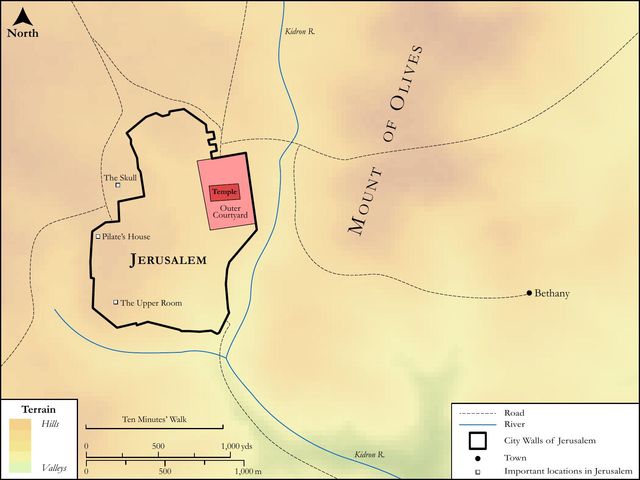
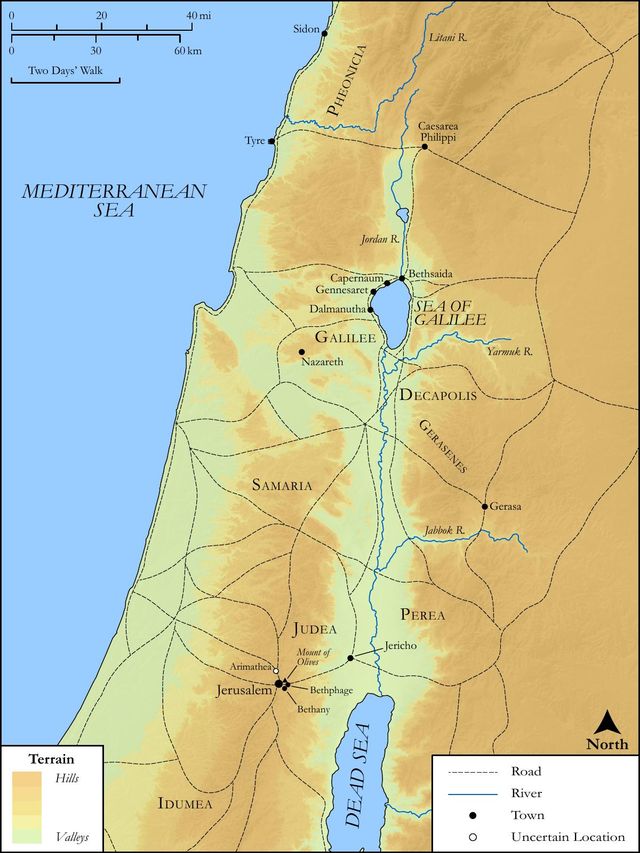
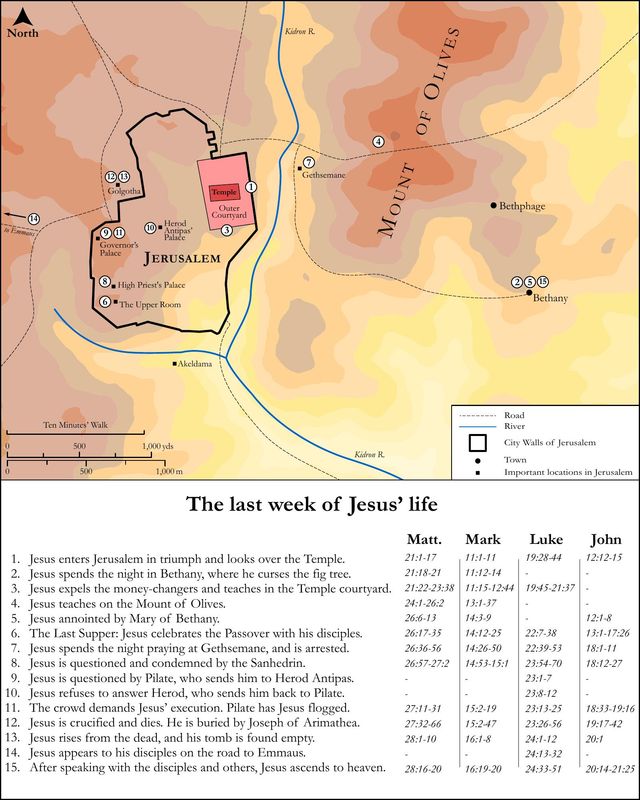
Study this verse
Public-domain commentary
Matthew Henry
From his Commentary on the Whole Bible. Henry comments on passages, not single verses — this entry covers Mark 16:19–20. His three-level outline is real structure in the source text, so it is rendered as structure.
Here is, 1. Christ welcomed into the upper world (Mar 16:19): After the Lord had spoken what he had to say to his disciples, he went up into heaven, in a cloud; which we have a particular account of (Act 1:9), and he had not only an admission, but an abundant entrance, into his kingdom there; he was received up, received in state, with loud acclamations of the heavenly hosts; and he sat on the right hand of God: sitting in a posture of rest, for now he had finished his work, and a posture of rule, for now he took possession of his kingdom; he sat at the right hand of God, which denotes the sovereign dignity he is advanced to, and the universal agency he is entrusted with. Whatever God does concerning us, gives to us, or accepts from us, it is by his Son. Now he is glorified with the glory he had before the world.
2.Christ welcomed in this lower world; his being believed on in the world, and received up into glory, are put together, Ti1 3:16.
(1.)We have here the apostles working diligently for him; they went forth, and preached every where far and near. Though the doctrine they preached, was spiritual and heavenly, and directly contrary to the spirit and genius of the world, though it met with abundance of opposition, and was utterly destitute of all secular supports and advantages, yet the preachers of it were neither afraid nor ashamed; they were so industrious in spreading the gospel, that within a few years the sound of it went forth into the ends of the earth, Rom 10:18.
(2.)We have here God working effectually with them, to make their labours successful, by confirming the word with signs following, partly by the miracles that were wrought upon the bodies of the people, which were divine seals to the Christian doctrine, and partly by the influence it had upon the minds of the people, through the operation of the Spirit of God, see Heb 2:4. These were properly signs following the word - the reformation of the world, the destruction of idolatry, the conversion of sinners, the comfort of saints; and these signs still follow it, and that they may do so more and more, for the honour of Christ and the good of mankind, the evangelist prays, and teaches us to say Amen. Father in heaven, thus let thy name be hallowed, and let thy kingdom come.
Historical interpretation
Eight Centuries of Reception
8 surviving comments on this verse. Each one is dated, so this reads as a timeline rather than a list.
Select a marker to jump to its quote. Markers stagger vertically where authors wrote within a few decades of each other.
The Lord Jesus, who had descended from heaven to give liberty to our weak nature, Himself also ascended above the heavens; wherefore it is said, So then after the Lord had spoken unto them, he was received up into heaven.
Let us draw near, then, my beloved, to faith, since its powers are so many. For faith raised up [Enoch] to the heavens, and overcame the deluge. It caused the barren to bring forth. It delivered from the sword. Faith raised up from the pit. It enriched the poor. It released the captives. It delivered the persecuted. It brought down the fire. It divided the sea. Faith cleft the rock and gave to the thirsty water to drink. It satisfied the hungry. It raised the dead and brought them up from Sheol. It stilled the billows. It healed the sick.
It goes on: And they went forth and preached every where, the Lord working with than, and confirming the word with signs and wonders.
(Epist. cxcix. 12.) (Acts 1:8) But how was this preaching fulfilled by the Apostles, since there are many nations in which it has just begun, and others in which it has not yet begun to be fulfilled? Truly then this precept was not so laid upon the Apostles by our Lord, as though they alone to whom He then spoke were to fulfil so great a charge; in the same way as He says, Behold, I am with you always, even unto the end of the world, apparently to them alone; but who does not understand that the promise is made to the Catholic Church, which though some are dying, others are born, shall be here unto the end of the world?
(ubi sup.) Are we then without faith because we cannot do these signs? Nay, but these things were necessary in the beginning of the Church, for the faith of believers was to be nourished by miracles, that it might increase. Thus we also, when we plant groves, pour water upon them, until we see that they have grown strong in the earth; but when once they have firmly fixed their roots, we leave off irrigating them. These signs and miracles have other things which we ought to consider more minutely. For Holy Church does every day in spirit what then the Apostles did in body; for when her Priests by the grace of exorcism lay their hands on believers, and forbid the evil spirits to dwell in their minds, what do they, but cast out devils? And the faithful who have left earthly words, and whose tongues sound forth the Holy Mysteries, speak a new language; they who by their good warnings take away evil from the hearts of others, take up serpents; and when they are hearing words of pestilent persuasion, without being at all drawn aside to evil doing, they drink a deadly thing, but it will never hurt them; whenever they see their neighbours growing weak in good works, and by their good example strengthen their life, they lay their hands on the sick, that they may recover. And all these miracles are greater in proportion as they are spiritual, and by them souls and not bodies are raised.
(ubi sup.) We have seen in the Old Testament that Elias was taken up into heaven. But the ethereal heaven is one thing, the aerial is another. The aerial heaven is nearer the earth, Elias then was raised into the aerial heaven, that he might be carried off suddenly into some secret region of the earth, there to live in great calmness of body and spirit, until he return at the end of the world, and pay the debt of death. We may also observe that Elias mounted up in a chariot, that by this they might understand that a mere man requires help from without. But our Redeemer, as we read, was not carried up by a chariot, not by angels, because He who had made all things was borne over all by His own power. We must also consider what Mark subjoins, And sat at the right hand of God, since Stephen says, I see the heavens opened, and the Son of Man standing at the right hand of God. Now sitting is the attitude of a judge, standing of one fighting or helping. Therefore Stephen, when toiling in the contest, saw Him standing, whom he had for his helper; but Mark describes Him as sitting after His assumption into heaven, because after the glory of His assumption, He will in the end be seen as a judge.
(ubi sup.) But what should we consider in these words, if it be not that obedience follows the precept and signs follow the obedience? For the Lord had commanded them, Go into all the world preaching the Gospel, and, Ye shall be witnesses even unto the ends of the earth.
"And they went forth and preached everywhere, the Lord working with them, and confirming the word with signs following."
What is to be considered in these things, what is to be committed to memory, except that obedience followed the command, and signs indeed followed obedience?
(ubi sup.) Observe that in proportion as Mark began his history later, so he makes it reach in writing to more distant times, for he began from the commencement of the preaching of the Gospel by John, and he reaches in his narrative those times in which the Apostles sowed the same word of the Gospel throughout the world.
But they, having departed, preached everywhere, with the Lord working with them and confirming the word with the accompanying signs. What is to be considered in this, what to be commended to memory, except that they followed the command with obedience, and obedience was followed by signs? Among these, it is notable that Mark, although he began his Gospel later than the others, extended it to longer times in his writing. For he neither mentioned the birth of the Lord himself or his forerunner, nor any account of their infancy or childhood, nor did he write in depth about the birth of the Savior, except that he called him the Son of God at the beginning of his Gospel. He began from the start of the evangelical preaching, which happened through John, and continued narrating up to the time when the apostles disseminated the entire Gospel word by preaching around the world.
But we must also know from this that words are confirmed by deeds as then in the Apostles works confirmed their words, for signs followed. Grant then, O Christ, that the good words which we speak may be confirmed by works and deeds, so that at the last, Thou working with us in word and in deed, we may be perfect, for Thine as is fitting is the glory both of word and deed. Amen.
Continue studying Mark 16:20 across the web’s major study libraries — every link below opens this exact verse, chapter, or book on the destination site.
Read & Compare
 BibleGatewayThis verse in more than 200 translations and 70 languages.
 Bible.comThe YouVersion reader — hundreds of translations, reading plans, and highlights.
 ESV.orgCrossway's official English Standard Version reader.
 NET BibleThe NET translation with 60,000+ translators' notes on every rendering decision.
 STEP BibleTyndale House's free study tool — original text, vocabulary, and scholarly resources.
 BibliaLogos Bible Software's free web reader.
 USCCBThe New American Bible (Revised Edition) with the U.S. bishops' study notes.
Commentaries
 BibleHub CommentariesDozens of classic commentaries on this verse, gathered on one page.
 StudyLightMore than 100 commentary sets — the largest collection on the web.
 BibleRefPlain-English commentary on what this verse means, verse by verse.
 Enduring WordDavid Guzik's free commentary on this chapter, widely used by Bible teachers.
 Bible Study ToolsVerse commentary alongside Greek and Hebrew study aids.
Original Language & Research
- BibleHub InterlinearThe verse word by word — original language, transliteration, and English.
- BibleHub LexiconEvery word's original-language definition and Strong's entry.
 Blue Letter BibleDeep-study tools — Strong's numbers, concordance, and word studies.
 CNTR CollationThe earliest Greek manuscripts of this verse, collated letter by letter.
Sermons, Hymns & Audio


TrulyRandomVerse is not affiliated with these sites and doesn’t control their content. They’re linked because they’re genuinely useful.
Summary
Mark 16:20 concludes the "longer ending" of Mark's Gospel by powerfully summarizing the immediate and widespread ministry of Jesus' disciples. It highlights their faithful obedience in proclaiming the Gospel universally, underscored by the active, divine partnership of the Lord Himself, who supernaturally confirmed their message with accompanying signs and wonders, validating the truth of the word they preached.
Context
ShowHideLiterary Context
This verse serves as the concluding statement of the "longer ending" of the Gospel of Mark (verses 9-20). It immediately follows Jesus' post-resurrection appearances and His definitive commission to His disciples to "Go into all the world and preach the gospel to every creature" Mark 16:15. Thus, Mark 16:20 acts as a concise narrative summary, demonstrating the disciples' immediate and faithful response to this monumental directive. It shifts from Jesus' direct instructions to the disciples' active implementation, showing the initial, Spirit-empowered thrust of the early church's evangelistic mission, thereby providing a satisfying narrative closure to Mark's account of Jesus' life, death, and resurrection.
Historical & Cultural Context
The historical setting for the events described in Mark 16:20 is the nascent period of the early Christian church, immediately following Jesus' ascension. This era was characterized by the apostles' initial evangelistic efforts, first in Jerusalem and Judea, and then expanding outwards, as detailed in the book of Acts. In the ancient world, particularly within Jewish and Greco-Roman cultures, the authentication of a messenger or a message often involved accompanying signs or wonders. Miracles served not merely as spectacles but as divine attestations, validating the authority of the one speaking and the truthfulness of their message. The disciples, initially a small group, faced significant cultural and religious opposition, making the divine confirmation through "signs following" crucial for establishing the credibility and divine origin of the Gospel they proclaimed.
Key Themes
ShowHideMark 16:20 encapsulates several profound themes central to the Christian faith and the mission of the church. Firstly, it underscores the theme of Obedience to the Great Commission, as the disciples "went forth, and preached every where," fulfilling Jesus' command to spread the Gospel universally, laying the groundwork for the global expansion of Christianity. Secondly, it highlights the indispensable theme of Divine Partnership and Empowerment in Ministry. The phrase "the Lord working with [them]" reveals that the effectiveness and success of their proclamation were not solely due to human effort or eloquence but were a direct result of God's active presence and power empowering their work. This divine enabling is a recurring motif for effective ministry, echoing Jesus' promise to be with His disciples always, even to the end of the age, as seen in Matthew 28:20. Finally, the verse emphasizes the theme of Divine Confirmation and Validation of the Word. The "signs following" served as tangible, supernatural evidence, authenticating the spoken Gospel message and the authority of those proclaiming it, thereby giving undeniable credibility to their mission in the eyes of the hearers, a truth also articulated in Hebrews 2:4.
Exposition and Analysis
ShowHideKey Word Analysis
ShowHideThis verb signifies "to herald (as a public crier), especially divine truth (the gospel)." It implies a public, authoritative, and urgent proclamation, not merely a quiet discussion. The disciples were not just sharing opinions; they were authoritatively announcing a message from God, much like a herald declares a king's decree. This word underscores the public and authoritative nature of their evangelistic task.
Derived from which we get "synergy," this term means "to be a fellow-worker, i.e., co-operate." It vividly portrays a collaborative effort where the Lord is not merely observing but actively participating and contributing to the disciples' ministry. This highlights the divine-human partnership inherent in the spread of the Gospel, where human effort is empowered and made effective by God's active involvement.
This verb means "to stabilitate (figuratively)," "to establish," or "to render sure." It indicates that the signs were not random occurrences but purposeful acts of God designed to firmly establish, validate, and authenticate the truth and authority of the preached word. The signs served as irrefutable proof, making the message firm and beyond doubt.
Verse Breakdown
ShowHide"And they went forth, and preached every where"
This clause describes the disciples' immediate and expansive obedience to the Great Commission. "Went forth" implies a purposeful departure from their previous location (likely Jerusalem) and a proactive engagement with the world. "Preached every where" emphasizes the universal scope of their mission, indicating that their proclamation of the Gospel was not confined to a single locality but was intended for all peoples and places. This highlights the foundational commitment of the early church to global evangelism.
"the Lord working with [them]"
This is the pivotal phrase revealing the source of the disciples' effectiveness. It signifies a divine partnership where Jesus, now ascended, actively collaborates with and empowers His followers. Their ministry was not a purely human endeavor; it was divinely enabled and sustained. This underscores the theological truth that true spiritual impact is always a result of God's active presence and power operating through His servants.
"and confirming the word with signs following"
This clause explains how the Lord worked with them. The "signs" (Greek: sēmeîon, meaning "an indication, especially ceremonially or supernaturally," a "miracle," "sign," or "wonder") were supernatural manifestations that served as divine authentication of the spoken Gospel message. These miracles were not ends in themselves but were purposeful demonstrations of God's power, validating the truth of the "word" (the Gospel message) preached by the disciples and establishing their divine authority. The phrase "signs following" indicates that these confirmations accompanied or ensued from their preaching.
"Amen."
This concluding word, of Hebrew origin, means "firm" or "trustworthy," and functions as an affirmation or "so be it." In this context, it serves as a powerful declaration of the absolute truth, certainty, and divine authority of the preceding statement. It seals the narrative, confirming the veracity of the disciples' mission and the Lord's active role in it.
Literary Devices
ShowHideMark 16:20 employs several literary devices to convey its powerful message. Firstly, it functions as a Narrative Summary, condensing a significant period of the early church's initial evangelistic activity into a single, concise statement. This allows the Gospel to conclude with a sense of fulfilled purpose and ongoing mission. Secondly, the phrase "the Lord working with [them]" exemplifies Divine Agency, emphasizing that the success of the disciples' ministry was not merely human effort but a direct result of God's active involvement and empowerment. This highlights the theological truth that God is the primary actor in the spread of His kingdom. Thirdly, there is a clear Cause and Effect relationship established: the disciples "went forth, and preached" (cause), and the Lord responded by "confirming the word with signs following" (effect). This illustrates the divine validation that accompanies faithful proclamation. Finally, the concluding "Amen" acts as an Affirmation or Doxological Seal, lending an air of finality, certainty, and divine approval to the entire account of Jesus' life and the subsequent mission of His followers.
Theological and Thematic Connections
ShowHideMark 16:20 offers profound theological insights that extend beyond its immediate historical context. It establishes the enduring pattern of Christian mission: human obedience in proclamation coupled with divine empowerment and validation. The "word" preached by the disciples is not merely human philosophy but God's truth, and its power is not derived from human eloquence but from the Lord's active presence. This dynamic partnership ensures that the Gospel message remains effective across generations, transforming lives not by persuasive words alone but by the demonstration of God's Spirit and power. While the specific manifestations of "signs following" may vary, the principle remains that God continues to confirm His word and His workers, whether through transformed lives, spiritual conviction, or answers to prayer, testifying to the living reality of the resurrected Christ and the power of His message.
Reflection and Application
ShowHideMark 16:20 provides a timeless blueprint for Christian life and ministry. It challenges believers to embrace the call to evangelism ("went forth, and preached every where") not as an optional activity, but as a fundamental response to Christ's commission. This means actively seeking opportunities to share the Gospel in our spheres of influence, whether locally in our communities or by supporting global missions. Crucially, the verse reminds us that our effectiveness is not rooted in our own abilities or resources, but in the divine partnership: "the Lord working with [them]." This calls us to a posture of humility and dependence, recognizing that true spiritual impact flows from God's empowering presence and enabling grace. Our efforts, however diligent, are merely instruments in His hands. Furthermore, the expectation of "confirming the word with signs following" encourages us to anticipate and pray for God's active demonstration of His power. While the specific forms of divine confirmation may differ across contexts and eras, God still validates His truth through transformed lives, spiritual conviction, answered prayers, and other tangible evidences of His kingdom. This verse inspires us to preach boldly, trust fully in God's co-working presence, and expect His supernatural confirmation, knowing that the "Amen" at the end of Mark's Gospel is a resounding affirmation of His faithfulness to His word and His people.
Questions for Reflection
ShowHideFAQ
ShowHideIs the "longer ending" of Mark (16:9-20) considered authentic scripture?
ShowHideThe "longer ending" of Mark (Mark 16:9-20), which includes verse 20, has been a subject of scholarly debate due to its absence in some of the earliest and most reliable Greek manuscripts, such as Codex Vaticanus and Codex Sinaiticus. Other manuscripts offer a "shorter ending," while the majority of later manuscripts include the longer ending. Textual critics generally agree that verses 9-20 were likely not part of Mark's original composition. However, this does not necessarily mean they are "uninspired" or "untrue." The content of the longer ending, including the Great Commission and the promise of accompanying signs, aligns closely with themes and events found in other canonical New Testament books, particularly Matthew 28:18-20 and the book of Acts. For centuries, the church has accepted and used this ending as part of the Gospel of Mark, and it is included in most modern Bible translations, often with footnotes indicating the textual variations. Therefore, while its textual history is complex, its theological message is consistent with the broader biblical narrative of the early church's mission and divine empowerment.
Are "signs following" still expected today, or were they limited to the apostolic age?
ShowHideThe question of whether "signs following" (miraculous manifestations like healings, exorcisms, or other supernatural occurrences) are still expected today is a point of ongoing theological discussion. Some traditions (cessationism) believe that such miraculous signs were primarily for the apostolic age, serving to authenticate the apostles and the foundational message of the Gospel before the completion of the New Testament canon. Other traditions (continuationism) believe that God continues to work through miraculous signs and wonders today, as a demonstration of His power and to confirm the preaching of His word. Regardless of one's specific view on the form of these signs, the underlying principle of Mark 16:20 remains profoundly relevant: God actively "works with" His people to "confirm the word." This confirmation may manifest in various ways beyond overt miracles, such as transformed lives, deep spiritual conviction, undeniable answers to prayer, or powerful demonstrations of God's presence that validate the truth of the Gospel. The call to preach the Gospel universally and the promise of God's active partnership in that mission are enduring truths for all believers, reminding us that the power of the Gospel is not merely human but divine, as Jesus Himself promised that His followers would do "greater works" than He did because He was going to the Father John 14:12.
Christ-Centered Fulfillment
ShowHideMark 16:20, though describing the ministry of the disciples, finds its ultimate Christ-centered fulfillment in the ongoing work of the resurrected and ascended Lord Jesus. The "word" they preached was fundamentally about Christ—His life, death, resurrection, and saving power. The "Lord working with [them]" is none other than Jesus Himself, fulfilling His promise to be with His disciples always Matthew 28:20 and to empower them through the Holy Spirit Acts 1:8. The "signs following" were not merely random acts of power but divine attestations to Christ's supreme authority, His victory over sin and death, and the truth of His Gospel. Every healing, every deliverance, every supernatural event was a tangible demonstration that Jesus, the Lamb of God John 1:29, was indeed alive, reigning, and actively building His church. Thus, Mark 16:20 points to Christ as the central figure of the Gospel, the source of all power, the one who sends, empowers, and confirms His messengers, ensuring that His redemptive work continues to advance throughout the world until His glorious return Revelation 22:20.