


Ruth 4:4
- וַאֲנִיva·'a·Niand IH589Conj-w ¦ Pro-1csPronoun Personal 1st Singular common genderוַandאֲנִיI
- אָמַרְתִּי'a·Mar·tiI saidH559V-Qal-Perf-1csVerb Qal Perfect 1st Singular common gender
- אֶגְלֶה'eg·LehI will uncoverH1540V-Qal-Imperf-1csVerb Qal Imperfect 1st Singular common gender
- אָזְנְךָ'a·ze·ne·Khayour earH241N-fsc ¦ 2msNoun Singular Feminine Constructאָזְנְearךָyour
- לֵאמֹרle·Mor<to> sayingH559Prep-l ¦ V-Qal-InfVerb Qal Infinitive Constructלֵ<to>אמֹרsaying
- קְנֵהKe·nehacquire [it]H7069V-Qal-Imp-2msVerb Qal Imperative 2nd Singular Masculine
- נֶגֶדNe·gedbeforeH5048Adj-mscAdjective Numerical Singular Masculine Construct
- הַיֹּשְׁבִיםhai·yo·she·Vimthe [ones] sittingH3427Art ¦ V-Qal-Prtcpl-mpVerb Qal Participle Plural Masculine Absoluteהַtheיֹּשְׁבִים[ones] sitting
- וְנֶגֶדve·Ne·gedand beforeH5048Conj-w ¦ Adj-mscAdjective Numerical Singular Masculine Constructוְandנֶגֶדbefore
- זִקְנֵיzik·Nei[the] elders ofH2205Adj-mpcAdjective Plural Masculine Construct
- עַמִּי'a·Mimy peopleH5971N-msc ¦ 1csNoun Singular Masculine Constructעַמִּpeopleיmy
- אִם'imifH518PrtParticle Conditional
- תִּגְאַלtig·'Alyou will redeemH1350V-Qal-Imperf-2msVerb Qal Imperfect 2nd Singular Masculine
- גְּאָלge·'AlredeemH1350V-Qal-Imp-2msVerb Qal Imperative 2nd Singular Masculine
- וְאִםve·'imand ifH518Conj-w ¦ PrtParticle Conditionalוְandאִםif
- לֹאlo'notH3808NegParticle Negative
- יִגְאַלyig·'Alhe will redeemH1350V-Qal-Imperf-3msVerb Qal Imperfect 3rd Singular Masculine
- הַגִּידָהha·Gi·dahtell !H5046V-Hiphil-Imp-2ms ¦ SfxVerb Hiphil Imperative 2nd Singular Masculineהַגִּידָtellה!
- לִּיLito <the> mePrep-l ¦ 1csSuffix Personal 1st Singular common genderלִּto <the>יme
- וְאֵדְעָהve·'e·da'so let me knowH3045Conj-w ¦ V-Qal-Imperf-1csVerb Qal Imperfect 1st Singular common genderוְsoאֵדְעָהlet me know
- כִּיkithatH3588PrtParticle Conditional
- אֵין'einthere notH369N-mscNoun Singular Masculine Construct
- זוּלָתְךָzu·la·te·Khaexcept youH2108N-fsc ¦ 2msNoun Singular Feminine Constructזוּלָתְexceptךָyou
- לִגְאוֹלlig·'ol[is] to redeemH1350Prep-l ¦ V-Qal-InfVerb Qal Infinitive Constructלִ[is] toגְאוֹלredeem
- וְאָנֹכִיve·'a·no·Khiand IH595Conj-w ¦ Pro-1csPronoun Personal 1st Singular common genderוְandאָנֹכִיI
- אַחֲרֶיךָ'a·cha·Rei·kha[am] after youH310Adj-mpc ¦ 2msAdjective Numerical Plural Masculine Constructאַחֲרֶי[am] afterךָyou
- וַיֹּאמֶרvai·Yo·merand he saidH559Conj-w ¦ V-Qal-ConsecImperf-3msVerb Qal Consecutive Imperfect 3rd Singular Masculineוַandיֹּאמֶרhe said
- אָנֹכִי'a·no·KhiIH595Pro-1csPronoun Personal 1st Singular common gender
- אֶגְאָל'eg·'AlI will redeemH1350V-Qal-Imperf-1csVerb Qal Imperfect 1st Singular common gender
English is a literal word-by-word gloss of the Hebrew, not the KJV's wording. Why?
This is the original text the KJV's translators worked from — each Hebrew word with its own literal English meaning in this verse, prepared by scholars at Tyndale House, Cambridge. The KJV translates whole sentences, not word by word, so its wording differs: one Hebrew word can become several English words, and the KJV may choose “the LORD” where the gloss reads “Yahweh”. Both are faithful — they answer different questions. For the KJV's own rendering, switch to the KJV text.
Details
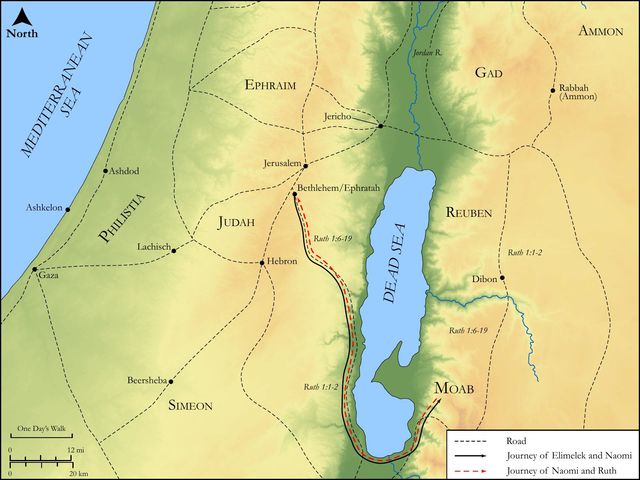
See on the biblical-era map
Study this verse
Public-domain commentary
Matthew Henry
From his Commentary on the Whole Bible. Henry comments on passages, not single verses — this entry covers Ruth 4:1–8.
Here, 1. Boaz calls a court immediately. It is probable he was himself one of the elders (or aldermen) of the city; for he was a mighty man of wealth. Perhaps he was father of the city, and sat chief; for he seems here to have gone up to the gate as one having authority, and not as a common person; like Job, Job 29:7, etc. We cannot suppose him less than a magistrate in his city who was grandson to Nahshon, prince of Judah; and his lying at the end of a heap of corn in the threshing-floor the night before was not at all inconsistent, in those days of plainness, with the honour of his sitting judge in the gate. But why was Boaz so hasty, why so fond of the match? Ruth was not rich, but lived upon alms; not honourable, but a poor stranger. She was never said to be beautiful; if ever she had been so, we may suppose that weeping, and travelling, and gleaning, had withered her lilies and roses. But that which made Boaz in love with her, and solicitous to expedite the affair, was that all her neighbours agreed she was a virtuous woman. This set her price with him far above rubies (Pro 31:10); and therefore he thinks, if by marrying her he might do her a real kindness, he should also do himself a very great kindness. He will therefore bring it to a conclusion immediately. It was not court-day, but he got ten men of the elders of the city to meet him in the town-hall over the gate, where public business used to be transacted, Rut 4:2. So many, it is probable, by the custom of the city, made a full court. Boaz, though a judge, would not be judge in his own cause, but desired the concurrence of other elders. Honest intentions dread not a public cognizance. 2. He summons his rival to come and hear the matter that was to be proposed to him (Rut 4:1): "Ho, such a one, sit down here." He called him by his name, no doubt, but the divine historian thought not fit to record it, for, because he refused to raise up the name of the dead, he deserved not to have his name preserved to future ages in this history. Providence favoured Boaz in ordering it so that this kinsman should come by thus opportunely, just when the matter was ready to be proposed to him. Great affairs are sometimes much furthered by small circumstances, which facilitate and expedite them. 3. He proposes to the other kinsman the redemption of Naomi's land, which, it is probable, had been mortgaged for money to buy bread with when the famine was in the land (Rut 4:3): "Naomi has a parcel of land to sell, namely, the equity of the redemption of it out of the hands of the mortgagee, which she is willing to part with;" or, as some think, it was her jointure for her life, and, wanting money, for a small matter she would sell her interest to the heir at law, who was fittest to be the purchaser. This he gives the kinsman legal notice of (Rut 4:4), that he might have the refusal of it. Whoever had it must pay for it, and Boaz might have said, "My money is as good as my kinsman's; if I have a mind to it, why may not I buy it privately, since I had the first proffer of it, and say nothing to my kinsman?" No, Boaz, though fond enough of the purchase, would not do so mean a thing as to take a bargain over another man's head that was nearer a-kin to it; and we are taught by his example to be not only just and honest, but fair and honourable, in all our dealings, and to do nothing which we are unwilling should see the light, but be above-board. 4. The kinsman seemed forward to redeem the land till he was told that, if he did that, he must marry the widow, and then he flew off. He liked the land well enough, and probably caught at that the more greedily because he hoped that the poor widow being under a necessity of selling he have so much the better bargain: "I will redeem it" (said he) "with all my heart," thinking it would be a fine addition to his estate, Rut 4:4. But Boaz told him there was a young widow in the case, and, if he have the land, he must take her with it, Terra transit cum onere - The estate passes with this incumbrance; either the divine law or the usage of the country would oblige him to it, or Naomi insisted upon it that she would not sell the land but upon this condition, Rut 4:5. Some think this does not relate to the law of marrying the brother's widow (for that seems to oblige only the children of the same father, Deu 25:5, unless by custom it was afterwards made to extend to the next of kin), but to the law of redemption of inheritances (Lev 25:24, Lev 25:25), for it is a Goel, a redeemer, that is here enquired for; and if so it was not by the law, but by Naomi's own resolution, that the purchaser was to marry the widow. However it was, this kinsman, when he heard the conditions of the bargain, refused it (Rut 4:6): "I cannot redeem it for myself. I will not meddle with it upon these terms, lest I mar my own inheritance." The land, he thought, would be an improvement of his inheritance, but not the land with the woman; that would mar it. Perhaps he thought it would be a disparagement to him to marry such a poor widow that had come from a strange country, and almost lived upon alms. He fancied it would be a blemish to his family, it would mar his blood, and disgrace his posterity. Her eminent virtues were not sufficient in his eye to counterbalance this. The Chaldee paraphrase makes his reason for this refusal to be that he had another wife, and, if he should take Ruth, it might occasion strife and contention in his family, which would mar the comfort of his inheritance. Or he thought she might bring him a great many children, and they would all expect shares out of his estate, which would scatter it into too many hands, so that the family would make the less figure. This makes many shy of the great redemption: they are not willing to espouse religion. They have heard well of it, and have nothing to say against it; they will give it their good word, but at the same time they will give their good word with it; they are willing to part with it, and cannot be bound to it, for fear of marring their own inheritance in this world. Heaven they could be glad of, but holiness they can dispense with; it will not agree with the lusts they have already espoused, and therefore, let who will purchase heaven at that rate, they cannot. 5. The right of redemption is fairly resigned to Boaz. If this nameless kinsman lost a good bargain, a good estate, and a good wife too, he may thank himself for not considering it better, and Boaz will thank him for making his way clear to that which he valued and desired above any thing. In those ancient times it was not the usage to pass estates by writings, as afterwards (Jer 32:10, etc.), but by some sign or ceremony, as with us by livery and seisin, as we commonly call it, that is, the delivery of seisin, seisin of a house by giving the key, of land by giving turf and a twig. The ceremony here used was, he that surrendered plucked off his shoe (the Chaldee says it was the glove of his right hand) and gave it to him to whom he made the surrender, intimating thereby that, whatever right he had to tread or go upon the land, he conveyed and transferred it, upon a valuable consideration, to the purchaser: this was a testimony in Israel, Rut 4:7. And it was done in this case, Rut 4:8. If this kinsman had been bound by the law to marry Ruth, and his refusal had been a contempt of that law, Ruth must have plucked off his shoe and spit in his face, Deu 25:9. But, though his relation should in some measure oblige him to the duty, yet the distance of his relation might serve to excuse him from the penalty, or Ruth might very well dispense with it, since his refusal was all she desired from him. But bishop Patrick, and the best interpreters, think this had no relation to that law, and that the drawing off of the shoe was not any disgrace as there, but a confirmation of the surrender, and an evidence that it was not fraudulently nor surreptitiously obtained. Note, Fair and open dealing in all matters of contract and commerce is what all those must make conscience of that would approve themselves Israelites indeed, without guile. How much more honourably and honestly does Boaz come by this purchase than if he had secretly undermined his kinsman, and privately struck up a bargain with Naomi, unknown to him. Honesty will be found the best policy.
Historical interpretation
Two Centuries of Reception
2 surviving comments on this verse. Each one is dated, so this reads as a timeline rather than a list.
Select a marker to jump to its quote. Markers stagger vertically where authors wrote within a few decades of each other.
The man was so virtuous that he did not rush into a marriage outside the law, but he spoke with his neighbors about the marriage. However, his words are also worthy of admiration. For his first words were not about the marriage but about the possession of fields, etc. Moreover, when, on account of the prospective marriage he [the relative] in fact refused the contract for the land and indeed took off his sandal and gave it to Boaz, in accordance with the law, Boaz then took Ruth to be his wife. Furthermore, because he was not serving lust, he took her in the spirit that one should take a wife, and his words also showed themselves worthy of praise, You are witnesses today, etc. “I do not,” he said, “transgress the law in marrying a Moabite woman; rather, I diligently fulfill divine law, so that the memory of the dead is not extinguished.”
When Ruth entered the land of Israel with her mother-in-law, it was provided (on account of the merits of her prayers) that she be married to a man of the lineage of Abraham and whom, indeed, she at first believed to be her closest kinsman. He [the nearest kinsman] said that he could not marry her and, when he had withdrawn, Boaz was married to her, with the witness of ten elders. He [Boaz] who previously confessed himself unable to marry that same woman was united with her and was blessed by those ten elders.It is thought that this passage prefigures John the Baptist who, when he himself was thought by the people of Israel to be Christ and was asked who he was, did not deny who he was but confessed it, saying that he was not Christ. And those who were sent persisted in these inquiries about who he was. He answered, “I am the voice crying in the desert.” He confessed the good news about the Lord, saying, “He who has the bride is the bridegroom.” He showed that he himself was the friend of the groom [the best man], since he added, “Truly, the friend of the groom is he who stands and hears him and rejoices on account of the groom’s voice.” And so they thought he was Christ, because they did not understand that Christ had come on the day of the visitation and that he who was earlier promised by the prophets’ voices was the church’s bridegroom. But just as he told her he was not her kinsman but then afterwards Ruth was united with Boaz, so Christ, who is the true bridegroom of the church, whom the sayings of all the prophets proclaim, was deemed worthy, from all Gentile nations, to claim the church, to present to God the Father unnumbered people throughout the whole orb of the world, because his kinsman took off the sandals.
Continue studying Ruth 4:4 across the web’s major study libraries — every link below opens this exact verse, chapter, or book on the destination site.
Read & Compare
 BibleGatewayThis verse in more than 200 translations and 70 languages.
 Bible.comThe YouVersion reader — hundreds of translations, reading plans, and highlights.
 ESV.orgCrossway's official English Standard Version reader.
 NET BibleThe NET translation with 60,000+ translators' notes on every rendering decision.
 STEP BibleTyndale House's free study tool — original text, vocabulary, and scholarly resources.
 BibliaLogos Bible Software's free web reader.
 USCCBThe New American Bible (Revised Edition) with the U.S. bishops' study notes.
Commentaries
 BibleHub CommentariesDozens of classic commentaries on this verse, gathered on one page.
 StudyLightMore than 100 commentary sets — the largest collection on the web.
 BibleRefPlain-English commentary on what this verse means, verse by verse.
 Enduring WordDavid Guzik's free commentary on this chapter, widely used by Bible teachers.
 Bible Study ToolsVerse commentary alongside Greek and Hebrew study aids.
Original Language & Research
- BibleHub InterlinearThe verse word by word — original language, transliteration, and English.
- BibleHub LexiconEvery word's original-language definition and Strong's entry.
 Blue Letter BibleDeep-study tools — Strong's numbers, concordance, and word studies.
 SefariaThe Hebrew text with Rashi and centuries of Jewish commentary.
Sermons, Hymns & Audio


TrulyRandomVerse is not affiliated with these sites and doesn’t control their content. They’re linked because they’re genuinely useful.
Summary
Ruth 4:4 captures a pivotal legal exchange at the Bethlehem city gate, where Boaz, with meticulous adherence to Israelite law and public transparency, formally presents the closer kinsman with the opportunity to fulfill the sacred duty of kinsman-redeemer. This verse encapsulates the intricate ancient customs concerning land redemption and the perpetuation of family lineage, establishing the critical choice that will determine the future of Naomi, Ruth, and the ancestral property, thereby setting the stage for the book's resolution and the continuation of a significant biblical lineage leading to King David.
Context
ShowHideLiterary Context
This verse immediately follows Boaz's strategic arrival at the city gate, where he encounters the unnamed kinsman-redeemer (Ruth 4:1) and gathers ten elders to serve as official witnesses (Ruth 4:2). Boaz's actions here are a direct fulfillment of his promise to Ruth in Ruth 3:13, assuring her he would act as a kinsman-redeemer if the nearer kinsman declined. The preceding chapters have meticulously built up the relationship between Boaz and Ruth, the dire plight of Naomi, and the legal framework necessary for their redemption. Boaz first introduces the matter of Naomi's land, setting the stage for the kinsman's decision, which will then be complicated by the inclusion of Ruth in Ruth 4:5. The careful staging of this public negotiation underscores the narrative's emphasis on divine providence working through human legal and social structures.
Historical & Cultural Context
The setting at the "city gate" was the traditional and legally recognized venue for all civic, commercial, and judicial transactions in ancient Israel. It was the public square where elders, who served as judges and witnesses, convened to validate agreements and settle disputes. The core custom at play is that of the goel (kinsman-redeemer), a relative with the right and responsibility to protect the family's interests, particularly in cases of poverty leading to land sale (Leviticus 25:25) or the need to raise an heir for a deceased family member. While distinct from levirate marriage (Deuteronomy 25:5-10), the goel's duty in Ruth combines land redemption with the responsibility to marry the widow to perpetuate the deceased's name and inheritance. Boaz's meticulous adherence to this public legal process underscores the importance of communal witness and legal integrity in Israelite society, ensuring the legitimacy and permanence of the transaction.
Key Themes
ShowHideThe central theme is the multifaceted role of the kinsman-redeemer (goel), embodying legal obligation, familial loyalty, and compassionate action. This verse highlights the theme of legal integrity and public witness, as the transaction is conducted "before the inhabitants, and before the elders of my people," ensuring transparency and legitimacy in a society where public reputation and legal standing were paramount. The clear presentation of a choice—"If thou wilt redeem [it], redeem [it]: but if thou wilt not redeem [it, then] tell me"—underscores the theme of individual decision within communal responsibility, demonstrating that while there are obligations, the kinsman retains agency. Furthermore, the underlying narrative demonstrates divine providence at work through human customs and choices, orchestrating events to secure Ruth's future and establish the lineage that will lead to King David, as hinted at throughout the book of Ruth.
Exposition and Analysis
ShowHideKey Word Analysis
ShowHideThis verb (H1540) means "to denude (especially in a disgraceful sense); by implication, to exile; figuratively, to reveal." In this context, it is used idiomatically to mean "to advertise" or "to make known plainly." Boaz is not merely informing but formally and publicly disclosing the legal proposition to the closer kinsman. It implies a clear, unambiguous statement of the terms, ensuring that the kinsman is fully aware of his rights and obligations, and that the entire community gathered at the gate is privy to the proceedings. This transparency is crucial for the legal validity of the subsequent actions.
This is the core verb (H1350) of the entire narrative, meaning "to redeem (according to the Oriental law of kinship), i.e., to be the next of kin (and as such to buy back a relative's property, marry his widow, etc.)." It carries both a legal and a deeply theological significance. Legally, it refers to the act of restoring property to its original owner or family, preventing its permanent loss. Theologically, it points to the concept of deliverance from bondage or peril, often used to describe God's saving acts for Israel (e.g., Exodus 6:6). Here, it specifically refers to the kinsman's duty to reclaim Elimelech's land and, implicitly, to raise up an heir for the deceased.
These were the respected, experienced, and authoritative men (H2205) of the community who served as local judges, administrators, and witnesses. Their presence was essential for any legal transaction to be considered binding and legitimate within Israelite society. By conducting the business "before the elders of my people," Boaz ensures that the agreement is not just a private understanding but a publicly sanctioned and legally recorded event, lending it full communal authority and preventing future disputes. Their role underscores the communal and covenantal nature of Israelite law.
Verse Breakdown
ShowHide"And I thought to advertise thee, saying, Buy [it] before the inhabitants, and before the elders of my people."
Boaz initiates the legal process with utmost transparency and formality. He publicly states his intention to inform the closer kinsman of his right to redeem Naomi's land (which belonged to her deceased husband, Elimelech). The phrase "before the inhabitants, and before the elders of my people" emphasizes the public, legally binding nature of the transaction. The elders serve as official witnesses, validating the proceedings, while the general populace ensures communal awareness and the legitimacy of the transfer.
"If thou wilt redeem [it], redeem [it]: but if thou wilt not redeem [it, then] tell me, that I may know: for [there is] none to redeem [it] beside thee; and I [am] after thee."
Boaz presents a clear, unambiguous choice to the kinsman, outlining the options and their implications. He explicitly states that the kinsman has the first right of redemption ("none to redeem [it] beside thee"), a formal legal challenge requiring a definitive "yes" or "no." Boaz then clarifies his own position: he is the next in line ("and I [am] after thee"), indicating his readiness and legal standing to step in if the first kinsman declines. This statement is crucial, as it sets up the legal transfer of responsibility and highlights Boaz's integrity and adherence to the law.
"And he said, I will redeem [it]."
The kinsman's immediate response is a positive affirmation. At this point, the kinsman only understands the land redemption aspect, which is economically favorable. His quick assent, without full knowledge of the additional obligation involving Ruth (which Boaz reveals in Ruth 4:5), creates dramatic tension and foreshadows his eventual refusal. This initial "yes" highlights the kinsman's limited understanding of the full scope of the goel's duty and sets the stage for the narrative's turning point.
Literary Devices
ShowHideThe verse is rich in Dialogue, serving not only to convey crucial legal information but also to drive the plot forward and reveal character. Boaz's precise and legally framed speech demonstrates his integrity, strategic thinking, and respect for the law, while the kinsman's terse reply sets up the dramatic turn in the next verse. The setting at the city gate creates a palpable sense of Legal Drama, transforming what might have been a simple transaction into a public spectacle with high stakes for Naomi, Ruth, and the ancestral lineage. The meticulous detailing of the legal process, including the presence of the elders, functions as Verisimilitude, lending authenticity and historical grounding to the narrative. There is also a subtle layer of Foreshadowing in the kinsman's quick "I will redeem it," as the reader, aware of Boaz's intentions towards Ruth, anticipates that this initial enthusiasm will be short-lived once the full terms are revealed. Furthermore, the narrative employs Irony, as the kinsman who initially seems eager to redeem the land for economic gain ultimately forfeits the greater blessing of perpetuating Elimelech's line and marrying Ruth, a decision that ironically opens the door for Boaz to become a pivotal figure in the lineage of Christ.
Theological and Thematic Connections
ShowHideRuth 4:4 profoundly illustrates the Old Testament concept of redemption, not merely as a financial transaction but as a comprehensive act of restoration and preservation within the covenant community. The goel system, meticulously followed by Boaz, reflects God's own character as the ultimate Redeemer of His people, who intervenes to restore what was lost, protect the vulnerable, and maintain the integrity of His covenant promises. This human institution foreshadows the divine redemptive work, where God "buys back" humanity from the bondage of sin and death, not with silver or gold, but with the precious blood of His Son. The public nature of the transaction also emphasizes the importance of integrity and accountability within God's people, mirroring how God's covenant dealings are often made manifest and witnessed by all creation.
Reflection and Application
ShowHideRuth 4:4 offers profound lessons on integrity, responsibility, and the providential hand of God working through human affairs. Boaz's meticulous adherence to legal and cultural norms, even when it might have complicated his personal desires, serves as a powerful example of ethical conduct and respect for established order. We are called to conduct our lives and our dealings with others with similar transparency and uprightness, understanding that our actions have public implications and reflect on our character and, ultimately, on the God we serve. Furthermore, the narrative reminds us that God often uses ordinary human choices and societal structures to accomplish His extraordinary purposes. Even when circumstances seem complex or uncertain, as they were for Naomi and Ruth, we can trust that God is sovereignly orchestrating events for the good of His people and the fulfillment of His divine plan. This encourages us to act faithfully in our spheres of influence, knowing that our obedience, however small, can contribute to a larger, divine tapestry.
Questions for Reflection
ShowHideFAQ
ShowHideWhat was the significance of conducting this transaction at the city gate?
ShowHideThe city gate was the primary public space in ancient Israelite towns, serving as the central hub for legal, commercial, and social activities. It was where the elders, who functioned as judges and civic leaders, gathered to administer justice, witness contracts, and settle disputes. Conducting the transaction at the city gate, "before the inhabitants, and before the elders of my people," ensured that the agreement was legally binding, publicly witnessed, and transparent. This public setting prevented future disputes and affirmed the legitimacy of the transfer of rights and property, making the agreement known to the entire community and underscoring the importance of communal accountability in Israelite society.
What was the kinsman-redeemer's (goel's) primary responsibility in this context?
ShowHideThe goel (kinsman-redeemer) had a multifaceted responsibility to protect the family's interests. In the context of Ruth 4:4, the primary responsibility initially presented was to "redeem" or buy back the land belonging to Naomi's deceased husband, Elimelech, which had fallen out of family possession due to poverty. This was based on the Mosaic Law outlined in Leviticus 25:25, which aimed to keep land within tribal and family inheritances. While the initial offer focused solely on the land, the full duty of the goel in this specific situation, as revealed in Ruth 4:5, also included marrying the childless widow (Ruth) to raise up an heir for the deceased, thereby preserving his name and inheritance in Israel.
Christ-Centered Fulfillment
ShowHideRuth 4:4, with its focus on the kinsman-redeemer, profoundly foreshadows the ultimate redemptive work of Jesus Christ. Boaz, the human goel, meticulously follows the law to redeem land and lineage, demonstrating a compassionate and costly commitment to restore what was lost and provide an heir. This earthly redemption points to Christ, our divine Kinsman-Redeemer, who, though not physically related to us in our fallen state, became our kinsman by taking on human flesh (Hebrews 2:14-17). He "redeemed us from the curse of the law by becoming a curse for us" (Galatians 3:13) and "purchased us with his own blood" (Acts 20:28), paying the ultimate price to buy us back from the bondage of sin and death. Just as Boaz secured Ruth's future and brought her into the lineage of David, Christ secures our eternal future, bringing us into God's family as co-heirs with Him (Romans 8:17). The kinsman's initial willingness to redeem the land but not the person (Ruth), due to the perceived cost or complication, highlights the immense and selfless love of Christ, who willingly bore the full cost of our redemption, including the "reproach" of the cross (Hebrews 12:2), to secure not just our inheritance, but our very lives and eternal belonging in His family.