


Jeremiah 32:10
Bible text: King James Version (1769 Blayney text) · Public domain
Bible text: Berean Standard Bible · Public domain
Bible text: American Standard Version (1901) · Public domain
Bible text: World English Bible, Messianic edition · Public domain
Bible text: Geneva Bible (1599) · Public domain
Bible text: Young's Literal Translation · Public domain
- וָאֶכְתֹּבva·'ekh·Toand I wroteH3789Conj-w ¦ V-Qal-ConsecImperf-1csVerb Qal Consecutive Imperfect 1st Singular common genderוָandאֶכְתֹּבI wrote
- בַּסֵּפֶרba·Se·feron the documentH5612Prep-b ¦ N-msNoun Singular Masculine Absoluteבַּon theסֵּפֶרdocument
- וָאֶחְתֹּםva·'ech·Tomand I sealed [it]H2856Conj-w ¦ V-Qal-ConsecImperf-1csVerb Qal Consecutive Imperfect 1st Singular common genderוָandאֶחְתֹּםI sealed [it]
- וָאָעֵדva·'a·'Edand I caused to witness [it]H5749Conj-w ¦ V-Hiphil-ConsecImperf-1csVerb Hiphil Consecutive Imperfect 1st Singular common genderוָandאָעֵדI caused to witness [it]
- עֵדִים'e·DimwitnessesH5707N-mpNoun Plural Masculine Absolute
- וָאֶשְׁקֹלva·'esh·Koland I weighed outH8254Conj-w ¦ V-Qal-ConsecImperf-1csVerb Qal Consecutive Imperfect 1st Singular common genderוָandאֶשְׁקֹלI weighed out
- הַכֶּסֶףha·Ke·sefthe silverH3701Art ¦ N-msNoun Singular Masculine Absoluteהַtheכֶּסֶףsilver
- בְּמֹאזְנָיִםbe·mo·ze·Na·yimon scalesH3976Prep-b ¦ N-mdNoun Dual Masculine Absoluteבְּonמֹאזְנָיִםscales
English is a literal word-by-word gloss of the Hebrew, not the KJV's wording. Why?
This is the original text the KJV's translators worked from — each Hebrew word with its own literal English meaning in this verse, prepared by scholars at Tyndale House, Cambridge. The KJV translates whole sentences, not word by word, so its wording differs: one Hebrew word can become several English words, and the KJV may choose “the LORD” where the gloss reads “Yahweh”. Both are faithful — they answer different questions. For the KJV's own rendering, switch to the KJV text.
Details
See on the biblical-era map
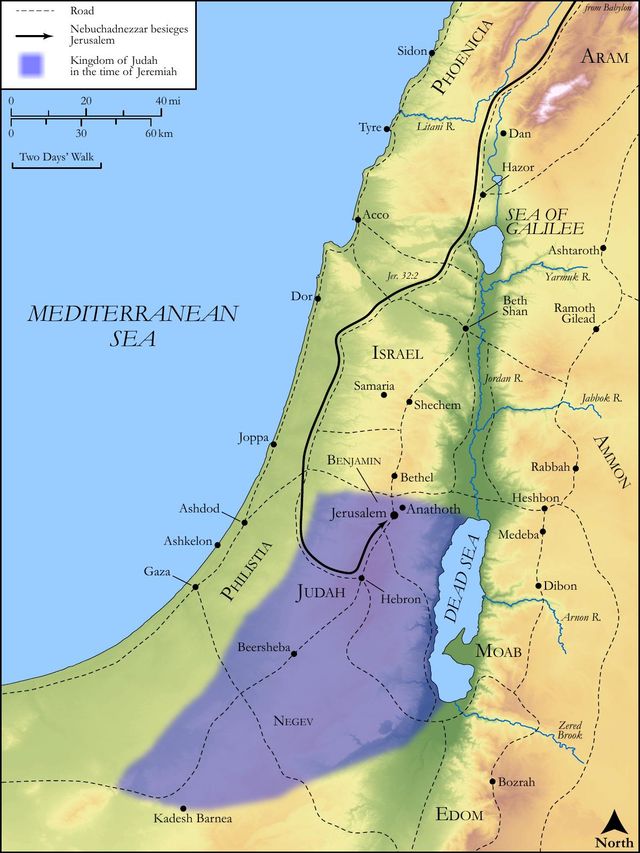
Study this verse
Public-domain commentary
Matthew Henry
From his Commentary on the Whole Bible. Henry comments on passages, not single verses — this entry covers Jeremiah 32:1–15. His four-level outline is real structure in the source text, so it is rendered as structure.
It appears by the date of this chapter that we are now coming very nigh to that fatal year which completed the desolations of Judah and Jerusalem by the Chaldeans. God's judgments came gradually upon them, but, they not meeting him by repentance in the way of his judgments, he proceeded in his controversy till all was laid waste, which was in the eleventh year of Zedekiah; now what is here recorded happened in the tenth. The king of Babylon's army had now invested Jerusalem and was carrying on the siege with vigour, not doubting but in a little time to make themselves masters of it, while the besieged had taken up a desperate resolution not to surrender, but to hold out to the last extremity. Now,
I.Jeremiah prophesies that both the city and the court shall fall into the hands of the king of Babylon.
He tells them expressly that the besiegers shall take the city as a prize, for God, whose city it was in a peculiar manner, will give it into their hands and put it out of his protection (Jer 32:3), - that, though Zedekiah attempt to make his escape, he shall be overtaken, and shall be delivered a prisoner into the hands of Nebuchadnezzar, shall be brought into his presence, to his great confusion and terror, he having made himself so obnoxious by breaking his faith with him, he shall hear the king of Babylon pronounce his doom, and see with what fury and indignation he will look upon him (His eyes shall behold his eyes, Jer 32:4), - that Zedekiah shall be carried to Babylon, and continue a miserable captive there, until God visit him, that is, till God put an end to his life by a natural death, as Nebuchadnezzar had long before put an end to his days by putting out his eyes. Note, Those that live in misery may be truly said to be visited in mercy when God by death takes them home to himself. And, lastly, he foretels that all their attempts to force the besiegers from their trenches shall be ineffectual: Though you fight with the Chaldeans, you shall not prosper; how should they, when God did not fight for them? Jer 32:5. See Jer 34:2, Jer 34:3.
II.For prophesying thus he is imprisoned, not in the common goal, but in the more creditable prison that was within the verge of the palace, in the king of Judah's house, and there not closely confined, but in custodia libera - in the court of the prison, where he might have good company, good air, and good intelligence brought him, and would be sheltered from the abuses of the mob; but, however, it was a prison, and Zedekiah shut him up in it for prophesying as he did, Jer 32:2, Jer 32:3. So far was he from humbling himself before Jeremiah, as he ought to have done (Ch2 36:12), that he hardened himself against him. Though he had formerly so far owned him to be a prophet as to desire him to enquire of the Lord for them (Jer 21:2), yet now he chides him for prophesying (Jer 32:3), and shuts him up in prison, perhaps not with design to punish him any further, but only to restrain him from prophesying any further, which was crime enough. Silencing God's prophets, though it is not so bad as mocking and killing them, is yet a great affront to the God of heaven. See how wretchedly the hearts of sinners are hardened by the deceitfulness of sin. Persecution was one of the sins for which God was now contending with them, and yet Zedekiah persists in it even now that he was in the depth of distress. No providences, no afflictions, will of themselves part between men and their sins, unless the grace of God work with them. Nay, some are made worse by those very judgments that should make them better.
III.Being in prison, he purchases from a near relation of his a piece of ground that lay in Anathoth, Jer 32:6, Jer 32:7, etc.
1.One would not have expected,
(1.)That a prophet should concern himself so far in the business of this world; but why not? Though ministers must not entangle themselves, yet they may concern themselves in the affairs of this life.
(2.)That one who had neither wife nor children should buy land. We find (Jer 16:2) that he had no family of his own; yet he may purchase for his own use while he lives, and leave it to the children of his relations when he dies.
(3.)One would little have thought that a prisoner should be a purchaser; how should he get money beforehand to buy land with? It is probably that he lived frugally, and saved something out of what belonged to him as a priest, which is no blemish at all to his character; but we have no reason to think that the people were kind, or that his being beforehand was owing to their generosity. Nay,
(4.)It was most strange of all that he should buy a piece of land when he himself knew that the whole land was now to be laid waste and fall into the hands of the Chaldeans, and then what good would this do him? But it was the will of God that he should buy it, and he submitted, though the money seemed to be thrown away. His kinsman came to offer it to him; it was not of his own seeking; he coveted not to lay house to house and field to field, but Providence brought it to him, and it was probably a good bargain; besides, the right of redemption belonged to him (Jer 32:8), and if he refused he would not do the kinsman's part. It is true he might lawfully refuse, but, being a prophet, in a thing of this nature he must do that which would be for the honour of his profession. It became him to fulfil all righteousness. It was land that lay within the suburbs of a priests' city, and, if he should refuse it, there was danger lest, in these times of disorder, it might be sold to one of another tribe, which was contrary to the law, to prevent which it was convenient for him to buy it. It would likewise be a kindness to his kinsman, who probably was at this time in great want of money. Jeremiah had but a little, but what he had he was willing to lay out in such a manner as might tend most to the honour of God and the good of his friends and country, which he preferred before his own private interests.
2.Two things may be observed concerning this purchase: -
(1.)How fairly the bargain was made. When Jeremiah knew by Hanameel's coming to him, as God had foretold he would, that it was the word of the Lord, that it was his mind that he should make this purchase, he made no more difficulty of it, but bought the field. And,
[1.]He was very honest and exact in paying the money. He weighted him the money, did not press him to take it upon his report, though he was his near kinsman, but weighed it to him, current money. It was seventeen shekels of silver, amounting to about forty shillings of our money. The land was probably but a little field and of small yearly value, when the purchase was so low; besides, the right of inheritance was in Jeremiah, so that he had only to buy out his kinsman's life, the reversion being his already. Some think this was only the earnest of a greater sum; but we shall not wonder at the smallness of the price if we consider what scarcity there was of money at this time and how little lands were counted upon.
[2.]He was very prudent and discreet in preserving the writings. They were subscribed before witnesses. One copy was sealed up, the other was open. One was the original, the other the counterpart; or perhaps that which was sealed up was for his own private use, the other that was open was to be laid up in the public register of conveyances, for any person concerned to consult. Due care and caution in things of this nature might prevent a great deal of injustice and contention. The deeds of purchase were lodged in the hands of Baruch, before witnesses, and he was ordered to lay them up in an earthen vessel (an emblem of the nature of all the securities this world can pretend to give us, brittle things and soon broken), that they might continue many days, for the use of Jeremiah's heirs, after the return out of captivity; for they might then have the benefit of this purchase. Purchasing reversions may be a kindness to those that come after us, and a good man thus lays up an inheritance for his children's children.
(2.)What was the design of having this bargain made. It was to signify that though Jerusalem was now besieged, and the whole country was likely to be laid waste, yet the time should come when houses, and fields, and vineyards should be again possessed in this land, Jer 32:15. As God appointed Jeremiah to confirm his predictions of the approaching destruction of Jerusalem by his own practice in living unmarried, so he now appointed him to confirm his predictions of the future restoration of Jerusalem by his own practice in purchasing this field. Note, It concerns ministers to make it to appear in their whole conversation that they do themselves believe that which they preach to others; and that they may do so, and impress it the more deeply upon their hearers, they must many a time deny themselves, as Jeremiah did in both these instances. God having promised that this land should again come into the possession of his people, Jeremiah will, on behalf of his heirs, put in for a share. Note, It is good to manage even our worldly affairs in faith, and to do common business with an eye to the providence and promise of God. Lucius Florus relates it as a great instance of the bravery of the Roman citizens that in the time of the second Punic war, when Hannibal besieged Rome and was very near making himself master of it, a field on which part of his army lay, being offered to sale at that time, was immediately purchased, in a firm belief that the Roman valour would raise the siege, lib. ii. cap. 6. And have not we much more reason to venture our all upon the word of God, and to embark in Zion's interests, which will undoubtedly be the prevailing interests at last? Non si male nunc et olim sic erit - Though now we suffer, we shall not suffer always.
Historical interpretation
Two Centuries of Reception
2 surviving comments on this verse. Each one is dated, so this reads as a timeline rather than a list.
Select a marker to jump to its quote. Markers stagger vertically where authors wrote within a few decades of each other.
Of course nothing is “too hard for the Lord.” But if we choose to apply this principle so extravagantly and harshly in our capricious imaginations, we may then make out God to have done anything we please, on the ground that it was not impossible for him to do it. We must not suppose, however, because he is able to do all things, that he has done what he has not done. But we must inquire whether he has really done it. God could, if he had liked, have furnished humankind with wings to fly with, just as he gave wings to kites. We must not, however, run to the conclusion that he did this because he was able to do it. He might also have extinguished Praxeas and all other heretics at once; it does not follow, however, that he did, simply because he was able. For it was necessary that there should be both kites and heretics; it was necessary also that the Father should be crucified. In one sense there will be something difficult even for God—namely, that which he has not done—not because he could not but because he would not do it. For with God, to be willing is to be able and to be unwilling is to be unable; all that he has willed, however, he has both been able to accomplish and has displayed his ability.
(v. 9 seqq.) But I understood that it was the word of the Lord, and I bought a field from my cousin Anameel, who is in Anathoth, and I weighed out the silver, seven shekels and ten silver coins. And I wrote it in a book, and signed it, and called witnesses, and weighed the silver on a scale. And I received the sealed deed, the terms and conditions, and the external seals. It was indeed difficult and almost absurd, worthy of laughter, for the one who was prophesying the imminent capture of Jerusalem and the captivity of all, to buy a field in Anathoth that he would never possess. But I understood, he said, that it was the word of the Lord and that my purchase should be connected with the argument and prophecy of the Lord; and therefore I obeyed his command to make the purchase; nor was it in vain that God spoke to me about such a matter: and I weighed out seventeen shekels of silver, which we convert into staters. Now a shekel has twenty obols, as it is written in the final volume of Ezekiel (Ezek. 45). And the Prophet bought it for seventeen shekels, a number in which the boy David, servant of the Lord, sang on the day when the Lord delivered him from the hand of all his enemies and from the hand of Saul, and said: I will love you, O Lord, my strength; the Lord is my rock, my fortress, and my deliverer. My God, my helper, and I will hope in Him: my protector, and the horn of my salvation (Psalm XVII, 1). The number ten indicates a mystical number, as shown in the Decalogue which was written on stone tablets by the finger of God, and the days of fasting and propitiation in the seventh month (Exodus XIII). We also prove, with numerous testimonies from the Scriptures, that the number seven, in which true Sabbath and rest exist, is holy. I could have provided at least a few examples, if it were not pointless to teach what is already known. Therefore, in this number, a possession is bought by a prophet and priest, and it is written in a book and signed, and witnesses are brought forth, and silver is carefully weighed out, so that all the rights of sale and purchase are preserved, and there is a certain ownership, confirmed by agreements and promises. Or let those who try to claim false wills, and sometimes even wills with witnesses, listen to this.
Continue studying Jeremiah 32:10 across the web’s major study libraries — every link below opens this exact verse, chapter, or book on the destination site.
Read & Compare
 BibleGatewayThis verse in more than 200 translations and 70 languages.
 Bible.comThe YouVersion reader — hundreds of translations, reading plans, and highlights.
 ESV.orgCrossway's official English Standard Version reader.
 NET BibleThe NET translation with 60,000+ translators' notes on every rendering decision.
 STEP BibleTyndale House's free study tool — original text, vocabulary, and scholarly resources.
 BibliaLogos Bible Software's free web reader.
 USCCBThe New American Bible (Revised Edition) with the U.S. bishops' study notes.
Commentaries
 BibleHub CommentariesDozens of classic commentaries on this verse, gathered on one page.
 StudyLightMore than 100 commentary sets — the largest collection on the web.
 BibleRefPlain-English commentary on what this verse means, verse by verse.
 Enduring WordDavid Guzik's free commentary on this chapter, widely used by Bible teachers.
 Bible Study ToolsVerse commentary alongside Greek and Hebrew study aids.
Original Language & Research
- BibleHub InterlinearThe verse word by word — original language, transliteration, and English.
- BibleHub LexiconEvery word's original-language definition and Strong's entry.
 Blue Letter BibleDeep-study tools — Strong's numbers, concordance, and word studies.
 SefariaThe Hebrew text with Rashi and centuries of Jewish commentary.
Sermons, Hymns & Audio


TrulyRandomVerse is not affiliated with these sites and doesn’t control their content. They’re linked because they’re genuinely useful.
Summary
Jeremiah 32:10 meticulously details the prophet Jeremiah's precise adherence to ancient Israelite legal procedures during the purchase of a field from his cousin Hanamel. This seemingly ordinary transaction, commanded by God amidst the Babylonian siege and imminent destruction of Jerusalem, served as a profound prophetic act. It was a tangible sign of God's unwavering faithfulness and a powerful promise of future restoration, demonstrating that despite present despair, land would once again be bought and sold in Judah, signifying a future return and renewal of God's covenant with His people.
Context
ShowHideLiterary Context
Jeremiah 32 opens with Jeremiah imprisoned in the court of the guard during the tenth year of Zedekiah's reign, while the Babylonian army relentlessly besieges Jerusalem. This is a period of intense national crisis and profound despair, with the city's fall and the people's exile seemingly inevitable. In this dire situation, God gives Jeremiah a seemingly illogical and counter-intuitive command: to purchase a field in Anathoth, his ancestral home, from his cousin Hanamel. The narrative immediately preceding verse 10 describes Hanamel's arrival at the prison and the explicit divine instruction to purchase the land as a sign that "houses and fields and vineyards shall be possessed again in this land" (Jeremiah 32:15). Verse 10, therefore, is the practical execution of this divine command, highlighting Jeremiah's meticulous obedience and the legal integrity of the prophetic act. The detailed legal steps underscore the certainty and binding nature of God's promise, even when human circumstances appear to contradict it entirely.
Historical & Cultural Context
The setting for this transaction is Jerusalem under siege by Nebuchadnezzar's forces, a time when land ownership would appear utterly meaningless, if not a cruel joke. Yet, the purchase of property held immense significance in ancient Israel, deeply tied to tribal inheritance, family lineage, and the very covenant promises of God concerning the land. The meticulous legal process described in verse 10 reflects the established customs of Israel for property transactions. Deeds were typically written, often in duplicate (one sealed for preservation, one open for immediate reference), witnessed by multiple parties, and authenticated with a personal seal. Money, typically silver, was not in standardized coinage but weighed out on scales to ensure precise value. This public and legally binding procedure ensured the validity of the transaction and protected future claims, even in times of political upheaval. Jeremiah's adherence to these customs, despite the impending exile, underscored the enduring validity of the transaction in God's eyes, even if the physical possession was temporarily suspended.
Key Themes
ShowHideJeremiah 32:10 contributes significantly to several major themes within the book of Jeremiah and broader biblical theology. Foremost is the theme of Divine Faithfulness and Hope Amidst Despair. God's command to purchase land, executed in this verse, is a powerful counter-narrative to the overwhelming hopelessness of the siege. It is a tangible sign that God's covenant promises, particularly concerning the land of Israel, remain intact despite the impending judgment and exile (Jeremiah 32:15). Another key theme is Obedience to God's Word, even when it seems irrational or contrary to present circumstances. Jeremiah's diligent execution of the purchase, despite his imprisonment and the city's imminent fall, exemplifies profound trust and obedience. Finally, the verse highlights Legal Integrity and Divine Sovereignty. The detailed legal process emphasizes the certainty and legitimacy of God's future plans. God's word is not just a vague promise but a legally binding reality, demonstrating His sovereign control over history and His ability to fulfill His promises regardless of human failures or present calamities, a theme echoed throughout Jeremiah's prophecies.
Exposition and Analysis
ShowHideKey Word Analysis
ShowHideThis primitive root means "to grave," and by implication, "to write (describe, inscribe, prescribe, subscribe)." In this context, it refers to the act of writing down the deed of purchase, creating a formal, documented record of the transaction. This emphasizes the legal and binding nature of the agreement, ensuring its validity for future reference and claims.
Derived from a primitive root meaning "to close up," specifically "to seal." This action involved pressing a signet ring or other seal into wax or clay on the document. Sealing served as a mark of authenticity, ownership, and finality, making the document legally binding and tamper-proof. It signified the completion and validation of the contract.
A primitive root meaning "to suspend or poise," especially "in trade." Before the advent of standardized coinage, precious metals like silver (Hebrew, keçeph' - H3701) served as currency. The act of "weighing" the money in "balances" (Hebrew, môʼzên' - H3976) ensured the precise amount and purity of the silver exchanged, reflecting the meticulous and honest nature of the transaction. This detail underscores the fairness and transparency of the legal process.
Verse Breakdown
ShowHide"And I subscribed the evidence"
Jeremiah, as the purchaser, personally wrote or oversaw the writing of the deed of purchase, referred to as the "evidence" (Hebrew, çêpher' - H5612) or "deed of purchase." This act formally documented the transfer of property, establishing a legal record of the transaction. This was a crucial step in ancient property law, ensuring clarity and preventing future disputes.
"and sealed [it]"
Following the writing, Jeremiah authenticated the document by sealing it. This involved pressing his personal seal (likely a signet ring) into soft clay or wax attached to the document. The seal served as a legal signature, confirming the authenticity and binding nature of the deed, making it legally unalterable once sealed and signifying the finality of the agreement.
"and took witnesses"
To further validate the transaction and provide independent verification, Jeremiah ensured the presence of witnesses (Hebrew, ʻêd' - H5707). In ancient legal systems, witnesses were essential for public accountability and to testify to the legitimacy of the proceedings, particularly for significant transactions like land purchases. Their presence added an irrefutable layer of legal integrity and ensured the deed could be verified later.
"and weighed [him] the money in the balances"
This describes the method of payment. Instead of counting coins, Jeremiah weighed out the agreed-upon amount of silver (the "money") to Hanamel using scales ("balances"). This practice was standard before standardized coinage, ensuring that the exact weight and therefore value of the silver was transferred, preventing fraud and confirming the completion of the payment as per the terms of the agreement.
Literary Devices
ShowHideJeremiah 32:10 is rich in Legal Language/Verisimilitude, meticulously detailing the steps of an ancient property transaction. This precise legalistic description lends authenticity and gravity to Jeremiah's actions, emphasizing that this was not a mere symbolic gesture but a real, binding legal act. The detailed process of subscribing, sealing, taking witnesses, and weighing money underscores the certainty and legitimacy of the transaction, mirroring the certainty of God's promise. Furthermore, the entire act serves as Symbolism. Jeremiah's purchase of land in a besieged city symbolizes God's future restoration of Israel to their land, a powerful message of hope against all human odds. The act is also a form of Prophetic Sign-Act, where the prophet's physical actions embody and communicate God's message. By engaging in a seemingly absurd transaction, Jeremiah visually and tangibly demonstrates God's unwavering faithfulness and His ultimate plan to bring His people back to their inheritance, even when judgment is imminent.
Theological and Thematic Connections
ShowHideJeremiah 32:10 profoundly illustrates God's unwavering faithfulness and His sovereign control over history, even in the darkest of times. The meticulous legal process of the land purchase, commanded by God, serves as a concrete demonstration that God's promises are as binding and certain as any human legal contract, indeed, far more so. It underscores that divine judgment, while severe, is not the final word; rather, it is a precursor to ultimate restoration. This act of faith, performed under the shadow of destruction, foreshadows the new covenant where God's law would be written on hearts, and His people would truly inherit spiritual blessings. It reminds us that God's economy of salvation often operates counter-intuitively to human logic, demanding radical trust in His unseen purposes and His ability to bring life from apparent death.
Reflection and Application
ShowHideJeremiah 32:10 offers a profound lesson in exercising faith when circumstances seem utterly hopeless. Jeremiah, imprisoned and witnessing the imminent collapse of his nation, is commanded by God to engage in a transaction that, from a human perspective, is absurd and futile. Yet, he obeys meticulously, demonstrating a trust in God's word that transcends immediate reality. For us, this means cultivating a deep-seated conviction in God's promises, even when our personal or collective situations appear dire. It calls us to act in faith, perhaps in ways that defy conventional wisdom, believing that God's ultimate purposes will prevail. This verse also emphasizes the importance of integrity and diligence in our dealings, reflecting God's own meticulousness in fulfilling His word. Our obedience, even in small, seemingly insignificant acts, can become powerful testimonies to God's faithfulness and a beacon of hope to those around us, demonstrating that true hope is found not in present circumstances but in the unchanging character and promises of God.
Questions for Reflection
ShowHideFAQ
ShowHideWhy was Jeremiah commanded to buy land when Jerusalem was about to fall?
ShowHideJeremiah was commanded to buy land as a powerful prophetic sign-act, demonstrating God's unwavering promise of future restoration for Israel. Despite the imminent destruction and exile, God wanted to assure His people that they would eventually return to the land and that life, including the buying and selling of property, would resume (Jeremiah 32:15). It was a tangible symbol of hope and divine faithfulness in a time of profound despair, illustrating that God's plans for His people would ultimately prevail over judgment and bring about a renewed future.
What is the significance of "sealing" and "weighing the money" in this verse?
ShowHideThese actions highlight the meticulous legal integrity of the transaction, which was crucial in ancient Israelite society. "Sealing" (with a signet) authenticated the deed, making it legally binding and tamper-proof, much like a signature today. "Weighing the money" (silver) in balances was the standard method of payment before standardized coinage, ensuring the precise value of the currency exchanged. These details underscore the certainty and legitimacy of the land purchase, reinforcing the idea that God's prophetic promise of future restoration was not a vague hope but a certain, legally assured reality, as firm and trustworthy as any human contract, emphasizing God's commitment to His covenant (Jeremiah 32:14).
Christ-Centered Fulfillment
ShowHideJeremiah 32:10, with its focus on the purchase of land as a sign of future inheritance and restoration, finds its ultimate fulfillment in Jesus Christ. While Jeremiah's act pointed to a physical return to the land of Israel, Christ's work establishes a spiritual inheritance and a new covenant that transcends geographical boundaries. Through His perfect obedience and sacrificial death, Jesus "purchased" for us a far greater inheritance—not merely a plot of land, but eternal life and citizenship in the Kingdom of God (Ephesians 1:11-14). Just as Jeremiah's deed was "sealed" and witnessed, the New Covenant is sealed by the blood of Christ (Hebrews 9:15) and witnessed by the Holy Spirit, who is given as a "deposit guaranteeing our inheritance" (Ephesians 1:14). The meticulous legal process Jeremiah undertook foreshadows the perfect, legally binding work of Christ, who fully satisfied the righteous demands of God's law, securing for us an eternal possession that will never be lost or taken away, even in the face of worldly destruction or despair (1 Peter 1:3-5). Thus, the hope of future restoration promised in Jeremiah is fully realized in the spiritual reality of redemption and the promise of a new heavens and a new earth through Christ (Revelation 21:1-4).