


Jeremiah 32:9
- וָאֶקְנֶהva·'ek·Nehand I boughtH7069Conj-w ¦ V-Qal-ConsecImperf-1csVerb Qal Consecutive Imperfect 1st Singular common genderוָandאֶקְנֶהI bought
- אֶת'et<obj.>H853DirObjMParticle Object Indicator
- הַשָּׂדֶהha·sa·Dehthe fieldH7704Art ¦ N-msNoun Singular Masculine Absoluteהַtheשָּׂדֶהfield
- מֵאֵתme·'Etfrom withH854Prep-m ¦ PrepPrepositionמֵfromאֵתwith
- חֲנַמְאֵלcha·nam·'ElHanamelH2601N-proper-mNoun Proper Masculine
- בֶּןben[the] son ofH1121N-mscNoun Singular Masculine Construct
- דֹּדִיdo·Dimy uncleH1730N-msc ¦ 1csNoun Singular Masculine Constructדֹּדִuncleיmy
- אֲשֶׁר'a·SherwhichH834RelParticle Relative
- בַּעֲנָתוֹתba·'a·na·Tot[was] at AnathothH6068Prep-b ¦ N-properNoun Proper Locationבַּ[was] atעֲנָתוֹתAnathoth
- וָאֶשְׁקֲלָהva·'esh·ka·lahand I weighed out !H8254Conj-w ¦ V-Qal-ConsecImperf-1cs ¦ SfxVerb Qal Consecutive Imperfect 1st Singular common genderוָandאֶשְׁקֲלָI weighed outה!
- לּוֹlofor <the> himPrep-l ¦ 3msSuffix Personal 3rd Singular Masculineלּfor <the>וֹhim
- אֶת'et<obj.>H853DirObjMParticle Object Indicator
- הַכֶּסֶףha·Ke·sefthe silverH3701Art ¦ N-msNoun Singular Masculine Absoluteהַtheכֶּסֶףsilver
- שִׁבְעָהshiv·'Ah[was] sevenH7651Adj-csAdjective Numerical Singular common gender Absolute
- שְׁקָלִיםshe·ka·LimshekelsH8255N-mpNoun Plural Masculine Absolute
- וַעֲשָׂרָהva·'a·sa·Rahand tenH6235Conj-w ¦ N-fsNoun Singular Feminine Absoluteוַandעֲשָׂרָהten
- הַכָּסֶףha·Ka·sefthe silverH3701Art ¦ N-msNoun Singular Masculine Absoluteהַtheכָּסֶףsilver
English is a literal word-by-word gloss of the Hebrew, not the KJV's wording. Why?
This is the original text the KJV's translators worked from — each Hebrew word with its own literal English meaning in this verse, prepared by scholars at Tyndale House, Cambridge. The KJV translates whole sentences, not word by word, so its wording differs: one Hebrew word can become several English words, and the KJV may choose “the LORD” where the gloss reads “Yahweh”. Both are faithful — they answer different questions. For the KJV's own rendering, switch to the KJV text.
Details
See on the biblical-era map
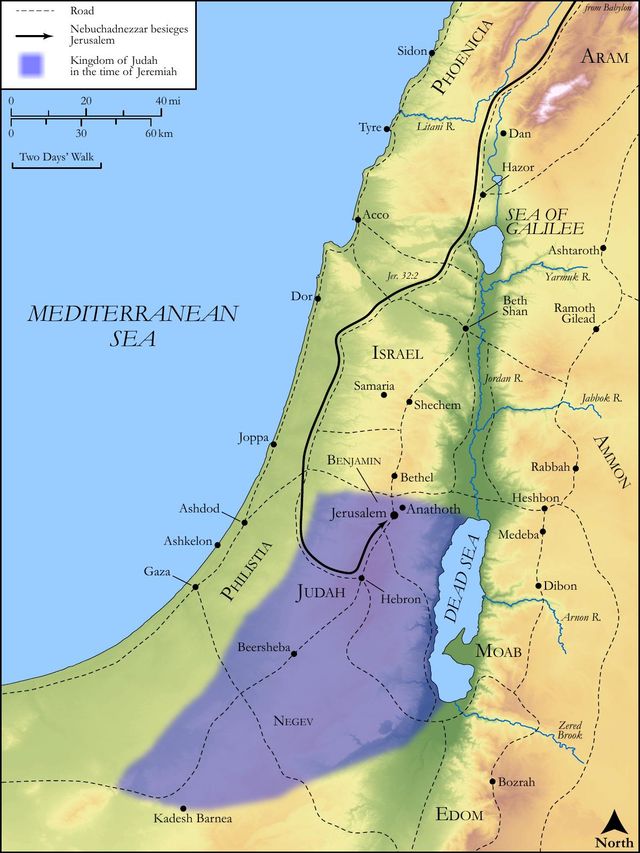
Study this verse
Public-domain commentary
Matthew Henry
From his Commentary on the Whole Bible. Henry comments on passages, not single verses — this entry covers Jeremiah 32:1–15. His four-level outline is real structure in the source text, so it is rendered as structure.
It appears by the date of this chapter that we are now coming very nigh to that fatal year which completed the desolations of Judah and Jerusalem by the Chaldeans. God's judgments came gradually upon them, but, they not meeting him by repentance in the way of his judgments, he proceeded in his controversy till all was laid waste, which was in the eleventh year of Zedekiah; now what is here recorded happened in the tenth. The king of Babylon's army had now invested Jerusalem and was carrying on the siege with vigour, not doubting but in a little time to make themselves masters of it, while the besieged had taken up a desperate resolution not to surrender, but to hold out to the last extremity. Now,
I.Jeremiah prophesies that both the city and the court shall fall into the hands of the king of Babylon.
He tells them expressly that the besiegers shall take the city as a prize, for God, whose city it was in a peculiar manner, will give it into their hands and put it out of his protection (Jer 32:3), - that, though Zedekiah attempt to make his escape, he shall be overtaken, and shall be delivered a prisoner into the hands of Nebuchadnezzar, shall be brought into his presence, to his great confusion and terror, he having made himself so obnoxious by breaking his faith with him, he shall hear the king of Babylon pronounce his doom, and see with what fury and indignation he will look upon him (His eyes shall behold his eyes, Jer 32:4), - that Zedekiah shall be carried to Babylon, and continue a miserable captive there, until God visit him, that is, till God put an end to his life by a natural death, as Nebuchadnezzar had long before put an end to his days by putting out his eyes. Note, Those that live in misery may be truly said to be visited in mercy when God by death takes them home to himself. And, lastly, he foretels that all their attempts to force the besiegers from their trenches shall be ineffectual: Though you fight with the Chaldeans, you shall not prosper; how should they, when God did not fight for them? Jer 32:5. See Jer 34:2, Jer 34:3.
II.For prophesying thus he is imprisoned, not in the common goal, but in the more creditable prison that was within the verge of the palace, in the king of Judah's house, and there not closely confined, but in custodia libera - in the court of the prison, where he might have good company, good air, and good intelligence brought him, and would be sheltered from the abuses of the mob; but, however, it was a prison, and Zedekiah shut him up in it for prophesying as he did, Jer 32:2, Jer 32:3. So far was he from humbling himself before Jeremiah, as he ought to have done (Ch2 36:12), that he hardened himself against him. Though he had formerly so far owned him to be a prophet as to desire him to enquire of the Lord for them (Jer 21:2), yet now he chides him for prophesying (Jer 32:3), and shuts him up in prison, perhaps not with design to punish him any further, but only to restrain him from prophesying any further, which was crime enough. Silencing God's prophets, though it is not so bad as mocking and killing them, is yet a great affront to the God of heaven. See how wretchedly the hearts of sinners are hardened by the deceitfulness of sin. Persecution was one of the sins for which God was now contending with them, and yet Zedekiah persists in it even now that he was in the depth of distress. No providences, no afflictions, will of themselves part between men and their sins, unless the grace of God work with them. Nay, some are made worse by those very judgments that should make them better.
III.Being in prison, he purchases from a near relation of his a piece of ground that lay in Anathoth, Jer 32:6, Jer 32:7, etc.
1.One would not have expected,
(1.)That a prophet should concern himself so far in the business of this world; but why not? Though ministers must not entangle themselves, yet they may concern themselves in the affairs of this life.
(2.)That one who had neither wife nor children should buy land. We find (Jer 16:2) that he had no family of his own; yet he may purchase for his own use while he lives, and leave it to the children of his relations when he dies.
(3.)One would little have thought that a prisoner should be a purchaser; how should he get money beforehand to buy land with? It is probably that he lived frugally, and saved something out of what belonged to him as a priest, which is no blemish at all to his character; but we have no reason to think that the people were kind, or that his being beforehand was owing to their generosity. Nay,
(4.)It was most strange of all that he should buy a piece of land when he himself knew that the whole land was now to be laid waste and fall into the hands of the Chaldeans, and then what good would this do him? But it was the will of God that he should buy it, and he submitted, though the money seemed to be thrown away. His kinsman came to offer it to him; it was not of his own seeking; he coveted not to lay house to house and field to field, but Providence brought it to him, and it was probably a good bargain; besides, the right of redemption belonged to him (Jer 32:8), and if he refused he would not do the kinsman's part. It is true he might lawfully refuse, but, being a prophet, in a thing of this nature he must do that which would be for the honour of his profession. It became him to fulfil all righteousness. It was land that lay within the suburbs of a priests' city, and, if he should refuse it, there was danger lest, in these times of disorder, it might be sold to one of another tribe, which was contrary to the law, to prevent which it was convenient for him to buy it. It would likewise be a kindness to his kinsman, who probably was at this time in great want of money. Jeremiah had but a little, but what he had he was willing to lay out in such a manner as might tend most to the honour of God and the good of his friends and country, which he preferred before his own private interests.
2.Two things may be observed concerning this purchase: -
(1.)How fairly the bargain was made. When Jeremiah knew by Hanameel's coming to him, as God had foretold he would, that it was the word of the Lord, that it was his mind that he should make this purchase, he made no more difficulty of it, but bought the field. And,
[1.]He was very honest and exact in paying the money. He weighted him the money, did not press him to take it upon his report, though he was his near kinsman, but weighed it to him, current money. It was seventeen shekels of silver, amounting to about forty shillings of our money. The land was probably but a little field and of small yearly value, when the purchase was so low; besides, the right of inheritance was in Jeremiah, so that he had only to buy out his kinsman's life, the reversion being his already. Some think this was only the earnest of a greater sum; but we shall not wonder at the smallness of the price if we consider what scarcity there was of money at this time and how little lands were counted upon.
[2.]He was very prudent and discreet in preserving the writings. They were subscribed before witnesses. One copy was sealed up, the other was open. One was the original, the other the counterpart; or perhaps that which was sealed up was for his own private use, the other that was open was to be laid up in the public register of conveyances, for any person concerned to consult. Due care and caution in things of this nature might prevent a great deal of injustice and contention. The deeds of purchase were lodged in the hands of Baruch, before witnesses, and he was ordered to lay them up in an earthen vessel (an emblem of the nature of all the securities this world can pretend to give us, brittle things and soon broken), that they might continue many days, for the use of Jeremiah's heirs, after the return out of captivity; for they might then have the benefit of this purchase. Purchasing reversions may be a kindness to those that come after us, and a good man thus lays up an inheritance for his children's children.
(2.)What was the design of having this bargain made. It was to signify that though Jerusalem was now besieged, and the whole country was likely to be laid waste, yet the time should come when houses, and fields, and vineyards should be again possessed in this land, Jer 32:15. As God appointed Jeremiah to confirm his predictions of the approaching destruction of Jerusalem by his own practice in living unmarried, so he now appointed him to confirm his predictions of the future restoration of Jerusalem by his own practice in purchasing this field. Note, It concerns ministers to make it to appear in their whole conversation that they do themselves believe that which they preach to others; and that they may do so, and impress it the more deeply upon their hearers, they must many a time deny themselves, as Jeremiah did in both these instances. God having promised that this land should again come into the possession of his people, Jeremiah will, on behalf of his heirs, put in for a share. Note, It is good to manage even our worldly affairs in faith, and to do common business with an eye to the providence and promise of God. Lucius Florus relates it as a great instance of the bravery of the Roman citizens that in the time of the second Punic war, when Hannibal besieged Rome and was very near making himself master of it, a field on which part of his army lay, being offered to sale at that time, was immediately purchased, in a firm belief that the Roman valour would raise the siege, lib. ii. cap. 6. And have not we much more reason to venture our all upon the word of God, and to embark in Zion's interests, which will undoubtedly be the prevailing interests at last? Non si male nunc et olim sic erit - Though now we suffer, we shall not suffer always.
Historical interpretation
Two Centuries of Reception
2 surviving comments on this verse. Each one is dated, so this reads as a timeline rather than a list.
Select a marker to jump to its quote. Markers stagger vertically where authors wrote within a few decades of each other.
Of course nothing is “too hard for the Lord.” But if we choose to apply this principle so extravagantly and harshly in our capricious imaginations, we may then make out God to have done anything we please, on the ground that it was not impossible for him to do it. We must not suppose, however, because he is able to do all things, that he has done what he has not done. But we must inquire whether he has really done it. God could, if he had liked, have furnished humankind with wings to fly with, just as he gave wings to kites. We must not, however, run to the conclusion that he did this because he was able to do it. He might also have extinguished Praxeas and all other heretics at once; it does not follow, however, that he did, simply because he was able. For it was necessary that there should be both kites and heretics; it was necessary also that the Father should be crucified. In one sense there will be something difficult even for God—namely, that which he has not done—not because he could not but because he would not do it. For with God, to be willing is to be able and to be unwilling is to be unable; all that he has willed, however, he has both been able to accomplish and has displayed his ability.
(v. 9 seqq.) But I understood that it was the word of the Lord, and I bought a field from my cousin Anameel, who is in Anathoth, and I weighed out the silver, seven shekels and ten silver coins. And I wrote it in a book, and signed it, and called witnesses, and weighed the silver on a scale. And I received the sealed deed, the terms and conditions, and the external seals. It was indeed difficult and almost absurd, worthy of laughter, for the one who was prophesying the imminent capture of Jerusalem and the captivity of all, to buy a field in Anathoth that he would never possess. But I understood, he said, that it was the word of the Lord and that my purchase should be connected with the argument and prophecy of the Lord; and therefore I obeyed his command to make the purchase; nor was it in vain that God spoke to me about such a matter: and I weighed out seventeen shekels of silver, which we convert into staters. Now a shekel has twenty obols, as it is written in the final volume of Ezekiel (Ezek. 45). And the Prophet bought it for seventeen shekels, a number in which the boy David, servant of the Lord, sang on the day when the Lord delivered him from the hand of all his enemies and from the hand of Saul, and said: I will love you, O Lord, my strength; the Lord is my rock, my fortress, and my deliverer. My God, my helper, and I will hope in Him: my protector, and the horn of my salvation (Psalm XVII, 1). The number ten indicates a mystical number, as shown in the Decalogue which was written on stone tablets by the finger of God, and the days of fasting and propitiation in the seventh month (Exodus XIII). We also prove, with numerous testimonies from the Scriptures, that the number seven, in which true Sabbath and rest exist, is holy. I could have provided at least a few examples, if it were not pointless to teach what is already known. Therefore, in this number, a possession is bought by a prophet and priest, and it is written in a book and signed, and witnesses are brought forth, and silver is carefully weighed out, so that all the rights of sale and purchase are preserved, and there is a certain ownership, confirmed by agreements and promises. Or let those who try to claim false wills, and sometimes even wills with witnesses, listen to this.
Continue studying Jeremiah 32:9 across the web’s major study libraries — every link below opens this exact verse, chapter, or book on the destination site.
Read & Compare
 BibleGatewayThis verse in more than 200 translations and 70 languages.
 Bible.comThe YouVersion reader — hundreds of translations, reading plans, and highlights.
 ESV.orgCrossway's official English Standard Version reader.
 NET BibleThe NET translation with 60,000+ translators' notes on every rendering decision.
 STEP BibleTyndale House's free study tool — original text, vocabulary, and scholarly resources.
 BibliaLogos Bible Software's free web reader.
 USCCBThe New American Bible (Revised Edition) with the U.S. bishops' study notes.
Commentaries
 BibleHub CommentariesDozens of classic commentaries on this verse, gathered on one page.
 StudyLightMore than 100 commentary sets — the largest collection on the web.
 BibleRefPlain-English commentary on what this verse means, verse by verse.
 Enduring WordDavid Guzik's free commentary on this chapter, widely used by Bible teachers.
 Bible Study ToolsVerse commentary alongside Greek and Hebrew study aids.
Original Language & Research
- BibleHub InterlinearThe verse word by word — original language, transliteration, and English.
- BibleHub LexiconEvery word's original-language definition and Strong's entry.
 Blue Letter BibleDeep-study tools — Strong's numbers, concordance, and word studies.
 SefariaThe Hebrew text with Rashi and centuries of Jewish commentary.
Sermons, Hymns & Audio


TrulyRandomVerse is not affiliated with these sites and doesn’t control their content. They’re linked because they’re genuinely useful.
Summary
Jeremiah 32:9 meticulously records a pivotal act of prophetic obedience and profound faith by the prophet Jeremiah. Despite Jerusalem being under a devastating siege by the Babylonian army and his own imprisonment, Jeremiah purchases a field from his cousin, Hanameel, in his ancestral hometown of Anathoth. This seemingly irrational and counter-intuitive transaction, involving the precise weighing of seventeen shekels of silver, serves as a powerful, tangible sign of God's unwavering promise of future restoration for Judah, signifying that land would once again be bought and sold in the devastated territory, a testament to God's faithfulness amidst despair.
Context
ShowHideLiterary Context
Jeremiah 32 opens with the prophet Jeremiah imprisoned in the court of the guard during the tenth year of King Zedekiah's reign, while Jerusalem is enduring a brutal siege by the Babylonian army. The preceding chapters detail Jeremiah's consistent and unpopular prophecies of judgment, exile, and the impending fall of Jerusalem, which directly led to his incarceration. Immediately prior to this verse, God explicitly commands Jeremiah to purchase the field from his cousin Hanameel, emphasizing that this act is a divine sign and a testament to future restoration, a stark contrast to the prevailing despair (see Jeremiah 32:6-8). Following the detailed account of the purchase in verse 9, Jeremiah proceeds to secure the deed, call witnesses, and then offers a prayer of lament and inquiry to the Lord. God responds to this prayer with a powerful reaffirmation of His omnipotence and His steadfast promise of restoration for His people and their land (see Jeremiah 32:10-44). The entire chapter thus functions as a profound counterpoint to the national collapse, illustrating God's absolute sovereignty over history and His unwavering faithfulness to His covenant promises, even in the darkest hour.
Historical & Cultural Context
At the time of this event, approximately 588-587 BC, the city of Jerusalem was under a relentless siege by Nebuchadnezzar's Babylonian forces, a siege that would ultimately culminate in the city's destruction and the forced exile of its inhabitants. Jeremiah's prophecies of this impending catastrophe had made him deeply unpopular with the political and religious leadership, leading to his imprisonment. From a purely human perspective, purchasing land in a territory that was on the verge of being conquered and occupied by an enemy army was an act of extreme financial and practical folly. However, the transaction itself meticulously followed established ancient Near Eastern legal and commercial customs. These customs included the presence of multiple witnesses to validate the agreement and the careful weighing of silver as currency, given that standardized coinage was not yet widely in use. Anathoth, Jeremiah's hometown, was a Levitical city situated a few miles northeast of Jerusalem. The land in question was part of his family's ancestral inheritance, which held immense cultural, legal, and theological significance for the Israelites, rooted in the division of the land by Joshua and the laws concerning land redemption and inheritance (e.g., Leviticus 25:23-28).
Key Themes
ShowHideJeremiah's purchase of the field in Anathoth powerfully underscores several major theological and narrative themes prevalent within the book of Jeremiah and broader biblical theology. Foremost is Faith in God's Promises, as Jeremiah's radical obedience in buying the land, despite the dire and seemingly hopeless circumstances, demonstrates a profound trust in God's revealed word over visible reality. This echoes the faith of patriarchs like Abraham, who "looked forward to the city that has foundations, whose architect and builder is God" (Hebrews 11:10). This act also serves as a concrete Divine Assurance of Restoration, a tangible and performative prophecy that the land of Judah, though facing devastation and exile, would one day be bought and sold again, signifying a return to normalcy, prosperity, and covenant blessing for God's people. This promise is explicitly stated by God Himself in Jeremiah 32:15. Furthermore, the event highlights God's Sovereignty over history, demonstrating that even in moments of national collapse and profound despair, God remains firmly in control, orchestrating events and providing signs of His ultimate plan for redemption and renewal. Finally, it powerfully reaffirms God's Covenant Faithfulness, proving that He would not utterly abandon His people but would faithfully bring them back from captivity, as promised in passages like Jeremiah 29:10-11.
Exposition and Analysis
ShowHideKey Word Analysis
ShowHideFrom the primitive root H7069, this verb signifies not merely a simple commercial transaction but carries deeper connotations of creation, acquisition, and possession. In Jeremiah 32:9, Jeremiah's "buying" of the field is an act of procuring something, but in the broader theological context of the book, it hints at God's ultimate re-acquisition and re-creation of His people's land and future. It speaks to a divine act of recovery and redemption, making the purchase a prophetic symbol of God's future restoration and His sovereign claim over His people and their inheritance.
From the primitive root H8254, this term refers to the ancient practice of suspending or poising items, particularly in trade, to determine their exact weight. Before the widespread use of standardized coinage, silver was traded by weight, making the act of "weighing" crucial for a legally valid and transparent transaction. In this verse, it emphasizes the meticulous and legitimate nature of Jeremiah's purchase, underscoring that this was a real, binding legal agreement, not just a symbolic gesture without substance. The precision of the weighing underscored the certainty of the transaction and, by extension, the certainty of God's promise.
Derived from a root meaning "to be pale," this word refers to the metal silver, which was the primary form of currency in ancient Israel. By implication, it also means "money." The mention of "seventeen shekels of silver" specifies the exact, tangible value exchanged. This detail grounds the prophetic act in economic reality, demonstrating that God's promise of future restoration is not an abstract concept but will manifest in concrete, economic, and social normalcy, where land is bought and sold with real money, signifying a return to a functioning society.
Verse Breakdown
ShowHide"And I bought the field of Hanameel my uncle's son"
This opening clause immediately establishes Jeremiah's active and obedient participation in the transaction, highlighting his personal commitment to God's command despite the dire and seemingly illogical circumstances. The familial relationship with Hanameel (his cousin, specifically "uncle's son" from H1730 dôwd "uncle" and H1121 bên "son") underscores the ancestral nature of the land and the legal right to redeem or purchase it within the family, as per Israelite law regarding inheritance and land redemption (e.g., Leviticus 25:25).
"that [was] in Anathoth"
This specifies the precise location of the field. Anathoth was Jeremiah's ancestral hometown, a Levitical city, and crucially, it was currently under Babylonian siege, making the land militarily occupied and humanly worthless. This detail emphasizes the seeming absurdity and human illogicality of the purchase, contrasting sharply with the divine wisdom behind the command. The land was seemingly beyond recovery, yet Jeremiah invested in it, demonstrating faith in God's power to restore the seemingly lost.
"and weighed him the money, [even] seventeen shekels of silver"
This final clause details the method and specific amount of payment. The act of "weighing" the silver highlights the ancient commercial practice, ensuring the exactness, legality, and transparency of the transaction. The specific amount, "seventeen shekels of silver," signifies a legitimate and precise payment, validating the purchase as a real, binding legal act, not merely a symbolic gesture without substance. This precision underscores the certainty and tangibility of God's future promise, which is as real and binding as this meticulously conducted transaction.
Literary Devices
ShowHideJeremiah 32:9 is rich with Symbolism. The act of buying a field during a siege is far more than a mere commercial transaction; it is a profound symbolic gesture of hope, restoration, and God's enduring covenant faithfulness. The land, which is seemingly worthless and irrecoverable at the moment, powerfully symbolizes the future inheritance and re-establishment of Israel in their promised land. There is also strong Irony present in the narrative, as Jeremiah, who has been imprisoned precisely for prophesying doom and destruction, performs an act that signifies future prosperity, normalcy, and divine blessing. This dramatic contrast underscores the paradox of divine wisdom, which often appears foolish or illogical to human reasoning and short-sighted perspectives. Furthermore, the entire event functions as a Prophetic Act or Sign-Act, a common and powerful literary device in prophetic books where the prophet's physical actions embody and communicate God's message more powerfully and tangibly than words alone. Jeremiah's purchase is a vivid, tangible embodiment of God's explicit promise that "houses and fields and vineyards shall again be bought in this land" (Jeremiah 32:15).
Theological and Thematic Connections
ShowHideJeremiah's purchase of the field in Anathoth is a profound theological statement about God's unwavering faithfulness and the very nature of biblical hope. It demonstrates that true faith is not a passive belief or a naive optimism, but an active, obedient response to God's word, even when circumstances are utterly contrary to the promise. In the face of national devastation, personal imprisonment, and overwhelming despair, Jeremiah's investment in a "worthless" piece of land testifies to a hope grounded not in visible reality or human logic, but solely in the immutable character and unfailing promises of God. This act prefigures the ultimate restoration that God brings, reminding us that His redemptive plans extend far beyond immediate judgment and suffering. It highlights God's covenant faithfulness, assuring His people that even when they face the consequences of their sin and experience severe discipline, His ultimate purpose is to bring them back to Himself and restore their inheritance, both physical and spiritual.
Reflection and Application
ShowHideJeremiah's extraordinary act of buying a field in a land under siege offers a timeless and profoundly challenging lesson for believers today. It calls us to cultivate a radical faith that looks beyond immediate despair, human logic, and overwhelming circumstances to the certainty of God's ultimate promises. In our own lives, whether facing personal crises, financial instability, professional setbacks, or overwhelming societal challenges, we are called to imitate Jeremiah's radical obedience and counter-cultural trust. This might mean investing our time, resources, or emotional energy in seemingly lost causes, holding onto hope when all appears hopeless, or making decisions based on God's revealed word rather than on our perceived circumstances or the prevailing wisdom of the world. Just as Jeremiah's purchase was a tangible sign of future restoration for Israel, our acts of faith, however small, illogical, or insignificant they may seem to others, can become powerful testimonies to God's unfailing faithfulness and His sovereign ability to bring life, hope, and flourishing out of desolation. This verse encourages us to live with an eternal perspective, trusting that God's plans for our future are always good, even when the present is bleak and the path forward is unclear.
Questions for Reflection
ShowHideFAQ
ShowHideWhy did Jeremiah buy the field when Jerusalem was about to fall?
ShowHideJeremiah bought the field not because it made sense from a human, economic, or strategic perspective, but because God explicitly commanded him to do so. This act was a powerful prophetic sign, a tangible demonstration of God's promise that despite the impending destruction and exile, there would be a future restoration for Judah. The purchase symbolized that land would again be bought and sold in the land, signifying a return to normalcy, prosperity, and covenant blessing for God's people after their period of judgment. It was an act of profound faith in God's long-term plan, even when the short-term outlook was dire and seemingly hopeless, as highlighted in God's own words in Jeremiah 32:15.
What was the significance of "seventeen shekels of silver"?
ShowHideThe "seventeen shekels of silver" was the specific, legally agreed-upon price for the field, demonstrating a legitimate and fully executed commercial transaction. While not an exceptionally large sum for land, its precise mention underscores the meticulousness and legality of the exchange. In ancient times, before the widespread use of standardized coinage, precious metals like silver were used as currency by weight. The specific amount confirmed that a real, binding legal agreement had taken place. This detail serves to ground the prophetic act in concrete reality, emphasizing that God's promise of future restoration is as real, certain, and binding as this carefully executed purchase. The exactness of the payment validates the integrity and certainty of the prophetic sign.
Was it common practice to "weigh" money in ancient Israel?
ShowHideYes, it was a very common and necessary practice throughout the ancient Near East, including ancient Israel. Before the widespread use of standardized coinage with fixed values, precious metals like silver and gold served as the primary form of currency. Transactions involved weighing the metal on scales to ensure the correct amount was exchanged, often with witnesses present to verify the accuracy. This practice is seen throughout the Old Testament, such as Abraham weighing out four hundred shekels of silver for a burial plot in Genesis 23:16. The mention of "weighed him the money" in Jeremiah 32:9 confirms the legal and customary nature of the transaction, adding to its authenticity and binding character as a prophetic sign.
Christ-Centered Fulfillment
ShowHideJeremiah's purchase of the field in Anathoth, a seemingly irrational act of faith in the face of certain destruction, finds its ultimate fulfillment and deepest meaning in the person and work of Jesus Christ. The land, which was lost due to Israel's unfaithfulness and faced desolation, was promised to be restored—an earthly restoration that powerfully foreshadows the spiritual and eternal inheritance secured by Christ. Just as Jeremiah bought a field as a tangible sign of future hope and restoration, Jesus, through His perfect obedience, sacrificial death on the cross, and glorious resurrection, "bought" us, redeeming humanity from the dominion of sin, death, and the curse of the law (see 1 Corinthians 6:20 and Galatians 3:13). He is the true and ultimate inheritor of all things, and through union with Him, believers receive an imperishable, undefiled, and unfading inheritance, kept in heaven for them (see 1 Peter 1:3-5). The promise that "houses and fields and vineyards shall again be bought in this land" (Jeremiah 32:15) points beyond a mere physical return to the land, towards the new heavens and new earth, where righteousness dwells, and where God's redeemed people will dwell securely with Him forever in a restored creation (see Revelation 21:1-4). Christ is the ultimate "field" or "treasure" for which everything else is sold (see Matthew 13:44), and through His redemptive work, the scattered children of God are gathered into one family, inheriting the promises of God in their fullest and most glorious form, far surpassing any earthly land. His resurrection is the ultimate sign-act, guaranteeing the future restoration of all creation and the eternal life of all who believe in Him, transforming seemingly hopeless circumstances into the certain reality of God's magnificent redemptive plan (see Romans 8:19-23).